Proceedings of the 2011 Conference on Empirical Methods in Natural Language Processing, pages 1147–1157,
Syntax-Based Grammaticality Improvement using CCG and Guided Search
Yue Zhang
University of Cambridge Computer Laboratory [email protected]
Stephen Clark
University of Cambridge Computer Laboratory
Abstract
Machine-produced text often lacks grammat-icality and fluency. This paper studies gram-maticality improvement using a syntax-based algorithm based on CCG. The goal of the search problem is to find an optimal parse tree among all that can be constructed through se-lection and ordering of the input words. The search problem, which is significantly harder than parsing, is solved by guided learning for best-first search. In a standard word order-ing task, our system gives a BLEU score of 40.1, higher than the previous result of 33.7 achieved by a dependency-based system.
1 Introduction
Machine-produced text, such as SMT output, often
lacks grammaticality and fluency, especially when using n-gram language modelling (Knight, 2007). Recent efforts have been made to improve grammat-icality using local language models (Blackwood et al., 2010) and global dependency structures (Wan et al., 2009). We study grammaticality improvement using a syntax-based system.
The task is effectively a text-to-text generation problem where the goal is to produce a grammati-cal sentence from an ungrammatigrammati-cal and fragmen-tary input. The input can range from a bag-of-words (Wan et al., 2009) to a fully-ordered sentence (Blackwood et al., 2010). A general form of the problem is to construct a grammatical sentence from a set of un-ordered input words. However, in cases where the base system produces fluent subsequences within the sentence, constraints on the choice and
order of certain words can be fed to the grammati-cality improvement system. The input may also in-clude words beyond the output of the base system, e.g. extra words from theSMT lattice, so that con-tent word insertion and deletion can be performed implicity via word selection.
We study the above task using CCG (Steedman, 2000). The main challenge is the search problem, which is to find an optimal parse tree among all that can be constructed with any word choice and order from the set of input words. We use an approximate best-first algorithm, guided by learning, to tackle the more-than-factorial complexity. Beam-search is used to control the volume of accepted hypotheses, so that only a very small portion of the whole search space is explored. The search algorithm is guided by perceptron training, which ensures that the explored path in the search space consists of highly proba-ble hypotheses. This framework of best-first search guided by learning is a general contribution of the paper, which could be applied to problems outside grammaticality improvement.
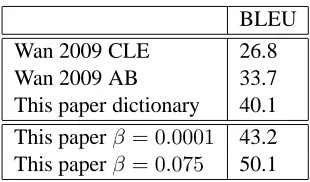
We evaluate our system using the generation task of word-order recovery, which is to recover the orig-inal word order of a fully scrambled input sentence (Bangalore et al., 2000; Wan et al., 2009). This problem is an instance of our general task formu-lation, but without any input constraints, or con-tent word selection (since all input words are used). It is straightforward to use this task to evaluate our system and compare with existing approaches. Our system gave 40.1 BLEU score, higher than the dependency-based system of Wan et al. (2009), for which a BLEU score of 33.7 was reported.
2 The Grammar
Combinatory Categorial Grammar (CCG; Steedman (2000)) is a lexicalized grammar formalism, which associates words with lexical categories. Lexical categories are detailed grammatical labels, typically expressing subcategorisation information. CCG, and parsing with CCG, has been described in detail elsewhere (Clark and Curran, 2007; Hockenmaier, 2003); here we provide only a short description.
DuringCCGparsing, adjacent categories are com-bined usingCCG’s combinatory rules. For example, a verb phrase in English (S\NP) can combine with anNP to its left:
NP S\NP ⇒S
In addition to binary rule instances, such as the one above, there are also unary rules which operate on a single category in order to change its type. For example, forward type-raising can change a subject
NP into a complex category looking to the right for a verb phrase:
NP ⇒S/(S\NP)
Following Hockenmaier (2003), we extract the grammar by reading rule instances directly from the derivations in CCGbank (Hockenmaier and Steed-man, 2007), rather than defining the combinatory rule schema manually as in Clark and Curran (2007).
3 The Search Algorithm
The input to the search algorithm is a set of words, each word having a count that specifies the maxi-mum number of times it can appear in the output. Typically, most input words can occur only once in the output. However, punctuation marks and func-tion words can be given a higher count. Depending on the fluency of the base output (e.g. the output of the base SMT system), some constraints can be given to specific input words, limiting their order or identifying them as an atomic phrase, for example.
The goal of the search algorithm is to find an op-timal parse tree (including the surface string) among all that can be constructed via selecting and ordering a subset of words from the input multiset. The com-plexity of this problem is much higher than a typical parsing problem, since there is an exponential num-ber of word choices for the output sentence, each
with a factorial number of orderings. Moreover, dy-namic programming packing for parsers, such as a
CKY chart, is not applicable, because of the lack of a fixed word order.
We perform approximate search using a best-first algorithm. Starting from single words, candi-date parses are constructed bottom-up. Similar to a best-first parser (Caraballo and Charniak, 1998), the highest scored hypothesis is expanded first. A hy-pothesis is expanded by applying CCG unary rules to the hypothesis, or by combining the hypothesis with existing hypotheses usingCCGbinary rules.
We use beam search to control the number of ac-cepted hypotheses, so that the computational com-plexity of expanding each hypothesis is linear in the size of the beam. Since there is no guarantee that a goal hypothesis will be found in polynomial time, we apply a robustness mechanism (Riezler et al., 2002; White, 2004), and construct a default output when no goal hypothesis is found within a time limit.
3.1 Data Structures
Edges are the basic structures that represent hy-potheses. Each edge is aCCGconstituent, spanning a sequence of words. Similar to partial parses in a typical chart parser, edges have recursive structures. Depending on the number of subedges, edges can be classified into leaf edges, unary edges and binary edges. Leaf edges, which represent input words, are constructed first in the search process. Existing edges are expanded to generate new edges via unary and binaryCCGrules. An edge that meets the output
criteria is called a goal edge. In the experiments of this paper, we define a goal edge as one that includes all input words the correct number of times.
The signature of an edge consists of the cate-gory label, surface string and head word of the con-stituent. Two edges are equivalent if they share the same signature. Given our feature definitions, a lower scoring edge with the same signature as a higher scoring edge cannot be part of the highest scoring derivation.
per-formed to make sure that the total count for a word from the two edges does not exceed the count for that word in the input. Intuitively, an edge can record the count of each unique input word it contains, and perform the input check in linear time. How-ever, since most input words typically occur once, they can be indexed and represented by a bitvector, which allows a constant time input check. The few multiple-occurrence words are stored in a count ar-ray.
In the best-first process, edges to be expanded are ordered by their scores, and stored in an agenda. Edges that have been expanded are stored in a chart. There are many ways in which edges could be or-dered and compared. Here the chart is organised as a set of beams, each containing a fixed number of edges with a particular size. This is similar to typical decoding algorithms for phrase-based SMT (Koehn, 2010). In each beam, edges are ordered by their scores, and low score edges are pruned. In addition to pruning by the beam, only the highest scored edge is kept among all that share the same signature.
3.2 The Search Process
Figure 1 shows pseudocode for the search algorithm. During initialization, the agenda (a) and chart (c) are cleared. All candidate lexical categories are as-signed to each input word, and the resulting leaf edges are put onto the agenda.
In the main loop, the best edge (e) is popped from the agenda. Ifeis a goal hypothesis, it is appended to a list of goals (goal), and the loop is continued without e being expanded. If e or any equivalent edge˜eofeis already in the chart, the loop continues without expandinge. It can be proved that any edge in the chart must have been combined with ˜e, and therefore the expansion ofeis unnecessary.
Edgeeis first expanded by applying unary rules, and any new edges are put into a list (new). Next,e
is matched against each existing edgee˜in the chart.
eande˜can be combined if they pass the input check, and there is a binary rule in which the constituents are combined.eande˜are combined in both possible orders, and any resulting edge is added to new.
At the end of each loop, edges from new are added to the agenda, and new is cleared. The loop contin-ues until a stopping criterion is met. A typical stop-ping condition is that goal contains N goal edges.
a←INITAGENDA(input)
c←INITCHART() new←[]
goal←[]
while notSTOP(goal, time):
e←POPBEST(a) ifGOALTEST(e)
APPEND(goal,e) continue
fore˜inc: ifEQUIV(˜e,e):
continue
fore′inUNARY(e, grammar):
APPEND(new,e′) fore˜inc:
ifCANCOMBINE(e,˜e):
e′ ←BINARY(e,e˜, grammar)
APPEND(new,e′)
ifCANCOMBINE(e˜,e):
e′ ←BINARY(e˜,e, grammar)
APPEND(new,e′)
fore′in new:
ADD(a,e′)
ADD(c,e) new←[]
Figure 1: The search algorithm.
We set N to 1 in our experiments. For practical reasons we also include a timeout stopping condi-tion. If no goal edges are found before the timeout is reached, a default output is constructed by the fol-lowing procedure. First, if any two edges in the chart pass the input check, and the words they contain constitute the full input set, they are concatenated to form an output string. Second, when no two edges in the chart meet the above condition, the largest edge ˜
ein the chart is chosen. Then edges in the chart are iterated over in the larger first order, with any edge that passes the input check withe˜concatenated with ˜
eande˜updated. The final ˜e, which can be shorter than the input, is taken as the default output.
4 Model and Features
~
wof the model.
SCORE(e) = Φ(e)·w~
Φ(e) represents the counts of individual features of e. It is computed incrementally as the edge is built. At each constituent level, the incremental fea-ture vector is extracted according to the feafea-ture tem-plates from Table 1, and we use the term constituent level vectorφto refer to it. So for any edgee,φ(e) consists of features from the top rule of the hierar-chical structure ofe. Φ(e)can be written as the sum ofφ(e′) of all recursive subedgese′ ofe, including
eitself:
Φ(e) = X
e′∈e
φ(e′)
The parameter update in Section 5 is in terms of con-stituent level vectors.
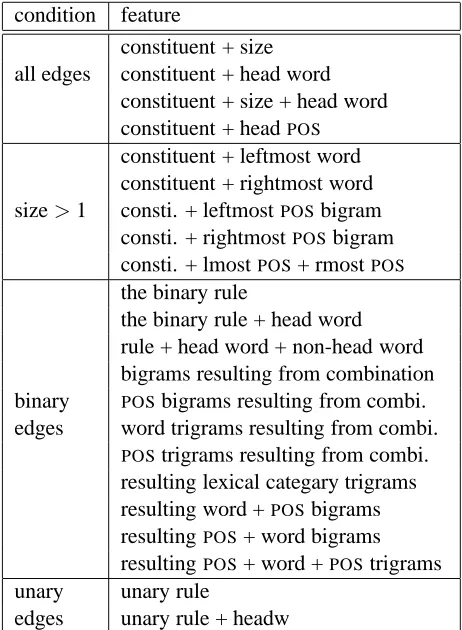
The features in Table 1 represent patterns in-cluding the constituent label; the head word of the constituent; the size of the constituent; word, POS
and lexical category N-grams resulting from a bi-nary combination; and the ubi-nary and bibi-nary rules by which the constituent is constructed. They can be classified roughly into “parsing” features (those about the parse structure, such as the binary rule) and “generation features” (those about the surface string, such as word bigrams), although some fea-tures, such as “rule + head word + non-head word”, contain both types of information.
5 The Learning Algorithm
The statistical model plays two important roles in our system. First, as in typical statistical systems, it is expected to give a higher score to a more correct hypothesis. Second, it is also crucial to the speed of the search algorithm, since the best-first mechanism relies on a model to find goal hypotheses efficiently. As an indication of the impact of the model on effi-ciency, if the model parameters are set to all zeros, the search algorithm cannot find a result for the first sentence in the development data within two hours.
We perform training on a corpus of CCG
tions, where constituents in a gold-standard deriva-tion serve as gold edges. The training algorithm runs the decoder on each training example, updat-ing the model when necessary, until the gold goal
condition feature
constituent + size all edges constituent + head word
constituent + size + head word constituent + headPOS
constituent + leftmost word constituent + rightmost word size>1 consti. + leftmostPOSbigram
consti. + rightmostPOSbigram
consti. + lmostPOS+ rmostPOS
the binary rule
the binary rule + head word rule + head word + non-head word bigrams resulting from combination binary POSbigrams resulting from combi. edges word trigrams resulting from combi.
POStrigrams resulting from combi. resulting lexical categary trigrams resulting word +POSbigrams resultingPOS+ word bigrams resultingPOS+ word +POStrigrams unary unary rule
[image:4.612.312.543.71.386.2]edges unary rule + headw
Table 1: Feature template definitions.
edge is recovered. We use the perceptron (Rosen-blatt, 1958) to perform parameter updates. The tra-ditional perceptron has been adapted to structural prediction (Collins, 2002) and search optimization problems (Daum´e III and Marcu, 2005; Shen et al., 2007). Our training algorithm can be viewed as an adaptation of the perceptron to our best-first frame-work for search efficiency and accuracy.
During a perceptron update, an incorrect predic-tion, corresponding to the current best edge in the agenda, is penalized, and the corresponding gold edge is rewarded. However, in our scenario it is not obvious what the corresponding gold edge should be, and there are many ways in which the gold edge could be defined. We investigated a number of alternatives, for example trying to find the “best match” for the incorrect prediction. In practice we found that the simple strategy of selecting the lowest scored gold-standard edge in the agenda was effec-tive, and the results presented in this paper are based on this method.
After an update, there are at least two alterna-tive methods to continue. The first is to reinitial-ize the agenda and chart using the new model, and continue until the current training example is cor-rectly predicted. This method is called aggressive training (Shen et al., 2007). In order to achieve reasonable efficiency, we adopt a second approach, which is to continue training without reinitializing the agenda and chart. Instead, only edges from the top of the agenda down to the lowest-scoring gold-standard edge are given new scores according to the new parameters.
Figure 2 shows pseudocode for the learning al-gorithm applied to one training example. The ini-tialization is identical to the test search, except that the list of goal edges is not maintained. In the main loop, the best edgeeis popped off the agenda. If it is the gold goal edge, the training for this sentence finishes. Ifeis not a gold edge, parameter updates are performed and the loop is continued with e be-ing discarded. Only gold edges are pushed onto the chart throughout the training process.
When updating parameters, the current non-gold edge (e) is used as the negative example, and the smallest gold edge in the agenda (minGold) is used as the corresponding positive example. The model parameters are updated by adding the constituent level feature vector (see Section 4) of minGold, and subtracting the constituent level feature vector ofe. Note that we do not use the global feature vector in the update, since only the constituent level param-eter vectors are compatible for edges with different sizes. After a parameter update, edges are rescored from the top of the agenda down to minGold.
The training algorithm iterates through all
train-a←INITAGENDA(input)
c←INITCHART() new←[]
while true:
e←POPBEST(a)
ifGOLD(e) andGOALTEST(e): return
if notGOLD(e): popped←[]
n←0
whilen <GOLDCOUNT(a): ˜
e←POPBEST(a)
APPEND(popped,e˜) ifGOLD(˜e):
minGold←˜e n←n+ 1
~
w←w~−φ(e) +φ(minGold) fore˜in popped:
RECOMPUTESCORE(e˜)
ADD(a,e˜) fore˜inc:
RECOMPUTESCORE(e˜) continue
fore′inUNARY(e, grammar): APPEND(new,e′)
fore˜inc:
ifCANCOMBINE(e,˜e):
e′ ←BINARY(e,e˜, grammar)
APPEND(new,e′) ifCANCOMBINE(e˜,e):
e′ ←BINARY(e˜,e, grammar)
APPEND(new,e′) fore′in new:
ADD(a,e′)
ADD(c,e) new←[]
Figure 2: The learning algorithm.
ing examplesN times, and the final parameter vec-tor is used as the model. In our experiments, N is chosen according to results on development data.
6 Experiments
We use CCGBank (Hockenmaier and Steedman, 2007) for experimental data. CCGbank is the CCG
used for training, section 00 is used for development and section 23 for the final test.
Original sentences from CCGBank are trans-formed into bags of words, with sequence informa-tion removed, and passed to our system as input data. The system outputs are compared to the orig-inal sentences for evaluation. Following Wan et al. (2009), we use the BLEU metric (Papineni et al., 2002) for string comparison. Whilst BLEU is not an ideal measure of fluency or grammaticality, be-ing based on n-gram precision, it is currently widely used for automatic evaluation and allows us to com-pare directly with existing work (Wan et al., 2009).
In addition to the surface string, our system also produces theCCGparse given an input bag of words. The quality of the parse tree can reflect both the grammaticality of the surface string and the quality of the trained grammar model. However, there is no direct way to automatically evaluate parse trees since output word choice and order can be differ-ent from the gold-standard. Instead, we indirectly measure parse quality by calculating the precision of
CCGlexical categories. SinceCCGlexical categories contain so much syntactic information, they provide a useful measure of parse quality. Again because the word order can be different, we turn both the output and the gold-standard into a bag of word/category pairs, and calculate the percentage of matched pairs as the lexical category precision.
For fair comparison with Wan et al. (2009), we keep base NPs as atomic units when preparing the input. Wan et al. (2009) used base NPs from Penn Treebank annotation, while we extract base NPs from the CCGBbank by taking as base NPs the NPs that do not recursively contain other NPs. These base NPs mostly correspond to the base NPs from the Penn Treebank. In the training data, there are 242,813 Penn Treebank base NPs with an average size of 1.09, and 216,670 CCGBank base NPs with an average size of 1.19.
6.1 Development Tests
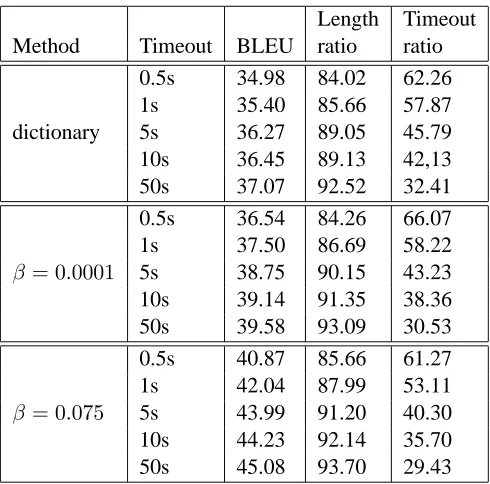
Table 2 shows a set of development experiment re-sults after one training iteration. Three different methods of assigning lexical categories are used. The first (“dictionary”) is to assign all possible lex-ical categories to each input word from the dictio-nary. The lexical category dictionary is built using
Length Timeout Method Timeout BLEU ratio ratio
0.5s 34.98 84.02 62.26 1s 35.40 85.66 57.87 dictionary 5s 36.27 89.05 45.79 10s 36.45 89.13 42,13 50s 37.07 92.52 32.41 0.5s 36.54 84.26 66.07 1s 37.50 86.69 58.22
β= 0.0001 5s 38.75 90.15 43.23 10s 39.14 91.35 38.36 50s 39.58 93.09 30.53 0.5s 40.87 85.66 61.27 1s 42.04 87.99 53.11
[image:6.612.313.558.69.311.2]β= 0.075 5s 43.99 91.20 40.30 10s 44.23 92.14 35.70 50s 45.08 93.70 29.43
Table 2: Development tests using various levels of lexical categories and timeouts, after one training iteration.
the training sections of CCGBank. For each word occurring more than 20 times in the corpus, the dic-tionary has an entry with all lexical categories the word has been seen with. For the rest of the words, the dictionary maintains an entry for eachPOSwhich contains all lexical categories it has been seen with. There are on average 26.8 different categories for each input word by this method.
In practice, it is often unnecessary to leave lexi-cal category disambiguation completely to the gram-maticality improvement system. When it is reason-able to assume that the input sentence for the gram-maticality improvement system is sufficiently fluent, a list of candidate lexical categories can be assigned automatically to each word via supertagging (Clark and Curran, 2007) on the input sequence. We use the C&C supertagger1 to assign a set of probable lexical categories to each input word using the gold-standard order. When the input is noisy, the accuracy of a supertagger tends to be lower than when the in-put is grammatical. One way to address this problem is to allow the supertagger to produce a larger list of possible supertags for each input word, and leave the ambiguity to the grammatical improvement sys-tem. We simulate the noisy input situation by using
1
Precision dictionary 58.5%
β = 0.0001 59.7%
[image:7.612.125.247.68.130.2]β = 0.075% 77.0%
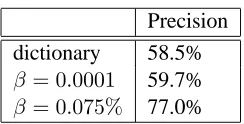
Table 3: Lexical category accuracies. Timeout = 5s. 1 training iteration.
a small probability cutoff (β) value in the supertag-ger, and supertag correctly ordered input sentences before breaking them into bags of words. With aβ
value of 0.0001, there are 5.4 lexical categories for each input word in the development test (which is smaller than the dictionary case).
The average number of lexical categories per word drops to 1.3 whenβequals 0.075, which is the value used for parsing newspaper text in Clark and Curran (2007). We include thisβin our experiments to compare the effect of differentβlevels.
The table shows that the BLEU score of the gram-maticality improvement system is higher when a su-per tagger is used, and the higher the β value, the better the BLEU score. In practice, the β value should be set in accordance with the lack of gram-maticality and fluency in the input. The dictionary method can be used when the output is extremely unreliable, while a small beta value can be used if the output is almost fluent.
Due to the default output mechanism on timeout, the system can sometimes fail to produce sentences that cover all input words. We choose five different timeout settings between 0.5s to 50s, and compare the speed/quality tradeoff. In addition to BLEU, we report the percentage of timeouts and the ratio of the sum of all output sentence lengths to the sum of all input sentence lengths.
When the timeout value increases, the BLEU score generally increases. The main effect of a larger timeout is the increased possibility of a complete sentence being found. As the time increases from 0.5s to 50s using the dictionary method, for exam-ple, the average output sentence length increases from 84% of the input length to 93%.
Table 3 shows the lexical category accuracies us-ing the dictionary, and supertagger with differentβ
levels. The timeout limit is set to 5 seconds. As the lexical category ambiguity decreases, the
accu-Length dictionary β = 0.0001 β = 0.075
≤5 75.65 89.42 92.64
≤10 57.74 66.00 78.54
≤20 42.44 48.89 58.23
≤40 37.48 40.32 46.00
≤80 36.50 39.01 44.26
all 36.27 38.75 43.99
Table 4: BLEU scores measured on different lengths on development data. Timeout = 5s. 1 training iteration.
racy increases. The best lexical category accuracy of 77% is achieved when using a supertagger with aβ level 0.075, the level for which the least lexical category disambiguation is required. However, com-pared to the 93% lexical category accuracy of aCCG
parser (Clark and Curran, 2007), which also uses aβ
level of0.075for the majority of sentences, the ac-curacy of our grammaticality improvement system is much lower. The lower score reflects the lower quality of the parse trees produced by our system. Besides the difference in the algorithms themselves, one important reason is the much higher complexity of our search problem.
Table 4 shows the BLEU scores measured by dif-ferent sizes of input. We also give some example output sentences in Figure 3. It can be seen from the table that the BLEU scores are higher when the size of input is smaller. For sentences shorter than 20 words, our system generally produces reason-ably fluent and grammatical outputs. For longer sen-tences, the grammaticality drops. There are three possible reasons. First, larger constituents require more steps to construct. The model and search algo-rithm face many more ambiguities, and error propa-gation is more severe. Second, the search algorithm often fails to find a goal hypothesis before timeout, and a default output that is less grammatical than a complete constituent is constructed. Long sen-tences have comparatively more input words uncov-ered in the output. Third, the upper bound is not 100, and presumably lower for longer sentences, because there are many ways to generate a grammatical sen-tence given a bag of words. For example, the bag {cats, chase, dogs}can produce two equally fluent and grammatical sentences.
[image:7.612.314.537.70.171.2]un-(dictionary) our products There is no asbestos in now .
(β= 0.0001) in our products now There is no asbestos .
(β= 0.075) There is no asbestos in our products now .
(dictionary) No price for the new shares has been set .
(bothβ) No price has been set for the new shares .
(all) Federal Data Corp. got a $ 29.4 million Air Force contract for intelligence data handling .
(dictionary) was a nonexecutive director of Rudolph Agnew and former chairman of Consolidated Gold Fields PLC , this British industrial
conglomerate , 55 years old . named
(β= 0.0001) old Consolidated Gold Fields PLC , was named 55 years , former
chairman of Rudolph Agnew and a nonexecutive director of this British industrial conglomerate .
(β= 0.075) Consolidated Gold Fields PLC , 55 years old , was named former
chairman of Rudolph Agnew and a nonexecutive director of this British industrial conglomerate .
(dictionary) McDermott International Inc. said its Babcock & Wilcox unit completed the sale of its Bailey Controls Operations for
Finmeccanica S.p . A. to $ 295 million .
(β= 0.0001) $ 295 million McDermott International Inc. for the sale of
its Babcock & Wilcox unit said its Bailey Controls Operations
completed to Finmeccanica S.p . A. .
(β= 0.075) McDermott International Inc. said its Bailey Controls
Operations completed the sale of Finmeccanica S.p . A. for its
[image:8.612.349.504.472.563.2]Babcock & Wilcox unit to $ 295 million .
Figure 3: Example outputs on development data.
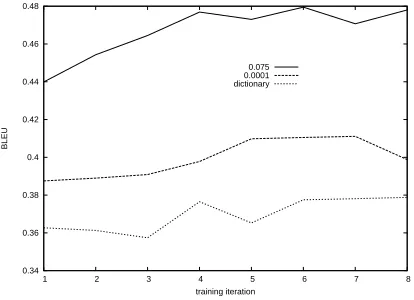
likely to be such a problem in practice, because the base system (e.g. an SMT system) is likely to produce sentences with locally fluent subsequences. When fluent local phrases in the input are treated as atomic units, the effective sentence length is shorter. All the above development experiments were per-formed using only one training iteration. Figure 4 shows the effect of different numbers of training it-erations. For the final test, based on the graphs in Figure 4, we chose the training iterations to be 8, 6 and 4 for the dictionary,β = 0.0001andβ= 0.075 methods, respectively.
6.2 Final Accuracies
Table 5 shows the final results of our system, to-gether with the MST-based (“Wan 2009 CLE”) and assignment-based (“Wan 2009 AB”) systems of Wan et al. (2009). Our system outperforms the
BLEU Wan 2009 CLE 26.8
Wan 2009 AB 33.7
This paper dictionary 40.1 This paperβ= 0.0001 43.2 This paperβ= 0.075 50.1
Table 5: Final accuracies.
dependency grammar-based systems, and using a supertagger with small β value produces the best BLEU. Note that through the use of a supertagger, we are no longer assuming that the input is a bag of words without any order, and therefore only the dic-tionary results are directly comparable with Wan et al. (2009)2.
2We also follow Wan et al. (2009) by assuming each word is
0.34 0.36 0.38 0.4 0.42 0.44 0.46 0.48
1 2 3 4 5 6 7 8
BLEU
[image:9.612.79.286.74.224.2]training iteration 0.075 0.0001 dictionary
Figure 4: The effect of training iterations.
7 Related Work
Both Wan et al. (2009) and our system use approx-imate search to solve the problem of input word or-dering. There are three differences. First, Wan et al. use a dependency grammar to model grammati-cality, while we useCCG. Compared to dependency trees, CCGhas stronger category constraints on the
parse structure. Moreover, CCGallows us to reduce the ambiguity level of the search algorithm through the assignment of possible lexical categories to input words, which is useful when the input has a basic degree of fluency, as is often the case in a grammat-icality improvement task.
Second, we use learning to optimise search in or-der to explore a large search space. In contrast, Wan et al. break the search problem into a sequence of sub tasks and use greedy search to connect them. Finally, in addition to ordering, our algorithm fur-ther allows word selection. This gives our system the flexibility to support word insertion and deletion. White (2004) describes a system that performs
CCG realization using best-first search. The search process of our algorithm is similar to his work. The problem we solve is different from realization, which takes an input in logical form and produces a corresponding sentence. Without constraints, the word order ambiguities can be much larger with a bag of words, and we use learning to guide our search algorithm. Espinosa et al. (2008) apply hy-pertagging to logical forms to assign lexical cate-gories for realization. White and Rajkumar (2009) further use perceptron reranking on N-best outputs to improve the quality.
The use of perceptron learning to improve search has been proposed in guided learning for easy-first search (Shen et al., 2007) and LaSO (Daum´e III and Marcu, 2005). LaSO is a general framework for various search strategies. Our learning algorithm is similar to LaSO with best-first inference, but the pa-rameter updates are different. In particular, LaSO updates parameters when all correct hypotheses are lost, but our algorithm makes an update as soon as the top item from the agenda is incorrect. Our algo-rithm updates the parameters using a stronger pre-condition, because of the large search space. Given an incorrect hypothesis, LaSO finds the correspond-ing gold hypothesis for perceptron update by con-structing its correct sibling. In contrast, our algo-rithm takes the lowest scored gold hypothesis cur-rently in the agenda to avoid updating parameters for hypotheses that may have not been constructed.
Our parameter update strategy is closer to the guided learning mechanism for the easy-first algo-rithm of Shen et al. (2007), which maintains a queue of hypotheses during search, and performs learning to ensure that the highest scored hypothesis in the queue is correct. However, in easy-first search, hy-potheses from the queue are ranked by the score of their next action, rather than the hypothesis score. Moreover, Shen et al. use aggressive learning and regenerate the queue after each update, but we per-form non-agressive learning, which is faster and is more feasible for our complex search space. Similar methods to Shen et al. (2007) have also been used in Shen and Joshi (2008) and Goldberg and Elhadad (2010).
8 Conclusion
We proposed a grammaticality improvement system using CCG, and evaluated it using a standard input word ordering task. Our system gave higher BLEU scores than the dependency-based system of Wan et al. (2009). We showed that the complex search prob-lem can be solved effectively using guided learning for best-first search.
Mel-lish (2010)) can be considered for each hypothesis so that it also considers the words that have not been used, leading to better search. Future work also in-cludes integration with anSMT system, where con-tent word selection will be applicable.
Acknowledgements
We thank Graeme Blackwood, Bill Byrne, Adri`a de Gispert, Stephen Wan and the anonymous reviewers for their discussions and suggestions. Yue Zhang and Stephen Clark are supported by the European Union Seventh Framework Programme (FP7-ICT-2009-4) under grant agreement no. 247762.
References
Srinivas Bangalore, Owen Rambow, and Steve Whittaker. 2000. Evaluation metrics for generation. In
Proceed-ings of the First International Natural Language Gen-eration Conference (INLG2000), Mitzpe, pages 1–8.
Graeme Blackwood, Adri`a de Gispert, and William Byrne. 2010. Fluency constraints for minimum bayes-risk decoding of statistical machine translation lattices. In Proceedings of the 23rd International Conference
on Computational Linguistics (Coling 2010), pages
71–79, Beijing, China, August. Coling 2010 Organiz-ing Committee.
Sharon A. Caraballo and Eugene Charniak. 1998. New figures of merit for best-first probabilistic chart pars-ing. Comput. Linguist., 24:275–298, June.
Stephen Clark and James R. Curran. 2007. Wide-coverage efficient statistical parsing with CCG and log-linear models. Computational Linguistics,
33(4):493–552.
Michael Collins. 2002. Discriminative training meth-ods for hidden Markov models: Theory and experi-ments with perceptron algorithms. In Proceedings of
EMNLP, pages 1–8, Philadelphia, USA.
Hal Daum´e III and Daniel Marcu. 2005. Learning as search optimization: approximate large margin meth-ods for structured prediction. In ICML, pages 169– 176.
Dominic Espinosa, Michael White, and Dennis Mehay. 2008. Hypertagging: Supertagging for surface real-ization with CCG. In Proceedings of ACL-08: HLT, pages 183–191, Columbus, Ohio, June. Association for Computational Linguistics.
Yoav Goldberg and Michael Elhadad. 2010. An effi-cient algorithm for easy-first non-directional depen-dency parsing. In Human Language Technologies:
The 2010 Annual Conference of the North American
Chapter of the Association for Computational Linguis-tics, pages 742–750, Los Angeles, California, June.
Association for Computational Linguistics.
Julia Hockenmaier and Mark Steedman. 2007. CCG-bank: A corpus of CCG derivations and dependency structures extracted from the Penn Treebank.
Compu-tational Linguistics, 33(3):355–396.
Julia Hockenmaier. 2003. Parsing with generative mod-els of predicate-argument structure. In Proceedings of
the 41st Meeting of the ACL, pages 359–366, Sapporo,
Japan.
Kevin Knight. 2007. Automatic language translation generation help needs badly. In MT Summit XI
Work-shop on Using Corpora for NLG: Keynote Address.
Phillip Koehn. 2010. Statistical Machine Translation. Cambridge University Press.
Kishore Papineni, Salim Roukos, Todd Ward, and Wei-Jing Zhu. 2002. Bleu: a method for automatic eval-uation of machine translation. In Proceedings of 40th
Annual Meeting of the Association for Computational Linguistics, pages 311–318, Philadelphia,
Pennsylva-nia, USA, July. Association for Computational Lin-guistics.
Stefan Riezler, Tracy H. King, Ronald M. Kaplan, Richard Crouch, John T. III Maxwell, and Mark John-son. 2002. Parsing the Wall Street Journal using a lexical-functional grammar and discriminative esti-mation techniques. In Proceedings of 40th Annual
Meeting of the Association for Computational Lin-guistics, pages 271–278, Philadelphia, Pennsylvania,
USA, July. Association for Computational Linguistics. F. Rosenblatt. 1958. The perceptron: A probabilistic model for information storage and organization in the brain. Psychological Review, 65:386–408.
Libin Shen and Aravind Joshi. 2008. LTAG dependency parsing with bidirectional incremental construction. In Proceedings of the 2008 Conference on Empirical
Methods in Natural Language Processing, pages 495–
504, Honolulu, Hawaii, October. Association for Com-putational Linguistics.
Libin Shen, Giorgio Satta, and Aravind Joshi. 2007. Guided learning for bidirectional sequence classifica-tion. In Proceedings of ACL, pages 760–767, Prague, Czech Republic, June.
Mark Steedman. 2000. The Syntactic Process. The MIT Press, Cambridge, Mass.
Sebastian Varges and Chris Mellish. 2010. Instance-based natural language generation. Natural Language
Engineering, 16(3):309–346.
In Proceedings of the 12th Conference of the
Euro-pean Chapter of the ACL (EACL 2009), pages 852–
860, Athens, Greece, March. Association for Compu-tational Linguistics.
Michael White and Rajakrishnan Rajkumar. 2009. Per-ceptron reranking for CCG realization. In Proceedings
of the 2009 Conference on Empirical Methods in Nat-ural Language Processing, pages 410–419, Singapore,
August. Association for Computational Linguistics. Michael White. 2004. Reining in CCG chart realization.