UNCORRECTED
PROOF
Bubble-bubble interactions in a 2d foam, close to the wet limit
☆
D. Weaire
a, R. H
ö
hler
b, c, S. Hutzler
a, *aSchool of Physics, Trinity College Dublin, The University of Dublin, Ireland
bUniversitéParis-Est Marne-la-Vallèe, 5 Bd Descartes, Champs-sur-Marne, F-77454 Marne-la-Vallèe cedex 2, France
cSorbonne Universités, UPMC UniversitéParis 06, CNRS-UMR 7588, Institut des NanoSciences de Paris, 4 place Jussieu, Paris 75005, France
A R T I C L E I N F O A B S T R A C T
Following the general approach of Morse and Witten for the deformation of a bubble in contact with neighbour-ing bubbles, we develop a model for contactneighbour-ing bubbles in two dimensions which can be solved analytically. The force-displacement relations are derived by elementary methods; unlike the case of 3d, no logarithmic factors arise in two dimensions. We also discuss the case of a uniform compression of a symmetric foam structure; the (osmotic) compressibility depends on the number of contacts, as was shown in earlier work by Lacasse et al. Our model, which is based on first principles, without any free parameters, may be extended to simulate 2d foams.
1. Introduction
In the theory of liquid foams [1,2] the idealized two-dimensional model has played an important role. It can represent some real systems, such as a layer of bubbles trapped between plates [3]. It also serves to expose and illustrate many properties which are also characteristic of three-dimensional foams, for which they may be much more difficult to visualize and analyze. Theoretical results often take simpler forms in two dimensions.
In the present case we seek to understand the interactions between 2d bubbles close to the wet (or jamming) limit, where they become cir-cular and the structure loses its ability to resist a static stress (rigidity loss transition [4]). This problem has not been studied intensely for as long as that of the dry limit, where the 2d bubbles take the form of poly-gons with curved sides; see Fig. 1.
Much of what has been advanced in describing wet foams has been based on a simple ad hoc model in which 2d bubbles are rep-resented by circles (or spheres in three dimensions) whose overlap is resisted by a force which varies linearly with distance between the centres of the circles [8–11]. This “Bubble Model”, used also exten-sively in studies of the jamming transition for soft particles [12], has been a valuable guide to general trends of foam properties, such as
energy or shear modulus. It is convenient for computation but it is clearly unreliable in detail.
What then is the true nature of the interaction between contacting bubbles? Morse and Witten [13] undertook to answer the question in the case of three dimensions, in a now classic paper. They raised it in the context of emulsions but for present purposes this makes no differ-ence. The equilibrium properties of both bubbles and emulsion droplets are generally well described in terms of incompressible fluids and a con-stant surface tension.
The analysis of Morse and Witten was highly original and penetrat-ing, but difficult to follow in detail, so that it is still poorly appreci-ated even today. Only a few papers have addressed it, or developed it further, e.g. [14–17]. The present paper arises from an attempt to thor-oughly rework the Morse-Witten analysis, in the course of which it be-came clear that the simpler two-dimensional case, hitherto neglected, was worthy of attention. Empirical work on bubble interactions, based on experimental data, exists only for quasi-two-dimensional emulsion droplets [18].
The main qualitative result of Morse and Witten was surprising: that the energyEassociated with the deformation of two contacting bubbles or a bubble contacting a wall, written as a function of the forceF be-tween them, involved the logarithm ofF. To lowest order in
☆ Invited contribution to Dominique Langevin Festschrift.
UNCORRECTED
[image:2.595.313.533.55.357.2]PROOF
Fig. 1.Examples of two-dimensional foam structures in the wet (near-circular bubbles) and dry regimes (near polygonal bubbles), obtained using the software PLAT [5–7].
F, their result is
(1) A corresponding result, confirmed by simulations [19] and related theories [20,21], as well as experiments [16], may also be written in terms of force and displacement, also involving a logarithm [20]. It de-serves to stand among other canonical forms of force laws in nature, such as that of Hertz for elastic particles [22], or Hooke's law.
What is the form of the corresponding interaction in two dimensions? Can it be adapted and extended in the manner of Höhler and CohAd-dad [17] to create a formalism of pairwise interactions, to model en-ergy, elastic moduli, etc.? We address these questions here. Our initial analysis of a single bubble subject to an applied force will be much more direct and elementary than that used by Morse and Witten [13] for their 3d problem. A detailed review of the latter will be presented in a further paper [23].
2. Single 2d bubble subject to a single contact force
The unperturbed bubble is taken to have radiusR0. Its area will be
conserved. This is a familiar condition, corresponding in practice to the incompressibility of the contained gas, under the weak forces encoun-tered in many situations where the Laplace pressure is many orders of magnitude smaller than the bulk modulus of the gas, and where there is no significant pressure gradient [2,24].
We wish to find the profile of the bubble under the action of a single point force of magnitudeF, but in order for equilibrium to be possible, it must be opposed by another. Following the lead of Morse and Wit-ten [13], we introduce an equal and opposite uniform body force via an internal pressure gradient per area. In an experiment, with a layer of bubbles or droplets confined between two parallel plates, this body force could be implemented by simply by tilting the plates, as in the experiments of Desmond et al. [18].
The profile of the deformed bubble, Fig. 2, will be expressed in (di-mensionless) circular polar coordinatesrandθ,
(2) whereδr(θ) is the (dimensionless) bubble displacement, see Appendix A. For small radial displacementδr(θ), it is governed by the linear dif-ferential equation
(3)
wherefis a dimensionless force, given by f=F/γ, and γis the sur
Fig. 2.Shape of a two-dimensional bubble in contact with a (dimensionless) point forcef
acting on its surface at angleθ= 0. (a) The thick black line represents the undeformed cir-cular bubble of the same area (radiusr(θ) =const. = 1). The coloured lines show the dis-placementδr(θ) in response to point forcesf= 0.1,0.5,1.0. (b) Radial displacementδr(θ) as a function ofθ. (For interpretation of the references to colour in this figure legend, the reader is referred to the web version of this article.)
face tension for a gas-liquid interface in 2d; see Appendix A. The right-hand side is the pressure variation associated with the compensat-ing force field mentioned above. The constantawill be specified below. Eq. (3) is the 2d equivalent of Eq. (3) of Morse and Witten [13], and may be obtained by linearising the full expression for curvature in the circular polar coordinates, and writing the condition for local equi-librium of the curved edge of the bubble, which involves surface ten-sion (hence curvature) and pressure. This is the Laplace-Young law; see Appendix A.
The general solution of Eq. (3) is elementary:
(4)
It includes two arbitrary constantsc1andc2in addition toa.
The constantc1is determined by demanding that the centre of mass
is not shifted, as in the 3d solution derived by Morse and Witten [13]. The condition
(5)
then results in c1=f/(4π). Later we will represent the equilibrium
UNCORRECTED
PROOF
(7)
plotted in Fig. 2 for three different values of forcef. Note that unlike the situation in 3d [13], here the deformation is not singular where the point force is applied.
A useful check is to consider force and surface tension at the point where the force is applied (atθ= 0 in Fig. 2). Computation of the slope of the bubble profile at this point shows that these are indeed in equi-librium.
In Section 4 we will demonstrate the validity of the model for the case of a bubble compressed between two plates, where an analytical solution exists.
3. Introduction of a finite contact
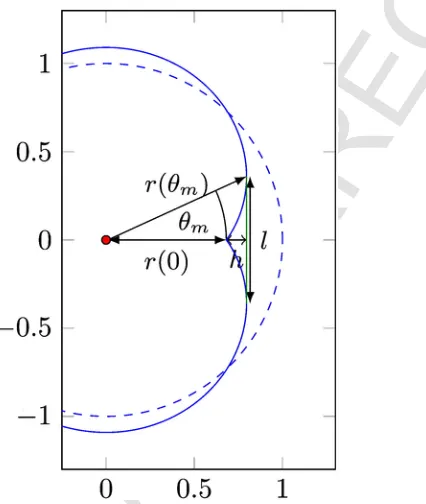
In relation to foams the case of a point contact is not directly rel-evant, but it can be adapted, following the lead of Morse and Witten. This introduces a flat‘cap’as shown in Fig. 3, representing the line of contact between two bubbles of equal pressure, with no change of the forcef, now distributed uniformly on it.
[image:3.595.80.293.406.658.2]Since the internal pressure (dimensionless Laplace pressure) is equal to unity, in lowest order, the corresponding estimate of the
Fig. 3.Sketch showing the flat‘cap’forming at the line of contact between two bubbles. (For purpose of illustration we are showing the case of a large deformation.) Expressions for cap lengthland heighthas a function of forcefare given in Appendix B. In the 3d case, part of the corresponding profile is unphysical, essentially because it violates the as-sumption thatδris small (instead it diverges). In 2d this is not the case, for smallf.
4. Force-displacement relations for several contacts
We now consider how this theory may be applied to an assembly of contacting bubbles, to arrive at a formalism similar to that used by Höhler and Cohen-Addad in 3d [17], which consists of explicit relations between force and displacement where all the contacts of a bubble are coupled to each other, due to the conservation of the bubble volume.
The radial displacementδr(θ), Eq. (7), is a linear function inf,
peri-odic in 2π. We will write it as , with
(8)
Proceeding in parallel with the formulation of Morse and Witten (see also [23]), the displacement at contactiis given by the following sum over all contactsjthat a bubble has,
(9)
Hereg(θij) takes the role of a Green's function (corresponding to Eq. (8)
of Morse and Witten [13]) andθijis the angle between the vectors and
which point from the centre of the undeformed bubble to contactsi andj, respectively.
As an illustration of the theory and the above relationship we will consider the case of a bubble which is compressed between two parallel plates, with contacts at angles 0 andπ, as in Fig. 4. Its shape is described byr(θ) = 1 +δr(θ) +δr(θ+π). For a deformation less than about 10 percent this turns out to be a very good approximation of the exact re-sult, which consists of two semi-circles meeting both top and bottom plates tangentially, separated by a rectangle. Fig. 4 (b) shows the devi-ations from the exact shape for a deformation of 20%. Here the inden-tations of the bubble at the two contacts are very pronounced, as is the lateral bubble extension required for area conservation.
In order to obtain the force-displacement relationship it is sufficient, due to symmetry, to compute the displacement of the contact at an-gle 0 only, resulting inθ11= 0 andθ12=π. From Eq. (8) we then
ob-taing(θ11) = −3/2 andg(θ12) = −1/2, resulting inδr1= −f1/πby use
of Eq. (9). Using symmetry, we obtainδr1=δr2= −f/π. Re-instating
physical dimensions gives the force per contact as .
UNCORRECTED
[image:4.595.115.493.55.184.2]PROOF
Fig. 4.Shape of a two-dimensional bubble in contact with two identical point forcesfacting on its surface at angleθ= 0 andθ=π(solid line). The dashed line represents the unde-formed circular bubble, the grey area marks the exact solution and the solid line the solutionr(θ) = 1 +δr(θ) +δr(θ+π) (see Eq. (7)). (a) In the case of the 10%deformation (ratio of distance between the tangents at top and bottom contacts to bubble diameter) the deviation between the result obtained for two point forces and the exact solution is only visible in the form of a small indentation at the point contacts. (b) For a large deformation of 20%the model overestimates the lateral dimension of the bubble and leads to large indentations at the point contacts.
5. Force-displacement relation for isotropic compression of a foam
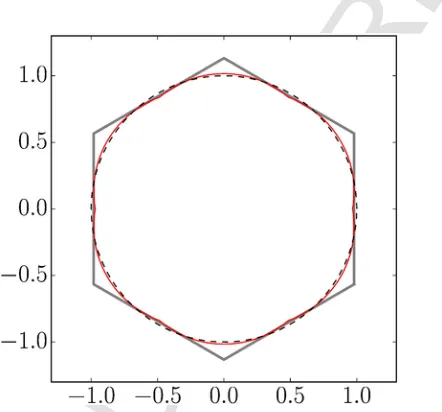
We may use the above equation to derive a force-displacement re-lation for an isotropically compressed bubble (e.g. in the hexagonal arrangement), as considered by Lacasse et al. [19]. We will here express it in terms of theosmotic compressibility, by which we mean the com-pressibility of a wet foam, allowing the liquid fraction to vary, while the gas is, as assumed above, incompressible. This is related to the concept of anosmoticpressure of a foam, which was introduced by Princen [25]. Let us consider the case of a uniform compression of a symmetric structure, such as the hexagonal confinement as shown in Fig. 5, for which Princen gave some analytical results in 1979 [25].
For a single bubble the number of contactsZcan take any integral value; space filling structures requireZ= 3 (triangular packing),Z= 4 (square) or Z= 6 (hexagonal) withZ= 2 corresponding to a linear bubble chain.
Using the above relationship, Eq. (9), and imposingZforces of mag-nitudef, with all radial displacementsδriset equal toδrwe arrive at
Fig. 5.Example calculations for a bubble confined in a hexagonal box. The dashed line shows the undeformed bubble, the solid line corresponds to the Morse-Witten solution
.
(10)
whereΔθ= 2π/Z.
Evaluation of the sum results in
(11)
as shown in Appendix C. While in the bubble model the correspond-ing equation isδr=f, here the osmotic compressibility varies approxi-mately as the inverse of the contact numberZ. More precisely, Eq. (11) is the asymptotic form asZtends to infinity; it agrees with the result from Lacasse et al. in the limit of small compression [19]. This result is at first surprising, if one is accustomed to thinking in terms of simple pairwise forces. Those described in Section 4 are quite different.
The source of this scaling is the condition of incompressibility of the contents of the bubbles which lies behind the displacement/force rela-tion fordifferentcontacts. Corresponding rules may be expected to occur more generally in other branches of material science, such as the theory of granular materials, wherever the constituent materials have a rela-tively low compressibility, as is commonly the case [26].
The example of a uniform compression of a symmetric structure is relatively trivial because the identification of contacts is self-evident, in-deed unvarying, for all values of liquid fraction. In general, and particu-larly for adisorderedfoam, the elimination or creation of contacts (that is, topological changes) present practical difficulties in the implementa-tion of this method in the more general context of typical 2d foams. We will address these elsewhere, in comparison with accurate simulations using the PLAT software [7].
6. Conclusion
The 2d case has fulfilled our expectations of a simple and transpar-ent theory of bubble interactions close to the wet limit. In particular, the origin of the variation of compressibility with contact number, con-tained in the work of Lacasse et al. [19], is clearly exposed.
[image:4.595.63.284.463.669.2]UNCORRECTED
PROOF
per.
Acknowledgments
It is a great pleasure to have this opportunity to acknowledge our many interactions with Dominique Langevin and her steadfast contribu-tion to the community of foam research, including the Eufoam confer-ence series.
We thank F Dunne and J Winkelmann for valuable assistance in preparing this manuscript. Research is supported in part by a research grant from Science Foundation Ireland (SFI) under grant number 13/ IA/1926. We also acknowledge the support of the MPNS COST Action MP1305‘Flowing matter’ and the European Space Agency ESA MAP Metalfoam (AO-99-075) and Soft Matter Dynamics (contract: 4000115113).
Appendix A. Derivation of differential equation for displacement
δr(θ), Eq. (2)
The curvature of a curve defined in polar coordinatesR(θ) is given by
(A.1)
where and . WritingR(θ) =R0+δR(θ) and
linearis-ing the expression for the curvature leads to
(A.2)
A free bubble immersed in water has a uniform curvature, , and its radius is related to the difference between internal and exter-nal pressure,pi0andpe0, via the Laplace-Young equation. In two
dimen-sions this is given byγ/R0=pi0−pe0, whereγis the surface tension of
a gas-liquid interface.
In the presence of an additional external force acting on the bubble, e.g. due to a contact with a wall or another bubble, the Laplace-Young equation takes the form
(A.3) where we have adopted the notation pi=pi0+δpi and
pe(θ) =pe0+δpe(θ) from Morse and Witten [13]. Inserting the
lin-earised expression for the curvature,κ(θ) (Eq. (A.2)), then results in
(A.4)
For the case of a bubble subject to a forceF at a single point (at
θ= 0) this force will need to be balanced via a uniform body force, arising from an increase in internal pressure. Its gradient is given as
Appendix B. Description of capped shape as a function of forcef
We refer to the sketch of Fig. 3 for the definition of cap lengthland heighthand also for the definition of the angleθm.
At the end points of the cap,r(θ) cos(θ) is a maximum with respect to
θ. This leads toθm=fπ/(2π−f). The cap length is then given byl= 2
(1 +δr(θm)) sinθm≃f(1 −f/(2π)).
The cap height is given by . The change in area
of the enclosed curve is thus of orderf3.
Appendix C. Derivation of Eq. (11), .
Eq. (10) is of a kind familiar from numerical integration and we will evaluate if by considering the integral . This may be approxi-mated using the composite trapezoid rule as
(C.1)
where we took into account thatg(0) =g(2π).
Since the left hand side vanishes by the condition of incompressibil-ity, see Eq. (6), we arrive at
(C.2)
We can now write the right hand side in turn as an integral, and
eval-uate this as , neglecting higher
order terms. For our functiong(θ), Eq. (8), this results in −2πand thus .
Returning to our original equation, Eq. (10), this then gives . InsertingΔθ= 2π/Zresults in (see Eq. (11)), in leading order inZ −1.
References
[1] I. Cantat, S. Cohen-Addad, F. Elias, F. Graner, R. Höhler, O. Pitois, Foams: struc-ture and dynamics, Oxford University Press, 2013.
[2] D. Weaire, S. Hutzler, Foams, in: E.M. Terentjev, D.A. Weitz (Eds.), The Oxford handbook of soft condensed matter, Oxford University Press, USA, 2015, pp. 147–166.
[3] S.J. Cox, M.F. Vaz, D. Weaire, Topological changes in a two-dimensional foam cluster, Eur Phys J E 11 (1) (2003) 29–35.
UNCORRECTED
PROOF
[5] F. Bolton, D. Weaire, The effects of Plateau borders in the two-dimensional soap froth. I. Decoration lemma and diffusion theorem, Phil Mag B 63 (1991) 795–809. [6] F. Bolton, D. Weaire, The effects of Plateau borders in the two-dimensional soap
froth. II. General simulation and analysis of rigidity loss transition, Phil Mag B 65 (1992) 473–487.
[7] F. Bolton https://github.com/fbolton/plat.
[8] D.J. Durian, Foam mechanics at the bubble scale, Phys Rev Lett 75 (1995) 4780–4783.
[9] D.J. Durian, Bubble-scale model of foam mechanics: melting, nonlinear behavior, and avalanches, Phys Rev E 55 (1997) 1739–1751.
[10]
V.J. Langlois, S. Hutzler, D. Weaire, Rheological properties of the soft disk model of 2D foams, Phys Rev E 021401 (2008) 78.
[11]
M.B. Sexton, M.E. Möbius, S. Hutzler, Bubble dynamics and rheology in sheared two-dimensional foams, Soft Matter 7 (23) (2011) 11252–11258.
[12]
M. van Hecke, Jamming of soft particles: geometry, mechanics, scaling and isosta-ticity, J Phys Condens Matter 22 (2010) 033101, 24pp.
[13]
D.C. Morse, T.A. Witten, Droplet elasticity in weakly compressed emulsions, Euro-phys Lett 22 (June 1993) 549.
[14]
D.M.A. Buzza, M.E. Cates, Uniaxial elastic modulus of concentrated emulsions, Langmuir 10 (12) (1994) 4503–4508.
[15]
J. Guzowski, M. Tasinkevych, S. Dietrich, Free energy of colloidal particles at the surface of sessile drops, Eur Phys J E 33 (3) (2010) 219–242.
[16]
F. Chevy, A. Chepelianskii, D. Quéré, E. Raphaël, Liquid Hertz contact: softness of weakly deformed drops on non-wetting substrates, EPL Europhys Lett 100 (5) (2012) 54002.
[17]
R. Höhler, S. Cohen-Addad, Many-body interactions in soft jammed materials, Soft Matter 13 (2017) 1371–1383.
[18]
K.W. Desmond, P.J. Young, D. Chen, E.R. Weeks, Experimental study of forces be-tween quasi-two-dimensional emulsion droplets near jamming, Soft Matter 9 (2013) 3424–3436.
[19]
M.D. Lacasse, G.S. Grest, D. Levine, Deformation of small compressed droplets, Phys Rev E 54 (5) (1996) 5436–5446.
[20]
S. Hutzler, R.P. Murtagh, D. Whyte, S.T. Tobin, D. Weaire, Z-cone model for the energy of an ordered foam, Soft Matter 10 (36) (2014) 7103–7108.
[21]
D. Whyte, R. Murtagh, D. Weaire, S. Hutzler, Applications and extensions of the Z-cone model for the energy of a foam, Colloids Surf A Physicochem Eng Asp 473 (2015) 115–122.
[22]
L.D. Landau, E.M. Lifshitz, Course of theoretical physics, Theory of Elasticity, vol. VII, 1986.
[23]
R. Höhler, D. Weaire, Bubble-bubble interactions in 3D close to the wet limit, 2017, in preparation.
[24]
W. Drenckhan, S. Hutzler, Structure and energy of liquid foams, Adv Colloid Interf Sci 224 (2015) 1–16.
[25]
H.M. Princen, Highly concentrated emulsions. I. Cylindrical systems, J Colloid In-terface Sci 71 (1) (1979) 55–66.
[26]
N. Brodu, J.A. Dijksman, R.P. Behringer, Multiple-contact discrete-element model for simulating dense granular media, Phys Rev E 91 (2015) 032201.
[27]
F.F. Dunne, F. Bolton, D. Weaire, S. Hutzler, Statistics and topological changes in 2d foam from the dry to the wet limit, Phil Mag (2017), (in press).
[28]
J. Winkelmann, F.F. Dunne, V.J. Langlois, M.E. Möebius, D. Weaire, S. Hutzler, 2d foams above the jamming transition: deformation matters, Colloids Surf A Physic-ochem Eng Asp (2017), (in press).
[29]
![Fig. 1.UNCORRECTED PROOF Examples of two-dimensional foam structures in the wet (near-circular bubbles)and dry regimes (near polygonal bubbles), obtained using the software PLAT [5–7].](https://thumb-us.123doks.com/thumbv2/123dok_us/933357.606186/2.595.313.533.55.357/uncorrected-examples-dimensional-structures-circular-polygonal-obtained-software.webp)