'°
0,.,
co co M
°'
~ 0"-~
~
"-0
$3.00
June-July 1986
Special AI Issue
PROLOG On The PC ... 6
A thorough comparison of PROLOGS available on the PC.
Expert Systems and Logic Programming ... 12
Expert systems designers are handing out numbers to prospective customers.
Opening Bids In Bridge ... . 18
A great example of how AI works. Grab your PROLOG and start coding.
And More
Building Your Own Logic Analyzer ... 26
Can't afford a commercial 32-channel logic analyzer? You can afford this one.
86
World ... 36
Our man in Turkey trots all over Asia looking for the complete supplier
of drives, systems, boa_rds.
256K RAM For Your 83 Kaypro ... 44
Finally, a do-it-yourself RAM upgrade for this venerable Z80 machine.
PC-DOS For Non-Clones ... 54
Brep-by-step
tutorial,
demo programs with source code included!Borland introduces Turbo Prolog,
the natural language of
Artificial Intelligence.
Prolog
is
probably the most
powerful computer programming
language ever conceived, which
is
wbywe've
made
it our
second
language-and ''turbocharged" it
to
create Turbo Prolog ...
Our
new Turbo Prolog brings
supercomputer power to your IBM®
PC
and introduces you step-by-step to
the fascinating new world of Artificial
Intelligence. And does
all this
for an
astounding $99.95.
@
:f:/::~f i:ir~
Pascal® is to Pa.sca.1!Our Turbo Pascal aston1Bhoo
eve:cyone who thought of Pascal
as 'Just another language:' We changed all that-and now Turbo
Pascal 18 the de facto worldwide
standard, With hundreds of thousands of enthus1astB W ' • • ' · · and users 1n
l#W!IAfi
c! universities,·· -... {research
· •· · V. · :.;
centers,•. I
1schools, L< and With pro-fessional program-"' mers, students,
and hobby1stB. You can expect at least the same impact from Turbo Prolog, because while Turbo Prolog 1s the most revolutionary and natural progra.rn.rnrng language, it 1s aloo
a complete development enV1ron-ment-juBt like Turbo Pascal
Turbo Prolog radically alters and dramatically improves the brave new world of a.rttllcial intelligence-and 1nV1tes you tnw that fasctnattng universe for a huma.nJ.y tntelligent $99.95.
_Q;;J=~:;;~e::,
~
our
free tutorial willget
you st;a.rt;edright
awayYou'll get started rlght away because we have tncluded a complete step-by-step tutorial as part of the mpage Turbo Prolog Reference Manual Our tuwrl.al
Will take you by the hand and teach you everything you're likely
w
needw
know about Turbo Prolog and a.rttllcial intelligence.For example: once you\re completed the tutorial, you '11 be able to desJgn your own expert systems ut111zlng Turbo Prolog's powerful problem-oolv!ng capabilities.
Th1nk of Turbo Prolog as a Wgh-speed electronic detect1V8.
First you feed it information and teach it rules. Then Turbo Pro1og "th1nks" the problem through
and comes up With all the reasonable answers-almost tnstantly.
If you think that th1a 18
amazing, you just need
w
remember that Turbo Prolog ls a 5th-generation language-and the kind of language that 21st century computers Will use routinely. In fact, you cancompare Turbo Prolog
w
4585 SCOTTS VALLEY OR/VE SCOTTS VALLEY. C4 95066 (408) 438-8400 TELEX 112J1J
Turbo Pascal the wey you could compare Turbo Pascal
w
machine language.$
You get the
Turbo Prolog completef;'=~~~Bsystem
You get a complete Turbo Prolog development system tnclud!ng:
•The lightn1ng-fast Turbo Prolog tncremental compiler and the tnteracttve Turbo Prolog editor. • The mpage reference
manual which tncludes the step-by-step Turbo Prolog tuwrial. • The free GeoBaseTM natural query language database tncluding commented oource
code on d1sk-ready to compile.
GeoBare 1s a complete database deslgn.ed and developed around
U.S. geography. It tncludes cities, mountatns, rivers, and Wghweys, and comes complete With natural query language. Use GeoBase
immediately "as 18," or mod!zy it to fit your own tnteresta.
So don't delay-don't waste a second-get Turbo Prolog now. $99.9518 an amaz1ng]y small price
w
pey to becOme an immediate authorlcy-an instant expert on a.rt1fic1al intelligence! The 21st century 1s only one phone call awey.Turbo Prolog 1.0
Technical SpecitJ.cations
ProgzmnmiDt 8yst,em .libatures
f!:1' Compiler. Incremental rompller
gen-erating Illl.tlVe ln-llne cxxle and llnkable oQJect malules. The l1nk1ng fonnat la romµit.lble with the FCOOS linker. large memmymcxiel support. Complies over 2600
llnea per minute on a standard !EM ro. f!:1' Int.eracttve 1'4tt.or: The E\)'Bt.em lnCludes a p:iwerful lnterect!Ve 1\J!l-rereen
text editor. If the rompller detects an error,
the ed!tor auoomatlCalzy pooltJona the
curoor epproprlately In the rource cxxle. At
run-t!me, Turlxl Prolog ~can call the edit.or, and v1eW the runrung PI'®'Wil's
oouroe cxxle.
f!:1' 7Jpe 8yBt:8m: A flexible oQJect,orWnted
cype E\)'Bt.em la supported. f!:1' W1Ddowtng Bupport: The E\)'Bt.em supports !xJth graphic and text WlndowB.
f!:1' Input/Output: Full I/O fac111t!ea, Including formatted I/0, streams, and
random aooeaa files.
f!:1' .Numeric P.a.nges: Integel'B: -32:lf!7 to 32767; Reala: lE-307 to IE+zre
f!:1' .Debugg1Dg: Complete bullt-tn trare de-buggtng CB.IW111t!ea allow1ng Single
st.eppJng of~
,
...
,
I
YES
I
!~a~~st
I
I
•
I
I
Turbo Prolog at only:I
=
$99.95
=
I
To order by phone,1
1
I
or for a dealer nearest you,I
Call (800) 255-8008
I
I
in CA call (800) 742-1133.I
I
Send me_ Turbo Prolog at $ _ _I
I
Outside USA add $10 per copyI
I
C4 am MA res. add applicable sales tax $ _ _I
I
Amount enclosed: $ _ _I
I
This price includes shipping to all US citiesI
I
Payment VISA MC Bank Draft CheckI
I
Credit card expiration date:--'-I
I
Card~ I I I I I I I II
I
11111111I
I
b1tfs ";5J ~V:,:, !8!' or 1111e corrpatible nminaI
I
My cO/TfJUlers name artJ model is:I
•
1
Thedislrsizeluseis·D3'1/ DSWI
NOT COPY PROTECTED
I
*60-DAY MONEY-BACK GUARANTEEI
I
Name.-I
I
Shipping Address·I.
I
I
I
City.-I
I
State: lip:I
I ·
Telephone:I
I
~~mcfi,~~5JsAOld:Jew:;~~[b~e:r:iff:~~I
I
International Pas/al Money Orrler. *YES, if within 60 days of purchase lhi~ product doesI
I :
~i~c:e~s~;;;~f::;!nra:J:~/¢;1;11I
I
arrangearefund.I
I
;;:~~~~"'A:.'t~'t requlrem1nt1:I
I
~~Of1¥Jatibles • ;.·.;.'.J
I
SUS • ;,.·;.~·Features:
• 8 MHz 80186 microprocessor with true
16-bit data bus. · ·
• True PC compatability with our own custom ROM BIOS and PC cardslots for the video of your choice.
• Standard 512K zero wait DRAM, ·or
~
1 M options.·~ 8087 numeric coprocessor support on board.
• On-board floppy disk controller for up to four 5114" drives.
• On-board SCSI hard disk controller port.
~ Supports WD1002 SHD., WD1003 ACS,
~ OMTI 5100, 5300 ADAPTEC ACB4000.
• 2 On-Board Serial Ports.
• Battery Back-Up Real Time Clock.
Designed, Manufactured and Serviced
by:
PC
[CH
:o~·~i~h
1
~~h
street
.
Lake City, MN 55041
(612) 345-4555
COD, VISA, MASTER CARO, CERTIFllSD. FUN CS
"
---
NEW LOWER.
Kits . All wave Soldered! ! .
PRICES
..
• Full Kit W/O SCSI, serial ports, clock .•. $ 550.00 · • Assembled and Tested
W/O SCSI, serial ports, clock ••• 1-4 $
5-9
$
SCSI Port ... add $
Serial Ports ... each - add $
Real Time Clock and Battery , add $
599.00 525.00 20.00 12.50. . ·1~.50
• 112 MEG Add-On ... :'. ... $ 105.00 .
• XT Style, Enclosure ... "$
• 150 Watt Power Supply, Tested ... $
~087-2
Coprocessor ...
$Total Solutions: .
.
Assembled and Tested Systems
75.00 105.00.
Call
• Mono-Chrome System ... $1,499.00
Includes: 512K, Power Supply, Enclosure, Keyboard, Monitor, Two Drives, and Printer· Port, 1 Serial Port, Real Time Clock.· • Quaritity Discounts Upon'·,Requ~st
:;MICRO
·, (}ORNUCOPI/\
The Micro Technical
Journal
Editor & Publisher David
J.
ThompsonOperations & Advertising David Pogue ·
Associate Editors
Rebecca Ozrelic Gary Entsminger
Accounting Sandra Thompson
Office Manager Tracey Anthony
~ ,, ,. Technical Department
Larry Fogg
Staff Assistants Laura Logan Cary Gatton
Renee Katter
MICRO CORNl]COPIA (ISSN 0747-587X) is published bi-monthly for $16 per year by Micro Cornucopia Inc. 155 NW Hawthorne Bend, OR 97701. Second-class postage paid at Bend, OR and additional mailing offices. POSTMASTER: Send address changes to MICRO CORNUCOPIA, PO Box 223, Bend · OR 97709.
SUBSCRIPTION RATES:
1 yr.(6 issues) ... $16.00 2 yr.(12 issues) ... $30.00 3 yr.(18 issues) ... : . ... $42.00 1 yr.(Canada & Mexico) ... $22.00 1 yr.(Other foreign) ... $30.00 Make all orders payable in U.S. funds on a U.S. bank, please. ·
CHANGE OF ADDRESS: Please send your old lcibel and new address.
MICRO CORNUCOPIA P.O. Box 223 · Bend, Oregon 97709
CUSTOMER SERVICE: For orders & sub-scription problems call 503-382-5060, 9 am to 5 pm,· Pacific time, M - F.
For technical help call 503-382-8048, 9 am to noon, Pacific time, M - F.
RBBS - 24 hrs. 300-1200-2400 baud 503-382-7643
Copyright 1986 by Micro Cornucopia Inc. All rights reserved
ISSN 0747-587X
EDITORIAL
By
David Thompson
Over The
Wall
Morrow Computers Says Goodby
George Morrow is still around, but Morrow computers, one of the early powers in this industry, has filed
Chapter 11. · . .. .
In his book Quotations From Chpirmqn :Morrow George wrote, '.'Money is the only lethal drug ·available on a
non-prescription basis.'' . .
"We pissed away $11 milliori,". he commented after the filing. (Something not experienced by·many.)
If someone doesn't come forth shortiy·with ·something that's green and folds and interests bankers, there won't be· another chapter.
Mirror Says A Lot
Be careful when you sue somecme - you might just be doing t~em a favor. Crosstalk is' suing Softklone over its Mirror communications package for the Compatibles, but publicity from the suit could be a super boost for Softklone's new product.
I called Softklone to see what the fuss was about. It turns out that Mirror will emulate Crosstalk, from communications protocol to configuration files. Mirror will also speak Christianson (CRC ·or checksum), Hayes,
and Kermit protocols. · ·
It has. a built.:in text eoitor, password . protection, data encoding/ decoding, plus it runs in the background. Gust hit both shift keys and the transfer continues in the " background while you use the system for other. tasks. Hit
the shifts ·again and you're back in Mfuor.) ... · Mirror. supports practically every· auto or manual dial modem· (Hayes compatible and non-compatible). It will even turn a PC into a VT-100 terminal if you wish.
I ordered one. After it arrived I tried it out on everything . I . could find. I'd been using Mite and Modem740, but. I musf say, this is better, much better. One problem I found is that it holds up the sender while it's writing to disk (in 4K blocks). At 9600 baud this delay becomes significant and reduces the effective transfer rate to about 5000 baud · (rurulir\g on a clone and writing orito · ·a Seagate winchester).. · . ·
However, at $49.95 (not copy protected),· it's definitely the best deal in commercial modem software I've seen.
Solid
I have a 'Holliston XT-186 board, and it's turned out· to be a. quick, :·very dependable performer. Though it doesn't have the video speed or the built-in floppy interface of PC Tech' s X-16, it certainly holds. its. own in the processing
(continued on page 90)
June-July 1986 Issue No. 30
Introduction To PROLOG
6
12
18
PROLOG On The PC
There's already quite a collection of compilers and interpreters for this unique new language
Expert
· Systems and
Logic
Programming
An overview of expert systemsdesign using PROLOG.
Opening Bids In Bridge
KNOWLEDGE BASE
Knowledge
Al:quisltlon And Refinement
NATURA LANGUAC INTERFAC
An example PROLOG application. Margaret Sklar lets her code do the talking.
More Features
26
54
72
Building Your
DC15Own Logic.
INt!5Analyzer
DCl4. Build your own IN14
fogic analyzer for DC13
INt3
peanuts. Part one DC12
of a two-part IN12
series.
PC-DOS For Non-Clones
Want to write a custom
Pc
BIOS for your 8088 system? Want to know what's happening inside your clone BIOS?Split
Personalities-The V Series
The V20 & V30 have been hot replacements for the 8088186. What can the rest of the series do?
68
94
CONTENTS
The Racer's Edge
The 68020 is out. Trevor Marshall and Co. tell us how it
matches up against the 32032. .
Fast Step Rate
For PC Disk Drives
Larry Fogg changes his clone's step rate in software. An easy, quiet mod.
Columns
36
44
48
64
77
78
82
86
96
86 World
Direct Importing. Laine picks up the baton and runs (all over Asia) with it. Fascinating adventure.
Kaypro
Folks have been requesting this mod for four years: tin
easy 256K RAM upgrade for the 83 Kaypro II and 4.
Pascal Procedures
John Jones tries writing a simple draw program for the
PC (and enjoys it).
C'ing Clearly Porting Code
Culture Corner An answer for $7.11.
On Your Own AI recommendations
In .the Public Domain
Another.CPIM emulator, but this one thinks it's a Z80. How about that
S-100 Bus Hardware supporting Turbodos
Technical Tips
Future Tense·
By Gary Entsminger98
104
Tidbits File recovery under MS-DOS and . the visible computer
The Last Page It's recursion: again, and again, and again, and ...
Digs The Duck
I own a DAK ADC modem and have had basically good experiences. The only problem I encountered was that one of the DIP switches did not oper-ate correctly. But since there was an equivalent command that I could imbed in my startup file, this was not a big problem.
I also found one little "gotcha" which I suspect is not limited to the duck. The modem will run in either · 300 or 1200 baud over the phone line, depending on what it detects coming in. However, I found that when I dialed a BBS which handles both baud rates, the BBS tried 300 first. The duck obediently "quacked" at the lower rate after initially connecting at 1200. The solution is simple: turn off the buffered mode (A TBO) before dialing a BBS which you know will handle 1200 baud. ·
Larry Blanchard 2018 N Valencia Santa Ana CA 92706
Curing Keyboard Lockup
. Several months ago a friend and I ordered speed-up mods and Pro-8 monitor ROMs from you to upgrade our 2-83s. Using the instructions en-closed with the kits we had no trouble successfully completing the modifica-tions to both machines.·
After about a half hour of continu-ous operation my computer developed a case of the dreaded "keyboard lock-up syndrome." Afte:i: several tele-phone calls to Micro C, Zilog chip dealers, and MicroSphere, and quite a few suggestions that sounded good but didn't work, I got my Issue 26 of Micro C. It contained a Technical Tip about an aluminum heatsink devel-oped by an English doctor.
Installation complete, power on, ev-erything looked good . - until an hour had passed. Then my system was off to la-la land again. I called Micro C for the third time, and that time, I got to talk to Mr. Thompson. During our 10 or 15 minutes on the phone we cov-ered a wide range of possibilities. But when I hung up, I had a clear idea of what I needed to do;
First I checked the power supply. No problem ___: steady 5.045 volts.
Next I hooked up a scope to pin 6 on the CPU to see what the new 5MHz signal looked like. The wave-form was quite ragged on the uphill side. In addition, the amplitude was extremely low, just over 2 volts. Just for comparison, I checked the now unused 2.5MHz pin and was amazed at the difference. The wave had an amplitude of well over 5 volts and was clean and smooth in appearance. Since I didn't have a replacement for the 74LS293 (U86 on the Micro C schemat-ic), which provides both the 2.SMHz and the SMHz signal, I couldn't see if it was a bad chip. Instead, I picked a 4MHz signal from pin 6 on U87 and fed it to the CPU. Eureka!
After installing a switch to allow transfer from 2.5 to 4MHz, I left the computer on for about 10 hours. No failure, and no recurrence. Thanks. Martin Leichtung
HRC 4260 Kachemak Dr. Homer AK 99603
Amiga Benchmarks
You asked for benchmarks on the Amiga in Issue 29; here are mine:
Benches 1 2 3
Amiga w/Int. 237.9 124.1 225.1 Amiga w/Short Int. 32.5 21.0 225.0 All times are in seconds and include floppy disk access time. I used Lattice C. The first times were done with the program as you listed it. The second times were generated with short (16-bit) integers.
Now I need some info from you: how do you protect your system in the event of a power supply failure? I just had a supply go out that cost me a motherboard and winchester, not to mention the supply. Fortunately the case and fan were just fine. Bob Gobeille
805 Laporte Ave Fort Collins CO 80521
Editor's note:
Lance Rutallie also submitted bench-marks almost identical to yours (he also used Lattice C V3.02). It's interesting to see the benchmark comparisons between the Amiga and the Atari ST.
A hunkering of knowledgeable guestima-tors came up with a set of expected times for the Amiga that showed beyond a doubt that knowledgeable guestimators don't
know what they're guestimating. They expected the Amiga to blow away anything less than an 8MHz 80286, especially for screen 110 which is measured in bench 3.
See Issue 29 for benchmark details. Times are. in seconds. All used 16-bit integers (short ints for Amiga). No speed optimization was used (like register vars)
w~en compiling. ·
Benches 1 2 3
Amiga w/Int. 237.9 124.1 225.1 Amiga w/Short Int. 32.5 21.0 225.0 Atari ST 28.0 18.0 35.5 6 HHz AT clone 11.2 7.4 34.2 4.77 HHz 8088 54.7 28.7 73.6 4 HHz Z80 478.2 244.6 39.0
As for power supplies; boy, you've got me. I've seen some of the cheapest switch-ing power supplies from Taiwan put up with all kinds of electrical violence without complaint (and without damaging the
sys-tem).
The old linear supplies ·(10-20lb 60Hz tranformers and house-warming linear reg-ulators) I have on my Big Boards weren't cheap, aren't small, and definitely aren't efficient but after almost 6 years they haven't eaten any processors.
One Out Of Two Ain't So Good My first order to DAK was satisfac-tory, although it took four weeks for delivery. instead of Mr. Bollinger's four days. My second order, however, was a nightmare. The printer I received was a defective, used one that had already been se~t back by a dissatis-· fied customer in Florida. I found his address label as well as a used candy wrapper in the "factory" packing. Parts of the case were missing, and . the machine never would initialize.
Two calls to customer service went unanswered. When I finally got through, their reply was, "You may send the merchandise back for a re-fund (sans shipping fees both ways).". A certified letter to the president of the company produced no better re-sults.
I believe companies which make mistakes should be willing to correct them at their cost instead of making the customer pay for those errors. Needless to say, I will never do busi-ness with DAK again.
David Randles P .0. Box 8461 Medford OR 97504
THE CHALLENGER XT-186
SINGLE BOARD COMPUTER
FULLY IBM COMPATIBLE BUT FOUR TIMES FASTER
STANDARD FEATURES: •Intel 80186 CPU, 8 MHz
•On-board 640K, parity checked RAM memory
•8 slots for 1/0 Interface Board 6 · 8 Bit Data
2 · 16 Bit Data •4 channel 8237 OMA •8 channel 8259 Interrupt •3 channel 8253 Timer •IBM PC-AT-like Bus with true 16
bit data path
OPTIONAL FEATURES: • 10 MHz operation
•8087 Numerical Processor Support
•NEW ROM BIOS Version 2.0
The Challenger XT-186 offers full IBM PC-XT compatibility. It supports industry standard operating systems: MS-DOS, PC-DOS, 1.0 through 3. 1, CP/ Mand runs all existing software with higher performance. The XT-186 mother board can directly replace any existing PC or PC-XT mother board, as it has the same physical dimensions and mounting holes. The Intel 80186 and 640K on-board 16 bit path RAM makes the XT-186 the fastest PC currently available.
MOTHER BOARD, 8 MHz, 640K, RAM, 8 1/0 slots
NEW LOWER PRICE
$695.00
The XT-186 ROM BIOS version 2.0 supports the IBM PC-T combined Hard Dish/Floppy Controller on the Challenger XT-186 mother board. With the new ROM BIOS installed the XT-186 can support two 1.2 MB floppy drives and two hard disk drives with the same fast access time of the IBM PC-AT. No other XT compatible system can offer either the speed or the disk storage capacity, (230 Mbytes maximum) of the XT-186.
XT-186 ROM BIOS version 2.0 Upgrade Kit
$50.00
--NOW
AVAILABLE--XT-88 Turbo Board
A reliable, low cost mother board with IBM PC-XT compati-bility, running 1.8 times faster. 8MHz hardware selectable to 4.7 MHz. On-board 8087 socket ready for co-processor chip installation. The 8088-2 processor with 8 1/0
$299
slots, 640K RAM and compatible ROM BIOS • . . . .
No RAM . . . • • . . • . .
$199
AT-286 Mother Board
Here's the power you need to get the job done! IBM PC-AT compatibility enables you to run a broad range of programs, both personal and professional. The board comes with a built-in Real-time clock and 80287 socket for future co-processor insertion. The AT-286 with the Intel 80286 microprocessor running at 8MHz with 640K RAM and Phoenix BIOS processes information faster and more efficiently. Build a high-perform· once computer and boost your productivity.
Mother Board, 8MHz clock rate, 640K RAM,
$
995
8 I/ 0 slots, Phoenix ROM BIOS . • . . .
No RAM
... $895
VISA and MASTERCARD Accepted - Please Add s3.00 ShippingHOLLISTON COMPUTER
P.O. Box 615, Chepachet, R.
I.
02814
401-568-0522
IBM PC-XT-AT, PC-DOS ore trademarks of International Business Machines Corp .• MC DOS is a registered trademark of Micro-Solt Corp .. CP Mis a registered trademark of Digital Research Inc
>PRO LOG On
The
PC
By Gary Entsminger
Starting
Out
In
PROLOG·
PROLOG, what's in it for. you? What's it· like to work with? Who's got the best ·PRO LOG package for beginners writing expert systems (or experts writing beginner systems)? Gary has dug up some very interest-. ing information about new
implemen-tations of this language.
T
he idea .. of logic programming , isn't new - PROLOG (forPRO-gramming in LOGic) was first implemented in Marseilles in 1972 -but its popularity had to wait for the Japanese to select it for their Fifth Ge11eration Project language in 1982.
The Fifth Generation envisions com-puter hardware engineered for logic processing (earlier generations of com-puters were engineered for arithmetic _ processing) and a logic programming language (i.e. PROLOG) for interact-ing between the logic processinteract-ing hard-ware and the upper level softhard-ware that implements problem solving strategies.
PROLOG Briefly
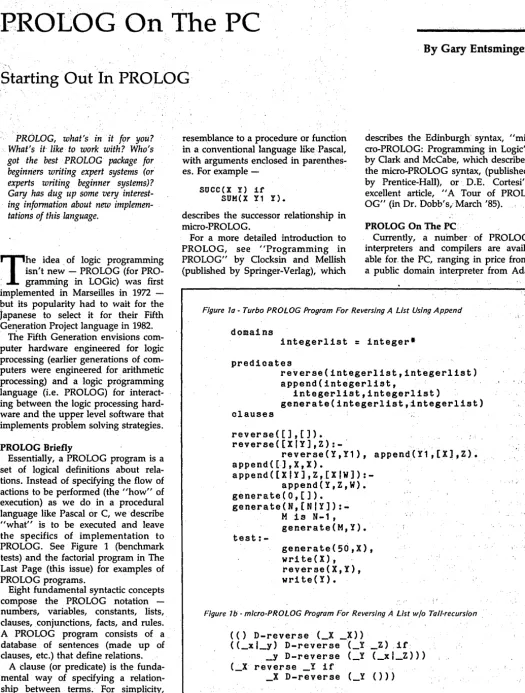
Essentially, a PROLOG program is a set of logical definitions about rela-tions. Instead of specifying the flow of actions to be performed (the "how" of execution) as we do in a procedural language like Pascal or C, we ·describe "what" is to be executed and leave the specifics of implementation to PROLOG. See Figure 1 (benchmark tests) and the factorial program in The Last Page (this issue) for examples of PROLOG programs.
Eight fundamental syntactic concepts · compose the PROLOG notation
-numbers, variables, constants, lists, clauses, . conjunctions, facts, and rules. A PROLOG program consists of a database of sentences (made up of clauses, etc.) that define relations.
A clause (or predicate) is the funda-mental way of specifying a relation-ship between terms. For simplicity, you might think of a predicate as a
,·
resemblance to a procedure or function in a conventional language like Pascal, with arguments enclosed in parenthes~
es. For example
-SUCC{X Y) i f SUM{X Y1 Y).
describes the successor relationship in micro-PRO LOG.
For a more detailed introduction to PROLOG, see "Programming in PROLOG" by Clocksin and Mellish (published by Springer-Verlag), which
describes the Edinburgh· syntax, "mi-cro-PROLOG: Programming in Logic" by Clark and McCabe, which describes the micro-PROLOG syntax, (published by Prentice~Hall), or· D.E. Cortesi's excellent article, "A Tour of PRO L-OG" (in Dr. Dobb's/March '85).
PROLOG.On The PC:
Currently, a nuinber · of PROLOG interpreters and compilers are avail-able for. the PC, ranging in price from a public domain interpreter from Ada
Figure Ta - Turbo PROLOG Program For Reversing A List Using Append
domains
integerlist
=
integer•predicates
reverse(integerlist,int~gerlist)
append ( integerlist, · ·' ·
integerlist,integerlist)
generate(integerlist1integerlist)
clauses
reverse([],[]). reverse([XIY],Z):-·
reverse(Y,Y1), append([],X,X).
append([XIY],Z,[XIW]):-append(Y,Z,W). generate(O,[]).
generate(N,[NIY]):-
test:-M is N-1, generate(M,Y).
generate(SO,X), write ( X),
reverse(X,Y), write(Y).
append.(Y1 ,[X] ,Z) ~
Figure Tb - micro-PROLOG Program For Reversing A List w/o Tail-recursion .
( () D-reverse · (_X _X))
( (_x l_y) D-reverse (_Y _Z) i f _
_ y D-reverse (_Y
(_xl.-.Z)))
c_x·
reverse _y if_X D-reverse (_Y ()))
[image:8.621.36.561.42.735.2](also available. on Micro C MS-Disk #19) to the very expensive PROLOG2 compiler from Expert Systems.
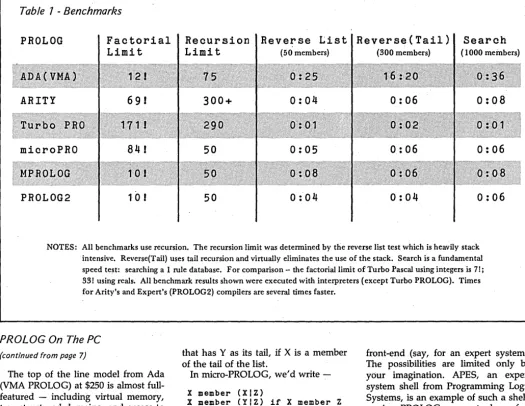
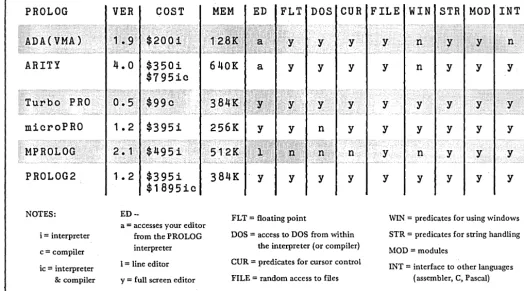
In this review, I'll quickly outline the features of each of the PROLOG tools I tested and indicate which ones will (I believe) · serve · the beginner . and the applications programmer.
In general, PROLOG tools have im-proved significantly during the . past year, and all those· tested have merit. The principal differences in the imple-.mentations are in syntax, features,
speed, documentation, and ease of .'use. As usual, ·you get what you pay for, but "higher price" doesn't neces-sarily mean "better product." Read on.
AdaPROLOG
Ada comes in several flavors, from a beginner's public domain version . (mentioned earlier) through an educa-: : tional and virtual memory yersion to a ·full-featured professional implementa..; tion. The main differences between ·them are price and features.
For $8 you get an Edinburgh core PROLOG without floating point, a debugging (or tracing) facility, random access to files, access to DOS com-mands, virtual memory, etc. But, if you're just wanting a very inexpensive taste of PROLOG, this might be the place to start. Unfortunately, the lack · of so many crucial features
(particular-ly the debugger) will probab(particular-ly give you a distorted view of PROLOG. If I . wanted to spend as little as possible to discover what PRO LOG is about, I'd spend a little more and get the .FS version.
At $49.95, .FS PROLOG includes all .. the features I mentioned in the last paragraph except for virtual memory. · The syntax is the Edinburgh standard, so a combination of .FS and· a copy of Clocksin and Mellish will be sUfficient to get you started toward sophisticated PROLOG programming.
·(continued next page)
NOW AVAILABLE for
MS-DOS PC-DOS CPM-86 CCPM-86 CPM-80
SPEED -
POWER -
VERSATILITY
-EXPRESS
2.0
FULL SCREEN EDITOR
HIGH PERFORMANCE AT A FAIR PRICE
Q
NL Y $29.
95
8 Bit Versions$34.
95
16 Bit VersionsDOES YOUR TEXT EDITOR REMIND YOU OF A 1949 PACKARD •••• Stop abusing yourself. It's time to retire that doggy old clunker! YOU DESERVE EXPRESS 2.0, the 280-Z of the editor world!
·EXPRESS
2.0
FEATURES
• FULL ACCESS TO CP/M USERS AREAS (up to 32) with any editor command! • NAMED DIRECTORIES supported on MSDOS VERSION!
• MEMORY MAPPED VIDEO AVAILABLE FOR IBM PC and PC clones!
• BU.Ill-IN CP/M LIKE COMMANDS (RENAME, COPY, ERASE, TYPE, DIR, LOG)! • POWERFUL KEYBOARD MACRO'S (as many as you want)!
• FULLY RECONFIGURABLE COMMAND KEYS (emulate any other editor if you like)! • FAST, FAST, FAST SEARCH!
• TERMINAL DATA BASE •• INSTANTLY configure for over 50 predefined terminals! • FILES LARGER THAN MEMORY handled with ease!
• CONTROL and HIGH BIT CHARACTERS maybe entered and edited I
• DYNAMIC WORD WRAP/UNWRAP• FULL CURSOR CONTROL (and then some) • EASY ot SET TAB STOPS • GLOBAL/SELECTIVE/LITERAL/IGNORE CASE REPLACE • FULL BLOCK INSTRUCTIONS including PRINT, SAVE, INCLUDE, MOVE, COPY, DELETE • VARIABLE SPEED (FAST!) Bl-DIRECTIONAL AUTO SCROLL • GOTO PAGE N/ LINEN • COMPACT on disk and in RAM. (even the 16 bit versions are only 25kbytes)!
• NOT COPY PROTECTED!
• AFFORDABLE •• High performance at a fair price is our motto
• EXPRESS 1.0 SAMPLER available FREE on your Local Bulletin Board or for only $10.00 from us. EXPRESS 1.0 is not just a demo. It is a real working editor with enough of the EXPRESS 2.0 features to demonstrate the POWER of EXPRESS ..
Notes:
CP/M-80 version requires a Z-80 CPU running CP/M 2.2 or greater. MSDOS version requires MSDOS/PCDOS 2.0 or higher.
We can support too many 5 inch disk formats to list them all. If you can't use one of the listed formats, please try to give us several options. · Please allow 4-6 weeks for delivery.
Gentlemen .. : .I'm ready to step up to EXPRESS ... please send the following: _ _ _ copies of EXPRESS 2.0 for CP/M-80 at $29.95 + $5.00 shipping and handling _ _ _ copies of EXPRESS 2.0 for CP/M-86 at $34.95 + $5.00 shipping and handling _ _ _ copies of EXPRESS 2.0 for MS/PCDOS at $34.95 + $5.00 shipping and hand Ii rig
-~-·copies of EXPRESS 1.0 for _ _ CP /M-80 _ _ . CP /M-86 _ _ MSDOS/PCDOS at $10.00 + $2.00 shipping and handling
COD - add $3.50 Wash. Residents add 7.8% state sales tax Make check or money order
payable to·:· TCI
Shipping informatiOn:
17733 205th Ave. NE
Woodinville, Washington 98072
Name Address
City - - - State _ _ _ ZIP
-Disk format desired: _ _ .Kaypro 2
ssop
_ _ Kaypro 2X/IV /10DSDD _ _ Osborne 1 SSDD_._Osborne 1 SSSD
_ _ . Epson QX-10 DSDD _ _ · Other
Phone Day Night
-_Morrow MD2 SSDD . _ _ Morrow MD3 DSDD _ 5" MS/PCDOS STD SSDD _ 5" MS/PCDOS STD DSDD _ 5" IBM CPM-86 STD SSDD
()
__ 5'.' Xerox SSSD _ _ 5". Xerox SSDD _ 5" Xerox DSDD - Zenith Z90 SSDD _8"SSSD
TOMORROW'S CoMPUTIN°G INNOVATIONS
Table 7 - Benchmarks
PROLOG
List Reverse(Tail) Search
( 1000 members)
PROLOG2
1 0 !50
0:04
0:04
0:06
NOTES: All benchmarks use recursion. The recursion limit was determined by the reverse list test which is heavily stack intensive. Reverse(Tail) uses tail recursion and virtually eliminates the use of the stack. Search is a fundamental speed te~t: searching a 1 rule database. For comparison -- the factorial limit of Turbo Pascal using integers is 7!; 33! using reals. All benchmark results shown were executed with interpreters (except Turbo PROLOG). Times for Arity's and Expert's (PROLOG2) compilers are several times faster.
PROLOG On
The
PC(continued from page 7)
The top of the line model from Ada (VMA PROLOG) at $250 is almost full-featured - including virtual memory, tree structured domains, and access to DOS commands, which allows you to invoke your own choice of editor. Its main drawback is a lack of speed. As the benchmarks show (see Table 1), VMA is the slowest of the PROLOGs tested. So if you're going to spend more than $50, you might look else-where for a PROLOG.
micro-PROLOG Professional
micro-PROLOG from Programming Logic Systems is the· oddball in the PROLOG world syntactically speaking. It implements a LISP-like syntax which differs from Edinburgh's in several ways, in particular in its exclusive use of parentheses in list processing.
For example, in the Edinburgh syn-tax an expression containing a member and a list might look like this
-member ( X, [XL]) •
member(X,[_IY]) :- member(X,Y).
The brackets indicate a list. Loosely translated the expression means
-X is a member of a list that has -X as its head, and X is a member of a list
that has Y as its tail, if X is a member of the tail of the list.
In microPROLOG, we'd write
-X member (-XIZ)
X member CYIZ) if X member Z
Notice the lack of brackets, the "if" instead of ":-", and the lack of punc-tuation. You might think of micro-PROLOG as a bare bones micro-PROLOG, perhaps a little harder to read initially, but in the long run, quite powerful.
micro-PROLOG Professional is Pro-gramming Logic Systems' top of the line model. It's full-featured, including a WordStar-like editor, screen cursor control, modules, and the capability for interfacing to assembly language. subroutines.
It comes with a copy of Clark and McCabe's definitive text (a good tutori-al) and the SIMPLE front-end which is very user friendly.
SIMPLE is a windowed environment running above the interpreter which enables you to load files, trace and run programs, add and delete clauses, and edit files.
Once you've gotten the hang of PROLOG, you can bypass SIMPLE and its menus and interact with the interpreter directly, or if you choose you can write your own interactive
front-end (say, for an expert system). The possibilities are limited only by your imagination. APES, an expert system shell from Programming Logic Systems, is an example of such a shell. micro-PROLOG seems to have few problems - lack of a compiler to create stand-alone programs and the oddball syntax are the main ones. Its documentation is excellent, and its speed in the benchmarks was more than adequate.
It's $395, and for the money you get an excellent implementation - worthy of beginner or professional.
PROLOG 1 And 2
Expert Systems offers two choices of PROLOGs an interpreter (PROLOGl) and a compiler/interpreter combination (PROLOG2). The compi-ler increases operating speed signifi-cantly (about 5 times), but does not compile to standalone programs. At $1895, the compiler is out of reach for all but the professional developer.
[image:10.624.36.561.36.441.2]Table 2 - Features of PROLOG Implementations
PROLOG
VER
COST
MEM
ED
FLT DOS CUR FILE WIN STR MOD INT
ARITY
microPRO
MPROLOG
4.0 $350i
$795ic
PROLOG2
1.2 $395i
384K
yy
y y$1895ic
NOTES:
ED--i = ED--interpreter c= compiler
a= accesses your editor from the PROLOG interpreter
FLT= floating point
DOS = access to DOS from within the interpreter (or compiler) 1 = line editor
ic = interpreter
& compiler y = full screen editor
CUR= predicates for cursor control FILE = random access to files
lacking the excellent windowed, user-friendly environment (complete with online help) that comes with PROLOG2.
Like micro-PROLOG, PROLOG2 cre-ates a work space conducive to learn-ing PROLOG, but unfortunately, the documentation, while technically. com-plete (running to about 500 pages) wouldn't give the beginner much com-fort (if he could afford it), confirming ·my impression that PROLOG2 is not intended for the first time PROLOG programmer. However, PROLOGl (the interpreter) does come with a tutorial.
Both systems are powerful, perform-ing very well on the speed bench-marks (although the arithmetic is limit-ed).
MPROLOG
MPROLOG is a mainframe PROL-OG translated to the PC, reasonably fast, although (like PROLOG2) limited for arithmetic. Oddly, it lacks floating ·point and includes a· line instead of full screen editor - a weak combina-tion.
The editor is easy to use once you get the hang of it, but a ·lot of keystrokes are necessary in order to modify a clause in a module.
For example, given this module -MODULE Test.
AlLglobal.
body.
test:-write(X).
In order to change "write(X)" to "write(Y)", you would have to focus the module and rule by entering
-f M test
then list the rule test -list test
to determine the line number. And then enter the editor with
-edit
Then make the change like so
-10:. write(Y) end
and return to command mode. It's not a difficult process, but it is tedious.
y
y y
y y y y
n y
y
y
y y y
y
WIN = predicates for using windows STR = predicates for string handling MOD = modules
INT= interface to other languages (assembler, C, Pascal)
MPROLOG's documentation is lengthy (running to 500 or so pages) and useful, but like its editor, cumber-some to use. I'd have traded most of those pages for a few concise, easy-to-locate lists of commands.
Although MPROLOG appears to be an advanced system in some ways (modules, trace facilities, assembler in-terface, loads of built-in predicates), it does not beckon to the beginner and lacks important features for the profes-sional - floating point, full screen editor, cursor control, windows, and access to DOS commands.
Arity
Arity PROLOG, like Ada PROLOG, comes in a variety of flavors - an Edinburgh core interpreter (for $95) which implements the Clocksin and Mellish syntax, a full-featured inter-preter (for $350), and an interinter-preter and compiler (for $795).
The core ihterpreter cmnes with a copy of "Programming in PROLOG" by Clocksin and Mellish and is a good starting point for the beginner. If you decide later to get serious about PROLOG, you can move up to one of their professional versions.
(continued next.page)
[image:11.631.52.576.64.355.2]PROLOG On The PC
(continued from page 9)
· Arity' s full-featured interpreter has mostly right ideas about a program-ming environment.· Although an editor isn't included you can access your favorite from within PROLOG. The transfer is clean and quick.
Arity' s professional versions include numerous built-in predicates for han-dling strings and files, accessing ports, and manipulating the database. No fewer than 10 predicates allow you to access the database via indices, hash tables, and b-trees', significantly reduc-ing search times.
Arity PROLOG is definitely a profes-sional implementation limited primari-ly by a lack of screen handling predi-cates and a windowed programming environment. It's fast, reliable, and the combination of interpreter and compi-ler allows the programmer to build standalone. applications without the additional expense of licensing fees:
Turbo PROLOG
Borland' s approach is a dramatic departure from traditional thinking. They've chosen a compiled rather than an inte:i;pretive implementation (allow-ing the development of standalone programs), and they're using' strict type checking.
Strictly speaking, type checking seems to oppose the freeform spirit of PROLOG in which data and rules are often entwined in a knowledge base
jungle. ,
But type checking, as any once-bitten C programmer knows., has its merits despite the objections of PROL-OG purists (I leave the philosophical discussion as an exercise to you-know-who ). In particular, in PROLOG, it adds speed to program execution.
A decrease . in the bookkeeping (which is required of other compiled PROLOGs) enables Turbo PROLOG to blast through data and rules in mind boggling numbers of logical inferences per second (or LIPS to the initiated). Turbo PRO LOG. is much faster than the other PROLOGs I tested.
In addition, its programming envi-ronment is exceptionally user friendly, with Reflex-like multi-windows and menus and an array of other features (see Table 2).
One of the strengths of a PROLOG program .is its flexibility, permitting the user to modify the program at runtime (wow!). The interpretive PROLOGs append and retract data to and from the program via (of course) the interpreter. Compiled versions like Arity PROLOG include key features of the interpreter in the standalone pro-grams.
Borland' s solution again is novel. Turbo PROLOG allows you to call the editor from a running (compiled) pro-gram and modify marked areas (data-bases). Type checking is again a key to the implementation.
Apart from the controversial type checking issue, the only potential limi-tation I see for TP is its lack of a virtual memory facility, a feature of all other major PROLOGs.
Turbo PROLOG requires 384K of RAM, and although many PCs have been upgraded to 640K, the profes-sional applications programmer might be frustrated by so little room for data (gee whiz, we used to be thrilled by the seemingly boun.dless space of 64K). However, databases can be ex-panded to disk which more or less circumvents the virtual memory prob-lem.
The documentation· is very good (perhaps excellent) and includes nu-merous programming examples, mak-ing it an accessible (and enjoyable) starting point for the first time PROL-OG programmer and the just curious.
Al though the version I tested was an early beta-test version (0.5) and suffered from a few minor bugs, Turbo PRO LOG looks like it's going to be a winner, for both the beginner and professional programmer.
Wrap It Up
As usual, I don't think any review can completely express the desirability or undesirability of a product. Tastes differ. Your piques differ from mine.
In this case, each PROLOG imple-mentation has merit, and I can't say definitively that any one is THE one.
If you're only a little curious about PROLOG, then save your nickels, dimes, quarters, and dollars, and peek into the public domain or maybe the ADA .FS version.
If you think you might be serious, but hate to spend a penny more than
necessary, than Turbo PROLOG (or Arity' s low-end model) is the way to fly.
And if you know already that PROL-OG indeed signals the beginning of the Fifth Generation, and you intend to write a professional expert system, produce prototypes, construct· natural language interfaces, prove theorems, and who knows what else, pick in order of what you can afford - one of the heavyweights (Arity or PROLOG2), micro-PROLOG (odd but very good), or TP (the new kid in town from Borland).
In any event, if you don't ch.eek into this fascinating newfangled language, you're missing out. ·
Cheers. For more info
-Arity PROLOG: Arity Corp. 336 Baker Ave Concord MA 07142 617-371-1243
Ada PROLOG:
Automata Design Assoc. 1570 Arran Way
Dresher PA 19025 215-646-4894
Turbo PROLOG: Borland International 4585 Scotts Valley Dr Scotts Valley CA 95066 408-438-8400
PROLOGl & 2:
Expert Systems International 1150 First Ave
King of Prussia PA 19406 215-337-2300
micro-PRO LOG:
Programming Logic Systems 31 Crescent Dr
Milford CT 06460 203-877-7988
MPROLOG: Logicware
5000 Birch St, W Tower St Newport Beach CA 92660 714-476-3634
---EPIC SALES,
INC.---
FIXED DISK DRIVE SYSTEMS
Tl PC (Zobex) Tl PC (Western Auto.) Tl PC (SASI)
Tl Bus. Pro.
IBM PC and Compatible* Sanyo 550/555
Zenith Z-100
For External Units Add $200
10MEG
$699 999 599 749 549
NIA
N/A
20MEG
$ 749 1049 649 799 599 799 899
30MEG
$ 899 1199 799 949 749 949
N/A
Above include drive, controller, cables, one year warranty and 30 day return privilege. Call for pricing on larger size drives.
*Compatibles: AT&T, Compaq, Tandy, Columbia, Corona, Zenith, Others.
- TAPE BACKUP SYSTEMS
Irwin Internal 10 Meg . . . $ 595
Irwin Internal 20 Meg (for AT) . . . 695
Wangtek Internal 60 Meg . . . 1049
For External Units Add $100 -AT&T PERSONAL COMPUTER 6300, Mono, 640K, 2 Floppy, DOS, Basic .... 6300, Mono, 640K, 1 Floppy, 20 Meg, DOS, Basic . 6300 Plus, Mono, 640K, 2 Floppy, DOS, Basic . For High Resolution Color Add ... . $1995 2395 4295 459 - OLIVETTI PERSONAL COMPUTER (Same as AT & T 6300) Mono, 640K, 2 Floppy, DOS, Basic ... . Mono, 640K, 1 Floppy, 20 Meg, DOS, Basic .. For High Resolution Color Add ... . $1895 2295 459
I'
I
- IDS PERSONAL COMPUTER Mono, 256K, 2 Floppy, P-Port, DOS ... . $11951795 Mono, 640K, 2 Floppy, 20 Meg, P-Port, DOS - FIXED DISK DRIVES FOR IBM AT AND Tl BUSINESS PRO 20 Meg Seagate ST-225 (65 ms) ... . 20 Meg Seagate ST-4026 (40 ms) ... . 30 Meg Seagate ST-238 (65 ms) ... . 30 Meg Seagate ST-4038 (40 ms) ... . 33 Meg Rodime R0-203E (55 ms) ... . 51 Meg Seagate ST-4051 (40 ms) (Bus. Pro. only) 72 Meg CDC Wren (35 ms) ... . 119 Meg Maxtor 1140 (30 ms) ... . - OKIDATA PRINTERS Model 182-IBM, 120 CPS, 9 in. Carriage ... . Model 192-IBM, 160 CPS, 9 in. Carriage ... . Model 193-IBM, 160 CPS, 15 in. Carriage ... . - FLOPPY DISK DRIVES Epson SD-521 DSDD 5.25 in. Floppy Drive ... . Shugart SA-465 OSQD 5.25 in. Floppy Drive ... . Siemans FD 200 8 in. DSDD Floppy Drive ... .
-
EXPANSION CARDS
STB Super RIO Plus II Multifunction Card (64K) ... . STB Graphics II Plus Card ... . STB Chauffeur Mono Graphics Card ... . STB Super 1/0 Plus Card ... . STB Serial Card ... . STB Parallel Card ... . Zobex ZX2T Controller CARD for TIPC ... . Western Digital WX2S Controller Card for IBM PC Taxan Model 555 Color Graphics Card ... . Central Point Copy II PC Option Board ... . Microsync dClock Real Time Clock ... . Western Automation S1 Multifunction Card (OK) ... . Western Automation S3 Multifunction Card (OK) ... . Western Automation Clock Option ... . 512 K Ram Expansion Card for Tl PC ... . 128K Ram Expansion Card for Tl Bus. Pro. . ... . Epic 1 Meg Ram Expansion Card for Tl Bus. Pro. . .... . Epic 2 Meg Ram Expansion Card for Tl Bus. Pro. . .... . Epic 3 Meg Ram Expansion Card for Tl Bus. Pro. . .... . $ 439 739 589 959 929 1149 1949 4595 $ 259 439 609 119 159 185 $ 259 305 259 195 95 79 335 169 229 89 59 355 545 125 259 169 995 1595 2195 -MODEMS Hayes 1200B Internal (IBM or Tl) . . . 399Prentice Pop Com External (IBM or Tl) . . . 339
- PC REPLACEMENT POWER SUPPLY 150 Watt Side Switch . . . 109
- INTEL MATH COPROCESSOR IC 8087-3 (5 MZ) . . . $ 150
8087-2 (8 MZ) • . . . 175
-RAM CHIPS 4164 (150ns) . . . 1.30 41256 (150ns) . . . 4.00 - NEC REPLACEMENT PROCESSOR V-20 (5 MZ 8088 REPLACEMENT) . . . . . . $ 20
V-30 (8 MZ 8086 REPLACEMENT) . . . 35
- TAXAN COLOR MONITORS Taxan Model 630 High Resolution Monitor . . . 539
Taxan Model 640 High Resolution Monitor . . . 639
- OTHER PRODUCTS World Media 5.25 in. DSDD Floppy Diskette ... · $ 10
Disk File 120, 5.25 in. Disk Storage . • . . . 9
A-8 Switch Box . . . • . . . 55
Keytronic KB5151 Keyboard . . . 199
Cabinet and Power Supply for (2) 5.25 in. Drives . . . 72
EPIC SALES INC.
132 WALNUT PLANO CENTER GARLAND, TX 75042
TOLL FREE ORDER LINE: 1-800-223-EPIC TECHNICAL INFO AND INQUIRIES: 1·214-272-5724 ·
TERMS: CASH, CHECK, COD, MASTERCARD AND VISA ADD 3%, AMERICAN EXPRESS ADD 5%. TEXAS RESIDENTS ADD 6.125% SALES TAX.
Expert Systems
And Logic Programming
What is an expert system? How is
it created? Why are list processing languages like PROLOG associated with expert systems rather than more familiar procedural languages like Pas-cal? Here are some answers.
A
n expert system is a program which can function as a con-sultant or advisor with a level of skill and reliability comparable to that of a human expert.Although expert systems currently replicate the skills of human experts, future systems may be developed in areas of problem solving where there are no human experts.
The aim of this article is to outline the characteristics of an expert system and discuss why logic or list process-ing languages are more convenient for implementing expert systems than procedural languages like C, Pascal, or FORTRAN.
In particular, we'll examine the pro-gramming language PROLOG, Japan's choice of a starting point for "Fifth Generation" or "Knowledge Informa-tion Processing Systems."
General Principles
The important facets of an expert system are
-1. Knowledge Base 2. Inference Engine 3. Explanation Subsystem 4. Natural Language Interface
5. Knowledge Acquisition And Refine-ment Subsystem
Knowledge Base
The Knowledge Base includes the components of the program which contain relevant knowledge for a field of expertise. It contains suitable repre-sentations. of facts and heuristic rules (uncertain rules which can be relied on most, but not all, of the time).
In other words, the knowledge base
includes the informal and highly relia-ble (but not absolutely certain) know-ledge which experts work with and the formal principles which compose the knowledge in any field.
Inference Engine
The Inference Engine uses the facts and rules in the knowledge base in conjunction with the particular circum-stances of a specific situation to draw conclusions (or inferences) and give advice.
Explanation Subsystem
The Explanation Subsystem, at a user's request, explains the underlying facts and rules the expert system used to draw its conclusions. Part of this subsystem is a facility for explaining why the system asks for additional information.
Natural Language Interface
The Natural Language Interface ena-bles the user to interact with the system in a language as close· to English (or French, or German, etc.) as possible.
Knowledge Acquisition And Refine-ment
The Knowledge Acquisition and Re- · finement Subsystem allows additions to and revisions of the knowledge and rules in the knowledge base.
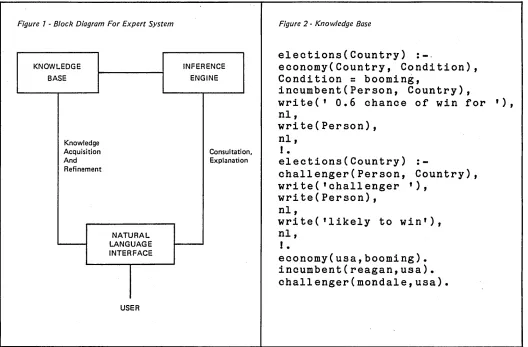
See Figure 1, a schematic diagram of an expert system.
Expert Or Conventional
An expert system differs primarily from a conventional program by em-phasizing the knowledge base.
In the 1950s and 1960s, the search for ways of making computers into more powerful problem-solvers
fo-cused on discovering. GENERAL prob-lem solving techniques. While this approach did yield some results, for example in mathematical theorem proofs, it wasn't very successful.
By Ramachandran Bharath
Mgmt, Mktg, & C.I.S. Dept. Northern Michigan University Marquette MI 49855
Eventually, there was a shift to an approach best summarized by Dr. Fei-genbaum, the designer of the DEN-DRAL expert system for spectrograph-ic analysis of chemspectrograph-ical structure (generally regarded as the first expert system).
"In the knowledge is the power," he said .. Or in other words, the effec-tiveness of an expert depends not only on his native intelligence but also on the vast stores of knowledge he ac-quires in a specific field. No all-pur-pose technique will work in all fields.
This approach led to some useful expert systems - DENDRAL; meta-DENDRAL; MYCIN, a program for diagnosis of bacterial infections; PROSPECTOR, a program for geologi-cal forecasting; and so on. For more details on these programs see refer-ences 1 and 2.
If-Then
Marvin Minsky of MIT, a pioneer and leader in Artificial Intelligence, · has written: "In a sense, today's ex-pert systems demonstrate a marvelous fact we did not know 25 years ago: if you write down if-then rules for a lot of situations and put them together well, the resulting system can solve problems that people think are hard."
·In that sense, a conventional pro-gram makes use of "knowledge" too, for any if-then statement in any lan-guage is the application of knowledge to draw a conclusion. But the distinc-tive feature of an expert system is that the knowledge base can be modified and· the inference engine (an interpret-er) can apply information from the knowledge base to the current situa-tion.
The separation of knowledge base and inference mechanism could be achieved in a conventional language, but it's far easier to implement in languages like LISP and PROLOG.
Figure 1 - Block Diagram For Expert System
KNOWLEDGE
BASE
Knowledge Acquisition And Refinement
NATURAL LANGUAGE INTERFACE
USER
between "data" and "program." The knowledge base is both program and data, so the user can modify not only data but the program itself at runtime. In other words, programs modify themselves as they acquire more infor-mation, a key aspect of powerful prob-lem solving.
Knowledge Engineering
The big problem in developing an expert system is extracting and refin-ing the set of rules and facts from a human expert.
This task, known as "knowledge engineering," has obvious problems. For example, an expert may not be aware of all the rules and knowledge he or she uses to solve a problem.
So the knowledge engineer may have to do a great deal of sleuthing as he builds the knowledge base. And, of course, the more complex the field, the more difficult the task.
Let's consider a simple PRO LOG program or ''knowledge base'' which makes predictions about election re-sults using a simple rule - if the
Figure 2 - Knowledge Base
elections( Country)
:-INFERENCE
ENGINE
economy( Country, Condition),
Condition
=
booming,
incumbent(Person, Country),
write(' 0.6 chance of win for '),
nl,
write (Person),
nl,
I •
Consultation,
Explanation
elections(Country)
:-challenger(Person, Country),
write( 'challenger '),
write( Person),
nl,
write( 'likely to win'),
nl,
I •
economy(usa,booming).
incumbent(reagan,usa).
challenger(mondale,usa).
economy is booming, predict a win for the incumbent, with· a probability of 0.6. If the economy isn't booming, predict a win for the challenger.
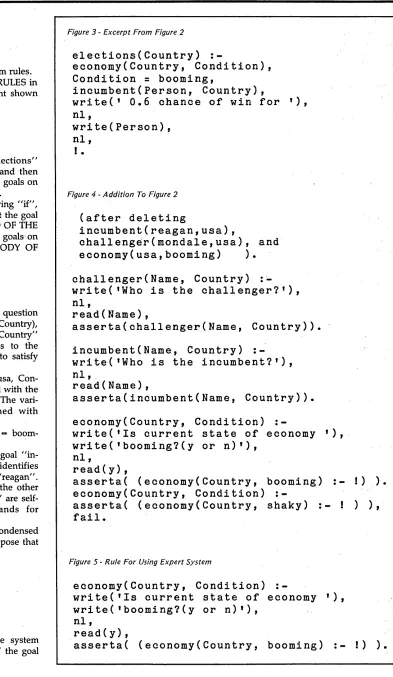
If we put in all the information about the incumbent and the challeng-er, the rules (discussed above) for _drawing conclusions, and express it in standard PRO LOG syntax, we'd have the knowledge base shown in the listing in Figure 2.
Let's review the basic principles of PROLOG to see how this works.
A PROLOG program consists of facts and rules.
FACTS · express relationships between objects. Fm: example, the fact -incumbent(reagan,usa). - relates the two objects "reagan" and "usa".
One standard PROLOG convention (the Edinburgh syntax) expresses con-stants in lower case and variables with an upper case letter as the first letter.
PROLOG works by matching the questions entered by the user to facts in the database. So, if a user enters
-?-incumbent(Who, usa).
PROLOG will match the variable "Who" to the cons~~nt "reagan" and output
-Who .... reagan.
Similarly, the question
-?- challenger(mondale, Where).
would generate the response
-Where ... usa.
based on the principles of pattern matching. The fact, Where, is a varia-ble and can be matched with "usa". This kind of patt~rn matching is usual-ly referred to as "satisfying .a goal."
In the above examples, w~ set the goals
-?- incumbent(Who,usa), and - ?-chal-lenger(mondale, Where).
and PROLOG met them.
(continued next page)
[image:15.612.52.580.64.411.2]EXPERT SYSTEMS AND LOGIC PROGRAMMING
(continued from page 13)
· PROLOG Power
PROLOG gets its power from rules. For example, in one of the RULES in
Figure 2 we have the segment shown in Figure 3.
If we enter the goal -?- elections(usa).
the system will match "elections" with the left of the :- sign, and then continue· to match each of the goals on the right of the :- sign in turn.
Think of the ":-" as signifying "if", so in general a rule states that the goal on the left of ":-" (the HEAD OF THE RULE) can be satisfied IF the goals· on the right of the ":-" (the BODY OF · THE RULE) can be satisfied.
So to satisfy
-?-elections(usa).
the system first matches our question . with the HEAD, elections(Country), ' and identifies the variable ''Country'' as "usa". Next, it proceeds to the ··BODY of the rule and tries to satisfy
the goals one by one.
The first goal is economy(usa, Con-dition), and it can be matched with the fact, economy(usa,booming). The vari-able "Condition" is .matched with ''booming''.
The next goal is Condition - boom-ing, and it's now true. ·
Next, the system tries the goal "in-cumbent(Person, usa)" and identifies the variable "Person" with "reagan". Then it goes on to examine the other goals. The goals with "write" are self-explanatory, and "nl" stands for "print a new line".
To conclude this very condensed review of PRO LOG, let's suppose that instead of
-economy(usa, booming).
we
had.-economy(usa, shaky).
in our knowledge base. The system would be unable to "satisfy" the goal '' economy(usa, booming)''.
Figure 3 - Excerpt From Figure 2
elections(Country)
:-economy(Country, Condition),
Condition
=
booming,
incumbent(Person, Country),
write(' 0.6 chance of win for '),
nl,
write(Person),
nl,
! •
Figure 4 - Addition To Figure 2
(after deleting
incumbent(reagan,usa),
challenger(mondale,usa), and
economy(usa,booming)
).
challenger(Name, Country)
:~write('Who is the challenger?'),
nl,
read( Name),
asserta(challenger(Name, Country)).
incumbent(Name, Country)
:-write( 'Who is the incumbent?'),
nl,.
read( Name),
asserta(incumbent(Name, Country)).
economy(Country, Condition)
:-write( 'Is current state of economy ' ) ,
write('booming?(y or n)•),
nl,
read(y),
asserta( (economy(Country, booming) :-
!) ).
economy(Country, Condition)
:-asserta( (economy( Country, shaky) :-
) ,
fail.
Figure 5 - Rule For Using Expert System
economy(Country, Condition)
:-write( 'Is current state of economy•),
write('booming?(y or n)'),
nl,
read(y),
asserta( (economy(Country, booming) :-
!) ).
[image:16.612.161.554.66.743.2]When
a
goal fails, the system revers-' es its tracks and tries to find analternative solution for the next goal on the left. This very important aspect of PROLOG is called BACKTRACK-ING.
In our example, PROLOG will go down the knowledge base trying the second rule with the same head '' elec-tions( Country)". Eventually, it will print the message ''challenger mon-dale is likely to win".
Learning
We can jazz up the above program to make it a more helpful learning program.
(Note: the cut operator (!) is, rough-ly speaking, a way of telling PROLOG not to look for alternative solutions.)
Suppose we don't want to specify who the challenger is, who the incum-;bent is, and what the state of the
economy of the usa is, as we did earlier. Instead we want the program to get this information by prompting the user.
We can arrange this new structure by deleting the facts about challenger, incumbent, and condition of the econ-. omy currently in the knowledge base
and adding the new information in the listing shown in Figure 4.
Suppose we again ask
-?-elections( usa).
After the same train of analysis, we see that the system will try to satisfy the goal
-?-economy( usa, Condition).
first, but finding no fact to match will use the rule shown in Figure 5.
The goal, read(y), is satisfied if the user types '' y'' to confirm the econo-my is booming, and the system pro-ceeds further.
Now the goal '' asserta'' tells the system to add the fact "econo-my(usa, booming)" to the knowledge base as a newly learned bit of know-ledge, and the next time we ask a question about "elections( usa)", the system won't ask for information, but will match the goal "econo-my(usa,Condition)" with the new (added) fact.
Similarly, by analyzing the elections
rule, we can see that the first time we ask the question, the system will ask for the name of the incumbent and add this to the database.
Having satisfied. all the goals, it will print the message
-0.6 chance of win for reagan
as before. But now, if we ask
-?-elections( usa).
it will proceed directly to the message, having "learned" the condition of the economy and the name of the incum-bent.
And just as we can ''assert'' to add information to the database, we can "retract" to remove it.
Suppose we enter
-?-retract(( economy(usa,booming) :- ! )).
and then ask __:,
?-elections( usa).
The system will then ask about the condition of the economy, and if we now say '' n'' to indicate the economy is not booming, the system will backtrack, add the information
-economy(usa,shaky):- !
to the knowledge base, and then try the second rule for elections, asking for the challenger's name. That name is added to the database, and the message about the challenger being likely to win is output.
Wrap Up
I hope this brief introduction to expert systems has whetted your ap-petite for more information about the possibilities of this fascinating lan-guage.
In PROLO.G, the emphasis is on describing the structure of the prob-lem, rather than specifying the steps required in searching for a solution. You might think of a conventional language as being "imperative," i.e. giving specific commands to the com-puter, and PROLOG as being "asser-tional," i.e .. describing or making as-sertions about the problem, leaving it to the system to· work out the specific
CPM-80 LIVES
ON YOUR. PC
CP/Mulator puts a 4mhz 8 bit CPM-80 emulator in your IBM-PC for only $99.
• Execute 8 bit CP/M programs at 4 mhz. Stop waiting around for those slow software emulators at twice the price of this speed demon!
• CP/Mulator makes a fantastic CP/M development environment and allows you to use all your CPM-80 tools, and the IBM-PC tools too!
• Why write off that expensive package that you bought for CPM-80 just because you up-grade to a IBM-PC? Apply the $99 solution and keep it working. No retraining or· conversion blues!
o CP/Mulator includes the NEC
uPD70108 processor which in-creases the speed of your IBM-PC by at least 10%. 100% compatible with existing IBM-PC software and 8087 compatible. PURCHASE THE SOFTWARE
ALONE FOR ONLY $69!! Source Information
P.O. Box 2974
Warminster, PA 18974
Efrj.
~
Phone (215) 628-4719steps required for finding a solution. There are slight differences in the various implementations of PROLOG; my examples have been run success-fully with EDPROLOG (from Ada) and PROLOG V (from Solution Systems).
References:
1. WINSTON, P.H. and PRENDER-GAST, K.A. (editors) - The AI Busi-ness: The Commercial Uses of Artifi-cial Intelligence (MIT Press, Cambridge, MA 1984).
2. HAYES, J.E. and MICHIE, D. (editors) - Intelligent Systems (John Wiley/Halsted Press, New York, NY 1983). See especially the article "Knowledge Engineering: The Ap-plied Side" by E.A. Feigenbaum.
3. CLARK, K.L. and MCCABE, F.G. - PROLOG: A Language for Imple-menting Expert Systems, in MA-CHINE INTELLIGENCE 10 edited by Hayes, J.E., Michie, D., and Pao, Y-H (Halsted Press, New York, NY 1982).
•••
ERAC CO.
8280 Clairemont Mesa Blvd., Suite 117
San Diego, California 92111
(619) 569-1864
Call tor our Test Equfpment Mailer!KAYPRO EQUIPMENT
9" Amber CRT ... $39.00 9"Green Monitor .... ; ... 35.00 12" Green Monitor ... 45.00 81 Series ROM 's ... 7.00 Keyboard (Kaypro) : ... 75.00 , Keyboard Siemens w/case ... 65.00 Wiring Harness ... 7. 50KAYPRO MAINBOARDS
K2 With Sockets ... $39.00 K2 Populated - Tested ... 129.00 K2 with PR08~3 Mod ... 239.00
This one runs at 2;4 & 5 MHz, up to 4 drives SS, DS, or Quad drives. New ROM has screen dump an