Solid-Phase Extraction
F. Borrull and R. M. MarceH, Universitat Rovira I Virgili, Tarragona, Spain
Copyright^ 2000 Academic Press
Polycyclic aromatic hydrocarbons (PAHs) are usually deRned as a group of chemicals with two or more fused benzenoid rings. If elements other than carbon and hydrogen are present, the term polycyclic aro-matic compounds (PAC) is used. PAHs are natural constituents of crude oil and many other petrochemi-cal products and they are also formed by the incom-plete combustion of organic matter. Therefore, they enter the environment from a wide variety of sources such as automobile emissions, industrial processes, waste incineration facilities, domestic heating systems and natural events such as forest Rres and volcanic eruptions.
Natural sources of PAH emission have always exis-ted but since the industrial revolution there has been a rapid increase in the loading of the environment with petrochemical PAHs and particularly with PAHs of pyrolytic origin.
The PAHs, both from natural and anthropogenic origins, are released into the atmosphere as vapour or adsorbed on to particles. They are then dispersed and transported long distances by wind before being de-posited on the ground or in water, directly or in rain. PAHs are also present in water samples as a result of sewage from industries which use these compounds in their manufacturing processes (e.g. pharmaceuticals, explosives, plastics, synthetic dyes, pesticides and so on).
PAHs are one of the most contaminating groups of pollutants in the environment because of their mutagenic and carcinogenic activity. The activity of each compound depends on its chemical structure. Typically, environmental samples contain a complex mixture of various PAHs, including isomeric struc-tures and both alkylated and nonalkylated PAH forms.Figure 1shows the structure of the 16 PAHs considered as priority pollutants by the US Environ-mental Protection Agency (EPA).
In PAH mixtures of petrochemical origin, two- or three-ring compounds are more abundant than the heavier PAHs, which have four or more rings. On the other hand a typical mixture from a high temperature combustion source contains mainly unsubstituted compounds and PAHs with four or more rings are more abundant than the smaller ones. So, PAHs in natural samples are always encountered as mixtures.
In the environment, PAHs may be eliminated or transformed to even more toxic compounds by chem-ical reactions such as photooxidation, sulfonation or nitration. For instance, pyrene, which is not mutagenic, can be transformed to nitropyrene, which is highly mutagenic, when nitrogen dioxide is present. In some conditions, traces of nitric acid in the gen dioxide can also transform some PAHs into nitro-PAHs.
Because of their mutagenic and carcinogenic prop-erties, PAHs have been determined in a variety of environmental matrices including air, water, soil, sludge and tissue. The European Community direc-tive (98/83/EC) on the quality of drinking water established the global maximum admissible concen-tration of four PAHs (benzo(b)Suoranthene, ben-zo(k)Suoranthene, benzo(ghi)perylene and indeno (1,2,3,c-d)pyrene) as 0.10g L\1 and speciRed an individual value of 0.010g L\1for benzo(a)pyrene. The World Health Organization (WHO) considers only benzo(a)pyrene with a reference value of 0.7g L\1.
Determination of PAHs
PAHs can be determined by high performance liquid chromatography (HPLC), gas chromatography (GC), supercriticalSuid chromatography (SFC) and capil-lary electrophoresis (CE), but the preferred method is reversed-phase HPLC.
In GC, the most usual detection systems areSame ionization and mass spectrometry, with the latter becoming increasingly common. However, GC is un-able to determine the nonvolatile and high molecular mass PAHs. SFC has also been used; its main advant-ages are its high separation efRciencies and short analysis times. UV-visible,Suorescence or mass spec-trometric detectors can all be used.
Micellar electrokinetic capillary chromatography (MEKC) or cyclodextrin-modiRed CE are capable of separating all 16 PAHs in under 20 min. Despite the advantages in resolution power, the main drawback of MEKC is its poor concentration sensitivity, but this can be partially solved by using a Suorescence detector.
HPLC with a diode array detector enables the UV-visible spectra to be compared and is quite often used to determine PAHs. Fluorescence detection is the most suitable because of its higher sensitivity, al-though a few PAHs }for instance, acenaphthylene
Figure 1 Chemical structure of the 16 PAHs considered to be prioritary pollutants by the US EPA.
detection and wavelength programming enable each compound to be detected at its maximum emission wavelength and so sensitivity and selectivity can be improved. If a micellar mobile phase is used instead of an aqueous}organic one, lower concentrations can be detected. Other detection techniques, such as am-perometry, have also been used and the limits of
detection are lower than those obtained with UV detection.
Sample-handling Techniques
samples which usually require treatment before chromatographic determination. For solid samples, such as soils, sludge, sediments and tissues, the classical Soxhlet extraction is still used, but the extraction is tedious and time-consuming. Other newer techniques, such as supercritical Suid extrac-tion, microwave-assisted solvent extraction and ultrasonic extraction, have proved to be suitable for extracting PAHs and the times required are consider-ably less. Some of these techniques are followed by a clean-up step, usually performed by solid-phase extraction.
For gaseous samples, different kinds of adsorbents are used to retain the PAHs. PAHs associated with particulate matter are usually collected onRlters and then vaporized and PAHs in the vapour phase are trapped by a back-up solid sorbent. Samples are de-sorbed using Soxhlet apparatus, ultrasonication or supercritical Suid extraction. Sample clean-up is usually required and performed by solid-phase ex-traction.
Liquid}liquid extraction is gradually being re-placed as a technique for extracting organic compounds from liquid samples because it uses con-siderable amounts of toxic solvents. In this respect, solid-phase extraction has been shown to give good results. Other techniques, such as closed-loop strip-ping or supercritical Suid extraction, alone or after the solid-phase extraction of the aqueous sample, also give good results. For water samples, results are bet-ter when supercriticalSuid extraction is applied after solid-phase extraction and not when supercritical Suid extraction is applied alone.
Solid-phase Extraction
In the determination of PAHs, solid-phase extraction is mainly applied to liquid samples but, as already mentioned, it is also applied in the clean-up step with gaseous or solid samples after other extraction tech-niques. The following discussion mainly refers to the analysis of aqueous samples but some references will be made to other kinds of samples.
Several kinds of sorbents in a variety of devices (e.g. cartridges or discs) may be used for the solid-phase extraction of PAHs. Solid-solid-phase extraction is usually carried out in the ofSine mode but the online mode does have some advantages and recently has been increasingly used. Solid-phase extraction has been coupled to HPLC and also to GC and SFC to determine PAHs.
One of the most recently developed techniques for extracting PAHs is solid-phase microextraction (SPME) where the sorbent is coated on to a fused-silicaRbre mounted in a syringe-like device. SPME is
a solvent-free technique, which is its main advantage, but it also has disadvantages compared to SPE.
Addition of Solvent or Micellar Media to Aqueous Samples
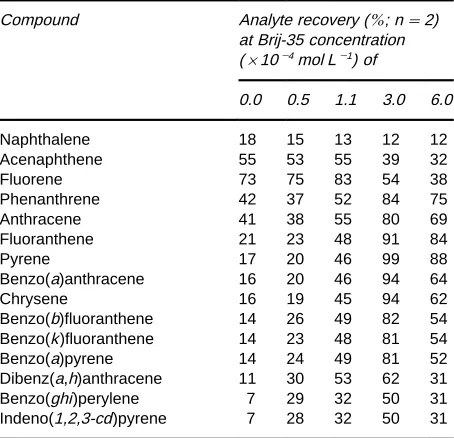
The solid-phase extraction of PAHs may seem to be a simple process because of their high hydrophobicity and because there are no expected breakthrough problems. However, the low solubility of the PAHs, which decreases as molecular weight increases, does present a problem. There may also be sorption prob-lems during sampling and storage and to avoid these problems, it is necessary to increase their solubility. Normally this is done by adding organic solvents, such as acetonitrile, methanol and 2-propanol, or surfactants to the sample as solubilizers. The percent-age of this solvent in the samples is a critical para-meter because if it is low it may not be enough to solubilize the high molecular weight PAHs, whereas if it is high, the breakthrough volume will be low for the low molecular weight PAHs. Therefore, for each kind of sample, solid-phase extraction sorbent and organic solvent, this parameter must be optimized. Typical values are between 10 and 25%, depending on the solvent added and the sorbent used.Table 1 shows the inSuence of 2-propanol on the PAH recove-ries. The higher the percentage of 2-propanol, the lower the recovery of low molecular weight PAHs, whereas the higher the percentage of 2-propanol, the higher the recoveries of high molecular weight PAHs. Surfactants have also been used instead of organic solvents. Surfactant molecules are amphiphilic, and have a polar and nonpolar moiety. Because of their amphiphilic nature, surfactant molecules can dissolve in water as monomers, or form a micelle with other surfactant molecules. The concentration at which they start to form micelles is termed the critical micelle concentration (CMC). The CMC depends on factors such as the surfactant itself, temperature, ionic strength and the presence of organic additives. It is the concentration at, or concentration range over which, solution properties like surface tension show an abrupt change in value. To solve the problems arising from the low solubility of PAHs in water and their adsorption on surfaces, surfactants such as so-dium dodecyl sulfate (SDS; anionic type, molecular mass 288 and 8.3;10\2mol L\1 CMC), cetyl trimethylammonium chloride (CTACl; cationic type, molecular mass 320 and 8.0;10\4mol L\1 CMC), Brij-35 (neutral type, molecular mass 1182 and 1.0;10\4mol L\1 CMC), have been used, among others. The concentration of surfactant signiRcantly affects the recovery of the PAHs, as shown in
Table 2, where the inSuence of the surfactant
Table 1 Influence of the percentage of 2-propanol in a sample of PAHs using C18and SDB membrane extraction. (Results are the
mean of three determinations)
Compound Recovery and RSD (%) in the presence of 2-propanol
0% 10% 15%
C18 SDB C18 SDB C18 SDB
Naphthalene 86$3.1 89$3.0 80$5.2 75$7.6 70$7.2 62$8.7
Acenaphthylene 83$4.3 85$3.1 80$5.5 80$4.5 75$6.1 65$7.6
Acenaphthene 85$3.3 87$3.6 83$4.5 82$4.3 81$5.6 70$6.3
Fluorene 87$3.5 85$4.1 85$3.5 80$5.5 86$5.8 73$6.3
Phenanthrene 84$4.0 88$3.2 92$3.0 90$3.2 95$3.2 78$5.7
Anthracene 79$5.2 81$3.1 85$3.4 75$4.5 93$3.1 78$5.5
Fluoranthene 75$5.0 70$4.9 92$3.1 80$4.8 97$3.0 79$4.8
Pyrene 74$6.1 70$5.2 92$3.2 75$5.6 97$3.3 71$5.8
Benzo(a)anthracene 64$7.5 52$7.6 72$4.6 82$4.7 98$3.4 85$4.3
Chrysene 71$6.8 53$8.2 75$5.2 80$3.5 99$3.2 84$3.8
Benzo(b)fluoranthene 66$7.4 45$8.7 74$6.3 77$4.7 99$3.1 85$4.1
Benzo(k)fluoranthene 74$6.9 50$7.8 85$4.1 78$5.6 95$3.2 88$4.0
Benzo(a)pyrene 54$8.7 44$8.6 75$5.2 69$7.5 95$4.0 85$4.2
Dibenz(a,h)anthracene 59$8.8 39$8.9 77$5.6 73$7.7 97$3.3 72$5.6
Benzo(ghi)perylene 60$8.3 37$10.0 81$4.8 70$8.3 97$3.1 82$4.8
Indeno(1,2,3-cd)pyrene 63$7.9 40$9.4 90$3.3 75$8.0 93$3.1 80$6.2
SDB, styrene-divinylbenzene. RSD, relative standard deviation.
Table 2 Influence of surfactant concentration on recovery of PAHs, after 10 mL preconcentration on a 10;3 mm i.d. Boos silica pre-column
Compound Analyte recovery (%; n"2)
at Brij-35 concentration (;10\4mol L\1) of
0.0 0.5 1.1 3.0 6.0
Naphthalene 18 15 13 12 12
Acenaphthene 55 53 55 39 32
Fluorene 73 75 83 54 38
Phenanthrene 42 37 52 84 75
Anthracene 41 38 55 80 69
Fluoranthene 21 23 48 91 84
Pyrene 17 20 46 99 88
Benzo(a)anthracene 16 20 46 94 64
Chrysene 16 19 45 94 62
Benzo(b)fluoranthene 14 26 49 82 54
Benzo(k)fluoranthene 14 23 48 81 54
Benzo(a)pyrene 14 24 49 81 52
Dibenz(a,h)anthracene 11 30 53 62 31
Benzo(ghi)perylene 7 29 32 50 31
Indeno(1,2,3-cd)pyrene 7 28 32 50 31
Reproduced with permission from Brouweret al. (1994). Sorbents
For aqueous samples, C18-bonded silica is mainly applied, although good results can also be obtained with styrene-divinylbenzene (SDB). Some authors claim that results are best when different sorbents are combined. For example, in the analysis of drinking
water samples, the best results are obtained from combined octadecylsilane (C18)}ammonia (NH2) solid-phase cartridges, whereas PAHs from soil sam-ples were best extracted with silica (Si)}cyano (CN) or C18}CN combinations.
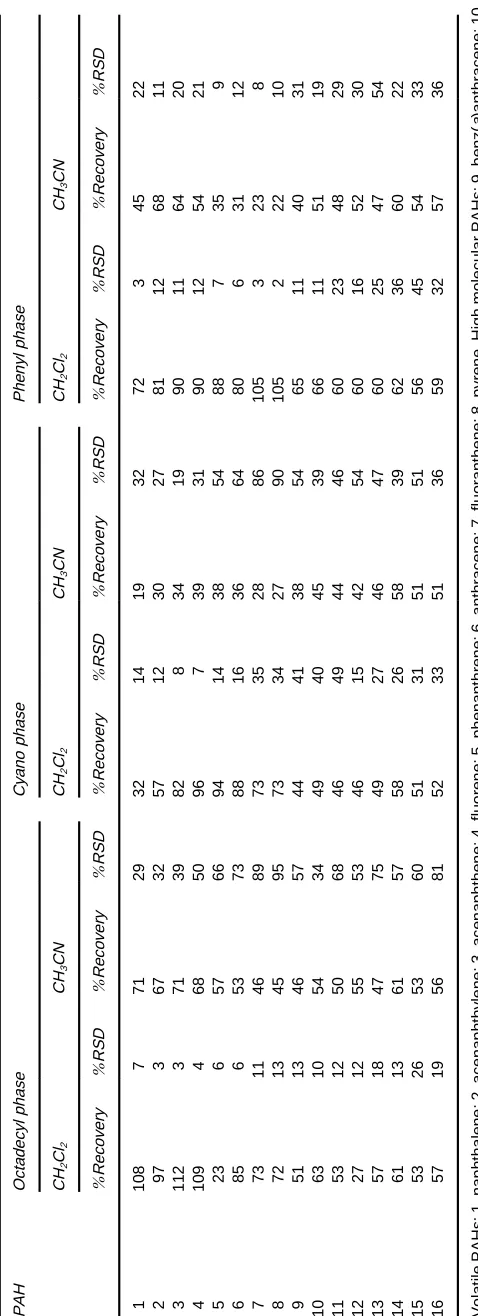
One group of researchers compared three different bonded silica sorbents, C18, cyano and phenyl, and demonstrated that results are best for C18-bonded silica. Results are shown inTable 3, where CH3CN and CH2Cl2 are used as organic solvents to elute PAHs.
The chromatographic system to be used must also be taken into account. It has been demonstrated that, to determine PAHs by HPLC}Suorescence in lake sediments, C18-bonded silica and silica columns could be used satisfactorily in the clean-up and preconcen-tration step. However, they could not be used with GC}mass spectrometry (GC-MS) for PAHs greater than chrysene, due to interference from aliphatic waxes.
[image:4.568.51.278.478.697.2]Figure 2 Online trace enrichment LC}fluorescence chromatograms of 10 mL surface water, containing 3;10\4mol L\1Brij-35,
spiked at the 100 ng L\1level with all PAHs, using Boos silica, ChromspherorC
18-bonded silica pre-columns. Peak assignation:
1, naphthalene; 2, acenaphthene; 3, fluorene; 4, phenanthrene; 5, anthracene; 6, fluoranthene; 7, pyrene; 8, benzo[a]anthracene; 9, chrysene; 10, benzo[b]fluoranthene; 11, benzo[k]fluoranthene; 12, benzo[a]pyrene; 13, dibenz[a,h]anthracene; 14, benzo[ghi ]pery-lene; 15, indeno[1,2,3-cd ]pyrene. For other conditions, see text. Reproduced with permission from Brouwer et al. (1994).)
Figure 2 shows chromatograms obtained in the
analysis of 10 mL of surface water spiked with PAHs using Boos silica, Chromspher and C18-bonded silica pre-columns. The Boos silica gives the cleanest chromatogram but has lost the two most volatile compounds.
Apart from the sorbents already mentioned, other sorbents such as Florisil (SiO2and MgO) can rapidly and efRciently recover PAHs for petroleum and sedi-ment extracts as a clean-up step after another extrac-tion technique.
Solid-phase extraction is widely used after the ultrasonication extraction or microwave extraction of soils and sediments, as a clean-up step before chromatographic determination. In these cases,
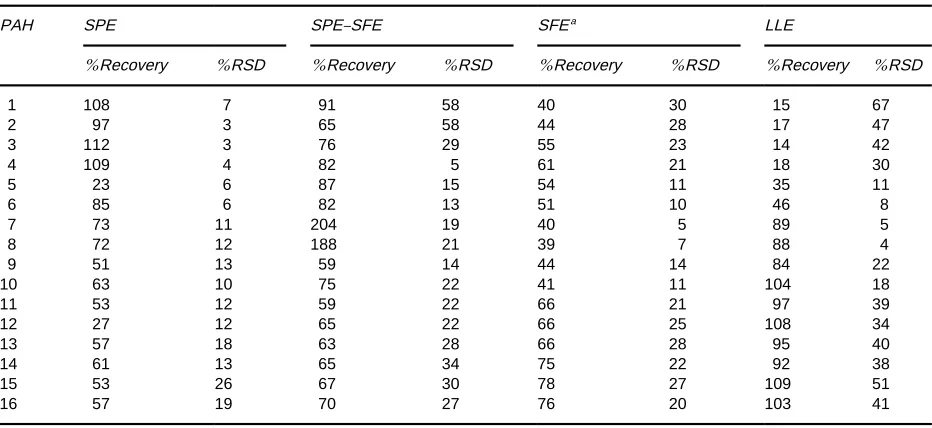
Florisil or C18-bonded silica are the sorbents which are most used. SPE is also used before supercritical Suid extraction to analyse aqueous samples and re-sults are better with solid-phase extraction} super-critical Suid extraction than with supercriticalSuid extraction alone.Table 4shows the results obtained when different extraction techniques were applied to determine PAHs in water samples. Much better re-sults can be seen when solid-phase extraction tech-nique is added to the supercritical Suid extraction one.
sur-Table 4 Comparison of recoveries for different extraction techniques for extraction of 16 PAHs from spiked HPLC-grade water
PAH SPE SPE}SFE SFEa LLE
%Recovery %RSD %Recovery %RSD %Recovery %RSD %Recovery %RSD
1 108 7 91 58 40 30 15 67
2 97 3 65 58 44 28 17 47
3 112 3 76 29 55 23 14 42
4 109 4 82 5 61 21 18 30
5 23 6 87 15 54 11 35 11
6 85 6 82 13 51 10 46 8
7 73 11 204 19 40 5 89 5
8 72 12 188 21 39 7 88 4
9 51 13 59 14 44 14 84 22
10 63 10 75 22 41 11 104 18
11 53 12 59 22 66 21 97 39
12 27 12 65 22 66 25 108 34
13 57 18 63 28 66 28 95 40
14 61 13 65 34 75 22 92 38
15 53 26 67 30 78 27 109 51
16 57 19 70 27 76 20 103 41
SPE, solid-phase extraction; SFE, supercritical fluid extraction; LLE, liquid-liquid extraction. Volatile PAHs:1, naphthalene; 2, acenaph-thylene; 3, acenaphthene; 4, fluorene; 5, phenanthrene; 6, anthracene; 7, fluoranthene; 8, pyrene. High molecular PAHs: 9, benz(a)anthracene; 10, chrysene; 11, benzo(b)fluoranthene; 12, benzo(k )fluoranthene; 13, benzo(a)pyrene; 14, indeno(1,2,3-cd )pyrene; 15, dibenz(a,h)anthracene; 16, benzo(ghi )perylene.
aDirect SFE.
Reproduced with permission from Sargenti and McNair (1998).
face of extraction, which means fewer clogging prob-lems for the sorbent. They also enable larger volumes to be extracted with the same amount of sorbent than when cartridges are used.
Two different membranes, C18-bonded silica and SDB were studied to determine PAHs from surface water. Prior to the extraction procedure, the discs were conditioned to prevent interfering peaks in the chromatogram. In this process, for C18 discs, 20 mL of organic elution solvent (dichloromethane} ethyl acetate}acetonitrile, 50 : 30 : 20 v/v/v) was ad-ded to the Rltration reservoir and slowly drawn through the discs by applying a slight vacuum. After drawing air through the discs for 5 min, 20 mL of an acetone}water mixture (80 : 20 v/v) was added and slowly drawn through theRltration discs, followed by 10 mL of Milli-Q water. The styrene-divinylbenzene copolymer discs were conditioned with 20 mL of acetone, 20 mL of acetonitrile and 20 mL of dichloromethane. After each addition a vacuum was applied to remove interfering compounds from the discs. Then, 20 mL of Milli-Q water was added and drawn through the disc before sample preconcentra-tion.
Table 1 shows the recovery values obtained when C18-bonded silica and SDB membrane discs were used in the determination of PAHs. In this case, 100 mL of Milli-Q water spiked with 0.5g L\1of 15 PAHs and 29g L\1of acenaphthylene were concentrated and
then eluted twice with 15 mL of organic mixture. In this table the inSuence of adding 2-propanol to the sample is also shown, as already mentioned.
Another group studied the solid-phase extraction of PAHs in water samples using solid-phase extrac-tion discs with a glassRbre matrix (GFM) and recove-ries were good for the six PAHs studied. The main advantage of this GFM sorbent is the high speed of extraction, and the lower amount of solvent required compared with the conventional cartridge.Figure 3 shows the chromatograms of analysis of seawater and riverwater using this kind of membrane.
Other selective sorbents, immunosorbents, based on antigen}antibody interactions, have also been used for selective isolation of PAHs from complex environ-mental samples. The extraction of the PAHs from sediments by sonication with dichloro-methane} meth-anol, subsequent extract dilution with water and ex-traction with an antiSuorene immunosorbent gave similar results to those obtained with conventional clean-up procedures but selectivity was higher.
Desorption Solvent
[image:7.568.51.517.69.283.2]Figure 3 Separation and recovery of PAHs in (A) seawater and (B) riverwater, after being spiked with 1 ng L\1for each compound,
except fluoranthene (10 ng L\1) and indenol[1,2,3-cd ]pyrene (5 ng L\1) to 1 L of sample. Peak assignation: 1, fluoranthene; 2,
benzo[a]fluoranthene; 3, benzo[k]fluoranthene; 4, benzo[a]pyrene; 5, benzo[ghi ]perylene; 6, indeno[1,2,3-cd ]pyrene. Reproduced with permission from Urbe and Ruana (1997).
Recoveries of the low molecular weight PAHs are higher with nonvolatile solvents, but the recoveries for most of the PAHs with 4}6 aromatic rings are higher when a nonpolar solvent is used. So, in order to ensure optimum recoveries of all the PAHs, mix-tures of solvents are usually recommended.
If the solvent used is compatible with the chromatographic system, concentration of the
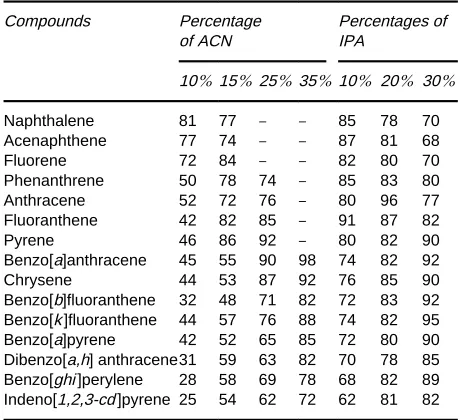
Table 5 Recovery values obtained in the analysis of 50 mL of a standard solution of 0.4g L!1using nine SDB discs at several percentages of ACN and IPA
Compounds Percentage
of ACN
Percentages of IPA
10%15%25%35%10% 20% 30%
Naphthalene 81 77 } } 85 78 70
Acenaphthene 77 74 } } 87 81 68
Fluorene 72 84 } } 82 80 70
Phenanthrene 50 78 74 } 85 83 80
Anthracene 52 72 76 } 80 96 77
Fluoranthene 42 82 85 } 91 87 82
Pyrene 46 86 92 } 80 82 90
Benzo[a]anthracene 45 55 90 98 74 82 92
Chrysene 44 53 87 92 76 85 90
Benzo[b]fluoranthene 32 48 71 82 72 83 92
Benzo[k ]fluoranthene 44 57 76 88 74 82 95
Benzo[a]pyrene 42 52 65 85 72 80 90
Dibenzo[a,h] anthracene31 59 63 82 70 78 85
Benzo[ghi ]perylene 28 58 69 78 68 82 89
Indeno[1,2,3-cd ]pyrene 25 54 62 72 62 81 82
}Not quantified.
ACN, acetonitrile; IPA; isopropanol.
used in a cartridge system (between 30 and 50 mL and 1}5 mL, respectively).
Online Solid-Phase Extraction Chromatographic System
The main advantages of online systems are that the samples have to be manipulated less, they reduce analysis time and they consume less organic solvent. SPE-HPLC is the most straightforward coupling method and therefore the most used. The sample preparation and conditioning steps are similar to those used in the ofSine but only the mobile phase is required to elute the compounds retained in the pre-column which is connected online to the analytical column.
The most used sorbents are the C18-bonded silicas and SDB, although other speciRc sorbents can also be used. Depending on the sorbent and the solvent added to the aqueous sample, some interfering peaks can appear in the chromatogram, even whenSuorescence detection is used. For instance, MeOH, acetonitrile and 2-propanol were tested as organic modiRers in the analysis of 50 mL of Milli-Q water with 15% of organic solvent by online solid-phase extraction with SDB discs. In this study, when using MeOH, peaks at the same retention time as naphthalene, phenan-threne, Suoranthene and pyrene appeared in the chromatogram. 2-Propanol gave peaks with the same retention time as naphthalene and phenanthrene. When acetonitrile was used, the blank was much cleaner and no interferences appeared in the chromatogram.
Table 5shows the recoveries obtained when
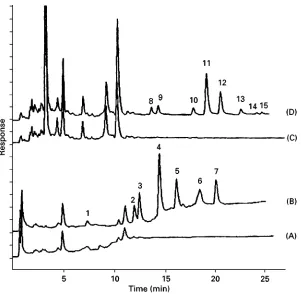
differ-ent percdiffer-entages of acetonitrile are used in the analysis of PAHs by online SPE-HPLC. It can be seen that it is necessary to increase the percentage of acetonitrile to increase the recovery of high molecular weight com-pounds. However, this distorts the peaks of the low molecular weight compounds and so they could not be quantiRed. This happened to naphthalene, acenaphthene andSuorene when 25% of acetonitrile was used and, for this reason, 15% acetonitrile is the maximum concentration that can be used. However, at this percentage, the recovery value for the high molecular weight compounds is quite low, so the authors recommend that the PAHs should be ana-lysed in two separate runs with 15% acetonitrile and 20% 2-propanol as modiRers, for the low molecular weight compounds (from naphthalene to pyrene) and the high molecular weight compounds (from ben-zo[a]anthracene to indeno[1,2,3-cd]pyrene).Figure 4 shows a chromatogram of the analysis of 50 mL tap water using acetonitrile as organic solvent for low molecular weight compounds and IPA for the high molecular weight compounds.
Using online SPE-HPLC it is possible to detect these compounds at very low ng L\1levels. Table 6 shows linearity range and limits of detection of PAHs in sea water.
Online coupling of solid-phase extraction to GC or SFC requires an additional step: drying the pre-col-umn before elution with the organic solvent in order to remove the water present when aqueous samples are analysed. An organic solvent added to the samples is also required in order to avoid adsorption of the PAHs. When SPE-GC is used, a small volume of an organic solvent, usually ethyl acetate, is used to pass the retained compounds to the chromatographic col-umn via a loop type or an on-colcol-umn interface. When SPE-SFC is used, the same mobile phase is used to elute the retained compounds.
Conclusions
PAHs are mainly determined by HPLCSuorescence and detection because of its high sensitivity. To reach the very low levels of concentration required, an extraction concentration technique is necessary. Solid-phase extraction is the preferred technique both for extracting aqueous samples and cleaning up after other extraction techniques.
C18 silica cartridges or discs are the most recom-mended in online and ofSine modes.
Figure 4 LC chromatogram of the analysis of 50 mL tap water using acetonitrile as organic solvent for low molecular weight compounds and isopropanol for the high molecular weight compounds. Analysis of low molecular weight compounds in tap water with addition of a standard solution of 10 ng L\1(B) and without any addition (A). Analysis of high molecular weight compounds in tap water
in the same conditions (C,D). Peak assignation: 1, naphthalene; 2, acenaphthene; 3, fluorene; 4, phenanthrene; 5, anthracene; 6, fluoranthene; 7, pyrene; 8, benzo[a]anthracene; 9, chrysene; 10, benzo[b]fluoranthene; 11, benzo[k]fluoranthene; 12, benzo[a]pyrene; 13, dibenz[a,h]anthracene; 14, benzo[ghi ]perylene; 15, indeno[1,2,3-cd ]pyrene. (Reproduced with permission from El Harrak et al. (1998)).
Table 6 Linear range and limits of detection of PAHs in sea-water. Volume of sample 50 mL
Compound Linear range
(ng L\1)
r2 LOD
(ng L\1)
Naphthalene 400}2.0 0.9994 1.0
Acenaphthene 400}1.0 0.9997 0.5
Fluorene 400}1.0 0.9995 0.5
Phenanthrene 400}0.5 0.9999 0.2
Anthracene 400}1.0 0.9998 0.5
Fluoranthene 400}1.0 0.9997 0.5
Pyrene 400}0.5 0.9998 0.2
Benzo[a]anthracene 200}2.0 0.9997 0.5
Chrysene 200}2.0 0.9999 0.4
Benzo[b]fluoranthene 200}2.0 0.9999 0.3
Benzo[k]fluoranthene 200}0.5 0.9998 0.2
Benzo[a]pyrene 200}2.0 0.9997 0.2
Dibenzo[a,h]anthracene 200}0.5 0.9998 0.2
Benzo[ghi ]perylene 200}5.0 0.9996 2.0
Indeno[1,2,3-cd ]pyrene 200}5.0 0.9995 2.0
to be added to the samples, in order to avoid adsorp-tion of these compounds in the system.
The use of solid-phase extraction and HPLC with Suorescence detection enables low levels (at ng L\1in
water samples) of PAHs to be determined in real samples.
See also: III/ Environmental Applications: Solid-Phase Microextraction; Supercritical Fluid Extraction.
Immunoaf\nity Extraction:Polycyclic Aromatic Hy-drocarbons; Gas Chromatography; Supercritical Fluid Chromatography; Thin-Layer (Planar) Chromatography.
Further Reading
Brouwer ER, Hermans ANJ, Lingeman H and Brinkman UATh (1994) Determination of polycyclic aromatic hy-drocarbons in surface water by common liquid chromatography withSuorescence detection, using on-line micellemediated samples preparation. Journal of Chromatography A669: 45}57.
El Harrak R, Calull M, MarceH RM and Borrull F (1996) Determination of polycyclic aromatic hydrocarbonds in water by solid-phase extraction membranes. Interna-tional Journal of Environmental Analytical Chemistry 64: 47}57.
[image:10.568.51.278.520.711.2]extraction for the determination of PAHs by liquid chrmatography and Suorescence detection. Journal of High Resolution Chromatography21: 667}670. Leeming R and Hamer W (1990) Determination of
polycyc-lic aromatic hydrocarbons in lake sediments. Organic Geochemistry15: 469}476.
Messer DC and Taylor LT (1995) Method development for the quantitation of trace polyaromatic from water via solid-phase extraction with supercritical Suid elution. Journal of Chromatographic Science33: 290}296. Peltonen K and Kuljukka T (1995) Air sampling and
analy-sis of polycyclic hydrocarbons.Journal of Chromatogra-phy A710: 93}108.
PeHrez S, Ferrer I, Hennion M-C and BarceloH D (1998) Isolation of priority polycyclic aromatic hydrocarbons
from natural sediments and sludge reference materials by an anti-Suorene immunosorbent followed by liquid chromatography and diode array detection.Analytical Chemistry70: 4996}5001.
Sargenti SR and McNair HM (1998) Comparison of solid-phase extraction and supercriticalSuid extraction for extraction of polycyclic aromatic hydrocarbons from drinking water.Journal of Microcolumn Separations10: 125}131.
Thurman EM and Mills MS (1998)Solid Phase Extraction. Principles and Practice. New York: John Wiley. Urbe I and Ruana J (1997) Application of solid-phase
extraction discs with a glassRber matrix to fast deter-mination of polycyclic aromatic hydrocarbons in water. Journal of Chromatography A778: 337}345.
Supercritical Fluid Chromatography
K. D. Bartle, University of Leeds, UK Copyright^ 2000 Academic Press
Introduction
There is tremendous analytical interest in polycyclic aromatic compounds (PAC) because of their carcino-genic properties and their impact on the environment. PAC mixtures can be very complex and extend over a wide range of molecular masses. They mainly orig-inate from the combustion of fossil fuels and are widespread in the environment.
The most commonly used separation techniques for PAC are gas chromatography (GC), high perfor-mance liquid chromatography (HPLC) and super-criticalSuid chromatography (SFC). GC is often the technique of choice since it works well for low mo-lecular weight and volatile compounds. It is also preferred because the high diffusivity of solutes in gases results in relatively short analysis times. HPLC employs liquids of high solvating power, high densit-ies and high viscositdensit-ies but is often time-consuming and has much less resolving power than GC.
Separation of PAC by SFC
Although HPLC and GC are commonly used for the analysis of PAC mixtures, SFC has a number of ad-vantages. SCF have diffusivities that are more gas-like, viscosities lower than liquids and densities that are more liquid-like. The resulting mass transfer coef-Rcients lead to a more rapid analysis in SFC than in HPLC. The diffusion coefRcients and viscosities of SCF allow GC-like separations on capillary columns but at much lower temperatures because of the high
solvating power of SCF. The approach in SFC in-volves the use of columns of the packed LC type, packed capillary (micro-packed) and the open tubular (capillary) GC type columns.
SFC on Packed Columns
Packed columns usually of the commercial HPLC variety were used in nearly all the early work in SFC. The length and internal diameter (i.d.) of SFC packed columns are constrained by (a) the larger pressure drops as compared to open tubular columns and (b) highSow rates, making interfacing to GC detectors more difRcult. Often, narrow-bore packed columns with a diameter of 1 to 2 mm are used because they can be installed in a capillary SFC instrument and are compatible with many detectors.
Early work on the separation of polycyclic aro-matic hydrocarbon (PAH) standards revealed that reduced particle size led to increased resolution, and that analysis times were reduced in comparison with HPLC; it was also shown that PAH elution order could be varied by changing the operating temper-ature and/or the pressure. Marked changes in reten-tion and selectivity are brought about by the addireten-tion of a modiRer to the mobile phase. Detailed studies of the retention characteristics of PAH on a wide range of packed columns showed that retention in SFC with CO2-based mobile phases correlates most closely with reverse phase HPLC. Very rapid analysis ((6 minutes) of the sixteen Environmental Protection Agency target PAH was demonstrated on a 15 cm long column packed with a specially bonded C18silica
(Figure 1). EfRcient separation of PAH can be


![Figure 3Separation and recovery of PAHs in (A) seawater and (B) riverwater, after being spiked with 1 ng Lbenzo[a]fluoranthene;3, benzo[k]fluoranthene;4, benzo[a]pyrene;5, benzo[ghi]perylene; 6, indeno[1,2,3-cd]pyrene](https://thumb-us.123doks.com/thumbv2/123dok_us/944250.607449/8.568.133.438.52.553/figure-separation-recovery-seawater-riverwater-fluoranthene-fluoranthene-perylene.webp)