The effect of combined sensory and semantic components
on audio–visual speech perception in older adults
Corrina Maguinness1,2, Annalisa Setti1,2, Kate E. Burke1,2, Rose Anne Kenny2,3and Fiona N. Newell1,2*
1
School of Psychology, Trinity College Dublin, Dublin, Ireland 2
Institute of Neuroscience, Trinity College Dublin, Dublin, Ireland 3Department of Medical Gerontology, Trinity College Dublin, Dublin, Ireland
Edited by:
Hari S. Sharma, Uppsala University, Sweden
Reviewed by:
Hari S. Sharma, Uppsala University, Sweden
Rongqiao He, Chinese Academy of Sciences, China
*Correspondence: Fiona N. Newell , Institute of Neuroscience, Lloyd Building, Trinity College Dublin, Dublin 2, Ireland. e-mail: fi[email protected]
Previous studies have found that perception in older people benefits from multisensory over unisensory information. As normal speech recognition is affected by both the audi-tory input and the visual lip movements of the speaker, we investigated the efficiency of audio and visual integration in an older population by manipulating the relative reliabil-ity of the auditory and visual information in speech. We also investigated the role of the semantic context of the sentence to assess whether audio–visual integration is affected by top-down semantic processing. We presented participants with audio–visual sentences in which the visual component was either blurred or not blurred. We found that there was a greater cost in recall performance for semantically meaningless speech in the audio–visual ‘blur’ compared to audio–visual ‘no blur’ condition and this effect was specific to the older group. Our findings have implications for understanding how aging affects efficient mul-tisensory integration for the perception of speech and suggests that mulmul-tisensory inputs may benefit speech perception in older adults when the semantic content of the speech is unpredictable.
Keywords: speech perception, aging, multisensory, audio–visual, cross-modal, top-down, semantics
INTRODUCTION
Perception in the everyday world is rarely based on inputs from one sensory modality (Stein and Meredith, 1993; Shimojo and Shams, 2001;Shams and Seitz, 2008;Spence et al., 2009) and the integration of multiple sensory cues can both disambiguate the perception of, and speed up reaction to, external stimuli (Stein et al., 1989;Schröger and Widmann, 1998;Bolognini et al., 2005). This multisensory enhancement (ME) is most likely to occur when two or more sensory stimuli correspond with one another
both spatially and temporally (Bolognini et al., 2005;Holmes and
Spence, 2005;Senkowski et al., 2007). This is particularly evident with audio–visual stimuli and it has been repeatedly shown that when such stimuli occur at the same time and spatial location they are responded to more efficiently than if they were pre-sented through either vision or audition alone (Perrott et al., 1991; Schröger and Widmann, 1998;Giard and Peronnet, 1999;Ngo and Spence, 2010).
One of the most prominent examples of multisensory integra-tion is in speech percepintegra-tion. During the articulaintegra-tion of speech the sound made by the speaker is accompanied by the congru-ent temporal and spatial visual information offered through the speaker’s jaw, tongue, and lip movements, referred to as the viseme. Here the brain makes use of what appears to be redundant visual information to enhance perception of the speech signal (Sumby and Pollack, 1954;Grant and Seitz, 2000;Callan et al., 2003;Besle et al., 2004;Ross et al., 2007). For example,Calvert et al. (1997) demonstrated that lip movements, in the absence of sound, are suf-ficient to induce activation in the primary auditory cortex. More-over, this activation is specific to visual speech movements and
does not occur with non-linguistic facial movements.
Jääskeläi-nen et al. (2004)later provided further evidence for this effect using whole-head magnetoencephalograpy (MEG). Specifically, they found that an N100m response in the auditory cortex, which was consistently evoked approximately 100 ms following an audi-tory speech input, decreased in amplitude when audiaudi-tory input
was preceded by visual input compared to when it was not.Davis
et al. (2008)reported a similar reduction in the N100m response to audio–visual in comparison with audio-only speech. Together these studies suggest that this response decrease may reflect an auditory facilitation effect associated with visual speech informa-tion. Visual information in speech may induce activation in the same neurons in the auditory cortex which are responsible for
processing phonetic information (e.g.,Besle et al., 2004).Davis
et al. (2008)suggest that the additional visual information may decrease the subsequent processing load on the auditory cortex during speech perception.
Integration across the senses may also allow for the compensa-tion of unreliable unisensory informacompensa-tion such that the brain can maintain robust perception by making use of partly redundant information from one sense to resolve or enhance information in
another (Meredith and Stein, 1986;Hairston et al., 2003;Frassinetti
et al., 2005;Serino et al., 2007). Sensory deficits are particularly prominent with aging as the quality of the signal received from the sensory organs declines due to degradation of the sensory organs
(Fozard and Gordon-Salant, 2001;Gordon-Salant, 2005;Schieber,
2006).
when listening environments are challenging (Sommers, 1997; Schneider et al., 2002; Surprenant, 2007; Pichora-Fuller, 2008; Sheldon et al., 2008). Adverse listening conditions may be elicited through a variety of factors including, but not limited to, poor lighting, background noise, rapid speech, and unfa-miliar vocabulary (Pichora-Fuller and Souza, 2003). However, speech perception in older adults has been shown to bene-fit from cross sensory audio–visual inputs under these chal-lenging listening situations. In general, the benefits of com-bining audio and visual signals change as a function of the quality of the unisensory signal, such that, when the sig-nal to noise ratio in the audio sigsig-nal is decreased, the pres-ence of visual information can help improve speech
percep-tion and comprehension (Sumby and Pollack, 1954; Ross et al.,
2007).
However visual speech information can conversely not only
facilitate perception, but it can also alter what is perceived.McGurk
and MacDonald (1976)demonstrated that when conflicting visual and auditory speech cues are presented, for example, when a visu-ally articulated syllable[ga]is dubbed with an acoustic syllable /ba/, the observer perceives a novel illusory percept which is a fusion
of the auditory and the visual signal da. This new percept is a
definitive example of how speech perception is a multisensory process, as what is perceived is neither the unisensory acoustic nor visual signal. Contrasting evidence exists in terms of how aging affects performance on this multisensory speech illusion. Cienkowski and Carney (2002)reported no difference between the amount of fused responses reported by older and younger adults, however others suggest that older adults are more suscepti-ble to this audio–visual fusion, and that this may relate to enhanced multisensory integration in older adults (Setti, Burke, Kenny and Newell, submitted).
However speech perception does not rely solely on the inte-gration of sensory inputs as it has been shown that the semantic context of speech also affects speech perception. Meaningful con-tent in speech generates semantic expectations about what words will follow. Violations in these semantic expectancies produce
both neurological (e.g.,Holcomb and Neville, 1990;Hagoort and
Brown, 2000) and behavioral outcomes; including reduced accu-racy in word recognition (Sheldon et al., 2008). The semantic context of a spoken sentence has been shown to significantly affect speech perception in older adults, with meaningful content supporting speech recognition in challenging listening
environ-ments (Surprenant, 2007; Sheldon et al., 2008). Verbal ability
remains intact with normal aging and older adults perform simi-larly to, and often better than, younger adults on vocabulary and
semantic word association tasks (Burke and Peters, 1986;Baltes
et al., 1999;Little et al., 2004). Older adults appear to be able to draw on this intact cognitive ability to compensate for decline in the sensory information received. Thus when speech perception appears to be equivalent for younger and older adults it cannot be assumed that the same perceptual or cognitive processes
under-lie this performance (Surprenant, 2007; Getzmann and
Falken-stein, 2011). Indeed the effect of aging on speech processing abilities may be further under reported, as much of speech pro-cessing involves detecting the overall meaning of what has been said. This type of comprehension may be relatively immune to
inaccuracies in the perception of individual words and stud-ies suggest that this general speech comprehension ability does
not diminish with age (Schneider et al., 2000;Tye-Murray et al.,
2008).
However, our understanding of how sentence content, both in terms of sensory information (visual and acoustic) and the seman-tic context, interact in speech comprehension in older adults is poor. Most studies which have investigated this issue have either focused on modulating the semantic context of speech, while
simultaneously altering the quality of the audio signal (e.g.,
Shel-don et al., 2008) or have manipulated the signal to noise ratio of speech signals for audio-only and audio–visual speech
pro-cessing, with no manipulation of semantics (e.g.,Sommers et al.,
2005). These studies have typically reported an increased benefit for audio–visual speech signals and semantic context when the signal to noise ratio in the auditory signal is low. However it is not clear how these two processes may interact in speech per-ception with age, and if either process may contribute more to the efficient perception of speech. Moreover many of the stud-ies have engaged different measurements of speech perception, including reporting the overall comprehension of meaning, word identification, or word recall. It is possible that speech compre-hension, in terms of detecting sentence meaning, may be relatively unaffected by changes in sensory or semantic input but that accu-rate recall of the spoken sentence may be susceptible to such changes.
The most relevant study to address the interaction of audio– visual integration and semantics in speech perception in normal
hearing older adults is that reported byGordon and Allen (2009).
In their study, younger and older adults were presented with sen-tences with either high or low semantic context in audio-only or audio–visual conditions in which the visual input was blurred (AV blur) or not (AV no blur). The audio signal was degraded
in all conditions.Gordon and Allen (2009) observed an
over-all audio–visual benefit for sentences with high semantic context for younger and older adults, compared to audio-only sentences. However they did not observe a difference in performance between audio–visual ‘blur’ and audio–visual ‘no blur’ modalities for older adults. They suggest that the cognitive and sensory integration
aspects of speech perception may be independent processes.
Gor-don and Allen (2009)however did not record speech perception performance in terms of detecting the overall meaning of the sen-tence and instead measured performance only in terms of recall of the end word in the sentence. Therefore it is not clear if sentence meaning was understood and it remains to be seen whether sen-tence meaning is affected by both cognitive and sensory processes.
AlthoughGordon and Allen (2009)also varied the semantic
con-tent of the sentences as low and high, it can be argued that there is still some degree of semantic predictability intact in the speech signal which can be exploited by older adults.
was unreliable (AV blur). We wished to assess the contribution of additional visual information in normal listening environments therefore the audio signal was set at a constant superthreshold level across both AV conditions. Furthermore, we altered the seman-tic content of the speech, by manipulating the meaning of the sentences presented such that sentences were either meaningful (high context) or non-meaningful. Non-meaningful sentences
dif-fered from low context sentences previously used byGordon and
Allen (2009)in that the replacement of a key word in the sentence with a different word rendered the sentence meaningless, thus making the semantic context an unreliable speech cue. We mea-sured speech perception performance in terms of both detection of sentence meaning and sentence recall.
We expected that speech perception in older adults would ben-efit more from a clear AV (i.e. no blur) over an AV blur input, although this difference was not expected for younger adults since the auditory component was always reliable. Moreover, a benefit for reliable multisensory inputs was expected to be particularly pronounced in older persons during the perception of sentences which were not meaningful, and therefore unpredictable. Fur-thermore we expected aging effects to be more pronounced for sentence recall than for detecting sentence meaning.
MATERIALS AND METHODS
PARTICIPANTS
Twenty (nine female) young adults with an age range of 18– 30 years (mean age=21.1 years, SD=2.4 years) participated in this experiment. All younger participants were native English speakers. All bar one reported to be right hand dominant and all reported no hearing impairments and normal or corrected to normal vision. Thirty-one (22 female) older adults were recruited for this task. All participants were recruited through a larger aging study namely the Technology Research for Independent Living (TRIL) project1. As we wished to specifically address the effect of aging on speech perception we controlled for any effects of cognitive decline, which may have affected task performance. As such, all participants were pre-screened and chosen from a
pop-ulation who scored≥25 (of 30; average score=29, SD=0.3) on
the mini mental state exam (MMSE;Folstein et al., 1975), which
indicates no evidence of cognitive decline2. In addition, to control
for sensory differences 10 participants’ data sets were subsequently removed from the analysis for the following reasons: seven were removed due to poor hearing or a mild hearing impairment as assessed by the Hughson Westlake Audiometer; two were removed due to poor visual acuity as assessed by the LogMAR; and one was removed due to both a mild hearing impairment and poor visual acuity. The remaining 21 (15 female) older adults had an
age range of 61–76 years (mean age=68.6 years, SD=1.1 year).
All were native English speakers, and all reported to be right hand dominant. All had normal hearing as assessed by Hughson West-lake Audiometer and normal vision for their age (mean binocular
1For a more detailed description of the demographic characteristics of the TRIL
cohort seeRomero-Ortuno et al. (2010).
2Although younger and older adults were not strictly matched for level of
edu-cation, we found no evidence that level of education correlated with any of the measurements of task performance leveling our study.
LogMAR score=0.03, SD=0.02). The experiment was approved
by St. James Hospital Ethics Committee and by the School of Psy-chology Research Ethics Committee, Trinity College Dublin, and it conformed to the Declaration of Helsinki. All participants gave their informed, written consent to participate. Younger adult par-ticipants were monetarily compensated for their time at a rate of C10.00 per hour.
STIMULI AND APPARATUS Sentences
The stimulus set consisted of 40 English sentences chosen from
a database of 123 sentences compiled byLittle et al. (2004). All
sentences in the database contained a target word positioned two to five words from the end. In half of the sentences the target word had a high context or “goodness of fit” within the sentence
meaning.Little et al. (2004)found this goodness of fit rating to
be consistent for both an older and younger adult population. In the other half of the sentences the target word was manipulated for the current study to have no context and be strongly incon-gruent within the sentence framework. Thus, due to target word manipulation, half the sentences were meaningful (M) and half were non-meaningful (NM). To reduce predictability, sentences which appeared in the meaningful sentence set were not used in the non-meaningful set, and all 40 sentences were distinct. All the sentences were syntactically correct and ranged from 7 to 10 words
in length. SeeTable 1for examples of the sentences used.
Audio–visual sentence stimuli
The stimuli were presented as digital video recordings of a native English-speaking female actor articulating the sentences at a nat-ural speech rate. In each video recording the actor’s face, shoulders, and neck were visible. Recordings were made in a quiet room with natural light using a JVC high band digital video camera. These recordings were subsequently edited with the software Adobe
Premiere®such that the duration of each video clip ranged from 2.9
to 4.1 s, with a mean duration of 3.4 s (SD=0.3 s). In the
exper-iment each sentence was presented twice (a total of 80 videos): once in each of the AV blur and AV no blur conditions. For the AV blur condition the visual component of the video was pixelated.
Table 1 | Examples of target word (underlined) manipulation within sentences presented as stimuli in this experiment, to create meaningful and non-meaningful sentences.
MEANINGFUL SENTENCE (TARGET WORD HIGH CONTEXT)
The mother always protected herbabyfrom harm
His habit for breakfast was to eatcerealevery day The town was destroyed by thetornadolast summer Her favorite painting had many shades ofredin it The employee hated thecompanywhere she worked
NON-MEANINGFUL SENTENCE (TARGET WORD NO CONTEXT)
After the battle doctors removed thepigin his leg She packed herskyscraperfor her trip
Pixelation comprised, on average, 10 pixels in the horizontal axis (from ear to ear) and 12 in the vertical axis (from chin to end of forehead), and effectively blurred the visual image. Otherwise, for the AV no blur condition all audio and visual information was
available at superthreshold levels. SeeFigure 1for an illustration
of the audio–visual sentence stimuli.
Participants sat at a distance of 57 cm from the screen with their head positioned on a height adjustable chin rest to ensure that the fixation point remained at a consistent height across par-ticipants. The images in the video clips subtended a visual angle of 17˚ horizontally and 12˚ vertically onscreen. The experiment was programmed using DMDX software (Forster and Forster, 2003). The experiment was run on a PC (Dell Dimension 8,200 CPU)
and displayed on a Dell Trinitron 19monitor.
DESIGN
[image:4.612.47.291.473.640.2]The design of the experiment was based on a Group (older or younger) by Presentation Modality (audio–visual ‘blur’ or audio–visual ‘no blur’) by Sentence Type (meaningful or non-meaningful) mixed design. The between subjects factor was the age of the Group (older or younger) and the repeated factors were Presentation Modality and Sentence Type. We collected two dif-ferent measures of speech perception. The first was based on the accuracy of detecting meaningful or non-meaningful sentences, using a two-alternative forced choice paradigm. The second was based on the number of words correctly recalled from a previ-ously presented sentence. Sentence recall performance was defined as the number of words which the participant repeated correctly per sentence, divided by the total number of words in that sen-tence. Correctly recalled words were defined strictly to what had been presented in the audio–visual display, with the exception of articles (e.g., “a” versus “the”) and morphological errors (e.g., a response of “desks” instead of “desk”). All trials were conducted within one block and trials were completely randomized within the block across Presentation Modality and Sentence Type.
FIGURE 1 | A schematic illustration of the audio–visual stimuli used in our experiments.The images are static samples from the audio–video clips of a female actor articulating a sentence. The video information was either blurred through pixelation (left of figure) or not blurred (right of figure). The audio channel remained clear throughout both the “blur” and “no blur” presentation modalities.
PROCEDURE
Participants were instructed to look at the video onscreen and to try to perceive the sentence which the actor was articulating. Following each video clip the participant was asked to indicate as accurately as possible, if the sentence was meaningful or not by pressing one of two assigned keys (“z” and “m”) on a com-puter keyboard using both the left and right hand. Response keys were counter-balanced across participants. Following this response, participants were then instructed to repeat the sentence aloud. This oral response was recorded by the experimenter who was present in the room and each response was later assessed for accuracy. The onset of the subsequent trial (i.e., video clip) was triggered by a key press which was self-paced.
RESULTS
DETECTION OF SENTENCE MEANING
Performance accuracy was defined as the number of correct responses in correctly judging if a sentence was meaningful or non-meaningful across trials divided by the total number of trials. The mean percent correct scores were calculated for each participant for each sentence type (meaningful or non-meaningful).
To investigate differences in accuracy performance across Pre-sentation Modality in younger and older adults, a 2×2×2 mixed design analysis of variance (ANOVA) was conducted. The between subjects factor was age of Group (younger or older), and both Presentation Modality (AV blur or AV no blur) and Sentence Type (meaningful or non-meaningful) were repeated factors. A significant main effect of Group was observed [F(1,39)=18.38, p<0.001], with lower overall accuracy in the older adult group in their detection of whether a sentence was meaningful or not (see Figure 2). A significant main effect of Sentence Meaning
was also observed [F(1,39)=6.18,p<0.02], with overall
bet-ter performance in detecting meaningful over non-meaningful
sentences (see Figure 2). There was no effect of Presentation
Modality [F(1,39)=2.16, n.s.], suggesting that sensory inputs did
not influence performance. No significant interactions of
[image:4.612.302.550.500.675.2]Pre-sentation Modality and Group [F(1,39)<1], Sentence Type and
Group [F(1,39)<1], or Presentation Modality and Sentence Type
[F(1,39)<1] were observed. The three-way interaction between
Presentation Modality, Sentence Type, and Group [F(1,39)<1]
was also not significant.
SENTENCE RECALL PERFORMANCE
The mean percent correct sentence recall was calculated for each participant for each sentence type. To investigate differ-ences in sentence recall performance across presentation modality
in younger and older adults, a 2×2×2 mixed design ANOVA
was conducted. The between subjects factor was age of Group (younger or older), and both Presentation Modality (AV blur or AV no blur) and Sentence Type (meaningful or non-meaningful) were repeated measures factors. A significant main effect of
Group was observed [F(1,39)=51.77,p<0.001], with less
accu-rate recall performance in the older relative to the younger adults. A main effect of Presentation Modality was also observed
[F(1,39)=15.04,p<0.001], with better recall in the AV no blur
than AV blur conditions. A main effect of Sentence Type was
also found [F(1,39)=85.20, p<0.001] with better recall for
meaningful than for non-meaningful sentences.
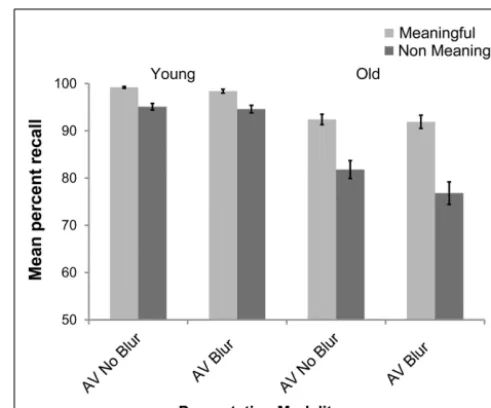
A significant interaction between Presentation Modality and
Group was also observed [F(1,39)=5.98,p<0.02]. Apost hoc
Fisher LSD on this interaction revealed that older adults had better recall for sentences presented in the AV no blur than AV blur modality but that this difference between AV conditions was not evidenced for the younger adult group. There was a significant interaction between Sentence Type and
Group [F(1,39)=23.6, p<0.001]: non-meaningful sentences
were recalled better by younger than older adults. There was a significant interaction between Presentation Modality and
Sen-tence Type [F(1,39)=4.71,p<0.04], with better recall for
non-meaningful sentences presented in the AV no blur condition compared to the AV blur condition. There was also a significant three-way interaction between Presentation Modality, Sentence
Type, and Group [F(1,39)=6.02,p<0.02], as shown inFigure 3.
We used apost hoc Fisher LSD to explore this interaction
fur-ther and found that sentence recall performance was worse in the older adult group compared to younger adults particularly for non-meaningful sentences presented in the AV blur condi-tion relative to the same sentences presented in the AV no blur condition.
In order to provide a better understanding of the interac-tion between Group, Sentence Type, and Presentainterac-tion Modality observed above, and as older adults’ performance is the main area of interest, we subsequently split the data across the groups and
conducted separate analysis. Specifically, we conducted a 2×2
ANOVA to investigate differences in sentence recall performance across Presentation Modality for younger adults, and separately for older adults. As above Presentation Modality (AV blur or AV no blur) and Sentence Type (meaningful or non-meaningful) were repeated factors. For the younger adults a main effect of
Sentence Type was observed [F(1,19)=35.60,p<0.001], with
better recall for meaningful than non-meaningful sentences. No
effect of Presentation Modality [F(1,19)=1.92,p=0.18] or a
sig-nificant interaction of Presentation Modality and Sentence Type
[image:5.612.305.551.61.265.2][F(1,19)<1] was found.
FIGURE 3 | Mean percent correct for sentence recall as a function of sentence type (meaningful/non-meaningful) and presentation modality (audio–visual blur/audio–visual no blur) for both younger and older adult groups.
For the older adults we observed significant main effects of
Presentation Modality [F(1,20)=14.08,p<0.002] and Sentence
Type [F(1,20)=59.8,p<0.000]. More pertinently a significant
interaction of Presentation Modality and Sentence Type was also
observed [F(1,20)=7.35,p<0.02]. Apost hocFisher LSD analysis
revealed that recall of non-meaningful sentences was better when they were presented through the AV no blur compared to AV blur conditions. There was no effect of blurring conditions on the recall of meaningful sentences.
ANALYSIS OF MULTISENSORY ENHANCEMENT
Multisensory enhancement was calculated for each individual as a function of their recall performance in the AV blur relative to the AV no blur conditions (measured in percent correct) for both meaningful (M) and non-meaningful (NM) sentences using the following equation:
ME =AV No Blur(M or NM)−AV Blur(M or NM)
1−AV Blur(M or NM)
We adapted the above equation from previous literature (Grant and Seitz, 1998;Sommers et al., 2005;Gordon and Allen, 2009)
in which this version was used: ME=AV−A/1−A where A is
auditory only.Sommers et al. (2005)suggested that this method
FIGURE 4 | Multisensory enhancement scores for younger and older adults for recall of meaningful and non-meaningful sentences.
condition and 80% correct recall in AV no blur condition will show the same ME effect as a person with relatively low performance of 40% correct recall in the AV blur condition and 60% correct recall in AV no blur condition.
In order to calculate the enhancement effect, performance to the AV no blur condition was normalized by performance in the AV blur condition for both older and younger adult groups. Allowing for this normalized measure of ME, we compared enhancement scores across Group and Sentence Type to a baseline
enhance-ment score of zero, using one samplet-tests. We found the same
pattern of results as for the sentence recall performance (see
Figure 3). Specifically, there was no ME in younger adults to
mean-ingful [t(1,19)<1] or non-meaningful sentences [t(1,19)<1].
However a significant ME effect was observed in older adults to
non-meaningful [t(1,19)=3.388,p<0.01] but not meaningful
sentences [t(1,20)= −1.01, n.s.]. Figure 4 illustrates this effect
where ME is specific to performance in the older adult group when recalling non-meaningful in comparison to meaningful sentences.
DISCUSSION
The current study investigated the effect of aging on audio–visual speech perception. Specifically, we manipulated the reliability of sensory information in an audio–visual video display of an actor articulating sentences by either blurring (AV blur) the image or not (AV no blur) and we manipulated the semantic content by presenting either meaningful or non-meaningful sentences. We measured speech perception in terms of both accuracy at detecting sentence meaning and recall of the entire sentence. We found better overall performance in younger adults rela-tive to their older counterparts in both detecting meaningful over non-meaningful sentences and in sentence recall. Moreover, manipulation of the sensory component did not affect detection of sentence meaning. In terms of sentence recall performance, younger adults were better at the task than older adults and for both groups, meaningful sentences were more accurately recalled
than non-meaningful sentences. However, changes in the sensory component affected sentence recall performance for the older adult group only: older adults were better at recalling sentences presented in the AV no blur condition over the AV blur condi-tion, although this difference was not observed for the younger adults. More interestingly, this benefit for AV no blur over AV blurred sentence presentation on sentence recall in the older adult group was particularly evident when the content of the sen-tence was non-meaningful and therefore unpredictable. When the sentence was meaningful, there was no benefit for reliable mul-tisensory over AV blurred inputs on performance in either age group.
Our findings are consistent with previous research which reported both behavioral and neurological evidence for the role of supportive semantic context in speech perception (Gordon-Salant and Fitzgibbons, 1997;Federmeier and Kutas, 2005;Sheldon et al., 2008). For exampleSheldon et al. (2008)observed that when both a word prime and a high context sentence were available, the sig-nal to noise ratio required for efficient perception of speech in the audio signal dropped by 50% for older adults, equating their performance to that of younger adults. Thus older adults could tolerate increased noise in the auditory speech signal when there was a semantic contextual support in the speech signal.
Although previous studies reported effects of speech context on
comprehension in both younger and older adults (e.g.,
Gordon-Salant and Fitzgibbons, 1997;Federmeier and Kutas, 2005), and in some cases an enhanced effect for context in older adults (e.g., Sheldon et al., 2008), many of such studies examined speech per-ception within a single modality, typically with auditory only input. Here we investigated multisensory conditions, which are arguably more aligned with real world experiences. In our study we examined speech perception performance across two condi-tions; one with clear auditory and visual inputs (AV no blur) and the other with clear auditory and blurred visual inputs (AV blur) and found that older adults show a greater gain with reli-able multisensory inputs when the semantic content of speech was unpredictable. When older adults have access only to audio information with unreliable visual information, their recall per-formance was significantly reduced relative to their perper-formance when audio and visual signals are reliable for sentences which are meaningless. As such, this disruption in the semantics of a sen-tence had the effect of reducing efficient speech processing in older adults, particularly when there was blurred visual speech
informa-tion available. This highlights a key point raised bySurprenant
The contribution of visual information in speech perception is thought to be that it allows the articulations in the audi-tory input to be more effectively resolved (Miki et al., 2004; Munhall et al., 2004; Stekelenburg and Vroomen, 2007; Davis et al., 2008). For example,Davis et al. (2008)provided evidence that when reliable visual information is unavailable then the pro-cessing load on the auditory cortex increases. They used ERP to demonstrate a decrease in the signal strength recorded from the auditory cortex when visual information was available dur-ing the perception of speech. Interestdur-ingly, in the present study we observed an audio–visual enhancement for speech percep-tion in older adults, particularly when the semantic content of speech was unreliable, even under superthreshold presentation conditions, (as we did not alter the quality of the audio sig-nal across sensory conditions). Other studies which investigated the role of vision in speech perception in older adults
manipu-lated the quality of the auditory signal. For example,Gordon and
Allen (2009)altered the auditory signal so that accurate speech recognition was approximately 20% across younger and older adults when there was no additional visual information. Here we observed that even when auditory performance was good, which arguably equates more to real world performance for nor-mal hearing older adults, age related differences in audio–visual performance for semantically meaningless speech were still evi-dent. The addition of visemes to auditory speech therefore allows for better perception of the speech signal in older adults and, fur-thermore, it enhanced recollection when semantic predictability was unreliable.
Gordon and Allen (2009)used a similar paradigm to the cur-rent study and demonstrated an audio–visual enhancement effect on speech perception in older adults only when the information presented in the visual domain was reliable (i.e., not blurred) but not when it was degraded (i.e., blurred). However, unlike the present study they found no effect on performance in perceiv-ing the semantically ambiguous (low context) speech across their visual “blur” and “no blur” conditions. They suggested that the multisensory processing of speech is unaffected by a change in the cognitive load in the speech signal and argued that the sensory and semantic components in speech processing may be dissocia-ble processes. However, in the present study, we used non-sense sentences, rather than semantically ambiguous sentences, since ambiguous sentences may still have some level of predictability
compared to meaningless sentences3. AdditionallyGordon and
Allen (2009) measured speech perception performance on the accuracy of recalling the final word of the sentence but not the entire sentence, which is a cognitively more demanding task. We suggest that the benefit of additional reliable visual information observed in the present study emerges only when the speech envi-ronment and the task at hand are both cognitively and perceptually challenging.
It is interesting to note that the benefit for reliable multisen-sory inputs occurred for sentence recall but not when the task
3The database of sentences provided byLittle et al. (2004)states that the target word
in semantically ambiguous sentences is nevertheless plausible within the sentence framework, but varies in the likelihood of occurrence.
involved detecting whether the sentence was meaningful or not. When the visual information in the AV input was unreliable, older adults could nevertheless correctly perceive whether a
sen-tence was meaningful or not. Tye-Murray et al. (2008) report
similar findings, with older and younger adults showing simi-lar discourse comprehension in both favorable and unfavorable audio–visual listening conditions. However they used meaningful discourse only, whereas here we found that even with sentences which are meaningless in nature older adults preserve the abil-ity to detect these sentences against more meaningful speech sentences. Overall detection of sentence meaning is relatively immune to misperceptions of individual words, as evidenced in the current study through the discrepancy in sentence comprehen-sion performance and overall sentence recall performance, when visual information was unreliable. We suggest that the addition of visual information helps resolve the phonetic information and enhances the representation of an unpredictable speech signal for later memory recall. Previous studies have shown that multisen-sory representations lead to more robust subsequent recall of the
information (see, e.g.,Ernst and Bülthoff, 2004; Murray et al.,
2004; Lehmann and Murray, 2005; von Kriegstein and Giraud, 2006).
Our results have implications for speech comprehension in older adults in the real world. On the one hand, our results show that the perception of meaningful and non-meaningful AV sen-tences is efficient in older adults, irrespective of the reliability of the information in the visual component. However, the ability of older adults to accurately recollect unpredictable (i.e., non-meaningful) sentences when the visual component of the AV input was unreli-able is relatively inefficient. For older adults, unpredictunreli-able speech patterns may include novel sentences, sentences with unfamiliar content (such as medical instructions), complex sentences, or sen-tences with ambiguous meaning. Thus when such information is being presented to an older person, our findings suggest that this information will be better remembered if presented in an audio–visual format, where information from both sensory com-ponents is reliable, than when the visual component is blurred or otherwise altered (such as when glasses are removed). For exam-ple, although speculative, it may be the case that asynchronous AV inputs (as often occur in AV communications technology) may also be specifically detrimental to speech recall in older adults. Moreover, unreliable AV speech components may lead to relatively good speech detection in older adults but may affect sub-sequent recall possibly leading older adults to fail to act to verbal instructions which were previously presented. Further research is required to elucidate the type of sentences which benefit from reliable AV inputs during speech perception and recall in older adults.
ACKNOWLEDGMENTS
This research was completed as part of a wider program of research within the Technology Research for Independent Living (TRIL) Centre. The TRIL Centre is a multidisciplinary research centre, bringing together researchers from TCD, UCD, NUIG, and Intel, funded by Intel, IDA Ireland, and GE Healthcare
REFERENCES
Baltes, P. B., Staudinger, U. M., and Lin-denberger, U. (1999). Lifespan psy-chology: theory and application to intellectual functioning.Annu. Rev. Psychol.50, 471–507.
Besle, J., Fort, A., Delpuech, C., and Giard, M. H. (2004). Bimodal speech: early suppressive visual effects in human auditory cortex. Eur. J. Neurosci.20, 2225–2234. Bolognini, N., Frassinetti, F., Serino, A.,
and Ladavas, E. (2005). “Acousti-cal vision” of below threshold stimuli: interaction among spa-tially converging audiovisual inputs. Exp. Brain Res. 160, 273–282.
Burke, D. M., and Peters, L. (1986). Word associations in old age: evi-dence for consistency in semantic encoding during adulthood.Psychol. Aging1, 283–292.
Callan, D. E., Jones, J. A., Munhall, K., Callan, A. M., Kroos, C., and Vatikiotis-Bateson, E. (2003). Neural processes underlying per-ceptual enhancement by visual speech gestures. Neuroreport 14, 2213–2218.
Calvert, G. A., Bullmore, E. T., Bram-mer, M. J., Campbell, R., Williams, S. C. R., McGuire, P. K., Woodruff, P. W. R., Iversen, S. D., and David, A. S. (1997). Activation of auditory cor-tex during silent lip reading.Science 276, 593–596.
Cienkowski, K. M., and Carney, A. E. (2002). Auditory-visual speech per-ception and aging. Ear Hear. 23, 439–449.
Davis, C., Kislyuk, D., Kim, J., and Sams, M. (2008).The effect of view-ing speech on auditory speech pro-cessing is different in the left and right hemispheres.Brain Res.1242, 151–161.
Ernst, M. O., and Bülthoff, H. H. (2004). Merging the senses into a robust per-cept.Trends Cogn. Sci. (Regul. Ed.)8, 162–169.
Federmeier, K. D., and Kutas, M. (2005). Aging in context: age-related changes in context use during lan-guage comprehension. Psychophysi-ology42, 133–141.
Folstein, M. F., Folstein, S. E., and McHugh, P. R. (1975). “Mini-mental state.” A practical method for grad-ing the cognitive state of patients for the clinician.J. Psychiatr. Res.12, 189–198.
Forster, K. I., and Forster, J. C. (2003). DMDX: a windows display program with millisecond accuracy. Behav. Res. Methods Instrum. Comput.35, 116–124.
Fozard, J. L., and Gordon-Salant, S. (2001). “Changes in vision and hear-ing with aghear-ing,” inHandbook of the Psychology of Aging, eds J. E. Birren and K. W. Schaie (San Diego, CA: Academic Press), 241–266. Frassinetti, F., Bolognini, N., Bottari, D.,
Bonora, A., and Ladavas, E. (2005). Audiovisual integration in patients with visual deficit.J. Cogn. Neurosci. 17, 1442–1452.
Getzmann, S., and Falkenstein, M. (2011). Understanding of spoken language under challenging listen-ing conditions in younger and older listeners: a combined behavioral and electrophysiological study.Brain Res.1415, 8–22.
Giard, M. H., and Peronnet, F. (1999). Auditory-visual integration during multimodal object recognition in humans: a behavioral and electro-physiological study.J. Cogn. Neu-rosci.11, 473–490.
Gordon, M. S., and Allen, S. (2009). Audiovisual speech in older and younger adults: integrating a dis-torted visual signal with speech in noise.Exp. Aging Res.35, 202–219. Gordon-Salant, S. (2005). Hearing loss
and aging: new research findings and clinical implications.J. Rehabil. Res. Dev.42, 9–24.
Gordon-Salant, S., and Fitzgibbons, P. J. (1997). Selected cognitive factors and speech recognition performance among young and elderly listeners.J. Speech Lang. Hear. Res.40, 423–431. Grant, K. W., and Seitz, P. F. (1998). Measures of auditory-visual inte-gration in nonsense syllables and sentences.J. Acoust. Soc. Am.104, 2438–2450.
Grant, K. W., and Seitz, P. F. (2000). The use of visible speech cues for improving auditory detection of spoken sentences.J. Acoust. Soc. Am. 108, 1197–1208.
Hagoort, P., and Brown, C. M. (2000). ERP effects of listening to speech: semantic ERP effects. Neuropsy-chologia38, 1518–1530.
Hairston, W. D., Laurienti, P. J., Mishra, G., Burdette, J. H., and Wallace, M. T. (2003). Multisensory enhancement of localization under conditions of induced myopia.Exp. Brain Res.152, 404–408.
Holcomb, P. J., and Neville, H. J. (1990). Auditory and visual semantic prim-ing in lexical decision: a comparison using event-related brain potentials. Lang. Cogn. Process.5, 281–312. Holmes, N. P., and Spence, C. (2005).
Multisensory integration: space, time and superadditivity.Curr. Biol. 15, R762–R764.
Jääskeläinen, I. P., Ojanen, V., Ahveni-nen, J., AuraAhveni-nen, T., LevaAhveni-nen, S., Mottonen, R., Tarnanen, I., and Sams, M. (2004). Adaptation of neuromagnetic N1 responses to phonetic stimuli by visual speech in humans.Neuroreport15, 2741–2744.
Lehmann, S., and Murray, M. M. (2005).The role of multisensory memories in unisensory object dis-crimination.Brain Res. Cogn. Brain Res.24, 326–334.
Little, D. M., Prentice, K. J., and Wing-field, A. (2004). Adult age differences in judgments of semantic fit.Appl. Psycholinguist.25, 135–143. McGurk, H., and MacDonald, J. (1976).
Hearing lips and seeing voices. Nature264, 746–748.
Meredith, M. A., and Stein, B. E. (1986). Visual, auditory, and somatosen-sory convergence on cells in supe-rior colliculus results in multisen-sory integration.J. Neurophysiol.56, 640–662.
Miki, K., Watanabe, S., and Kakigi, R. (2004). Interaction between audi-tory and visual stimulus relating to the vowel sounds in the auditory cor-tex in humans: a magnetoencephalo-graphic study.Neurosci. Lett. 357, 199–202.
Munhall, K. G., Jones, J. A., Callan, D. E., Kuratate, T., and Vatikiotis-Bateson, E. (2004). Visual prosody and speech intelligibility: head move-ment improves auditory speech per-ception.Psychol. Sci.15, 133–137. Murray, M. M., Michel, C. M., Grave de
Peralta, R., Ortigue, S., Brunet, D., Gonzalez Andino, S., and Schnider, A. (2004). Rapid discrimination of visual and multisensory memories revealed by electrical neuroimaging. Neuroimage21, 125–135. Ngo, M. K., and Spence, C. (2010).
Crossmodal facilitation of masked visual target discrimination by infor-mative auditory cuing. Neurosci. Lett.479, 102–106.
Perrott, D. R., Sadralodabai, T., Saberi, K., and Strybel, T. Z. (1991). Aurally aided visual search in the central visual field: effects of visual load and visual enhancement of the target. Hum. Factors33, 389–400. Pichora-Fuller, M. K. (2008). Use
of supportive context by younger and older adult listeners: balancing bottom-up and top-down informa-tion processing.Int. J. Audiol.47, S72–S82.
Pichora-Fuller, M. K., and Souza, P. E. (2003). Effects of aging on auditory processing of speech.Int. J. Audiol. 42, S11–S16.
Romero-Ortuno, R., Cogan, L., Cun-ningham, C. U., and Kenny, R. A. (2010). Do older pedestrians have enough time to cross roads in Dublin? A critique of the Traf-fic Management Guidelines based on clinical research findings.Age Ageing 39, 80–86.
Ross, L. A., Saint-Amour, D., Leavitt, V. M., Javitt, D. C., and Foxe, J. J. (2007). Do you see what I am saying? Exploring visual enhance-ment of speech comprehension in noisy environments. Cereb. Cortex 17, 1147–1153.
Schieber, F. (2006). “Vision and aging,” in Handbook of the Psychology of Aging, eds J. E. Birren and K. W. Schaie (Amsterdam: Elsevier), 129–161.
Schneider, B. A., Daneman, M., Murphy, D. R., and See, S. K. (2000). Listening to discourse in distracting settings: the effects of aging.Psychol. Aging 15, 110–125.
Schneider, B. A., Daneman, M., and Pichora-Fuller, M. K. (2002). Listen-ing in agListen-ing adults: from discourse comprehension to psychoacoustics. Can. J. Exp. Psychol.56, 139–152. Schröger, E., and Widmann, A. (1998).
Speeded responses to audiovisual signal changes result from bimodal integration. Psychophysiology 35, 755–759.
Senkowski, D., Talsma, D., Grigutsch, M., Herrmann, C. S., and Woldorff, M. G. (2007). Good times for multisensory integration: effects of the precision of temporal syn-chrony as revealed by gamma-band oscillations. Neuropsychologia 45, 561–571.
Serino, A., Farne, A., Rinaldesi, M. L., Haggard, P., and Ladavas, E. (2007). Can vision of the body ameliorate impaired somatosensory function? Neuropsychologia45, 1101–1107. Shams, L., and Seitz, A. R. (2008).
Bene-fits of multisensory learning.Trends Cogn. Sci. (Regul. Ed.)12, 411–417. Sheldon, S., Pichora-Fuller, M. K., and
Schneider, B. A. (2008). Priming and sentence context support listening to noise-vocoded speech by younger and older adults.J. Acoust. Soc. Am. 123, 489–499.
Shimojo, S., and Shams, L. (2001). Sensory modalities are not sepa-rate modalities: plasticity and inter-actions.Curr. Opin. Neurobiol.11, 505–509.
Sommers, M. S., Tye-Murray, N., and Spehar, B. (2005). Auditory-visual speech perception and auditory-visual enhancement in normal-hearing younger and older adults. Ear Hear.26, 263–275.
Spence, C., Senkowski, D., and Roder, B. (2009). Crossmodal processing.Exp. Brain Res.198, 107–111.
Stein, B. E., and Meredith, M. A. (1993). The Merging of the Senses. Cam-bridge, MA: MIT Press.
Stein, B. E., Meredith, M. E., Huney-cutt, W. S., and Mc Dade, L. W. (1989). Behavioral indices of mul-tisensory integration: orientation to visual cues is affected by auditory stimuli.J. Cogn. Neurosci.1, 12–24.
Stekelenburg, J. J., and Vroomen, J. (2007). Neural correlates of multi-sensory integration of ecologically valid audiovisual events. J. Cogn. Neurosci.19, 1964–1973.
Sumby, W. H., and Pollack, I. (1954). Visual contribution to speech in noise. J. Acoust. Soc. Am. 26, 212–215.
Surprenant, A. M. (2007). Effects of noise on identification and serial recall of nonsense syl-lables in older and younger adults. Neuropsychol. Dev. Cogn. B Aging Neuropsychol. Cogn. 14, 126–143.
Tye-Murray, N., Sommers, M., Spehar, B., Myerson, J., Hale, S., and Rose,
N. S. (2008). Auditory-visual dis-course comprehension by older and young adults in favorable and unfa-vorable conditions.Int. J. Audiol.47, S31–S37.
von Kriegstein, K., and Giraud, A. L. (2006). Implicit multisensory asso-ciations influence voice recognition. PLoS Biol.4, e326. doi:10.1371/jour-nal.pbio.0040326
Conflict of Interest Statement: The authors declare that the research was conducted in the absence of any commercial or financial relationships that could be construed as a potential conflict of interest.
Received: 07 November 2011; accepted: 28 November 2011; published online: 22 December 2011.