Rubinstein J (1995)Column Flotation:Processes,Designs and Practices. New York: Gordon and Breach. Schubert H and Bischofberger C (1979) On the
optimiza-tion of hydrodynamics inSotation processes. In: Las-kowski J (ed.) Proceedings of the 13th International Mineral Process Congress, pp. 1261}1287. Warsaw: Elsevier.
Wills BA (1992) Introduction to Mineral Processing Techno-logy, 5th edn, pp. 558}575. Oxford: Pergamon Press. Xu M, Quinn P and Stratton-Crawley R (1994)
Graph-ite/chalcopyrite separation using a rapid column cell. In: Yalcin T (ed.)Innovations in Mineral Processing, pp. 181}186. Sudbury, Ontario, Canada.
Xu M, Quinn P and Stratton-Crawley R (1996) A feed-line aeratedSotation column.Minerals Engineering8(10): 1159}1173.
Yang DC (1988) A new packed columnSotation system, columnSotation ’88. In: Sastry KVS (ed.)Proceedings of the International Symposium on Column Flotation, pp. 257}265. Phoenix, USA: SME.
Yoon RH, Adel GT and Luttrell GH (1988) A process and apparatus for separatingRne particles by microbubble Sotation together with a process and apparatus for generation of microbubbles. US patent no. 5761008. Yoon RH and Luttrell GH (1989) The effect of bubble size
onRne particleSotation.Mineral Processing and Ex-tractive Metallurgy Review5: 101}122.
Young FR (1989)Cavitation. London: McGraw-Hill. Zhou ZA, Xu Z and Finch JA (1994) On the role of
cavitation in particle collection during Sotation } a critical review. Minerals Engineering 7 (9): 1073} 1084.
Zhou ZA, Xu Z and Finch JA (1995) The minimum recovery zone height in Sotation columns from par-ticle}bubble collision analysis.Transactions of the Insti-tution of Mining and Metallurgy104: C102}C106. Zhou ZA, Xu Z and Finch JA (1995) Fundamental study of
cavitation in Sotation. In XIX International Mineral Processing Congress, vol. 3, pp. 93}97. San Francisco, USA: SME.
Zhou ZA, Xu Z and Finch JA (1996) Effect of gas nuclei on hydrophobic coagulation.Journal of Colloid Interface Science179: 311}314.
Zhou ZA, Xu Z, Finch JA and Liu Q (1966) Effect of gas nuclei on the Rltration of Rne particles with different surface properties.Colloids &Surfaces113: 67}77.
Zhou ZA, Hu H, Xu Zet al. (1997) Role of hydrodynamic cavitation inRne particleSotation.International Jour-nal of Mineral Processing51: 139}149.
Zhou ZA, Langlois R, Xu Zet al. (1997) In-plant testing of a hydrodynamic reactor in Sotation. In: Finch JA, Rao SR and Holubec I (eds) Processing of Complex Ores, pp. 185}193. Sudbury, Canada: CIM.
Reagent Adsorption on Phosphates
P. Somasundaran and L. Zhang, Columbia University, NY, USA
Copyright^ 2000 Academic Press
Introduction
Adsorption of surfactants on minerals is the basic process governingSotation. It is controlled by various physicochemical processes in the pulp involving inter-actions among the mineral particles, surfactants, dis-solved inorganics, solvent species and other additives such as polymers. Adsorption can be considered as selective partitioning of the surfactant adsorbate into the interfacial region, resulting from the more ener-getically favourable interactions between the adsor-bate and the solid than those between the former and the species in the bulk solution. The interactions leading to adsorption include chemical bonding, elec-trostatic interaction, desolvation of the surfactant po-lar group and the mineral surface species, hydrogen bonding, van der Waals interactions, etc.
Water chemistry plays an important role in the adsorption process by affecting the surfactant} solution equilibria, the mineral}solution equilibria
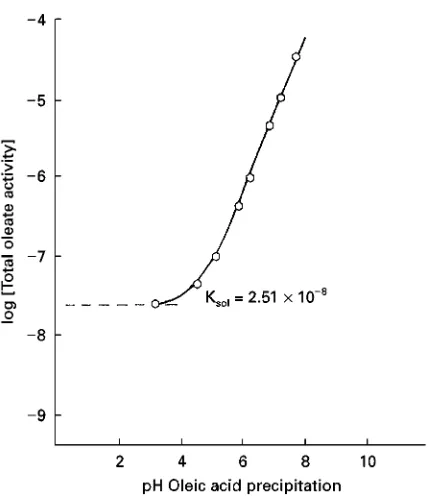
Figure 1 pH of oleic acid precipitation. (From Morgan LJ, Anan-thapadmanabhan KP and Somasundaran P (1986) Oleate ad-sorption on hematite: problem and methods.International Journal of Mineral Processing 18: 39. Copyright: Elsevier Science.)
Phosphate is one of the most important minerals processed by Sotation techniques. Flotation is
ef-Rcient for the beneRciation of phosphate ores with silicate gangues, but those with carbonaceous gan-gues are difRcult to separate by Sotation tech-niques. The low selectivity has been attributed to the similarities in the surface chemical properties of the constituent minerals. These properties, in turn, are inSuenced by the water chemistry of the surfactant} mineral systems. In this section the effects of water chemistry on the surfactant}solution equilib-rium, the mineral}solution equilibrium, the surfac-tant}mineral interactions in the separation of phos-phate and associated minerals are discussed. Methods to manipulate and control the solution chemistry to achieve selectivity inSotation are also examined.
Water Chemistry of Flotation
Reagents
Long chain fatty acids such as oleic acid are among the commonly used reagents for the Sotation of ox-ides, silicates and salt-type minerals. Flotation of these minerals using fatty acids is affected greatly by solution properties such as pH, since weakly acidic fatty acids undergo association interactions that can inSuence their adsorption and Sotation properties. For example, oleic acid species will undergo
dissocia-tion to form ions (Ol\) at high pH values and exist as neutral molecules (HOI) at low pH value. In the intermediate region, the ionic and the neutral molecu-lar species can associate to form ion}molecule com-plexes ((Ol)2H\). As the surfactant concentration is increased, micellization or precipitation of the surfactant can occur in the solution. In addition, surfactant species can associate to form other aggregates such as the dimer (Ol2\
2 ) in premicellar solutions. Also, long chain fatty acids such as oleic acid have very limited solubility, which is a sensitive function of pH. The pH of precipitation of oleic acid calculated as a function of total oleate is shown in
Figure 1.
The solution equilibria of oleic acid (HOl) are expressed as below:
HOl(liquid)"HOl(aq)
pKsol"7.6 (Ksol: solubility product)
HOl(aq)"H##Ol\
pKa"4.95 (Ka: acid dissociation constant)
2Ol\"(Ol)2\ 2
pKd"!3.7 (Kd: dimerization constant)
HOl#Ol\"(Ol)2H\
pKad"!5.25 (Kad: acid}soap formation constant)
The species distribution of oleic acid as a function of pH based on the above equilibria at a given concen-tration is shown inFigure 2. It can be seen from this
Rgure that:
1. The pH of the precipitation of oleic acid at the given concentration is 7.45.
2. The activities of oleic monomer and dimer remain almost constant above the precipitation pH and decrease sharply below it.
3. The activity of the acid}soap (Ol)2H\ exhibits a maximum in the neutral pH range.
The surface activities of the various surfactant spe-cies can be markedly different from each other. It has been estimated that the surface activity of the acid}soap (Ol)2H\isRve orders of magnitude higher than that of the neutral molecule (HOl) and about seven orders of magnitude higher than that of the neutral molecule (HOl) and about seven orders of magnitude higher than that of the oleate monomer Ol\.
Figure 2 Oleate species distribution as a function of pH. Total oleate concentration"3;10\5mol L\1. (From Ananthapad-manabhan KP and Somasundaran P (1980) Oleate chemistry and hematite flotation. In: Yarar B and Spottiswood DJ (eds) Interfacial Phenomena in Mineral Processing, p. 207. New York: Engineering Foundation.)
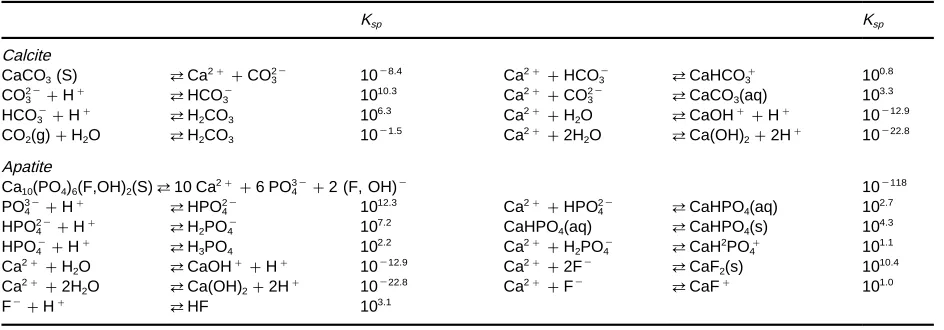
Table 1 Equilibria controlling the dissolution of calcite and apatite in water
Ksp Ksp
Calcite
CaCO3(S) 8Ca2##CO2\
3 10\8.4 Ca2##HCO\3 8CaHCO#3 100.8 CO2\
3 #H# 8HCO\3 1010.3 Ca2##CO23\ 8CaCO3(aq) 103.3 HCO\3#H# 8H2CO3 106.3 Ca2##H2O 8CaOH##H# 10\12.9 CO2(g)#H2O 8H2CO3 10\1.5 Ca2##2H2O 8Ca(OH)2#2H# 10\22.8
Apatite
Ca10(PO4)6(F,OH)2(S)810 Ca2##6 PO34\#2 (F, OH)\ 10\118 PO3\
4 #H# 8HPO24\ 1012.3 Ca2##HPO24\ 8CaHPO4(aq) 102.7 HPO2\
4 #H# 8H2PO4\ 107.2 CaHPO4(aq) 8CaHPO4(s) 104.3 HPO\4#H# 8H3PO4 102.2 Ca2##H2PO4\ 8CaH2PO#4 101.1 Ca2##H
2O 8CaOH##H# 10\12.9 Ca2##2F\ 8CaF2(s) 1010.4 Ca2##2H
2O 8Ca(OH)2#2H# 10\22.8 Ca2##F\ 8CaF# 101.0 F\#H# 8HF 103.1
It is clear that, to understand the adsorption of reagents on solids, the effects of concentration, pH, ionic strength and activities of the various poss-ible reagent species on the adsorption process need to be taken into account.
The Effect of Water Chemistry
on Mineral
^
Solution Equilibrium
When mineral particles are in contact with water, they undergo dissolution, the extent of which is de-pendent on the type and concentration of chemicals in solution. The dissolved mineral species can under-go further reactions such as hydrolysis, complexa-tion, adsorption and precipitation. The complex equilibria involving all such reactions can be expected to determine the interfacial properties of the minerals and theirSotation behaviour. The equilibria that
con-trol the dissolution of calcite and apatite in water are given inTable 1.
In the case of carbonaceous phosphate minerals, apatite, calcite and dolomite will dissolve in water, followed by pH-dependent hydrolysis and complexa-tion of the dissolved species. Since these minerals are sparing soluble, the dissolved species have a marked effect on their interfacial properties.
It should be noted that, from theoretical consider-ations, depending on the solution conditions, the sur-face of apatite can be converted to calcite and vice versa through surface reactions or bulk precipitation of the more stable phase. The stoichiometry of the equilibrium governing the conversion of apatite to calcite can be written as:
Ca10(PO4)6(OH)2(S)#10CO23\
"10CaCO3(S)#6PO24\#2OH\
It can be seen from this equation that, depending on the pH of the solution, apatite can be converted to calcite if the total carbonate in solution exceeds a cer-tain value. In fact, the amount of dissolved carbonate from atmospheric CO2does exceed that required to convert apatite to calcite under high pH conditions. Surface conversion due to the reaction of the dis-solved species with the mineral surface can be pre-dicted using stability diagrams for heterogeneous mineral systems. This is illustrated inFigure 3for the calcite}apatite system. The activity of Ca2#in
equi-librium with various solid phases shows that the point of interception for calcite and apatite is pH 9.3. Above this pH, apatite is less stable than calcite and hence conversion of apatite to that of calcite can be expected in the calcite}apatite system. Similarly, apatite is more stable than calcite below pH 9.3. It is to be noted that Ca2# in equilibrium with calcite in
[image:3.568.50.522.548.713.2]Figure 3 pH dependence of activity of Ca2#in equilibrium with
[image:4.568.52.278.365.623.2]calcium oleate (dotted line: OlT"10\4kmol m\3), calcite (open (closed lines) and closed (dots and dashes) systems) and apatite (dashed lines). (From Ananthapadmanabhan KP and Somasun-daran P (1984) The role of dissolved mineral species in calcite-apatite flotation.Mineral and Metallurgical Processing 1: 36.)
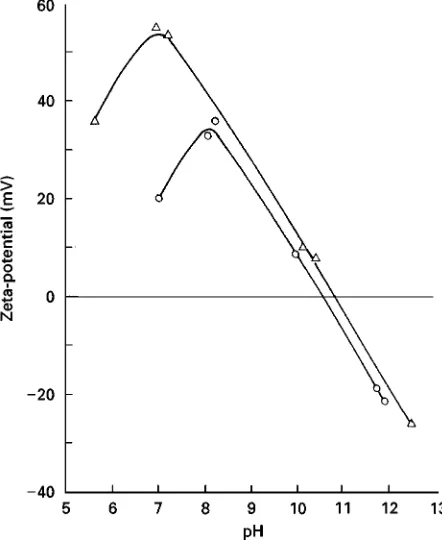
Figure 4 Illustration of the effect of supernatants on the zeta potential and isoelectric point of calcite and apatite: 2;10\3kmol m\3KNO
3. Open circles, calcite in water; open triangles, apatite in water; filled triangles, apatite in calcite super-natant; filled circles, calcite in apatite supernatant. (From Anan-thapadmanabhan KP and Somasundaran P (1984) The role of dissolved mineral species in calcite-apatite flotation.Mineral and Metallurgical Processing 1: 36.)
Figure 5 Illustration of the similarity in zeta potentials of calcite (circles) and apatite (triangles) in mixed supernatants. (From Ananthapadmanabhan KP and Somasundaran P (1984) The role of dissolved mineral species in calcite-apatite flotation.Mineral and Metallurgical Processing 1: 36.)
in the absence of atmospheric CO2, apatite has a wider stability region than in the open system. Atmospheric CO2can thus be expected to play an important role in these types of mineral}solution equilibria and in op-erations dependent on interfacial properties.
The surface conversions in the calcite}apatite system have been proved experimentally; electrokinetic data obtained for the calcite}apatite system in water and in the supernatant of each other are shown inFigure 4. When apatite is in contact with calcite supernatant, its zeta potential is seen to shift to that of calcite and vice versa, suggesting surface conversion of apatite to cal-cite and calcal-cite to apatite, respectively.
The zeta potential data obtained in mixed super-natants of calcite and apatite also show the effect of dissolved mineral species. If supernatants of calcite and apatite are combined as a 1 : 1 mixture, the two minerals have almost identical surface charge charac-teristics in the basic pH range (Figure 5).
The surface conversion of apatite and calcite is fur-ther supported by the result of electron spectroscopy for chemical analysis (ESCA) measurements. The re-sults in Figure 6 show that, when apatite is condi-tioned in the supernatant of calcite at pH&12, its surface exhibits spectroscopic properties characteristic of both calcite and apatite. This behaviour is attributed to the precipitation of calcite on the apatite.
[image:4.568.291.512.386.657.2]Figure 6 ESCA spectra of C(1s) peak of apatite conditioned in calcite supernatant at pH&12. (A) Apatite in water; (B) calcite in water; (C) apatite in calcite supernatant. (From Ananthapad-manabhan KP and Somasundaran P (1984) The role of dissolved mineral species in calcite-apatite flotation.Mineral and Metallurgi-cal Processing 1: 36.)
Figure 7 Depletion isotherms of14C-labelled oleic acid on fran-colite (squares: pH"8.2) and dolomite (circles: pH"9.2). Tem-perature, 253C; S/L"0.3; I"3;10\2kmol m\3KNO
3. (From Somasundaran P, Xiao L and Wang D (1991) Solution chemistry of flotation of sparingly soluble minerals.Mineral and Metallurgical Processing 8: 115}121.)
The Effect of Water Chemistry on
Adsorption of Reagents on Minerals
Chemical equilibria in aqueous solutions containing both the minerals and the surfactants can be expected to be much more complex than in either of the indi-vidual systems discussed above. In addition to surfac-tant adsorption at the solid}liquid interface, interac-tions between dissolved mineral species with various surfactant species can be expected. All these interac-tions can affect the surfactant adsorption and the subsequentSotation.
As indicated earlier, oleic acid has a very low solu-bility and adsorption of oleate, in some cases, is in fact precipitation of the surfactant in the interfacial region. In Figure 3, the activity of Ca2# in
equilib-rium with various solid phases is plotted. If, at any stage, activity of Ca2#in solution is greater than that
in equilibrium with Ca2#-oleate, Ca2#-oleate can be
expected to precipitate.
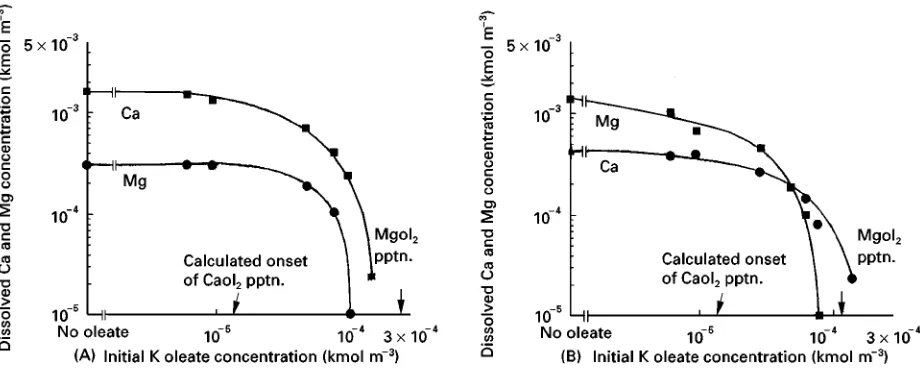
Depletion isotherms of oleic acid on both francolite and dolomite has been observed to be a two-region linear isotherm with a change of slope at about 10\4kmol m\3 (Figure 7). Simultaneous analysis of the dissolved mineral species in the supernatants of the samples used in the adsorption experiments (Figure 8) shows a sharp decrease in the concentrations of both Mg and Ca species when oleate concentration exceeds 1.0;10\5kmol m\3in the case of francolite and 3.0;10\5kmol m\3 in the case of dolomite. This suggests that bulk precipitation of calcium and magnesium species can occur under such conditions. Major chemical equilibria for the precipitation of Ca and Mg species by oleate can be given as follows:
Ca2##2 Ol\"Ca(Ol)
2 KCa(Ol)2"3.81;10\13
Mg2##2 Ol\"Mg(Ol)
2 KMg(Ol)2"1.58;10\11
The onset of the precipitation of Ca(Ol)2and Mg(Ol)2 is calculated from the solubility products given above and marked in Figure 8. The calculated oleate con-centrations at the onset of precipitation are in good agreement with experimental observations.
It is postulated that, in the case of oleate adsorption
on dolomite and francolite, different
[image:5.568.292.514.441.643.2]Figure 8 Dissolved Ca (squares) and Mg (circles) levels from (A) francolite (pH"8.2) and (B) dolomite (pH"9.2) suspensions as a function of oleate concentration. (From Somasundaran P, Xiao L and Wang D (1991) Solution chemistry of flotation of sparingly soluble minerals.Mineral and Metallurgical Processing 8: 115.)
of oleate on both minerals occurs mainly due to chemical bonding on surfaces without any precipita-tion. At an intermediate concentration of about 10\4kmol m\3, the solubility limit of Ca and Mg oleate can be reached in the interfacial region but not in the bulk solution, suggesting surface precipitation of oleate on both minerals. In the high concentration range ('5;10\4kmol m\3), oleate depletion may be dominated in the case of both minerals by the precipitation of Ca and Mg species with oleate, on the mineral surface and in the bulk solution.
From the above discussion on apatite}calcite con-version, it is clear that aSotation separation scheme designed on the basis of the surface properties of a single mineral is not likely to perform satisfactorily. The effect of dissolved species of calcite and apatite on fatty acidSotation of both minerals has in fact been studied using mineral supernatant solutions containing various dissolved species. The Sotation results are shown inFigure 9. Both supernatants of calcite and apatite are found to depress the calcite
Sotation by oleic acid in the tested pH range, with apatite supernatant exhibiting a greater depressing effect. Similar results have also been obtained for apatiteSotation. The supernatants of calcite and apa-tite depress the apaapa-titeSotation under all tested pH conditions.
Studies on the dissolved species responsible for the observed effect revealed that, for calcite S ota-tion, the depression role of apatite supernatant results from the combined effects of calcium species and the phosphate species in solution, while the depress-ion role of calcite supernatant is mostly that of the calcium ion and possibly some carbonate ions. The depression due to calcium ion is caused by the
de-pletion of oleate owing to the precipitation of calcium oleate. In the case of apatiteSotation, the depression is due to phosphate and carbonate species in solution. The adsorption of these ions on the surface calcium sites reduces the sites available for oleate adsorption which, in turn, lowers the hydrophobicity of the sur-face and so depresses the apatite Sotation. Calcium oleate precipitation, in this case, does not occur to a signiRcant extent due to the low concentration of oleic acid used inSotation. The above observations clearly show that water chemistry plays a crucial role in theSotation of apatite}calcite systems.
In addition to reagent complexation and precipita-tion, other reactions that occur in the bulk solution can take place in the interfacial region. For example, hemimicellization at a solid}liquid interface is a phenomenon that drastically affects the adsorp-tion of collector reagents on solids.
Flotation is a dynamic process. In addition to the equilibrium effects associated with the water chemistry, it can also inSuence the adsorption kinet-ics of surfactants on the solid surfaces. Anionic condi-tioning is a unit operation that precedes rougher
Sotation and skin Sotation of phosphates in Florida
Figure 9 (A) Effect of apatite supernatant (squares) on calcite flotation. K oleate 10\4kmol m\3; I"3;10\2kmol m\3KNO3. Circles, water. (B) Effect of calcite supernatant (squares) on calcite flotation. K oleate 10\4kmol m\3; I"3;10\2kmol m\3KNO3. Circles, water. (C) Effect of calcite supernatant (squares) on apatite flotation. K oleate"2;10\6kmol m\3; I"3;10\2kmol m\3 KNO3. Circles, water. (D) Effect of apatite supernatant (squares) on apatite flotation. K oleate"2;10\6kmol m\3; I"3; 10\2kmol m\3KNO
3. Circles, water. (From Ananthapadmanabhan KP and Somasundaran P (1984) The role of dissolved mineral species in calcite-apatite flotation.Mineral and Metallurgical Processing 1: 36.)
Table 2 Comparison of laboratory and plant conditions
Laboratory conditions Plant conditions
Conditioner Wrist-action shaker Lightnin Labmaster L1U08, four-bladed cruciform propeller operating at 350 rpm pH 9.1}9.5 9.1}9.5
Water Distilled and plant water Plant water Solid (%) 10 (2 g sample) 72 (1000 g sample) Time (min) 120 (except for kinetics) 3 (except for kinetics)
water. Under laboratory conditions, the adsorption in plant water is signiRcantly lower than that in the distilled water. It is proposed that this is due to reagent loss resulting from the dissolved species in plant water precipitating the oleic acid. In contrast, under plant conditions, the adsorption behaviour of
[image:7.568.128.441.620.710.2]Figure 10 Kinetics of oleic acid adsorption on francolite in distilled water and plant water under laboratory and plant conditions. Open squares, distilled water in laboratory conditions; filled squares, plant water in laboratory conditions; open circles, distilled water in plant conditions; filled circles, plant water in plant conditions. Oleic acid concentration: 8.1;10\3mol L\1; pH 9.1}9.5. (From Maltesh C, Somasundaran P and Gruber GA (1996) Fundamentals of oleic acid adsorption on phosphate flotation feed during anionic conditioning. Mineral and Metallurgical Processing 13: 157.)
reagent in the water adsorbs. This will also result in a lower reagent concentration in solution reducing the precipitation eject. The intense agitation in the plant conditioner may also remove some of the bound reagent from the surface.
The adsorption isotherms of oleic acid on fran-colite under laboratory and plant conditions are compared in Figure 11. Adsorption is markedly higher under laboratory conditions than under plant conditions. On the other hand, under plant condi-tions the adsorption is similar in distilled water and plant water. This suggests that the effect of dis-solved species is reduced under plant conditions.
From the above discussion, it can be seen that the adsorption of surfactant on a mineral is a compli-cated process involving interactions such as surfac-tant self-association, mineral dissolution, bulk precipitation, adsorption and surface precipitation. The interactions are further complicated by the kin-etic effects of the various reactions.
Understanding the effect of the water chem-istry on reagent adsorption offers opportunities to manipulate such processes by optimizing the con-tributing factors such as alteration of the surface properties, complexation of ions which cause precipi-tation of the surfactant, prevention or enhancement of collector adsorption and changes in the adsorption kinetics to achieve the desired selectivity inSotation.
In the anionic Sotation of phosphate, Ca2#
affects the grade of phosphate by activating the quartz through formation of calcium-bearing precipi-tates at high pH. This detrimental effect can be prevented by adding sodium silicate, which can inter-act with Ca2# and form calcium silicate. Since
cal-cium silicate and quartz are negatively charged, de-tachment of calcium silicate from quartz can occur and thus quartzSotation can be depressed.
It has been found that in carbonate/phosphate sys-tems, with fatty acid as collector, apatite is depressed in the acid medium (pH 5.5}6.0) while carbonate is
Soated. The depression of phosphate at this pH is possibly due to the adsorption (or formation) of aque-ous CaHPO4 on its surface, preventing surfactant ions from approaching the surface of the phosphate particles. Free Ca2# in solution can affect the
formation of aqueous CaHPO4. From thermody-namic considerations it can be predicted that the selective Sotation of carbonates from phosphates in acid media can be enhanced by minimizing free Ca2#
in solution and by increasing HPO2\
4 in the system. This can be done by (1) decreasing free Ca2#
Figure 11 Adsorption isotherms of oleic acid adsorption on francolite in distilled water and plant water under laboratory and plant conditions. Squares, distilled water in laboratory conditions; open circles, distilled water in plant conditions; filled circles, plant water in plant conditions. (From Maltesh C, Somasundaran P and Gruber GA (1996) Fundamentals of oleic acid adsorption on phosphate flotation feed during anionic conditioning.Mineral and Metallurgical Processing 13: 157.)
natural phosphate ores are in agreement with the theoretical predictions.
Based on the oleic acid solution chemistry, a two-stage conditioning process for the Sotation of dol-omite from apatite has been proposed. The mixed minerals areRrst conditioned at pH 10 with oleic acid collector. The system is then reconditioned below pH 4.5 where dolomite isSoated. The selectivity of dol-omite from apatite is attributed to two factors in this process.
1. High adsorption of oleate on dolomite during the
Rrst stage at pH 10, which is maintained after reconditioning at lower pH.
2. Oleate to oleic acid transformation upon recon-ditioning, reducing its efRciency, and this re-duction being more severe for apatite than for dolomite.
In the high pH range, oleate adsorbs on to apatite and calcite through speciRc interactions, while at low pH, when oleic acid is the major species, the adsorption is through weaker physical interaction. Thus, oleic acid is a poor collector compared to oleate.
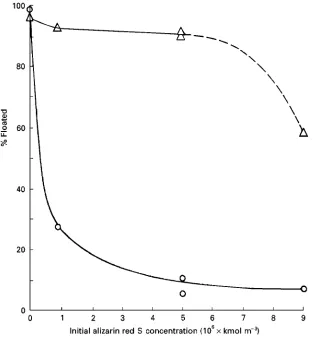
ModiRcation of collector adsorption on minerals can be used to control theirSotation response. In one study, Alizarin Red S, a dye that stains calcite, was tested as a modifying agent in calcite}apatite system due to its preferential adsorption on these
minerals. Even though Alizarin Red S adsorbs more on apatite than on calcite, it depresses theS ota-tion of apatite using oleate as collector more than that of calcite (Figure 12). In the absence of the dye, both calcite and apatiteSoat with oleate at pH 10.5. When the dye concentration increases to 5;10\6mol m\3, the Sotation of calcite is very little affected with a recovery of about 90%, while apatite Sotation is depressed to 5}10%. Calcite Sotation is only affected at higher concentrations of dye. Alizarin Red S or its derivatives are hence promising reagents for the beneRciation of phosphate with carbonaceous gangues.
Summary
Figure 12 Flotation of calcite (triangles) and apatite (circles) from their mixture (1 : 1) at pH 10.5 as a function of Alizarin red S concentration. Alizarin red S conditioning time"1 min; K oleate"9;10\5kmol m\3; KCl"3;10\2kmol m\3; pH"10.5$0.2. (From Fu E and Somasundaran P (1986)International Journal of Mineral Processing 18: 287, with permission from Elsevier Science.)
dissolution depending upon solution conditions such as pH, ionic strength and concentration of constitu-ent ions. The dissolved mineral species can further interact with mineral solids, leading to surface con-version of the minerals. They can also interact with surfactant, leading to surface and bulk precipitation. All these processes can signiRcantly affect the adsorption of surfactant on minerals. A full under-standing of the various interactions in surfactant} solid}solution system is essential for developing efRcient separation schemes. Indeed, desired se-lectivity can be achieved by using appropriate addi-tives to control dissolved species or modifying collector adsorption and by optimizing solution con-ditions as well as the kinetics involved.
Acknowledgement
The authors acknowledge Rnancial support of the National Science Foundation (CTS-9622781 and EEC-94-02989)
Further Reading
Amankonah JO, Somasundaran P and Ananthapadma-nabhan KP (1985) Effects of dissolved mineral spe-cies on the dissolution/precipitation characteristics of calcite and apatite.Colloids and Surfaces15: 295. Amankonah JO, Somasundaran P and
Ananthapadma-nabhan KP (1985) Effects of dissolved mineral species on the electrokinetic behavior of calcite and apatite.Colloids and Surfaces15: 335.
Ananthapadmanabhan KP and Somasundaran P (1980) Oleate chemistry and hematite Sotation. In: Yarar B and Spottiswood DJ (eds) Interfacial Phenomena in Mineral Processing, p. 207, New York: Engineering Foundation.
Ananthapadmanabhan KP and Somasundaran P (1984) The role of dissolved mineral species in calcite-apatiteSotation.Mineral and Metallurgical Processing
1: 36.
Ananthapadmanabhan KP and Somasundaran P (1988) Acid}soap formation in aqueous oleate solutions. Jour-nal of Colloid Interface Science122: 104.
Dho H and Iwasaki I (1990) Role of sodium silicate in phosphateSotation.Mineral and Metallurgical Process-ing7: 215.
Elgillani DA and Abouzeid A-ZM (1993) Flotation of car-bonates from phosphate ores in acidic media. Interna-tional Journal of Mineral Processing38: 235.
Fu E, Somasundaran P (1986) Alizarin red S as aSotation modifying agent in calcite-apatite systems.International Journal of Mineral Processing18: 287.
Leja J (1982)Surface Chemistry of Froth Flotation. New York: Plenum Press.
Maltesh C, Somasundaran P and Gruber GA (1996) Funda-mentals of oleic acid adsorption on phosphateSotation feed during anionic conditioning.Mineral and Metallur-gical Processing13: 157.
Morgan LJ, Ananthapadmanabhan KP and Somasundaran P (1986) Oleate adsorption on hematite: problem and
methods. International Journal of Mineral Processing
18: 139.
Moudgil BM and Chanchani R (1985) SelectiveSotation of dolomite from francolite using two-stage conditioning.
Mineral and Metallurgical Processing2: 19}25. Somasundaran P (1969) Adsorption of starch and
oleate and interaction between them on calcite in aqueous solutions.Journal of Colloid Interface Science
31: 557.
Somasundaran P and Ananthapadmanabhan KP (1986) Solution chemistry of Sotation. In: Somasundaran P. (Ed.), Advances in Mineral Processing, p. 426. New York: AIME.
Somasundaran P, Amankonah JO and Ananthapadma-nabhan KP (1985) Mineral}solution equilibria in spar-ingly soluble mineral systems.Colloids and Surfaces15: 309.
Somasundaran P, Xiao L and Wang D (1991) Solution chemistry of Sotation of sparingly soluble minerals.
Mineral and Metallurgical Processing8: 115}121.
ION EXCHANGE
Catalysis: Organic Ion
Exchangers
R. L. Albright, Albright Consulting, Southampton, PA, USA
Copyright^ 2000 Academic Press
Introduction
The ion exchange polymers most often used in cataly-sis are insoluble materials that can be constructed from inorganic or organic monomer units. This article will present only catalysis performed by the organic ion exchangers that are insoluble solids. There are commercial ion exchangers that are liquids, but to date they have been used very little in catalysis and, therefore, will not be included in this discussion.
Insoluble ion exchangers carry out their catalytic work in a heterogeneous rather than a homogeneous fashion and are, therefore, part of the group called heterogeneous catalysts. Heterogeneous catalysts have three very signiRcant advantages over homo-geneous catalysts: Rrst, they are not corrosive; sec-ond, they are very readily separated from the reaction mixture by a simple Rltration; and third, they are
most often recyclable from one run to the next with-out any added treatment. Potentially, they suffer one major disadvantage over homogeneous catalysts. Intimate contact between reactants and the catalytic site is not achieved simply by mixing the heterogen-eous catalyst with the reactants. In a stirred reactor, intimate contact between reactants and the homo-geneous catalyst is very easily achieved and mass transport of reactants to catalyst is very rapid and almost never rate-limiting. With heterogeneous cata-lysis, mass transport of reactants to the catalytic site may often be the rate-limiting element, especially if the activation energy for the reaction is small and the chemical reaction is rapid. There are excellent texts and monographs on the issues surrounding hetero-geneous catalysis, and the reader is referred to these for the development of a fuller understanding (see Further Reading).
Nature of Organic Ion Exchange
Polymers
Chemical Composition