Abstract—This paper aims to introduce a new flexible block in order to manage processes in Business Process Reengineering. This splits an activity in multiple ones and, when the last ends, they are collected in a new single output activity. This block has been created using AnyLogic® software. Furthermore, in order to show the wide application range of this block two different applications are provided. The first one has been performed in a harbor and the data are collected by means of questionnaires. The second one has been performed in a hospital, in particular in the surgical process. In this last application the data are gathered using Data Mining applied to real medical database which contains a huge amount of data.
Index Terms— Data Mining, Digital Twin, Business Process Reengineering (BPR), Healthcare, Harbor.
I. INTRODUCTION
O OWADAYS, business is developing dramatically owing to a market which is becoming more and more global. For this reason, competitiveness become a crucial point for organizations which must constantly assure a continuous adaptation of their business processes to the dynamic environment in which they work. [1]
In particular, Business Process Reengineering (BPR) is an effective tool able to ensure this thanks to a radical revamp of the organizations.
This concept appeared for the first in a paper written by Michael Hammer and published on the Harvard Business Review. [2]
Hammer and Champy defines Business Process as “a collection of activities that takes one or more kinds of input and creates an output that is of value to the customer. A
Manuscript received July, 2019; revised July, 2019.
Gabriele Galli is a Ph.D. student at Industrial and Manufacturing System Engineering Department (I.M.S.E), University of Michigan-Dearborn, Dearborn MI 48128 USA (e-mail: [email protected]).
Carlotta Patrone is a Ph.D. and Management Engineer at the Galliera Hospital in Genoa, Italy (e-mail: [email protected]).
Akhil Chowdary Bellam, is a M.S. student at Mechanical, Industrial and Transport Engineer Department (D.I.M.E.), University of Genoa, Genoa, Ge 16126 Italy (e-mail: [email protected]).
Nagarjuna Reddy Annapareddy, is a M.S. student at Mechanical, Industrial and Transport Engineer Department (D.I.M.E.), University of Genoa, Genoa, Ge 16126 Italy (e-mail: [email protected]).
Roberto Revetria is a Professor at Mechanical, Industrial and Transport Engineer Department (D.I.M.E.), University of Genoa, Genoa, Ge 16126 Italy (corresponding author to provide phone: +39 320 7982 156; fax: +39 010 317750; e-mail: [email protected]).
business process has a goal and is affected by events occurring in the external world or in other processes”. [3]
In this view, one of the first definition of BPR is: “Business Process Reengineering (BPR) is the fundamental rethinking and radical redesign of business processes to achieve dramatic improvements in critical, contemporary measures of
performance, such as cost, quality, service and speed”. [3] The basic idea in BPR is to rethink process as completely new in order to easily enable radical changes within the organizations which could turn out totally different from the actual ones. For this purpose, a huge boost has been given by the introduction of Information and Communication Technologies (ICT). As shown in figure 1, the improvement related to BPR is discontinuous due to its radical nature.
Fig. 1. Comparison between Continuous and Discontinuous Improvement.
One of the most pivotal features in BPR is the ability to clearly depict processes in the clearest and meaningful way possible. In this regard, the most used process representation techniques are: Business Process Model and Notation (BPMN) and Integration Definition for Functioning Modeling (IDEF0).
BPMN is a de-facto standard which allow to describe graphically all the processes. [4] It stands as the connection between design and implementation of business processes using a flowchart approach whose diagrams are very close to the activities diagram in Unified Modeling Language (UML). [5] BPMN has been created by Business Process
Improving Process Using Digital Twin:
A Methodology for the Automatic Creation of
Models
Gabriele Galli, Carlotta Patrone, Akhil C. Bellam, Nagarjuna R. Annapareddy, and Roberto Revetria
Management Initiative (now Object Management Group) and its latest version, released in January 2014, is BPMN 2.0.2.
IDEF0 is another crucial method involved in the decision-making processes, it has been created by the United States Air
Force in the 70s with the purpose of enhancing the industrial productivity. It consists of a hierarchy of diagrams which illustrate the system functions and their connections with an increasing level of detail. The main elements in diagrams are functions represented by boxes whereas data (ICOM elements), represented by arrows, connects functions to each other. [6]
This paper introduces a new general method which aims to perform BPR quickly and easily switching from BPMN to simulation thanks to the creation of a 1:1 correspondence between BPMN model and the simulation one. In particular, BPMN has been chosen due to its simplicity, comprehensibility and well-suited approach toward business applications. In order to enable this passage a new simulation block has been created, this splits a single activity into many which are performed in parallel and, when the last one occurred then these sub-activities are combined in an output one.
II. LITERATURE REVIEW
Purpose of the following review is to find previous works which attempt to link Business Process Reengineering, Simulation and BPMN or IDEF0.
A literature review has been performed according to these steps: (i) identification of the keywords and their combination; (ii) selection of a source database; (iii) results analysis. (i) Two selections of keywords have been performed. In the first one the following keywords have been used: Business Process Reengineering, BPR, Simulation, Business Process Model and Notation, BPMN, whereas, in the second one: Business Process Reengineering, BPR, Simulation, Integration Definition for Function Modeling, IDEF0.
In the second search step (ii), Scopus has been chosen as source database of peer-reviewed literature. At the end of this phase nine articles have been collected. After a first evaluation of the abstracts 4 studies have been considered, in particular two of them are the results of the first search and the remains of the second one.
During the third step (iii), the collected papers have been systematized in terms of name of the authors, year of publication, journal title, objective, approach and characteristics.
Below a summary of the articles analyzed has been presented, the first two highlight the bond among BPR, Simulation and BPMN whereas, the remaining, underline the bond among BPR, Simulation and IDEF0.
A. BPR, Simulation and BPMN
Reference [7] aims to study the business process and its improvement in district public services using a BPR approach which is supported by Key Performance Indicator (KPI), Critical Success Factor (CSF) and BPMN. The authors use a Service Engineering approach which generally is divided in three main parts: (i) identification phase, (ii) design phase, (iii) prototypes phase, this last one has been
carried out using Bizagi modeler software. The first phase (i) aims to identify the existing problems in the organization using BPR, CSF and KPI. In the second one (ii), the new design has been modeled using BPMN thanks to Bizagi software whereas, in the last one (iii), the model has been validate using time analysis in Bizagi which allows to simulate the process and find the best solution accordingly.
Reference [8] is an implementation of BPR in order to reduce cost in an insurance company. The BPR method used is divided in three steps: (i) mapping as-is process, (ii) analyzing as-is process, (iii) modeling to-be process. The first step (i) has been achieved using the simulation software iGrafx which is based on a BPMN approach. The second step (ii) has been performed observing the process time in each activity of the as-is process and finding the bottlenecks, in this case study there are nine of them. These nine bottleneck activities are improved thanks to BPR. In the last stage (iii), in order to model the to-be process a literature study of BPR improvement targets on insurance conditions has been performed. Starting from these results, three different to-be scenarios (without automation, half automation, full automation) have been analyzed in order to find the best solution. These ones pinpoint a 35-76% in process time reduction compared to as-is process and the third scenario is the best.
B. BPR, Simulation and IDEF0
The first effort to link these disciplines has been performed in 1997 by reference [9] in which the authors uses IDEF0 as a method to model processes in BPR. They recognize that it is a static method and, for this reason, not suitable to model dynamic processes. This paper provides one way to obtain dynamic results linking IDEF0 with simulation based on Petri nets. The authors states that IDEF0 does not take into account crucial aspects of process modeling and reengineering like time, cost associated with the process, utilization of resources during the process and so forth. The authors by means of a comparison based on BPR features between Petri nets and IDEF0 highlights the resulting drawbacks which can be solved by developing and using an appropriate simulation tool
Reference [10] is based on a BPR case study in a pharmaceutical company in order to reduce delays in the shipment processes. In this, IDEF0 method has been used to model and analyze logistic systems. The case-study has been lead using a BPR approach divided in four phases: (i) identify/categorize targets; (ii) assess business process; (iii) design business process, in this phase (as-is), the business process is mapped using IDEF0 and the problems are analyzed thanks to a simulation carried out with iGrafx and the time of the processes is noted down; (iv) Process change, in this last phase (to-be), improvement strategies based on ESIA strategy (Eliminate, Simplify, Integrate, Automate) are determined by analyzing literature and discussing with company managers. In the end, five scenarios (to-be) are analyzed and simulated with iGrafx and compared with the as-is ones. The second scenario turned out the most optimized.
III. PROPOSED OF METHODOLOGY
study aims to propose a new approach to speed up Business Process Reengineering problems by overcoming the limitation of the simulation tool in BPMN software. In fact, they can simulate just one process at a time. For this reason, it is necessary to switch to simulation software in order to represent and simulate the plurality of processes which is very common within organizations.
Indeed, it is possible to make the process global by passing from a BPMN environment to a simulation one, moreover, this is eased thanks to the creation of interchangeable components. In particular, this paper introduces a component which aims to create a block able to split an activity in more parallel ones and, when the last is ended, they are all gathered in a new output activity.
This block helps to describe complex activities with a non-atomic approach in fact, resources are not represented as single entities but as parts of a subprocess. The new component exploits a minimal information approach, this means that only the most essential information has been collected.
In this view, the component is doubly useful in fact, on one side, it allows to describe complex system easily and, from the other, it permits to perform a meticulous simulation study requiring a lower number of information. This allows to less bother the personnel during their working activities to ask for data and it allows also to reduce errors due to human mistakes in the data collection procedure.
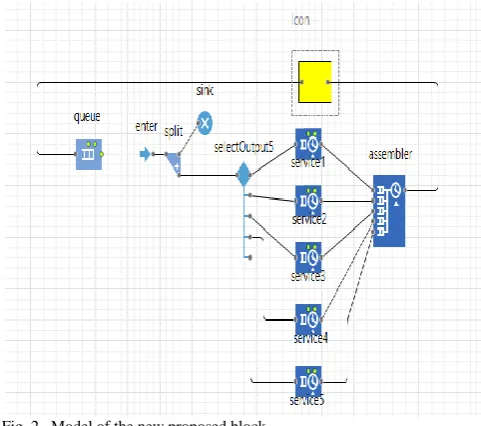
[image:3.595.56.297.406.619.2]This flexible block has been create using components available in AnyLogic® and it exploits a Discrete Event approach. It is shown in figure 2.
Fig. 2. Model of the new proposed block
As illustrated in figure 2, an agent is split in 5 new ones by the split block. Afterwards, thanks to the SelectOutput5 block, each of these are assigned to a service block which contains an adjustable time and a resource. When each service time elapses, the corresponding agent is collected by the assembler. This block gathers all the agents and, once the last one enters, it releases a single output agent. There are 10 parameters divided into 2 categories which are settable by the user. The first ones are TimeServices which allow to choose the time value of each activity block, whereas the second ones are the related Resources.
Moreover, this model has been exported as a library, therefore it can be easily used in all the model which required a similar logic.
There are a huge number of applications which require this kind of process. The following sections of this paper aim to provide two real Business Process Reengineering applications of this new block. These are applied in two completely different environment, a harbor and a hospital. In particular, they diversify in input data: in the first one they are collected by means of questionnaires whereas, in the second, by means of Data Mining.
IV. HARBOR APPLICATION
This chapter aims to provide an application in a harbor environment in order to switch from BPMN to Simulation based on Discrete Event approach using the block described above.
Through this method, the simulator will show a sequence of activities and the period of time for Customers/Entities to wait from one state to another state of event. This study was done in order to identify the average time for a Terminalist/Entity to get the authorization based on a specific paperwork application. In fact, Discrete Event Simulation is used to find the best solution for the harbor management board to enhance processes efficiency. Usually Discrete Event Simulation requires a lot number of numerical data so that the result obtained is more accurate. All these connections between the elements may produce an output like the waiting time spent by the entity in the system, the total usage of the resources and also the lengths of the queue facing by the entity.
In a general paperwork application, the necessary documents are submitted either physically or electronically by the subject who make the request to the appropriate office and such request flow through various levels or steps while detailed inspections and decisions are made. The status of the processing of documents is communicated regularly with the applicant through Dealer in order to finalize the Authorization (approval) or Rejection (denial). The applicant is allowed to integrate more documents in the procedure in case of insufficient details or missing documents.
By Interviewing the harbor personnel, a BPMN model is developed and is replicated onto Anylogic® using Discrete event Model to indicate the Business Flow or various steps involved in the release of authorizations and concessions. Also, the necessary numerical data is collected which is required by the Discrete Event model as input for simulating the scenario to obtain the expected results of efficiency. This process can be divided in two parts: data collection and simulation.
A. Data Collection using questionnaires
The triangular-density function is customarily used when function parameters can be directly estimated by experts. A typical example is for estimating activity durations by identifying a minimum value, a most likely value, and a maximum value [11]. These values are then used to construct triangular-density functions to represent uncertain activity durations.
B. Simulation Process
By simulating this model, we obtain the Queue time, the total usage of the available resources and the waiting time during the processing of the documents submitted by the entity for the release of authorization. The simulation model has been shown in figure 3.
Fig. 3. Discrete event model of the Release of authorizations and concessions for 4 years from Port Authority
The elements used while creating this model are Source, Service, Select output, Connectors, Split, Combine and a new component developed is used which aims to create a block able to split an activity in more parallel ones and, when the last activity is ended, they are all gathered in a new output activity. Nowadays, simulation modeling is applied for solving a wide range of problems. There are simulations which require significant performance and time resources. The goal of this project is to create a model and library enabling clear and rapid development of parallel discrete event models. This project can be easily described using the block in the chapter III. For instance, the block V_p_5, can be easily changed with this new block with just 3 active channels. This way, the overall system become smaller and easy to model and can be automated.
V. HEALTHCARE APPLICATION
Business Process Reengineering in healthcare is pivotal. For instance, Patrone et al. provides a practical case which highlights the importance of BPR during the construction of a new hospital [12]. This chapter aims to provide a tool able to improve the surgical path in hospitals, in particular it is applied to Galliera Hospital in Genoa.
This application can be divided in two phases: Data Mining and Digital Twin creation.
A. Data Mining
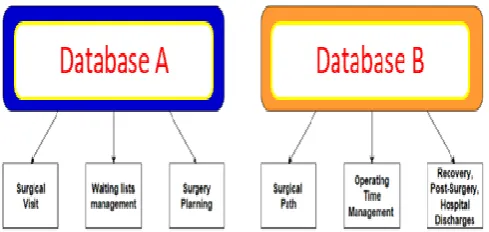
To improve their processes, Galliera Hospital uses a computerized waiting list which aims to provide maximum transparency in the priority allocation process. This system is called Database A and it allows sharing all relevant
information regarding patient care plan processes in real-time with team members (e.g. surgeons, anesthetists, nurses, admin). During the initial visit, the surgeon set an evaluation of the patient based on the patient’s status and establish a maximum waiting time and a position of this latter in the list. The priority is updated daily thanks to a recalculation related to a clinical revaluation and a possible worsening [13]. Furthermore, the surgeon inserts also an estimate of the surgery duration.
Summing up, thanks to Database A it is possible to have a priority-based waiting list of patients and a tracking of clinical and organizational events.
Once the patient is admitted in the operating room (OR), the system used is no longer Database A but Database B which is the operating rooms register and allows their centralized management. After that, all the activities performed in the surgical time are inserted in this one. This is very useful in terms of legality and safety, immediate availability of medical reports, operating room times recorded and data analysis.
The operating room times are:
- T0 - patient gets into the Block of Operating Rooms (BOR)
- T1 - patient gets into the OR
- T2 - anesthesia infused, patient ready for surgery,
- T3 - skin incision,
- T4 - skin suture,
- T5-end of anesthesia,
- T6 - exit from the OR,
- T7 - exit from the BOR,
- T8 - OR is available for next surgery.
As it is possible to notice, Database B is a specialized platform able to manage surgical paths so as to monitor in a continuous way the patient in each process phase.
[image:4.595.49.290.220.381.2]Figure 4 highlights the main application of the two databases.
Fig. 4. Comparison between DatabaseA and DatabaseB
[image:4.595.307.552.504.620.2]process. Once having calculate this difference the data has been divided in omogeneus class according to the surgical code and, for each of these, the most proper probability distribution has been calculated. This has been performed thanks to the tool DataFit tool contained in Plant Simulation Software.
B. Digital Twin Creation
Digital Twins based on simulation are widely used in healthcare. [14]
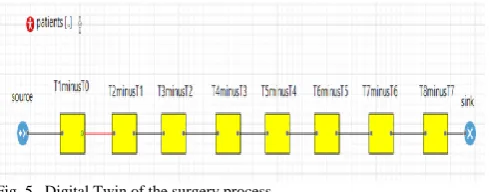
[image:5.595.49.294.208.304.2]The model proposed in this paper aims to describe the surgical process using a Discrete Event Approach and it has been shown in figure 5.
Fig. 5. Digital Twin of the surgery process
Each of the yellow block contains the model described in chapter III. Thanks to this approach, evaluating the time of more entities becomes possible. For instance, when the entity reaches the surgery block (T4minusT3), it is divided in more parallel ones represented by the servers. This way, for example, server1 depicts the suregeon, server2 the anesthetist, server3 the scrub nurse and so forth. Now it is possible to have a clear idea about the times of all the staff and to optimize them accordingly.
VI. CONCLUSION AND FUTURE WORK
These applications clearly witnessed the flexibility and the potentialities of this new block.
In fact, concerning the Harbor study this block allows to describe the entire BPMN model in a simulation environment using the same block for describing each activity. This way will be easy to switch from BPMN to Simulation.
In the healthcare study, this model enabled to add one more level of precision to the surgical path. Undeniably, a bad time management in healthcare can cause delays in waiting time, improper care settings, increase of hospitalization days, waste of resources, increase of risks for patients. In this view, the digital twin proposed can be a good way to optimize the times.
So far, it has been possible to calculate just the global time and not the time of each entities in the process. Indeed, now it will be possible to have more times to evaluate in order to increase the system efficiency. Furthermore, thanks to the block structure, doing this will be possible with a low effort of the user who have to set just the parameters of the new block.
A possible drawback of this application could be the time wasted for noting down the times by hands. This also leads to make mistakes during the annotation caused by inaccuracies. As a matter of fact, the data mining procedure revealed more than 6000 inaccuracies in the annotation.
An effective solution to solve this problem and to help the personnel to sign the time is the introduction of Internet of
Things buttons which must be pressed each time a process phase ends [15].
REFERENCES
[1] A. Nikravanshalmani, M. Ahmadi, “Providing a framework to improve the performance of business process management projects based on BPMN,” Advances in Computer Science: a International Journal, 2016.
[2] M. Hammer, “Reengineering work: don’t automate, obliterate,”
Harvard Business Review, Vol. 68, n.4, July/August, pp 104-112.
1990.
[3] M. Hammer, J. Champy, “Re-engineering the Corporation; A Manifesto for Business Revolution,” Harper Business, New York, 1993.
[4] M. Chinosi, A. Trombetta BPMN: An introduction to the standard.
Computer Standards and Interfaces, 34(1), 124-134, 2012.
[5] S. White, “Process Modeling Notations and Workflow Patterns,” 2004.
[6] [ICAM Architecture Part II-Volume IV - Function Modeling Manual (IDEF0), AFWAL-TR-81-4023, Materials Laboratory, Air Force Wright Aeronautical Laboratories, Air Force Systems Command, Wright-Patterson Air Force Base, Ohio 45433, June 1981.
[7] Silvia, Suhardi, P. Yustianto, "Business process improvement of district government innovation service: Case study cimahi tengah district of cimahi," International Conference on Information Technology Systems and Innovation, ICITSI - Proceedings, 2016 [8] A.R. Masayu, M. Dachyar, "Designing Improvement of Procurement
Business Process Reengineering Approach: A Study Case of Insurance Company," MATEC Web of Conferences, 2018
[9] L. Peters, J. Peters (1997), "Using IDEF0 for dynamic process analysis," Proceedings - IEEE International Conference on Robotics and Automation, 4 3203-3208, 1997.
[10] M. Dachyar, G. Novita, G. "Business process re-engineering of logistics system in pharmaceutical company," ARPN Journal of Engineering and Applied Sciences, 11(7), 4539-4546, 2016
[11] W. Edward Back, Walter W. Boles, Gary Fry “Defining Triangular Probability Distributions from Historical Cost Data”.
[12] C. Patrone, M. Mezzano Kozlova, G. Galli, R. Revetria, “Hospital Warehouse Management during the construction of a new building through Lean Technique,” paper submitted to Engineering Letters IAENG.
[13] L. Morando, “il time management del percorso chirurgico: organizzare il tempo e governarlo,” Festival della scienza, 2014. [14] C. Patrone, G. Galli, R. Revetria, “A State of the Art of Digital Twin
and Simulation Supported by Data Mining in the Healthcare Sector,” paper submitted to SOMET (accepted).