Ames Laboratory Publications
Ames Laboratory
9-30-2016
Energy gap evolution across the superconductivity
dome in single crystals of (Ba1−xKx)Fe2As2
Kyuil Cho
Iowa State University and Ames Laboratory, [email protected]
Marcin Kończykowski
Université Paris-SaclaySerafim Teknowijoyo
Iowa State University and Ames Laboratory, [email protected]
Makariy A. Tanatar
Iowa State University and Ames Laboratory, [email protected]
Yong Liu
Ames Laboratory, [email protected]
See next page for additional authors
Follow this and additional works at:
https://lib.dr.iastate.edu/ameslab_pubs
Part of the
Engineering Physics Commons
, and the
Materials Science and Engineering
Commons
The complete bibliographic information for this item can be found at
https://lib.dr.iastate.edu/
ameslab_pubs/416
. For information on how to cite this item, please visit
http://lib.dr.iastate.edu/
howtocite.html
.
of (Ba1−xKx)Fe2As2
Abstract
The mechanism of unconventional superconductivity in iron-based superconductors (IBSs) is one of the most
intriguing questions in current materials research. Among non-oxide IBSs, (Ba1−xKx)Fe2As2 has been
intensively studied because of its high superconducting transition temperature and fascinating evolution of the
superconducting gap structure from being fully isotropic at optimal doping (x ≈ 0.4) to becoming nodal at x >
0.8. Although this marked evolution was identified in several independent experiments, there are no details of
the gap evolution to date because of the lack of high-quality single crystals covering the entire K-doping range
of the superconducting dome. We conducted a systematic study of the London penetration depth, λ(T),
across the full phase diagram for different concentrations of point-like defects introduced by 2.5-MeV electron
irradiation. Fitting the low-temperature variation with the power law, Δλ ~ Tn, we find that the exponent n is
the highest and the Tc suppression rate with disorder is the smallest at optimal doping, and they evolve with
doping being away from optimal, which is consistent with increasing gap anisotropy, including an abrupt
change around x
≃
0.8, indicating the onset of nodal behavior. Our analysis using a self-consistent t-matrix
approach suggests the ubiquitous and robust nature of s± pairing in IBSs and argues against a previously
suggested transition to a d-wave state near x = 1 in this system.
Keywords
Superconductor, pairing symmetry, pnictides
Disciplines
Engineering Physics | Materials Science and Engineering | Physics
Comments
This article is published as Cho, Kyuil, Marcin Kończykowski, Serafim Teknowijoyo, Makariy A. Tanatar, Yong
Liu, Thomas A. Lograsso, Warren E. Straszheim et al. "Energy gap evolution across the superconductivity
dome in single crystals of (Ba1− xKx) Fe2As2."
Science Advances
2, no. 9 (2016): e1600807. DOI:
10.1126/
sciadv.1600807
. Posted with permission.
Creative Commons License
This work is licensed under a
Creative Commons Attribution-Noncommercial 4.0 License
Authors
Kyuil Cho, Marcin Kończykowski, Serafim Teknowijoyo, Makariy A. Tanatar, Yong Liu, Thomas A. Lograsso,
Warren E. Straszheim, Vivek Mishra, Saurabh Maiti, Peter J. Hirschfeld, and Ruslan Prozorov
M A T E R I A L S S C I E N C E 2016 © The Authors, some rights reserved; exclusive licensee American Association for the Advancement of Science. Distributed under a Creative Commons Attribution NonCommercial License 4.0 (CC BY-NC). 10.1126/sciadv.1600807
Energy gap evolution across the
superconductivity dome in single crystals
of (Ba
1
−
x
K
x
)Fe
2
As
2
Kyuil Cho,1,2Marcin Kończykowski,3Serafim Teknowijoyo,1,2Makariy A. Tanatar,1,2Yong Liu,1Thomas A. Lograsso,1,4 Warren E. Straszheim,1Vivek Mishra,5,6Saurabh Maiti,7Peter J. Hirschfeld,7Ruslan Prozorov1,2*
The mechanism of unconventional superconductivity in iron-based superconductors (IBSs) is one of the most intriguing questions in current materials research. Among non-oxide IBSs, (Ba1−xKx)Fe2As2has been intensively studied
because of its high superconducting transition temperature and fascinating evolution of the superconducting gap structure from being fully isotropic at optimal doping (x≈0.4) to becoming nodal atx> 0.8. Although this marked evolution was identified in several independent experiments, there are no details of the gap evolution to date because of the lack of high-quality single crystals covering the entire K-doping range of the superconducting dome. We con-ducted a systematic study of the London penetration depth,l(T), across the full phase diagram for different concen-trations of point-like defects introduced by 2.5-MeV electron irradiation. Fitting the low-temperature variation with the power law,Dl∼Tn, we find that the exponentnis the highest and theTcsuppression rate with disorder is the smallest
at optimal doping, and they evolve with doping being away from optimal, which is consistent with increasing gap anisotropy, including an abrupt change aroundx≃0.8, indicating the onset of nodal behavior. Our analysis using a self-consistentt-matrix approach suggests the ubiquitous and robust nature ofs±pairing in IBSs and argues against a
previously suggested transition to ad-wave state nearx= 1 in this system.
INTRODUCTION
Understanding the mechanisms of superconductivity in iron-based superconductors (IBSs) is a challenging task, partially due to the mul-tiband character of interactions and scattering (1–4). On the other hand, the rich chemistry of IBSs offers a unique opportunity to study the physics within one family of materials and test material-specific theories of superconductivity. It is widely believed that spin fluctua-tions due to repulsive Coulomb interacfluctua-tions are responsible for super-conductivity and lead to sign-changing pair states around the Fermi surface. Theories of superconductivity based on exchange of these electronic excitations predict that large-momentum pair scattering pro-cesses dominate the pairing interactions, but details distinguish between competing pair states, usuallyswave anddwave. For the simplest band structures characteristic of these systems, it was found that optimally doped systems should have a fully gapped,s-wave ground state, but as the system was overdoped,dwave would become more competitive and even thes-wave state would become extremely anisotropic (5). Sys-tematically testing these predictions would be an important step toward understanding the origins of superconductivity in these systems.
Among various IBSs, (Ba1−xKx)Fe2As2(BaK122) is, perhaps, one of the most interesting and intensively studied compounds, exhibiting an unusual variation of the superconducting gap structure across the superconducting dome that exists betweenx≈0.18 and 1. In the opti-mally doped region,x≈0.35 to 0.4, two effective isotropic
super-conducting gap scales (roughly with a 2:1 magnitude ratio) were identified in many experiments, for example, thermal conductivity (6), London penetration depth (7,8), and angle-resolved photoemission spectroscopy (ARPES) (8–12). In the heavily overdoped region,x≥0.8, a gap with line nodes was identified by thermal conductivity (13–15), London penetration depth (16), and ARPES (9,11). Although some thermodynamic (17,18) and small-angle neutron measurements (19) have reported tiny full gaps instead, there is a consensus that the gap anisotropy is very strong.
An important feature of the overdoped Ba122 system is the Lifshitz transition reported for both electron-doped (20) and hole-doped (21) compounds. In the material of interest here, BaK122, there is a series of Lifshitz transitions in thex~ 0.7 to 0.9 region that result in the re-placement of electron-like pockets at theMpoint by hole-like pockets (21,22), although a more precise determination of the critical composi-tions and the exact evolution of the three-dimensional band structure is still lacking. Indeed, this marked change in the electronic band structure must be taken into account when trying to explain the observed evolu-tion of the superconducting properties with doping. One of the problems is the absence of systematic studies for a sufficient number of different compositions with reliably established values ofx, spanning the whole doping range. Here, we measured 16 different compositions withxvalues determined by the wavelength-dispersive spectroscopy (WDS) in each measured sample.
Although there is an overall experimental consensus on the evolu-tion with doping from large, isotropic to smaller, highly anisotropic gaps in BaK122, several possible theoretical interpretations exist. Most authors propose a crossover between two generalizeds-wave states, where the usual configuration of isotropic gaps with opposite signs on the electron and hole pockets crosses over to a configuration with opposite signs on the hole pockets resulting in accidental nodes (15).
1Ames Laboratory, Ames, IA 50011, USA.2Department of Physics and Astronomy, Iowa State
University, Ames, IA 50011, USA.3Laboratoire des Solides Irradiés, École Polytechnique, CNRS, CEA, Université Paris-Saclay, 91128 Palaiseau Cedex, France.4Department of Materials Science and Engineering, Iowa State University, Ames, IA 50011, USA.5Joint Institute for Computational Sciences, University of Tennessee, Knoxville, TN 37996, USA.6Center for Na-nophase Materials Sciences, Oak Ridge National Laboratory, Oak Ridge, TN 37831, USA.7 De-partment of Physics, University of Florida, Gainesville, FL 32611, USA.
*Corresponding author. Email: [email protected]
R E S E A R C H A R T I C L E
This crossover may happen through an intermediate time-reversal symmetry brokens+isstate (23). Some consider a transition froms±to dwave either directly (24) or via an intermediates+idstate (1,25,26). Still, others propose the existence of too-small-to-measure but finite
“Lilliputian”gaps (17,18). Because of the multitude of Fermi surface sheets and the absence of direct phase-sensitive experiments, it is difficult to pinpoint the most plausible explanation, and further studies are needed. This is where the introduction of controlled artificial disorder becomes a very useful tool. In fact, impurity scattering is phase-sensitive and therefore can be used to at least narrow down possible scenarios. In most cases, only suppression ofTcis studied, and even then, it can pro-vide important information. For example, strong support fors±pairing was found in electron-irradiated Ba(Fe,Ru)2As2(27). Of course, in IBSs, it is rather difficult to draw definitive conclusions fromTcsuppression alone because of the many parameters involved in multiband pair-breaking (28). Measurements of another disorder-sensitive parameter, for example, low-temperature behavior of London penetration depth, can significantly constrain theoretical interpretations. This was sug-gested as a way to distinguish betweens±ands++pairing (29). This idea has been used to interpret the data in BaFe2(As,P)2(30) and SrFe2(As,P)2 (31), where potential scattering lifted the nodes, thus proving them acci-dental and, therefore, lending a strong support tos±pairing.
Here, we measured low-temperature variation of London penetra-tion depth,Dl(T), down to 50 mK in 16 different compositions of BaK122, for most of which the effect of artificial point-like disorder in-duced by 2.5-MeV electron irradiation at several doses was examined. By analyzing both the rate ofTcsuppression and changes inDl(T), we conclude that increasing gap anisotropy on one of the hole bands at the Gpoint leads to the development of accidental nodes, and when the electron band no longer crosses the Fermi level at theMpoint,s±pairing is realized between two hole bands. This is illustrated schematically in
Fig. 1. In principle, the incipient electron band can still play a role in interband interactions and pair-breaking scattering, but these effects are not qualitatively relevant here because superconductivity is supported by robust bands at the Fermi level (32,33). We also discuss the possibility of a crossover fromstodsymmetry with increasingx and conclude that this is very unlikely, in line with ARPES studies that find accidental nodes on hole bands all the way up tox= 1 (11,34).
[image:4.594.321.538.409.632.2]RESULTS
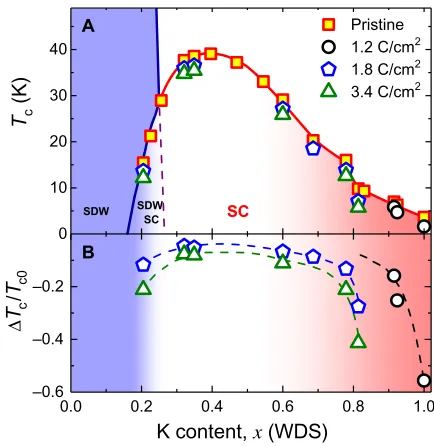
Figure 2A shows the composition phase diagram of BaK122 com-pounds. The superconducting transition temperature,Tc(x), was determined as the midpoint of the transition in penetration depth mea-surements (see fig. S1). For pristine samples,Tc0(x) shows its maximum value of 39 K at aroundx≈0.40 and gradually decreases toward lower and higherx, forming a ubiquitous superconducting“dome.”Although the evolution ofTc(x) is smooth in general, there is an apparent jump nearx= 0.80. This anomaly correlates with the appearance of accidental nodes induced in this material as a consequence of the Lifshitz transition (35). For most compositions shown in Fig. 2, the same samples were electron-irradiated and the London penetration depth was measured before and after each irradiation run. The relative change, (Tc−Tc0)/Tc0, is shown in Fig. 2B for the same samples as in Fig. 2A. The largest suppression of ~47% per 1 C/cm2(~56.4% for 1.2 C/cm2) was found in pure KFe2As2, and the smallest suppression was found in the optimally doped compounds.
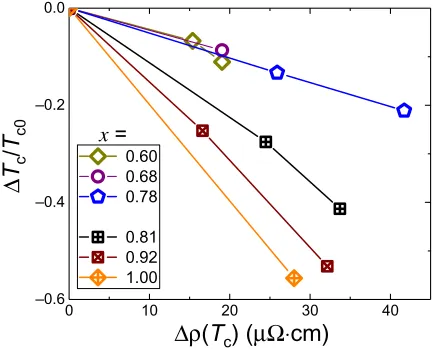
As shown in Fig. 3, the“physically meaningful”normalizedTc sup-pression plotted versus resistivity atTcshows a significant increase when transitioning from optimal to overdoped regimes. Note that because of
-+
x= 1.0
x= 0.9
x= 0.8
Γ
M
Lifshitz
transition
x= 0.4
B
M
Γ
A
+
--
-- +
--
-- +
-Fig. 1. (Color online) Schematic illustration of the effective band struc-ture and order parameter evolution with doping.(A) Change in the electronic band structure across the Lifshitz transition. The electron pocket atMis lifted but remains in the vicinity ofEF. The extendeds±pairing survives
but is shifted to the hole bands at theGpoint. (B) Hole and electron pockets relevant for calculations with the sign-changing order parameter. Signs are encoded by green (+) and red (−) colors.
0 10 20 30 40
Pristine
1.2 C/cm2
1.8 C/cm2
3.4 C/cm2
SDW
Tc
(K
)
A
SC
SDW SC
0.0 0.2 0.4 0.6 0.8 1.0
0.6 0.4 –
–
– 0.2
K content,x(WDS)
B
∆
Tc
/
Tc0
Fig. 2. (Color online)Temperature-composition phase diagram.(A) Composition-dependent superconducting transition temperature,Tc(x), in pristine (squares)
and electron-irradiated (other symbols, see legend) samples. SDW, spin-density wave; SC, superconducting phase. (B) NormalizedDTc/Tc0. The largestTc
[image:4.594.57.272.422.619.2]magnetic ordering, these rates should not be compared directly to those of the underdoped regime, which require a separate analysis as a result of the competition between superconductivity and magnetism (36).
In terms of the rate per irradiation fluence, the normalized suppres-sion rate of optimally doped samples (fig. S4A) is about 0.025 per 1 C/cm2 and increases to 0.07 per 1 C/cm2in the underdoped samples (x= 0.22), consistent with our previous report (7). In sharp contrast, the suppres-sion rate increases markedly in the far overdoped region, reaching 0.47 per 1 C/cm2, which is 20 times larger than that of the optimally doped regime. All these numbers for the rate ofTcsuppression (i) are much greater than those expected from conventionals++pairing and (ii) can be explained within a generalizeds±pairing model if one is allowed to tune gap anisotropy and the ratio of interband/intraband scattering [see Prozorovet al. (27) and references therein].
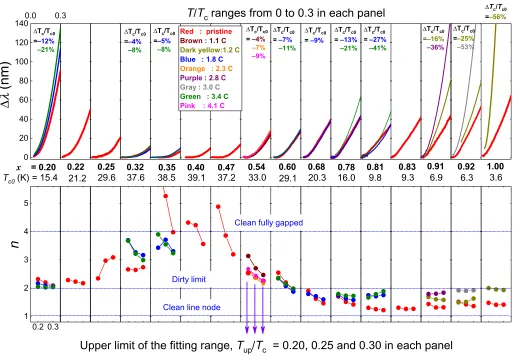
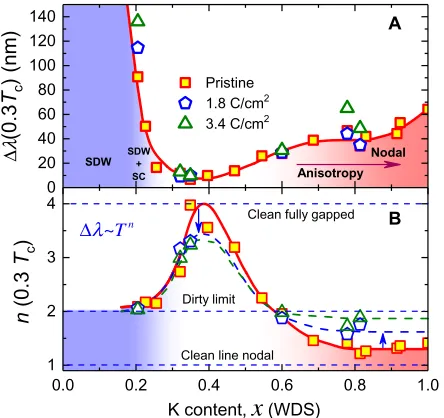
To understand the evolution of the superconducting gap with dop-ing and disorder, we analyze the low-temperature behavior of the London penetration depth in terms of the power law,Dl(T) =A(T/Tc)n, as shown in Fig. 4 and summarized in Fig. 5. To present the observed sys-tematic trends, the upper panels in Fig. 4 showDl(T) on a fixed scale of 0 to 140 nm and at a temperature range of 0 to 0.3 (T/Tc) (fig. S1 shows full-range curves). Figure 5A shows the composition variation of Dl(0.3T/Tc) reflecting the density of thermally excited quasi-particles. There is a clear trend of a marked increase inDlas we move away from optimal doping. At smallx, this trend is naturally explained in terms of the competition between superconducting and SDW order (7,36,37). The increase toward the underdoped region is quite monotonic, whereas the increase towardx= 1 is distinctly nonmonotonic. There is even some decrease ofDl(0.3Tc) aroundx= 0.80, coincident with the anomaly inTc(x) (Fig. 2) and where the Lifshitz transition is believed to occur (21). Similar nonmonotonic behavior in the same region was reported before (15); thus, it seems that this is not an experimental ab-erration. In fact, this feature may signal the onset of accidental nodes near the Lifshitz transition (35).
The lower panels in Fig. 4 show the exponent,n, obtained in the power-law fitting. To examine the robustness of the power-law repre-sentation, fitting ofDl(T/Tc) was performed from the base temperature up to three different upper limits,Tup/Tc= 0.2, 0.25, and 0.30. The results
are shown by three points in each frame of the lower panel in Fig. 4. Figure 5B summarizes the composition and irradiation evolution of the exponentnobtained atTup/Tc= 0.3. Horizontal lines show three principal limits of the exponentnexpected for different scenarios. A clean line nodal gap corresponds ton= 1, whereas exponential behavior is experimentally not distinguishable from a large exponent (n≥3 to 4). In all cases,n= 2 is the terminal dirty limit for any scenario with pair-breaking (s±ordwave), but it should be exponential fors++pairing where nonmagnetic scattering is not pair-breaking.
At smallx, in the coexistence regime, the gap anisotropy increases, but we find no evidence of nodes, consistent with previous studies (7,36). This result argues against ans++gap structure, in which the reconstruction of Fermi surfaces due to SDW order must lead to robust nodes (37). Upon electron irradiation,Tcslowly decreases, suggesting moderate gap anisotropy and the presence of small but significant interband impurity scattering (38). Close to the optimal composition ofx= 0.4, the penetration depth exponentndecreases significantly with irradiation, providing strong evidence fors±pairing. On the other hand, even upon a high-dose irradiation of 3.4 C/cm2, the exponent remains greater thann= 3, whereasTcdecreases by 8%, which is suggestive of robust full gaps. In a fully gappeds++state, the only effect of disorder is to average the gap over the Fermi surface, leading in-evitably to the increase of the minimum gap and therefore an increase in the exponentnwith disorder, contrary to our observations.
Moving to a higherxaway from optimal composition, the gap an-isotropy increases and the exponentnfor the pristine samples decreases. Upon irradiation, the gap anisotropy is smeared out and the exponent increases even in thes±case, provided that all bands are still fully gapped and the intraband impurity scattering is dominant. This is apparently the case forx= 0.54. For yet higher doping levels, the anisotropy becomes so strong that the system develops accidental nodes (n→ 1), which, in this case, are apparently not lifted by the disorder (39). This is possibly due to (i) the substantial change in the electronic band struc-ture approaching the Lifshitz transition and/or (ii) substantial interband impurity scattering. Note that this evolution is very different from the isovalently substituted BaFe2(As,P)2(30) in which line nodes are found at allxvalues and the band structure is unchanged. In our case, at a large x, the exponential temperature dependence in pristine samples changes to∼T2at aroundx= 0.60 and tends toward∼Tatx≥0.80, indicative of gaps with line nodes. Unlike the optimally doped region, the electron irradiation is much more effective in decreasingTc, that is, 41% upon 3.4 C/cm2(x= 0.81) and 56% upon 1.2 C/cm2(x= 1.00). Nevertheless, the exponentnnever exceeds 2.
s±superconductivity in the overdoped region
In previous studies of London penetration depth and thermal conduc-tivity in overdoped samples, nodal behavior was identified abovex= 0.8 and attributed to a crossover from a fully isotropics-wave state with sign change between electron and hole pockets to a new type ofs±pairing with sign change between the hole pockets (15), which also acquired accidental nodes. Thermal conductivity measurements of the end mem-ber, atx= 1, indicate line nodes and were interpreted in terms ofd-wave pairing (13,40), which was also claimed theoretically (24). Here, we add an additional restriction on possible interpretations by looking simulta-neously at the variation ofTcand temperature-dependent London pen-etration depth with controlled point-like disorder. As we mentioned above, the suppression ofTcwith irradiation at optimal doping rules out a globals++state. Now, the challenge is to begin with a“conventional”
0 10 20 30 40
–0.6 –0.4 –0.2 0.0
0.60 0.68 0.78
0.81 0.92 1.00
∆
T
c/
T
c0∆ρ
(
T
c) (
µΩ⋅
cm)
x
=
Fig. 3. (Color online) Normalized suppression,DTc/Tc0versus resistivity atTcobtained from normal skin depth (see fig. S2).
R E S E A R C H A R T I C L E
[image:5.594.56.277.491.666.2](nodeless)s±state and determine whether a reasonable model of super-conducting gap and its evolution with composition can be constructed to describe all experimental results. We find that a generalized sign-changings±state with accidental nodes can be used to describe the en-tire phase diagram, including a crossover from nodeless to nodal gap. The novel assertion of our approach is that with electron pockets absent above Lifshitz transition,x> 0.8, thes±pairing shifts to hole pockets, naturally resulting in a nodal state.
We use the self-consistentt-matrix formalism and sign-changings± state to describe both the London penetration depth and theTc suppres-sion rate for different levels of disorder. To keep the analysis tractable and to fit the experimental data, we minimize our parameter set by working in the 2Fe-BZ and modeling the gap structure as shown sche-matically in Fig. 1. Specifically, before the Lifshitz transitions, two elec-tron pockets at theMpoint and two hole pockets at theGpoint are each modeled as a singleC4symmetric pocket with gap, DeðfÞ ¼Disoe þ Danie cos 4fandDh1ðfÞ ¼D
iso h1 þD
ani
h1 cos 4f, respectively. Here, angle
fis measured from the zone diagonal. After the Lifshitz transition, the electron pockets disappear, and the two model bands now corre-spond to two hole pockets. Each hole pocket gap is now modeled
inde-pendently, with its own isotropic and anisotropic components, Dh2 ¼D
iso h2 þD
ani
h2 cos 4f. We realize that the actual band structure is
more complex, and its evolution across the Lifshitz transition involves several bands changing across the Brillouin zone. However, we find that a model with two effective gaps each having isotropic and anisotropic parts is sufficient to explain the observed results.
First, we fit the data for the pristine samples and then include im-purity scattering within self-consistentt-matrix formalism (41–44). We model the defects induced by electron irradiation as point-like scat-terers, which scatter between the bands with a certain (interband) am-plitude and within the same band with another (inband) amam-plitude. The presence of interband impurity scattering and the relative sign change between these two bands are necessary to explain theTc sup-pression and penetration depth in the irradiated samples (see the Sup-plementary Materials for details of the fitting procedure). The obtained gap amplitudes are shown in Fig. 6 as a function of composition,x. It is important that the average gap h1on one of the hole bands changes its sign with increasingx. This is essential to fit theTcsuppression and penetration depth on equal footing in a self-consistent manner (see fig. S4b). Without a relative sign change between the hole pockets, even
0.0 0.3
0 20 40 60 80 100 120 140
0.2 0.3 1 2 3 4 5
3.6 6.3 6.9 9.3 9.8 16.0 20.3 29.1 33.0 37.2 39.1 38.5 37.6 29.6 21.2 Tc0(K) = 15.4
∆Tc/Tc0
=–12%
–21%
∆
(nm)
x = 0.20 0.22 0.25 0.32 0.35 0.40 0.47 0.54 0.60 0.68 0.78 0.81 0.83 0.91 0.92 1.00
∆Tc/Tc0
=–4%
–8%
∆Tc/Tc0
=–13%
–21%
∆Tc/Tc0
=–27%
–41%
∆Tc/Tc0
=–7%
–11%
T
/
T
cranges from 0 to 0.3 in each panel
Dirty limit
Clean line node
n
Clean fully gapped
Upper limit of the fitting range,
T
up/
T
c= 0.20, 0.25 and 0.30 in each panel
∆Tc/Tc0
=–5%
–8%
∆Tc/Tc0
=–4% –7% –9% Red : pristine
Brown : 1.1 C Dark yellow:1.2 C
Blue : 1.8 C Orange : 2.3 C Purple : 2.8 C
Gray : 3.0 C Green : 3.4 C
Pink : 4.1 C
∆Tc/Tc0 =–16% –36%
∆Tc/Tc0
=–56% ∆Tc/Tc0
=–9%
∆Tc/Tc0
=–25%
–53%
λ
Fig. 4. (Color online) Evolution of temperature dependence of London penetration depth (Dl).Upper panels:D(T/Tc) for 16 different compositions before and after electron irradiation. Each individual panel shows a low-temperature region ofT/Tc< 0.3 (full-range curves are shown in fig. S1). Lower panels:
Exponentnobtained from the power-law fitting,Dl=A(T/Tc)n. For each curve, three different upper-limit temperatures were used,Tup/Tc= 0.20, 0.25, and
[image:6.594.43.559.296.653.2]a strong interband impurity scattering will average the gap anisotropy, leading to a weak suppression ofTcand activated behavior in the tem-perature dependence of the low-temtem-perature penetration depth, which is not in agreement with the data. The obtained evolution of gaps sug-gests a new paradigm where ans±superconducting state with relative sign change between the hole and electron pockets at moderate doping levels evolves into ans±state with the sign change between the hole bands with accidental line nodes. This evolution of the gap structure is shown schematically in Fig. 1 and is the central result of this paper. We note that if one concentrates exclusively on Fermi surface– integrated quantities, such as thermal conductivity or penetration depth, distinguishingd-wave states from anisotropic, deeply nodals states can be very difficult. As shown in Fig. 7, bothd-wave and aniso-tropics±states give reasonable fits to the pristine penetration depth data forx= 1.0. Furthermore, distinguishing on the basis of disorder is dif-ficult because here we do not have a well-established link between the pair-breaking rate and irradiation dosage; thus, it is possible to find parameters for either“dirtydwave”or“dirty nodalswave”cases that fit both theDlandDTcdata for the singlex= 1 sample. However, on the basis of the fits to the heavily K-doped alloys nearx= 0.9 in Fig. 7, we see that there is substantial additional curvature at low temperatures that is incompatible with the cos 2fdwave. It is conceivable that a strong anti-phase cos 6fcomponent in ad-wave state could fit the penetration depth data. However, there is no theory in support of such a state, and we therefore conclude that the superconducting condensate in this system hass-wave symmetry throughout the phase diagram and simply evolves in an anisotropic manner as roughly depicted in Fig. 1. In Fig. 7, we show a comparison between the state with accidental nodes and a d-wave state forx= 0.91 andx= 0.92. Forx= 0.91 andx= 0.92, we see the incompatibility of ad-wave gap with experimental data. However,
forx= 1.0, bothd-wave ands±states with accidental nodes can fit the data. Thus, we cannot rule out a crossover betweens-wave andd-wave symmetries betweenx= 0.92 andx= 1.0. However, ARPES measure-ments provide a strong argument against this scenario (11).
An additional argument favorings±pairing with accidental nodes over thedwave is the nonmonotonicity ofDl(0.3Tc,x) nearx~ 0.8 (see Fig. 5). Because of an overall decrease inTcin the overdoped region, the normal fluid density in an isotropics-wave ord-wave state is expected to monotonically increase. On the other hand, this nonmono-tonicity occurs naturally during a smooth onset of accidental nodes— where a fully gappedD(f) near the expected nodal region transits to a linear-in-fdependence through an intermediate quadratic,D(f)∼f2, dependence. Accidental nodes not only are more probable fors-wave pairing as opposed tod-wave pairing but also are expected to appear around the Lifshitz transition (35). Of course, nonmonotonicity of Dl(0.3Tc,x) does not uniquely imply accidental nodes, but accidental nodes naturally lead to the observed nonmonotonic behavior. This scenario can also explain variations observed at the lowest temperatures for close compositions, such asx= 0.91 and 0.92 (see Fig. 7).
We emphasize that our analysis of the rate ofTcsuppression by non-magnetic scattering supports accidental nodes in ans±state rather than in ans++state. Although a small gap could be present in thex= 0.92 sample, atx= 1, our data and fitting appear to rule this out. However, within our experimental temperature range, down to 50 mK, it is im-possible from the penetration depth alone to definitively rule out gaps on the order of 0.1 meV or smaller, such as those suggested by the anal-ysis of the specific heat experiments (17,18).
Nevertheless, our systematic measurements and analysis of many different compositions add to the growing experimental support for thes-wave origin of the pairing interaction nearx∼1 (and there-fore over the whole phase diagram). This, in turn, indicates that any
0 20 40 60 80 100 120 140
Anisotropy
SDW + SC
Pristine 1.8 C/cm2 3.4 C/cm2
SDW
A
∆
λ
(0.3
Tc
)(
nm
)
Nodal
0.0 0.2 0.4 0.6 0.8 1.0
1 2 3 4
B
n
(0.3
Tc
)
K content,
x
(WDS)Clean fully gapped
Clean line nodal Dirty limit
~ n T ∆λ
Fig. 5. (Color online) Absolute change ofDlfrom 0 to 0.3Tcfor all com-positions.(A) The change in the London penetration depth,Dl(0.3Tc), versus
xfor pristine and postirradiated samples. (B) Composition dependence of the power-law exponentnfor pristine and irradiated samples. As the ir-radiation dose increases, the exponent approaches, but never exceeds the value ofn= 2.
0.4 0.5 0.6 0.7 0.8 0.9 1.0
2 – –1
0 1 2
∆eiso ∆eani ∆h2iso ∆h2ani ∆h1iso ∆h1ani
∆
/
T
cK content,x(WDS)
Nodal
Fig. 6. (Color online) Evolution of the superconducting gaps in BaK122 with composition,x, obtained from self-consistentt-matrix fitting (see fig. S3) as described in the text.Assumed angular variations of the gaps is shown schematically in Fig. 1. As long as the isotropic part is greater than the anisotropic one, the state is nodeless (that is, forx< 0.8). In the opposite limit, the nodes appear. This is shown by inscribed triangles in the figure for h1contribution. Consequently, thes±pairing switches from
hole-electron pockets below the Lifshitz transition to hole-hole above.
R E S E A R C H A R T I C L E
[image:7.594.54.276.418.627.2] [image:7.594.323.540.431.610.2]competingd-wave channel, as predicted by many theoretical ap-proaches, is competitive but subleading all the way up tox= 1. The extent of this competition can be addressed by probing collective modes in the nonpairing channel using other experimental tech-niques (for example, Raman scattering). We note that some studies of thex= 1 composition under pressure also propose a change of pairing symmetry fromdtos(45). Our work poses severe difficulties for such an interpretation.
CONCLUSIONS
In conclusion, we used deliberately introduced point-like disorder as a phase-sensitive tool to study the compositional evolution of the superconducting gap structure in BaK122. Measurements of both the low-temperature variation of London penetration depth andTc sup-pression provided stringent constraints on the possible gap structures. By using a generalizeds±model andt-matrix calculations, we were able to describe the compositional evolution of the superconducting gap, in-cluding a crossover from nodeless to nodal concomitant with the Lifshitz transition. Our model provides a natural interpretation of the rich physics of this system and shows thats±pairing is a very robust state of iron pnictides.
MATERIALS AND METHODS
Crystal growth
We developed an inverted temperature gradient method to grow large and high-quality single crystals of BaK122. The starting materials—Ba and K lumps, and Fe and As powders—were weighed and loaded into an alumina crucible in a glove box. The alumina crucible was sealed in a tantalum tube by arc welding. The tantalum tube was then sealed in a quartz ampoule to prevent the tantalum tube from oxidizing in the fur-nace. The crystallization processes from the top of a liquid melt help to expel impurity phases during the crystal growth, compared to the growth inside the flux. Details of the growth and detailed characteriza-tion for the entire dome can be found elsewhere (46,47).
Sample characterization and selection
Sixteen different compositions ranging fromx= 0.20 to 1.00 were iden-tified using WDS. More than one sample of each composition was studied. The crystals had typical dimensions of 0.5 mm × 0.5 mm × 0.03 mm.
All samples were prescreened using a dipper version of the tunnel diode resonator (TDR) technique (48), using the sharpness of the super-conducting transition as a measure of quality in each particular piece. After this prescreening, the chemical composition of each individual sample was determined using WDS in a JEOL JXA-8200 electron mi-croprobe. In each sample, the composition was measured for 12 points per surface area and averaged (46).
The variation of in-plane London penetration depthDl(T) was measured down to 50 mK using a self-oscillating TDR (49–51). To study the effect of disorder,Dl(T) for each crystal was measured before and after the irradiation.
Electron irradiation
Irradiation by 2.5-MeV electrons was performed at the SIRIUS Pelletron in Laboratoire des Solides Irradiés at École Polytechnique (Palaiseau, France). The electrons created Frenkel pairs that acted as point-like atomic defects. Throughout the paper, the total acquired irradiation dose was conveniently measured in coulombs per square centimeter, where 1 C/cm2= 6.24 × 10¹⁸electrons/cm2. With a calculated head-on collision displacement energy for Fe ions of 22 eV and a cross section to create Frenkel pairs at 2.5 MeV of 115 barn (b), a dose of 1 C/cm2 resulted in about 0.07% of the defects per iron site. Similar numbers were obtained for other sites—cross sections for Ba and As are 105 and 35 b, respectively. It is known that the interstitials migrate to various sinks (surface, dislocations, etc) and vacancies remain in the lattice. The electron irradiation was conducted in liquid hydrogen at 22 K, and recombination of the vacancy-interstitial pairs upon warming up to room temperature was 20 to 30%, as measured directly from the decrease of residual resistivity (27). After initial annealing, the de-fects remained stable, which was established from remeasurements performed several months (up to more than a year) apart. In addition, by measuring the Hall coefficient, it was determined that electron ir-radiation did not change the effective doping level; neither did it in-duce a measurable magnetic signal, which would be detected in our sensitive TDR measurements.
SUPPLEMENTARY MATERIALS
Supplementary material for this article is available at http://advances.sciencemag.org/cgi/ content/full/2/9/e1600807/DC1
London penetration depth
T-matrix fitting procedure
fig. S1. (Color online) Full transition curves of∆l(T) for the studied samples. fig. S2. (Color online) Resistivity estimated from the skin depth (TDR).
fig. S3. (Color online)t-Matrix fitting of the London penetration depth for compositions spanning the superconductivity dome.
fig. S4. (Color online) Variation of superconducting critical temperature upon irradiation for different compositions.
fig. S5. (Color online) Comparison ofTcsuppression as a function of increasing disorder for
various possible scenarios for heavily overdoped systems.
REFERENCES AND NOTES
1. A. Chubukov, Pairing mechanism in Fe-based superconductors.Annu. Rev. Condens. Matter Phys.3, 57–92 (2012).
2. A. Chubukov, P. J. Hirschfeld, Iron-based superconductors, seven years later.Phys. Today
68, 46–52 (2015).
0.0 0.1 0.2
0 10 20 30 40 50 60 70
0.0 0.1 0.2 0.0 0.1 0.2 0.3
Data Extended s d-Wave
∆λ
(nm)
T/Tc
x= 0.91 x= 0.92 x= 1.00
Fig. 7. (Color online) The change in penetration depth for thex> 0.9 samples fitted with symmetry-imposedd-wave ands±states.Ford-wave fit, both the hole bands are assumed to have gaps of theDh1=h2cos 2fform.
The gap magnitudes (D01,D02) for dopingsx= 0.91, 0.92, and 1.00 are
[image:8.594.37.291.64.217.2]3. Z. Guguchia, R. Khasanov, Z. Bukowski, F. von Rohr, M. Medarde, P. K. Biswas, H. Luetkens, A. Amato, E. Morenzoni, Probing the pairing symmetry in the over-doped Fe-based super-conductor Ba0.35Rb0.65Fe2As2as a function of hydrostatic pressure.Phys. Rev. B93, 094513
(2016).
4. P. J. Hirschfeld, Using gap symmetry and structure to reveal the pairing mechanism in Fe-based superconductors.C. R. Phys.17, 197–231 (2016).
5. S. Maiti, M. M. Korshunov, T. A. Maier, P. J. Hirschfeld, A. V. Chubukov, Evolution of symmetry and structure of the gap in iron-based superconductors with doping and inter-actions.Phys. Rev. B84, 224505 (2011).
6. X. G. Luo, M. A. Tanatar, J.-P. Reid, H. Shakeripour, N. Doiron-Leyraud, N. Ni, S. L. Bud’ko, P. C. Canfield, H. Luo, Z. Wang, H.-H. Wen, R. Prozorov, L. Taillefer, Quasiparticle heat transport in single-crystalline (Ba1−xKx)Fe2As2: Evidence for ak-dependent
superconduct-ing gap without nodes.Phys. Rev. B80, 140503(R) (2009).
7. K. Cho, M. Kończykowski, J. Murphy, H. Kim, M. A. Tanatar, W. E. Straszheim, B. Shen, H. H. Wen, R. Prozorov, Effects of electron irradiation on resistivity and London penetra-tion depth Ba1−xKxFe2As2(x= 0.34) iron-pnictide superconductor.Phys. Rev. B90,
104514 (2014).
8. D. V. Evtushinsky, D. S. Inosov, V. B. Zabolotnyy, M. S. Viazovska, R. Khasanov, A. Amato, H.-H. Klauss, H. Luetkens, C. Niedermayer, G. L. Sun, V. Hinkov, C. T. Lin, A. Varykhalov, A. Koitzsch, M. Knupfer, B. Büchner, A. A. Kordyuk, S. V. Borisenko, Momentum-resolved superconducting gap in the bulk of Ba1−xKxFe2As2from combined ARPES andmSR
mea-surements.New J. Phys.11, 055069 (2009).
9. H. Ding, P. Richard, K. Nakayama, K. Sugawara, T. Arakane, Y. Sekiba, A. Takayama, S. Souma, T. Sato, T. Takahashi, Z. Wang, X. Dai, Z. Fang, G. F. Chen, J. L. Luo, N. L. Wang, Observation of Fermi-surface–dependent nodeless superconducting gaps in Ba0.6K0.4Fe2As2.Europhys. Lett.83, 47001 (2008).
10. K. Nakayama, T. Sato, P. Richard, Y.-M. Xu, T. Kawahara, K. Umezawa, T. Qian, M. Neupane, G. F. Chen, H. Ding, T. Takahashi, Universality of superconducting gaps in overdoped Ba0.3K0.7Fe2As2observed by angle-resolved photoemission spectroscopy.Phys. Rev. B
83, 020501(R) (2011).
11. Y. Ota, K. Okazaki, Y. Kotani, T. Shimojima, W. Malaeb, S. Watanabe, C.-T. Chen, K. Kihou, C. H. Lee, A. Iyo, H. Eisaki, T. Saito, H. Fukazawa, Y. Kohori, S. Shin, Evidence for excluding the possibility ofd-wave superconducting-gap symmetry in Ba-doped KFe2As2.Phys. Rev.
B89, 081103(R) (2014).
12. T. Shimojima, K. Okazaki, S. Shin, Low-temperature and high-energy-resolution laser pho-toemission spectroscopy.J. Phys. Soc. Jpn.84, 072001 (2015).
13. J.-P. Reid, M. A. Tanatar, A. Juneau-Fecteau, R. T. Gordon, S. René de Cotret, N. Doiron-Leyraud, T. Saito, H. Fukazawa, Y. Kohori, K. Kihou, C. H. Lee, A. Iyo, H. Eisaki, R. Prozorov, L. Taillefer, Universal heat conduction in the iron arsenide superconductor KFe2As2: Evidence of ad-wave state.Phys. Rev. Lett.109, 087001 (2012).
14. X.-C. Hong, A.-F. Wang, Z. Zhang, J. Pan, L.-P. He, X.-G. Luo, X.-H. Chen, S.-Y. Li, Doping evolution of the superconducting gap structure in heavily hole-doped Ba1−xKxFe2As2: A
heat transport study.Chin. Phys. Lett.32, 127403 (2015).
15. D. Watanabe, T. Yamashita, Y. Kawamoto, S. Kurata, Y. Mizukami, T. Ohta, S. Kasahara, M. Yamashita, T. Saito, H. Fukazawa, Y. Kohori, S. Ishida, K. Kihou, C. H. Lee, A. Iyo, H. Eisaki, A. B. Vorontsov, T. Shibauchi, Y. Matsuda, Doping evolution of the quasiparticle excitations in heavily hole-doped Ba1−xKxFe2As2: A possible superconducting gap with
sign-reversal between hole pockets.Phys. Rev. B89, 115112 (2014).
16. K. Hashimoto, A. Serafin, S. Tonegawa, R. Katsumata, R. Okazaki, T. Saito, H. Fukazawa, Y. Kohori, K. Kihou, C. H. Lee, A. Iyo, H. Eisaki, H. Ikeda, Y. Matsuda, A. Carrington, T. Shibauchi, Evidence for superconducting gap nodes in the zone-centered hole bands of KFe2As2from magnetic penetration-depth measurements.Phys. Rev. B82, 014526
(2010).
17. F. Hardy, R. Eder, M. Jackson, D. Aoki, C. Paulsen, T. Wolf, P. Burger, A. Böhmer, P. Schweiss, P. Adelmann, R. A. Fisher, C. Meingast, Multiband superconductivity in KFe2As2:
Evi-dence for one isotropic and several lilliputian energy gaps.J. Phys. Soc. Jpn.83, 014711 (2014).
18. F. Hardy, A. E. Böhmer, L. de’Medici, M. Capone, G. Giovannetti, R. Eder, L. Wang, M. He, T. Wolf, P. Schweiss, R. Heid, A. Herbig, P. Adelmann, R. A. Fisher, C. Meingast, Strong cor-relations, strong coupling and s-wave superconductivity in hole-doped BaFe2As2single
crystals. arXiv:1605.05485 (2016).
19. H. Kawano-Furukawa, C. J. Bowell, J. S. White, R. W. Heslop, A. S. Cameron, E. M. Forgan, K. Kihou, C. H. Lee, A. Iyo, H. Eisaki, T. Saito, H. Fukazawa, Y. Kohori, R. Cubitt, C. D. Dewhurst, J. L. Gavilano, M. Zolliker, Gap in KFe2As2studied by small-angle neutron scattering
observa-tions of the magnetic vortex lattice.Phys. Rev. B84, 024507 (2011).
20. C. Liu, T. Kondo, R. M. Fernandes, A. D. Palczewski, E. Deok Mun, N. Ni, A. N. Thaler, A. Bostwick, E. Rotenberg, J. Schmalian, S. L. Bud’ko, P. C. Canfield, A. Kaminski, Evidence for a Lifshitz transition in electron-doped iron arsenic superconductors at the onset of superconductivity.Nat. Phys.6, 419–423 (2010).
21. N. Xu, P. Richard, X. Shi, A. van Roekeghem, T. Qian, E. Razzoli, E. Rienks, G.-F. Chen, E. Ieki, K. Nakayama, T. Sato, T. Takahashi, M. Shi, H. Ding, Possible nodal superconducting gap and Lifshitz transition in heavily hole-doped Ba0.1K0.9Fe2As2.Phys. Rev. B88, 220508(R) (2013).
22. P. Richard, T. Qian, H. Ding, ARPES measurements of the superconducting gap of Fe-based superconductors and their implications to the pairing mechanism.J. Phys. Condens. Matter
27, 293203 (2015).
23. S. Maiti, M. Sigrist, A. Chubukov, Spontaneous currents in a superconductor withs+is
symmetry.Phys. Rev. B91, 161102(R) (2015).
24. R. Thomale, C. Platt, W. Hanke, J. Hu, B. A. Bernevig, Exoticd-wave superconducting state of strongly hole-doped KxBa1−xFe2As2.Phys. Rev. Lett.107, 117001 (2011).
25. C. Platt, R. Thomale, C. Honerkamp, S.-C. Zhang, W. Hanke, Mechanism for a pairing state with time-reversal symmetry breaking in iron-based superconductors.Phys. Rev. B85, 180502 (2012).
26. R. M. Fernandes, A. J. Millis, Nematicity as a probe of superconducting pairing in iron-based superconductors.Phys. Rev. Lett.111, 127001 (2013).
27. R. Prozorov, M. Kończykowski, M. A. Tanatar, A. N. Thaler, S. L. Bud’ko, P. C. Canfield, V. Mishra, P. J. Hirschfeld, Effect of electron irradiation on superconductivity in single crystals of Ba(Fe1−xRux)2As2(x= 0.24).Phys. Rev. X4, 041032 (2014).
28. D. V. Efremov, M. M. Korshunov, O. V. Dolgov, A. A. Golubov, P. J. Hirschfeld, Disorder-induced transition betweens±ands++states in two-band superconductors.Phys. Rev. B
84, 180512(R) (2011).
29. Y. Wang, A. Kreisel, P. J. Hirschfeld, V. Mishra, Using controlled disorder to distinguishs±
ands++gap structure in Fe-based superconductors.Phys. Rev. B87, 094504 (2013).
30. Y. Mizukami, M. Konczykowski, Y. Kawamoto, S. Kurata, S. Kasahara, K. Hashimoto, V. Mishra, A. Kreisel, Y. Wang, P. J. Hirschfeld, Y. Matsuda, T. Shibauchi, Disorder-induced topological change of the superconducting gap structure in iron pnictides.Nat. Commun.
5, 5657 (2014).
31. C. P. Strehlow, M. Kończykowski, J. A. Murphy, S. Teknowijoyo, K. Cho, M. A. Tanatar, T. Kobayashi, S. Miyasaka, S. Tajima, R. Prozorov, Comparative study of the effects of elec-tron irradiation and natural disorder in single crystals of SrFe2(As1−xPx)2superconductor (x=
0.35).Phys. Rev. B90, 020508(R) (2014).
32. X. Chen, S. Maiti, A. Linscheid, P. J. Hirschfeld, Electron pairing in the presence of incipient bands in iron-based superconductors.Phys. Rev. B92, 224514 (2015).
33. A. Linscheid, S. Maiti, Y. Wang, S. Johnston, P. J. Hirschfeld, High Tc via spin fluctuations from incipient bands: Application to monolayers and intercalates of FeSe. arXiv:1603.03739 (2016).
34. K. Okazaki, Y. Ota, Y. Kotani, W. Malaeb, Y. Ishida, T. Shimojima, T. Kiss, S. Watanabe, C.-T. Chen, K. Kihou, C. H. Lee, A. Iyo, H. Eisaki, T. Saito, H. Fukazawa, Y. Kohori, K. Hashimoto, T. Shibauchi, Y. Matsuda, H. Ikeda, H. Miyahara, R. Arita, A. Chainani, S. Shin, Octet-line node structure of superconducting order parameter in KFe2As2.Science
337, 1314–1317 (2012).
35. S. Maiti, M. M. Korshunov, A. V. Chubukov, Gap symmetry in KFe2As2and the cos 4qgap
component in LiFeAs.Phys. Rev. B85, 014511 (2012).
36. H. Kim, M. A. Tanatar, W. E. Straszheim, K. Cho, J. Murphy, N. Spyrison, J.-P. Reid, Bing Shen, Hai-Hu Wen, R. M. Fernandes, R. Prozorov, Competition between superconductivity and magnetic/nematic order as a source of anisotropic superconducting gap in underdoped Ba1−xKxFe2As2.Phys. Rev. B90, 014517 (2014).
37. D. Parker, M. G. Vavilov, A. V. Chubukov, I. I. Mazin, Coexistence of superconductivity and a spin-density wave in pnictide superconductors: Gap symmetry and nodal lines.Phys. Rev. B
80, 100508(R) (2009).
38. V. Mishra, Effect of disorder on superconductivity in the presence of spin-density wave order.Phys. Rev. B91, 104501 (2015).
39. V. Mishra, G. Boyd, S. Graser, T. Maier, P. J. Hirschfeld, D. J. Scalapino, Lifting of nodes by disorder in extended-s-state superconductors: Application to ferropnictides.Phys. Rev. B
79, 094512 (2009).
40. J.-P. Reid, A. Juneau-Fecteau, R. T. Gordon, S. René de Cotret, N. Doiron-Leyraud, X. G. Luo, H. Shakeripour, J. Chang, M. A. Tanatar, H. Kim, R. Prozorov, T. Saito, H. Fukazawa, Y. Kohori, K. Kihou, C. H. Lee, A. Iyo, H. Eisaki, B. Shen, H.-H. Wen, L. Taillefer, From d-wave to s-wave pairing in the iron-pnictide superconductor (Ba,K)Fe2As2.Supercond. Sci. Technol.25,
084013 (2012).
41. P. J. Hirschfeld, N. Goldenfeld, Effect of strong scattering on the low-temperature pene-tration depth of ad-wave superconductor.Phys. Rev. B48, 4219(R) (1993).
42. P. J. Hirschfeld, P. Wölfle, D. Einzel, Consequences of resonant impurity scattering in an-isotropic superconductors: Thermal and spin relaxation properties.Phys. Rev. B37, 83–97 (1988).
43. V. Mishra, S. Graser, P. J. Hirschfeld, Transport properties of three-dimensional extendeds-wave states in Fe-based superconductors.Phys. Rev. B84, 014524 (2011).
44. V. Mishra, A. Vorontsov, P. J. Hirschfeld, I. Vekhter, Theory of thermal conductivity in extended-sstate superconductors: Application to ferropnictides.Phys. Rev. B80, 224525 (2009).
45. F. F. Tafti, A. Ouellet, A. Juneau-Fecteau, S. Faucher, M. Lapointe-Major, N. Doiron-Leyraud, A. F. Wang, X.-G. Luo, X. H. Chen, L. Taillefer, Universal V-shaped temperature-pressure phase diagram in the iron-based superconductors KFe2As2, RbFe2As2, and CsFe2As2.Phys.
Rev. B91, 054511 (2015).
R E S E A R C H A R T I C L E
46. Y. Liu, M. A. Tanatar, W. E. Straszheim, B. Jensen, K. W. Dennis, R. W. McCallum, V. G. Kogan, R. Prozorov, T. A. Lograsso, Comprehensive scenario for single-crystal growth and doping dependence of resistivity and anisotropic upper critical fields in (Ba1−xKx)Fe2As2(0.22 <x<
1).Phys. Rev. B89, 134504 (2014).
47. Y. Liu, M. A. Tanatar, V. G. Kogan, H. Kim, T. A. Lograsso, R. Prozorov, Upper critical field of high-quality single crystals of KFe2As2.Phys. Rev. B87, 134513 (2013).
48. N. Spyrison, M. A. Tanatar, Kyuil Cho, Y. Song, P. Dai, C. Zhang, R. Prozorov, Environmental stability and anisotropic resistivity of Co-doped Na1−dFe1−xCoxAs.Phys. Rev. B86, 144528
(2012).
49. R. Prozorov, R. W. Giannetta, A. Carrington, F. M. Araujo-Moreira, Meissner-London state in superconductors of rectangular cross section in a perpendicular magnetic field.Phys. Rev. B62, 115–118 (2000).
50. R. Prozorov, R. W. Giannetta, Magnetic penetration depth in unconventional superconduc-tors.Supercond. Sci. Technol.19, R41 (2006).
51. R. Prozorov, V. G. Kogan, London penetration depth in iron-based superconductors.Rep. Prog. Phys.74, 124505 (2011).
Acknowledgments:We thank A. Chubukov, R. Fernandes, Y. Matsuda, I. Mazin, T. Shibauchi, and L. Taillefer for useful discussions.Funding:This work was supported by the U.S. Depart-ment of Energy (DOE), Office of Science, Basic Energy Sciences, Materials Science and Engi-neering Division. Ames Laboratory is operated for the U.S. DOE by Iowa State University under contract DE-AC02-07CH11358. We thank the SIRIUS team, O. Cavani, B. Boizot, V. Metayer, and J. Losco, for running electron irradiation at École Polytechnique [supported by the EMIR (Réseau national d’accélérateurs pour les Etudes des Matériaux sous Irradiation) network, proposal
11-11-0121]. V.M. acknowledges the support from the Laboratory Directed Research and Development Program of Oak Ridge National Laboratory, managed by UT-Battelle, LLC, for the U.S. DOE. P.J.H. and S.M. were partially supported by NSF-DMR-1005625.Author contributions:K.C. and S.T. con-ducted London penetration depth measurements. K.C. processed and analyzed raw data. M.K. led electron irradiation work. M.K., R.P. and K.C. performed electron irradiation. M.A.T. handled all sam-ple preparation and transport measurements. Y.L. and T.A.L. grew single crystals. W.E.S. performed WDS measurements. V.M., S.M., and P.J.H. led theoretical work. V.M. performedt-matrix fitting and data analysis. R.P. devised and coordinated the project. All authors extensively discussed the results, the models, and the interpretations. All authors contributed to the writing of the manu-script.Competing interests:The authors declare that they have no competing interests.Data and materials availability:All data needed to evaluate the conclusions in the paper are present in the paper and/or the Supplementary Materials. Additional data related to this paper may be requested from the authors.
Submitted 16 April 2016 Accepted 22 August 2016 Published 30 September 2016 10.1126/sciadv.1600807
Citation:K. Cho, M. Kończykowski, S. Teknowijoyo, M. A. Tanatar, Y. Liu, T. A. Lograsso, W. E. Straszheim, V. Mishra, S. Maiti, P. J. Hirschfeld, R. Prozorov, Energy gap evolution across the superconductivity dome in single crystals of (Ba1−xKx)Fe2As2.Sci. Adv.2,