2010 3rd International Conference on Biomedical Engineering and Informatics (BMEI 2010)
The Design of an EHR for Clinical Decision Support
Liang Xiao
a, Gráinne Cousins
b, Lucy Hederman
c, Tom Fahey
b, Borislav Dimitrov
ba Hubei University of Technology, China, b Royal College of Surgeons in Ireland, Ireland, c Trinity College Dublin, Ireland
Abstract :
In this paper, we give an overview of methadone treatment in Ireland and outline the rationale for designing an electronic healthcare record (EHR) with extensibility, interoperability and decision support functionality. Incorporating the openEHR standard, we designed a set of archetypes in line with the current best practice and clinical guidelines. They guide the information gathering process. A web-based data entry system has been implemented, incorporating elements of the paper-based prescription form, while at the same time facilitating the decision support function. The data collected via this Irish system can be aggregated into a larger dataset, if necessary, for analysis and evidence gathering, since we adopted the openEHR standard. It will be later extended to include the functionalities of prescribing drugs other than methadone during our work at the HRB Centre for Primary Care Research [1].
Keywords:
Clinical decision support system (CDSS), Clinical guideline, Computer based prescribing, Electronic healthcare record (EHR), Methadone maintenance therapy (MMT)
I BACKGROUND AND INTRODUCTION
Drug misuse is a major public health problem, both nationally and internationally. There was an estimated 14,452 opiate users identified in Ireland in 2001 [2].Drug misusers have an annual mortality rate six times higher than that for a general, age-matched population, with over two-thirds being due to drug overdoses [3].
Methadone is a synthetic opioid capable of blocking the euphoric effects of heroin and reduces cravings for the drug. Methadone therapy can be used as maintenance (methadone maintenance therapy or MMT), which involves the prescribing of methadone over an indefinite period of time. Alternatively, the dosage of methadone can be reduced over time (methadone reduction therapy) until the patient is drug free. MMT is the most common form of treatment. The aim of MMT is to replace illicit opiate use with a legally prescribed oral medication in order to provide the individual with a stable lifestyle. Evidence shows that effective MMT is associated with substantial health benefits for patients: decreasing use of heroin and other opioids; diminishing the transmission of opioid associated infectious disease such as hepatitis B and HIV; and reducing criminality behaviour in drug users who are stabilised on MMT [4], [5], [6].
Guidelines for treating opiate users in general practice are provided by the Irish College of General Practitioners (ICGP)
[7]. The aim of these guidelines is to provide GPs with the relevant information and recommendations needed to treat opiate users. The guidelines, published in the form of an information booklet, cover a wide range of issues such as initial assessment, prescribing and dispensing methadone, urine screening, management options, and on-going monitoring and review to name but a few. However, the main problem is that these guidelines are not integrated into an electronic patient record, thus do not provide patient-specific recommendations for individual patients.
The move from paper based record keeping to structured electronic records for MMT will help information collection and analysis, auditing, policy development as well as decision making in Ireland. Irish GP systems do not have a purpose-built facility for recording methadone-related prescribing, supervision, and review. Although GPs are expected to comply with the clinical guidelines set out in a paper format, they are not provided with a corresponding computerised support for monitoring or drug prescribing as part of their routine data recording. Therefore a national audit of MMT in Ireland is by necessity manual and thus very costly. In addition, any attempt to evaluate the implementation of clinical guidelines into practice is currently very difficult, due to a reliance on paper based prescribing or, in the best case scenario, poor and unstructured notes in disparate systems. More importantly, safe prescribing and proper supervision management can not be guaranteed. Human mistakes are more likely in the absence of a decision support system working behind daily prescribing practice.
The aim of the project is to establish a system which facilitates easy data entry and decision support for GPs, as well as easy data collection and auditing for clinical authorities. The system is designed to be generic and flexible to incorporate the need of data and knowledge management, with regards to medicine management in fields other than methadone prescribing, by meeting international standards and guidelines.
II DESIGN OF AN EHR FOR METHADONE TREATMENT
RECORDING
current problems and being an index to relevant parts of the record (progress notes) associated with the problems; 3) progress notes (SOAP):
S: The subjective experience by the patient of the problem, or the “reason for encounter”.
O: The objective clinical findings.
A: The assessment or diagnosis of the patient’s problem.
P: The process of care or intervention plan.
The use of the problem-oriented approaches can clearly divide medical records into background and consultation episodes each being in relation to or indexed by one or more problems. Highlighting the problem list at the front of the record or a summary sheet allows everyone involved in the care of the patient to be aware of the problem history, including those active and those inactive/resolved, and update status whenever they identify changes [17]. Information extraction or collection, and their analysis with regards to a particular problem will be relatively straightforward, since different problem parts are separately organised. Two major advantages of applying this model to building our EHR can be envisioned: 1) Extensibility. Opioid dependence is only one problem where methadone treatment is necessary. The independent arrangement of this part of the record can help its later merging into the record of other prescriptions addressing other problems, as well as its integration into other systems if the same model is adopted but where methadone treatment is not available. 2) Decision support. The continuous treatment on methadone is incrementally recorded in episodes of care. Being supplied with the knowledge of the past treatment history as well as the current condition of the patient, a decision support system can be designed and integrated into the EHR, which makes sense of the record and guides the current consultation. This requires the computerisation of the clinical guidelines and applying them upon the EHR, e.g. dosage and supervision recommendations over time, until the stabilisation of the patient on treatment.
We recognise that efforts have to be made in three directions, in applying the problem oriented approach to build the EHR and leverage its potential benefits of extensibility and decision support. Firstly, we must adopt a standard to classify different problem areas, so that record parts relevant to these can be distinguished, separately stored and easily queried. Secondly, we must adopt an open standard for modelling
methadone-related prescribing information in the episodes of
care without losing the generality or causing difficulties when later merging it into a larger data set. Thirdly, we must adopt a
terminology standard for the codification of information
pieces in the information model. In line with these requirements and the international standards, namely ICPC2, openEHR archetype, and SNOMED CT, we describe below a hierarchical EHR model of three levels, each being associated with a standard in the right position playing the right role.
Level 1: High level EHR model: care episodes and problem areas (standard: ICPC2)
ICPC2 can classify all but the objective clinical findings (O) in the previously mentioned SOAP structure. The biaxial
structure of ICPC2 has chapters which can model problem areas and components which can model the rest of SOAP: Component 1 (rubrics 1-29) for symptom (S), Component 7 (rubrics 70-99) for diagnosis (A), and Component 3 (rubrics 50-59) for treatment procedures and medication/ intervention
process (P). Recognising: 1) the recurring episodes (each
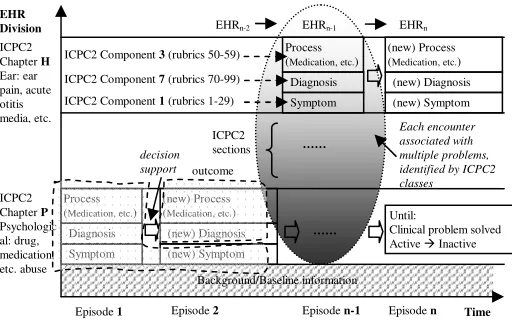
[image:2.612.317.573.260.428.2]being coded as per SOAP) over time accumulating EHR horizontally on X axis; and 2) the problem areas separating the EHR vertically on Y axis, we outline in Figure 1 a conceptual model for organising a complete EHR. It combines the SOAP approach and the ICPC2 coding system but also includes a timeline factor as it plays a role in decision support. Information spanning several problem areas may be organised into one subset record, e.g. a test result in chapter X and a medication order in chapter Y, since a single encounter can include multiple problems and customised data composition is often needed in the real world.
Figure 1. A conceptual model of (de)composing EHR
Assume ₣ is a decision logic function which takes the past records and current symptom and suggests current diagnosis and process to follow, the composition of an EHR depends upon the following components:
EHRn = EHRn-1 + (for each ICPC2 chapter) ∑ (symptomn +
₣ (EHRn-1 + symptomn) )
Such a model marks clinical concepts in three dimensions of 1) episode number; 2) problem area numbers or ICPC2 chapters; 3) SOAP sections or ICPC2 components, and links them together on a continuing timeframe in a decision logic function. In addition, it may help to analyse co-morbidity and model drug interaction across problem areas. Aiming at the maintenance of any current EHR in the hope of integrity and human error free, in the presence of ICPC2 chapter A with an associated disease A1 and medication A2, and in the context of dealing with an active ICPC2 chapter P in relation to methadone prescribing, one may be advised to activate a rule that automatically increases or decreases the dosage due to drug interaction. Such a model, nevertheless, may be confronted with a limitation if not complemented with another system covering greater granularity than ICPC2, e.g. drug abuse is P19 but how to represent methadone-specific concepts?
Background/Baseline information Symptom
Diagnosis Process (Medication, etc.) ICPC2
Chapter P
Psychologic al: drug, medication, etc. abuse
Episode 1 Time
EHR Division
Symptom Diagnosis Process (Medication, etc.) ICPC2
Chapter H
Ear: ear pain, acute otitis media, etc.
(new) Symptom (new) Diagnosis (new) Process (Medication, etc.)
Episode 2
(new) Symptom (new) Diagnosis (new) Process (Medication, etc.) EHRn-1 EHRn
EHRn-2
ICPC2
sections ……
Episode n-1 Episode n
decision support outcome
Each encounter associated with multiple problems, identified by ICPC2 classes
……
Until:
Clinical problem solved Active Inactive ICPC2 Component 3 (rubrics 50-59)
Level 2: Information model of EHR in the particular problem area of methadone treatment (standard: openEHR archetype)
The openEHR standard requires that an EHR system consists of at least an EHR repository, an archetype repository, terminology, and demographic information [10]. Demographics are included in the background information of Level 1 (and shown as a strip at bottom of Figure 1) and the terminology will be covered by Level 3. This Level 2 develops archetypes to confine the structures of EHR. Considering only methadone treatment, a band expanding along the X axis and falling into Chapter P on the Y axis in Figure 1 is our primary concern here. We need to represent all relevant components in a standardised manner, in order to support later data aggregation and interoperation.
The method advocated by openEHR for information recording, which it claims to be typical not just of clinical medicine but of science in general, models the iterative problem solving process as: observations
opinions/assessment instructions actions. This is
actually a synthesis model of Weed’s problem-oriented method and roughly, one can map these from the block of three components shown in Figure 1: “symptom” becomes
“observation”, “diagnosis” becomes “opinion or assessment”,
and “process” becomes “instruction” and “action”. The opinions/assessment part is where human hypothesis making or opinion forming bridges the incoming observations and outgoing instructions. It is also where the computer systems can support human decisions, integrating either evidence-based or guideline-based knowledge into the human personal knowledge base. From an opinion/assessment, further advice on prescribing instructions or dispensing actions can be suggested. Such knowledge deducing processes (human + machine) lead to EHR forming in Level 1, as concluded by formula ₣. In the entire process we mentioned above, the openEHR supports the modeling of information structures, by introducing equivalent kinds of archetypes:
openEHR-EHR-OBSERVATION, openEHR-EHR-EVALUATION,
openEHR-EHR-INSTRUCTION, openEHR-EHR-ACTION. Together
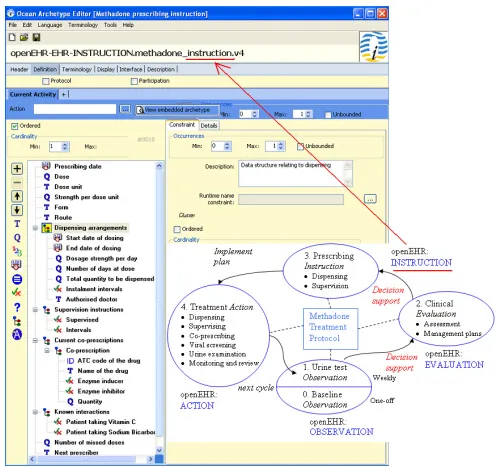
[image:3.612.316.564.51.285.2]with an “ADMIN_ENTRY”, they form the five concrete subtypes of the “ENTRY” class (being a collection of “Data Value” and collectively forming “Composition”). All clinical information can ultimately be expressed in “Entries”, or logical clinical statements. They are the most important in openEHR and make up the vast majority of archetypes defined for the EHR [10]. Some existing and reusable archetypes have been peer-reviewed and published in the openEHR online repository and are accessible at: http://www.openehr.org/knowledge/. We find they are general purpose, e.g. “medication order” cannot be taken directly but specialisation is needed for capturing the proper level of details. Nevertheless, such archetypes as alcohol consumption, tobacco use, or lab result may be included in a composition with our specifically designed archetypes, and support a larger variety of applications.
Figure 2. Design of four types of archetypes (OBSERVATION, EVALUATION, INSTRUCTION, ACTION) for the episode of methadone
treatment, with one example archetype of “Prescribing Instruction” being presented in an archetype editor
Our design of archetypes for the methadone treatment protocol accurately reflects the minimum requirements imposed upon the information collection processes by the current practice and clinical guidelines but also incorporates additional fields that impact on the decision making. In the beginning, a patient claiming to be using illicit opiate approaches the GP. The current paper-based “Addiction
Assessment Form” [7] is used to collect demographic data,
drug, medical, and social history, and establish the presence and severity of opiate dependence, prior to commencing methadone treatment, e.g. abstinence may be achievable in patients with a short history of heroin use and therefore methadone treatment not required. The form structure guides the construction of a baseline archetype. From this initial
observation (0) and the following observation (1) of urine
audit nurses and the care provided by GPs to their methadone patients is reviewed and referenced to the current guidelines. In the “Audit Criteria” table [7], items include virology assessment, urinalysis, and other psychoactive drugs prescribed. Since the treatment of opiate users aims to improve the overall physical, psychological and social health of individuals, ongoing review of the treatment plan is essential to determine how effective it is in relation to patient’s illicit or non-prescribed drug use, as well as their health risks associated with illicit drug use, particularly the risk of HIV, hepatitis A, B, and C. Thus, an archetype for monitoring and review becomes a crucial addition. The above archetypes designed for the methadone treatment protocol are being submitted to the Clinical Review Board of openEHR for review so that they will become reusable and enable interoperation. Now imagine when a patient comes to the practice and a new episode of care is established, the EHR expands along the X axis and within the Chapter P band on the Y axis of Figure 1. Information is gathered step by step and validated against the defined archetypes around the cycle shown in the bottom right part of Figure 2. Eventually, an extensible and interoperable EHR can be built up incrementally.
Level 3: Archetype linkage to a terminology (standard: SNOMED CT)
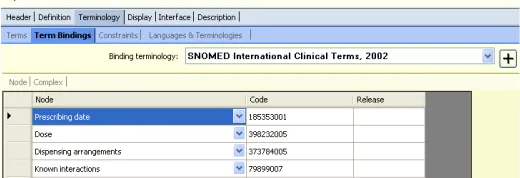
[image:4.612.44.304.589.678.2]Level 1 gives high level division on problem areas and Level 2 defines the information structures falling into a given problem area that one can use for applications. In the following level, the fields in such information structures need to be mutually understandable, and their semantic meanings agreed by the wide community, when a party downloads an archetype to validate an imported data structure from another party. The concept of methadone, as a substance of opioid treatment is certainly associated with ICPC2’s P Chapter and information structures around their prescribing can be defined for various applications. Two systems requiring the identification of such a term as a unique thing, however, cannot rely on either ICPC2 or archetypes as they do not support such a function. SNOMED, instead, has a detailed conceptualisation of clinical terms, e.g. methadone (substance) has a unique concept Id of “387286002” and “is-a” “drugs used to treat addiction (substance)”. Figure 3 shows the binding of terms from our example “Prescribing Instruction” archetype to SNOMED.
Figure 3. Binding of the terms in our archetype to SNOMED CT
The greater power of binding sharable and reusable archetypes and a community-agreed standard terminology is magnified in concept relationship reasoning where both archetypes and terms are referenced and their meanings computable in decision logics, within or across applications. It has been argued in [18] that terminology provides the ability to do hierarchical inference on values in instances of data created in accordance with the information model. Similarly to an example given in their testimony, an information model for methadone prescribing order or instruction could be concisely expressed as below. Also given is a structure for expressing the interaction between methadone and enzyme inducers or inhibitors which decreases or increases the clinical effect of methadone and thus requires a corresponding methadone dosage change.
MethadoneOrder ::= SET { methadone: Drug, dose: Decimal,
dispensing: Dispensing……}
MethadoneInteraction ::= SET { inducers: EnzymeInducerList, inhibitors: EnzymeInhibitorList …}
In the above, “Drug” is a concept whose semantic meaning has been agreed and sub-categories of this concept can be related in a terminology. Assume an information model for co-prescription order exists, similar to that for methadone, a decision logic for adjusting methadone dosage is shown below, where“is-a” is used, specifically in this context, to judge if a drug belongs to an enzyme inducer or inhibitor. However, in the presence of a semantic network of drugs organised in a classification hierarchy (effectively many generically defined and globally validated “is-a” among every possible drug types), the inference of a drug as being an inducer or inhibitor via the network will eventually diminish the need of listing/identifying all such categorisation, e.g. inducers or inhibitors in the
“MethadoneInteraction” structure, for every single application.
IF there exists a MethadoneOrder AND a CoprescriptionOrder for patient p Where p.CoprescriptionOrder.drug is-in MethadoneInteraction
Then {
IF p.CoprescriptionOrder.drug is-a
MethadoneInteraction.inducers THEN p.MethadoneOrder.dose = p.MethadoneOrder.dose * 150%
AND
IF p.CoprescriptionOrder.drug is-a
IIITHE DATA ENTRY INTERFACE
We have implemented data entry interface for: A) Baseline
Information; B) Urine Testing; C) Methadone Dosage and
Dispensing Arrangement; and D) Monitoring/Review. The
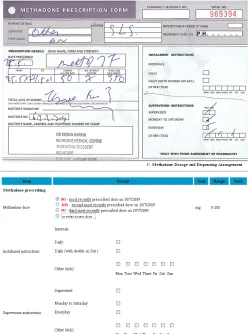
structure of data for collection matches that of the defined archetypes and can be coded accordingly. Figure 4 shows a paper-based prescription form used in the current practice and, part of Section C of our interface. The structured data entry interface only collects the very essential information and not all archetype fields defined in Figure 2 have associated collection points in the interface, e.g. “prescribing date” can be populated into the actual EHR automatically by the programme; “missed doses” can be calculated from the record history in EHR; 1mg/1ml formulation of liquid methadone by oral consumption is fixed in the Irish setting, despite the definition of “strength”, “form”, and “route” in the archetype for interoperation purpose.
[image:5.612.48.298.272.606.2]
Figure 4. Paper-based methadone prescription form and the corresponding computerised user interface
Advice has been taken from a wide range of people during the development of the interface. In the beginning, the interface has been designed as a series of questions and answers. Interviewing a GP who prescribes methadone at the Inchicore Medical Centre in the South of Dublin reveals that such a form was “too lengthy” and would “take too long to
administer in regular consultations and be resisted by many as a result”. Considering the standard paper-based forms, the data entry template used in their surgery, and additional features relevant to decision support, we adapted the previous interface in terms of the structure and made them as concise and clear as possible. Finally, one web page has been deployed for collecting the one-off baseline information (A), one for the urine testing results (B), one for the weekly prescribing information (C), and the last one for the six-monthly review (D). The core prescribing or Section C is the only mandatory data entry at each appointment. The GP will be requested to carry out urine testing only if such tests have been ignored or requests for testing have been overridden for a sufficient number of times. Each page is accommodated in a single screen with option selection questions, which are straightforward to go through and answer. This will be fitted and rendered more GP-friendly as a result. Other suggestions on the interface come from the potential GP users, and existing clinical decision support system designers and lecturers. Such enhancements include: listing the previously recorded urine testing or prescribing data below the main data collection section with a show/hide switch option; for the current prescribing, suggesting the options of three most recently prescribed doses beside a new dose field for filling in; automatic floating layer popup when the mouse is placed over a term, providing further explanation or clarification when necessary.
IVSTRUCTURING GUIDELINES
Figure 5 - The recommended methadone treatment protocol structured as a decision making flowchart or care pathway
V COMPUTERISED DECISION SUPPORT
We show in Figure 1 that decision support can facilitate the move from observation to evaluation and then to prescribing instruction and action, during the transition among various stages of methadone treatment. More experienced doctors usually rely on pattern recognition, or the previous knowledge of treating patients with similar issues. Less experienced doctors, especially those who just finish their initial training on methadone prescribing, may need frequent reference to the guidelines. Automatic decision support will be very valuable to them in guiding methadone prescribing and reducing potential mistakes. The envisioned decision support component will take the current patient EHR, judge their status (nodes such as commencement, stabilising, reduction, etc. in Figure 5), apply the guidelines associated with the status upon the past prescribing history (rules under the node titles in Figure 5), and generate recommendations for the current prescribing for that patient. This component could be used to explicitly give recommended dosage and supervision arrangement when a GP starts a new consultation with a patient. Alternatively, if a GP prefers, it could run behind the scene and will only alter/remind if the given prescription (shown in the interface of Figure 4) does not comply with the guidelines and an alternative dosage or supervision arrangement is thus suggested for consideration. The other useful functions the decision support component can provide include the monitoring of the patient’s status change and reminding or alerting the GP to consider adjusting management plan, e.g. reminding them of the possibility of carrying out a reduction regime when a patient has reached stabilisation for a certain period of time or automatically alerting the destabilisation if certain doses have been missed. We believe such a model of decision support, providing recommendations rather than
assessments (recommending adjusted dosage), at the time and location of decision making (while recording the consultation), automatically as part of the clinical workflow (being triggered automatically just prior to the prescribing confirmation), meet the criteria of a decision support system’s ability to improve practice [11].
We are investigating the use of a standard knowledge representation language for the documentation of clinical guidelines (management options, flowcharts, rules, etc.). A common template will be designed for the management of knowledge (not limited to methadone prescribing) in a standard computerised format. The represented guideline knowledge will be able to be queried, retrieved, triggered, and applied by a knowledge engine at runtime. Such an engine effectively guides the accumulation of EHR over care episodes, and operates upon information structures constrained by the well-defined archetypes. As an example, Figure 5 illustrates the guidelines in relation to dosage value change over transition, which represents one field in the “Prescribing Instruction” archetype. In the very simple case (without consideration of co-prescribing and other issues), the current value can be computed by retrieving the previous value and applying whatever increment/reduction recommended by the guidelines.
VIDISCUSSION
A difficulty we identified in the beginning of our study is the lack of enthusiasm among various GP software vendors in relation to the integration of a methadone treatment package into existing systems. Therefore, the best sustainable solution is to develop an EHR that adopts international standards and supports prescribing as per the paper guidelines. This will enable the later interoperation among systems and support linkage from various existing records to the methadone-related records. Also, the EHR needs to be extensible to cover medicine management in general as per the Centre’s programme and not limit itself to methadone.
When starting the design of a new system from scratch, we use well-defined archetypes to guide the development of data storage in database and data presentation in interface, the structures of both being consistent with archetypes. This will save the inconvenience of later mapping. From the Software Engineering perspective, the use of archetypes captures the ever changing requirements in the healthcare domain and externalises them in constrained data structures. With runtime mapping and interpretation, it is possible to do dynamic data aggregation and knowledge understanding without changing the underpinning software, as evidenced in our previous work first on software adaptivity [12] and later security modelling for healthcare information systems [13], both in distributed environments. Defining archetypes explicitly rather than having all information structures hard-coded, we have our methadone treatment EHR system open for data aggregation and sharing: we publish our archetypes, send the data to whoever is authorised to receive it, they download the published archetypes, use them to validate data, understand
Commencing on Treatment • Start no greater than 30mg daily
• If tolerance is low, then 10-20mg
Stabilising on Treatment
• Increments no greater than 10mg at a time
• Increments made until no physical withdrawals and illicit drug use ceased
• Increments discontinue if signs of intoxication
• In normal conditions, patients stabilise on doses 60mg-80mg
• In exceptional conditions, higher doses of methadone (>80mg) required in patients on concomitant medication (50% increase may be needed)
Reduction Regime
• In general reduction of 5-10% of the current dose
• If stable on more than 100mgs then reduce by 5-10 mgs at a time
• If stable on 40-90mgs then reduce by 5mgs at a time
• If stable on 20-40mgs then reduce by 2-5mgs at a time
• Below 20mgs then reduce by 1-2mgs at a time
Detoxification Destabilisation
Signs
• Opiate positive urinalysis
• Missed doses
• Change in mood
Strategies
• Increase dosage
• Increase surgery attendance
• Increase urine testing in frequency
data structures and contents, query the structures, retrieve the useful bits, and import them to their own systems for benefits.
We are liaising with the Irish College of General Practitioners (ICGP), which has authorised governance over the methadone prescribing guidelines, to promote the creation of a more useable and integrated software [14]. We will evaluate our system using a clustered randomised controlled trial (RCT), comparing treatment with our system with usual care. This will allow for a robust evaluation of the impact of ICT intervention in terms of patient retention in treatment. Retaining patients in MMT is essential as patients who leave voluntarily or have been expelled have increased mortality risks [15] [16]. Patients are most likely to leave MMT as they destabilise on treatment. We anticipate that our system will flag a warning to the treating GP when a patient is showing signs of destabilisation as displayed in Figure 5, providing them with evidence based strategies to re-engage the patient to stabilisation, thus retaining the patient and reducing the likelihood of mortality. Our system will also be evaluated in terms of the process of care, and patient outcome measures, at 12 months follow up. By demonstrating the potential benefits to the ICGP and the wider community, we wish the GP software vendors will be urged to adopt it and computerised decision support promoted in Ireland.
VIICONCLUSIONS AND FUTURE WORK
This paper describes the use of openEHR to build an EHR model and demonstrates its application to the recording of methadone treatment. Such an approach contributes to the ordinary EHR extensibility, interoperability, and decision support. Separately built systems can have data stored in their individual databases and information exchanged and understood unambiguously across systems, structurally via archetype constraints and conceptually via any binding terminology. Such a paradigm can also enable the accumulation of evidence from the actual use in practice with regards to adherence to guidelines and associate them with outcomes. In this way, it can suggest improvement to the guidelines.
The ultimate aim of building such a structured EHR is the development of a fully integrated CDSS, reducing prescribing errors and supporting auditing, as hand-written prescriptions are required for controlled drugs in this country. In our future work, we will develop a knowledge interpretation engine and use a standard knowledge representation to capture the guidelines in a computable form, as described previously. We will also investigate the dynamic generation of data collection use interfaces from archetypes, which is technically feasible and indeed what archetypes should support, data entry fields corresponding to their archetype structure counterparts and recorded in an EHR of the same structure.
ACKNOWLEDGMENTS
This work is supported by Health Research Board of Ireland through the HRB Centre for Primary Care Research under Grant HRC/2007/1.
REFERENCES
1. The HRB Centre for Primary Care Research: http://hrb.rcsi.ie/. 2. Kelly A, Carvalho M, Teljeur C. Prevalence of Opiate Use in
Ireland 2000-2001. A 3-Source Capture-recapture Study. 2004. Dublin, National Advisory Committee on Drugs.
3. Gossop M, Stewart D, Treacy S, Marsden J. A prospective study of morality among drug misusers during a 4-year period after seeking treatment. Addiction 2001; 97: 39-47
4. Mattick RP, Breen C, Kimber J, Davoli M. Methadone maintenance therapy versus no opioid replacement therapy for opioid dependence. Cochrane Database Syst Rev 2003;(2):CD002209.
5. Ward J, Hall W, Mattick RP. Role of maintenance treatment in opioid dependence. Lancet 1999;353:221-6.
6. Sporer KA. Strategies for preventing heroin overdose. BMJ 2003;326:442-4.
7. Irish College of General Practitioners. Working with Opiate Users in Community Based Primary Care. ICGP, 2008. 8. Weed LL, Medical records that guide and teach, The New
England journal of medicine, Vol. 278, No. 11, pp. 593-600. 9. Weed LL, Medical records, medical education, and patient care.
The problem-oriented record as a basic tool. Cleveland, OH: Case Western Reserve University, 1969.
10. Beale T, Heard S, Chapter 6 Design of the openEHR EHR, in:
The openEHR architecture overview, openEHR Foundation,
2007, last accessed: 17th Sep, 2009.
11. Kawamoto K, Houlihan CA, Balas EA, Lobach DF, Improving clinical practice using clinical decision support systems: a systematic review of trials to identify features critical to success, BMJ 330:765, 2005.
12. Xiao L, Greer D, Adaptive Agent Model: Software Adaptivity using an Agent-oriented Model Driven Architecture, Information & Software Technology 51(1):109-137, Elsevier, 2009.
13. Xiao L, Hu B, Croitoru M, Lewis P, Dasmahapatra S, A Knowledgeable Security Model for Distributed Health Information Systems, Special Issue on Software Engineering for Secure Systems, Computers & Security 29(3):331-349, Elsevier, 2010.
14. Garg A X, Adhikari N, McDonald H, Rosas-Arellano M P, Devereaux p J, Beyene J, Sam J, Haynes R B. Effects of comupterised clinical decision support systems on practitioner performance and patient outcomes. A systematic review. JAMA 293: 1223-38, 2005.
15. Fugelstad A, Stenbacka M, Leifman A, Nylander M, Thiblin I. Methadone maintenance treatment: the balance between life-saving treatment and fatal poisonings. Addiction, 102: 406-412, 2007.
16. Davoli M, Bargagli A M, Perucci1 C A, Schifano1 P, Belleudi V, Hickman M, Salamina G, Diecidue R, Vigna-Taglianti F, Faggiano F. Risk of overdose during and after specialis drug treatment: the VEdeTTE study, a national multi-site prospective cohort study. Addiction, 102: 1954-1959, 2007.
17. Savage P, A book that changed my practice: Problem oriented medical records, BMJ Feb 2001; 322: 275.