Evaluation of Aspect-Oriented Software Development For
Distributed Systems
Cormac Driver
A dissertation submitted to the University Of Dublin in partial fulfilment of
the requirements of the degree of Master of Science in Computer Science
Declaration
I declare that the work described in this dissertation is, except where
otherwise stated, entirely my own work and has not been submitted as an
exercise for a degree at this or any other university.
Signed: _________________
Permission to lend and/or copy
I agree that Trinity College Library may lend or copy this dissertation upon
request.
Signed: _________________
Acknowledgments
I would like to thank my supervisor, Dr. Siobhán Clarke, for all her guidance
and assistance, and especially for taking such a dedicated interest in my
work.
Thanks and appreciation go to those classmates who helped me out along the
way - Howard Kim for his insights on my field of study and Arkaitz Bitorika
for his enlightening critiques and technical support.
Much thanks goes to my family for putting me where I am, and to my
friends for all their inspiration.
Abstract
Problems relating to the issue of modularity result in the underperformance of the
object-oriented software development paradigm. Aspect-oriented software
development (AOSD) is a new technology for the separation of crosscutting
concerns in computer software. A crosscutting concern arises in a software system
when the implementation of a system requirement impacts on more than one
implementation module. It is proposed that AOSD techniques can modularise
crosscutting concerns that are inherent in object-oriented software systems,
resulting in software with greater reusability, evolvability and comprehensibility.
The objective of this dissertation is to evaluate the performance of the
current AOSD state of the art when applied to distributed systems. Aspect-oriented
design and implementation languages/tools are used to re-implement an existing
object-oriented application called AppTrack. AppTrack is a web-based
information system implemented using Java, an object-oriented programming
language.
Table of Contents
1 INTRODUCTION… … … ... 15
1.1 AppTrack … … … 15
1.2 Project Goals… … … 16
1.3 Dissertation Roadmap… … … .. 17
2 STATE OF THE ART… … … .. 18
2.1 Approaches To Aspect-Oriented Software Development … … … . 18
2.2 Aspects… … … .. 19
2.2.1 AspectJ… … … .. 19
2.2.1.1 Language Constructs… … … .. 19
2.2.1.2 Tools… … … .. 20
2.2.1.3 GUI… … … . 21
2.2.1.4 Performance … … … ... 21
2.2.2 Other Tools And Languages… … … . 21
2.2.2.1 Aspect Languages… … … .. 22
2.2.2.2 Aspect Tools… … … .. 22
2.3 Multi-Dimensional Separation of Concerns and Hyperspaces… … … . 22
2.3.1 Hyperspaces… … … .. 24
2.3.2 Hyper/J… … … .. 24
2.4 Composition Filters… … … .. 25
2.4.1 ComposeJ… … … .. 25
2.4.2 Other Composition Filter Languages and Tools… … … .. 26
2.5 Other Approaches to Aspect-Oriented Software Development… … … 26
2.6 Composition Patterns: Designing For Separation of Concerns… … … 26
2.7 Related Research… … … .. 29
2.7.1 Case Study in Building a Web-Based Learning Environment using AOP.. 29
2.7.2 A Study on Exception Detection and Handling Using AOP… … … 30
2.7.4 Challenges of Aspect-oriented Technology… … … .. 31
2.7.5 AOP: Does it Make Sense? The Case of Concurrency and Failures… … … 32
3 DESIGN… … … . 34
3.1 Tracing… … … .. 34
3.2 Transactions… … … .. 36
3.3 Enforcing Factory Design Pattern … … … . 40
3.4 Database Compatibility… … … . 42
3.5 Design By Contract (Preconditions)… … … 45
3.6 Exception Handling… … … .. 47
3.7 Recording Bean Properties Modification… … … .. 49
4 IMPLEMENTATION… … … .. 52
4.1 Implementation Environment… … … .. 52
4.2 Tracing… … … .. 52
4.2.1 Tracing with AspectJ… … … 52
4.2.2 Tracing with Hyper/J… … … 55
4.3 Transactions… … … .. 57
4.3.1 Transactions with AspectJ… … … 57
4.3.2 Transactions with Hyper/J … … … . 59
4.4 Enforcing Factory Design Pattern… … … . 60
4.4.1 Enforce Factory Design Pattern with AspectJ… … … .. 60
4.4.2 Enforcing Factory Design Pattern with Hyper/J… … … .. 62
4.5 Database Compatibility… … … .… 63
4.5.1 Database Compatibility with AspectJ … … … ... 63
4.5.2 Database Compatibility with Hyper/J… … … .… .. 64
4.6 Design By Contract (Preconditions)… … … .… 65
4.6.1 Design By Contract (Preconditions) with AspectJ… … … ... 65
4.6.2 Design By Contract (Preconditions) with Hyper/J… … … .… .. 66
4.7 Exception Handling… … … .. 67
4.7.2 Exception Handling with Hyper/J… … … . 69
4.8 Recording Bean Properties Modification… … … .. 69
4.8.1 Recording Bean Properties Modification with AspectJ… … … 69
4.8.2 Recording Bean Properties Modification with Hyper/J … … … ... 71
5 EVALUATION… … … . 72
5.1 Tracing… … … .. 74
5.1.1 Separation Achieved… … … . 74
5.1.2 Changeability/Extensibility… … … .. 75
5.1.3 Reusability… … … 75
5.1.4 Pluggability… … … .. 76
5.1.5 Complexity… … … 76
5.1.6 Productivity… … … .. 76
5.1.7 Lines of Code… … … 76
5.1.8 Conclusion… … … 77
5.2 Transactions… … … .. 77
5.2.1 Separation Achieved… … … . 77
5.2.2 Changeability/Extensibility… … … .. 79
5.2.3 Reusability… … … 79
5.2.4 Pluggability… … … .. 80
5.2.5 Complexity… … … 80
5.2.6 Productivity… … … .. 80
5.2.7 Lines of Code… … … 81
5.2.8 Conclusion… … … 81
5.3 Enforce Factory Design Pattern… … … 81
5.3.1 Separation Achieved… … … . 81
5.3.2 Changeability/Extensibility… … … .. 82
5.3.3 Reusability… … … 82
5.3.4 Pluggability… … … .. 83
5.3.5 Complexity… … … 83
5.3.7 Lines of Code… … … 83
5.3.8 Conclusion… … … 84
5.4 Database Compatibility… … … . 84
5.4.1 Separation Achieved… … … . 84
5.4.2 Changeability/Extensibility… … … .. 86
5.4.3 Reusability… … … 86
5.4.4 Pluggability… … … .. 86
5.4.5 Complexity… … … 87
5.4.6 Productivity… … … .. 87
5.4.7 Lines of Code… … … 87
5.4.8 Conclusion… … … 88
5.5 Design By Contract (Preconditions)… … … . 88
5.5.1 Separation Achieved… … … . 88
5.5.2 Changeability/Extensibility… … … .. 89
5.5.3 Reusability… … … 90
5.5.4 Pluggability… … … .. 90
5.5.5 Complexity… … … 91
5.5.6 Productivity… … … .. 91
5.5.7 Lines of Code… … … 91
5.5.8 Conclusion… … … 91
5.6 Exception Handling… … … .. 92
5.6.1 Separation Achieved… … … . 92
5.6.2 Changeability/Extensibility… … … .. 93
5.6.3 Reusability… … … 94
5.6.4 Pluggability… … … .. 94
5.6.5 Complexity… … … 95
5.6.6 Productivity… … … .. 96
5.6.7 Lines of Code… … … 96
5.6.8 Conclusion… … … 96
5.7 Recording Bean Properties Modification… … … .. 97
5.7.2 Changeability/Extensibility… … … .. 98
5.7.3 Reusability… … … 99
5.7.4 Pluggability… … … .. 99
5.7.5 Complexity… … … 99
5.7.6 Productivity… … … .. 99
5.7.7 Lines of Code… … … .. 100
5.7.8 Conclusion… … … .. 100
5.8 Evaluation of Composition Patterns… … … .. 100
5.9 Summary of Evaluation… … … .. 102
5.9.1 Separation Achieved… … … ... 102
5.9.2 Changeability/Extensibility… … … . 102
5.9.3 Reusability… … … .. 103
5.9.4 Pluggability… … … . 103
5.9.5 Complexity… … … .. 103
5.9.6 Productivity… … … . 103
5.9.7 Lines of Code… … … .. 104
5.10 Table-based Evaluation Summary… … … .. 104
6 CONCLUSIONS… … … . 105
6.1 General Conclusions… … … . 105
6.1.1 Intimate Concerns… … … ... 106
6.1.2 Remembering Object-Oriented Programming… … … 107
6.2 The Value of Re-engineering with AOSD… … … 108
6.3 Future of AOSD… … … 108
6.4 Future Research… … … 110
6.4.1 Aspect-Oriented Unit Testing… … … . 110
List of Figures
Figure 1: AppTrack application architecture... 16
Figure 2: An example composition patterns template... 27
Figure 3: An example composition patterns collaboration diagram ... 28
Figure 4: An example composition patterns composition relationship... 28
Figure 5: Tracing template ... 35
Figure 6: Tracing collaboration ... 36
Figure 7: Tracing composition relationship ... 36
Figure 8: AppTrack transaction and data access architecture ... 37
Figure 9: Transactions template... 38
Figure 10: Transactions collaboration... 39
Figure 11: Transactions composition relationship ... 39
Figure 12: The
Status
hierarchy ... 40
Figure 13: Enforce factory pattern collaboration... 41
Figure 14: Enforce factory composition relationship ... 42
Figure 15: The database compatibility template... 43
Figure 16: Database compatibility collaboration... 44
Figure 17: Database compatibility composition relationship ... 44
Figure 18: Mail sending preconditions template ... 46
Figure 19: Mail sending preconditions collaboration ... 46
Figure 20: Mail sending preconditions composition relationship ... 47
Figure 21: Exception handling template ... 48
Figure 22: Exception handling collaboration ... 48
Figure 23: Exception handling composition relationship... 49
Figure 24: Record property modification template... 50
Figure 25: Record property modification collaboration... 50
Figure 26: Record property update composition relationship ... 51
Figure 27: The package structure with the
aspect
and
log
packages added... 53
Figure 29: Separation of tracing concern ... 75
Figure 30: Tracing concern LOC comparison ... 77
Figure 31: Tangling in original transactions concern ... 78
Figure 32: Separation of transactions concern... 78
Figure 33: Separation of enforce factory concern... 82
Figure 34: Scattering and tangling in original database compatibility concern ... 85
Figure 35: Separation of the database compatibility concern ... 85
Figure 36: Tangling in original design by contract (preconditions) concern ... 88
Figure 37: Separation of the design by contract (preconditions) concern... 89
Figure 38: Scattering and Tangling in original exception handling concern ... 93
Figure 39: Separation of the exception handling concern ... 93
Figure 40: Scattering and Tangling in original record bean properties modification
concern... 97
Figure 41: Separation of the record bean properties modification concern ... 98
List of Tables
1 INTRODUCTION
Software engineers have long been aware of the need to make software less complex. Reducing complexity can result in such benefits as maintainability, evolvability, tracability and comprehensibility. A key concept in reducing the overall complexity levels in computer software is modularity. By keeping related modules together and separating them from modules addressing unrelated issues, software systems can evolve freely without establishing restrictive dependencies. The practice of dividing different areas of interest into separate, independent modules is widely referred to as separation of concerns [1,2]. It has been established that total separation of concerns is not possible with the current standard programming paradigms [3].
Object-oriented programming is the current standard paradigm for software development. Promoters of the paradigm claim that it can fundamentally aid software engineering by creating architectures that better fit with domain models. Whilst this is partially true, the whole story is not being told. There are many software development problems to which a suitable solution cannot be achieved with object-orientation. It is problems relating to the issue of modularity that result in the underperformance of the object-oriented model. There is a need for a new concept to address these shortcomings.
Aspect-oriented software development (AOSD) is a new technology for separation of concerns in software development [4]. The AOSD community propose that it is possible to modularise crosscutting aspects of a system using AOSD techniques. In this context a crosscutting aspect can be thought of as a requirement in a software system that involves affecting more than one implementation module (most commonly the object-oriented class or method) during its implementation. Applying AOSD techniques can lead to a system that exhibits cleanly captured concerns within its codebase and possesses the beneficial properties mentioned earlier. The aim of this dissertation is to evaluate aspect-oriented software development techniques when applied to a distributed information system called AppTrack.
1.1 AppTrack
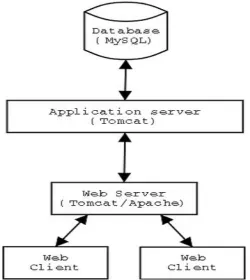
Figure 1: AppTrack application architecture
Figure 1 illustrates a high-level overview of the AppTrack application architecture. The application code residing on the Tomcat server was written using the Struts framework. Struts is an open-source framework from the Jakarta project for building web applications. The framework encourages application architectures based on the Model 2 approach, a variation of the classic Model-View-Controller (MVC) design pattern. The use of the Struts framework enforces rules on the application code i.e. classes must implement specific interfaces. Whilst conformance to the Struts framework leads to a good degree of modularity, there remain some concerns (non-MVC related) that are not cleanly separated. AppTrack is composed of 81 Java classes and 20 Java Server Pages.
1.2 Project Goals
The major goal of this dissertation is the evaluation of aspect-oriented software development as a technique for achieving better separation of concerns in distributed systems. Achieving this goal required the following actions:
- Gaining a full understanding of the need for separation of concerns - Understanding how AOSD can help increase modularity
1.3 Dissertation Roadmap
The remaining chapters of this dissertation are laid out as follows:
Chapter 2 – State of the Art
This chapter provides an overview of the current leading technology in the areas of separation of concerns and aspect-oriented software development. It is elements of this technology that are used during the implementation phase. This chapter also introduces and discusses other research that is relevant to this project.
Chapter 3 – Design
This chapter details the identification of crosscutting concerns in the AppTrack codebase and the design of an aspect-oriented software solution for each concern.
Chapter 4 – Implementation
This chapter explains the implementation of the aspects designed in the preceding chapter. Each aspect is implemented using two markedly different AOSD techniques.
Chapter 5 – Evaluation
The implementation phase is evaluated in order to determine the advantages and disadvantages of the chosen solution(s) relative the existing solution. This chapter records the evaluation process.
Chapter 6 – Conclusions
The final chapter draws conclusions regarding the success of the completed work in relation to the original stated goals of the project. The future and worth of AOSD are discussed, as well as possible future work on the project.
2 STATE OF THE ART
AOSD is a new technology for the separation of concerns in software development [4]. Separation of concerns in software has long been the goal of many notable computer scientists such as Dijkstra, Parnas and Jackson. Promoters of AOSD claim that by using this new technology it is possible to fully modularise the crosscutting concerns (or aspects) of a software system.
A crosscutting concern arises in a software system when the implementation of a system requirement impacts on more than one implementation module (most commonly the class or method in Object-Oriented Programming). Crosscutting concerns are also known as aspects [3]. More often than not, aspects tend not to be implementations of requirements that come straight from the initial requirements document but rather properties that affect the system in a non-functional way. Classic examples of aspects include codebase tracing and synchronisation of concurrent objects.
Object-Oriented code suffers from two phenomena known as scattering and tangling [3]. Scattering is evident when similar code is distributed throughout many system modules, with the risk of misuse and inconsistencies at each point of use. Changes to the system's implementation may require finding and editing all scattered code belonging to an aspect. Tangling occurs when two or more concerns are implemented in the same implementation module (class/method), making the module harder to understand and change. The word crosscutting is used to characterise a concern that spans multiple units of Object-Oriented modularity. Crosscutting concerns inevitably evolve through the use of current programming methodologies, resulting in the development of systems that are harder to design, understand, implement, maintain and evolve. AOSD aims to allow system design documents (usually diagrams) and implementation code to be structured to reflect the way developers want to think about a system [5]. There are currently three main approaches being promoted as the solution to clearly expressing programs that involve crosscutting concerns. These are:
1. The Aspect Approach [3]
2. The Hyperspace approach (Multi-Dimensional Separation of Concerns) [6] 3. The Composition Filters [7] Approach
Each of the areas above is supported by numerous tools and languages that combine to establish a state of the art for AOSD. There are both major and minor players in each area and these are discussed in the following subsections.
2.1 Approaches To Aspect-Oriented Software Development
2.2 Aspects
The Aspect approach was first presented in [3]. A system property or requirement that must be implemented is an aspect if it cannot be cleanly encapsulated in a component that is well localised, easily accessed and composed. The goal of aspect-oriented programming (AOP) as stated in [3] is to support the programmer in cleanly separating components and aspects from each other, by providing mechanisms that make it possible to abstract and compose them to produce the overall system. This goal is achieved by adding an aspect language and an aspect weaver to the set of standard tools used in the implementation of a software system. The aspect language is a separate language to the component language (Java, C++ etc.) and is used to program the aspects. The aspect weaver is used to integrate aspects written in the aspect language with the rest of the program code, which is written in the component language. The aspect weaver is a tool that accepts both component and aspect language as input and outputs the combination of the two in component language. The most prominent language supporting the aspect approach is AspectJ [8], which is discussed below.
2.2.1 AspectJ
AspectJ is an example of an aspect language. It is an aspect-oriented extension to Java that supports general-purpose aspect-oriented programming [9]. The word aspect means two things in AspectJ, depending on the context in which it is stated. At the design level it is a concern that crosscuts (as previously described). At the implementation level it is a programming construct that enables crosscutting concerns to be implemented in a modular fashion. This programming level aspect is the dominant unit of decomposition in the AspectJ programming language.
2.2.1.1 Language Constructs
AspectJ is based on a concept referred to as the dynamic joinpoint. Dynamic joinpoints are points in the execution of a Java program such as method calls and access to class attributes. The joinpoint is the main new concept that AspectJ adds to Java, with most of the rest of the language being made up of simple constructs based around this notion. Pointcuts and advice dynamically affect program flow whereas
introduction, another new concept, statically affects a program's class hierarchy. Pointcuts select certain joinpoints and values at those points. Advice defines code that is executed when a joinpoint is reached. This is the dynamic behaviour of AspectJ. AspectJ uses introduction to modify a program's static structure, the members of its classes and the relationships between those classes by either introducing new member variables and methods into a class or by defining new parents for an existing class/defining that a class implements another class. The last new construct in AspectJ is the aspect itself. Aspects are AspectJ's unit of modularity for crosscutting concerns and they are defined in terms of pointcuts, advice and introduction.
aspect MethodLogger { private String name; private String kind; private String signature;
pointcut trace() : within(application..*) && execution(* *(..)) && !within(application.aspect.log.*);
before() : trace() {
name = thisJoinPoint.getSignature().getName();
kind = thisJoinPoint.getKind();
signature = "" + thisJoinPoint.getSignature();
System.out.println.setName(name);
System.out.println.setKind(kind);
System.out.println.setSignature(signature);
} }
The pointcut trace() defines a pointcut that picks out the execution of every method within every package including and contained within the specified package but not within the package containing the logging aspect itself. On the execution of each method a piece of code, known as advice, is executed. In this case the code is executed before the execution of the method currently picked out by the joinpoint. The body of this before() advice uses the static variable thisJoinPoint to retrieve information about
the method currently executing. The information is then printed to the terminal screen. The
thisJoinPoint variable offers context specific information about the currently executing joinpoint as identified by the pointcut. It can be thought of as similar to the this variable in standard Java.
What this simple aspect shows is that using the constructs outlined previously it is possible to get the same end result by writing one aspect class that you would get by scattering code among many classes. Of course you also get the added benefits that come with separating concerns in your codebase such as maintainability, evolvability, pluggability and reusability.
2.2.1.2 Tools
The AspectJ development team have developed three main tools to support the use of the language. ajc is the compiler that combines Java and AspectJ source files to create standard Java class files. This means that a program written with AspectJ can run on a standard JVM and ensures that any AspectJ program is a legal
Java program and vice versa. ajdb is a debugger for AspectJ programs. This tool has all the capabilities of a standard Java debugger. In addition, the AspectJ working directory can be specified and the breakpoint command, stop on, has been extended to allow the setting of a breakpoint on an aspect source file line.
ajdoc generates HTML API documentation for pointcuts, advice and intertype declarations, as well as the
2.2.1.3 GUI
The AspectJ browser is a GUI tool for compiling programs with the ajc and navigating the crosscutting structure. It is essentially a development tool that supports AspectJ's aspects and can be used to edit source files and configuration build files.
The AspectJ team have developed plug-ins for various widely used IDEs including Eclipse, JBuilder, Forte and Emacs. These plug-ins all offer similar functionality such as AspectJ compilation from within the development environment, browsing of the aspect structure and establishment of a compile configuration for specifying which files are to be passed to the compiler. This allows for the simple integration of pluggable aspects with your codebase. The learning curve when adopting the language is greatly reduced through the use of these tools because they allow you to see the areas of the codebase that your pointcuts affect. This means you can ascertain (to a certain extent) whether or not you are achieving the desired affects without running the application and observing its behaviour.
2.2.1.4 Performance
In many cases the use of AspectJ's aspects will reduce the number of lines of code needed to implement a system. This is a side effect and was not an initial goal of the language. The major benefit of using aspects is not the reduced number of lines but the improved modularity. Aspects gather code into a single module that would otherwise be redundantly duplicated throughout the codebase. This lack of duplication is the reason for the reduction in code size.
There is currently no benchmark against which aspect-oriented programming languages can be compared. It is too early for the development of important benchmarks as languages are still maturing and no one coding style is prominent. In the absence of benchmarks it can be said that AspectJ displays acceptable performance for everything except non-static advice (this is because the ajc compiler must
insert more checks into the weaved code to cater for the this type of advice). Introduction and static advice have an extremely small overhead compared to doing the same thing by hand.
It has been suggested that AspectJ violates encapsulation [12]. Whilst this is definitely true the developers have answered this criticism by stating that they have given more power to the language initially (in the spirit of Smalltalk [11]) to let the user community experiment and discover what is right. Currently this strategy has led to the creation of many useful aspects that crosscut the internal state of an object but the developers have not ruled out future restrictions [12].
2.2.2 Other Tools And Languages
2.2.2.1 Aspect Languages
AspectR [13] is an AOP implementation for the Ruby programming language, letting you wrap code around existing methods in your classes. AspectS is an early prototype that enables AOP in the Squeak/Smalltalk environment. Apostle [15] is another extension of the Smalltalk language with the aim of providing AOP functionality. It is a port of AspectJ to Smalltalk, sporting a similar language model with joinpoints, pointcuts, advice and aspects. MixJuice [14] is an extension of the Java language that adopts difference-based modules instead of Java's original module mechanism. This means that crosscutting concerns can be modularised, developed and tested independently. ArchJava [17] is an extension to the Java language with explicit software architecture constructs, separating out structural concerns that would otherwise crosscut the system. This language is significantly different to AspectJ. Pythius [18] is an open-source project to support aspect-oriented programming techniques in the Python programming language. Pythius is a set of tools to assess the quality of Python code by using AOP to implement simple metrics on Python source code. AspectC [19] and AspectC++ [20] are prototype AOP implementations for C and C++ respectively. AspectC is a simple extension to C based on AspectJ. AspectC++ is a more substantial language, also heavily based on the constructs introduced by AspectJ. The preceding two AOP languages are of some importance to the success of AOP and AOSD as the majority of software systems are still being written in C and C++.
2.2.2.2 Aspect Tools
The most important aspect related tools that have been developed thus far support the identification of aspects in existing codebases. Many programmers find the idea of AOSD interesting but don't know where or how to start actually applying the techniques. The Aspect Mining Tool (AMT) [21] and the Feature Exploration and Analysis Tool (FEAT) [22] are two tools that have a similar function. Both tools provide a graphical interface for identification, location and analysis of aspects in a codebase. This graphical functionality makes concern location a lot easier than trawling through large amounts of source code, making AOSD more accessible to beginners.
Despite their worth, these tools were not employed during for the aspect discovery work on the project being described in this dissertation. After some experimentation with these tools it was decided that their involvement was not necessary. The main reasons for arriving at this decision are that the codebase was reasonably compact and I was quite familiar with it having been on the initial development team. This negated the necessity for such tools.
2.3 Multi-Dimensional Separation of Concerns and Hyperspaces
Initial attempts at separation of concerns led to increased modularisation. These efforts were carried out with the intention of alleviating expensive change as well as obstacles to reuse and component integration. The key reason that past modularisation efforts such as object orientation did not fully achieve these goals is the fact that you need different decompositions according to different concerns at different times. However, most languages and modularisation approaches support only one kind of modularisation. This unit of modularisation is referred to as the dominant decomposition. Once a system has been decomposed by the dominant decomposition, extensive refactoring is needed to remodularise it. MDSOC and hyperspaces seeks to address the problems caused by the use of a dominant decomposition in system modularisation. MDSOC allows for simultaneous separation according to multiple, arbitrary kinds (dimensions) of concern, with on-demand remodularisation.
Concerns are the reason for organising software into modules that are understandable and manageable. Many different kinds of concerns can be relevant to different developers in different roles, at different stages of the software lifecycle. Data and classes can be concerns, as can features such as persistence and aspects such concurrency control. In MDSOC terminology, a kind of concern is referred to as a dimension
of concern. Hence, separation of concerns involves decomposition of software according to one or more dimensions of concern. Separation along one dimension of concern may promote some goals whilst impeding others. It is difficult to discover the relevant set of concerns to separate as they are context sensitive and vary over time. This means that any set of criterion for decomposition and integration will be appropriate for some set of requirements but not for all. Additionally, multiple dimensions of concern may be relevant simultaneously, and they may overlap and interact, as features and classes do. Thus, modularisation according to different dimensions of concern is needed for different purposes: sometimes by class, sometimes by feature, sometimes by aspect or other criterion. These considerations imply that developers must be able identify, encapsulate, modularise and manipulate multiple dimensions of concern simultaneously, and to introduce new concerns and dimensions at any point during the software lifecycle without suffering the effects of invasive modification and rearchitecure. As mentioned earlier, modern languages suffer from a problem termed the "tyranny of the dominant decomposition" [23] - they permit separation and encapsulation of only one kind of concern at a time. It is therefore impossible to obtain the benefits of different decomposition dimensions throughout the software lifecycle. Changing the unit of modularisation during the evolution of a system can have disastrous effects, some languages don't even let you change your dominant decomposition e.g. you must use classes in Object-Oriented programming.
The term MDSOC is used to denote separation of concerns involving the following:
- Multiple, arbitrary dimensions of concern
- Separation along these dimensions simultaneously
- The ability to handle new concerns, and new dimensions of concern, dynamically - Overlapping and interacting concerns1
1
Full support for MDSOC opens the door to on-demand remodularisation, allowing a developer to choose at any time the best modularisation, based on any or all of the concerns, for the development task at hand.
2.3.1 Hyperspaces
Hyperspaces permit the explicit identification of any concerns of importance, encapsulation of those concerns, identification and management of relationships among those concerns, and integration of concerns. The primary goal of hyperspaces is to limit the impact of change and simplify evolution.
A concern space is made up of all units in some body of software, where units can be primitive or
compound. A primitive unit is considered to be atomic e.g. an instance variable, a method or a performance requirement. A compound unit is composed of primitive units e.g. a class or collaboration diagram. The job of the concern space is to organise the units in a body of software so as to separate all important concerns, describe relationships between concerns and to indicate how they can be composed together. There are three distinct elements to separation of concerns: identification, encapsulation and integration.
A hyperspace is a concern space characterised by a number of unique features. Firstly, all its units are organised in a multi-dimensional matrix. Each axis represents a dimension of concern, and each point on an axis represents a concern in that dimension. This structure makes explicit all the dimensions of interest, the concerns that belong to each dimension, and which concerns are affected by which units. The coordinates of a unit indicate which concerns it affects; the structure clarifies that each unit affects exactly one concern in each dimension. Each dimension can be viewed as a partition of the set of units - a particular software decomposition.
Identification of concerns is achieved in practice by declaring the packages that contain the concerns in a hyperspace file. Any package or class within this file becomes part of the conceptual hyperspace and is available to be manipulated when separating concerns.
A hyperslice is a set of concerns that is declaratively complete, that is, it must explicitly declare everything to which it refers. Essentially, a hyperslice will capture a concern that exists in the system codebase. A concern mapping is used to declare the elements of the concern such as the classes, features and variables. Usually, each package named in the hyperspace specification file will itself become a distinct hyperslice.
A set of hyperslices cannot exist in isolation; concerns need to interact to make up a working system. The hypermodule comprises a set of hyperslices that are to be integrated and it contains a set of relationships used to bind the hyperslices together. The hypermodule essentially acts as an integrator of the separated concerns in your codebase.
2.3.2 Hyper/J
WYSIWYG specification of concerns in a project codebase. Hyper/J is a tool, there is no need for developers to learn a new language or use special-purpose compilers or virtual machines. The only new syntax that developers are required to learn is that of the hypermodule, hyperspace and concern mapping specifications. Hyper/J works on and generates standard Java. The current version of the tool does not implement the full hyperspace specification making the results achievable with Hyper/J somewhat limited. For example, to date the developers have worked only with units at the granularity of declarations (methods, classes) rather than lower-level constructs such as statements and expressions. Finer granularity is required to suitably capture some of the concerns identified in the AppTrack system. As well as this issue, some relationships required to implement crucial delegation functionality have not been implemented. This prohibits the implementation of AppTrack concerns that require delegation from existing methods to newly created proxy methods.
2.4 Composition Filters
The composition filters approach to AOSD was first proposed in [7]. Essentially, this approach seeks to solve the problems inherent in current techniques by using composition filters to abstract communications among objects. The basic object model is extended modularly by introducing input and output composition filters that affect the sent and received messages respectively. The main claim that this approach is making is that it is more beneficial to modularly extend the object-oriented model rather than build increasingly complex object structures [24].
Each message that arrives at an object is subject to evaluation and manipulation by the filters associated with that object. Filters support functions such as delegation, pre/post conditions, synchronisation and error detection. They have well-defined semantics and are open-ended, two properties that support the quality factors of verifiability and evolvability respectively. Filters can be added/attached to objects defined in object-oriented programming languages such as Java and Smalltalk without modifying the languages. This means that a non-language extension approach, similar to that used in Hyper/J, is adopted. A composition filters definition language is used to create the filters and an appropriate tool is used to map the filters onto the object-oriented language that being used as the primary development language.
2.4.1 ComposeJ
2.4.2 Other Composition Filter Languages and Tools
ConcernJ [26] is a tool based on the composition filters model that allows for the super-imposition of composition filter specifications over a Java system. The work arose out of the need for a systematic way to apply filters application-wide. The current prototype demonstrates the transformation of language independent concern specifications and Java classes into executable composition filters and Java files. This concept is built upon the initial concept of composition filters.
2.5 Other Approaches to Aspect-Oriented Software Development
There are of course other approaches to AOSD. Another less prominent but still substantial approach is Adaptive Programming [27]. Essentially, adaptive programming is concerned with facilitating the expression of elements (classes, methods, variables) that are essential to an application by avoiding making a commitment on the particular structure of the application. Demeter/Java [28] is a high-level interface to Java that allows developers to write Java programs using the adaptive programming methodology. The approach is based on the Law of Demeter, hence the name. The Law of Demeter is a simple style rule for designing object-oriented systems. "Only talk to your immediate friends" is the motto.
2.6 Composition Patterns: Designing For Separation of Concerns
The above languages and tools address the issue of implementing systems free of code scattering and tangling. Before implementation must of course come design. Design is important for many reasons, including management of complexity, gaining a greater understanding and improving evolvability. Systems implemented using aspect-oriented development techniques are on the surface no different to systems developed with more widely used paradigms. However, when it comes to designing aspect-oriented systems the modelling techniques used for these standard paradigms are not sufficient. System requirements that suggest a crosscutting implementation can be separated at the design level using composition patterns [29]. Composition patterns were developed as a way of capturing reusable patterns of crosscutting behaviour at the design level. These patterns, an extension to the subject-oriented model, use extensions to the UML to define modelling language elements that can be used together to model requirements for aspect-oriented systems. The model seeks to be generic in that it can model requirements for aspect-oriented systems, regardless of the chosen implementation technique i.e. AspectJ, Hyper/J, Composition Filters etc.
There are three important models in the composition patterns specification. As a whole, these three
1. Templates
2. Cross-Cutting Behaviour 3. Binding
A template is a parameterised model element that cannot actually be used directly in a concrete design model but acts as a placeholder for future design elements related to the template models. Actual units of modularity such as classes and methods can be bound to the template to generate usable models by the use of a special binding relationship. The binding relationship takes as parameters the actual parameters that are to replace the parameters in the template.
Figure 2: An example composition patterns template
Figure 2 is an example of a composition pattern. Each template is given a name and the parameters are contained within the dotted box. The presence of the AffectedClass class illustrates that any bound
class can be augmented with extra functionality. The operation preceded with the underscore represents an operation that can be used to delegate to additional behaviour as defined in the composition pattern. In the example this additional behaviour is represented by the someBehaviour() method of the
ExtraFunctionality class. The operation preceded with the plus sign represents the combination of
both the standard method (underscored method) and the extra behaviour. Note that the affectedOp(..)
method can in practice accept any parameters; this is denoted by the double dot notation.
Figure 3: An example composition patterns collaboration diagram
Figure 3 shows the sequence of events that actually occur when the affectOp() method is executed.
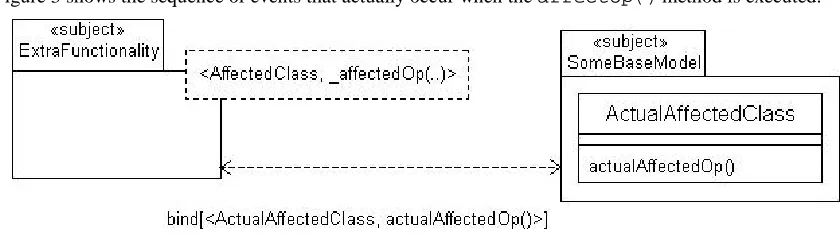
Figure 4: An example composition patterns composition relationship
Figure 4 shows that the class ActualAffectedClass and the operation actualAffectedOp() are
the concrete class and method that will be augmented with the extra functionality. The bind attachment can define more than one method to be affected or more than one {class, method} pair.
2.7 Related Research
This section will outline some recent research that is considered important in relation to this dissertation. The papers discussed in this section describe research with varying degrees of similarity to the work I conducted. These papers provided a good basis on which to commence this work.
2.7.1 A Case Study in Building a Web-Based Learning Environment using AOP
The Advanced Teaching and Learning Academic Server (Atlas) is a software system that supports web-based learning. The system was developed using aspect-oriented software development techniques and the results of the implementation are described in [30]. The fact that the paper describes experiences with applying aspect-oriented techniques to the development of web-based systems makes it quite relevant to this dissertation.
The paper describes the identification of aspects and how they were implemented using an early version of AspectJ. They found that development aspects such as tracing and debugging proved to be not as useful as they thought. This is because the production aspect they implemented (configuring different network contexts) made things a lot less complicated than before and there was less need for debugging and tracing. However, because these concerns had been modularised, they could be easily plugged out and back in at will. My findings from re-implementing the AppTrack system do not completely align theirs in this area. Although complexity is reduced in some areas there was still a need for the tracing concern throughout the aspect-oriented development process. The log files generated by the tracing concern proved useful not only for debugging but also for learning how the aspect-oriented languages were working at runtime. It was found that the implementation of a tracing concern could go some way towards helping to flatten the learning curve associated with AOSD and AOP languages. I do however totally agree with the conclusions of the researchers as regards the pluggability of the concerns.
The paper describes some guidelines and techniques for designing a system using the aspect approach. The knows-about relationship is a key factor in determining what should be an aspect. An aspect knows about another class when the aspect names the class. A class knows about an aspect if it relies on the aspect to provide it with state or functionality. Using this relationship, aspects can be divided into four categories – open (both the aspect and the class know about each other), closed (neither the aspect nor the class know about the other), class directional (aspect knows about the class but not vice-versa) and aspect-directional
(class knows about the aspect but not vice-versa). Thinking of aspects as belonging to a certain category makes it easier to understand how the aspect affects your codebase and how these aspects may behave in the future.
A major finding of the paper is that choosing what should be an aspect is difficult and there is no set formula to follow. Their approach was to begin with an initial object model and to incrementally consider crosscutting additions as aspects, using the concept of the knows-about relationship and the aspect style rules to help them. Overall they found the application of AOSD techniques to the development of a web-based system resulted in a fast, well-structured system in a reasonable amount of time.
2.7.2 A Study on Exception Detection and Handling Using AOP
Exception handling is a source of both scattering and tangling and I had recorded this as a potential aspect in the AppTrack system. In [31], Lippert and Lopes describe their investigation into the ability of AOSD to ease tangling and scattering related to exception handling. The paper describes the re-engineering of an existing system and the results and conclusions they derived from the exercise.
The detailed implementations and results tables presented in the paper prove their main conclusion that the use of AOP and specifically AspectJ can drastically reduce the portion of the code related to exception detection and handling. On one occasion exception related code was reduced by a factor of four. Along with this reduction in code they found that AspectJ provided better support for different configurations of exceptional behaviour with respect to standard Java. Also achieved was support greater reuse, incremental development, automatic enforcement of contracts and cleaner program texts.
Some weaknesses with AspectJ were highlighted in the paper and these weaknesses were said to hinder the work. The main issue was the lack of expressiveness of the pointcut designators. The issue has since been satisfactorily addressed and did not hinder my re-implementation of the exception handling concern in the AppTrack system. However, there were other issues with the language that I encountered during the implementation of the exception handling concern that were a cause for some concern (these are discussed in section 6.1.1).
2.7.3 Initial Assessment of Aspect-Oriented Programming
A number of experiments were carried out at the University of British Columbia to assess the capabilities of AOP in two main areas. The results of these experiments and the general findings resulting from the work are presented in [32].
The experiments involved participants undertaking programming exercises spread over six sessions – three sessions using AspectJ and three using a control language. Each session began with training on both the languages being used and the topic of the concern being modularised.
In the second experiment it was the AspectJ participants who required more time to finish the change task. However, in two out of three cases this time was spent on coding their solution in AspectJ rather than repeatedly switching files or conducting analysis of the semantic content of the control language files. The participant who did spend a significant amount of time analysing the control files was the only one to successfully complete the task. This suggests that an in-depth analysis of the control language is required to carry out a change task using AspectJ.
The results of the experiments led the researchers to two key insights. The first of these is that programmers may be better able to understand an aspect-oriented program when the effect of the aspect code has a well-defined scope. Debugging can be easily understood as a concept but a change task is more complex which involves analysing and understanding an unknown quantity of classes. The second insight is that the presence of aspect code may alter the strategies programmers use to address tasks perceived to be associated with aspect code.
2.7.4 Challenges of Aspect-oriented Technology
Alexander and Bieman of Colorado State University have recently turned to exploring the costs of AOSD in terms of its impact on software engineering. Their findings are described in [33]. The paper seeks to understand both the strengths and weaknesses of AOSD and to raise awareness of the potential negative side effects of its use. The following areas for disquiet are put forward for consideration:
- Understandability – is there of a loss of understandability?
- Emergent Properties and Fault Resolution – more testing and debugging required?
- Implicit Changes in Syntactic Structure and Semantics – structure not fully defined until after a weave has occurred?
- Effects on Cognitive Burden – how do you know you won’t cause undesirable emergent properties after weaving?
The paper also poses the following questions?
- How to measure the complexity that results from the weaving process? - How do we maintain aspect-oriented programs?
- How do we effectively test aspect-oriented programs? - How do we analyse aspect-oriented programs?
I encountered a number of the issues highlighted in this paper during my analysis of the re-implementation of the AppTrack system. Whilst the points made by authors are certainly valid, my conclusions are generally not as pessimistic. Given a sufficient understanding of both AOSD and the AOP language(s) used in a software system, I don’t believe there to be a significant change in either understandability or cognitive burden. I found that maintenance of the AppTrack system is much improved following the aspect-oriented re-implementation, transforming from an awkward, time consuming process into a well-defined and efficient task. There are however some cases that give credence to their views.
2.7.5 AOP: Does it Make Sense? The Case of Concurrency and Failures
Researches from the Swiss Federal Institute of Technology have recently investigated the area of applying AOSD/AOP techniques to the problems of concurrency and failures in distributed computing. Their findings are described in [45].
The authors begin by highlighting that they feel it does not make sense to use AOP techniques to separate concurrency control and failure management concerns from the other parts of a distributed system. They believe that currency control should be dealt with as a full part of the application semantics. They state that whilst AOP can be used to achieve some level of separation, the separation achieved is purely syntactic rather than semantic. The base their opinions on the results of three experiments conducted as part of their research.
The aim of the first experiment was to figure out the extent to which it is possible to aspectise transaction semantics. That is, they attempted to figure out the extent to which it is possible to completely hide transactional semantics from the programmer and have these semantics implicitly associated with the relevant modules in an automatic manner. They concluded that this is impossible for a number of reasons (discussed in full in the paper).
The second experiment is aimed at analysing the extent to which it is possible to aspectise transaction interfaces. That is, the authors attempted to figure out the extent to which one can completely separate transactional interfaces (begin, commit, abort) from the main object methods, and have these encapsulated writin code invoked through specific aspects. The results show that such separation is possible, but that in certain cases it may be artificial, and that it leads to rather confusing code.
3 DESIGN
This chapter details the design phase of the AppTrack re-engineering project. The design phase consisted of two major tasks, both of which would have a considerable impact on the later stages of the project and so consequently were of great importance.
The first undertaking was the identification of concerns in the code that were to be separated to achieve greater modularity. As discussed in chapter 2, there are tools for the exploration of codebases for the purpose of aspect discovery. However after some experimentation with these tools it was decided that their involvement was not necessary. There were two main reasons for arriving at this decision. Firstly, the codebase was small enough to navigate through without the use of a tool. Secondly, I was extremely familiar with the codebase after being part of the original development team. In a situation where both these factors are not present I believe the aspect identification tools currently available would add considerable value to an AOSD re-engineering effort.
The second task was the design of the aspects identified in the first phase of the design. Normally when designing a software system the Unified Modelling Language is used to graphically represent the objects that interact to satisfy the requirements. As mentioned previously, the UML is not suitable for designing systems based on AOSD concepts. For this reason, the UML-based composition patterns modelling language is used to visually describe the separation of concerns that was conceived.
The following aspects were identified in the AppTrack codebase and the remainder of this chapter deals with the identification and design of each one individually:
- Tracing - Transactions
- Enforcing Factory Design Pattern - Database Compatibility
- Design By Contract (Preconditions) - Exception Handling
- Recording Bean Properties Modification
3.1 Tracing
During the implementation of the AppTrack system my colleagues and I, the original development team, predictably found ourselves in situations where our expectations had not been met by a certain piece of functionality that we had implemented. Non-conformance to requirements manifested itself as errors ranging from minor bugs to major deficiencies. Although we were following a test-first [46] approach to the development of the system, we sometimes lapsed back into the classic scenario in which you find
and tangling are manifest in the implementation of this concern. Scattering because the same piece of tracing code was cut and paste into many different methods across many different classes in many different packages. Tangling because to fully implement the tracing concern, numerous classes not designed to cater for tracing behaviour were required to encapsulate tracing logic, leading to the implementation of at least two concerns within one implementation module. As mentioned, the tracing concern was implemented on as “as needed” basis. When some difficulty arose and we needed to trace certain methods we would implement some crosscutting tracing behaviour. Full implementation of the tracing concern in this manner would have required adding approximately five lines of code to every method of every class. This would have been a huge undertaking for only limited rewards as tracing is a development concern and this code would have had to be removed from the production release of the system. An aspect-oriented design for this concern would in theory provide pluggable tracing functionality, implemented without affecting any other core concern.
Using the composition patterns model and aspect-oriented software development techniques a tracing concern was designed. There were a number of requirements for the concern:
- It had to be standalone – its implementation must not establish any dependency relationships (in either direction) with the core AppTrack codebase
- It must record context specific information. This is more of an implementation issue but it must be kept in mind during design that context must be available without creating dependencies
- Any method must be eligible for tracing
[image:34.612.146.460.450.570.2]- The tracing must happen before the execution of the method being logged
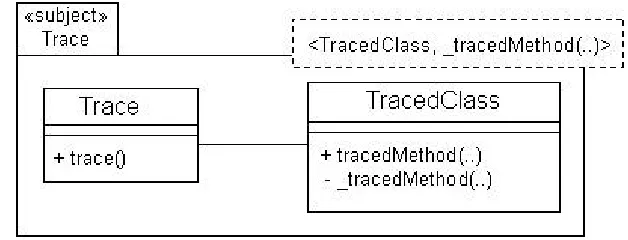
Figure 5: Tracing template
Figure 5 illustrates that a traced method, encapsulated within a traced class, can be augmented with tracing behaviour. Any method is available for tracing; hence there are no parameter restrictions on the
tracedMethod(..) operation defined in the template. The tracing functionality is encapsulated in a
Figure 6: Tracing collaboration
[image:35.612.111.492.359.461.2]Figure 6 shows the object interaction at runtime. The invocation of a traced method will delegate to an invocation of the tracing concern’s functionality before the behaviour of the actual traced method is performed.
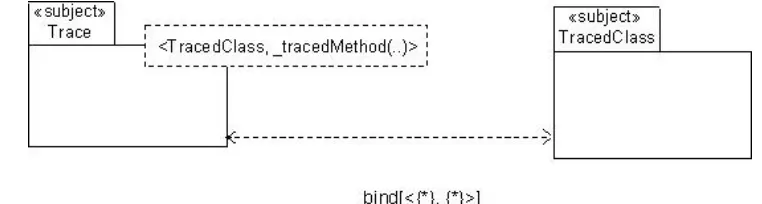
Figure 7: Tracing composition relationship
Figure 7 illustrates the composition relationship with bind attachment. From the asterisks within the braces of the bind attachment we can see that any method from any class can be traced.
The three models presented in this subsection describe the design of the tracing concern that was implemented for the AppTrack system. The models show that the requirements of every method being traceable and the tracing happening before the method execution have been satisfied. Satisfaction of the other requirements will be proven during the implementation phase.
3.2 Transactions
is cause for their separation. In AppTrack they are implemented together and the result is extremely tight coupling.
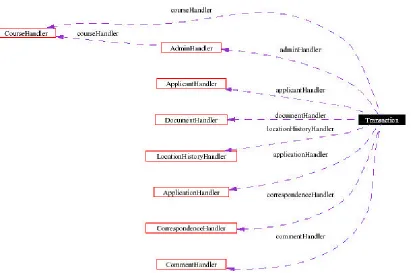
Figure 8: AppTrack transaction and data access architecture
Figure 8 shows the relationship between the transactions concern and the data access concern. Each key object in the system has a Handler class to cater for its data access requirements. The key objects are derived from the requirements specification. As can be seen from the diagram, any class that wants to use data access functionality can only gain access to classes that will deliver this functionality by going through
the Transaction class. What this means in practice is that you must declare an instance of the
Transaction class and obtain the instance of the Handler you desire from the Transaction
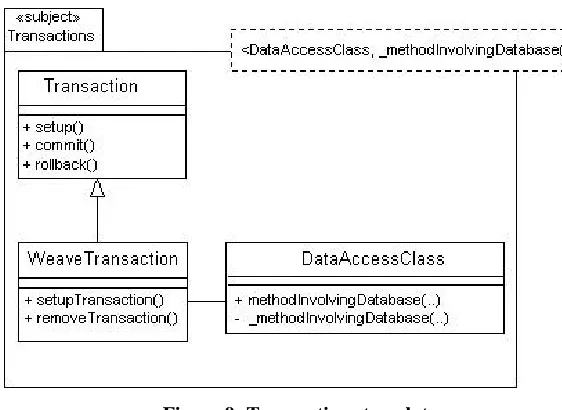
Figure 9: Transactions template
Figure 9 shows the composition patterns structure for the transactions concern. The Struts framework dictates that certain classes must implement certain interfaces and perform particular duties. Action
classes contain the code for the actual core behaviour of a requirement such as, for example, registering a
potential applicant with the system. Action classes (and supporting bean and form classes) are the only classes that perform data access and hence it is only these classes that can be enhanced with transactional
behaviour. An instance of one of these classes is referred to as a DataAccessClass in the template model. There are no parameter restrictions on methods that can have their data access functionality supplemented with transactions.
The transactional behaviour resides in the Transaction class. This class contains core database
connection management methods such as setup(), commit() and rollback(). The behaviour
implemented in the Transaction class is weaved into the methods in the data access classes by the
WeaveTransaction class. This class contains simple methods for designating which methods in the data access classes need to be augmented with transaction setup and removal behaviour.
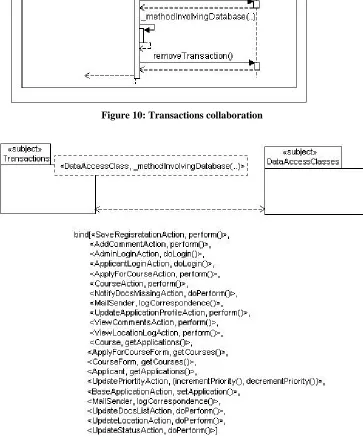
Figure 10 shows the sequence of interactions that occur between the transactions concern and the
DataAccessClass that is making use of it. When a method involving data access is invoked, a
transaction will be setup. The database will be accessed and the rest of the method body will execute. Following the completion of the method involving the data access, the transaction will be committed and all appropriate resources will be freed. This behaviour is encapsulated in the removeTransaction()
Figure 10: Transactions collaboration
Figure 11: Transactions composition relationship
Figure 11 presents the composition relationship for the transactions concern. Any method involving data access can have that data access execute within the context of a transaction. The bind attachment to the composition relationship shows the actual methods in the AppTrack codebase that use the transactions concern. Note the use of the parenthesis to add transactional behaviour to two methods in the same class,
The models presented in this subsection describe the design of the transactions concern that was implemented for the AppTrack system. The models show that any appropriate method that needs to access the database can have this data access execute within a transaction. This behaviour can be achieved without tightly coupling the concerns as tightly as they were before. This is discussed further in the section that evaluates the re-implementation of this concern (section 5.2).
3.3 Enforcing Factory Design Pattern
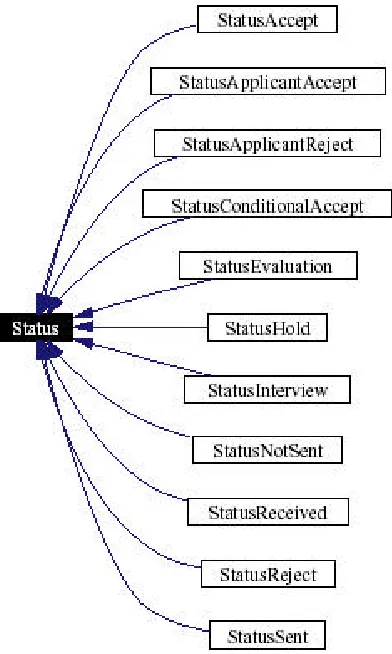
The concept of object factories is presented in [34]. This concept forms the basis of the Factory Method and Abstract Factory design patterns. These two patterns are object-oriented software design patterns. The core intent of the patterns is to formalise structures for object creation. The Factory Method lets a class defer instantiation to subclasses. The pattern is a class creational pattern. The Abstract Factory pattern provides an interface for creating families of related or dependent objects, without specifying their concrete classes. A factory class based on the general concept (controlling object creation) of these two design patterns is used in AppTrack for the implementation of the application status requirement. Each application for a postgraduate course has an associated status. There are eleven possible statuses that an application can have. Each status from the requirements specification has a status object to represent it. Each of these
[image:39.612.208.404.367.694.2]objects implements the Status interface.
A factory-style pattern is needed to put tighter controls on how status objects can be created and manipulated. It would not be desirable to have unrestrained creation of status objects as only one instance of each one needed. This instance can be shared amongst all clients of the application and the factory enforces this because it is a Singleton [34] itself. The Singleton pattern is used to ensure that only one instance of a class is created, and that a global point of access is provided to it.
The inclusion of a factory in the AppTrack architecture required slightly more development resources
than a less elegant solution involving non-regulated creation of Status objects (making it harder to
enforce the high-level requirements of the system that place restrictions on status transition e.g. you may only go from status A to status B, not status C). The pattern makes it possible to easily extend or modify the existing base of status objects and to integrate any new statuses seamlessly. It is desirable to protect this investment in the architecture so that any future maintainers of the system follow the pattern. Although the pattern is in place, it would be possible to bypass it when making future modifications to the system. It is possible to enforce the use of the pattern by ensuring that any class that implements the Status interface
is only instantiated from within the StatusFactory class. An object-oriented solution to this
enforcement requirement would necessitate somehow (possibly using Java Reflection) checking which class was calling the constructor of each concrete status object. If this client class wasn’t the
StatusFactory then an exception would be raised or some other appropriate action would be taken. There are two main problems with an object-oriented solution (if one is possible at all). Firstly, the implementation would be overly complex; there is no easy way to do what we want to with the object-oriented approach. Complexity should always be avoided wherever possible. Secondly, including design pattern enforcement code in the constructor of a concrete status object leads to the tangling of concerns. The standard status behaviour should be separate to any enforcement of the factory pattern. An aspect-oriented solution to this dilemma proves to be superior to its object-aspect-oriented counterpart.
The requirement, once more, is to ensure that concrete status objects are only instantiated from within
the StatusFactory class. Any call to the constructor of a concrete status object, denoted in AspectJ by
the method someStatus.new(..) will cause the execution of the enforceFactory() method.
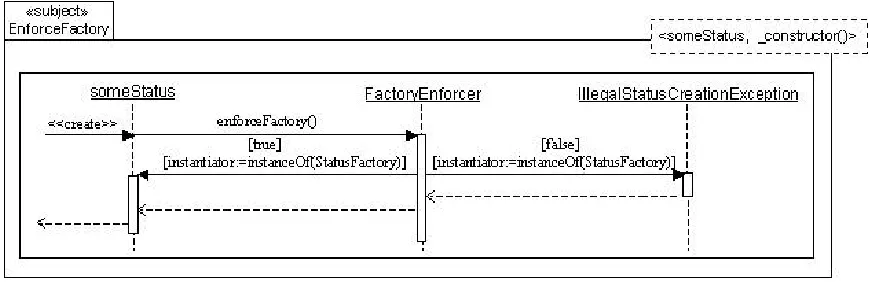
[image:40.612.88.523.543.684.2]The FactoryEnforcer is not explicitly associated with any class in the system and vice versa.
Figure 13 describes the sequence of events that occur when the constructor of a concrete status object is
invoked. Before the constructor executes, the precondition-style enforceFactory() method executes.
This method checks to see if the Status object was invoked from a valid location. If it has then the object is created successfully, otherwise an exception is thrown before the creation of the object. The actual
implementation of enforceFactory() method is not overly important, the key point is that the method runs whenever a status object is created and it contains appropriate behaviour so as to enforce the correct use of the status factory pattern.
Figure 14: Enforce factory composition relationship
Figure 14 illustrates the composition relationship for the enforce factory concern. The StatusFactory
class contains one instance of each Status class, represented here by the someStatus class. In the
implementation of this model, the someStatus class is replaced by the actual Status classes in the AppTrack codebase. These classes are listed in the bind attachment. Therefore, the instantiation of any of the listed classes will cause the execution of the enforce status factory behaviour.
The models presented in this subsection explain the design of the status factory enforcing concern that was implemented for the AppTrack system. The models show that any call to the constructor of a class implementing the Status interface will be checked to see if it is legal. Using AOSD techniques this
behaviour can be realised without tangling the precondition with the status constructor.
3.4 Database Compatibility
behaviour. The MySQL workaround for this issue is to double up on apostrophes when they are required. If the same applicant registers with the system then the name will be parsed and all apostrophes will be replaced with double apostrophes (’’). The user’s name will now be read back as “John O’ Leary”.
There exists a Handler class for each key object in the system (see figure 8). These database
interface classes contain a method, setQueryParams(), that sets the parameters for any database
queries that the Handler’ classes make. We implemented a method to parse any parameters that were set
inside this method. This solution worked fine and there were never any problems adding and displaying names or indeed any text string containing an apostrophe. However, because we had included the fix to this database issue inside our core application codebase there were two problems. The first of these was that we had coded our system into a state where it was database specific. Due to the parsing and manipulation of strings containing apostrophes we could not port seamlessly to another DBMS. From a software
engineering perspective, the second problem is that database fix code was tangled within the Handler
classes. A greater degree of separation of these two related but distinct concerns was definitely desirable. It must be noted here that standard object-oriented software development techniques could have been used to reduce the degree of scattering and tangling caused by the implementation of this concern. The parsing behaviour could have been encapsulated within a class of its own (as opposed to appearing in each
Handler class) and then invoked from the database handler classes. This would reduce the number of scattered lines of code in the system that related to this concern but the concern would still be tangled
within the Handler classes.
Figure 15: The database compatibility template
Figure 15 shows the composition patterns structure for the database compatibility concern in the AppTrack
system. Each Handler class has a setQueryParams method, which is the method that sets the
parameters to be sent to the database. The fixQuotes() method of the FixQuotes class is run in
Figure 16: Database