Analysis of the Numerical Solutions for the
Massive Dirac Equation with Electric Potential
Employing Biquaternionic Functions
A. Bucio R.
IAENG, Member
, V. Martinez-Garza-Garcia
IAENG, Member
,
M. P. Ramirez T.
IAENG, Member
, R. Castillo-Perez.
Abstract—We study a new class of numerical solutions for the Dirac equation, considering electric potentials depending upon one spacial variable, based on the numerical approaching of the Taylor series in formal powers, solutions of a biquaternionic Vekua equation. Furthermore, employing the solutions of the Dirac equation, we plot the probability functions that describe the dynamics of the quantum particles within a circular domain, enhancing a common pattern detected for all the researched cases.
Index Terms—Biquaternions, Dirac equation, Vekua equa-tion.
I. INTRODUCTION
T
HE study of the massive Dirac equation with different kinds of potentials is fundamental in many branches of Theoretical and Experimental Physics, Engineering and Applied Mathematics. As an example, its foundations allow a better understanding of many processes in Nuclear Medicine Radiation Dosimetry, as posed in [9], a branch of science that virtually employs the convergence of the four areas mentioned before, among others. This shall illustrate the importance of new areas of Applied Mathematics that allow the study of the Dirac equation from novel points of view, as the modern elements of the pseudoanalytic function theory do [6].More precisely, this work recapitulates the results pre-sented in [10] and [11], where it the massive Dirac equation was analyzed with an arbitrary electric potential depending upon one spacial variable. Employing a technique that once rewritten in biquaternionic form, allowed the decoupling of the Dirac equation into a pair of partial differential equations. One of them can be solved immediately, and the other one is a special kind of a biquaternionic Vekua equation, as stated in [11], that is indeed an independent rediscovering of a particular class of the two-dimensional bicomplex Vekua equations studied for more general cases in [6], and that in these pages will be researched in more detail by considering four specific classes of electric potentials.
The main objective is to extend the analysis of the new classes of solutions, upcoming from the representation of A. Bucio R.is with the SEPI-UPIITA Instituto Politecnico Nacional, Av. IPN 2580, C.P. 07340, Mexico, [email protected]
V. Martinez-Garza-Garciais with the Engineering Faculty of Universi-dad La Salle, B. Franklin 47, C.P. 06140, Mexico, and with the Biomedical Engineering Department of the Hospital General de MexicoDr. Eduardo Liceaga, Dr. Balmis 148, C.P. 06726, [email protected]
M. P. Ramirez T. is with Asaji Audio Internacional S.A. de C.V., Guadalupe I.R. 687, C.P. 16030, Mexico, [email protected]
R. Castillo-Perezis with SEPI, ESIME Zacatenco, Instituto Politecnico Nacional, Av. IPN S/N, C.P. 07738, Mexico, [email protected]
the general solution for the biquaternionic Vekua equation in terms of the so-called Taylor series in formal powers [1], upto the approaching of the probability functions obtained from the corresponding solutions for the massive Dirac equation. Additionally, as the reader will notice, the exact rep-resentations of these probability functions are in general inaccessible. Thus we also present a numerical method, based upon a variation of the techniques exposed in [2], that will allow the construction of the probability functions, providing enough material for illustrating a particular behavior detected in several classes of the employed electric potentials.
The conclusions enhance the necessity of a deeper research in order to determine if such behavior is inherent to the massive Dirac equation with electric potentials depending upon only one spacial variable, or if it is exclusively attached to those probability functions constructed by means of the techniques used here.
II. PRELIMINARIES: ELEMENTS OF QUATERNIONIC ANALYSIS
As explained in [7], we shall consider the set of biquater-nionic functionsH(C), where the elementsq∈H(C)posses the form:
q=
3 X
n=0
qnen, (1)
beingqn complex-valued functions:qn=Reqn+iImqn,i
the standard imaginary uniti2 =−1,e
0= 1, and{en}
3
n=1 the quaternionic units, which fulfill the relations:
e1e2=−e2e1=e3,
e2e3=−e3e2=e1,
e3e1=−e1e3=e2,
e21=e22=e23=−1. (2) We shall appoint that the imaginary uniti, by definition, will commute with the quaternionic units:ien=eni. A
comple-mentary representation for the biquaternionsq ∈H(C)that will be useful in this work is:
q=Sc q+Vec q, (3)
where
Scq=q0, whereas
Vecq=
3 X
n=1
Notice relations (2) indicate that, in general, the multi-plication between two biquaternions p, q ∈ H(C) is not commutative. Therefore we will introduce a notation for the multiplication by the right-hand side of q by p in the following form:
Mpq=q·p.
Besides, we shall consider the partial differential operator
D, known as the Moisil-Theodoresco operator, as well as the Dirac operator, that is introduced in the form:
D=e1∂1+e2∂2+e3∂3.
Here we employ the abbreviated notation∂n= ∂x∂n, for each n= 1,2,3. Notice this operator is defined in the space of at least once-derivable biquaternions with respect to the spacial variablesx1, x2, andx3.
A. A special class of biquaternionic partial differential equa-tions.
As it will be established further, the classical Dirac equa-tion for massive particles under the influence of an arbi-trary electric potential, depending upon one spatial variable, is closely related with a partial differential biquaternionic equation of the form:
D−Mge1+me2f = 0, (4) More precisely, m is an purely scalar real constant m =
Sc Rem, whereasg is a purely scalar imaginary function depending upon the variable x1: g = iSc Im g(x1). In general,f ∈H(C)is a full biquaternionic function.
There have been several works dedicated to approximate exact solutions for this equation, utilizing elements of the modern pseudoanalytic functions theory (see [6], [8] and more recently [10] and [11]). Here we will employ a variation of the techniques presented in the cited works, in order to obtain different classes of solutions that will be numerically approached.
Thus, as proposed first in [8], let us consider:
f =αQ, (5)
whereαis a purely scalar functionα=Scα, andQ∈H(C) is a full biquaternion, in the sense of the notation (3). Expanding the differential equation (4) according to the representation (5) off, we will have that:
Dα·Q+αDQ−αQge1−αQme2= 0. (6) Now, as posed in [11], let us assume that the following relations hold:
DQ−Qge1= 0, (7)
Dα·Q−αQme2= 0. (8) If additionally we assume thatQis not azero divisor(see [7] for a detailed explanation), this is, that there exist a Q−1∈ H(C)such that: Q·Q−1= 1, and that:
Q=q1e1+q3e3, (9) the equations (7) and (8) will reach a pair of decoupled partial differential equations:
DQ−Qge1= 0, (10)
and
∂1α+gα= 0. (11) We can immediately verify that:
α=Ke−mx2, (12)
whereKis a real constant, is the general solution of (11). On the other hand, as it was explained in detail [11], equation (10) is fully equivalent to a special kind of biquaternionic Vekua equation [6] with the form:
∂zW− ∂zp
p W = 0, (13)
where
∂z=∂1+e1∂3,
W =q1−q3e1, W =q1+q3e1 (14) and
p=eRgdx1. (15)
The extension of the pseudoanalytic function theory posed by L. Bers in [1] that allows the construction of the gen-eral solution for the biquaternionic Vekua equation (13), named in honor I. Vekua [12], can be found in the work of V. Kravchenko [6]. Indeed, the equation (13) presented in [11], constitutes a rediscovering of a special class of two-dimensional biquaternionic Dirac equations, previously studied in [6].
In this sense, the contribution of this work is the prelimi-nary analysis of the probability distributions rising up from the solutions of the Dirac equation, since, as the reader shall verify, most part of them are only accessible by means of the numerical analysis, because the integral expressions that will be further displayed can not be solved in exact form. As a matter of fact, these pages intend to start a preliminary discussion about such probability distributions, for the mains of most works cited above might not directly allow to discuss this topic.
Therefore, let us review some of the propositions presented by V. Kravchenko in [6], adapted by the authors on behalf of the results that shall be exposed, that will allow the construction of the general solution of (13) in terms of the so-called Taylor series in formal powers [1]. The general solution of (13) accepts the expansion:
W =
∞
X
n=0
Z0(n)(an, z0;z) (16) wherean are biquaternionic constants of the form:
an=a0n+a00ne1, being
a0n=Rea0n+iIm a0n; a00n =Rea00n+iIma00n.
Also,z is a purely real quaternionic variable:
z=x1+e1x3;
andz0is a fixed point in the quaternionic plane. Specifically, for this work we will considerz0 at the originz0= 0.
Moreover, according to [1] and [6], each formal power
Z0(n)(an, z0;z) is a solution of (13), and possesses the property:
Z0(n)(an, z0;z) =a0Z (n)
0 (1, z0;z) +a00Z (n)
among many others. This implies that, for the purpose of this work, we can center our attention into the construction of some elements of the set:
n
Z0(n)(1,0;z), Z0(n)(e1,0;z) o∞
n=0 (17)
for everyone of them can be related with a solution of the Dirac equation in classical form, and in consequence, to provide a probability distribution for a specific massive quantum particle.
The formal and complete propositions to approach the formal powers (17) can be found in [6]. Here for the sake of briefness we shall present only essential elements without proofs. We will circumscribe our explanations to the construction of the elements of the subset:
n
Z0(n)(1,0;z)o
∞
n=0
because, in general, the procedures are identical to those for constructing the rest of the elements of (17).
First, let us introduce the set of functions:
F0=p−1, G0=e1p, F1=p, G1=e1p−1, (18) whereppossesses the form indicated in (15). These shall be grouped in two pairs:(F0, G0)and(F1, G1), and they shall be namedgenerating pairs[1][6], since they both fulfill the condition:
Vec F G
6
= 0,
where F = Sc F −Vec F. Then we can introduce a complementary set of functions:
F0∗=−e1p−1, G∗0=p, F1∗=−e1p, G∗0=p− 1
, (19) where(F0∗, G∗0)will be called theadjoint pair of (F0, G0), as well (F1∗, G∗1) the adjoint of(F1, G1).
Furthermore, the generating pairs (F0, G0) and (F1, G1) are embedded into a periodic generating sequence (see [1] and [6]), with period c= 2. On the light of this, the formal powers can be constructed as follows:
Z0(0)(1,0;z) =λF0,
where λ is a constant that warrantsλF0(0) = 1. The sub-sequent formal powers will be determined by the recursive formulae:
Zj(n+1)(1,0;z) =n Fj Sc
Z
Γ
G∗jZk(n)(1,0;z)dz+
+n Gj Sc
Z
Γ
Fj∗Zk(n)(1,0;z)dz, (20) whereΓis a rectifiable curve going from0tillz, and where
k= 0 ifj= 1, as well ask= 1 ifj= 0.
III. THEDIRAC EQUATION FOR MASSIVE PARTICLES UNDER THE INFLUENCE OF AN ELECTRIC POTENTIAL
Consider the Dirac equation in classical form as follows: "
γ0∂t−
3 X
n=1
γn∂n+im+γ0u(x1) #
Φ(t, x) = 0, (21) wheremis the mass of the quantum particle,urepresents an arbitrary electric potential depending only uponx1,∂t= ∂t∂,
t is the time variable, and γn,n= 0,1,2,3; are the
Pauli-Dirac matrices:
γ0=
1 0 0 0 0 1 0 0 0 0 −1 0 0 0 0 −1
,
γ1=
0 0 0 −1 0 0 −1 0 0 1 0 0 1 0 0 0
,
γ2=
0 0 0 i
0 0 −i 0 0 −i 0 0
i 0 0 0
,
γ3=
0 0 −1 0 0 0 0 1 1 0 0 0 0 −1 0 0
.
Let us consider the time-harmonic representation of Φ:
Φ(t, x) = eiωtϕ(x), where ω denotes the energy of the particle. Then the Dirac equation (21) will turn into:
"
iωγ0− 3 X
n=1
γn∂m+im+γ0u(x1) #
ϕ(x) = 0, (22) Beside, we shall employ the pair of matrix operators A
andA−1, presented in [7]:
A=
0 −1 1 0
i 0 0 −i
−1 0 0 −1 0 i i 0
,
A−1=
0 −i −1 0
−1 0 0 −i
1 0 0 −i
0 i −1 0
, (23)
because by applying them together with the matricesγn to
the differential operator of the Dirac equation (22), according to the expression:
Aγ1γ2γ3 "
γ0∂t−
3 X
n=1
γn∂n+im+γ0u(x1) #
A−1,
we will obtain a biquaternionic Dirac equation precisely of the form (4):
D−Mge1+me2f = 0. Indeed, hereg will represent
g=iu(x1) +iω, and
f =Aϕ(x).
It should be noted that the employment of A and A−1 will provoke the reflection of thex3-axis when applied [7]. This is:
A−1ϕ(x1, x2, x3)→f(x1, x2,−x3), as well
A. Numerical approaching of the solutions for the quater-nionic Dirac equation.
When we analyze the solutions uprising from the tech-niques presented in Section II, positively considering the fact that u is an arbitrary function, it becomes easy to see that the parametric integrals of the formulae (20) can not be solved, in general, in exact form. Therefor we shall em-ploy a numerical approximation to evaluate these integrals, and in consequence, to analyze the probability distributions obtained from the solutions of the Dirac equation.
For this purpose, we will focus our attention into four kinds of electric potentials:
u=B, B∈R, (24)
u=B x1, B∈R, (25)
u=B eCx1, B, C∈
R, (26)
u=Bcos (Cx1), B, C∈R, (27) Notwithstanding the first of these potentials could reach a moderate amount of exact solutions for the integral expres-sions (20), on behalf of briefness we will directly study the corresponding numerical results.
More precisely, we will approach n= 10formal powers
Z0(n)(1,0;z) for every case, assuming that the curvesΓ of (20) are straight lines (radii) with lengthR= 1, converging at the (x1, x3)-plane origin, and whose slopes are equally distributed along the angle interval [0,2π). In other words, we will approach the formal powers within the unit circle.
Also, we will considerN = 1000radii, each one sectioned into 1000equal segments, producingP = 1001 points over which the formal powers are to be analyzed.
Beside, in order to approach a set of P = 1001 values for each radius, r= 0,1, ...,1000; corresponding to the nu-merical formal powers Z0(n)(x1[r], x3[r]); we will employ a variation of the computational method presented in [2], whose recursive discrete formulae can be summarized as follows:
Z0(n+1)(x1[r+ 1], x3[r+ 1]) =
= 1
2F0(x1[r], x3[r])·
·ScG∗0(x1[r+ 1], x3[r+ 1])· ·Z1(n)(x1[r+ 1], x3[r+ 1])dz[r] +
+1
2F0(x1[r], x3[r])·
·Sc G∗0(x1[r], x3[r])Z (n)
1 (x1[r], x3[r])dz[r] +
+1
2G0(x1[r], x3[r])·
·ScF0∗(x1[r+ 1], x3[r+ 1])· ·Z1(n)(x1[r+ 1], x3[r+ 1])dz[r] +
+1
2G0(x1[r], x3[r])·
·Sc F0∗(x1[r], x3[r])Z (n)
1 (x1[r], x3[r])dz[r] +
+Z0(n+1)(x1[r], x3[r]) ;
where we have that:
x1[r] =
r
P−1cosθ[l],
x3[r] =
r
P−1sinθ[l],
dz[r] =x1[r+ 1] +x3[r+ 1]e1−x1[r]−x3[r]e1, being
r= 0,1, ..., P −1;
whereas
θ[l] = l·2π
N ; l= 0,1, ..., N−1.
Once the full procedure is performed, we will possesN×
P = 100100values for every numerically approached formal powerZ0(n)(1,0;z),n= 0,1, ...,10.
Evoking now the relation (14):
W =q1−q3e1,
whereW is a solution of the biquaternionic Vekua equation (13), we can provide solutions for the biquaternionic Dirac equation (4) according to the expression (5):
f =αQ=Ke−mx2(q
1e1+q3e3),
whereK is an arbitrary real constant, as appointed in (12). Since each formal power is solution of the Vekua equation (13), the following expression will hold:
f =Ke−mx2(q
1e1+q3e3) =
=Ke−mx2e 1Sc Z
(n)
0 (1,0;z)−e3VecZ (n) 0 (1,0;z)
.
Hereafter, it only remains the application of the matrix transformation A−1 described in (23) to the solutions f, in order to obtain solutions for the time-harmonic Dirac equation (22):
ϕ=
−ScZ0(n)(1,0;x1,−x3)
VecZ0(n)(1,0;x1,−x3)
VecZ0(n)(1,0;x1,−x3)
ScZ0(n)(1,0;x1,−x3)
Ke−mx2.
Still, we require an additional calculation in order to clarify the physical meaning of the solutions of the Dirac equation, for the Cartesian norm of the vector function ϕ
represents a probabilistic function describing the mechanics of the quantum particle within a domain (seee.g. [5]).
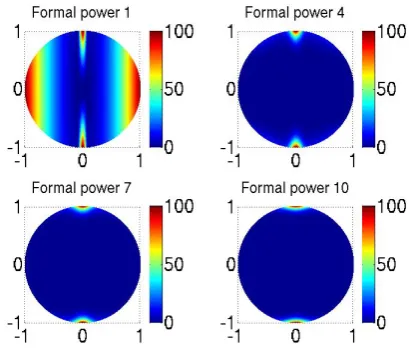
The methods posed along this work can be directly re-ferred to a cylindrical domain, but since the dependence of the x2-variable influences the magnitude of the rest of the solutions in a very clear form, it should be more convenient to focus our attention into the behaviour of the remaining functions within the unit circle. Therefore, we shall now present a set of illustrations that displays the behaviour of the probabilistic functionsP provided by the relations:
P =kScZ0(n)(1,0;x1,−x3)k2+
+kVecZ0(n)(1,0;x1,−x3)k2, where:
kScZ0(n)(1,0;x1,−x3)k2=
Re ScZ0(n)(1,0;x1,−x3) 2
+Im Sc Z0(n)(1,0;x1,−x3) 2
,
as well as
kVec Z0(n)(1,0;x1,−x3)k2=
Re VecZ0(n)(1,0;x1,−x3) 2
+ +Im Vec Z0(n)(1,0;x1,−x3)
2
.
We must clarify that on behalf of the space we have omit-ted the full procedure of normalization for the probability functionsP, limiting our plots to a simple scale adjustment to allow a better comparison between the different cases. All presented plots correspond to the case when K = 1 and
[image:5.595.324.528.57.232.2]x2= 0.
Fig. 1: Probability functionsPgenerated by the formal powersZ1 0,
Z04,Z 7 0 andZ
10
[image:5.595.67.272.251.424.2]0 whenu= 5πandw= 5π.
Fig. 2: Probability functionsPgenerated by the formal powersZ01,
Z04,Z07 andZ010whenu= 20x1 andw= 10π. From the scope of the shown figures, it becomes evident that only the first formal power of the cases (24), (25), (26) and (27) reports, in some sense, a more intricate dynamics of the probability functions P, for the formal powers with
n > 1 already provoke the clustering of the highest values ofP near the boundary and over thex3-axis. As a matter of fact, this behavior is already observed for the value n= 2,
Fig. 3: Probability functionsPgenerated by the formal powersZ01,
[image:5.595.320.529.281.452.2]Z04,Z07 andZ010 whenu= 10e10x1 andw= 10π.
Fig. 4: Probability functionsPgenerated by the formal powersZ1 0,
Z04,Z 7 0 andZ
10
0 whenu=−100 cos (10π x1)and w= 10π. yet we selected to present the graphics of the functions P corresponding to n = 4,7 and 10 to better illustrate our observations.
We need to emphasize that a very similar dynamics are present when analyzing the probability functions P of the electric potentials (24), (25), (26) and (27), upcoming from the formal powersZ0(n)(e1,0;z).
IV. CONCLUSIONS
Considering that an important amount of interesting works have been published within the last decade, dedicated to numerically approach formal powers to study a wide variety of problems in Mathematical Physics (seee.g. [3] and [4]), it is in order to enhance that this work intends to make a contribution within the numerical analysis by fully consider-ing a biquaternionic (also named bicomplex) Vekua equation, whereas another works are developed studying only complex Vequa equations. It is also important to remark that we try to justify a further study of the numerical results, by proposing a preliminary discussion of their physical meanings.
[image:5.595.67.272.483.658.2][6], from the original works of L. Bers [1] and I. Vekua [12], based onto the fact that, notwithstanding the biquaternionic Vekua equation presented in [10] and analyzed in the current pages is an independent rediscovering of the more general results posed in [6], the concepts along this work can be easily integrated in the research line traced by Kravchenko et al.
At this point, we enhance that the research line is dis-tinguished by the fine mathematical characterization of the novel results, but by its very nature, the studies precising the physical implications of the new concepts, considering more specific information, remained out of the scope of most works. This pages shall offer a contribution in this direction, since explicit kinds of electric potentials were considered, and the probability functions upcoming from the new solutions of the Dirac equations were shown.
The main annotation that needs to be settled down is the clear tendency of the higher values of the probabilistic func-tionsP to remain clustered near to the domain boundary, and around the x3-axis, independently of the electric potential
u(x1)considered into the calculations, and already from the very second formal power n= 2.
This fact shows that we need to analyze a wider class of probability functions P, preferentially obtained with complete different techniques, in order to understand if this phenomenon is characteristic of the solutions of the massive Dirac equation when considering electric potentials depending upon only one spacial variable, or if it is strictly related to the results obtained by applying this branch of the generalized pseudoanalytic function theory to the Dirac equation.
Independently, it might have been shown that the analysis of the biquaternonic Vekua equation attached to the massive Dirac equation, can make positive contributions in Relativis-tic Quantum Mechanics, and that it could well take the new results closer to be employed in the applied sciences, e.g as part of the foundations of Nuclear Medicine Radiation Dosimetry [9].
Acknowledgments1: A. Bucio R. would like to thank the support of the project SIP 20150203, IPN, Mexico.
M. P. Ramirez T. would like to thank the support of Mantenimiento a Instalaciones Conservacion de Equipo e Inmuebles S.A. de C.V., Mexico.R. Castillo P. would like to thank the support of the SIBE and EDI programs of the IPN as well as that of the project SIP20150203.
REFERENCES
[1] L. Bers (1953),Theory of Pseudoanalytic Functions,IMM, New York University.
[2] A. Bucio R., R. Castillo-Perez, M.P. Ramirez T. (2011), On the Numerical Construction of Formal Powers and their Application to the Electrical Impedance Equation, 8th International Conference on Electrical Engineering, Computing Science and Automatic Control, IEEE Catalog Number: CFP11827-ART, ISBN:978-1-4577-1013-1, pp. 769-774.
[3] H. M. Campos, R. Castillo-Perez, V. V. Kravchenko (2011), Con-struction and application of Bergman-type reproducing kernels for boundary and eigenvalue problems in the plane, Complex Variables and Elliptic Equations, 1-38.
[4] R. Castillo-Perez., V. Kravchenko, R. Resendiz V. (2011), Solution of boundary value and eigenvalue problems for second order elliptic operators in the plane using pseudoanalytic formal powers, Mathe-matical Methods in the Applied Sciences, Vol. 34, Issue 4. [5] W. Greiner (2013),Relativistic Quantum Mechanics. Wave Equations,
Springer, Germany.
[6] V. V. Kravchenko (2009),Applied Pseudoanalytic Function Theory, Series: Frontiers in Mathematics, ISBN: 978-3-0346-0003-3. [7] V. Kravchenko (2003),Applied Quaternionic Analysis, Heldermann. [8] V. Kravchenko, M. P. Ramirez T. (2000),New Exact Solutions for the
Massive Dirac Equation with Electric or Scalar Potential, Mathemat-ical Methods in the Applied Sciences, Vol. 23, 769-776.
[9] B. J. McParland (2010), Nuclear Medicine Radiation Dosimetry: Advanced Theoretical Principles, Springer verlag London Limited. [10] M. P. Ramirez T., V. Martinez-Garza-Garcia (2014),New Solutions
for the Massive Dirac Equation with Electric Potential, Employing Biquaternionic and Pseudoanalytic Functions, Proceedings of the World Congress on Engineering and Computer Science 2014 Vol I, ISBN: 978-988-19252-0-6, ISSN: 0958 (Print); ISSN: 2078-0966 (Online), USA.
[11] M. P. Ramirez T., V. Martinez-Garza-Garcia (2015),Solutions for the massive Dirac equation with electric potential, employing a biquater-nionic Vekua equation, Transactions on Engineering Technologies: World Congress on Engineering and Computer Science 2014, Springer (to be published).