Technology for the Aging Society - A Focus and
Design of a Cost Effective Smart Home for the
Aged and Disabled
Abstract─Smart homes automations no longer exist as design concepts for the future generation. With the fast growing and increasing trends in technologies in smart systems, the development of smart homes have seen innovative trends in designs. The aged, Alzheimer and Anosmia patients and people with disability face many difficulties in going about their routines at home. The challenges they encounter especially when they are at home alone pose a threat to their safety and security. This paper seeks to design and prototype a smart home which consists of a lighting control system developed with photo sensors to regulate the external and internal lighting and a vibrating alert system to assist the deaf when the door-bell rings or scenarios that may endanger them using Arduino microcontroller. A human-movement detection system was also integrated into the design to enhance security. The Alzheimer patient is assisted by a gas detection system. The smart home developed is monitored and controlled remotely using a web browser. The prototype has been tested and found to be very assistive to the aged and disabled.
Index Terms─aging society, disabled, intrusion detection, cost effective smart home, gas leakage
I. INTRODUCTION
umans are generally prone to living in uncertainty. As we grow, we are faced with so many unpredictable situations that may cause our inability to perform certain routines. The unforeseen situations among the lot may be due to accidents or complications that may render us disabled to perform duties. Aging is another factor that presents diseases and other complications, which prevent us from living a normal life. The Aged and physically challenged are more likely to be exposed to daily life problems than other healthy people. While the deaf may not be able to hear the doorbell, a person without hands may not be able to open the door, the Alzheimer person may forget to turn the gas tap off or even turn off some home appliances, the dumb may not be able to call for help in danger such as fire outbreaks.
Manuscript received June 11, 2015; revised July 18, 2015
Albert Kwansah Ansah is a lecturer with the Computer Science and Engineering Department, University of Mines and Technology, TK 237 Tarkwa, Ghana (cell: +233 264 518866, email: [email protected]) Jeffrey Antwi Ansah is a teaching assistant with the Computer Science and Engineering Department, University of Mines and Technology, TK 237 Tarkwa, Ghana ([email protected])
Stephen Anokye is a lecturer with the Computer Science and Engineering Department, University of Mines and Technology, TK 237 Tarkwa, Ghana ([email protected])
Thus, it is imperative to develop assistive systems for people in such situations. Smart homes are now being developed to provide automation of some basic appliances in the home.
Smart Home is a term commonly used to define home or building, equipped with special systems that do some intelligent actuations according to situations. Smart Homes are now concepts of this age and are being implemented now with a focus on having a direct impact on the lifestyles of people living in them [1]. A smart environment is a context aware system based on ubiquitous computing [2]. A smart home promotes a physical world that is richly and invisibly interwoven with sensors, actuators, displays, and computational elements, embedded seamlessly in the everyday objects of our lives, and connected through a continuous network [3] in which the environment interacts with its inhabitants through embedded dedicated devices. The fast increasing trends in technology has provided many opportunities for connectivity and automation of systems whereby computers and other devices are linked to perform everyday routine activities and commonplace tasks. These Smart homes control lighting, doors, temperature, humidity and other conditions in the home. While the cost of living is going up, there is a growing focus to involve technology to lower those prices. Smart homes take advantage of their environment and allow seamless control whether the user is present or away. A smart home must not only automate but also integrate monitoring and control systems to guarantee safety and security of the aged and disability.
Home automation otherwise known as domotic is usually described as the introduction of technology within the home environment to provide convenience, comfort, security and energy efficiency to its occupants [4]. With the introduction of Internet of Things (IOT), research and implementation of home automation are getting more popular [5]. Various wireless technologies that can support remote data transfer, sensing and control such as Bluetooth, Wi-Fi, Radio Frequency Identification (RFID), and cellular networks have been utilized to embed various levels of intelligence in the home. [6] presented on the feasibility of Bluetooth based home automation systems using Android Smart phones without the Internet controllability. Proposed mobile IP based architecture and its potential applications in Smart
Albert Kwansah Ansah, Member, IAENG, Jeffrey Antwi Ansah, Stephen Anokye
deployment and testing [7]. In recent time, researchers have also presented use of Web services, Simple Object Access Protocol (SOAP) and representational state transfer (REST) as an interoperable application layer to remotely access home automation systems. Other systems include the introduction of a smart home management scheme over the Ethernet network based on XML SOAP standards [4].
II. SYSTEM DESIGN
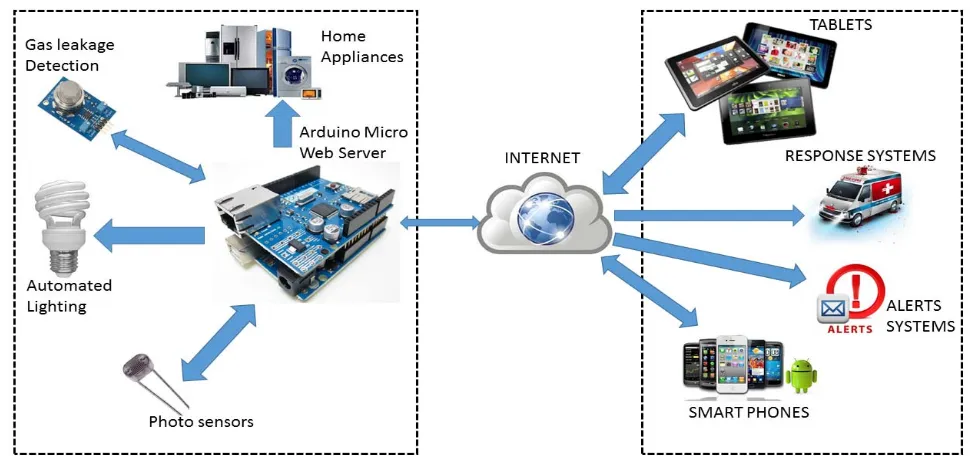
The system design provides an insight on the system architecture that is low cost, efficient, with less power consumption and remote monitoring capabilities and the logics of operation behind the various functionalities of the smart home. In our design, a low cost assistive smart home system for remotely controlling and monitoring the smart home environment is presented. The architecture can be customized in diverse ways to suite different application scenarios in a smart home with minimum recoding and design and it is divided into three layers: home environment, home gateway and remote environment (Fig. 1). The features offered by the design include:
Control of energy management systems such as lightings, power plugs and heating, ventilation and air conditioning systems;
Security as fire detection and intrusion detection with alarm and automatic notifications; and Remote smart home environment control such as
[image:2.595.69.554.508.736.2]maintaining a certain room temperature and turning devices on and off from a remote location.
Fig 1 shows feature of the smart home and communication with remote devices.
disabled and aged will be in direct contact with and consists of sensors, which pick up various signals and perform some actuating response to make life easier for the aged and the disabled. The sensors deployed include:
Photo sensors which performs light automation; Gas detector which turns the gas off when gas
leakage is detected;
Motion sensor which will detect intruder’s presence and warn the occupants of the home; and Temperature sensor, which initiates the turning off
and on of the cooling system in the room.
In the home environment, the sensors deployed will pick the signals, send them to the Arduino board, which does the interpretation, and send commands for specific actuations to be performed. All the sensors in this environment communicate directly with the Arduino board. The sensors and actuators are directly interfaced to the main Arduino controller.
the status of the home, monitor and control remotely. The Arduino microcontroller is the main controller that hosts the micro web-server and performs the necessary actions that needs to be carried out. The following functionalities are provided for by the control and monitoring applications to the user:
Remote connection to the Home Gateway; Device control; and
Device Monitoring.
In the system scenarios, we designed an automatic doors system to assist the disabled and the aged, which notices, and recognize them and opens and closes the door automatically. Two sensors are placed inside and outside of home. The gas leakage detection system cares for Alzheimer and Anosmia persons, which warns when there is a gas leakage. Gas detector sensor is responsible for an actuation into a peripheral gas sensor circuit with a servomotor connected to it. If there is a gas leakage, gas sensor circuit detects it, interrupts the knob, and broadcasts a warning message about the leakage. The actors through the kitchen alarm system receive the message. The servomotor circuit rotates to turn off the gas knob.
The doorbell functionality has been designed specifically to assist the deaf. A small vibration motor is connected to a radio shield, which communicates with the Arduino while the doorbell circuit also connects to a radio receiver on the Arduino. This system enables to make aware of these people physically by driving vibration motor on Human when the doorbell is pushed. The intrusion detection system is integrated into the smart home to improve security and help the blind recognize the presence of the other persons in the home.
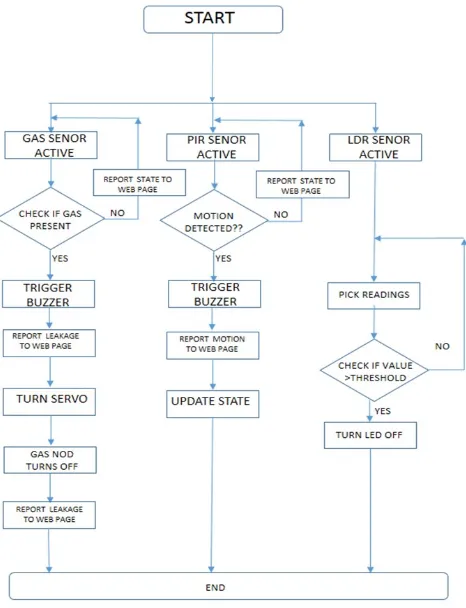
[image:3.595.320.553.66.370.2]A motion sensor is deployed around the home and activated to detect the presence of other persons in the home. An alarm system is triggered which in turn triggers a notification system to security agencies for the necessary response action to take place once there is a detection. The system is remotely monitored via the web browser. In the advent where the disabled or aged may not be fit to move around, the remote monitoring and control features provides the functionality of turning devices in the home on and off. Inclusive are the lighting system, air conditions, and other devices in the home. A Light Dependent Resistor (LDR) is deployed to regulate both the outside and inside lights based on the ambient light intensity. This saves energy and makes life easier for the disabled.
Fig 2. Flow Chart: Showing flow chart for the system where the gas sensor, Passive Infrared (PIR) motion sensor and the LDR have been
deployed.
III. SYSTEM IMPLEMENTATION AND PROTOTYPING
Here a prototype is built with deployment of the sensors. To develop the system, the building was first modelled in blender 3D to get a pictorial view of the entire system. The individual sensors to be deployed was tested to ensure they were all working perfectly before integration. Sketch was the Integrated Development Environment (IDE) used to program the sensors. This system makes use of affordable but efficient sensors. Table I shows the components that was used to design and build the smart home and Table II depicts the pin allocation to the various components that were connected to the Arduino.
COMPONENTS USED
Arduino Uno MQ5 Gas Sensor
Arduino Ethernet Shield Light Emitting Diodes (LEDs) bulbs
PIR motion Sensor Jumper Cables
Buzzer Resistors
Photocell(LDR) Solderless Bread Board
[image:4.595.105.504.43.663.2]Servo Motor
Table II
PIN ALLOCATION TO THE VARIOUS COMPONENTS
Pin Number Component
Analog Pin 0 MQ5 Gas Sensor
Analog Pin 1 Photocell
Digital Pin 2 Buzzer
Digital Pin 3 Outside Led
Digital Pin 5 PIR Motion Sensor
Digital Pin 6 Servo Motor
Digital Pin 7 Remote Led
Digital Pin 9,10,11,12 Arduino Ethernet Shield
[image:4.595.73.521.64.334.2][image:4.595.138.459.334.650.2]
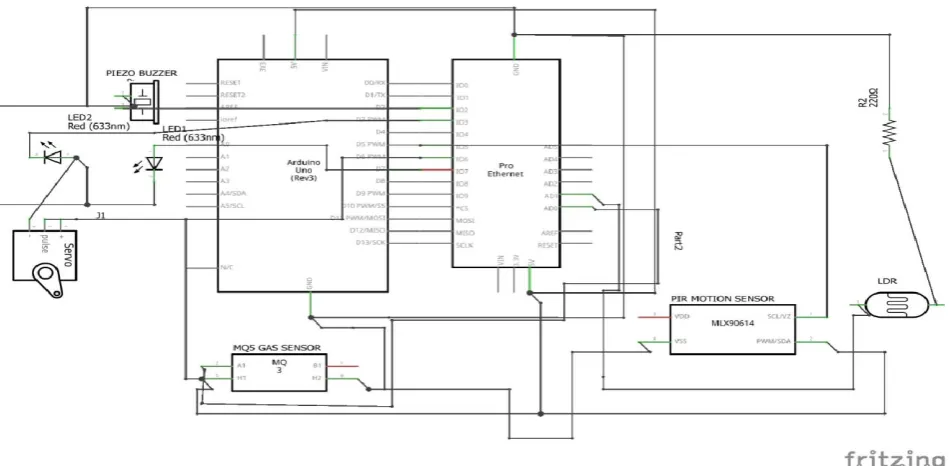
Fig 4. Circuit Diagram
In Fig 4., the Circuit diagram designed using Fritzing circuit designer with the Arduino board, the Ethernet shield, the sensors and the various actuators all connected to the breadboard.
The entire project was coded in C using the Sketch IDE as mentioned earlier, which is an open source software specifically designed for programming the Arduino micro controller board.
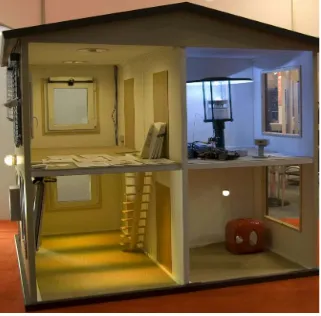
The prototype for the smart home was built out of a box. The box was designed according to the dimensions and architecture of the 3D model designed in blender. Paper glue and a glue gun was used to mend the joints of the roofing to ensure the building gets a firm stand. The circuit schematics was used to connect the breadboard and the jumper cables to the components. Fig. 3 and Fig. 4 depict the prototype building and the circuit testing of the smart home respectively.
IV. CONCLUSION
In this paper, an assistive smart home system for the aged and disabled has been designed and implemented with remote monitoring and controlling functionalities. A prototype of the smart home system has also been developed. With functionalities like gas leakage detection, automatic turning off and on of the gas knob, intruder detection alarms systems, ambient light controlling, remote monitoring and controlling home devices from remote locations, systems monitoring functionalities etc., the aged
disabled are sure to enjoy better living at home. Energy consumption of the entire system is also minimal.
REFERENCES
[1] Işilak, A. H. (2010), “Smart home applications for disabled people by using wireless sensor network”, Unpublished BSc Project Report, Yeditepe University, Istanbul 57pp.
[2] Chander, V. R. (2012), “Novel Ubiquitous Interoperable Context-aware Smart Environments through Web Services”, Proceedings of International Multi Conference of Engineers and Computer Scientists IMECS 2012, Hong Kong March 14-16, Vol. 1, pp. 45 – 46.
[3] Weiser, M. (1991), “The computer of the twenty-first century”, Scientific American, Vol. 265, No. 3 pp. 94 - 104. [4] Piyare, R and Lee S.R. (2013), “Smart Home-Control and
Monitoring System Using Smartphone”, Proceedings, The 1st International Conference on Convergence and it's Application ICCA 2013, ASTL, Vol. 24, pp. 83 - 86.
[5] Kelly, S.D.T., Suryadevara N.K., and Mukhopadhyay S.C. (2013), “Towards the Implementation of IoT for Environmental Condition Monitoring in Homes”, Institute of Electrical and Electronic Engineers IEEE, Vol. 13, pp. 3846 – 3853.
[6] Yan, M. Shi, H. (2013), “Smart Living Using Bluetooth-Based Android Smartphone”, International Journal of Wireless & Mobile Networks (IJWMN), Vol. 5, No. 5, pp. 65 – 72. Condition Monitoring in Homes”, Institute of Electrical and Electronic Engineers IEEE, Vol. 13, pp. 3846 – 3853. [7] Park, B. (2012), “Mobile IP-based architecture for smart