User Intentions in Interactive Tasks
Parameswaran, Nandan and Chakrapani, Pani N,
Member, IAENG
Abstract - In this paper we have argued that a task that
interacts with its user needs to have the user intentions explicitly represented. The user intentions depend on the current situation during a task execution. We consider several structures of user intentions and point out that they are useful in (a) responding to unexpected events in the world with regard to an intended action, and (b) executing the action at the best available opportunity. However, complex intentional structures result in computational overhead called mental effort for an agent. We measure the mental effort of an agent in terms of its intentions over time in different shopping scenarios and observe that repetitive (loop based) actions result in larger mental effort compared to simple and conditional actions.
Index Terms – agents, interactive tasks, intentions, mental states.
I. INTRODUCTION
A task consists of a set of actions that an agent may execute to achieve its goals. (The agent may be a human user or a software agent.) The agent may sometimes execute a task in order to achieve a desired behavior. Tasks can have complex structures such as the ones represented in BPMN [7]. When a task is executed in a dynamic world, the agent may have to respond to unexpected situations often resulting in a need to change the task execution behavior. The agent examines the current world state, and specifies a course of actions it thinks are appropriate in the current situation. The actions that are thus specified form the basis for defining intentions (in this paper). Once an intention is specified, it then is only necessary to focus on how to execute the actions that were intended. While executing complex tasks, the agent can use its intentions as a guide to monitor and maintain its task execution behavior in response to unexpected changes in the environment.
The rest of the paper is structured as follows. In Section II we define intention, argue how it is useful in interactive task execution, and present several types of intention structures using event model. In Section III we present our simulation results where we measure the mental effort spent in maintaining intention structures. In Section IV we discuss different types of intentions. In Section V we present related work. Section VI is Conclusion where we discuss further challenges in this area, and suggest future work.
Manuscript received July 19, 2014.
Nandan Parameswaran is an Adjunct Senior Lecturer in the School of Computer Science and Engineering, The University of New South Wales, Sydney 2052, Australia (email: [email protected])
Pani N. Chakrapani is professor and director of computer science program, Department of Mathematics and Computer Science, University of Redlands, Redlands, CA 92373, USA (email:[email protected])
II. INTENTION IN INTERACTIVE TASKS
Consider the trace of a task execution s0 → s1 → s2 → ... →
sn-1 where s0 is the initial state and sn-1 is the final (goal) state of
the world. Typically all available data are input to the task executing agent at s0 and the output (result) is delivered at the
final state sn-1. In an interactive task, the task execution
typically results in partial output at a set of chosen intermediate states, the agent accepts new data for further execution and identifies a set of options that the agent will need to consider starting from those intermediate states.
The proposed options may contain simple actions a1: si→
sj where the execution of a1 changes the state of the
world from si to sj, or a sequence of actions, say <a1;a2;a3>
where a1:si → sj, a2:sj → sk, and a3:sk → sl. Figure 1 shows a
state diagram with options during a task execution. At s0 the
agent has more than one option: by selecting action a1 and
performing a1, it can go to s2; or it can go to s1 by selecting and
performing a01. At s2, the world may slip into an error state serr
due to an unexpected event u occurring in the world.
A. Intention and Intention cycle
The intention I of an agent towards an activity is a mental state of the agent where the agent commits itself to the activity and acts accordingly. For example, in Figure 1, when the agent intends to achieve sG02, it selects (and thus commits
itself to) the option a1.
Consider an action a1 that the agent wants to execute at time
t2. The agent initially has no intention, and no intention is
To execute the action a1 at a future time t2, the agent forms
an intention at time t1 which we denote as I(a1,t2). At this point,
the agent has committed itself to executing the action a1 and
holds the intention until the time t2 where it executes a1
changing the world state from s0 to s1 at t2. At some point t3, the
agent decides to drop its intention as it is no longer required. This is called the intention cycle. Figure 2 also shows the dependency of events that occur during the intention cycle. At t1, when the agent forms the intention, a mental event occurs at
t1. The world event occurring at t2 causing a state change from
s1 to s2 owes its occurrence to the intention I(a1,t1). The mental
event occurring later at t3 depends on the existence of the
world state s1 at some point before t3. When t1 is not specified,
the agent may choose to execute a1 at any time, but reasonably
soon. The presence of options in a state diagram provides an opportunity to the agent to form intentions and achieve them during its task execution activity. Thus, for example, each path from s0 leading to a goal state in Figure 1 can be an (complex)
intention. An intention is usually defined in terms of actions. One such intention has been marked by the blue path <a1;a2;a3;a4> in Figure 1 above.
Definition
An intention to do an action ai at time ti, denoted I(ai,ti), is a
mental disposition of the agent where the agent has chosen to commit itself to perform the action ai at a future time ti. (If ti
is not specified, the agent attempts to execute ai within a
reasonable time.)
Following are some examples of intentions: I intend to buy
an ice cream. We denote this intention by I(buy_ice_cream),
and it denotes the mental disposition that I have committed myself at this moment (now) that I would buy an ice cream (reasonably soon). Consider another example: I intend to buy
a house within three years. In this, I start holding the intention
from now up to at least three years. In the example, I intend to
buy an ice cream and buy a house within three years, I hold
two intentions at the same time lasting probably for different durations of time.
Uses of intention
An intention models the agent’s executional awareness for an action and it is useful in communicating with the other agents during cooperation. It also provides a source of persistence in a dynamic world. For example, while
responding to an unexpected event occurring in the world, the presence of intention provides a rationale for deciding which option is appropriate for the agent’s current set of intentions. When an intention is “turned on” in an agent’s mind, the agent is on the lookout for the best available opportunities to execute the action. If any unexpected event occurring in the world appears to threaten the execution of the action, the agent can decide what to do with the intention or the event, or choose the time when the action can be executed. If the intention is “turned off”, the agent will find no reason to “be concerned” about the threat to the action.
B. Intention Structures
In a real world, agents often need to form more complex intentions than the ones we discussed above. Fortunately, several useful intention structures can be derived from control abstractions. We discuss below some of them.
Intention for conditional actions
Consider a conditional action if c then a1. An agent that
intends to perform this action will form an (abstract) intention
I(if c then a1) before actually performing the conditional
action. I (if c then a1) has two options: the option that the
agent have the intention I(a1) if c is true in the current world
state; and (ii) the option that the agent have the intention I(nil) if c is false, where nil denotes an empty action. (See Figure 3. We have dropped t from the intention for the sake of simplicity.) Suppose that c is true. Then the agent forms I(a1)
which results in the eventual execution of a1 at t3, I(a1) is
dropped at t4, and the parent intention I(if c then a1) is
also dropped at t6. (Formation of I(a1) is not shown in Figure
3.) If c is false, a nil action is executed. It may be noted that there is a difference between Inull and I(nil). Inull refers to a
mental disposition that the agent has no intention at all, and thus there are no actions performed by the agent due to Inull. I(nil) on the other hand refers to a non-null
Intention for repetitive action
We denote the intention to perform an action a1 repeatedly
by I0(while c do a1) where c is a condition. Figure 4 shows the
structure for this intention along with its sub intention structures I0(a1; while c do a1) and I0(nil). The intention I0(a1;
while c do a1) gives rise to two sub intentions I1(a1) and
I1(while c do a1) both of which are simultaneously adopted by
the agent as shown in Figure 4. I1(a1) results in the execution of
a1 at t5, but the agent still does not drop its original
intention I0(a; while c do a1) until c becomes false.
Intention for action sequence
We denote the intention for an action sequence by I(<a1;a1;...;a1>). The intentions exist all in parallel (parallel
intention strategy) to start with, and as actions are executed, the corresponding intentions are dropped one after another. The agent begins with I(<a1;a2;...;an>) which gives rise to
two sub intentions I(a1) and I(<a2;...;an>) which may occur in
any order. I(<a2;...;an>) gives rise to two new sub intentions
I(a2) and I(<a3;...;an>) but I(<a1;a2;...;an>) is still not
dropped. This continues until no more new sub intentions are generated. As the actions are executed, the sub intentions I(a1), …, I(an) are dropped, and then I(<an-1,an>), I(<a
n-2;…;an>), … , I(<a2;...;an>) are all dropped one after another,
and finally I(<a1;...;an>) is also dropped. Note that the
actions are executed in the order a1, a2, etc. correctly though
the sub intentions may be generated in any order. In this case, the maximum number of intentions that can simultaneously exist at any time is 2n-1. We may also let the agent form intentions one after another (sequential intention strategy) where the agent holds only one intention at a time. The difference between the parallel and sequential strategies is that though the ultimate effect on the world states remain the same in the both these cases, the underlying mental states are different. Specifically, in the sequential strategy, when the agent is holding I(a1) the agent is not aware
of the fact that it will be executing a2 later, whereas in the
parallel strategy, the agent is aware that it will be executing a1,a2, etc., even before any execution starts. We refer to the
awareness due to intention as intention awareness, and the advantage of this awareness is that when an unexpected situation threatens the execution of an action anytime, the “current” mental state of the agent enables the agent to respond to this threat. The response to the threat may include, for example, advancing or postponing the execution or executing a different action from another option in place of the originally intended action. Note that in the sequential case, the agent will not be able to respond to such a threat until it is too late.
C. Intentions and Mental Effort
In dynamic situations, while specifying user intentions in interactive task execution improves task execution management, it does add computational overheads during execution. We call this overhead as the mental effort of the agent. We measure the mental effort em due to an
intention by an amount proportional to the duration over which the intention was maintained.
Mental effort due to a single action a1
Let I(a1) be the intention that was adopted at time t1 and
dropped at t2. The total mental effort spent on holding this
intention is given as em(I(a1), t1, t2) = k*(t2 - t1) for some
constant k.
Mental effort in parallel intentions
For a sequence of two actions <a1;a2> the mental effort is: em(I(<a1;a2>),t1,t4)= em(I(a1),t1,t2)+ em(I(a2),t3,t4). Thus, em(I
(<a1;...;an>),t1,tn) = ∑(em(I(ai)) where i ranges from 1 to n.
Assuming that em(I(ai)) = k for all i, em(I(<a1;...;an>)) can be
shown to be O(n2) for parallel intentions strategy.
Mental effort in Sequential Intention
While it is hard to specify when exactly a human forms an intention before executing an action, it is quite possible to design agents that form intentions as we want. In the cases above, the agent we used formed as many intentions as there were actions and held them as long as each one was necessary. However, if we can constrain our agent to form and maintain not more than one intention at any time, then the total mental effort for a sequence of actions <a1;...;an> can be
reduced to a constant; that is, em(I(<a1;...;an>)) can
be O(1). Thus agents with sequential intentions are more efficient at the cost of not being able to respond adequately to unexpected changes in the world.
Mental effort in Repetitive action
intentions out of which two will be dropped after the execution of the action and one will be retained. Following the intention structure model in Figure 4, we see that after the execution of the action, the agent forms three more intentions in the next iteration, and this process continues until c becomes false. Thus, em(while c do a1) is proportional to n2,
where n is the number of iterations, which simplifies to O(n2).
If we consider loops nesting m times, then em(while c ( while c
(...)) a1) will be O(n2m). Thus, nested loops are more expensive
even in sequential intention model. In sequential intention model, the required mental effort for a single loop will also be O(n2), and for nested loops with m loops nesting, the number
of intentions that will need to be maintained is O(n2m). In
parallel intentions, as we pointed out, the agent is more prepared to respond to unexpected events in the world and it is more suitable for interactive task applications.
III. SIMULATIONS
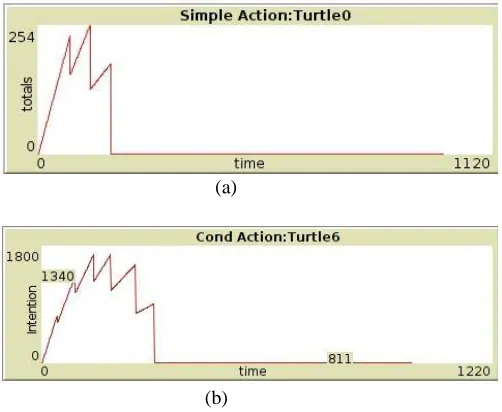
We consider several agents shopping by moving from one shop to another. Each agent starts its shopping activity with a shopping list. Figure 5 shows the mental efforts spent for different shopping scenarios (in NETLOGO [8] simulation). We consider three types of actions of buying an item: simple (first plot), conditional (second plot), and repetitive (third plot), all using the parallel intention strategy. The shopping lists were created randomly and the shops sold items from a randomized list of items. An agent begins with a large set of intentions, looking for the items it wants to buy, and the mental effort increases as time passes. It drops an intention when the item corresponding to that intention has been bought, and this results in the reduction of its mental effort at that point. Conditional actions consume similar mental effort. Repetitive actions require increasing mental effort as time passes as several intentions are needed to be maintained until the loop condition becomes false.
(a)
(b)
[image:4.612.57.308.514.720.2](c)
Figure 5. Physical and mental efforts spent while shopping.
IV. DISCUSSION
When an agent adopts an intention, the adoption typically occurs in a situation where the agent has options not to adopt the intention. We call such intentions as autonomous
intentions since the agent commits to a particular choice
autonomously among several choices. There are however situations where the number of options is exactly 1. We call such intentions as forced intentions. Intention is about doing an action in future however close it is to the present. It is useful to ask how early an intention should be formed. Since intentions cause overhead, forming them must be delayed as much as possible, but not too late since the agent may risk the opportunity of executing the action in the right temporal context. Intention can be viewed as a model for partial action awareness, and more the number of intentions better the opportunities for being in a state to respond appropriately to an unexpected event in the world. Intentions can also be about intentions; for example, I intend to intend to buy a house; that is, I(I(buy_house)). In multiagent scenarios, an agent may intend that another agent do an action; for example, I intend that John intend to buy a house. The type of intentions we discussed so far in this paper may be termed as explicit intentions which may be distinguished from implicit intentions. An agent is said to perform an action a1 with an
implicit intention when the action execution is not directed by the agent’s (mental) intention cycle. This distinction is particularly important in a multiagent scenario since an agent with an implicit intention may not be able to share its mental state with the other cooperative agents.
V. RELATED WORK
suggested in [4] how agents use plans not only as a recipe to achieve their goals, but also to reason about situations and cooperate with other agents. In [3] she presents a theory of intention representation that provides solutions to representational problems in order to fill an important gap in existing theories of agents, planning and collaborative planning. In [6], Stone has attempted to formalize natural language grammatical knowledge using intentional structures in discourses. In our work, we have used intention to model a restricted form of temporal awareness that helps agent perform actions at points where the agent thinks appropriate.
VI. CONCLUSION
In this paper, we argued the need for explicitly modelling intentions in interactive tasks. Representing intentions in tasks provides opportunities for focusing on some parts of a task. This is particularly useful when the task structure is large such as in BPMN, UML, etc. We also demonstrated that the procedural control abstractions can be used to derive complex yet well-defined intention structures. One natural extension of our work is to the domain of multiagent cooperative activities. In this domain, individual agents may spend considerable amount of mental effort in maintaining user intentions.
REFERENCES
[1] M.Bratman, “Two faces of Intention,” The Philosophical Review, XCIII, No. 3 (July 1984).
[2] B.J.Grosz and C.L.Sidner,“Attention, Intentions, and the Discourse Structure,” Computational Linguistics, Volume 12, Number 3, July-September 1986.
[3] L.Hunsberger and C.L.Ortiz, Jr. “Dynamic Intention Structures I: A theory of Intention Representation,” Autonomous Agents and Multi-Agent System, Volume 16, Issue 3, 2008.
[4] M.E. Pollack, “Plans as complex mental attitudes,” In P. R. Cohen, J. Morgan, and M. E. Pollack, eds., Intentions in Communication, MIT Press, 1990.
[5] R.Scheer, “The Mental State Theory of Intentions,” Philo-sophy, Vol. 79, No. 307,Cambridge University Press,2004.
[6] M. Stone, “Intention, Interpretation and the Computational Structure of Language,” Center for Cognitive Science, Rutgers, The State University of New Jersey, 2004.
[7] S. A. White, and D. Miers, BPMN Modeling and Reference Guide: Understanding and Using BPMN, Future Strategies Inc. 2008.