Abstract—A multi-objective multi-site order planning problem in MTO manufacturing is investigated with consideration of various production uncertainties and real-world features. A novel intelligent multi-objective optimization approach is developed to tackle this problem, which combines a harmony search based Pareto optimization (HSPO) process with a Monte Carlo simulation process. A series of experiments are conducted to evaluate the proposed approach based on real industrial data, and experimental results validates the effectiveness of the proposed approach.
Index Terms—Production planning; Order planning; Harmony search; Pareto optimization; Mento Carlo simulation
I. INTRODUCTION
ITH increasing globalization, more and more MTO manufacturing enterprises produce their customer orders in multiple sites (plants) located in different areas. Order planning is at the top level of production decision-making and its performance can greatly affect the overall production and supply chain performance of an MTO enterprise. It is thus very important for these enterprises to make effective order planning decisions so that each order can be assigned to an appropriate plant for production.
Some researchers also investigated the multi-site production planning problem [1], which consider each site as an independent and parallel production unit and usually belong to aggregate planning problems. However, relatively little research has investigated the order planning problem that aims at assigning each order or its production processes to appropriate plants or shop floors.
Ashby and Uzsoy [2] addressed an order planning problem integrating order release, group scheduling and order sequencing in a single-stage production environment. Some researchers addressed order release problems in production planning stage under different production environments, including job shop [3], flow shop [4] and multi-stage assembly system [5]. These problems determined the starting
Manuscript received July 3, 2014; revised July 15, 2014. This work was supported in part by the National Natural Science Foundation of China (Grant No.s 71302134, 71371130) and Sichuan University (Grant No. SKYB201301).
Z.X. Guo, Longchao Chen and Jing Yang are with the Business School of Sichuan University, Chengdu 610065, PR China (tel: +86 28 85417867; fax: +86 28 85415628; e-mails: [email protected]; [email protected]; [email protected]).
* Jing Yang is the corresponding author.
time of different production processes but did not consider where each process was performed. Chen and Pundoor [6] addressed order allocation and scheduling at supply chain level, which focused on assigning production orders to different plants and exploring appropriate schedules for processing the assigned orders in each plant. However, their studies have not considered the effects of such manufacturing features as different production departments and their different production capacities on order planning decisions. These features are typical in such MTO manufacturing industries as apparel, which greatly increase the complexity of production decision-making.
This paper will investigate a multi-objective multi-site order planning (MMOP) problem in an MTO manufacturing environment with the consideration of multiple plants, multiple departments and multiple production uncertainties. The MMOP problem aims at planning the allocation of customer orders to n self-owned or collaborative production plants, located in different regions so that multiple specified production objectives can be achieved.
The investigated MMOP problem is a complex combinatorial optimization problem with a large solution space. Classical optimization techniques are not able to handle the MMOP problem effectively due to its computational complexity. Meta-heuristic optimization techniques have the potential to provide effective solutions for this kind of problems due to their heuristic nature [7, 8], among which genetic algorithm is the most commonly used one. In recent years, a novel meta-heuristic technique developed by Geem et al. [9], harmony search (HS) algorithm, has attracted increasing attention. Some studies showed that the HS could generate superior solutions to other meta-heuristic techniques such as genetic algorithm, particle swarm optimization and simulated annealing [9, 10]. However, few studies developed and used the HS algorithm in handling multi-objective combinatorial optimization problem. Especially, the multi-objective HS algorithm for production decision-making problems has not been reported so far.
To solve the investigated MMOP problem, this research develops a novel intelligent multi-objective optimization (IMO) approach based on harmony search, in which a novel harmony search-based Pareto optimization (HSPO) process is developed to seek Pareto optimal MMOP solutions in terms of the fast non-dominated sorting technique developed by Deb et al. [11]. Moreover, Monte Carlo simulation technique is utilized to handle production uncertainties in
An
Intelligent Multi-objective Optimization
Approach for Multi-site Order Planning in MTO
Manufacturing
Z.X. Guo, Longchao Chen, Jing Yang*
order planning since the HSPO process cannot handle uncertainties directly.
II. PROBLEM STATEMENT
The production in such labor-intensive MTO manufacturing industries as apparel and footwear is characterized by small order sizes and tight due dates. The manufacturer usually receives production orders with the same or close due dates from a customer at a time and then assign these orders to its n plants for production. The orders from a same customer are grouped by their due dates. Each group of these orders with the same due date is defined as an order group. In each order group, some orders are uncertain because they can be cancelled by the customer before the final contract is confirmed. Each order consists of a maximum of N production processes, which need to be produced in turn. Each production process of an order needs to be assigned to one and only one production department for production in a plant, donoted by k, due to the small order size. A total of N types of production departments, numbered as 1 to N , are included, which perform, respectively, N types of different production processes denoted as process type 1 to process type N. Different plants can include different types of production departments. The process with smaller process type number must be produced earlier. All finished products are delivered to a central warehouse for product distribution.
The operation complexities of different production processes from different orders are different due to different technical and quality requirements. On the other hand, different production departments have different production competences due to different skill levels of their operators and different management performances. In real production, the higher the production competence level of a production department and the lower the operation complexity level of a process, the higher the production efficiency of the department for producing this process.
This research uses the term “standard manpower” to represent the standard available manpower in a production department, which equals the summation of each operator’s average efficiency for processing a production order with standard product style and complexity in the department. The investigated MMOP problem will consider various production uncertainties existing in real-world production, including uncertain orders, uncertain processing time and uncertain daily production capacity in collaborative plants, which is thus a stochastic combinatorial optimization problem.
The aim of the MMOP problem addressed is to minimize three important and commonly used production objectives in MTO manufacturing by determining the optimal solutions of beginning time Bij and process allocation
k ij
X of production process Pij.
k ij
X is 1 if process Pij is assigned to the kth plant; otherwise it is 0.
The three objectives are expressed as
) , ( 1 min :
1 k
ij Xij
B F
Objective
with
1( , ) (max(0, ))
1
m
i
i i k
ij X C D
B F
ij
(1) )
, ( 2 min :
2 k
ij Xij
B F Objective
with
1
1 1
2( , ij) ( )
m m
k
ij i iN i
i i
F B X TPT C B
(2)) , ( 3 min :
3 F Bij Xkij
Objective with
n
k N
j P SP
ij n
k N
j kj k
ij
kj ij
ij TIT WT
X B F
1 1 1 1
) (
) , (
3 (3)
The three objectives minimize the total tardiness of all orders, the total throughput time of all orders, and the total idle time of all production departments, respectively. Ci and
i
D denote the completion time and the due date of order Oi respectively, Bij and Cij denote the beginning time and the
completion time for performing process Pij respectively, WTij
denotes the time (days) to wait for the arrival of process Pij in
the idle production department, and SPkj denotes the set of production processes assigned to Skj for processing.
[image:2.595.314.548.51.201.2]III. PROBLEM SOLVING METHODOLOGY A. Framework of the proposed IMO approach
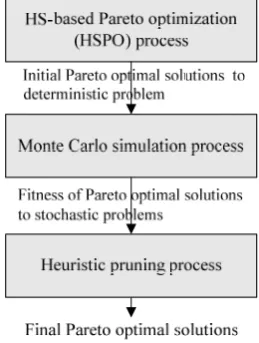
Fig. 1 shows the architecture of the proposed IMO approach, which generates the final MMOP solutions using the following 3 process:
(1) Harmony search-based Pareto optimization (HSPO) process: This process is employed to seek the initial Pareto optimal solutions to the deterministic MMOP problem, which does not consider production uncertainty and assumes that all uncertain orders need to be produced and the processing time of an order equals the mean of its processing time in the department assigned.
(2) Monte Carlo simulation process: On the basis of initial Pareto optimal solutions, this process is then employed to evaluate the performance of each initial solution for the stochastic MMOP problem, by considering production uncertainties in order planning.
[image:2.595.368.498.586.758.2](3) Heuristic pruning process: Based on the performance evaluation for initial solutions in process (2), the heuristic pruning process is finally employed to generate the final optimal solutions for multi-site order planning practice.
The Monte Carlo simulation process and the heuristic pruning process adopted the same processes proposed by Guo et al. [12]. The HSPO process is presented in section III.B
B. HS-based Pareto optimization
The HSPO process is proposed to generate Pareto optimal solutions for the deterministic MMOP problem, called initial Pareto optimal solutions.
1) Procedures of HSPO
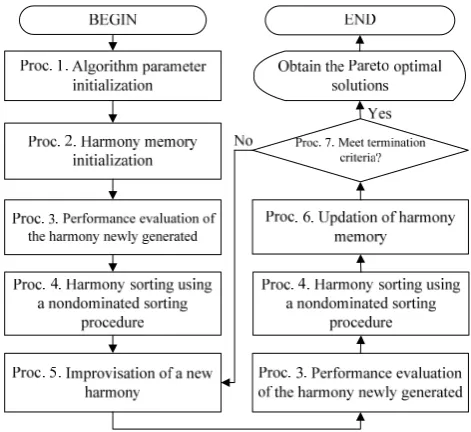
Fig. 2 illustrates the flowchart of the HSPO process, which consists of 7 procedures (proc.1 - proc.7). The HSPO process integrates a non-dominated sorting technique into a harmony search process for generating Pareto optimal solutions to the deterministic MMOP problem. The 7 procedures are described as follows.
Procedure 1. Algorithm parameter initialization
The parameters related to the problem and HS algorithm need to be specified in this procedure, which include the possible ranges of values for all decision variables (input weights and hidden biases), the total number of candidate input variables (C), the harmony memory size (HMS), harmony memory consideration rate ( HMCR ), pitch adjustment rate (PAR), and the number of improvisations (NI).
Procedure 2. Harmony memory initialization
The harmony memory is generated randomly with a specified initial harmony memory size according to a specific harmony representation. The harmony memory member is called a harmony, represented by
s
, which is a feasible MMOP solution. The method of harmony representation will be described detailedly in section III.B.2).Procedure 3. Performance evaluation of the harmony newly generated
The performance of each newly generated harmony is evaluated by calculating the values of objective functions to be optimized. Sub-section III.B.3) will describe in detail how the objective function values are calculated.
Procedure 4. Harmony sorting using a non-dominated sorting technique
On the basis of the values of objective functions of all harmonies, the multi-objective performances of these harmonies are sorted by using the fast non-dominated sorting technique [11].
Procedure 5. Improvise a new harmony
Generating a new harmony is called improvisation. After the objective function values of all harmonies in the harmony memory are calculated, the improvisation process proposed by Mahdavi et al. [13] is used to improvise a new harmony.
Procedure 6. Updation of harmony memory
If the new harmony is better than the worst one in the harmony memory in terms of the harmony sorting result, the new one is used to replace to the existing worst in the harmony memory. All harmonies in the harmony memory are then sorted by their objective function values.
Procedure 7. Termination criteria checking
The HS is controlled by a specified number of improvisations. If this termination criteria is satisfied, the HS process is terminated and the best harmonies are the Pareto optimal solutions to the deterministic problem. Otherwise, go to procedure 5.
2) Harmony representation
Each harmony (solution individual) represents a distinct and feasible MMOP solution. To handle the investigated problem, a feasible solution should be capable of determining the assignment of each production process of each order to an appropriate plant. Actually, the solution can be determined by the assignment of each order group’s production
processes because the orders of each order group should be assigned to the same plant.
In real production practice, the number of production plants assigned to process an order should be as few as possible to reduce the transportation time and cost between different plants. The assignment of production process 1 of each order group determines the assignments of subsequent processes in this order group. This research thus constructs the harmony by using the assignment of production process 1 of each order group to an appropriate plant. Each harmony
s
is a sequence of elements,
s
[
s
1,
s
2,...,
s
i,...,
s
C]
, whose length is equal to the number of order groups to be processed. Each element represents an order group, and the value of each element indicates the plant to produce production process 1 of the corresponding order group. Fig. 3 shows an example of this representation which considers an order planning problem of allocating 10 order groups to 4 plants.Solution
individual 1 3 1 2 2 3 2 3 1 4
Order group
[image:3.595.309.545.201.417.2]No. 1 2 3 4 5 6 7 8 9 10
Fig.3. An example of the harmony representation
[image:3.595.323.531.681.746.2]On the basis of each harmony, the allocation and processing sequence of the subsequent production processes
of each order group are then deduced by the process assignment rules described in section III.B.3).
3) Calculation of objective function values
To obtain the values of objective functions, one needs to firstly determine the values of variables Bij and
k
ij
X . Since the harmony only indicates the assignment of production process 1 of each order group to an appropriate plant, the allocation and processing sequence of the subsequent production processes of each order group need to be deduced further by heuristic rules.
The following three heuristic process assignment rules are proposed to handle the assignment of subsequent processes: Rule 1) The production processes of the same process type in a order group must be assigned to the same plant for processing in real-world production.
Rule 2) For a production process of a production order, if the plant, assigned to produce its last process, contains the production department processing the current process, the process must be assigned to the same plant for processing. Otherwise go to rule 3).
Rule 3) Randomly assign the current process to another plant capable of processing it.
The processing sequence of production process Pij(j2) in a production department corresponds to its beginning time
ij
B , which depends on this process’s arrival time, the completion time of its preceding process Pi,'j in the department and the processing priority of its corresponding order. In the scenario that the production department is idle and waiting for the arrival of production orders, the order with earlier arrival time should be processed first. In the scenario that multiple orders are awaiting to be processed in a department, the order with highest processing priority should be processed first. The processing priority of each order and order group is determined in terms of following rules:
Rule 1) The order group with an earlier due date needs to be produced with a higher priority.
Rule 2) The order group with the less production workload needs to be produced with a higher priority if multiple order groups have a same due date.
Rule 3) The order with the larger number of processes needs to be produced with a higher priority in an order group.
Rule 4) The order with less workload needs to be produced with a higher priority, if multiple orders have the same number of production processes in an order group.
IV. NUMERICAL EXPERIMENTS
To evaluate the performance of the proposed IMO approach, a series of simulation experiments have been conducted. Due to the page limit, this section highlights one experiment in detail. Similar production tasks widely exist in most labor-intensive MTO manufacturing companies.
A. Experimental data and setting
There are no available public datasets appropriate for the experiments of this research because very limited similar research can be found so far. Industrial data was thus collected as experimental data from the production
management database in an MTO manufacturing company producing outwear in Mainland China.
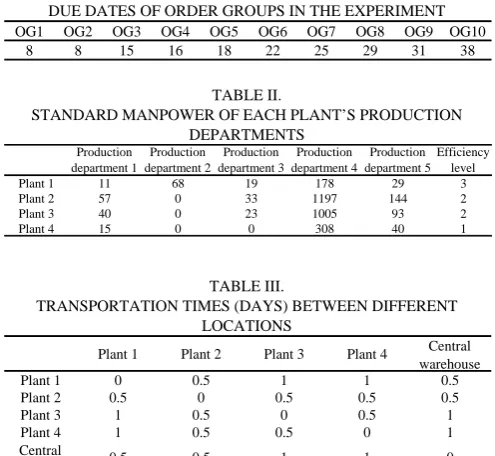
In this experiment, 10 order groups with 55 production orders are processed. Due to page limit, this paper does not show the related information of each production process of each order, including the workloads of 5 production processes of one order, the complexity level and the cancellation probability of each order, which plant has produced a same order before, and the number of times the additional order has been processed in the plant. The due dates of order groups are shown in Table I (count workdays only).
[image:4.595.303.551.328.556.2]The investigated company comprises 4 plants located in different cities. 5 different production departments are involved. Table II shows the standard manpower of production departments in each plant and the efficiency level of each plant. The standard manpower of a production department is 0 if the department does not exist in the plant. The transportation time between different locations, including 4 plants and a distribution center, is shown in Table III.
TABLE I.
DUE DATES OF ORDER GROUPS IN THE EXPERIMENT OG1 OG2 OG3 OG4 OG5 OG6 OG7 OG8 OG9 OG10
8 8 15 16 18 22 25 29 31 38
TABLE II.
STANDARD MANPOWER OF EACH PLANT’S PRODUCTION DEPARTMENTS
Production department 1
Production department 2
Production department 3
Production department 4
Production department 5
Efficiency level
Plant 1 11 68 19 178 29 3
Plant 2 57 0 33 1197 144 2
Plant 3 40 0 23 1005 93 2
Plant 4 15 0 0 308 40 1
TABLE III.
TRANSPORTATION TIMES (DAYS) BETWEEN DIFFERENT LOCATIONS
Plant 1 Plant 2 Plant 3 Plant 4 Central warehouse
Plant 1 0 0.5 1 1 0.5
Plant 2 0.5 0 0.5 0.5 0.5
Plant 3 1 0.5 0 0.5 1
Plant 4 1 0.5 0.5 0 1
Central
warehouse 0.5 0.5 1 1 0
For simplicity, it is assumed that the production departments discussed are empty initially. The proposed approach was established based on the settings: the initial harmony memory sizes HMS of HSPO processes was equal to 500, the maximum numbers of improvisations NI was 100, and the harmony memory consideration rates HMCR
was 0.9. maxMvTimes equaled 30, and maxSimTimes equaled 10000.
[image:4.595.304.552.497.565.2]B. Experimental results
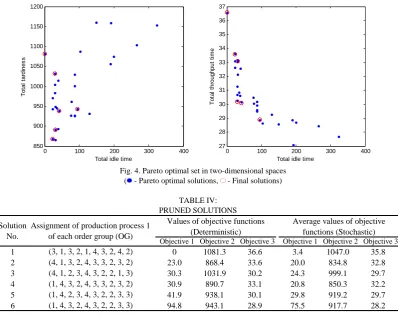
Fig. 4 shows 30 initial Pareto optimal solutions generated by the IMO approach. Based on these initial solutions, the heuristic pruning process generated 6 final (pruned) solutions as shown in Table IV In Fig. 4, the final solutions are also marked by ‘ ’ points while the initial Pareto optimal solutions are marked by ‘ ’ points. The second column of Table IV shows the 6 allocation solutions of production process 1 of all order groups. Taking solution 1 as an example, the production process 1 of order group 2 and 5 are assigned to plant 1 while the production process 1 of order groups 4, 8 and 10 are assigned to plant 2. Columns 3-5 show the values of 3 objective functions generated by the corresponding solution to the deterministic MMOP problem, whereas columns 6-8 show the average values of objective functions generated by the solution when various uncertainties are considered.
C. Performance comparison
In the proposed IMO approach, the HSPO process is the most crucial component since it takes charge of seeking initial Pareto optimal solutions and determines the optimum-seeking capability of the IMO approach. To further validate the optimum-seeking capability of the IMO approach, this research compares optimization results generated by the HSPO process with those generated by an NSGA-II [11] -based optimization process (NSGA-II approach) and an industrial method in terms of the deterministic MMOP problems.
It is well known that Pareto optimal solutions generated by a metaheuristic optimization approach are probably different in different trials if multiple trials are conducted. To reduce the effects of randomicity of iterative processes of the proposed HSPO process and NSGA-II approach, this research repeatedly runs the two approaches 50 times to obtain the statistical results of each objective. In each run, the Pareto optimal solutions to the deterministic MMOP problem are obtained.
The NSGA-II approach, used for performance comparison, had the same solution representation to the HSPO process. In this approach, the tournament selection was adopted. The mutation operation was implemented by randomly changing the values of several randomly selected genes. The uniform crossover was adopted to execute crossover operation. In the NSGA-II approach, the maximum number of generations was 1000. The population size was equal to 500. In each generation, the crossover probability changed randomly between 0.5 and 0.8 while the mutation probability changed randomly between 0.01 and 0.05.
The solutions generated by the industrial method are called industrial solutions. The industrial method, which is being used in the investigated manufacturing company, generates actual MMOP solutions by using four rules: (1) The actual order planning only focuses on the objective of minimizing the total tardiness of all orders; (2) The order group with a larger product quantity needs to be assigned to the plants with more available standard manpower; (3) Order planning decisions are made by considering the production in sewing departments only; and (4) The order group with an earlier due date needs to be processed first.
0 100 200 300 400
850 900 950 1000 1050 1100 1150 1200
Total idle time
T
o
ta
l ta
rd
in
e
s
s
0 100 200 300 400
27 28 29 30 31 32 33 34 35 36 37
Total idle time
T
ot
al
t
hr
oug
hput
t
im
[image:5.595.99.498.71.386.2]e
Fig. 4. Pareto optimal set in two-dimensional spaces ( - Pareto optimal solutions, - Final solutions)
TABLE IV: PRUNED SOLUTIONS
Objective 1 Objective 2 Objective 3 Objective 1 Objective 2 Objective 3
1 0 1081.3 36.6 3.4 1047.0 35.8
2 23.0 868.4 33.6 20.0 834.8 32.8
3 30.3 1031.9 30.2 24.3 999.1 29.7
4 30.9 890.7 33.1 20.8 850.3 32.2
5 41.9 938.1 30.1 29.8 919.2 29.7
6 94.8 943.1 28.9 75.5 917.7 28.2
(1, 4, 2, 3, 4, 3, 2, 2, 3, 3) (1, 4, 3, 2, 4, 3, 2, 2, 3, 3)
Values of objective functions (Deterministic) Solution
No.
Average values of objective functions (Stochastic) Assignment of production process 1
of each order group (OG)
Table V shows the comparison results, based on the solutions, generated by the 3 different methods, to the deterministic MMOP problems. Columns of ‘Min’ and ‘Mean’ show respectively the minimum, mean of the corresponding objectives generated by the 3 methods in 50 repetitive runs whereas ‘Times’ columns show the times of getting the corresponding minimal objective value in the 50 runs. It can be found that from Table V that:
(1) The HSPO process has the ability to find the globally optimal solutions. Taking objective 1 as an example, it is clear that the minimal value of objective 1 converges to its global minimum 0;
(2) Comparing with the NSGA-II approach, the HSPO process reaches the minima more frequently and generates less means for 3 objectives;
(3) For each objective, some minima generated by the proposed HSPO process is slightly less than the minima of corresponding objective values shown in Columns 3-5 of Table IV. It is because some initial Pareto optimal solutions with a globally minimal objective value could be pruned if their other objectives are relatively large;
(4) The HSPO and NSGA-II can generate superior results to the industrial methods because they generate smaller objective values.
The comparison results described above show that the proposed HSPO process can achieve good convergence and effectively handle the MMOP problem by generating Pareto optimal solutions obviously superior to the results generated by the NSGA-II approach and the industrial method.
V. CONCLUSIONS
This paper addressed an MMOP problem in MTO manufacturing environment with the consideration of production uncertainties. A novel intelligent optimization approach was developed to handle the investigated problem. This approach firstly employed an HSPO process to seek the initial Pareto optimal solutions to the deterministic MMOP problem. The Monte Carlo simulation process and the pruning process were then used to handle uncertainties and to obtain final Pareto optimal solutions. Extensive experiments were conducted to evaluate the effectiveness of the proposed IMO approach by using production data from industrial practice. The experimental results have shown that the proposed approach could tackle the MMOP problem effectively. Further research will focus on the application of the proposed methodology to MMOP problems in other manufacturing environments, and the development of novel pruning techniques.
REFERENCES
[1] S. Leung, S. Tsang, W. Ng, and Y. Wu, "A robust optimization model for multi-site production planning problem in an uncertain environment," European Journal of Operational Research, vol. 181, pp. 224-238, 2007.
[2] J. Ashby and R. Uzsoy, "Scheduling and order release in a single-stage production system," Journal of Manufacturing Systems, vol. 14, pp. 290-306, 1995.
[3] F. Gentile and K. J. Rogers, "Order Release and Dispatching in a Sequence Dependent Job Shop," in Proceedings of PICMET 09 - Technology Management in the Age of Fundamental Change, Portland, Oregon, USA, 2009, pp. 1164-1175.
[4] N. Fernandes and S. Carmo-Silva, "Order release in a workload controlled flow-shop with sequence-dependent set-up times," International Journal of Production Research, vol. 49, pp. 2443-2454, 2011.
[5] S. Axsater, "Planning order releases for an assembly system with random operation times," OR Spectrum, vol. 27, pp. 459-470, 2005. [6] Z. Chen and G. Pundoor, "Order assignment and scheduling in a supply
chain," Operations Research, vol. 54, pp. 555-572, 2006.
[7] G. Luh and C. Chueh, "A multi-modal immune algorithm for the job-shop scheduling problem," Information Sciences, vol. 179, pp. 1516-1532, 2009.
[8] K. Shin, J. Park, and Y. Kim, "Multi-objective FMS process planning with various flexibilities using a symbiotic evolutionary algorithm," Computers & Operations Research, vol. 38, pp. 702-712, 2011. [9] Z. Geem, J. Kim, and G. Loganathan, "A new heuristic optimization
algorithm: Harmony search," Simulation, vol. 76, pp. 60-68, 2001. [10] C. Wang and Y. Huang, "Self-adaptive harmony search algorithm for
optimization," Expert Systems with Applications, vol. 37, pp. 2826-2837, 2010.
[11] K. Deb, A. Pratap, S. Agarwal, and T. Meyarivan, "A fast and elitist multiobjective genetic algorithm: NSGA-II," IEEE Transactions on Evolutionary Computation, vol. 6, pp. 182-197, 2002.
[12] Z. Guo, W. Wong, and S. Leung, "A hybrid intelligent model for order allocation planning in make-to-order manufacturing," Applied Soft Computing, vol. 13, pp. 1376-1390, 2013.
[image:6.595.100.490.75.149.2][13] M. Mahdavi, M. Fesanghary, and E. Damangir, "An improved harmony search algorithm for solving optimization problems," Applied Mathematics and Computation, vol. 188, pp. 1567-1579, 2007. TABLE V.
PERFORMANCE COMPARISON OF DIFFERENT METHODS
Min Times Mean Min Times Mean Min Times Mean
Proposed
HSPO 0 42 0.1 866.2 48 866.3 25.9 47 26.0
NSGA-II 0 37 0.5 866.2 46 866.4 25.9 35 32.8
Industrial
method 23.0 / / 868.4 / / 33.6 / /
Method involved