Abstract— The article covers the issues of innovation commercialization in case of marketing efficiency on operational and strategic levels. The analysis of official statistical data and innovation theory publications enabled to distinguish the factors of poor innovation activity in Russia. The authors suggest the methodological approach to the industrial innovations probability of success, characterized by both the project economic performance estimation and the innovation’s market and product potential impact evaluation. The assessment of the industrial innovations potential includes the three aspects: marketing (marketing analysis), technical (technical and process analysis) and economic (business planning and risk analysis). Marketing analysis considers the innovation’s relevance for the specific market segment at the moment; technical and process test carries out the comparative analysis between the innovation and its existing counterparts in the context of economic, process and performance specifications; while the risk analysis ensures the cost efficiency evaluation of its implementation. The suggested methodology kit will facilitate the grounded decisions regarding the extension or termination of the industrial innovation commercialization.
Index Terms— Marketing analysis, marketing efficiency, innovative activity, enterprise pioneering work, industrial innovative solution, industrial innovation commercialization analysis
I. INTRODUCTION
T present, Russia has set off to the innovation-based growth, featuring the trend of the economy’s industrial branch upgrade. The paramount importance
Manuscript received February 14, 2017; revised March 04, 2017. The work was supported by Act 211 Government of the Russian Federation, contract № 02.A03.21.
I. P. Savelyeva is with the Higher School of Economics and Management Department, South Ural State University, 76 Prospekt Lenina, Chelyabinsk, 454080, Russian Federation (e-mail: [email protected]).
N. A. Belyaev is with the Higher School of Economics and Management Department, South Ural State University, 76 Prospekt Lenina, Chelyabinsk, 454080, Russian Federation (e-mail: [email protected]).
E. Y. Trofimenko is with the Higher School of Economics and Management Department, South Ural State University, 76 Prospekt Lenina, Chelyabinsk, 454080, Russian Federation (e-mail: [email protected]).
S. V. Aliukov is with the Higher School of Economics and Management Department, South Ural State University, 76 Prospekt Lenina, Chelyabinsk, 454080, Russian Federation (corresponding author, home phone: +7-351-267-97-81; sell phone: 8-922-6350-198; e-mail: [email protected]).
in this challenge resolution will have the Strategy of Russia’s innovative development for the period up to 2020. Despite the high performance of intellectual activity and significant technological innovation financing (1203638,1 mln. RUB) 1, currently the experts register the deficiency of its practical implementation in terms of commercial products. Thus, the Strategy stipulated for increasing the share of the innovative products in GDP from 6,8% as of 2011 to 25% as of 2020, yet last year it totaled to 7,2%. Therefore, this indicator has hardly changed over the past 5 years2.
Regardless the variety of innovation theory publications, many of them focus on separate issues only: funding, technologies, promotion etc. The comprehensive approach to the innovation adoption will improve the innovations’ commercialization process and raise the innovation share in GDP in general.
II. URGENCY OF THE ISSUE.REVIEW OF LITERATURE
Current state of the Russian economy is explained by the “New Normal” concept (standing for new reality, new standard), going viral in the scientific community recently. The New Normal term was suggested and introduced for scientific use by the American economists William H. Gross and Mohammed El-Erian in 2009, to describe the modern economic variation fundamentals 2.
According to Ksenia Yudayeva, Head of the Presidential Experts Directorate 3, the transition logic to new normal is true for all the countries globally, including Russia. The researchers outline the following new normal features in Russia 2: low rate of economic growth, expensive labor, absence of excess capacity and low oil prices. The above-mentioned system modifications are of no temporary nature and become the new reality baseline
3]. The authors distinguish the ‘new normal’ challenge reactions, such as provision of the effective workplaces
3; transformation of the regional economic growth strategic vector oriented to new industrialization 4-8; shift to the innovative development scenario 9. All these trends are either way associated with the enterprise pioneering work.
The fundamental studies in the field of innovation theory were originally covered by the proceedings of such prominent scientists as N.D. Kondratyev [10.], J. Schumpeter [11], G. Mensch [12], S. Mendell and D. Annis [13]. The research conducted raised the issues of the economic development cycle, the impact of scientific and
I. Savelyeva, N. Belyaev, E. Trofimenko and S. Aliukov
Assessment of the Industrial Innovative
Solutions Viability: the Methodic and Practical
Aspects of Marketing, Technical and Economic
Efficiency on Operational and Strategic Levels
A
ISBN: 978-988-14048-3-1
technical progress on economy and the innovation’s relevance in the enterprise activities.
The problem of industrial innovations introduction at the enterprises is studied by the publications of a number of Russian and foreign economists, including A.P. Burlakova [14], L.A. Sizov [15], E.S. Pikh [16], G.G. Demichev [17], A.I. Shlafman [18], N.V. Klimova [19], and others.
It is also noteworthy that there are no concurrent views on the exhaustive list of the enterprise investment activity benchmarks.
The key element of innovative processes in the Russian economy is the innovation marketing. Many enterprises experience the essential fault in that field’s theory. It is noteworthy that the coordinating and integrating function of marketing in the enterprise innovative activity management was studied by such outstanding experts, as P. Kotler [20], J. Evans [21], P. Doyle [22], J.-J. Lambin [23], and others. However, the issues of marketing management in the context of innovations commercialization are understudied yet.
At present, the pioneering activity defined by the share of innovatively active enterprises in their overall amount is low - both in the context of Russia in general and in terms of its separate regions 24. The similarly negative trend can be observed in the industrial sector: the indicator dynamics has decreased from 9,2% as of 2013 to 8,2% as of 2015 25]. The low innovative activity factor analysis
26 has allowed arranging the factors into groups according to the three aspects, as follows:
Economic factors: shortfall of own resources, lack of government support, small demand for new products and services; high cost of innovations; high economic risks. Internal factors: the enterprise low innovation potential, shortage of qualified personnel; new technology information gap; lack of new market information; underdeveloped cooperation ties. Infrastructural factors: inadequacy of legal and normative documents regulating and stimulating the innovation activities; underdeveloped innovation infrastructure (facilitation, consulting, legal, banking and other services); uncertain value in the intellectual property use.
So, the survey of innovation theory publications has revealed the necessity in developing the innovation adoption prospects analysis methodology kit for the purpose of improving the process efficiency.
III. STATEMENT OF RESEARCH OBJECTIVES AND
METHODOLOGY
Today a lot of enterprises experience a remarkable deficiency in new competitive products, which results in weak profitability, loss of market positions and potentially - bankruptcy.
The issue of the industrial production modernization and R&D results commercialization is extremely urgent in Russia. The scientific knowledge embodied in new products becomes the enterprise economic growth driver, both at macroeconomic and microeconomic levels.
Low efficiency of the innovative processes, as mentioned above, has predetermined the necessity in the methodology kit for analyzing the industrial innovation prospects at all commercialization stages.
[image:2.595.318.546.502.615.2]To assess the innovation prospects in the market, the methodology is suggested (Fig. 1), the key feature of which is innovation market and product potential consideration alongside the project economic performance evaluation.
Fig. 1. The algorithm of innovative solution prospect analysis: marketing level, technical level, economic level
The innovative solution prospects assessment consists of 3 aspects: marketing (marketing analysis), technical (technical and process analysis) and economic (business planning and risk analysis). Marketing analysis considers the innovation’s relevance for the specific market sector at the moment; technical and process test carries out the comparative analysis between the innovation and its existing counterparts in the context of economic, process and performance features; while the risk analysis ensures the cost efficiency evaluation of its implementation.
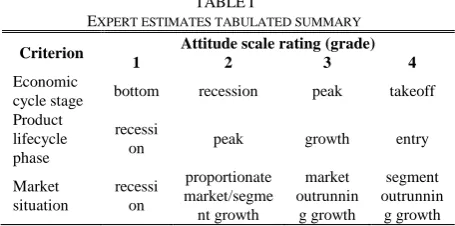
The evaluation of the following items within the first marketing analysis stage is suggested: economic cycle stage, product lifecycle phase and market situation. For the purpose of bringing the heterogeneous exponents to the unified dimension, it is suggested to apply the integral estimate and uniform scales (Table I).
TABLEI
EXPERT ESTIMATES TABULATED SUMMARY
Criterion Attitude scale rating (grade)
1 2 3 4
Economic
cycle stage bottom recession peak takeoff Product
lifecycle phase
recessi
on peak growth entry Market
situation
recessi on
proportionate market/segme nt growth
market outrunnin
g growth
segment outrunnin g growth
At various economic cycle stages the business activity, particularly, the investment and innovation activity, has diverse character: bottom, recession, peak and takeoff [27]. Consequently, the more investor-preferable phase is (for instance, takeoff) – the higher the rating should be. According to the innovative solution’s economic cycle stage, the following grades are assigned: takeoff 4, peak -3, recession – 2 and bottom - 1.
while the economic growth rate is calculated according to the following formula [27]:
g=(Yt-Yt-1)/(Yt-1)×100% (1)
where Yt is current-year real GDP;Yt-1 is last-year real
GDP.
Based on the innovative solution’s functional specifications, the benchmark market is defined. The market factor dynamic study (scale of output, export amount, import amount) is capable of identifying the counterpart products’ lifecycle phase. The market size then will be calculated according to the formula [27]:
V=PE+I (2)
where V is market size; P is scale of output; E is export amount, I is import amount.
Grades are assigned according to the similar scale: entry - 4, growth - 3, peak - 2, recession - 1.
The market situation is evaluated through the ratio of market dynamics to that of the innovation’s market segment. The evaluation is based on the hypothesis of the market segment outrunning growth favorably affecting the innovation commercialization viability: segment outrunning growth – 4, market outrunning growth – 3, proportionate market/segment growth – 2, market or segment recession or stagnation – 1.
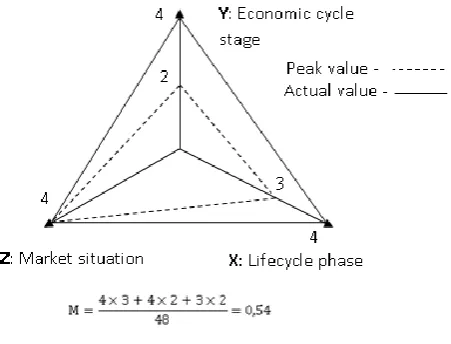
The marketing analysis stage results in the innovation’s viability integral estimate that can be represented as a ratio of the area of specific innovation market potential triangle to the area of the maximum possible triangle (where all ratings equal to 4) and is calculated according to the formula 3:
M=(xy+xz+yz)/Smax, (3)
where M is the innovation’s viability integral estimate; x, y, z is grade values of the potential marketing factors; Smax is maximum area of triangle.
The triangle apices lie within the axes of coordinates: economic cycle stage; lifecycle phase; market situation (fig. 3).
The attribute of the successful result (further review of the innovation commercialization option – carrying out the R&D) is crossing a 50% threshold of integral estimate, as well as the absence of zero parameters.
After the R&D conduction and obtaining the pilot sample, the comparative analysis of the innovation’s economic, performance and process features to the existing counterparts is carried out (the second stage of innovative solution prospect analysis). This stage is based on the expert evaluation method. The experts carry out a 3-grade comparative analysis of the most important (identified from the correlation analysis) innovative solution’s economic, technical and performance specifications to those of the existing analogues: 0 – inferior to counterparts, 1 – equaling to counterparts, 2 – superior to counterparts.
The comparative estimate is calculated according to the formula:
C=∑i=1∑j=1(ajbij)/2n, (4)
where i – 1,2…n - the number of experts; j – 1,2…m – the number of specifications under analysis; aj - the strength of the j-th specification; bij - the i-th expert’s grade to the j-th specification based on a 3-grade scale (0, 1, 2); 2n – innovation’s potentially maximum amount of grades.
As follows from the statistics [28], approximately 30% (20399 – total amount of patents, 6566 assimilated) of patented technologies are introduced in the enterprise activity, or restated – are commercialized. Therefore, the 70% innovation efficiency threshold was selected.
If the innovation commercialization viability evaluation threshold (attribute) as of 0,7 is crossed, then the final stage comes into effect – business planning and risk analysis. The project risk analysis is based on the UNIDO (United Nations Industrial Development Organization) method and consists in return on investment evaluation: net present value (further referred to as NPV); internal rate of return (IRR); profitability index (PI). Furthermore, project payback period is often considered: payback period (further on - PB); discounted payback period (DPB). The performance criteria herein are set by the investor according to the project objectives.
IV. BASIC RESEARCH FINDINGS
[image:3.595.312.548.415.584.2]The authoring team has suggested an idea of the low-material-consumption stamp-in-one ball valve design capability [29], to be achieved due to the ball stopper bimetal structure and ball valve hemispherical dies stamping technology (Fig. 2).
Fig. 2. The prospect analysis of the stamp-in-one ball valves commercialization
Stage 1: marketing analysis
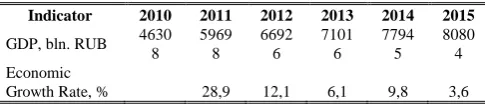
1) The economic cycle stage. Feed data: the GDP indicator (Table II) was taken from the Federal State Statistics Service report [24], while the economic growth rate was calculated according to the formula (1).
TABLEII
GDP AND ECONOMIC GROWTH RATE DYNAMICS OVER THE PERIOD 2010– 2015
Indicator 2010 2011 2012 2013 2014 2015
GDP, bln. RUB 4630 8
5969 8
6692 6
7101 6
7794 5
8080 4 Economic
Growth Rate, % 28,9 12,1 6,1 9,8 3,6
ISBN: 978-988-14048-3-1
[image:3.595.309.552.713.767.2]The 2014 global economic crisis aftershock and market sanctions have had a negative effect on the GDP and economic growth rate dynamics. As a result of a dynamic rows analysis, it can be concluded that the Russian economy is currently at the stage of recession; therefore, the integral estimate element of the economic cycle stage was rated as 2.
2) The lifecycle phase. The life span of industrial products and time frames of its separate phases depend on the product reference. Over the past years, the Russian valve industry has experienced the drop in sales [30]. In 2013-2014, the recession was caused by the valve market cyclical nature; the Russian economy’s wait and see attitude and cutbacks to funding of various industries before holding the Sochi Olympic Games in 2014. The drop in sales as of 2014 was also affected by the crisis phenomena, resulting in oil and gas projects funding reduction.
In 2015, the piping accessory sales decreased on 12,3% affected by the Russian crisis, considerable ruble devaluation, and thereby freeze of a number of infrastructural projects in the oil and gas industry and new build commissioning slowdown.
At that, the analysts register that the drop in piping accessory sales, initiated by crisis changes in the Russian economy, has not been as large-scale as in the other industries.
Yet, according to the analysis of the data obtained, it was discovered that at the moment, the ball valve product category is at the lifecycle phase of growth, as the market has shifted to the pre-crisis growth rates and therefore, the integral estimate element of lifecycle phase is rated as 3.
3) Market situation.
As a result of the statistics analysis, it was revealed that the ball valve market segment demonstrates the positive dynamics compared to the piping accessories industry dynamics (Table III). Thereby, the market situation integral estimate element was rated as 4.
TABLEIII
ABSOLUTE AND RELATED MEASURES OF THE PIPELINE ACCESSORY INDUSTRY AND BALL VALVE MARKET
Indicator
201
0 2011 2012 2013 2014 2015
Pipeline accessory industry size, mln. USD
925 1023 1248 1664 1475 1294 Pipeline accessory
industry dynamics, %
- 10,7 0
21,9 0
33,3
0 -11,3 -12,3 Ball valve market
size, mln. USD* 108 139 181 335 310 515 Ball valve market
dynamics, % -
29,0 5
30,2 0
84,3 7 -7,36
65,7 4 *Source: report of the Scientific and industrial association of valve
specialists
[image:4.595.320.546.86.258.2]The integral estimate graphical interpretation of the innovative stamp-in-one ball valve commercialization viability at the stage of marketing analysis is illustrated in Fig. 3, and according to the formula (3) amounts to 0,54 (Fig. 3).
As stipulated by the calculations above, the integral estimate exceeds the 0,5 criterion (0,54), which means that there are high chances of the innovation under analysis being a commercial success on the valve market, and
consequently, the second stage of the innovation commercialization can be initiated.
Fig. 3. Integral estimate graphical interpretation
Stage 2: technical and process analysis
According to the analysis of the ball valve pilot sample test results, the national standard and the product catalog and prices, the list of the basic engineering and economical specifications was arranged, namely: the caliber; the internal and external ambient temperature; the length; the weight and pressure. To assess the impact of the engineering and economical features on the product cost (the innovation’s principal competitive advantage), the correlation analysis tool was applied, the results of which are illustrated in the Table IV.
TABLEIV
THE BALL VALVE ENGINEERING AND ECONOMICAL SPECIFICATIONS CORRELATION ANALYSIS
Specifications Caliber Internal ambient temperat ure
External ambient temperat ure
Length Weight Pressure Price 0,628 -0,144 0,197 0,724 0,654 -0,089
Hence, the ball valve price is majorly affected by the material weight, which is actually the principal competitive advantage of the innovation. The global leader Broen (Denmark) ball valve was taken as a counterpart product for the comparative analysis. Due to the large variety of ball valve types and typical sizes, it was resolved to take the stamp-in-one ball valves as of Dn=100 as a basis. The comparative characteristics list was based on the GOST 28343-89 “Steel flanged ball valves. Specifications” as follows: scope of application; process temperature; process pressure; stem location; ball stopper material; stem material; secondary service; process environment; welded part length; body material.
The independent engineering specialists were invited as experts. All specifications were suggested being provisionally equal in terms of customer value contribution, due to the large amount of potential customer industries, each of which sets up its own requirements to the valves.
The expert survey conducted (6 experts) allowed calculating the comparative estimate: С=8,4/12=0,7. The comparative estimate has exceeded the 0,7 threshold,
ISBN: 978-988-14048-3-1
[image:4.595.43.287.539.655.2]which enabled to confirm the innovation’s high potential of the valve market penetration.
Summing up, it was identified that the innovative solution (the anti-corrosion steel stamp-in-one ball valve) offers the prominent cost competitive edge: the material price benefit of the structure suggested (bimetal ball stopper) by contrast with the regular one for the ball valves of the industrial standard dimension (floating ball) starts from 30% and expands with the dimension growth.
Stage 3: business planning and risk analysis
At the final stage, the business plan was developed for establishing the production of fixed ball valves with two ball stopper types: stainless steel and bimetal stamps. Planning horizon: 5 years. Project budget: 42 973,3 k RUB. The business plan risk analysis provided the results (Table V), which once again prove the innovative product commercialization success.
TABLEV PROJECT SUCCESS CRITERIA
Index Project for the ball valve commercialization NPV, RUB. 42774578 IRR, % 62,63 PI 1,86 PB, mth. 25 DPB, mth. 38
According to the results of the study, the company management decided upon establishing the production of the anti-corrosion steel stamp-in-one ball valves. The company took part in the START program of the Foundation for Assistance to Small Innovative Enterprises in Science and Technology and won funding for the project implementation.
REFERENCES
[1] Federal State Statistics Service [online resource] / Official website. – Access mode: http://www.gks.ru/wps/wcm/connect/rosstat_main/rosstat/ru/statis tics/science_and_innovations/science/
[2] CNEWS [online resource] / Official website. – Access mode;
http://www.cnews.ru/news/line/2015-10-29_za_poslednie_5_let_dolya_ innovatsionnoj_produktsii [3] K. Yudayeva, "New Normal for Russia," Economy policy, no. 6,
2010, pp.196-200.;
[4] V. Kovalev, "Economic growth and innovations in Russia," Legal
and economic studies journal, no. 4, 2013.
[5] Y. Silin, E. Animitsa and N.Novikova, “New Normal” in the Russian economy: the regional aspect, Regional economics, vol. 12 (3), 2016.
[6] S. Gubanov, "Sovereign breakthrough. Russia’s neoindustrialization and vertical integration," М.: Knizhniy mir, 2012, 224 p.
[7] P. Ryazanov, "New industrialization time: Russia’s prospects," Economist, no. 8, 2013, pp. 3-40.
[8] B. Korneychuk, “New industrialization” doctrine’s academic and ideological basis," Economic issues, no. 3, 2014, pp.141-149. [9] V. Kovalev, "Economic growth and innovations in Russia," Legal
and economic studies journal, no. 4, 2013.
[10] N. Kondratyev, "Conjuncture major cycles," [Text], 1925. [11] J. Schumpeter, "The theory of economic development," [Text]/
Translation from German by V.S. Avtonomov and others, М.:
Progress, 1982, 455 p.
[12] G. Mencsh, "Das technologische Patt: Innovationen uberwinden du Depression," Frankfurt am Main, 1977; G. Mencsh, Stalemate in Technology: Innovation Overcome the Depression. Cambridge (Mass.), 1979.
[13] S. Mendell and D. Ennis, "Looking at innovation strategies," Research Management, vol. 28, no. 3, 1985, 33 p.
[14] A. Burlakova, "Implementation challenges of innovations at industrial enterprises in the Tver region," Reporter of the Tver State Technical University. Series: Liberal Arts and Humanities,
Tver: Publishing office: Tver State Technical University, no. 1, 2015, pp. 132-136.
[15] L. Sizov, "Innovative processes on modern Russian industrial enterprises," Transport business of Russia, no. 11, 2010, pp. 83-86.
[16] E. Pikh, "Solutions of some innovative industrial policy challenges in Russia today," Innovation management: theory, methodology, practices, no. 3, 2012, pp. 19-23.
[17] G. Demichev, "On the innovative development of industrial enterprises at the stage of testing, certification and standardization of new processes and products," Transport business of Russia, no. 7, 2010, pp. 23-24.
[18] A. Schlafman and A. Mottayeva, "Interdisciplinary and interregional innovations in the Russian economy," Online journal Naukovedenie, no. 6 (19), 2013, p. 114.
[19] N. Klimova and N. Larina, "Foreign experience of innovation activity in the industrial sector," Fundamental Studies, no. 6-7, 2014, pp. 1442-1446.
[20] P. Kotler, "Marketing essentials," [Text], М., 1990.
[21] J. Evans and B. Berman, "Marketing: Abbr," transl. from English. [Text], Preface author and science editor А. Goryachev, М.:
Economics, 1993, 335 p.
[22] P. Doyle, "Marketing management and strategy," 3rd ed. [Text], Translation from English edited by Y. Kapturevsky, SP.: Piter, 2002, 544 p.
[23] J.-J. Lambin, "Market-driven management," [Text], Translation from English edited by V. Kolchanov, SP.: Piter, 2008, 800 p. [24] Federal State Statistics Service [online resource] / Official
website. – Access mode: http://www.gks.ru/wps/wcm/connect/rosstat_main/rosstat/ru/statis tics/science_and_innovations/science/
[25] F. Glisin, "Some development trends of the Russian innovative activity in the context of limited financial resources," Innovatics and expertise, no. 1 (14), 2015, pp. 50-57.
[26] HSE Data Books [online resource] / Official website. – Access mode:https://www.hse.ru/primarydata/ii2016.
[27] C. McConnell and S. Brue, "Economics," Transl. of the 13th English edition, М., 1999, 984p.
[28] Science and technology indicators 2013: data book, Moscow: National Research University Higher School of Economics, 2013, pp. 400.
[29] V. Andrianov, V. Tverskoy and V. Markin, "Stamp-in-One Ball Valve of Corrosion-Resistant Materials," [Text], Valve industry magazine, no. 5 (44), 2006.
ISBN: 978-988-14048-3-1