Abstract— The current competitive scenario is driving manufacturing companies to introduce innovative and faster ICT solutions, which allow to deal with short product life-cycle and time to market constraints. In this context, the German high tech strategy Industry 4.0 has been risen with the aim of enhancing the high innovation and economic potential resulting from the continuing impact of rapidly advancing information and communication technology in the factory domain. In particular, starting from the Industry 4.0 vision, the paper focuses on the identification of technological solutions for the classification of steel scrap, which is the main supply source of industries based on electric steelmaking. In fact, a clear identification of steel scrap is at the base of a steel production, which then could satisfy specific customer needs. The research of available tools is performed with the “quick and dirty” method, which aims at identifying innovative opportunities started from available technologies. The paper presents a comparison between different current tools, analyzed with respect to various dimensions such as performance, time and costs. Finally, the outcome of the paper is to demonstrate if an available solution exists, and if it could be implemented in steel industries with a low effort and costs.
Index Terms— Industry 4.0, innovation, quick and dirty method, steel industry
I. INTRODUCTION
URRENT manufacturing companies are facing various challenges caused by the complexity and the increasing variability in the manufacturing environment such as shorter product life-cycle and time to market lowered [1]. In this context manufacturing companies are pushed to embrace innovation as to be responsive to customer demand while maintaining the quality of products. In fact, quick response to the business opportunities is considered as one of the most important factors for withstanding competitiveness [2]. The Industry 4.0 strategy is considered a relevant solution to these challenges, in fact, it promotes the use of new
Manuscript received June 16, 2017; revised July 27, 2017.
M. D: is with the University of Genoa, Department of Mechanical Engineering, Via Opera Pia 15, 16132 Genoa, Italy (e-mail: [email protected]).
L. D. is with the University of Genoa, Department of Mechanical Engineering, Via Opera Pia 15, 16132 Genoa, Italy (e-mail: [email protected]).
R. R. is with the University of Genoa, Department of Mechanical Engineering, Via Opera Pia 15, 16132 Genoa, Italy (Phone number: + 39 339874234; e-mail: [email protected]).
F. T. is with the University of Genoa, Department of Mechanical Engineering, Via Opera Pia 15, 16132 Genoa, Italy (e-mail: [email protected]).
communication technologies and accelerates the implementation of cyber-physical systems in the manufacturing industry, playing a role of a significant innovation push [3]. In this proactive context, the goal is to identify innovative solutions, which allow the classification of metal scraps through a reference image, linking it to its steel classification. The identification of steel scrap, is particularly important for steel industries based on electric steelmaking, in fact, the major raw material for this type of factories is scrap. Steel is completely recyclable. It can be reused over and over again without any loss of quality. Steel scrap, consists of different materials and presents various levels of quality, most notably:
• Home scrap arising during steel making, • Process scrap from steel use and
• Obsolete scrap at the end of the products’ lifetime. They vary widely in quality, and these elements influence the steel production. They can influence the processing conditions of steel, from ladle treatment through casting to final annealing, thus indirectly affecting the quality of steel. Furthermore, as constituents of steel they can directly influence the mechanical properties of steel products [4]. Thus, for these reasons is extremely important to adopt technology which allows a correct identification and classification of steel scrap in order to match the scrap supply with the correct production and final use. Furthermore, the identification of steel scrap is particularly important, also because industrial systems have evolved through competition and technological change, facing the need to reduce or contain the ecological footprint of its production processes. In this field, many approaches are focused on manufacturing technology, supply chain management and product-service systems, with industrial manufacturers exploring significant savings in energy, water, waste and materials in their plants and throughout their supply chains [5], [6]. At this point it is important to underline that this type of identification and classification technologies already exist but are, also, very expensive, therefore the specific scope of the work is to determine a current solution which could be applied and implemented in industries with low efforts, time and costs. To this end, there are two different approaches that are supposed to produce innovation: the “elegant and slow” approach and the “quick and dirty”. The first one allows developing a custom solution based on the problem definition, in which all features are monitored and there is the possibility to change the model for specific requirements. The second approach is
An Innovative Model for Crashing DSS
Implementation Process in Industry 4.0: A Case
Study
Melissa Demartini, Lorenzo Damiani, Roberto Revetria, Flavio Tonelli
the “quick and dirty”, which allows identifying innovative opportunities starting from an already established technology but, sometimes, not yet fully explored in its potential. It is an approach oriented to problem solving and based on a rapid response to customer. Clearly the two approaches present different strong and weak points (Figure 1), the first one delivers solution based on specific customer requirements but the time and costs required are huge, rather than the second approach has as its major strong points reduced time and costs but it is an “adaptive” solution.
Therefore, for this purpose the “quick and dirty” approach is considered the most suitable approach for its characteristics of innovation oriented, rapid response to customer and the concrete possibility to achieve tangible results, through a “dirty” solution which aligns two opposite concepts such as time to market and quality of products.
The aim of the paper is to identify technological solutions, which could help steel companies in the identification of steel scraps, this process is performed through the application of the “quick and dirty” method that, allows minimizing costs, efforts and time to market.
The paper is organized as follow: in section two the research methodology adopted for the study is explained. Section three presents the comparison between different tools, while section four shows the results and discussions of the proposed tool. Finally, conclusions and future developments are reported.
II.BACKGROUND:TECHNICAL DEBT
Technical debt has been recently studied in software engineering; it is the phenomenon of increasing software development costs over time. Ward Cunningham first
introduced the technical debt concept in 1992. He defines it as “shipping first time code is like going into debt. A little debt speeds development so long as it is paid back promptly with a rewrite. The danger occurs when the debt is not repaid. Every minute spent on not-quite-right code counts as interest on that debt. Entire engineering organizations can be brought to a stand-still under the debt load of an unconsolidated implementation, object-oriented or otherwise” [7]. While Tom et all. has recognized it as a critical issue in the software development industry and highlights that if it is not managed, the company might have to be compelled to invest all its efforts into keeping the system running, rather than increasing the value of the system by adding new capabilities [8].
Generally, it occurs when whilst code decay and architectural deterioration are recognized. Moreover, it can grow because of the development process or circumstances that are beyond the developers’ control [9]. On the other hand, debt is not necessarily “bad”, in fact a small level of debt can help developers speed up the development process in the short term and put new products on the market.
[image:2.595.56.390.460.596.2]Finally, it is important to underline that benefits of refactoring software to remove technical debt are largely invisible, sometimes intangible, and usually long term, whereas the costs of refactoring activities are significant and immediate. Although a strategy based on the minimization of the technical debt, as the quick and dirty approach is, could be useful in order to validate and face design problems, helping companies in the management of resources.
Fig. 1. Comparison between the “elegant and slow” approach and the “quick and dirty”
[image:2.595.48.427.628.769.2]III. RESEARCH METHODOLOGY
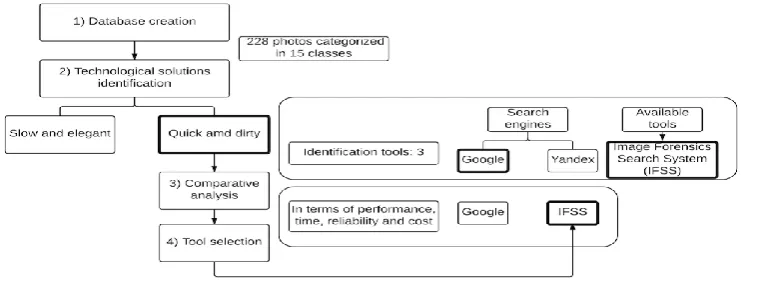
As previously introduced, the purpose of the paper is to identify current solutions through the quick and dirty approach, which allow minimizing the technical debt. Such existing solutions should identify the steel scrap with the scope of matching the scrap supply with the correct production and final use respect to its level of quality. Thanks to the adoption of the “quick and dirty” approach, the scope is to examine solutions, which are already on the market, developed and tested, and understand if such solutions are also applicable at the industrial context of steel industry. The methodology adopted for this paper distinguishes four main steps: i) database creation, ii) technological solutions identification, iii) tools comparison and iv) tool selection. The methodological design is conceptually depicted in Fig. 2.
A.Database creation
The first phase of the methodology is Database creation, it has been populated by 228 scrap images which have been classified in 15 classes. The database has been provided by a real steel industry, and its composition is reported in Table 1.
TABLEI DATABASE COMPOSITION
Class of scrap
Number of photos
Class description G1 3 It is characterized by a circular shape G2 11 This class distinguishes for the linear shape of
the scrap, particularity almost unique within the proposed groups
G3 15 The characteristic of this material is the oxidation process which give it a particular coloring G4 14 This class differentiates from Scrap type 3 for
shape less clear
G5 12 Images belonging to this class have reveled to be the most complex because it is very difficult to understand the particularizes
G6 28 This class shows defined shapes, with linear or cylindrical appearances
G7 14 Its characteristic is the pyramid shape G8 26 Images belonging to this class present linear
shape and effects caused by oxidation process G9 3 This class is similar to Scrap type 9, in fact the
material is the same but it is rearrange as a packet G10 14 It is a typology of Scrap type 9, it’s characteristic
is small sizing combined with a lack of light G11 19 It is a typology of Scrap type 9, characterized by
a shape derived by extracted shavings G12 12 It is similar to cast iron and presents defined
shapes as it
G13 14 It is characterized by steel profiles G14 19 It presents very small dimensions G15 24 It shows fiber and shavings shapes
The selected database presents heterogeneous characteristics; in fact it is populated by images with different dimensions, colors and shapes. Specifically the images depict not only the specific scrap but also the surrounding area. For this reason, some images needed some photo-retouch procedures such as improvements of brightness, contrast and if ever images’ clipping.
B.Technological solution identification
The second phase of the proposed methodology is
Technological solution identification. To do this end the
“quick and dirty” method is used. “Quick” because it is able to give results very quickly, making it suitable for frequent monitoring, and “dirty” because within such a short time-scale it is obviously not possible to use very sophisticated methodologies, or go into a great level of detail. The methodology presents some clear advantages [10]:
Timeliness: all the results can be obtained in very short
time;
Quantitative and qualitative data and information: this
allows for greater objectivity and conciseness, but without losing the “richness” and completeness of qualitative information;
Triangulation: data and information are collected from
different sources, in order to guarantee an objective picture;
Summarization: a few tables and pictures provide a
complete overview of the results obtained;
Focus: the collected data and information make it
possible to draw a focused picture of a particular competence areas and/or application, by aggregating all the information quantitative and qualitative.
From these hypotheses, Authors started to analyze technological solutions offered by the market for the specific aforementioned purpose. Generally, a typical image recognition task involves the following two subtasks: image representation and image classification. The first subtask is to define an effective and discriminative image representation, which contains sufficient information extracted or selected from a specific characteristic that the image possesses for future classification (different typology of scraps). The second subtask is to classify a new image with the chosen image representation model [11]. The scope of this phase is to identify tools that own these capabilities.
Finally, Authors identify an open source free software used for image recognition, called as Image Forensics Search System (IFSS). It allows to search:
A target image within another image; Images that, are similar to a target image.
The main motivation behind the development of the IFSS software is to assist law enforcement agencies and similar organizations in finding a particular image (which they already possess) stored in the typically thousands of images on a hard disk. Although the final use of the software is quite different by Authors scope, but the methodology and the software features make it a good and prompt solution for further analysis. In conclusion, the technological solutions identified for further analyses are search engines and the aforementioned IFSS.
C.Tools comparison and tool selection
After the tool identification, the following phases are tools comparison and tool selection. At this point it is important to underline that a first comparative analysis will be performed between search engines in order to understand which tool could better respond to the identification and classification tasks. Then the best search engine will be used as a benchmark in order to make a comparison between it and IFSS. This process of comparative analysis will point out the best tool for the purpose of the paper.
The comparative analysis is performed analyzing each tools respect to the Project Management Triangle, which is a model born in the software developers environment’s and defines success criteria that a solution should own [17]. Those criteria for measuring success include (Figure 3):
Cost: available budget for the implementation of the solution.
Scope: goals of the project in terms of features,
performance and requirements.
Time: it is the amount of time necessary to complete the project, it is a crucial variable because, often it isn’t simple to estimate the required time for each activities.
Fig. 3. The design of Project Management Triangle
IV. RESULTS AND DISCUSSIONS
This section shows results derived by the comparison between selected tools respect to the Project management triangle in order to understand what solutions could be adopted for our scope. Furthermore, the process of
identification and classification of search engines and IFSS has been described.
The following steps compose the search engine process: 1. The system analyzes the image target;
2. It classifies images;
3. It reports the more suitable responses presented in the network.
While, the following steps describe the IFSS process: 1. Source image selection, this operation could be done
or from the software directory or from an external device;
2. The search process could be chosen as: a. Search for similar images; b. Search of the source image;
c. Search of the source image from a specific directory (option chosen by Authors); 3. It reports the more suitable responses in term of
ranking from the more similar to the worst.
A.Google vs Yandex
The first comparative analysis between Google and Yandex is performed. These search engines have been chosen for their ample level of “knowledge”, in fact, they have been able to collect huge amount of information and increase their intelligence over time. Google is the most known search engine and it is chosen for its global coverage, recognizable and applicability. The other search engine is Yandex, it is a Russian tool which is at the first position in terms of popularity in its country. These tools have been preferred for the results obtained in the preliminary analysis. These search engines, in fact, have been proved to be more suitable rather than the others. The first step of the comparative analysis is a performance comparison, based on two factors:
Visual analysis;
Description, which matched with the image. It is important to underline that the second factor, description, often resulted in a general definition of “scrap”, then it revealed the need for an assessment system based on four evaluation levels which allows to understand if the description match with the steel scrap. The assessment system is reported in Table 2.
TABLEII ASSESSMENT SYSTEM
Value Description
8 The description match completely with the corresponding classification
4 The description match quite with the corresponding classification 2 The description doesn’t match with the corresponding
classification -8 There is no reply
Moreover, in order to show the search engines capability of increase knowledge over the time, performance analyses have been conducted in three different periods:
P1: February-March (2016); P2: April-May (2016); P3: September (2016).
Fig. 4. Performance comparison between Google and Yandex
As reported, it is possible to evidence that except for the G2 in which both achieve the maximum assessment, for the other response overall Google is always better that Yandex. Moreover, Google presents only one negative response for the G5 group while Yandex shows negative response in three groups (G3, G4, G5). This comparative analysis allows proving the more suitable Google performance rather than Yandex, thus make it possible choosing Google as search engine in order to continue the test. Then Authors report a comparative analysis between period P1, P2 and P3 in order to highlight the learning capacity of Google (Figure 5).
[image:5.595.306.548.272.375.2]
Fig. 5. Comparison of Google performance over P1, P2, P3 periods
The performance analysis over time shows the aforementioned machine learning capability own of Google. This characteristic allows it to achieve the maximum value in G4 and G13 where in the first period it shows low response. Besides, it has been able to pass from an assessment of -4 to 6 in the G9. It is also interesting to notice that:
G7 shows a stable trend, visible also in the third period;
G10 has presented a countertrend, in fact it decreases from 0,73 to 0,43;
G15 maintains its negative trend over time.
In conclusion Google has been selected as a benchmark, thanks to its identification capabilities, in order to test and analyze IFSS effectiveness and facilities.
B.Google vs IFSS
In this section, the comparative analysis between Google and IFSS is reported. Respect to the previous comparative investigation between Google and Yandex, in which the search engines have been compared with respect to the identification capability of recognizing the image scrap, in this specific analysis it is also introduced the classification aspect, asking the software to associate each image to the
belonging group. For this purpose, a new assessment system has been introduced, and it is reported in Table 3.
TABLEIII NEW ASSESSMENT SYSTEM
Value Description
8 The target group is recognized and it is gotten in first position 4 The target group is gotten in second position
2 The target group is gotten in third position -8 The target group isn’t gotten in the first ten positions
This assessment system is based on the frequency examination, which shows the target image position in the ranking, considering only the first ten positions. It is also important to underline that from this ranking it is necessary to exclude possible repetitions of the same image in order to obtain a final ranking populated by ten different images. Figure 6 shows the results of the comparison between Google and IFSS.
Fig. 6. Performance comparison between Google and IFSS
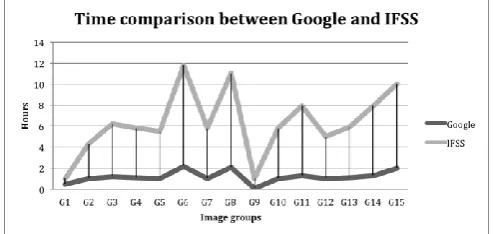
[image:5.595.45.292.357.465.2]The graph highlights the stable and positive assessment in each group for the IFSS software; moreover it overcomes Google in four groups G2, G7, G12 and G15. Google presents often better results respect to IFSS and confirm the negative trend for G15 group. In order to have a clear outline of the situation the tools have been compared also respect to the time dimension. In particular, it have been observed the average time of image processing including the image loading time and the time necessary for the tool to identify the belonging image group. Figure 7 shows the results of time comparison.
Fig. 7. Time comparison between Google and IFSS
[image:5.595.303.550.539.656.2]C.Economic and time analysis
Finally, in this section an economic comparison has been reported in order to demonstrate the superiority of the “quick and dirty” approach respect to the “slow and elegant” and demonstrate that the first one presents a lower technical debt. “Slow and elegant” and “quick and dirty” will be analyzed in terms of required phases necessary for the established scope.
The development phases of the slow and elegant approach are: i) analysis, ii) requirements definition, iii) implementation, iv) testing and v) commissioning. In the table below is descripted each phase with the relative time efforts (Table 4).
TABLEIV SLOW AND ELEGANT PHASES
Phase Description Average time efforts [months] Analysis Scope, budget and time constraints
definition
6 Requirements
definition
Requirements planning and activities writing with a specific time table
3 Implementation This phase is the most substantial part
because the development and practical implementation of the project have be done.
12
Testing This phase evaluate the correct mode of operation of the project
4 Commissioning Final phase, in which the whole
project is evaluated, analyzing if it is aligned with the target scope.
4
While the development phases of the quick and dirty approach are: i) analysis, ii) software adjustment, iii) testing and iv) commissioning. In the table below is descripted each phase with the relative time efforts (Table 5).
TABLEV QUICK AND DIRTY PHASES
Phase Description Average time efforts
[months] Analysis Scope, budget and time constraints
definition
1 Software
adjustment
This phase is done in order to make the software capabilities own of the company
1 Testing This phase is the most substantial part
in which the evaluate mode of operation of the project is tested and allow to understand if it could applied.
4
Commissioning Final phase, in which the whole project is evaluated, analyzing if it is aligned with the target scope.
2
1)Time comparison between “Slow and elegant” and
“Quick and dirty”
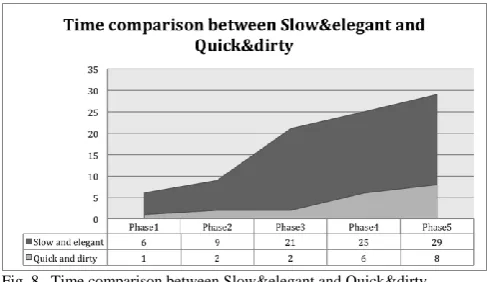
[image:6.595.304.548.49.190.2]The quick and dirty approach as showed by Figure 8, allows company to be on the market with a time of 8 months rather than the slow and elegant has the use of 29 months. Moreover, the graph support the initial thesis that the quick and dirty approach is particularly good in order to reduce the time to market and obtain the maximum results in term of it.
Fig. 8. Time comparison between Slow&elegant and Quick&dirty
2)Economic comparison between “Slow and elegant” and
“Quick and dirty
Finally, an economic analysis (Figure 9) has been reported, as could be expected, it follows the time trend. In particular, a complete solution developed with the slow and elegant approach costs around 382000 € rather then the quick and dirty solution is expected to cost around 102 000 €. These costs are calculated supposing that both solutions require two specific positions: one Analyst and one Developer, the Table 6 shows the hourly labor costs and each phase in which these roles are employed.
TABLEVI HOURLY LABOR COSTS
Role Slow and elegant Quick and dirty Hourly labor
cost Analyst Analysis, Requirements
definition and Commissioning
Analysis and Commissioning
95 €/h
Developer Implementation and Testing
Software adjustment And Testing
65 €/h
[image:6.595.305.548.606.757.2]Figure 9 confirms that the gap between the two solutions is mainly caused by the technical debt; in fact each solutions implicate the creation of it, for this reason it is important to define the scope of the project and the context in which it operates in order to minimize it. Hence, the quick and dirty solution presents a technical debt lower than the slow and elegant approach. Therefore, decision-making is essential in the management of technical debt. Such considerations can include issues as the acceptable amount of technical debt and the right moment to reduce technical debt.
The results achieved make clear that the solution found within the market, represented by the software IFSS, is able to effectively fulfill the scope, succeeding in obtaining positive results with all types of scrap analyzed. The simplicity of use and the possibility of performing different target image analyses allow the user to reach a satisfactory control of the tool. Moreover, the tool is open source, it allows the user accesses the source code, making changes, extensions or improvements, with the possibility of developing specific customization. The economic analysis reported at the end of the project reinforces the real applicability in factory, leading to a tangible implementation of the software and the possibility to help company in the scrap classification with a moderate level of efforts and technical debt.
V.CONCLUSIONS AND FUTURE DEVELOPMENT
The purpose of the paper was to identify technological solutions for the classification of steel scrap, which is the main supply source of industries based on electric steelmaking. The aim of such investigations is to gain the information necessary for the identification of scrap and to determine proper measures to reuse it in the right production process and final use. To this end a “quick and dirty” approach has been adopted in order to search for a current and prompt solution, which allows reducing the technical debt and being implemented by industries. The application of this methodology, reveals itself very effective, in fact several advantages can be achieve: i) all the results can be obtained in a very short time and with low economic efforts, ii) it allows for greater objectivity and conciseness and iii) it creates a technical debt which is lower than the slow and elegant solution and therefore could be better monitored and managed. In this context, the IFSS software resulted very attractive for its simplicity and for fast and scalable implementation in industries with a moderate level of efforts and costs.
There are obviously also several limitations to be pointed out. The first relates to the depth of the results. The short time-scale of the assessment necessarily limits the level of detail and depth of the analysis. This means that the validity of the proposed methodology could be greatly increased through further theoretical and empirical research [18] including the use of modeling and simulation [19]. In particular, other applications might reveal additional limitations as well as opportunities for addressing the existing problems.
REFERENCES
[1] N. Burger, M. Demartini, F. Tonelli, F. Bodendorf, and C. Testa, “Investigating flexibility as a performance dimension of a Manufacturing Value Modeling Methodology ( MVMM ): a framework for identifying flexibility types in manufacturing systems,” Procedia CIRP, 2017.
[2] P. K. Paritala, S. Manchikatla, and P. K. D. V. Yarlagadda, “Digital Manufacturing- Applications Past, Current, and Future Trends,” Procedia Eng., vol. 174, pp. 982–991, 2017.
[3] R. Anderl, “Industrie 4.0 -Technological approaches, use cases, and implementation,” At-Automatisierungstechnik, vol. 63, no. 10, pp. 753–765, 2015.
[4] D. Janke, L. Savov, H. Weddige, and E. Schulz, “Scrap-Based Steel Production and Recycling of Steel,” vol. 34, no. 6, pp. 387–399, 2000. [5] P. Taticchi, P. Garengo, S. S. Nudurupati, F. Tonelli, and R. Pasqualino, “A review of decision-support tools and performance
measurement and sustainable supply chain management,” Int. J. Prod. Res., no. July 2015, pp. 1–22, 2014.
[6] E. Briano, C. Caballini, P. Giribone, and R. Revetria, “Using system dynamics for short life cycle supply chains evaluation,” Proc. - Winter Simul. Conf., pp. 1820–1832, 2010.
[7] W. Cunningham, “The WyCash portfolio management system,” WyCash Portf. Manag. Syst., vol. 4, no. 2, pp. 29–30, 1992.
[8] S. O. W. Cunningham, and D. 1145/157710. 157715. Mess. 4 (1992) 29–30, “An exploration of technical debt,” J. Syst. Softw., vol. 86, no. 6, 2013.
[9] C. Fernández-Sánchez, J. Garbajosa, A. Yagüe, and J. Perez, “Identification and analysis of the elements required to manage technical debt by means of a systematic mapping study,” J. Syst. Softw., vol. 124, 2017.
[10] G. Azzone and R. Manzini, “Quick and dirty technology assessment: The case of an Italian Research Centre,” Technol. Forecast. Soc. Change, vol. 75, no. 8, pp. 1324–1338, 2008.
[11] S. Zhang, B. He, R. Nian, J. Wang, B. Han, A. Lendasse, and G. Yuan, “Fast Image Recognition Based on Independent Component Analysis and Extreme Learning Machine,” Cognit. Comput., vol. 6, no. 3, pp. 405–422, 2014.
[12] J. Liu, H. Yu, W. Yang, and C. Sun, “Combining Active Learning and Semi-Supervised Learning Based on Extreme Learning Machine for Multi-class Image Classification,” Lect. Notes Comput. Sci. (including Subser. Lect. Notes Artif. Intell. Lect. Notes Bioinformatics), vol. 9242, p. 1, 2015.
[13] M.-O. J.M., S. B., and L. E., “Image analysis and automatic surface identification by a bi-level multi-classifier,” Lect. Notes Comput. Sci. (including Subser. Lect. Notes Artif. Intell. Lect. Notes Bioinformatics), vol. 3704 LNCS, pp. 467–476, 2005.
[14] U. Chester and J. Ratsaby, “Image analysis and automatic surface identification by a bi-level multi-classifiere,” Lect. Notes Comput. Sci. (including Subser. Lect. Notes Artif. Intell. Lect. Notes Bioinformatics), vol. 8199 LNCS, pp. 59–72, 2013.
[15] F. Cao, B. Liu, and D. Sun Park, “Image classification based on effective extreme learning machine,” Neurocomputing, vol. 102, pp. 90–97, 2013.
[16] S. Qu, R. Jian, T. Chu, J. Wang, and T. Tan, “Comuptional reasoning and learning for smart manufacturing under realistic conditions,” Proc. 2014 IEEE Int. Conf. Behav. Econ. Socio-Cultural Comput. BESC 2014, 2014.
[17] R. Atkinson, “Project management: cost, time and quality, two best guesses and a phenomenon, its time to accept other success criteria,” vol. 17, no. 6, pp. 337–342, 1999.
[18] L. Cassettari, R. Mosca, and R. Revetria, Experimental Error Measurement in Monte Carlo Simulation, no. January. 2009. [19] L. Cassettari, M. Mosca, R. Mosca, and F. Rolando, “The yearly