
MULTI-USER OFDM EMPLOYING PARALLEL INTERFERENCE CANCELLATION
ASSISTED DECISION-DIRECTED CHANNEL ESTIMATION
Matthias M ¨unster and Lajos Hanzo
Dept. of ECS, University of Southampton, SO17 1BJ, UK.
Tel: +44-23-80-593 125, Fax: +44-23-80-594 508
Email:[email protected], http://www-mobile.ecs.soton.ac.uk
ABSTRACT
Multiple reception antenna assisted Space Division Multiple Access (SDMA) techniques designed for wireless Orthogonal Frequency Division Multiplexing (OFDM) systems have recently drawn wide interests. These techniques facilitate the imple-mentation of effective multi-user detection algorithms at the receiver. A prerequisite of their operation is the availability of an estimate of the channels’ frequency domain transfer func-tions. This contribution analyses a recursive Decision-Directed Channel Estimator (DDCE). Our simulation results demon-strate that this channel transfer function estimator is capable of outperforming state-of-the-art transversal filter based DD-CEs in terms of the mean-square estimation error in scenarios, where the product of the number of transmit antennas and the number of CIR taps to be estimated per transmit antenna ap-proaches the number of subcarriers hosted by an OFDM sym-bol.
1. OVERVIEW
In this contribution an improved decision-directed channel estima-tor (DDCE) designed for multi-user Space Division Multiple Ac-cess (SDMA) assisted Orthogonal Frequency Division Multiplex-ing (OFDM) applications is presented. The structure of the paper is as follows. In Section 2 the SDMA scenario is outlined, fol-lowed by the portrayal of the channel estimation problem and the review of state-of-the-art solutions in Section 3.1. In Section 3.2 the proposed recursive DDCE is analysed with the aim of deriving an expression for the´apriori channel transfer function estima-tion Mean-Square Error (MSE) at the input of the antenna com-bining stage. A further expression is provided for the´aposteriori
MSE encountered after updating the channel transfer function es-timates on the basis of the most recently received subcarrier sym-bols. Furthermore, the recursive estimator’s stability conditions are derived and potential approaches for determining the optimum ´
apriorichannel estimator’s coefficients in the sense of the Mini-mum MSE (MMSE) are presented. This is followed by our perfor-mance assessment in Section 4. Our conclusions will be offered in Section 5.
Receiver
User 1
User 2
User L
Channel
x1
x2
xP H(PL)
H(2)2
s(1)
s(2)
n2
nP H2(L)
H(L) 1
H1(1)
HP(2) H1(2)
n1
H(1)
P
H2(1)
[image:1.595.306.557.208.317.2]s(L)
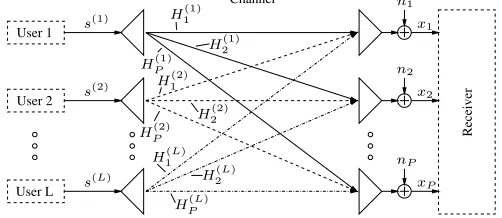
Figure 1:Schematic of an SDMA uplink scenario as observed on an OFDM subcarrier basis, where each of theLusers is equipped with a single transmit antenna and the receiver is assisted by aP-element antenna front-end.
2. THE SIGNAL MODEL
In Figure 1 we have portrayed an SDMA uplink transmission sce-nario, where each of thePsimultaneous users is equipped with a single transmission antenna, while the receiver capitalizes on aP -element antenna front-end. The set of complex signals,xp[n, k],
p∈ {1, . . . , P}received by theP-element antenna array in the
k-th subcarrier of then-th OFDM symbol is constituted by the su-perposition of the independently faded signals associated with the
Lusers sharing the same space-frequency resource. The received signal was corrupted by the Gaussian noise at the array elements. Regarding the statistical properties of the different signal compo-nents depicted in Figure 1, we assume that the complex data signal
s(l)transmitted by thel-th user has zero-mean and a variance of
σ2
l. The AWGN noise processnp at any antenna array element
pexhibits also zero-mean and a variance ofσ2, which is identi-cal for all array elements. The frequency domain channel transfer functionsHp(l)of the different array elementsp∈ {1, . . . , P}or usersl∈ {1, . . . , L}are independent, stationary, complex Gaus-sian distributed processes with zero-mean and unit variance.
VTC’2002, VANCOUVER, CANADA
3. PARALLEL INTERFERENCE CANCELLATION ASSISTED DECISION-DIRECTED CHANNEL
ESTIMATOR
3.1. Motivation
A Minimum Mean-Square Error (MMSE) channel estimator was proposed by Liet al.[1], which aims at recovering the different users’ channel transfer functions on the basis of the output signal of a specific reception antenna element and by also capitalizing on the remodulated received symbols associated with the different users. The performance of this estimator was found to be limited in terms of the mean-square estimation error in scenarios, where the product of the number of transmit antennas and the number of CIR taps to be estimated per transmit antenna approaches the number of subcarriers hosted by an OFDM symbol.
In [2] a DDCE was proposed by Jeonet al.for a space-time coded OFDM scenario of two transmit antennas and two receive anten-nas. Specifically, the channel transfer function associated with each transmit-receive antenna pair was estimated on the basis of the output signal of the specific receive antenna upon subtract-ingthe interfering signal contributions associated with the remain-ing transmit antennas. These interference contributions were es-timated by capitalizing on the knowledge of the channel transfer functions of all interfering transmit antennas predicted during the (n−1)-th OFDM symbol period for then-th OFDM symbol, also invoking the corresponding remodulated symbols associated with then-th OFDM symbol.
By contrast, in [3] a similar technique was proposed by Li with the aim of simplifying the DDCE approach of [1], which operates in the time-domain. Since according to our analysis the subtrac-tive DDCE approach proposed in [3], where the cancellation of the different transmit antennas’ interfering signals is performed in the time-domain, exhibits a higher complexity than the subtractive DDCE of [2] performing the interference cancellation in the fre-quency domain, we decided to employ the latter approach in our further investigations.
3.2. The Recursive Estimator
3.2.1. A´Priori andA´Posteriori Channel Estimates
The complex output signalxp[n, k]of thep-th receiver antenna element in thek-th subcarrier of then-th OFDM symbol is given by:
xp[n, k] = L
i=1
H(i)
p [n, k]s(i)[n, k] +np[n, k], (1)
where the different variables have been defined in Section 2. Ana´
posteriori(apt) estimateHˆapt(j)[n, k]of the channel transfer factor
H(j)[n, k]between thej-th user’s single transmit antenna and the
p-th receive antenna can be obtained by subtracting all the(L−1) interfering users’ estimated signal contributions from the compos-ite received signalxp[n, k]of theLusers. This is followed by normalization of the resultant expression to thej-th user’s detected complex symbolsˆ(j)[n, k], yielding:
ˆ
Hapt(j)[n, k] = ˆs(j)[1n, k]
x[n, k]−
L
i=1 i=j
ˆ
H(i)
apr[n, k]ˆs(i)[n, k]
,
(2)
where for simplicity’s sake we have omitted the receiver antenna’s indexp. In Equation 2,Hˆapr(i)[n, k]denotes the complex´apriori
channel transfer factor predicted during the(n−1)-th OFDM sym-bol period for thek-th subcarrier of then-th OFDM symbol, as a function of the´aposteriorichannel transfer factorsHˆapt(i)[n−´n,k´] associated with the previousNnumber of OFDM symbols, which is formulated as:
ˆ
H(´i)
apr[n, k] =f
ˆ
H(´i)
apt[n−1,´k], . . . ,Hˆapt(´i)[n−N,k´] , (3)
where´i ∈ {1, . . . , L}, k´ ∈ {0, . . . , K −1}. We will further elaborate on the structure of the functionf()in Section 3.2.4. Upon assuming error-free symbol decisions we haveˆs(l)[n, k] =
s(l)[n, k],l∈ {1, . . . , L}and substitutingx[n, k]defined in
Equa-tion 1 into EquaEqua-tion 2 yields:
ˆ
H(j)
apt[n, k] = H(j)[n, k] +sn(j)[n, k[n, k]]+ (4)
+L i=1 i=j
H(i)[n, k]−Hˆ(i)
apr[n, k] s (i)[n, k]
s(j)[n, k].
From Equation 4 we infer that the´aposteriorichannel estimate ˆ
Hapt(j)[n, k]deviates from its true valueH(j)[n, k]due to
contam-ination by the AWGN as well as by an additional contribution at-tributed to the imperfections of thea´prioriestimatesHˆapr(i)[n, k]
of the channel transfer factorsH(i)[n, k],i=j.
3.2.2. A´Priori and A´Posteriori Channel Estimation MSE without Filtering
Following from Equation 4 a relation between thej-tha´posteriori
channel estimation error signal∆ ˆHapt(j)[n, k]and the(L−1) ´a
priorichannel estimation error signals∆ ˆHapr(i)[n, k], withi=jis hence given by:
∆ ˆHapt(j)[n, k] = −sn(j)[n, k[n, k]]− (5)
−
L
i=1 i=j
∆ ˆH(i)
apr[n, k] s (i)[n, k]
s(j)[n, k],
where
∆ ˆH(´i)
ap(t/r)[n, k] =H(´i)[n, k]−Hˆap(t/r)(´i) [n, k], (6)
´i ∈ {1, . . . , L}. The variance of the error signals∆ ˆHapt(j)[n, k] and∆ ˆHapr(i)[n, k],i=jor, equivalently, the mean-square channel estimation errors are hence related by:
MSE(j)
apt[n, k] =α·σ 2
σ2 j +α·
L
i=1 i=j
MSE(i)
apr[n, k], (7)
where
MSEap(t/r)(´i) [n, k] =E|∆ ˆHap(t/r)(´i) [n, k]|2, (8)
as for example QPSK we haveα = 1, while for higher-order Quadrature Amplitude Modulation (QAM) schemes we haveα > 1[4]. In the context of the derivation of Equation 7 we have ex-ploited that the complex symbols transmitted by different users in the same subcarrier are statistically independent, which also im-plies that they are uncorrelated,i.e.E{s(i)[n, k]s(j)∗[n, k]}= 0,
i=j.
3.2.3. A´Priori and A´Posteriori Channel Estimation MSE after FFT based CIR Windowing
In order to further improve the channel transfer function estima-tor’s MSE, a well-established approach [4,5] is to apply Fast Fourier Transform (FFT) based time-domain windowing to the´a posteri-oriestimated channel transfer factorsHˆapt(j)[n, k],k∈ {0, . . . , K− 1}of Equation 4, using a window sizeK0equivalent toTm/Ts , whereTm denotes the multipath spread of the channel and Ts
is the samping period duration. Hence in the simplified scenario of a sample-spaced CIR the desired signal componentH(j)[n, k] of Equation 4 is not affected by the windowing, while the vari-ance of the undesired´aposteriorichannel estimation error signal ∆ ˆHapt(j)[n, k]of Equation 5 which was quantified in Equation 7
-is reduced by a factor ofρ= K0K. The factorρwas termed in [4] as the “filter noise reduction factor”. The MSE of Equation 7 can therefore be modified to yield:
˙
MSE(j)apt[n, k] =χ·σ 2
σ2s +χ· L
i=1 i=j
˙
MSE(i)apr[n, k], (9)
whereχ = ρα. In contrast to Equation 7, the reduced MSE is denoted byMSE˙ . Please also note that in all previous equations the variables of estimated channel transfer functionsHˆ have to be substituted by their time-domain windowed counterparts. It is of critical importance that due to the windowing not only the vari-ance of the spectrally white AWGN contributionn[n, k], but also the variance of the spectrally coloured´a priorichannel estima-tion error∆ ˆHapr(i)[n, k]of Equation 5 is reduced by a factor of
ρduring then-th OFDM symbol period. The latter reduction is observed, since although the CIR resulting in the frequency do-main channel transfer functionHˆapr(i)[n, k]has been truncated to the lowest-delayK0number of CIR taps as a result of the window-ing durwindow-ing the(n−1)-th OFDM symbol period, nonetheless the multiplication of∆ ˆHapr(i)[n, k]with the complex subcarrier sym-bolss(i)[n, k]in Equation 5 - which are assumed to be statistically independent for different subcarriers and different OFDM sym-bols - results in the spreading of its effects over all CIR taps in the time-domain. Thus the´apriorichannel transfer function estima-tion error∆ ˆHapr(i)[n, k]can be further reduced by the time-domain windowing invoked during then-th OFDM symbol period.
3.2.4. A´Priori andA´Posteriori Channel Estimation MSE af-ter FFT based CIR Windowing in the Context ofN-Tap Linear
´
APriori Channel Estimation
As observed in Equations 7 and 9, the´aposteriorichannel transfer function estimation MSE in then-th OFDM symbol is linked to the´aposteriorichannel estimation MSE in the(n−1)-th OFDM symbol via the´apriorichannel estimation or prediction formula of Equation 3.
Hence, instead of Equation 3 for anN-tap linear´apriori chan-nel transfer factor estimator we obtain:
˙ˆ
H(´apri) [n, k] = N
´ n=1
ξ(´i) ´ n H˙ˆ
(´i)
apt[n−n, k´ ], (10)
where´i ∈ {1, . . . , L}. Since different users may exhibit differ-ent maximum Doppler frequencies due to their differdiffer-ent vehicular speeds, each user is associated with an individual set of CIR- or channel transfer factor predictor coefficients. More specifically, as observed in Equation 10, the´i-th user’s predictor coefficients are given byξ(´n´i),n´ ∈ {1, . . . , N}. Upon substituting Equation 10 into Equation 6 and further substituting the result into Equation 8 we obtain:
˙
MSE(´apri) [n, k] = MSE˙ (´Decorri) [n, k] + (11)
+
N
´ n=1
(ξn(´´i))2MSE˙ apt(´i)[n−n, k´ ],
where
˙
MSE(´Decorri) [n, k] = E{|(H(´i)[n, k]− (12)
−
N
´ n=1
ξn(´´i)H(´i)[n−n, k´ ]|2}
denotes the channel transfer function mismatch MSE due to the channel’s decorrelation. In order to separate the total MSE into
its componentsMSE˙ (´Decorri) [n, k]andMSE˙ apt(´i)[n−´n, k],n´ ∈
{1, . . . , N}, as seen in Equation 11, we exploited that the ex-pected value of the transmitted signal is zero. Specifically, we haveE{s()[]}= 0, which is a consequence of the symmetric na-ture of the modulation constellations considered, as well as that of the statistically independent nature of the complex symbols trans-mitted in the same subcarrier of different OFDM symbols, which is expressed asE{s(´i)[´n1, k]·s(´i)∗[´n2, k]} = 0andn´1,n´2 ∈
{1, . . . , N},n´1= ´n2.
3.2.5. Stability Analysis
On the basis of Equations 9, 11 and 12 a closed-form solution can be obtained for the´apriorianda´posterioriMSE associated with the different users’ channel transfer function estimation processes as a function of both the first-order statistics of the different users’ channel transfer functions, as indicated by Equation 12, as well as a function of the prediction filter coefficients employed and that of the parameterχ=ρα, whereρ= K0K . These MSE expressions are derived by stipulating that for each user the system is in its steady-state condition expressed as:
˙
MSEap(t/r)(´i) [n, k] =MSE˙ ap(t/r)(´i) [n−n, k´ ], (13)
where´i ∈ {1, . . . , L}andn´ ∈ {1, . . . , N}. In order to sim-plify the analysis we will assume that all the users have an iden-tical transmit power ofσ´i2 = σs2,´i ∈ {1, . . . , L}, and that the different users’ channels exhibit the same maximum Doppler fre-quency. Hence their prediction filter coefficients and consequently also their channel transfer function estimation MSE in the above steady-state condition will be identical, yielding:
¨
where´i,´j ∈ {1, . . . , L}andn` ∈ {0, . . . , N}. With the aid of these assumptions, we obtain for the specific´aposteriorichannel estimation MSE:
¨
MSEapt[n, k] =
χ·σ2 σ2
s +χ·(L−1)·MSE¨ Decorr[n, k] 1−χ·(L−1)·ξ
(15) and for the specific´apriorichannel estimation MSE:
¨
MSEapr[n, k] =
χ·ξ·σ2
σ2s + ¨MSEDecorr[n, k]
1−χ·(L−1)·ξ , (16)
whereξ =Nn=1´ ξn2´. The steady-state stability condition can be directly inferred from the denominator of Equations 15 and 16 by exploiting that the channel transfer function estimation MSE must be a finite positive value according to Equation 8, yielding:
χ·(L−1)·ξ <1. (17)
This is equivalent to the condition that the poles of the system’s transfer function are located inside the z-transform related unit cir-cle.
3.2.6. MMSE OptimumA´Priori Estimator Coefficients
A viable approach to determining thea´priorichannel estimator’s coefficientsξ´n,n´ ∈ {1, . . . , N}seen in Equation 10 is to mini-mize the MSE of the´apriorichannel transfer function estimates, as observed at the input of the detection stage. More specifically, for the simplified scenario of Section 3.2.5, this involves minimiz-ing Equation 16, for example with the aid of standard gradient based techniques. For´apriori channel estimator orders higher than one in Equation 16 it is not straightforward to find a closed-form solution for the optimum estimator coefficients. Hence a more practical solution is to optimize these coefficients with the aid of an iterative approach, such as for example the gradient based method [6], or a genetic algorithm [7] as invoked in the context of our numerical evaluations in Section 4. For an insufficient number of filter taps the cost function given by Equation 16 exhibits mul-tiple local minima associated with potentially different values [8] and hence the gradient approach may converge to a suboptimum set of estimator coefficients. By contrast, genetic algorithms are less likely to get trapped at a suboptimum solution due to their ability to more thoroughly explore the solution space.
4. SIMULATION RESULTS
The OFDM parameters stipulated wereK = 512subcarriers and a guard interval length ofK0 = 64samples - following the spec-ifications of an indoor WATM system [6]. The OFDM symbol normalized Doppler frequency was assumed to beFD = 0.007, which corresponds to a vehicular speed of50km/hin the context of the indoor WATM system’s parameters. Throughout our in-vestigations we will capitalize on the assumption frame-invariant fading in order to avoid the obfuscating effects of inter-subcarrier interference (ICI) and also on the assumption of error-free sub-carrier symbol decisions, which is justified for sufficiently high SNRs in the context of effective SDMA multiuser detection algo-rithms, such as for example successive interference cancellation (SIC) [9, 10].
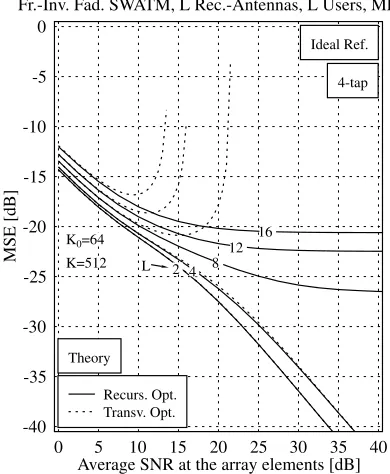
In Figure 2 we have plotted the´a prioriestimator MSE of Equation 16 exhibited in the context of the optimum filter weights
0 5 10 15 20 25 30 35 40
Average SNR at the array elements [dB] -40
-35 -30 -25 -20 -15 -10 -5 0
MSE
[dB]
Fr.-Inv. Fad. SWATM, L Rec.-Antennas, L Users, MPSK
Ideal Ref.
4-tap
Transv. Opt. Recurs. Opt. Theory
2 4 8 12
16
L K0=64
[image:4.595.318.513.57.294.2]K=512
Figure 2:A´priorichannel estimation MSE (σ2=2) of the recur-siveN = 4-tap´apriori estimation assisted arrange-ment, assumingerror-free subcarrier symbol decisions, parametrized with the number of simultaneous usersL. A further MSE improvement can be achieved upon in-creasing the´apriori channel estimator’s range.
taking into account the recursive nature of the system, as well as that exhibited in the context of the suboptimum transversal filter weights, derived from Equation 16 by removing the signal feed-back related termχ·(L−1)·ξ, both as a function of the number of simultaneous usersL. An ´apriori channel transfer function estimator range of four taps was assumed. We observe that for the suboptimum filter weights the estimator suffers from an in-stability, while for the optimum recursive filter weights stability problems do not occur. Along with increasing the numberLof si-multaneous users the estimator MSE is degraded, since more noise is injected into the estimation process due to the channel transfer function decorrelation between successive OFDM symbols.
In order to further underline the potential benefits of the advo-cated recursive estimator structure in scenarios supporting a rela-tively high number of users and transmit antennas, in Figure 3 we have compared thea´priori MSE exhibited by the recursive estima-tor to the´apriori MSE exhibited by a transversal channel transfer function estimator, which followed the philosophy of [1]. We note that here a scenario ofK = 64andK0 = 8is considered which is identical to a scenario ofK = 512andK0 = 64in the con-text of the recursive estimator advocated, in terms of the´apriori
0 5 10 15 20 25 30 35 40 Average SNR at the array elements [dB] -40
-35 -30 -25 -20 -15 -10 -5 0
MSE
[dB]
Fr.-Inv. Fad., L Rec.-Antennas, L Users, MPSK
Ideal Ref.
4-tap
Benchmarker Recurs. Opt. Theory K0=8
K=64
56 7
8
L 5 67
8 DL=2.0
DL=4.0 NO DL
[image:5.595.60.253.53.293.2]L
Figure 3:A´ priori channel estimation MSE (σ2=2) of the re-cursive N = 4-tap ´a priori estimation assisted arrangement, assuming error-free symbol decisions, parametrized with the number of simultaneous usersL. As a benchmarker we have plotted the´apriori chan-nel estimation MSE (σ2=2) of a transversalN = 4 -tapa´prioriestimation assisted arrangement [1], again, upon assumingerror-free subcarrier symbol decisions, where in the context of L = 8 simultaneous users a simple matrix regularization by diagonal loading (DL) was employed for facilitating the invertibility of the dif-ferent users’ transmitted symbol sequences’ correlation matrix.
correlation matrix associated with the different users’ transmitted symbol sequences. By even further increasing the number of si-multaneous users, namely beyond the value ofLmax =K/K0, reliable channel estimation became virtually impossible. This was also alluded to in [3]. By contrast, the recursive estimator proposed here does not suffer from these limitations.
5. CONCLUSIONS
In this contribution we have analysed and assessed a subtractive recursive DDCE proposed for multiuser OFDM-SDMA environ-ments. As a performance criterion the´aprioriestimator MSE was employed. We have demonstrated that the recursive estimator is capable of operating in scenarios where the product of theL num-ber of transmit antennas supported and the numnum-ber of CIR tapsK0
to be estimated per channel is in excess of the number of subcar-riersK, i.e. L > K/K0. This was found to be a limitation for the transversal channel transfer function estimator of [1]. Further-more, the complexity of the recursive estimator which performs the interference cancellation in the frequency domain is signifi-cantly lower than that of the transversal estimator of [1] and it is also lower than that of a subtractive recursive estimator operating in the time-domain, which was proposed in [3]. A disadvantage
associated with the recursive approach is related to the more com-plex channel transfer function filter coefficient calculation, which was performed in the context of our numerical simulations with the aid of a genetic algorithm.
6. REFERENCES
[1] Y. Li, N. Seshadri, and S. Ariyavisitakul, “Channel Estimation for OFDM Sys-tems with Transmitter Diversity in Mobile Wireless Channels,”IEEE Journal on Selected Areas in Communications, vol. 17, pp. 461–471, March 1999.
[2] W. G. Jeon, K. H. Paik, and Y. S. Cho, “An Efficient Channel Estimation Technique for OFDM Systems with Transmitter Diversity,” inProc. of PIMRC, IEEE, 2000.
[3] Y. Li, “Optimum Training Sequences for OFDM Systems with Multiple Trans-mit Antennas,” inProc. of Global Telecommunications Conference, vol. 3, (San Francisco, United States), pp. 1478–1482, IEEE, November 27 - December 1 2000.
[4] A. Chini, Y. Wu, M. El-Tanany, and S. Mahmoud, “Filtered Decision Feedback Channel Estimation for OFDM Based DTV Terrestrial Broadcasting System,”
IEEE Transactions on Broadcasting, vol. 44, pp. 2–11, March 1998.
[5] Y. Li, L. J. Cimini, and N. R. Sollenberger, “Robust Channel Estimation for OFDM Systems with Rapid Dispersive Fading Channels,”IEEE Transactions on Communications, vol. 46, pp. 902–915, Apr 1998.
[6] L. Hanzo, W. Webb, and T. Keller,Single- and Multi-carrier Quadrature Am-plitude Modulation. IEEE Press- John Wiley, April 2000.
[7] Y. Kai and L. Hanzo, “ Genetic Algorithm Assisted Joint Multiuser Symbol Detection and Fading Channel Estimation for Synchronous CDMA Systems,”
IEEE JSAC, vol. 19, pp. 985–998, June 2001.
[8] O. Macchi,The Least Mean Squares Approach with Applications in Transmis-sion. John Wiley, New York, 1995.
[9] G. D. Golden, G. J. Foschini, R. A. Valenzuela, and P. W. Wolniansky, “De-tection Algorithms and Initial Laboratory Results using V-BLAST Space-Time Communication Architecture,”IEE Electronics Letters, vol. 35, pp. 14–16, Jan. 1999.
![Figure 3: A´ priori channel estimation MSE (σ2=2) of the re-cursive N=4-tap ´a priori estimation assistedarrangement, assuming error-free symbol decisions,parametrized with the number of simultaneous users L.As a benchmarker we have plotted the ´a priori chan-nel estimation MSE (σ2=2) of a transversal N = 4-tap ´a priori estimation assisted arrangement [1], again,upon assuming error-free subcarrier symbol decisions,where in the context of L = 8 simultaneous users asimple matrix regularization by diagonal loading (DL)was employed for facilitating the invertibility of the dif-ferent users’ transmitted symbol sequences’ correlationmatrix.](https://thumb-us.123doks.com/thumbv2/123dok_us/1024750.617656/5.595.60.253.53.293/assistedarrangement-parametrized-simultaneous-simultaneous-regularization-facilitating-invertibility-correlationmatrix.webp)
