A Generic Architecture to Control Jini
Services over the Internet
Brian McSweeney
A dissertation submitted to the University of Dublin,
in partial fulfilment of the requirements for the degree of
Master of Science in Computer Science
Declaration
I declare that the work described in this dissertation is, except where
otherwise stated, entirely my own work and has not been submitted as an
exercise for a degree at this or any other university.
___________________
Brian McSweeney
14
thSeptember 2001
Permission to lend and/or copy
I agree that Trinity College Library may lend or copy this dissertation
upon request.
___________________
Abstract
Distributed computer systems have brought many advantages over traditional
centralised systems. However these systems have innate complications such as partial
failure, lack of system wide knowledge, concurrency etc. Programming environments
for these systems have typically been few and have often failed to adequately address,
or even ignored, the associated complications of distributed systems. Sun
MicroSystems’ Jini technology [Jini Spec ‘99] is a new distributed systems
programming technology where programmers write software as Jini services. It
provides the mechanisms by which programmers can try to manage these distributed
systems complications.
This dissertation aims to address three issues currently restricting the widespread
adoption of Jini technology.
Firstly, the usage of Jini has initially been restricted to Local Area Network
(LAN) environments. This thesis addresses this issue by describing a generic
architecture to allow Jini services to be accessed and controlled over the Internet.
Secondly, the core Jini technology installation files necessitate over 3MB of
memory, thus impeding Jini services on devices of limited memory capacity. This
thesis investigates how Jini services can include devices of limited memory
capability and describes the implementation of such a service.
Finally, the implementation of a Jini client for a specific service currently
necessitates providing the client with information about the service in advance.
This is a significant restriction on Jini technology in that each service writer must
provide its own client implementation for that service. This thesis describes and
implements a method by which clients can control Jini services without any
Acknowledgements
I would like to thank my supervisors Alexis Donnelly and Simon Dobson for their
interest, enthusiasm and guidance throughout the course of this project. I would also
like to thank all my friends, family and classmates for their friendship, support and
Contents
1 INTRODUCTION ... 1
1.1 DISTRIBUTED SYSTEMS... 2
1.2 JINI TECHNOLOGY... 3
1.3 PROJECT GOALS... 4
1.4 OVERVIEW OF DESIGN... 5
1.5 PROJECT ACHIEVEMENTS... 7
1.6 ROADMAP... 7
2 BACKGROUND – JINI TECHNOLOGY ... 9
2.1 NETWORK SETUP... 9
2.2 BASIC JINI SERVICE ARCHITECTURE... 10
2.3 SERVICE DESIGN CHOICES... 10
2.4 JINI SERVICE FUNCTIONS... 12
2.5 JINI CLIENT FUNCTIONS... 15
2.6 ADVANCED JINI CONCEPTS... 18
2.6.1 Remote Events... 18
2.6.2 Distributed Transactions ... 19
3 STATE OF THE ART ... 21
3.1 DISTRIBUTED PROGRAMMING TECHNOLOGIES... 21
3.1.1 Remote Method Invocation (RMI)... 21
3.1.2 Common Object Request Broker Architecture (CORBA)... 22
3.1.3 Enterprise Java Beans (EJB)... 23
3.2 WEB SERVICE TECHNOLOGIES... 24
3.2.1 Simple Object Access Protocol (SOAP) ... 24
3.2.2 Universal Discription Discovery and Integration (UDDI) ... 24
3.3 SPONTANEOUS NETWORKING TECHNOLOGIES... 26
3.3.1 Universal Plug and Play (UPnP) ... 26
3.3.2 Salutation... 27
3.4 RELATED JINI RESEARCH PROJECTS... 27
3.4.1 The SOAP-UDDI Project ... 28
3.4.2 The Surrogate Architecture ... 28
3.4.3 The Service User Interface Project ... 30
4 DESIGN ... 33
4.1 CONTROL OF JINI SERVICES OVER THE INTERNET... 33
4.1.1 A Web Bridging Architecture... 33
4.1.2 Reflection – A Generic Jini Client ... 35
4.2 LIMITED MEMORY CAPABLE DEVICES AS JINI SERVICES... 38
4.2.1 A Thin Proxy Architecture to Control A Lego Robot ... 39
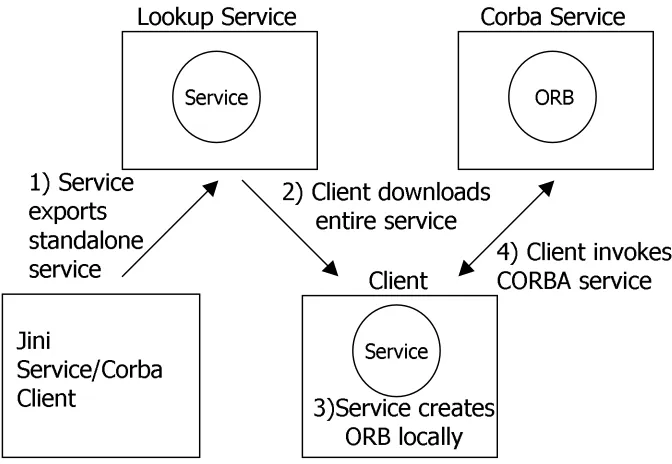
4.2.2 Accessing CORBA Services from Jini Clients ... 40
5 IMPLEMENTATION ... 41
5.1 IMPLEMENTING THE WEB BRIDGING ARCHITECTURE... 41
5.1.1 A SOAP Jini Client/Web Bridge ... 41
5.1.3 Implementing A Generic Jini Client with Reflection... 45
5.2 IMPLEMENTING LIMITED MEMORY DEVICES AS JINI SERVICES... 46
5.2.1 Implementing a Lego Robot Jini Service... 47
5.2.2 Implementing a Jini/CORBA Service ... 48
6 CONCLUSIONS ... 50
6.1 GOALS ACHIEVED AND COMPLETED WORK... 50
6.2 FUTURE WORK... 52
7 BIBLIOGRAPHY... 53
8 APPENDIX 1 ... 56
Table Of Figures
2.1 BASIC JINI SERVICE ARCHITECTURE 9
2.2 JINI DESIGN PATTERN ONE 9
2.3 JINI DESIGN PATTERN TWO 10
2.4 JINI DESIGN PATTERN THREE 10 3.1 JAVA 2 ENTERPRISE EDITION TECHNOLOGY OVERVIEW 22 3.2 WEB SERVICES PROTOCOL STACK 24
3.3 THE SURROGATE ARCHITECTURE 28
4.1 WEB BRIDGING ARCHITECTURE 34
4.2 GENERIC CLIENT ARCHITECTURE 36 4.3 THIN PROXY ARCHITECTURE TO CONTROL LEGO MINDSTORMS ROBOT 38
4.4 JINI CORBA ARCHITECTURE 39
Chapter 1
1
Introduction
The exponential growth of the Internet has been accompanied by technologies that are
designed to make distributed systems programming easier. However, fundamental
research in this area [Tanenbaum ‘95] concludes that distributed systems are
inherently unreliable and distributed programming is complex. Jini technology [Jini
Spec ‘99] is a new technology designed by Sun Microsystems that is aimed at
addressing these difficulties. It takes the new programming paradigm approach of
forcing programmers to design their software systems as Jini services which must
acknowledge and account for the difficulties and inherent unreliability of distributed
computing.
However the adoption of Jini technology has been not as widespread as initially
hoped. There are three main factors that may have hampered Jini’s proliferation.
1 Firstly, the usage of Jini has initially been restricted to LAN environments.
2 Secondly, in order to be able to run a Jini service on a specific machine, that
machine must have at least 3 MB of available memory to install the core Jini
technology files, thus further restricting Jini’s adoption.
3 Finally, in order to be able to utilise a Jini service, a client must be provided with
information about the service at compile time. In this current situation, it is
impossible to have a generic Jini client that can access all Jini services, which
would be desirable in certain circumstances (discussed in section 3.4.3). Jini
clients can currently only access services which are written before the client, and
This thesis aims to address all three factors. In addressing the first and third point, the
thesis designs and implements a generic architecture to allow Jini services to be
accessed and controlled via the Internet without any need for information about the
service at compile time. To address the second point, it investigates how these
services can include devices of limited memory capability. It designs and implements
such a service using a Lego Mindstorms robot. It also designs and implements an
architecture to allow such other services, written in languages other than Java, to be
accessed from Jini clients using the Common Object Request Broker Architecture
(CORBA).
This chapter provides an introduction to the area of distributed computing, followed
by an overview of Jini technology. The main project goals, design and achievements
are then outlined and finally a synopsis of the structure of the remainder of this
dissertation is provided.
1.1
Distributed Systems
“A distributed system is a collection of independent computers that appear to the
users of the system as a single computer” [Tanenbaum ‘95]. The growth of distributed
systems over traditional centralised systems has been a trend in the computer industry
since the late eighties which can be explained by the advantages of the former systems
over the latter. These advantages include a better price/performance ratio, increased
speed, the inherent distribution of some applications, reliability and the ability to add
computing power in small increments.
However, design of distributed systems has led to the identification of the following
seven associated fallacies: the network is reliable; latency is zero; bandwidth is
infinite; the network is secure; topology doesn’t change; there is one administrator;
transport cost is zero. [Deutsch]. The goal of distributed programming paradigms and
technologies is to make it easier to program systems in which processes on different
machines communicate with each other. Unfortunately however, the current
distributed object programming technologies such as Java RMI, CORBA, DCOM and
issues such as partial failure and don’t provide a model to the programmer as to how a
distributed software system should behave when communication between its
components fails. Compounding these problems is the fact that distributed algorithms
are inherently complex due to concurrency, partial failure, lack of global knowledge
and performance and scaling issues.
Jini technology takes a new approach to distributed systems programming. The Jini
model tries to ease the administration burden of distributed systems by allowing
software network services to just “plug and work”. There should be no need to edit
configuration files. The software (or hardware) service, once started, should
automatically and seamlessly be able to be found by clients. Jini does this via
“spontaneous networking” whereby the services announce themselves to the network
and clients automatically find them. Jini also supports redundant infrastructure and
changes in the network topology in a seamless manner. Furthermore, by making the
programmers of Jini services acknowledge and deal with the inherent unreliability of
distributed systems, communities of Jini services become self-healing. Given time the
system will repair damage to itself. The core parts of the Jini technology model that
enable these features are the topic of the next section.
1.2
Jini Technology
Three main components of the Jini technology enable Jini services and clients to
spontaneously communicate, with limited need for administration.
1) A Lookup Service – this is essentially a meta-service or naming service which
keeps track of all existing Jini services on the network. It is similar in function to
the RMI registry, the Corba naming service etc. Sun Microsystems’ default
implementation of this lookup service is named Reggie.
2) Discovery – in order for services to be able to register themselves with a lookup
service, they initially send multicast messages out on the network searching for
be aware of the location of a lookup service in advance. Moreover, this system
enables several lookup services to be run independently on a network for fault
tolerance purposes.
3) Proxy objects – clients use services through proxy objects which they download
from the lookup service. These proxy objects provide the code needed to invoke a
particular service. The proxy objects are what the Jini services register with the
lookup service. There are several design decisions left to the programmer as to
how the proxy object should behave, essentially whether it should be a fat or thin
proxy. These design decisions are dependent on the specific service and are
discussed in section 2.3.
Furthermore, being built around current Java technology, Jini technology relies
heavily on Java’s ability to move code from one machine to another to enable a truly
de-centralised system. It builds on Java’s concurrency class libraries to provide
distributed transaction services and although not limited to RMI, it uses RMI to allow
services to be invoked between machines.
1.3
Project Goals
This project tries to address the three factors outlined in the introduction as restricting
the growth of Jini technology. With this in mind, the project has two distinct aims.
Firstly, to design and build a system to allow Jini services to be controlled over the
Internet. This addresses the first factor identified as restricting Jini’s proliferation. A
further enhancement of this system would be to enable the client to be generic, i.e.
allowing a human user to control all Jini services as they become available even
though the client knows nothing about them at compile time. This addresses the third
factor identified as restricting Jini’s proliferation.
Secondly, to investigate how these services can include devices of limited memory
capability. This will address the second factor identified as restricting Jini’s
Therefore the project can be divided into two distinct sections. The first section
involves researching, designing and building the generic architecture to control Jini
services over the Internet. The second section deals with researching and enabling
limited memory capable devices to be run as Jini services.
1.4
Overview of Design
There are two distinct sections of design. Firstly the design of the architecture to
control Jini services seamlessly over the Internet and secondly the design to control
devices of limited capability. These sections are dealt with consecutively.
Initially it was hoped to be able to control Jini services over the Internet using applets
by allowing the applet to download a service’s proxy object and directly contact the
service’s machine. However, on closer examination and much research several
problems were identified with this scenario. Firstly, for this scenario to be efficient the
client would have to install the core Jini files. Secondly, if the proxy object used RMI
to talk back to its service then the applet would have to use RMI over HyperText
Transfer Protocol (HTTP). This solution was cited as not working at the time of
writing this thesis [Li ‘00]. Finally, depending on firewall configurations it may be
impossible for a client to access a service if that service is behind the firewall.
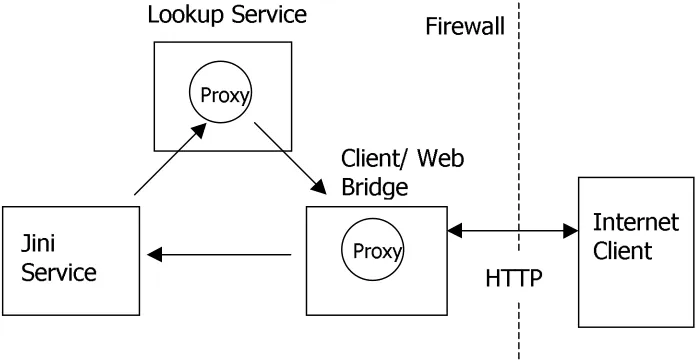
A “Web Bridging Architecture” was designed to overcome the problems of RMI over
HTTP, firewalls and distribution of client files (shown in figure 4.1). This design adds
an extra level of indirection to the standard Jini architecture (shown in figure 2.1).
This extra level of indirection is undesirable but necessary. In the normal Jini
scenario, the Jini client contacts the Jini service’s machine directly without any
problem. This is because they are both within the LAN. In the modified architecture,
the client is outside the LAN on the Internet. Rather than the client directly contacting
the Jini service’s machine, it contacts a bridge which, which in turn contacts the
service’s machine and passes on any client requests. A bridging architecture where the
bridge acts as the Jini client obviates the need for any Internet clients to install the Jini
access the service’s machine if that machine is within a LAN unless firewall
restrictions are relaxed. Finally the bridging architecture allows any services which
are based on RMI to be effectively invoked since the bridge will be within the LAN
and can use RMI directly.
The remaining question was choice of technology to implement the Web Bridging
Architecture. An emerging Jini community project [Harrison ‘01] suggested a solution
using the Simple Object Access Protocol (SOAP) and so a SOAP client and bridge
was investigated and built. However while successfully controlling Jini devices over
the Internet, many of the same problems remained. For example the client, while not
needing to install the Jini core files, would still need to install core SOAP files and
Extensible Markup Language (XML) parsing files and the service client. Furthermore,
using SOAP means that the client cannot use a standard web browser client. These
constraints definitely do not allow a generic seamless architecture to control Jini
services over the Internet. Therefore a third architecture of a series of servlets using
reflection in a modified servlet engine was designed and built. This has the advantage
of allowing the clients to access the services without any pre-configuration or
installation of files, and using any standard web browser.
The second section of the design involved investigating an architecture to control
devices of limited capacity via Jini services, it soon became evident that exactly such
an architecture was under construction by the Jini community. This architecture is
known as the Surrogate Architecture [Surrogate Spec ‘01] and is explained in detail in
section 3.4.2. There was little point in attempting to design any other architecture as
the community process designing the Surrogate Architecture is large, experienced and
in the process of adopting this architecture. A device on which to implement the
Surrogate Architecture was purchased – namely, A Lego Mindstorms robot. The robot
only has 32K of RAM and therefore is totally incapable of installing the Jini core files
and seemed a perfect candidate to attempt to implement the Surrogate Architecture.
Unfortunately it became evident that the Mindstorms robot would be unable to
implement the Surrogate Architecture without writing and downloading new firmware
to the computer in the robot. The reasons for this are discussed in section 3.4.2.
therefore it was decided to design a service that controlled the device as a Jini service
yet unfortunately would not conform to the Surrogate Architecture. A main web site
resource for programmers of the Mindstorm system [Nelson 01] indentified a 100%
Java API built by Dario Laverde to control the Mindstorm robot. It was decided to
design the robot Jini service by utilising this package. In effect, a machine capable of
running the Jini core files would have to act as a proxy to the robot, invoking the
methods from the pre-written package. In order for this to be done remotely, the
service would be built on RMI.
An architecture to allow CORBA services to be accessed from Jini clients was also
designed and built. This enables Jini clients to access services written in languages
other than Java. Because of its significant memory requirements, Java is not generally
used as a programming language for devices of limited memory capacity. Allowing
Jini clients to invoke services written in other languages should aid in their ability to
access services on limited devices.
1.5
Project Achievements
The majority of the aims outlined in the project goals have been achieved. A system
has been designed and built to allow Jini services to be controlled over the Internet.
Furthermore, this system provides a generic client where it is not necessary to know
anything in advance about the services available, or how to use them. A service
controlling a device of limited capacity has also been created. However, although a
generic architecture for this was investigated and identified, it was not possible to
implement this architecture for reasons discussed in section 3.4.2. An architecture to
allow CORBA services to be accessed from Jini clients was also designed and built.
This should aid in the ability of Jini clients to access services on limited devices by
allowing them to invoke services written in other languages.
1.6
Roadmap
In Chapter 2 (Background) a more detailed discussion of the Jini model is presented.
In Chapter 3 (State of the Art) other distributed programming technologies are
discussed and their relationship with Jini examined. Alternative “spontaneous
networking” technologies are also discussed and other current relevant Jini research
are examined. Chapter 4 (Design) outlines the architecture to control Jini services
over the Internet and explains how reflection is used to obviate the need for client
programs to be aware of services’ interfaces in order to control them. The
identification and design of an architecture used to control devices of limited capacity
as Jini services is also presented as is the architecture to enable CORBA services to be
accessed from Jini clients.
Chapter 5 (Implementation) explains how the architectures specified in the design
were constructed along with various other implementation specific details. It also
discusses problems encountered with trying to implement the architecture identified to
control devices of limited capacity and the alternative approach taken. Finally in
Chapter 6 (Conclusions) the conclusions arrived at by the completion of the project
Chapter 2
2
Background – Jini Technology
This chapter describes in detail the primary elements of Sun Microsystems’ Jini
technology, the core technology on which this thesis is based. The purpose of the
chapter is to familiarise the reader with the central concepts of the technology.
Following a brief explanation of how to set up a Jini network, writing a Jini service is
discussed. This begins with the identification and discussion of three Jini service
design choices which have been identified through experience writing Jini services
and from synthesis of the literature [Edwards ‘01] [Newmarch ‘00]. A more technical
discussion on the core elements of the Jini API version 1.1 used to create a Jini
service then follows. This is then repeated for a Jini client. These sections include
discussion and explanation of the key Jini concepts of “Discovery”, “Lookup
Services” and “Leasing”. The chapter finishes with discussion of the two advanced
core Jini concepts – Remote Events and Distributed Transactions.
2.1
Network Setup
The latest version of the Jini technology (version 1.1) may be downloaded from the
Sun Microsystems’ web-site [Jini technology ‘01]. The Jini binary files are slightly
larger than 3MB. Every machine that is to partake in the Jini network directly must
install these files (note - machines using a proxy or bridging architecture as described
previously need not install these files). At least one machine on the Jini network must
run a “lookup service”, or LUS. The core Jini download comes with a default
implementation of a LUS named Reggie and comes with instructions to start Reggie.
In order to run Reggie a basic HTTP server must be run on the same machine in order
to export proxy objects to clients. An RMI activation daemon must also be run on the
same machine so as the proxy objects can be activated only when they are needed.
2.2
Basic Jini Service Architecture
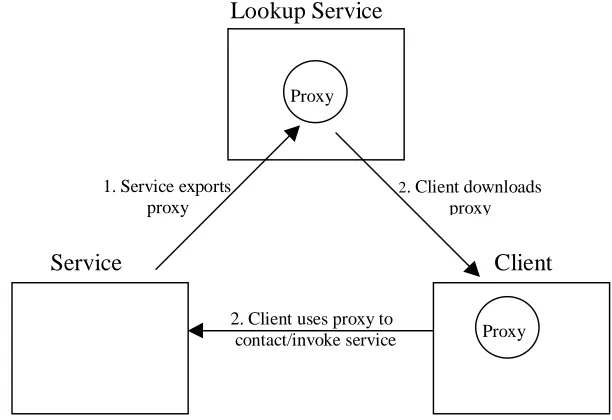
There are three steps to use a Jini service in a standard Jini service architecture.
Firstly, the service must locate and register its service proxy object with a lookup
service. To do this the service must run a small HTTP server to export the proxy
object. Secondly the client must locate the lookup service and search for the relevant
service. It then downloads the proxy object. The final step is when the client uses the
proxy object to contact and invoke the service. This interaction can be seen in figure
2.1
2.3
Service Design Choices
The scenario outlined previously is the most common Jini service design. However
three distinct design choices based on the type of service have been identified from
fusion of the literature and experience writing Jini services. Each of the design
choices relate to the implementation of the proxy object.
The first choice is where the entire service is run in the client Java virtual machine
and thus the client never contacts the service exporter machine. In fact this is just
dynamic code downloading and will rarely be used. This “fat proxy” scenario can be
[image:17.595.139.445.292.502.2]seen in figure 2.2.
Figure 2.1 – Basic Jini Service Architecture
Proxy
Service Client
Lookup Service
1. Service exports proxy
2. Client downloads proxy
2. Client uses proxy to contact/invoke service
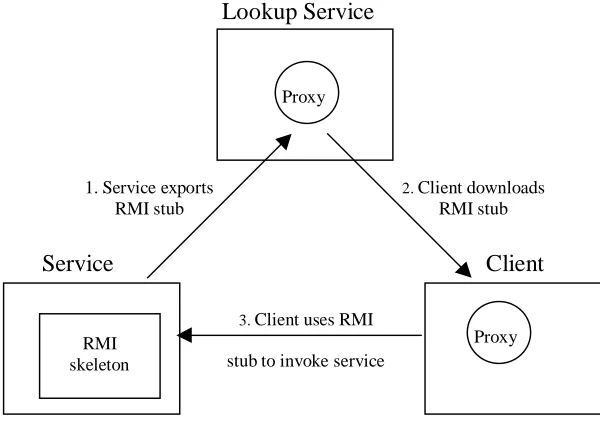
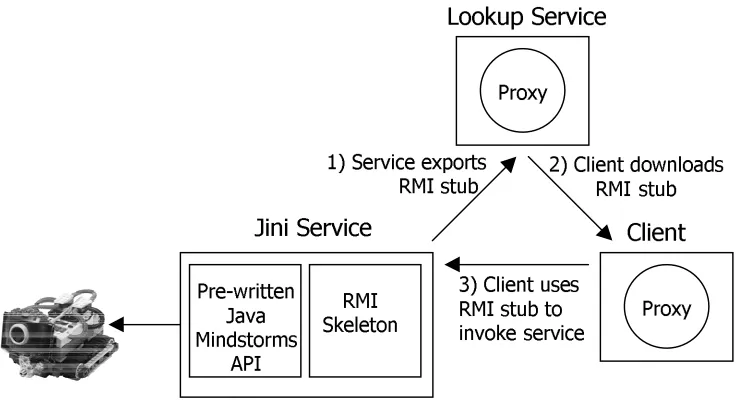
The second choice uses a thin proxy object, which just passes on methods from the
client to the server. This scenario is applicable when all the processing must be run on
the server machine. A standard way to implement this is using Java RMI where the
service exports the RMI stub as the proxy object. This “thin proxy” scenario can be
[image:18.595.145.447.106.321.2]seen in figure 2.3
Figure 2.2 – Jini Design Pattern 1
Figure 2.3 – Jini Design Pattern 2
Proxy
Service Client
Lookup Service
1. Service exports standalone service
2. Client downloads entire service Proxy
3. Client runs entire service locally
Proxy
Service Client
Lookup Service
1. Service exports RMI stub
2. Client downloads RMI stub Proxy
3. Client uses RMI
stub to invoke service RMI
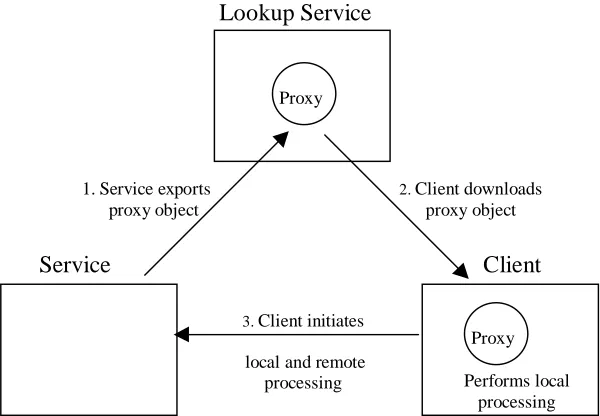
[image:18.595.136.436.486.697.2]The final scenario is where the processing is divided between both the server and the
client. In this scenario the proxy object can contact the server via any protocol such as
setting up sockets or using HTTP. However it also does some processing on the client
Java virtual machine. This scenario can be seen in figure 2.4.
2.4
Jini Service Functions
All Jini services must describe their service, discover one or more lookup services and
register their proxy object, which contains their service description, with the lookup
services discovered. As of Jini version 1.1 this process has been dramatically
simplified by providing a utility class named LookupDiscoveryManager to take
care of the discovery process and a utility class named JoinManager to perform the
registration process. With these two classes the majority of the standard Jini work for
the service developer is greatly simplified. In fact, the whole process can now occur in
a single line of code. A more indepth technical overview of these two utility classes
now follows.
We shall firstly examine the JoinManager class. The class has two constructors.
[image:19.595.159.459.189.397.2]The first is used when the service is new and has not been previously registered with a
Figure 2.4 – Jini Design Pattern 3
Proxy
Service Client
Lookup Service
1. Service exports proxy object
2. Client downloads proxy object Proxy
3. Client initiates
local and remote
lookup service. The second is used when the lookup service has registered the service
at some earlier time and has returned a service ID to the service.
public class JoinManager {
public JoinManager(Object obj,
Entry[ ] attrSets,
ServiceIDListener callback,
DiscoveryManagement
discoverMgr,
LeaseRenewalManager
leaseMgr)
throws IOException;
public JoinManager(Object obj,
Entry[ ] attrSets,
ServiceID serviceID,
DiscoveryManagement
discoverMgr,
LeaseRenewalManager
leaseMgr)
throws IOException;
}
The first parameter in the constructor is the actual proxy object to be registered. The
second parameter is an array of objects that implement the Entry interface and are
used to describe the service. The third parameter is either the ServiceID if it is
known or an object that implements the ServiceIDListener if it is not known.
The fourth parameter is an object that implements the DiscoveryManagement
interface. In fact the other utility class LookupDiscoveryManager actually
implements this interface and an object of it will usually be passed in here. The final
parameter is a LeaseRenewalManager object.
object with the lookup service it requests an object which implements the Lease
interface. This is equivalent to a promise from the lookup service to keep the proxy
object registered for the duration of the lease object returned. This lease object will
have to be renewed by the service before it expires for the proxy object to maintain its
registration in the lookup service and for the service to thus still be available. The
LeaseRenewalManager object handles these issues for the service.
The other utility class mentioned, LookupDiscoveryManager, manages all
discovery related issues on behalf of either a service or a client. A service or client
that wants to contact lookup services whose locations are known to it can use this
class’ “unicast” facilities (i.e. contact them directly), yet also use whatever lookup
services it can find by multicast discovery.
public class LookupDiscoveryManager implements
DiscoveryManagement,
DiscoveryGroupManagement,
DiscoveryLocatorManagement {
public JoinManager(String[ ] groups,
LookupLocator[ ] locator,
DiscoveryListener listener)
throws IOException;
}
The first parameter is an array of Strings that identify what types of lookup services
we want to locate. Some lookup services may be based on organisational departments,
others may be open to the public. By passing in the constant
LookupDiscovery.ALL_GROUPS here we would search for all available lookup
services. The second parameter is an array of LookupLocator objects. A service or
client that wants to contact lookup services whose locations are known to it can use
this class’ “unicast” facilities by creating LookupLocater objects for each known
lookup service address. The final parameter is an object that implements the
DiscoveryListener interface. This object provides methods that determine what
The following code fragment illustrates these concepts:
try {
JoinManager joinMgr = new
JoinManager(proxy, attrSets, this, null,
null);
}
catch(IOException ex) {
ex.printStackTrace();
}
It can be seen that by providing null as the final two parameters creates default
LookupDiscoveryManager and LeaseRenewalManager objects
respectively. In the above fragment of code proxy is the service’s proxy object
which is created earlier. attrSets is an array of objects implementing the Entry
interface, describing the service.
2.5
Jini Client Functions
All Jini clients also go through a standard set of steps. They must also discover one or
more lookup services, search that lookup service for the type of service they require
and only then can they use the service. As with services, the discovery of lookup
services can be simplified for clients by using the utility class
LookupDiscoveryManager previously discussed. A utility class named
ServiceDiscoveryManager is used to aid client side searching and is to the
client developer as the JoinManager is to the service developer.
public class ServiceDiscoveryManager{
public ServiceDiscoveryManager
(DiscoveryManagement DiscoveryMgr,
LeaseRenewalManager leaseMgr)
The class has a single constructor that takes an object that implements the
DiscoveryManagement interface. Again, the object usually passed here is an
instance of the LookupDiscoveryManager class which will indicate whether the
client wants to use multicast searching for lookup services, unicast searching for
lookup services or both. The second parameter is an instance of the
LeaseRenewalManager class.
Once the ServiceDiscoveryManager has been created, and lookup services
have been located, those lookup services are typically searched by clients for services
that they are interested in. The ServiceDiscoveryManager class provides four
lookup methods to simplify this process.
ServiceItem[] lookup(ServiceTemplate tmpl, int
minMatches, int maxMatches,
ServiceItemFilter filter, long
waitDur);
ServiceItem[] lookup(ServiceTemplate tmpl,
int maxMatches,
ServiceItemFilter filter);
ServiceItem lookup(ServiceTemplate tmpl,
ServiceItemFilter filter);
ServiceItem lookup(ServiceTemplate tmpl,
ServiceItemFilter filter, long
waitDur);
In each case the method returns either a ServiceItem object or an array of such
objects. This object contains the services’ proxy object and descriptions about the
service. In each case also, the client must pass a ServiceTemplate object as a
parameter. This object determines what type of services the client wishes to search
all services based on the client’s needs. One of the parameters in constructing a
ServiceTemplate object is an array of Class objects of interfaces. Thus only
services implementing these interfaces will be found. In this way, the client needs to
know of the interfaces in advance. The other parameters relate to the number of
matches that should be returned and the amount of time that should be taken to match
a service.
The following code fragment illustrates these concepts. Firstly, the
ServiceDiscoveryManager object is created. If null is passed as the two
parameters of the ServiceDiscoveryManager constructor, default
LookupDiscoveryManager and LeaseRenewalManager objects are created.
try{
ServiceDiscoveryManager sdm = new
ServiceDiscoveryManager(null,null);
}
catch(IOException ex){
ex.printStackTrace();
}
Then we specify the types of services we are searching for by creating a
ServiceTemplate object.
Class [] types = new
Class[]{SpecificServiceInterface.class};
ServiceTemplate template = new ServiceTemplate(null,
types, null);
ServiceItem found = null;
Finally we try to find a service implementing the specified interface.
try {
catch (Exception ex){
ex.printStackTrace();
}
Once a matching proxy object is returned to the ServiceItem, it is trivial to invoke
the services of the proxy object.
if(found!=null){
SpecificServiceInterface jiniService =
(SpecificServiceInterface) found.service;
//call the method now
JiniService.arbitraryMethod();
}
2.6
Advanced Jini Concepts
Three main Jini concepts have been discussed so far:
Discovery – both multicast and unicast discovery of lookup services.
Using Lookup Services –
Services publishing their proxies;
Clients searching for services
Leasing – used by services to confirm their availability
However there are two further concepts that are not necessary for many Jini services
but are still core to Jini technology. These are:
Remote Events
Distributed Transactions
2.6.1 Remote Events
Jini uses events to perform asynchronous notifications of state changes just like Java.
asynchronous notifications within a single Java virtual machine whereas the Jini event
model delivers events in a distributed environment. For example, a client may want to
know if a service that it is interested in has changed in some way. It is up to the
service to deliver events to the client notifying him/her of this change.
Any client who wants to be notified of these changes in services will have to register a
listener for this service. This is done via the RemoteEventListener interface
which has a notify() method that services can invoke. The Jini event class is
called RemoteEvent and all remote events must use or subclass this class.
Remote events raise many problems that local events do not such as order of delivery
and partial-failure. Jini leaves the handling of these issues up to the service
programmers, who must decide if they need to try to re-send the remote events in the
case of partial-failure and determining if clients need to receive the events in the order
they were sent.
2.6.2 Distributed Transactions
Transactions are a fundamental concept in distributed systems. They are used to group
several distinct operations together, so as they all occur as a single operation. They
provide the ACID properties to data manipulations:
Atomicity – either all of the transaction’s operations succeed, or they all fail.
Consistency – a transaction is a correct transformation of the system state. This
means that after the transaction completes, the system should be in a consistent,
understandable state.
Isolation – partial effects of one transaction are not visible to other transactions.
In practice transactions implement a protocol known as the two-phase commit
protocol. In this protocol, all participants in a transaction are asked to prepare to
commit to the transaction in a primary pre-commit phase. They each execute their
own individual part of the transaction here and store the results in a temporary
manner. If all respond that they are prepared to go ahead, then each participant is told
to commit (i.e. execute) in a secondary stage. The commit effectively says that they
must each make their temporary data changes permanent. This decision is final and
even if a participant should fail before it can commit, it must do so when it restarts.
However, if any participant should reply with an abort during the primary phase then
each participant is told to abort and the whole transaction is thus aborted. Throughout
this procedure a central entity is the destination for receiving of abort or commit
messages. This entity is the transaction manager. It decides, based on all the messages
it receives, as to whether or not the transaction should go ahead.
In Jini an object which implements the TransactionManager interface is used to
manage the two-phase commit protocol. Sun Microsystems have provided a default
transaction manager that implements this interface. It is a Jini service and is named
mahalo. For an object to be a participant in a transaction it must implement the
TransactionParticipant interface. This interface provides abort,
prepare and commit methods which are invoked by the transaction manager.
The process for creating a transaction is as follows. Firstly a TransactionManager is
located using the normal discovery process. Then the programmer creates a
Transaction object using the TransactionFactory class. This
Transaction object’s operations are then defined, i.e. the programmer decides
what is to comprise the transaction. The Transaction object is then passed to the
TransactionManager who executes it to the standards of the two-phase commit
protocol. Note that it is left up to the programmer to determine what actions each of
Chapter 3
3
State Of The Art
This chapter provides an introduction to technologies and research related to Jini and
this dissertation. It is divided into four sections. The first section discusses the
distributed programming technologies of RMI, CORBA and Enterprise Java Beans
(EJB) along with their relationship to Jini. The second section introduces the new web
technology combination of SOAP and Universal Description Discovery and
Integration (UDDI). SOAP is a more recent distributed programming technology that
concentrates on web services. UDDI is a technology that aims to be the Yellow Pages
of web services. The relationship of these technologies to Jini is examined. The third
section deals with two alternative technologies which, like Jini, are aimed to
“spontaneously network” devices – Universal Plug and Play (UPnP) and Salutation.
Finally, a number of fundamental research projects in the area of Jini that are relevant
to the work in this dissertation are presented.
3.1
Distributed Programming Technologies
3.1.1 Remote Method Invocation (RMI)
RMI [RMI Spec ‘00] technology is a distributed object technology enabling
programmers to write distributed object-oriented applications. Remote Method
Invocation (RMI) technology is entirely implemented in the Java language. The
technology allows clients to invoke methods on objects which reside on a remote
server, as if they were invocations on a local object. A naming service, similar in
function to Jini’s lookup service, is provided called the rmiregistry. This acts as an
information repository storing the location of all the distributed objects. Servers
register their objects with this registry and provide an HTTP server whereby clients
the service. The URL locating the remote reference is then passed back to the client
who thus obtains the stub. This stub is responsible for the marshalling, or gathering
and transforming of data from the client into a valid format for transmission. A
corresponding skeleton resides on the server, which unmarshalls data from the client
and marshals responses back to the client.
Jini services, especially those with a thin proxy object, are often built using RMI as
both technologies are written in the Java language. However, Jini provides
spontaneous networking associated with its discovery protocols. It also reveals to the
programmer a technology which was used behind the scenes in RMI – leasing.
Leasing is the enabling technology for Jini’s self-healing mechanisms.
3.1.2 Common Object Request Broker Architecture (CORBA)
CORBA (Common Object Request Broker Architecture) is, like RMI, a distributed
objects technology. Using CORBA, a client can call a method on an object residing
on a remote server, as if it were calling a method on a local object. Like RMI,
interaction between the client and the server is specified by an interface. However in
CORBA, this interface is written in a language neutral Interface Definition Language
(IDL). The infrastructure to handle the actual passing of requests from the client to the
server and its responses is hidden from the client. It consists of an Object Request
Broker (ORB) residing on the client machine and another one residing on the server.
The two ORBs communicate using a standard protocol known as General Inter-ORB
Protocol (GIOP). This protocol allows ORBs from different vendors to communicate.
The Internet Inter-ORB Protocol (IIOP) is a mapping of the GIOP specification for
Transport Control Protocol/Internet Protocol (TCP/IP) networks.
The advantage of CORBA over other distributed technologies is that it is language
neutral. CORBA objects may be written in many languages e.g. Java, C and C++.
However, unlike RMI and Jini, CORBA objects are not mobile. They can only
execute in a single machine whereas RMI and Jini objects and their data may be
moved from one machine to another and executed there. There is significant value in
neutrality is a significant advantage in distributed systems, especially in services of
limited memory capability. A bridging architecture to enable this is described in
section 4.2.2.
3.1.3 Enterprise Java Beans (EJB)
Sun Microsystems has built an infrastructure to allow programmers develop server
side Java programs. This infrastructure is called the “Java 2 Enterprise Edition” or
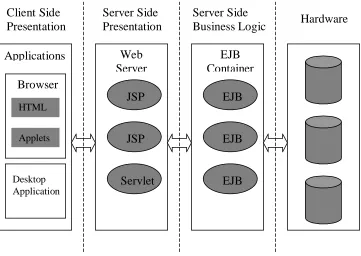
J2EE. EJB is one aspect of the J2EE architecture. The relevant technologies and their
relationship with each other can be seen in figure 3.1.
EJBs are meant to contain the server side business logic. They do have similarities to
Jini however in that EJB is another distributed programming technology, providing
the notion of services on the network. EJBs often reside in different areas on the
network and can access other network services via RMI over IIOP. Using IIOP adds
the promise of CORBA interoperability and thus communication with languages other
than Java. EJBs could be exposed as Jini services and thus be dynamically discovered
once run. In fact work is being done currently to investigate the integration of these
[image:30.595.112.473.304.560.2]two technologies [EnterpriseWeb ‘01].
Figure 3.1 – Java 2 Enterprise Edition Technology Overview
Client Side Presentation
Server Side Presentation
Server Side
Business Logic Hardware
3.2
Web Service Technologies
3.2.1 Simple Object Access Protocol (SOAP)
SOAP is an XML based protocol used to allow distributed software applications to
communicate via HTTP [SOAP Spec. ‘00]. Because it is over HTTP, SOAP messages
have the advantage (if you are not a system administrator) of being allowed by
firewalls over the standard web server port 80. SOAP essentially allows Remote
Procedure Call (RPC) to run over HTTP. The SOAP protocol consists of three parts:
an envelope describing what is in a message, who and how to process it;
a serialization mechanism for exchanging application defined datatypes;
a convention for invoking remote procedure calls and responses.
SOAP is a protocol specification headed by Microsoft and IBM, and submitted to the
World Wide Web Consortium (W3C). SOAP is designed to be simple and therefore
doesn’t contain much of the functionality of other distributed object technologies such
as:
Distributed garbage collection
Message batching
Passing objects-by-reference
Activation
SOAP is a protocol specification and is therefore not tied to any one programming
language. There are implementations of the SOAP protocol in many languages
including Java, C++, Visual Basic, Perl and Python.
3.2.2 Universal Discription Discovery and Integration (UDDI)
UDDI is a multi-vendor initiative aimed to be a Yellow-Pages type directory of
used to describe a business entity and its web services in UDDI. This XML file
consists of three conceptual components [UDDI ‘00]:
“white pages” which consist of addresses, contact names and numbers etc.
“yellow pages” which consist of industrial categorisations based on standard
taxonomies
“green pages” which consist of the technical information about the services that
are exposed by the business
These business registration XML files are registered in a public UDDI business
registry on the web. IBM and Microsoft currently run public UDDI registries on their
web sites.
The UDDI business registry can be used to search for businesses in a specific industry
category and see what web services they offer. It can also be used to determine the
technical details of how that web service is provided in order to invoke the service.
The web services that businesses register in the UDDI registries are normally
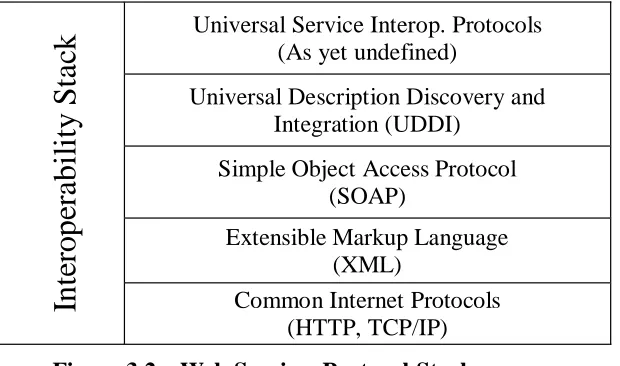
[image:32.595.144.454.524.707.2]implemented in SOAP. The interaction of these protocols can be seen in figure 3.2
[UDDI ‘00].
Universal Service Interop. Protocols (As yet undefined)
Universal Description Discovery and Integration (UDDI)
Simple Object Access Protocol (SOAP)
Extensible Markup Language (XML)
In
te
ro
p
er
ab
il
it
y
S
ta
ck
Common Internet Protocols (HTTP, TCP/IP)
Figure 3.2 – Web Services Protocol Stack
Perhaps not surprisingly, UDDI is an industry initiative led by many of the same
The combination of SOAP and UDDI aims to be a key tool in the future of
Business-to-Business technologies and web services. Their relevance to this dissertation is that
SOAP and UDDI are possible technologies that could be used to expose Jini LAN
based services as services on the Internet, which is the first aim of this dissertation.
3.3
Spontaneous Networking Technologies
When Jini technology was initially released, a lot of the marketing hype explained Jini
as a technology that would allow spontaneous networking of home devices. This hype
has not been lived up to, largely because of the memory constraints of home devices.
As much of the research in this area has shown, Jini is actually a powerful software
solution that doesn’t have to be device centric at all. However, several other
technologies were also created and marketed as solutions for the spontaneous
networking of home devices. This section describes two of them – UPnP and
Salutation.
3.3.1 Universal Plug and Play (UPnP)
UPnP is a technology from a consortium led by Microsoft [UPnP]. It is seen as
networking extension of Microsoft’s Plug and Play technology. UPnP concentrates on
the TCP/IP protocol stack. It defines additions to the lower levels of the protocol
stack, which can be implemented by device manufacturers.
Like Jini, UPnP implements the idea of discovery. It uses a protocol known as Simple
Service Discovery Protocol (SSDP) that enables devices to announce their presence to
the network as well as discover available devices. Note that the emphasis in UPnP is
on hardware devices, whereas Jini emphasises services – both software and hardware.
Discovery in UPnP can work with a lookup service, like in Jini, or without one. Again
like in Jini, discovery is based on the device sending multicast messages announcing
its presence.
One innovative aspect of UPnP is self-configuration. This allows devices that cannot
be allocated IP addresses dynamically, because of a lack of any DHCP server, to use a
pre-assigned range of IP addresses. However these addresses are not valid Internet
routable addresses and are used only for the surrounding network of UPnP devices.
Therefore if a DHCP server becomes available at any time, it will change the IP
address of the device into a valid Internet routable one.
While UPnP has the backing of Microsoft and many device manufacturers, it is a very
different technology offering to Jini. It does not offer a comprehensive programming
API like Jini and is aimed completely at seamlessly and spontaneously networking
devices together whereas Jini is aimed at services, be they hardware or software.
3.3.2 Salutation
Salutation [Salutation] is another discovery and spontaneous networking (known to
Salutation as “Find and Bind” networking) technology from a consortium of computer
industry companies and academics. It is based on research on intelligent agents. A
device talks directly to a Salutation Manager (SLM), which may be in the same device
or located remotely. Salutation assumes that this SLM is known to the device in
advance. The SLMs then act on behalf of the device, discovering and coordinating
with each other using Sun Microsystems' Open Network Computing Remote
Procedure Call (ONC RPC).
Salutation and UPnP are aimed specifically at dynamically networking hardware
devices. Jini provides far more than just the capability of dynamically networking
devices. Essentially it provides the capability of dynamically networking software.
Furthermore Jini has developed a strong software development community [Jini
Community] due to its extensive API.
3.4
Related Jini Research Projects
The following section describes three research projects of special relevance to this
dissertation. The first, “The SOAP-UDDI Project”, is a project that addresses the issue
of how to access Jini services over the Internet. The second, “The Surrogate
how Jini clients can invoke Jini services dynamically even if those services are not
known in advance. These three projects are especially relevant because they address
the three issues that were identified in the beginning of this dissertation as impeding
the proliferation of Jini technology.
3.4.1 The SOAP-UDDI Project
In section 3.2.2 SOAP was identified as a possible means of invoking Jini services
over the Internet. Furthermore, UDDI was discussed as a sort of Internet Yellow
Pages where these Jini services could be registered. In fact, this is exactly the aim of
the SOAP-UDDI project [Harrison ‘01]. This research project is very new, created on
the 18th of June 2001. It was the initial impetus to this thesis’ investigation of SOAP
as a means to accessing Jini services over the Internet. However, as stated previously,
using SOAP requires distribution of the SOAP and XML parser files to all the clients
for installation. Furthermore, the necessity to parse XML on both the client and server
introduces noticeable reductions in operation speed. These inconveniences were found
to be major disadvantages to using SOAP to access Jini clients.
3.4.2 The Surrogate Architecture
As stated previously, in order for a hardware or software component to participate in a
Jini network, it must be able to run the core Jini files which occupy over 3 MB of
memory. In addition it must be able to download and execute classes written in the
Java programming language and it may need the ability to export classes written in
Java so that they are available for downloading to a remote entity. For devices of
limited capacity which cannot meet these criteria, the use of a third party or proxy
which will perform these functions for the device is a solution. The Jini Surrogate
project [Surrogate Spec. ‘01] has defined such a proxy architecture called “The
Surrogate Architecture”. The architecture specification is network and device
independent and preserves Jini’s concepts of discovery, code downloading, and
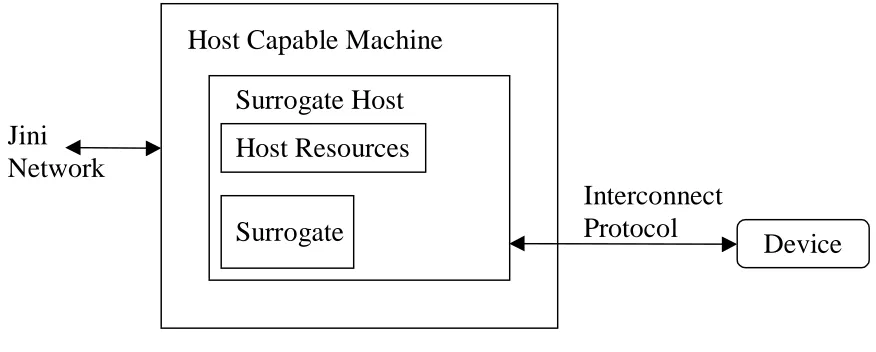
The basic components of the Surrogate Architecture are shown in figure 3.3. The
proxy is a machine capable of participating in a Jini network directly. It shall allocate
resources for the device in a framework known as the “Surrogate Host”. A
“Surrogate” is an object that represents, and allows control of, the device. This may be
a collection of Java software components and other resources.
The Surrogate must be retrieved by the Host Capable Machine. This operation may be
a push (the device uploads the surrogate to the surrogate host) or a pull (the surrogate
host extracts the surrogate from the device or from some third party). The
“Interconnect Protocol” is the logical and physical connection between the Surrogate
Host and the device. The Interconnect must be specified for each network protocol.
This has been done for the Internet Protocol [Interconnect Protocol ‘01] and it is in the
process of being done for the Bluetooth network protocol and for Java smart-cards. It
is foreseen that the interconnect for more network protocols shall be specified in the
future.
The Surrogate Architecture solves the second problem constraining the proliferation
of Jini technology identified in this dissertation – that of integrating device of limited
memory capacity into a Jini network. However, for the device of limited memory
capacity used in this thesis (a Lego Mindstorms robot) using this architecture was not
possible. This was due to the fact that it is impossible to upload a surrogate from the
Mindstorms robot without re-writing its firmware, which was beyond the scope of the
[image:36.595.98.536.216.392.2]project. However the Surrogate Architecture is the generic way of solving the problem
Figure 3.3 – The Surrogate Architecture
Surrogate
Host Resources
Surrogate Host
Host Capable Machine
Device
Interconnect
Protocol
Jini
3.4.3 The Service User Interface Project
The Service User Interface project [Venners ‘01] aims to standardise ways to attach
and use any kind of user interface (text-based, graphical, voice, etc.) to Jini services.
Note the difference here between the interface that the service implements which
provides methods to the client to invoke on that service, and a user interface which
may be graphical, voice etc. which allows control of the service. The Service User
Interface project is relevant to this dissertation in that it relates to the third problem
identified as restricting the proliferation of Jini technology, namely, if a client doesn’t
know the interface that the Jini service implements then there is no way for them to
work together programmatically. However, while this is a problem for an automated
client, it may not be a problem for a client used by a human. If an intuitive user
interface is provided then the human may still be able to use the service. There are
four choices for providing the intelligent user interface.
The service’s proxy not only implements the interface that the service is driven
on, but also implements the user interface. The proxy could therefore be a subclass
of JWindow which could display a complete user interface. However, if the client
doesn’t have access to the correct user interface class files it won’t be able to use
the user interface. Furthermore, user interface code becomes entwined with
service code, which is undesirable from a design point of view.
A better approach is that the service implements a separate interface e.g.
“Interfaceable” which returns the GUI for the client. Clients could specify
their type and the methods invoked through the Interfaceable interface
should return the appropriate user interface. However this prohibits the addition of
a user interface by the client after the service has been created.
Another approach attaches user interfaces as attributes to the service’s proxy
object, by sub-classing the Entry interface. Thus many user interfaces can be
provided, one for each client type. However, if the client doesn’t have the correct
class files to use the user interface it is still a problem. Furthermore, the user
interface will have to be serialised to transmit it. This is a serious limitation to the
A fourth approach attaches not a user interface as an attribute to the service’s
proxy object, but an object that creates a user interface. This is a subtle but
important difference. It provides several key benefits. As with the previous
approach it allows clients to attach new user interfaces that the service writer may
have omitted. It also allows clients to search for their appropriate user interface.
However a major advantage is also that the user interface is instantiated on the
client Java virtual machine, rather than on the server one and then serialised. This
is a major advantage because instantiating swing components on the server side
normally gives them data references that reside on the server machine. When these
are serialised and sent to the client, they often won’t work once de-serialised on
the client.
The Service User Interface project and the Jini community have decided on the fourth
approach. It defines a standard way for user interface providers to associate a user
interface with a Jini service by providing three items:
A UIDescriptor that describes the user interface, and is attached as an
attribute to the service proxy;
A user interface “factory” that will be instantiated on the client’s Java virtual
machine to produce the user interface;
The user interface itself;
The UIDescriptor is the most important of these. It contains the following items:
1. A “role”, which indicates how the user interface generated by the user interface
factory will be used. A user interface returned by the factory object must
implement a specified role. For example, two roles currently defined are:
MainUI – for a service’s “main” user interface.
2. A “toolkit”, which defines the necessary packages for the user interface. Two
toolkits have been defined to date. One specifying the javax.swing package
and another specifying the java.awt package.
3. A set of attributes that describes the user interface represented by the
UIDescriptor.
4. A factory, represented as a MarshalledObject, which can be used to
instantiate the user interface.
A client using the Service User Interface Project’s approach must use its packages in
order to invoke the factory to create the appropriate user interface. However, the
Service User Interface is an evolving project and at the time of this thesis it was not
standardised. Therefore a fifth approach using Java’s “Reflection” capabilities was
investigated.
Reflection is the ability to examine the type of an object at run time. This obviates
compile-time type requirements, and enables us to call any method on any arbitrary
object without having to know that object’s type at compile time [Neward ‘00]. This
is an obvious solution to the problem of the Jini client requiring the service’s interface
in advance.
This approach has the advantage that the client doesn’t need to know of any
non-standard Java classes in order to use the Jini service. Furthermore, it doesn’t need to
know the interface that the service implements in advance. Moreover, in order to
access Jini services via the Internet, this thesis takes the approach of using servlets.
HTML is thus the graphical user interface. For these reasons the Reflection approach
was used and not the Service User Interface approach. However, once its packages are
defined, due to its flexibility, the Service User Interface will undoubtedly become the
standard mechanism by which most human controlled clients will access services
Chapter 4
4
Design
As stated earlier, there are two distinct sections of design. The first section deals with
the architecture to control Jini services over the Internet, while also addressing the
question of how to make the client generic. This in essence tries to solve the first and
the third problem identified as impeding the growth of Jini technology – namely, how
to access Jini services over the Internet and, how to enable a generic Jini client to
control Jini services without any advanced knowledge of them. Thus the first section
deals with the design of a generic Jini client to control Jini services over the Internet.
The second section of the design deals with the control of devices of limited
capability as Jini services. This addresses the second problem identified as impeding
the growth of Jini technology – that in order to partake in a Jini network, devices need
at least 3 MB of available memory to install the Jini software.
4.1
Control of Jini Services over the Internet
This section is divided into two sub-sections. The first sub-section describes the
problems associated with trying to access Jini services over the Internet and provides
the design of a web bridging architecture as a solution to these problems. The second
sub-section discusses the necessity for a generic client and describes an addition to the
web bridging architecture, which uses reflection to create the generic client.
4.1.1 A Web Bridging Architecture
As described in section 2.2, in the normal Jini scenario, when both a client and service
are within a LAN, the client downloads a “proxy object” which it can use to control
the service. Initially it was hoped to be able to continue to use this normal Jini
architecture to control Jini services over the Internet using applets by allowing the
applet to download a service’s proxy object and directly contact the service’s
However, when the client is outside the LAN this same interaction raises problems.
Firstly, the client would have to install the core Jini files. Moreover, the use of
multicast to discover the lookup service cannot be used. This however can be solved
by Jini’s unicast lookup facility where the client specifies a known IP address of a
lookup service. Unfortunately there are more serious problems. Even if the client
knows the IP address of the machine running the lookup service and uses Jini’s
unicast facilities to try to contact it, there it is unlikely to get through to it if that
machine is behind a firewall. If the firewall is configured to allow access to that
relevant port on the lookup service machine, then the client will be able to access it
and download the proxy object. However, in many cases the service will use the
second design pattern specified in section 2.3 in which case the proxy object will then
attempt to access another machine on which to run the service. Again we come across
the problem of access to this machine if it is behind a firewall. We are now in the
nasty position of having to open ports for every machine we run a service on. Even if
this was attempted, the communication between the proxy object and the service
back-end will often use RMI. RMI dynamically allocates port numbers when using
communication between clients and servers and thus trying to give access to these Jini
service back-end machines using RMI would be equivalent to giving access to every
port on that machine.
One approach to this problem is to try to tunnel RMI over HTTP. This involves
encapsulating the client RMI call in an HTTP POST request and unpacking it on the
server side. However there is extensive negative experience with this on the
RMI-users mailing list. Furthermore, this issue has been raised previously as the Jini
community attempts to access Jini services over the Internet. Moreover, at the time of
writing, the RMI over HTTP solution was cited as not working [Li ‘01]. Even if this
solution became feasible, the client would still have to install the core Jini technology
files in advance.
The solution these this problems is to add an extra level of indirection to the standard
The standard Jini client now becomes a web bridge also, allowing a browser client to
invoke the Jini client facilities such as discovery, searching of the lookup service and
service invocations. While this design isn’t as simple and elegant as the standard Jini
architecture, it resolves all of the problems discussed earlier. The proxy objects can
access the service back-end even if it is via RMI seeing as the Jini client/web bridge is
still within the LAN. The main issue left to resolve is the type of “Jini client/web
bridge” technology and thus Internet client to choose. Two alternative
implementations are discussed in sections 5.1.1 and 5.1.2. While this section has
identified an architecture to access Jini services over the Internet, it has not addressed
the question of providing a generic client for all services. The following section
provides an addition to the web bridging architecture that enables this.
4.1.2 Reflection – A Generic Jini Client
As discussed in section 2.5, in the normal scenario for a Jini client, once the lookup
service has been found, it can be searched for services that implement a specific
interface. Therefore, if the client is to search for a specific type of service, it must be
aware of that service’s interface at compile time. A client can however search for all
services available implementing any interface by passing null as a parameter in the
[image:42.595.124.474.144.324.2]methods that search the lookup service. However, in order to invoke the methods, we
Figure 4.1 – Web Bridging Architecture
!
" #%$&('
" #%$&('
)
*
+,,.-/
In cases where the client is automated, this is not a problem because it doesn’t make
sense for programmatic clients to invoke a service they know nothing about. However
if there is human interaction with the client, it may be possible to provide the user
with enough information about the service at run time so as he/she can sensibly
invoke the service. This system would allow any new service to be accessed and
invoked by the generic client, without updating or modifying the client whatsoever.
Although the client knows nothing about the service, it aims to extract enough
information about it at run-time, and provide this to the user, so as he/she can make a
value judgement as to whether or not it makes sense to access the service.
Java’s “Reflection” capabilities allow us to discover the type of an object, the
interfaces it implements, and the methods those interfaces define, when we receive the
object at run time. These capabilities can be used to augment the web bridging
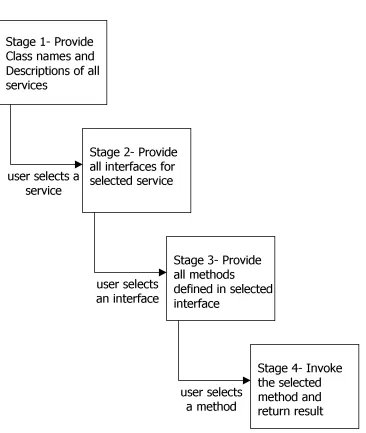
architecture. The four-stage generic client architecture using reflection is shown in
As the diagram shows, the first stage supplies all discovered services, their class
names and a description of each service. The user then selects a specific service that
he/she wishes to access. This selection is passed to the second stage, which provides a
list of all the interfaces supported by the selected service. The user then selects a
specific interface. This selection is passed to the third stage, which provides a list of
all the methods defined by that interface. The user then selects a method to invoke.
The method is invoked on the underlying service and the final stage shows the method
result. Details of the specific reflection capabilities used at each stage are described in
[image:44.595.132.498.107.540.2]section 5.1.3 – Implementing a Generic Jini Client with Reflection.