Abstract—The introduction of the femtocells has a promising solution in reducing the mobile network operational cost (building of macrocell site) and increasing turnover such as revenue. This new technology provides a high quality of service and high data rate at the indoor environment. Thus the primary challenges that face femtocell is Interference which solely depends on the kinds of access point chosen by the users. In this paper we focus on the access control model for accessing femtocell network and we compare closed and open access control mechanism. We also discuss the need for hybrid access control mechanism. We illustrate the scenarios when we increase the number of femtocell users and draw our results for both closed and open access points graphically.
Index Terms— Femtocell, Closed Access, Open Access, Hybrid Access Control, Interference
I. INTRODUCTION
HEtopology of a cellular network was designed for a single application, but due to the arrival of 3G and Long Term Evolution(LTE) technology, the use of data is highly demanded by users particularly in the indoor environment.
The introduction of the new technology called femtocell technology in the cellular network [1] [2] met the need of high demand of mobile data at the indoor environment. In line with [3] 90% of the voice call and data traffic will occur mostly in the indoor environment. Since the effectiveness of macrocell is to delivered coverage but are not very efficient at the indoors due to high penetration losses [4] which has being a challenge to the mobile service of the networks.
Femtocell is seen as a promising technology to cope with these challenges of coverage problem in home or offices and other functionality for the network user. Femtocell is a small home base station that is mounted by the customer in the home for the purpose of coverage. The connection of Femtocell is through the mobile core network by using wireless or wired lines. It enhances bandwidths quality, provides additional service and offloads traffic from the existing network [5]. These advantages cannot be achieved easily because of the challenges faced by femtocell which are Interference, Security Issues, Resources Sharing, Timing and Synchronization and Provision of Emergency Service
Manuscript received January 27, 2017; revised 8 Feb 2017. This work was supported by University of Johannesburg.
O. A. Akinlabi is with the Electrical and Electronic Engineering Science Department, University of Johannesburg, Johannesburg, South Africa (phone: +27717157260; e-mail: [email protected]).
M. K. Joseph is an Associate Professor at the Electrical and Electronic Engineering Technology Department, University of Johannesburg, Johannesburg, South Africa.
but amongst them, interference is the most important.
The the cross-tier interference is described as an element between femtocell and macrocell, and vice versa while Co-tier interference occurs in the same Co-tier of element [12]. The security features and access points need to be studied by 3GPP TSG Service &System Aspects (SA) WG3 [13]. More than a few possible processes are recognised to mutually authenticate the femtocell access point and the operator’s network, along with other security measures [13] [6].
The configuration of the femtocell is considered by means of access methods such as the open access method, closed access method and hybrid access method [7]. The types of access control chosen by the user determines the effects on the network performance played by interference. The methods used to access femtocell network are: Open access, closed access and the hybrid methods.
The Open Access is mainly used in public placed such as the mail, bus station, and school in other to access the network through femtocell network. Whereas closed access is limited to only those that are registered, to the network operator. The hybrid method is used to compromise between subscriber and nonsubscribers.
When the access control blocks the femtocell’s resources of a subset of the users within its coverage network, a fresh of interference is implicitly defined in such area. Hence, the deployment of Closed Subscriber Group (CSG) complicated the problem of interference mitigation. On the contrary, the implementation of open Femtocell Access Point (FAPs) would resolve this issue, but considering the issues of security and sharing to users of the network. Furthermore, the movement of users within an open area, especially for an open access point, otherwise increase/reduce the networks.
The introduction of the hybrid method is used as a trade-off between open and closed methods. However, some common resources must be carefully adjusted, in other cases increased to improve the impact of the quality of service for femtocell network.
The role of access control is a way of reducing the present of cross-tier interference and handover attempts, which must be carefully chosen by the users. Our primary focus is to provider the existing access methods, challenges of different access methods, the need for hybrid access methods, the performance analysis in the team of outages, throughput and handover attempts. Based on the air-interface, different types of femtocell technologies has being
Case Study on Technical Challenge of Access
Control for Femtocell Network
O.A Akinlabi and M. K. Joseph
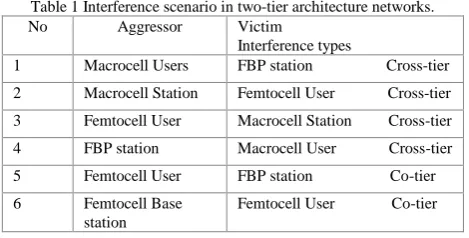
developed for mobile service and standards, and above all the access method. In Table 1 we illustrate various kinds of interference present in two-tier network.
Table 1 Interference scenario in two-tier architecture networks. No Aggressor Victim
Interference types
1 Macrocell Users FBP station Cross-tier 2 Macrocell Station Femtocell User Cross-tier 3 Femtocell User Macrocell Station Cross-tier 4 FBP station Macrocell User Cross-tier 5 Femtocell User FBP station Co-tier 6 Femtocell Base
station
Femtocell User Co-tier
II.GENERAL REQUIREMENT FOR FEMTOCELL NETWORKS
1.Quality of service
This condition was placed by IEEE 802.11 on all aspects of Internet connection for the mobile provider, such condition were an equal signal to noise ratio, loss, time response and frequency sharing etc. The motivation is to ensure a standardized grade of quality and performance for the network users. To achieve quality of service for the new technology as a femtocell, there is a need for a change of hardware used by the mobile providers. Such as Integrated Services and Differentiated Service, both contribute to improved quality of service and reserve resources through a network. However, router and switches also promote improved quality of service.
2.Interference Issues
Based on the benefits of femtocells, the key issues is the interference with the existing network due to the fact that it operates with the same licensed band and this is one of the limitations of the femtocell. In this via, Wi-Fi also face such problem in as much that Wi-Fi operate with the same unlicensed band in this vicinity. Thus, femtocell is used to improve the network where poor reception of signal is experienced by the users.
3.Controlling
The access model need to be controlled and good security feature should be provided by the mobile operators in order to ensure any network user may use and reduce interference within the network. This will enhance an improved network service performance. This should be controlled or checked to prevent unauthorized use.
4.
Frequency problemHaving known that spectrum is a scarce resource and it operates with the same existing licensed band allocated for cellular service providers. Femtocell should be allowed to use a reuse band in Order to save the problem of frequency problem between the existing networks. The overcrowded problem that leads to two methods such as the Co-channel Frequency Deployment and Orthogonal Channel Deployment. The merit on this method is less the potential in
interference, while the demerit it limits the system capacity (sizes).
III. TECHNICAL CHALLENGES IN DEPLOYMENT OF
FEMTOCELL NETWORK
The deployment of the femtocell has given rise to challenges in the two-tier architecture networks, which need to be controlled through the use of the access mode choose by the network user. However, the challenges of this access model are studied to avoid interference between neighboring femtocells and within themselves.
A.Closed Access Control
Closed Access Control are classified into two line of their connectivity to the mobile network, which are subscriber and non-subscriber.
A subscriber are register user of a femtocell which is connected to the mobile core network.
A non-subscriber are not register user of a femtocell. The challenge of closed access model: The closed access control mechanism is only for the registered subscriber of the femtocell to the mobile network, which the non-subscriber will not be included to link the femtocell without the permission of the registered user. But however, the cross-tier interference is highly presented between both tiers (i.e. the communication at the downlink and uplinks jams).
Due to this challenge both uplink and downlink occurs when a non-subscriber enters into a closed femtocell network as a hosting, the interfering power is much more than the received signal.
This situation can be avoided, by authorising the non-subscriber as a guest to access femtocell. However, the presence of Co-tier interference come up due to the neighbouring femtocells in dense deployments, it causes severely jammed by the neighbouring femtocell, thus unable to connect. The solution is to mitigate the presence of both tier interference to achieve large deployment of femtocell within the existing cellular networks.
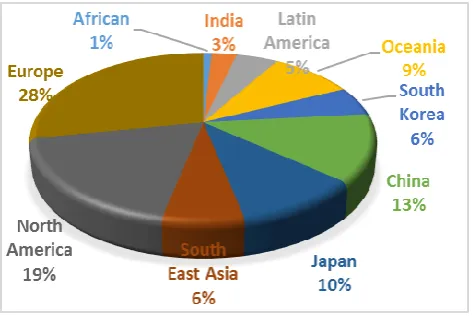
Figure 1: The percentage rate of femtocell deployment
B. Open Access Control
Here in open access control, most users are always permitted to connect to the service provider for the use of network within an open place such as shopping mail, airport, bus stop and train station, thus is for a public used. However, there are not much differences between the open and closed access model.
The Challenge of Open access mode: Open access control is deployed to reduce interference management that is caused by closed access model and every non-subscriber is authorized to connect to any femtocell network. The users are continually linked to the server for the purpose of Internet/Network. Here, the presence of cross interference is dominant since almost everyone can connect to the server the mobile operators will need to avoid the interference. This type of FAP is deployed random location, being self-organization a good solution to minimise the negative impact of a femtocell.
Thus, the deployment is always done by the operators, and interference is reduced through the approach of network planning and optimising the network. The setting of power transmission and frequency assignment for each femtocell should be planned in advance. The limitation of open access model is that it reduces the performance of the registered owner of femtocell due to the sharing of femtocell resource. However, this model support handover between cells due to the movement of outdoor users.
This suffers an adverse effect to the operator side due to the signalling decreased, and the probability of call dropped because of failure in the handover process. Furthermore, there is a tendancy of increase for a handover failure, when the neighbouring femtocell is not correctly configured and updated. Irrespective of various proposed solutions, the radio channel is used as a method of achieving the parameters in the surrounding environment whereby updating the neighbouring femtocell list [9]. Table 2 list the difference between closed and open access model of the femtocell.
With a specific solution to the technical challenges of access control for femtocell network, this will be a feasible solution for the indoor environment compared to other solution such as Picocells indoor repeaters, distributed indoor system and Wi-Fi network. Femtocell takes advantage of low price cost comparing to other mentioned solution at the indoor.
IV. THE NEED FOR HYBRID ACCESS CONTROL MODEL
Table 2 illustrates the performance between the two access model (closed and open access mode).
Table 2: Closed and open of access model of femtocell networks No Closed Access
Point
Open Access Point 1 Register own: low
Interference
Public used: More handovers, many users, Presence of interference
2 Good Throughput High throughputs since is for generally used
3 Home, offices SMEs, Hotspots 4 The server is
might for indoor users: improved network strength
Improved both indoor and outdoor network 5 Cost effective Less/Lower: 6 Secure and easier
billing
No security needed
In order to evaluate the access modes, we carry out a system performance of the mode. The test environment were deployed with femtocell users in a cellular coverage. Similar simulations were centred on a radio coverage predication tool with measurements [10]. However one can find more details of parameters of the system performance in [11]. Table 3 illustrates the comparison between closed and open model performance in terms of handover and users outages. Here, the system considers two access model with mobility structures and more number of closed users.
[image:3.595.51.288.61.219.2]Table 3: Performance of access point
Number of Femtocell 10 20 30 40
Access point Closed Open Closed Open Closed Open Closed Open
Handovers 3 7 12 8 18 12 22 18
Ordinary attempts in regions 6 4 13 7 20 10 25 15
Outages at both region in the network 5 5 8 12 10 18 20 20
Average throughput[mbps] 4.1 7 10 19 12 16 15 21
Due to the interference effect and draw back of both closed and open access model it is better to have a hybrid access model to improve and correct the draw backs of both access model. The hybrid access approach brings cooperation between the subscribers and non-subscriber to grant the level of access for both, and more so, the sharing resources.
V.GRAPHICAL RESULTS
Based on scenarios in Table 3 we draw our results for both closed and open access points graphically using MS Excel for different. The need for hybrids access point and the purpose of throughput at both regions in the network for the users will be taken into account.
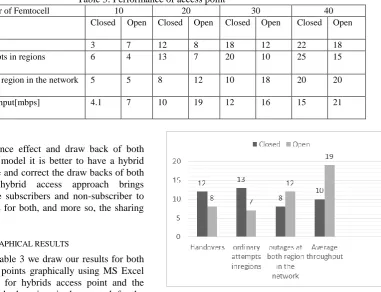
[image:4.595.48.290.475.638.2]Figure 2, we illustrate the scenario when the number of femtocell user is 10. Here, we observed that the handover attempts for closed is three against seven for open access which means that they present interference within the network. The network outages for both regions are much better.
Figure 2: Number of femtocell -10
In figure 3, we increased the number of femtocells users from 10 to 20, in order to see the reaction of increased users of femtocell. Here, the open access point get more improved in terms of average throughput. In the same via, closed access point it overrids in team of handover and outrage due to the fact that is used by a registered owner and ir is not for the use of general public.
Figure 3: Increased number of femtocell to 20
Figure 4, show the increase number of femtocell user to 30. We notice here that this figure is almost similar to figure 2 with a slight different in average in throughput and outages for open access point while the closed access point need an improvement.
Figure 4: The number of femtocell - 30
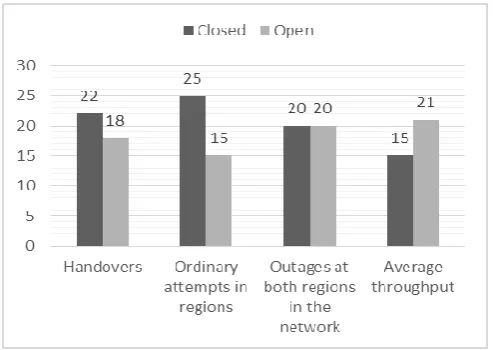
[image:4.595.276.546.480.659.2]Figure 5: Increase number of femtocell users to 40
Due to the variation on this parameter of femtocell and also the effect of interference within the access point that called for the needs of hybrid model.
VI. CONCLUSION
Table 2 illustrates the performance between the two access model (closed and open access mode). To evaluate the access modes, we carry out a system performance of the both modes. The test environment was deployed with femtocells users in cellular coverage. The simulation was centred on a radio coverage predication tool with measurements [10]. However, find more detail of parameters of the system performance in [11]. Thus, Table 3 shows the comparison between closed and open model performance regarding handover and users outages.
Here, the system considered two access model with mobility structures and more number of a closed users. In this we expected the coverage should be (250x300 m) by different femtocells and the base stations serving the femtocell at the centre of the coverage, using 20MHz bandwidth. From Table 3, we notice that the handover attempts in the regions for closed are lower comparing to open access model due to the presence of cross-tier interference within the regions. We draw our results for both closed and open access points graphically by slightly increasing number of femtocell users. The outages of the network for open access override the close access model whenever it receives good signal strength of the pilot signal of a neighboring cell.
REFERENCES
[1] Femto Forum, Tech. Rep ―Interference management in UMTS femtocells‖, December 2008.
[2] 3GPP, Ts 22.220 v9.0.0, March 2009.
[3] Nortel and Vodafone, ―Open and closed access for home NodeBs,‖ 3GPP TSG-RAN Working Group 4 (Radio), Athens, Greece, Tech. Rep. R4- 071231, 2007.
[4] O.A Akinlabi, B.S. Paul, M. K. Joseph, and H.C. Ferreira, "Indoor Communication: Femtocell Behavior in an Indoor Environment," Lecture Notes in Engineering and Computer Science: Proceedings of The International MultiConference of Engineers and Computer Scientists 2015, 18-20 March, 2015, Hong Kong, pp610-614. [5] V. Chandrasekhar and J. G. Andrews, ―Femtocell networks: A
survey‖. IEEE Communication Magazine, vol. 46, no. 9, pp. 59–67, September 2008.
[6] H. Claussen, L. T. W. Ho, and L. G. Samuel, ―An overview of the femtocell concept,‖ Bell Labs Technical Journal - Wiley, vol. 3, no. 1, pp. 221–245, May 2008.
[7] V. Chandrasekhar and J. G. Andrews, ―Uplink Capacity and Interference Avoidance for Two-Tier Femtocell Networks,‖ IEEE Transactions on Wireless Communication, vol. 8, no. 7, pp. 3498– 3509, Jul. 2009.
[8] D. L´opez-P´erez, A. Ladanyi, A. Juttner, and J. Zhang, ―Ofdma femtocells: A self-organizing approach for frequency assignment,‖ in
Personal, Indoor and Mobile Radio Communications Symposium (PIMRC), Tokyo, Japan, pp. 2202-2207, September 2009,.
[9] M. Amirijoo, P. Frenger, F. Gunnarsson, H. Kallin, J. Moe, and K. Zetterberg, ―Neighbor cell relation list and physical cell identity self-organization in LTE,‖ in IEEE International Conference on CommunicationsWorkshops, 2008. New Orleans, USA, pp. 37 – 41, May 2008.
[10] A. Valcarce, G. De La Roche, A. Juttner, D. Lopez-Perez, and J. Zhang, ―Applying FDTD to the coverage prediction of WiMAX femtocells,‖ EURASIP Journal on Wireless Communications and Networking, Vol. 2009, Article ID 308606, pp 1-13, 2009.
[11] D. Lopez-Perez, A. Valcarce, G. D. L. Roche, and J. Zhang, ―Access methods to WIMAX femtocells: A downlink system-level case study‖, in 11th IEEE International Conference on Communications Systems, Singapore, pp. 1657-1662, November 2008.
[12] Mofreh El-Gendy and Essam Sourour. "A study of access methods effect on the performance of two tier LTE femtocell networks", 28th National Radio Science Conference (NRSC) (IEEE), pp.1-8, 2011. [13] Mansour Zuair, A. M. B. Rahhal, M. M. Al Rahhal, and M. Iftikhar.