
Examination of Wavelet-Based Features
for Congestive Heart Failure Classification
Using SVM
Suparerk Janjarasjitt,
Member, IAENG,
Abstract—One of the most common heart disease is con-gestive heart failure. In this study, the detail coefficients of RR interval data obtained from the discrete wavelet transform are applied for congestive heart failure (CHF) classification. The wavelet-based feature examined is a difference between the logarithms of variances of detail coefficients of RR interval data corresponding to two consecutive levels, referred to as∆l.
A feature vector used in CHF classification is formed by a pair of wavelet-based features, i.e., [∆m,∆n]. The classification is
performed using SVM with a linear kernel function and its performance is validated using 10-fold cross-validation. From the computational results, the best performance on the CHF classification can be achieved using the feature vectors[∆2,∆3]
and[∆1,∆2]where the best accuracy, the best sensitivity and
the best specificity for the CHF classification are, respectively, 80.9324%, 81.4103% and 82.8938%.
Index Terms—congestive heart failure, heartbeat, wavelet analysis, classification.
I. INTRODUCTION
Heart failure (HF), also called cardiac failure, and con-gestive heart failure (CHF), is a condition in which the heart is no longer able to pump enough blood to meet the body’s needs [1]. Heart failure is a common but serious condition. There are about 5.1 million people who have heart failure in the United States [2]. The most common causes of heart failure are diseases that damage the heart including coronary heart disease, high blood pressure, and diabetes [1]. There is no single diagnostic test for heart failure [3]. An electrocardiogram (ECG) is one of the most common diagnostic tests that records the heart’s electrical activity. One of crucial informations obtained from the ECG is the heart’s rhythm. There have been a variety of computational methods and techniques applied to RR interval or heartbeat data for congestive heart failure classification.
Heart rate variability (HRV) analysis is a fundamental approach commonly used for assessing heart’s health and also diagnosing heart diseases. HRV may be evaluated using a number of methods [4] such as time domain methods, statistical methods, frequency domain methods, and nonlin-ear methods. Diagnosis and classification of congestive hnonlin-eart failure are ones of applications to which HRV applied. There have been several studies applying measures obtained from various HRV analysis techniques, for example, [5]–[10]. Some computational techniques provide promising results on CHF classification with high sensitivity and specificity.
This work is supported by the Higher Education Research Promotion and National Research University Project of Thailand, Office of the Higher Education Commission.
S. Janjarasjitt is with the Department of Electrical and Electronic Engi-neering, Ubon Ratchathani University, Ubon Ratchathani, 34190 Thailand e-mail: [email protected]
Recently, computational tools and techniques applied for complex systems analysis have been widely applied to appli-cations in biology and medicine including cardiology. Some of measures derived from such complex systems analysis applied to characterize HRV include spectral exponent, scal-ing exponent, correlation dimension, and Lyapunov exponent [4]. Self-similarity or scale-invariance is one of intriguing properties that have been investigated in phyiological and biological signals. The1/f processes is a class of statistical self-similar processes that exhibiting a power law behavior [11], [12]. The spectral exponent is an exponent characteriz-ing such power law behavior of1/f processes that specifies the distribution of power in1/f processes from low to high frequencies.
In addition to frequency domain methods using various spectral analysis techniques, the spectral exponent can be estimated using wavelet coefficients, in particular detail co-efficients, obtained from the discrete wavelet transform. The discrete wavelet transform is a natural tool for characterizing self-similar signals [11], [12]. In this study, the detail coeffi-cients of RR interval data obtained from the discrete wavelet transform are applied as features for classifying between RR interval data associated with congestive heart failure and those associated with normal sinus rhythm. Vectors of wavelet-based features are classified using support vector machine (SVM) technique.
The rest of this paper is organized as follows. Section II presents data, feature extraction, and experimental setup. Section III details and discusses the CHF classification re-sults. Finally, Section IV summarizes the paper and provides concluding remarks.
II. METHODS
A. Data and Subjects
0 200 400 600 800 1000 1200 1400 1600 1800 2000 0.7
0.8 0.9 1 1.1 1.2 1.3
Beat
RR interval (s)
(a) NSR subject
0 200 400 600 800 1000 1200 1400 1600 1800 2000
0.5 0.6 0.7 0.8 0.9 1
Beat
RR interval (s)
[image:2.595.81.510.66.505.2](b) CHF subject
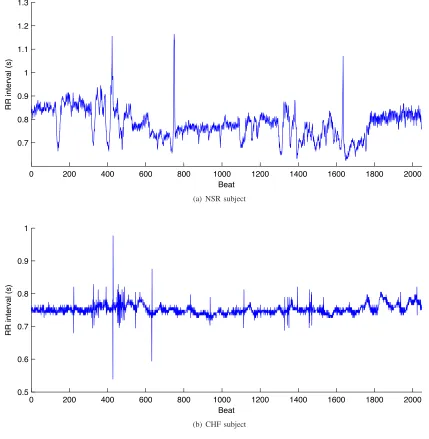
Fig. 1. Epochs of RR interval data of NSR and CHF subjects.
The beat annotations in both databases were obtained by automated analysis with manual review and correction. Examples of 2048-beat epochs of RR interval data obtained from the NSR and CHF data sets are shown in Fig. 1(a) and Fig. 1(b), respectively.
B. Wavelet-Based Feature Extraction
The discrete wavelet transform (DWT) is a representation of a signal using a countably-infinite set of wavelets [14]. The discrete wavelet transform can be interpreted as a generalized octave-band filter bank [11], [15] as a wavelet is a bandpass filter [16]. A signal can be decomposed into approximations and details using the scaling function and the wavelet func-tion that, respectively, correspond to halfband lowpass filter and halfband highpass filter [17]. For each single-level dis-crete wavelet decomposition, the approximation coefficients (al) and the detail coefficients (dl) are obtained through the
filtering processes. The detail coefficients obtained from the discrete wavelet decomposition are applied in this study.
The Wavelet-based features of RR interval data proposed
for congestive heart failure classification in this study can be obtained by the following steps.
1) Apply the wavelet transform to decompose RR interval data into Llevels to obtain the detail coefficientsdl.
2) Compute the variance of detail coefficients dl
corre-sponding to each levell:var(dl).
3) Take the logarith to base 2 of the corresponding variances of detail coefficients:log2var(dl).
4) Subtract the logarithm of variance of detail coefficients corresponding to the levellfrom that corresponding to the lower level:∆l= log2var(dl+1)−log2var(dl).
C. Experimental Setup
1 2 3 4 5
−4
−3
−2
−1 0 1 2 3 4 5
l ∆ l
(a) NSR data set
1 2 3 4 5
−4
−3
−2
−1 0 1 2 3 4 5
l ∆ l
[image:3.595.57.523.66.271.2](b) CHF data set
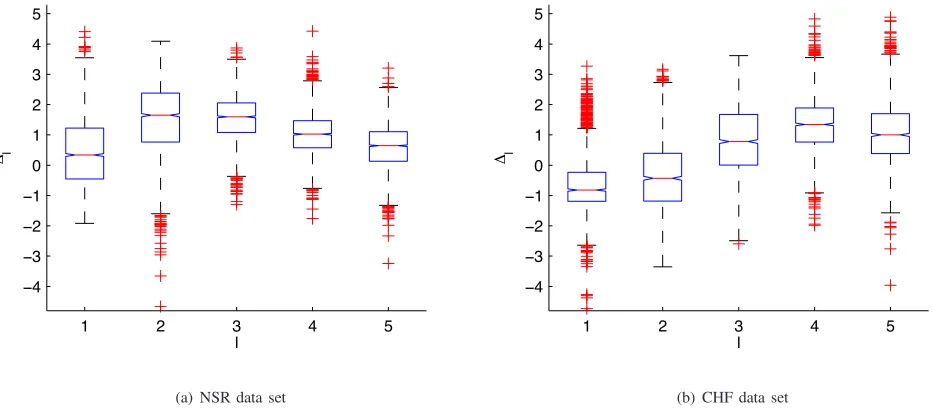
Fig. 2. Box plots of wavelet-based features∆lof epochs of RR interval data corresponding to various levelsl.
the CHF data set. Note that the number of epochs of RR interval data of each subject is varied according to its original length. For the wavelet-based feature extraction, the 12th order Daubechies wavelets are used. The 2048-beat epochs of RR interval data are decomposed into 6 levels that are the maximum levels the 2048-beat epochs can be decomposed. Consequently, there are 5 wavelet-based features extracted from each epoch of RR interval data, i.e.,∆1,∆2,∆3,∆4, and∆5.
A pair of wavelet-based features, i.e., [∆m,∆n], is used
as a feature vector applied for the CHF classification. Epochs of RR interval data obtained from the CHF data set are classified from epochs of RR interval data obtained from the NSR data set using SVM. The performance of the feature vector [∆m,∆n] composed of all possible combinations of
pairs of the wavelet-based features on the CHF classification are examined. A linear kernel function is used to train an SVM classifier. The performance of the CHF classification is validated using 10-fold cross-validation.
Furthermore, the performance of the CHF classification is evaluted using three conventional measures: accuracy (Ac), sensitivity (Se), and specificity (Sp) that are given by, respectively,
Ac= T P+T N
T P+T N+F P +F N
Se= T P
T P+F N, and
Sp= T N
T N+F P
where T P, T N, F P, and F N denote a number of true positives, a number of true negatives, a number of false positives, and a number of false negatives.
III. RESULTS
A. Characteristics of the Wavelet-Based Features
The wavelet-based features∆lof all epochs of RR interval
data obtained from the NSR and CHF data sets corresponding to various levels l are shown in Fig. 2(a) and Fig. 2(b),
respectively. Table I summarizes the means and the standard deviations of the wavelet-based features∆l of all epochs of
RR interval data obtained from the NSR and CHF data sets corresponding to various levelsl. The wavelet-based feature
∆lof epochs of RR interval data obtained from the CHF data
set tends to increase as the levell increases, except for∆5. On the other hand, the wavelet-based feature ∆l of epochs
of RR interval data obtained from the NSR data set does not significantly change.
B. Performance of the CHF Classification
The accuracy (Ac), the sensitivity (Se) and the specificity (Sp) of the CHF classification by applying SVM to the feature vector[∆m,∆n]composed of all possible
combina-tions of pairs of the wavelet-based features are summarized in Table II. The performance of the CHF classification using 10-fold cross-validation corresponding to each feature vector [∆m,∆n] is different. The performance of the CHF
classification using the wavelet-based feature ∆l extracted
from the lower levels, i.e.,l= 1, 2 and 3, corresponding to higher-frequency components tends to be better.
The best accuracy for the CHF classification is achieved using the feature vector [∆2,∆3] with the accuracy of 80.9324%. The best sensitivity for the CHF classification is achieved using the feature vector [∆2,∆4] with the sen-sitivity of 81.4103%. The best specificity for the congestive
TABLE I
STATISTICALVALUES(MEAN±S.D.)OF THEWAVELET-BASED FEATURES∆l
Levell Data Set
NSR CHF
1 0.4161±1.08 -0.6220±1.00
2 1.5127±1.19 -0.3107±1.11
3 1.5583±0.72 0.7922±1.15
4 1.0185±0.69 1.3424±0.92
−4 −2 0 2 4 6 8
−3
−2
−1 0 1 2 3 4
m=2
n=3
NSR CHF
[image:4.595.88.501.62.498.2]Support Vectors
Fig. 3. The SVM classifier using the feature vector[∆2,∆3].
−4 −2 0 2 4 6
−5 0 5
m=1
n=2
NSR CHF
Support Vectors
Fig. 4. The SVM classifier using the feature vector[∆1,∆2].
heart failure is achieved using the feature vector [∆2,∆3] with the specificity of 82.8938%. The best overall
perfor-TABLE II
PERFORMANCE OF THECHF CLASSIFICATIONS
Feature Vector Accuracy (Ac) Sensitivity (Se)
Specificity (Sp)
[∆1,∆2] 80.3030 80.0641 80.4396
[∆1,∆3] 77.5058 68.4615 82.6740
[∆1,∆4] 69.3473 77.8205 64.5055
[∆1,∆5] 70.3730 76.8590 66.6667
[∆2,∆3] 80.9324 77.5000 82.8938
[∆2,∆4] 79.0210 81.4103 77.6557
[∆2,∆5] 79.3473 78.7179 79.7070
[∆3,∆4] 71.6317 64.7436 75.5678
[∆3,∆5] 72.3776 57.8846 80.6593
[∆4,∆5] 65.3147 59.6154 68.5714
mance, i.e., the average of all three performance measures, is achieved using the feature vector[∆2,∆3]. However, the feature vector[∆1,∆2]provides the CHF classification with all three performance measures greater than 80.0% and the second best overall performance. The support vectors and the corresponding separating line obtained using the feature vectors[∆2,∆3]and[∆1,∆2]are shown in Fig. 3 and Fig. 4, respectively.
IV. CONCLUSIONS
The feature of RR interval data obtained from subjects with normal sinus rhythm and those obtained from subjects with congestive heart failure is extracted using the discrete wavelet transform. The difference between the logarithms of variances of detail coefficients of RR interval data cor-responding to two consecutive levels,∆l, is examined. The
classification of RR interval data associated with the conges-tive heart failure is performed using SVM with a linear kernel function applied to the feature vectors formed by a pair of wavelet-based features[∆m,∆n]. All possible combinations
[image:4.595.46.295.611.783.2]CHF classification. From the computational results, it is shown that the wavelet-based feature is potentially a good feature for the CHF classification. The best accuracy, the best sensitivity, and the best specificity for the CHF classification are 80.9324%, 81.4103%, and 82.8938%, respectively. The wavelet-based feature ∆l extracted from lower levels tends
to provide a better performance on the CHF classification. The feature vectors providing the best performance on the CHF classification are[∆2,∆3] and[∆1,∆2].
REFERENCES
[1] Heart Failure. National Heart, Lung, and Blood Institute, Bethesda, MD, 2014 [Online]. Available: http://www.ncbi.nlm.nih.gov/ pubmedhealth/PMH0063056/
[2] A.S. Go,et al., “Heart disease and stroke statistics — 2013 update: a report from the American Heart Association,”Circulation, vol. 127, pp. e6–e245, 2013.
[3] C.W. Yancy,et al., “2013 ACCF/AHA guideline for the management of heart failure: a report of the American College of Cardiology Foun-dation/American Heart Association task force on practice guidelines,” Circulation, vol. 128, pp. e240–e327, 2013.
[4] Electrophysiology, Task Force of the European Society of Cardiology the North American Society of Pacing, “Heart rate variability: stan-dards of measurement, physiological interpretation, and clinical use,” Circulation, vol. 93, pp. 1043–1065, 1996.
[5] G. Liu, et al., “A new approach to detect congestive heart failure using short-term heart rate variability measures,”PLoS ONE, vol. 9, pp. e93399, 2014.
[6] R.K.G. Moore,et al., “HRV spectral power and mortality in chronic heart failure (CHF): 5 year results of the UK heart study,”Heart, vol. 90, pp. A6, 2004.
[7] S. Guzzetti, E. Magatelli, E. Borroni, and S. Mezzetti, “Heart rate variability in chronic heart failure,”Auton. Neurosci., vol. 90, pp. 102– 105, 2001.
[8] J. Nolan, et al., “Prospective study of heart rate variability and mortality in chronic heart failure: results of the United Kingdom heart failure evaluation and assessment of risk trial (UK-Heart),” Circulation, vol. 98, pp. 1510–1516, 1998.
[9] M.H. Asyali, “Discrimination power of long-term heart rate variability measures,” inProc. 25th Annu. Int. Conf. IEEE Eng. Med. Biol. Soc., 2003, pp. 200–203.
[10] Y. Isler and M. Kuntalp, “Combining classical HRV indices with wavelet entropy measures improves to performance in diagnosing congestive heart failure,”Comput. Biol. Med., vol. 37, pp. 1502–1510, 2007.
[11] G.W. Wornell, “Wavelet-based representations for the1/f family of fractal processes,”Proceedings of the IEEE, vol. 81, pp. 1428–1450, 1993.
[12] G.W. Wornell, Signal Processing with Fractals: A Wavelet-Based Approach. Prentice Hall: New Jersey, 1995.
[13] A. L. Goldberger,et al., “PhysioBank, PhysioToolkit, and PhysioNet: Components of a new research resource for complex physiologic signals,”Circulation, vol. 101, pp. e215–e220, 2000.
[14] S. Mallat,A Wavelet Tour of Signal Processing. Academic Press: San Diego, 1998.
[15] G.W. Wornell and A.V. Oppenheim, “Estimation of fractal signals from noisy measurements using wavelets,” IEEE Trans. Signal Process., vol. 40, pp. 611–623, 1992.
[16] M. Vetterli and C. Herley, “Wavelets and filter banks: theory and design,”IEEE Trans. Signal Process., vol. 40, pp. 2207–2232, 1992. [17] S. Janjarasjitt, “Temporal characteristics of wavelet subbands of
![Fig. 4. The SVM classifier using the feature vector [∆1, ∆2].](https://thumb-us.123doks.com/thumbv2/123dok_us/431248.540813/4.595.88.501.62.498/fig-svm-classier-using-feature-vector.webp)