The uniformity of irrigation dose application is one of the most important aspects of work quality indicators of irrigator machinery (Solomon 1979; Ayars et al. 1999). In order to ensure the optimal moisture content across the whole irrigated area. it is essential to achieve the greatest possible uni-formity of irrigation which is the most important quality indicator for irrigation by sprinkling (Burt et al. 1997; Tomášik, Jobbágy 2013; Berbel, Mateos 2014). The quality of irrigation is assessed by the controlled intensity of irrigation and its uni-formity. Intensity of irrigation is expressed by the volume of applied water in mm by specific irriga-tor in a specified time unit (Okenka et al. 2000; Huang et al. 2008; Jobbágy et al. 2014).
The irrigation machinery quality of work is in many cases evaluated using uniformity coefficients
that are calculated from the measured values of irrigation dose captured in rain gauge containers (Topak et al. 2005). These irrigation systems there-fore require a certain minimal value of uniformity that is considered as acceptable in terms of require-ment for final customers (Jackson et al. 2001).
According to Keller and Bliesner (1990), the coefficient of uniformity of irrigation below the specified value 84%, following Christiansen, repre-sents a low work quality of irrigators. Many authors also state that wind speed belongs to the essential factors that affect the irrigation machinery qual-ity of work (Solomon 1979; Kincaid et al. 1996; Dechmi et al. 2003a, b). Absolute uniformity is not required because it is almost impossible to achieve it with spray irrigation technology due to the effect of wind. There is also a horizontal movement of
Evaluation of the coefficient of uniformity and
non-uniformity of irrigation for wide-range irrigators in
various field conditions
Ján Jobbágy, Koloman Krištof*
Department of Machines and Production Biosystems, Faculty of Engineering, Slovak University
of Agriculture in Nitra, Nitra, Slovak Republic
*Corresponding author: [email protected]
Abstract
Jobbágy J., Koloman K. (2018): Evaluation of the coefficient of uniformity and non-uniformity of irrigation for wide-range irrigators in various field conditions. Res. Agr. Eng., 64: 55–62.
The aim of this paper is to address an issue of work quality of irrigation machines with eight parameters that were selected and defined as input variables. The objective of the study was to determine possibilities of different evaluation methods for a wide range of irrigation machines and their versatility. All input conditions that could affect the results were recorded and analysed. The results were statistically analysed by a linear model (ANOVA). The results confirm that there are no statistically significant differences in used evaluation methods (p > 0.05) when the effect of locality was not considered. When the effect of locality was considered, statistically significant differences were observed (p < 0.05). When considering the coefficient of non-uniformity, statistically significant differences were not observed, however in case of considering different irrigation machines, statistically significant differences were observed. The obtained results indicate that the evaluation of irrigation uniformity is possible to carry out with other methods; however, the specific field conditions are not interchangeable as a parameter.
Keywords: irrigation machinery; irrigation uniformity; coefficient of uniformity; quality of work
water in the soil profile that eliminates the nega-tive lower uniformity. Among other indicators of spray quality, it is also a droplet size and its kinetic energy. In addition, coefficient of uniformity of irri-gation machinery has a direct effect on the efficient application of irrigation, and therefore on crop yields as a whole as well (Li 1998; Li, Rao 2000; Dechmi et al. 2003a,b; Li, Rao 2003; Jobbágy et al. 2013; Lü et al. 2015).
As was indicated in previous studies researchers use various methods to evaluate work quality of irri-gation machinery, e.g. coefficient of uniformity, co-efficient of non-uniformity, degree of uniformity and coefficient of variation (de Menezes et al. 2015). It means that the expressed individual equations may achieve different results in irrigation water distribu-tion uniformity on the same elementary areas.
The aim of the study is to compare the selected coefficients of uniformity in several field conditions and to point out the possibilities of application of the studied types of results evaluation of selected wide-range irrigators.
MATERIAL AND METHODS
Field measurements were conducted during the appropriate season to irrigate various crops (e.g. maize, sugar beet, potatoes, vegetables, etc.). All the irrigated fields were located at the western part of Slovakia and they belong to different
agri-cultural companies. Measurements were repeated from 2006 to 2010 and on various types of soils. Soil types depended on specific locations but basi-cally were characterised as sandy, sandy-loam and loamy-sand soils. Measurements were performed according to the standard ISO/TC23/SC18N190.
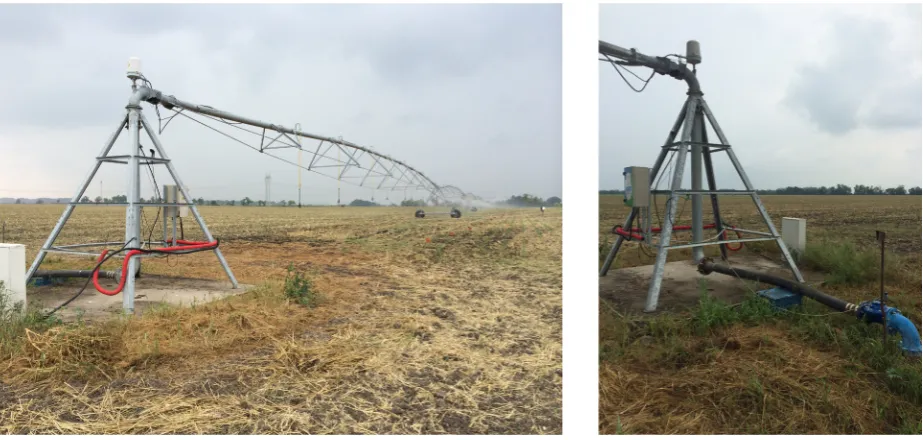
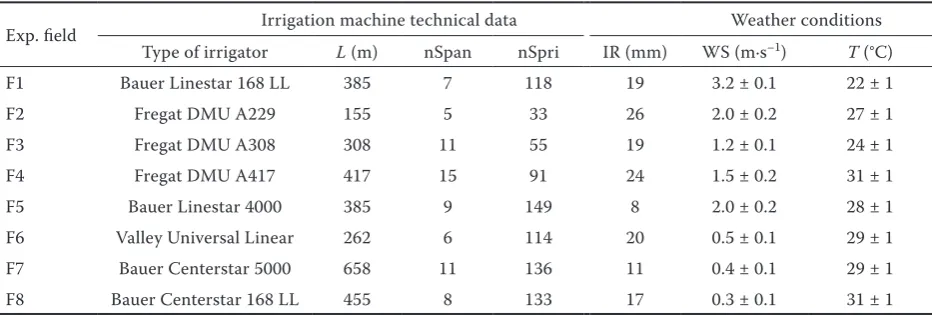
Irrigation machinery used in the experiments. The selected fields were irrigated by wide-range ir-rigation machinery equipped with new and reman-ufactured distributors of irrigation water (Fig. 1). The distributors (sprinklers) were provided by vari-ous manufacturers, namely: Agref, Ltd. (Komárno, Slovakia) for machines Fregat; Senninger, Ltd. (Cl-ermont, USA) and Nelson, Ltd. (Walla Walla, USA) for machines Valley and Bauer. Nearby river and lake served as a source of irrigation water and wa-ter was pumped into the irrigation system by the main irrigation device that consists of a pumping station and appropriate hydrant. Technical param-eters of input irrigators used in measurements and weather conditions during these measurements are presented in Table 1.
Evaluation of irrigation machinery work qual-ity. Evaluations of work quality of selected irriga-tion machinery, i.e. tests of uniformity, were con-ducted by using rain gauges commonly used for measurements of uniformity of irrigation water distribution. The rain gauges were designed with 115 mm diameter and 100 mm height. There were laid alongside an irrigation radius. The irrigated radius is a distance that is measured from the
[image:2.595.70.532.512.732.2]tre of the irrigation machinery (specific irrigator, nozzle, etc.) to the farthest rain gauge container in which the minimal irrigation intensity in not lower than 0.25 mm·h–1 (Li et al. 2015). Following
evaluation of irrigation was carried out in accor-dance with several methods which were described and explained in details by e.g. Topak et al. (2005), Huang et al. (2008)‚ Maroufpoor et al. (2010), and Jobbágy et al. (2011).
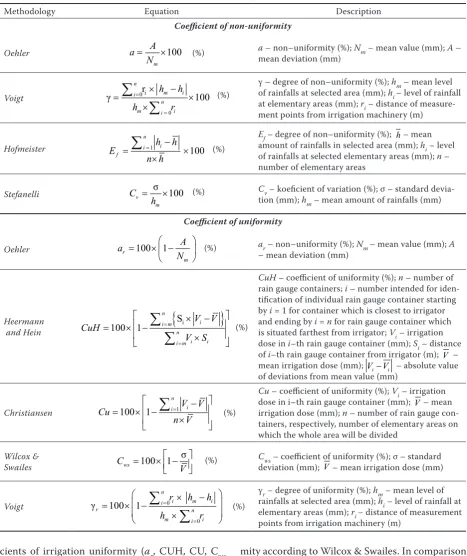
The evaluation of uniformity and non-uniformity of irrigation was calculated by various methods that are described in Table 2 (Oehler 1933; Wilcox, Swailes 1947; Voight 1962; Asae 1998; Asae 1991).
One of the research pioneers, those who were at the beginning of irrigation uniformity evaluation, was Staebner (1931). He postulated the rule that the maximal intensity of irrigation should not exceed double of the minimal intensity with exception of marginal zone. Based on the measurements of rainfall amounts in rain gauge containers, the isograms (lines with the equal amounts of rainfall) were designed and the uniformity of irrigation was then evaluated visu-ally as very good, good, satisfactory and not good.
Statistical analysis of the results. The aim of the study and its main objective was to evaluate and compare suggested coefficients proposed by indi-vidual researchers and their application on the re-sults obtained in long term experiments in various locations, field and weather conditions. To achieve it, the Duncan’s test was applied with the level of reliability at 95%. To evaluate and compare the re-sults obtained by various coefficients of irrigation uniformity, the following statistical model was used (one-way analysis of variance ANOVA):
yij= µ + Ci + eij (mm) (1)
where: yij – measured value (mm); µ – overall mean (mm); Ci – effect of the coefficient of unifor-mity (–); eij – random error with mean 0 and vari-ance σ2 (mm)
RESULTS AND DISCUSSION
The results of irrigation machinery work quality evaluation were expressed by nine various coeffi-cients according to the selected authors defined in Table 2. For the purpose of this study, eight irriga-tion machineries were used (therefore, various ad-mission conditions were described and monitored) from which five coefficients of uniformity and four coefficients of non-uniformity were selected and evaluated. In the case of comparison of these co-efficients, it was suggested to express the results in percentage. In evaluation with the coefficient of non-uniformity a, the coefficient of uniformity ar was introduced to allow comparison of the ob-tained results with other coefficients.
The obtained data of calculated coefficients of uniformity for several experimental fields are shown in Fig. 2. The results suggest certain dif-ferences between individual values expressing the uniformity of irrigation (according to different methods of evaluation) and also a difference be-tween the values obtained from different experi-ment fields. Therefore, a statistical evaluation of the obtained data sets was introduced. The study therefore points that in case of the statistical model in which the samples consist of individual coeffi-Table 1. The irrigation machinery technical data and weather conditions details
L – length of irrigator; nSpan – number of spans; nSpri – number of sprinkles; IR – irrigation dose; WS – wind speed during measurement; T – temperature during measurement
Exp. field Irrigation machine technical data Weather conditions
Type of irrigator L (m) nSpan nSpri IR (mm) WS(m·s–1) T (°C)
F1 Bauer Linestar 168 LL 385 7 118 19 3.2 ± 0.1 22 ± 1
F2 Fregat DMU A229 155 5 33 26 2.0 ± 0.2 27 ± 1
F3 Fregat DMU A308 308 11 55 19 1.2 ± 0.1 24 ± 1
F4 Fregat DMU A417 417 15 91 24 1.5 ± 0.2 31 ± 1
F5 Bauer Linestar 4000 385 9 149 8 2.0 ± 0.2 28 ± 1
F6 Valley Universal Linear 262 6 114 20 0.5 ± 0.1 29 ± 1
F7 Bauer Centerstar 5000 658 11 136 11 0.4 ± 0.1 29 ± 1
[image:3.595.65.533.110.268.2]cients of irrigation uniformity (ar, CUH, CU, Cws and γr) statistically significant differences (p > 0.05; F = 1.84 < Fcrit) were not observed.
Data presented in Fig. 2 prove that the coef-ficients according to Oehler (ar), Heermann and Hein (CuH), Christiansen (Cu) and Voight (γr) are very close to each other. The greatest differences were recorded in case of the coefficient of
[image:4.595.64.532.110.667.2]unifor-mity according to Wilcox & Swailes. In comparison of the results where individual fields were selected as variables, with different input conditions as well as irrigation machinery used, the differences were even greater and in the case of Wilcox and Swailes coefficient of uniformity, they showed the greatest variability in the calculated value (from 58.47% up to 87.17%). In this case, experimental fields were Table 2. Compilation of methods used for evaluation of uniformity and non-uniformity of irrigation
Methodology Equation Description
Coefficient of non-uniformity
Oehler 100
m A a
N
(%) a – non–uniformity (%); Nm – mean value (mm); A – mean deviation (mm)
Voigt 0i
0 r γ 100 n m i i n m i i
h h h r
(%)γ – degree of non–uniformity (%); hm– mean level of rainfalls at selected area (mm); hi – level of rainfall at elementary areas (mm); ri– distance of measure-ment points from irrigation machinery (m)
Hofmeister 1 100
n i i f h h E n h
(%) Ef– degree of non–uniformity (%); h– meanamount of rainfalls in selected area (mm); hi – level of rainfalls at selected elementary areas (mm); n – number of elementary areas
Stefanelli v σ 100
m C
h
(%) Cv– koeficient of variation (%); σ – standard devia-tion (mm); hm – mean amount of rainfalls (mm)
Coefficient of uniformity
Oehler r 100 1
m A a N (%)
ar – non–uniformity (%); Nm – mean value (mm); A – mean deviation (mm)
Heermann
and Hein
i S 100 1 n i i m n i i i m V V CuH V S
(%)CuH – coefficient of uniformity (%); n – number of rain gauge containers; i – number intended for iden-tification of individual rain gauge container starting by i = 1 for container which is closest to irrigator and ending by i = n for rain gauge container which is situated farthest from irrigator; Vi– irrigation dose in i–th rain gauge container (mm); Si– distance of i–th rain gauge container from irrigator (m); V – mean irrigation dose (mm); V Vi i – absolute value of deviations from mean value (mm)
Christiansen 100 1 1 n
i i V V Cu n V
(%)Cu – coefficient of uniformity (%); Vi– irrigation dose in i–th rain gauge container (mm); V– mean irrigation dose (mm); n – number of rain gauge con-tainers, respectively, number of elementary areas on which the whole area will be divided
Wilcox & Swailes σ 100 1 ws C V (%)
Cws – coefficient of uniformity (%); σ – standard deviation (mm); V – mean irrigation dose (mm)
Voigt 0
0
γ 100 1
n
i m i
i
r n
m i i
r h h
h r
(%)considered as the samples (i.e. the effect of irriga-tion machinery was considered) and it can be con-cluded that there is a statistically significant dif-ference between the compared data sets (p< 0.05; F=17.12 > Fcrit). The value of coefficient of irriga-tion uniformity did not exceed 100%.
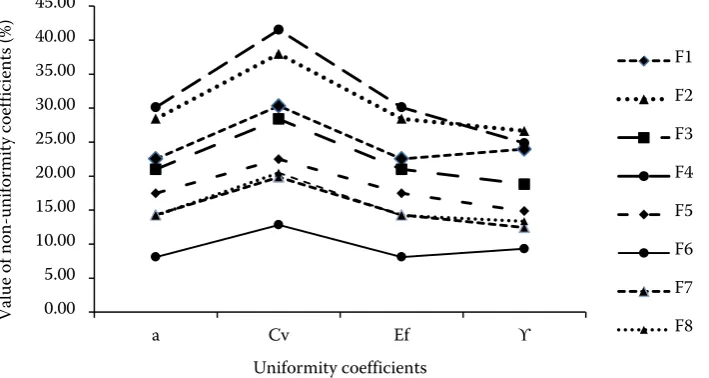
The aim of the study, as it was also described in the methodology section, was to evaluate also the results of calculated coefficients of non-unifor-mity (Fig. 3). As a basis were selected the results
[image:5.595.77.422.100.283.2]of irrigation machinery work quality according to Oehler (a), a coefficient of variation (Cv), a degree of non-uniformity according to Hofmeister (Ef ) and a coefficient of non-uniformity according to Voigt (γ). Also in the case where various methods of evaluation of irrigation machinery work quality were selected as samples, the coefficient of irriga-tion uniformity showed statistical independence as a result of the statistical analysis (p > 0.05; F < Fcrit). However, in the case of evaluation of the individual Fig. 2. The results of different uniformity coefficients for all the experimental fields (F1–F8)
ar– coefficient of uniformity according to Oehler; CUH – coefficient of uniformity according to Heerman and Hein; CU – coef-ficient of uniformity according to Christiansen; Cws – coefcoef-ficient of uniformity according to Wilcox and Swailes; γr – coefficient of uniformity according to Voigt
50.00 55.00 60.00 65.00 70.00 75.00 80.00 85.00 90.00 95.00
ar CUH CU Cws ϒr
Va
lu
e o
f c
oef
fic
ien
ts o
f u
nif
or
m
ity
(%
)
Coefficients of uniformity
F1 F2 F3 F4 F5 F6 F7 F8
Fig. 3. The results of different non-uniformity coefficients for all the experimental fields (F1–F8)
a – coefficient of non-uniformity according to Oehler; Cv – coefficient of variation; Ef – degree of non-uniformity according to Hofmeister; γ – coefficient of non-uniformity according to Voigt
0.00 5.00 10.00 15.00 20.00 25.00 30.00 35.00 40.00 45.00
a Cv Ef ϒ
V
al
ue
of
n
on
-u
nif
or
m
ity
co
ef
fic
ien
ts
(%
)
Uniformity coefficients
[image:5.595.75.430.517.706.2]experimental fields effect, i. e. different irrigation machinery, statistically significant differences were shown (p < 0.05; F > Fcrit).
Solomon (1979) reported that the coefficient of uniformity depends on the system variables (sprin-kler make, size and type of nozzle, pressure and sprinkler spacing), and the main uncontrollable vari-able, i.e. wind speed. Furthermore, conventional ir-rigation even uses drip irir-rigation (Berbel, Mateos 2014), therefore, farmers need not choose the emit-ter flow because of unknown properties and irriga-tion parameters as was stated by Temizel (2016).
In the past few decades, several coefficients of uniformity were developed to express the unifor-mity of water distribution for different sprinkler irrigation systems. Christiansen’s uniformity co-efficient seems to be the most popular uniformity coefficient used by researchers on the global scale (Li et al. 2015; Lovarelli et al. 2016). Finally, the results of work quality study in the Kurdistan Prov-ince emphasised the fact that various coefficients of uniformity depend on the field conditions and one is not allowed to use a given uniformity coefficient for any other field conditions (Maroufpoor et al. 2010). Moreover, Castellanos et al. (2016) stated that the blue water footprint needs to include the extra consumption of water irrigation that a farmer has to apply to compensate - firstly, the fail of uni-formity on discharge of drips, and secondly, perco-lation losses or salts leaching, which depends on the salt tolerance of the crop, soil and irrigation water quality. According to Rajan et al. (2015), a producer who applies a certain amount of water using a less efficient irrigation system could potentially see an effective increase in water applied if a more efficient irrigation system had been used, simply because a larger percentage of the applied water would soak into the rooting zone and would not be lost through soil evaporation or evaporation from plant surfaces. Therefore following Mueller et al. (2012), switch-ing to a more efficient irrigation system is like get-ting ’extra’ water to apply to the crop, even though the basic irrigation rate stays the same.
Subsequently, a solid set sprinkler system was used to investigate the effect of the operating pres-sures and riser heights of sprinkler on irrigation uniformity and its reflection on barley crop yield and crop water productivity. For each treatment, coefficient of uniformity (CU), distribution unifor-mity (DU) and coefficient of variation (CV) were determined. The CU values were always higher
than those of DU. The CU and DU increased with increasing operating pressure (El-Wahed et al. 2015; Abd El-Wahed et al. 2016).
Furthermore, in case of explaining some inter-dependencies, González Perea et al. (2014) troduced a new methodology to simulate the in-teractions between on-demand water distribution systems and irrigation performance in critical points that was developed and applied in the BMD (Bem-bézar Margen Derecha, Spain) irrigation district. On-demand irrigation implies a significant expendi-ture in energy that is even higher when some criti-cal points are responsible for a large percentage of the total pressure head. Thus, the effective manage-ment of the critical points is necessary to enhance the overall efficiency of the irrigation infrastructure with minimal costs (Stoate et al. 2009). However, a detailed analysis at the water distribution and on-farm irrigation systems levels is needed before the adoption of improvement measures.
CONCLUSION
In conclusion, it is possible to state that the re-sults are partially dependent on the introduced coefficients of uniformity or non-uniformity. No statistically significant differences were observed in the used evaluation methods (p > 0.05) when the effect of locality was not considered, whereas with the effect of locality considered, statistically signifi-cant differences were observed (p < 0.05). When considering the coefficient of non-uniformity, sta-tistically significant differences were not observed; yet, in case of considering different irrigation ma-chines, statistically significant differences were observed. The obtained results indicate that the evaluation of irrigation uniformity is possible us-ing other methods, whereas field conditions are not interchangeable in the individual analyses.
References
Abd El-Wahed M.H., Medici M., Lorenzini G. (2016): Sprin-kler irrigation uniformity: Impact on the crop yield and water use efficiency. Journal of Engineering Thermophys-ics, 25: 117–125.
ASAE (1991): Desing and Instalation of Micro Irrigation Systems, ASAE Engineering Practice ASAE.EP, USA. ASAE (1998): S436.1. Test procedure for determining the
Jobbágy J., Holbay A., Tomášik L. (2013): Design and testing of device for measuring the longitudinal uniformity of reel hose irrigation machine. Journal of Central European Ag-riculture, 14: 1317–1325.
Jobbágy J., Findura P., Janík F. (2014): Effect of irrigation machines on soil compaction. Research in agricultural engineering, 60(Special issue): 1–8.
Keller J., Bliesner R.D. (1990): Sprinkle and Trickle Irrigation. AVI Book. Van Nostrand Reinhold, New York.
Kincaid D.C., Solomon K.H., Oliphant J.C. (1996): Drop size distributions for irrigation sprinklers. Transactions of the ASAE, 39: 839–845.
Li J. (1998): Modeling crop yield as affected by uniformity of sprinkler irrigation system. Agricultural Water Manage-ment, 38: 135–146.
Li Y., Bai B., Yan H. (2015): Development and validation of a modified model to simulate the sprinkler water distribution. Computers and Electronics in Agriculture, 111: 38–47. Li J., Rao M. (2000): Sprinkler water distributions as affected
by winter wheat canopy. Irrigation Science, 20: 29–35. Li J., Rao M. (2003): Field evaluation of crop yield as affected
by nonuniformity of sprinkler-applied water and fertilizers. Agricultural Water Management, 59: 1–13.
Lü G.H., Song J.Q., Bai W.B., Wu Y.F., Liu Y., Kang Y.H. (2015): Effects of different irrigation methods on micro-environ-ments and root distribution in winter wheat fields. Journal of Integrative Agriculture, 14: 1658–1672.
Lovarelli D., Bacenetti J., Fiala M. (2016): Water Footprint of crop productions: A review. Science of the Total Environ-ment, 548–549: 236–251.
Maroufpoor E., Faryabi A., Ghamarnia H., Moshrefi G.Y. (2010): Evaluation of Uniformity Coefficients for Sprin-kler Irrigation Systems under Different Field Conditions in Kurdistan Province (Northwest of Iran). Soil & Water Research, 5: 139–145.
Mueller N.D., Gerber J.S., Johnston M., Ray D.K., Ramankutty N., Foley J.A. (2012): Closing yield gaps through nutrient and water management. Nature, 490: 254–257.
Oehler T. (1932): Die Wasserverteilung bei natürlichen und künstlicher Regen. Heft 30 der BKTL-Schriften „Die Feld-beregnung“, Berlin. (in German)
Oehler T. (1933): Die Gleichmässigkeit der Wasserverteilung durch Drehstrahlregner. Die Feld. Beregnung, Heft 38 der RKTL – Schriften, Berlin, 1933 (in German).
Okenka I., Simoník J., Látečka M. (2000): Modelling of the process of mechanized sprinkling irrigation. Vesci Akademii agrarnych navuk Belarusi, 2: 62–64.
Rajan N., Maas S., Kellison R., Dollar M., Cui S., Sharma S., Attia A. (2015): Emitter Uniformity and Application Effi-ciency for Centre - Pivot Irrigation Systems. Irrigation and Drainage, 64: 353–361.
move irrigation machines equipped with spray or sprinkler nozzles. St. Joseph, ASAE.
Ayars J.E., Phene C.J., Hutmacher R.B., Davis K.R., Schone-man R.A., Vail S.S., Mead R.M. (1999): Subsurface drip irrigation of row crops: A review of 15 years of research at the Water Management Research Laboratory. Agricultural Water Management, 42: 1–27.
Berbel J., Mateos L. (2014): Does investment in irriga-tion technology necessarily generate rebound effects? A simulation analysis based on an agro-economic model. Agricultural Systems, 128: 25–34.
Burt C.M., Clemmens A.J., Strelkoff T.S., Solomon K.H., Bliesner R.D., Hardy L.A., Howell T.A., Eisenhauer D.E. (1997): Irrigation performance measures: Efficiency and uniformity. Journal of Irrigation and Drainage Engineer-ing, 123: 423–442.
Castellanos M.T., Cartagena M.C., Requejo M.I., Arce A., Cabello M.J., Ribas F., Tarquis A.M. (2016): Agronomic concepts in water footprint assessment: A case of study ina fertirrigated melon crop under semiarid conditions. Agricultural Water Management, 170: 81–90.
Dechmi F., Playán E., Faci J.M., Tejero M. (2003a): Analysis of an irrigation district in northeastern Spain I. Charac-terisation and water use assessment. Agricultural Water Management, 61: 75–92.
Dechmi F., Playán E., Faci J.M., Tejero M., Bercero A. (2003b): Analysis of an irrigation district in northeastern Spain II. Irrigation evaluation, simulation and scheduling. Agricul-tural Water Management, 61: 93–109.
de Menezes P.L., de Azevedo C.A.V., Eyng E., Neto J.D., de Lima V.L.A. (2015): Artificial neural network model for simulation of water distribution in sprinkle irrigation. Revista Brasileira de Engenharia Agricola e Ambiental, 19: 817–822. El-Wahed M.A., Sabagh A.E., Saneoka H., Abdelkhalek A.A.,
Barutçular C. (2015): Sprinkler irrigation uniformity and crop water productivity of barley in arid region. Emirates Journal of Food and Agriculture, 27: 770–775.
González Perea R., Camacho Poyato E., Montesinos P., Rodríguez Díaz J.A. (2014): Critical points: Interactions between on-farm irrigation systems and water distribution network. Irrigation Science, 32: 255–265.
Huang T.L., Li X.Y., Zhang H. (2008): Theoretical analysis on non-uniformity of water distribution and influence of construction parameters on settling efficiency. Water Sci-ence and Technology, 58: 1007–1014.
Jackson R.B., Carpenter S.R., Dahm C.N., McKnight D.M., Naiman R.J., Postel S.L., Running S.W. (2001): Water in a changing world. Ecological Applications, 11: 1027–1045. Jobbágy J., Simoník J., Findura P. (2011): Evaluation of efficiency
Rezende R., Gonçalves A.C.A., Frizzone J.A., Folegatti M.V., Muniz J.A. (2000): Non-Uniformity conventional sprin-kler irrigation effects on bean yield. Acta Horticulturae (ISHS), 537: III International Symposium on Irrigation of Horticultural Crops. Available at https://doi.org/10.17660/ ActaHortic.2000.537.102
Solomon K. (1979): Variability of sprinkler coefficient of uniformity test results. Transactions of the ASAE, 22: 1078–1086.
Statistical Analysis System (SAS) (2003): SAS User’s Guide: Statistics. Version 8.02, SAS Institute, Inc., Cary.
Staebner F.E. (1931): Test of Spray Irrigation Equipment. Unit-ed States Department of Agriculture, Washington: 1–29. Stoate C., Báldi A., Beja P., Boatman N.D., Herzon I., van Doorn
A., de Snoo G.R., Rakosy L., Ramwell C. (2009): Ecological impacts of early 21st century agricultural change in Europe - A review. Journal of Environmental Management, 91: 22–46.
Temizel K.E. (2016): Mapping of some soil properties due to precision irrigation in agriculture. Agronomy Research, 14: 959–966.
Topak R., Suheri S., Ciftci N., Acar B. (2005): Performance evaluation of sprinkler irrigation in a semi-arid area. Paki-stan Journal of Biological Sciences, 8: 97–103.
Tomášik L., Jobbágy J. (2013): Optimization of Irrigation Spray Distribution in the Term of its Uniformity. AGRIS online Papers in Economics and Informatics, 5: 103–109.
Voight D. (1962): Die Beurteilung der Wasserverteilung bei Drehstrahlregnern. Deutsche Agrartechnik, 12: 264–266. Wilcox J.C. Swailes G.E. (1947): Uniformity of water
distri-bution by some under tree orchard sprinkler. Journal of Scientific Agriculture, 27: 565–583.
Received for publication January 16, 2017