Abstract—In this research, we supported learning of heuristic knowledge for amateur photographers. Since the widespread availability of digital cameras, the hobby of photography has spread to persons who were not previously interested in photography. However, it is difficult to reduce occurrence of failed photographs using only knowledge from books and magazines, etc.
Therefore, we developed a system that enables learning of photography knowledge, in order to verify whether heuristic knowledge can be learned. This system suggests photography themes and analyzes failed photographs, based on the cognitive model of the professional photographer. As a result of an evaluation experiment and a questionnaire about using the support system, we demonstrated that using this system enables acquisition of photography knowledge and reduces failed photographs.
Index Terms—cognitive model, heuristics knowledge, support system and photograph
I. INTRODUCTION
UNCTION and usability of cameras have improved with digitization in recent years. Photography functions have also been added to devices other than cameras, such as mobile phones. Therefore, the hobby of photography has spread to persons who were not previously interested in photography, including the younger generation, senior citizens and women. In addition, social environments have developed in which everybody can easily share their photographs with the public on communication websites such as blogs, Facebook, etc. This is another reason that photography has become more widespread.
Along with this popularization of cameras and the developing social environment, people who purchase DSLR (digital single lens reflex) cameras are increasing; such consumers are not satisfied with the quality of compact digital cameras or photograph functions on cell phones. Production volume of cameras indicates a rise in the number of DSLR camera users. The production volume of cameras in 2000, when the shift from analog to digital cameras began, was about 42.53 million units. In contrast, this had almost
Manuscript received July 16, 2013; revised Aug 14, 2013.
This work was supported in part by the U.S. Department of Commerce under Grant BS123456.
Sota Kobayahsi is with Graduate School of Information Science and Engineering, Ritsumeikan University, Shiga, Japan. (e-mail: [email protected]).
Izumi Tomoko is with College of information Science and Engineering Ritsumeikan University, Shiga, Japan. (e-mail: [email protected] ) Yoshio Nakatani is with College of information Science and Engineering Ritsumeikan University, Shiga, Japan. (e-mail:[email protected]).
tripled in 2011, when 114.62 million units were produced [1].
DSLR camera beginners learn their photography knowledge from technical books, magazines and Web pages, etc. Whatever the method, users can acquire knowledge about the functions of the camera and when to use these functions. However, it is impossible to create satisfactory photographs with only general knowledge. Heuristic knowledge from experience, know-how and sensitivity need to be utilized to reduce failed photographs and create satisfactory photographs.
Accordingly, we interviewed professional photographers who teach photography classes, in order to investigate problems for novice photographers. As a result, the following can be suggested as problems for beginners of photography.
1. Including unnecessary elements in a photograph. 2. Failed photographs are deleted immediately.
The first problem, inclusion of unnecessary elements in a photograph, is one of the common failures of novice photographers. The photographer has to decide their target of shooting in an instant, because photographs only have a short time available from target discovery to completion of the work, unlike a drawing or other artwork. However, a novice photographer cannot decide their target of shooting in an instant, and the photograph becomes a failure by including unnecessary elements. This is caused by not deciding on the theme of photography before shooting.
The second problem is a characteristic of the transition to digital cameras. When analog cameras were mainstream, because photographers developed and printed negative films, failed photographs were on hand to the photographer as a reference for self-examination. Since the shift to digital cameras, failed photographs are often deleted immediately. Therefore, chances for self-examination from failed photographs are lost, and this is a factor in impeding amateur photographers’ accumulation of heuristic knowledge.
In this research, we support novice photographers by solving the above two problems. The method of this support is setting photography themes and analyzing failed photographs of everyday amateur photography, based on the cognitive model of the professional photographer. The photography themes described here expressive contents such as “magnificent”, rather than the targets of shooting, such as “cherry blossoms”. We propose a system that aims to reduce failed photographs by supporting learning of heuristic knowledge, while utilizing the creativity of the amateur
Support System for
Learning Heuristic Knowledge of Photography
Sota Kobayashi, Tomoko Izumi, and Yoshio Nakatani
photographer.
II. RESEARCH TREND
A. Chains of Cognitive Actions Related to Creation
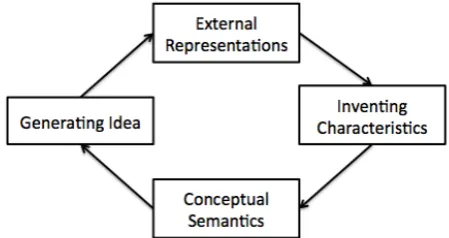
Suwa suggests the existence of chains of cognitive actions related to creation [2]. This means that when humans invent characteristics that are not intended in external representations, these connect to conceptual semantics, and consequently an idea is generated (Fig.1). Conceptual semantics and idea creation produce further perceptual discovery. However, people cannot always generate idea if there are external representations. For example, Professional artists were able to create a lot of idea from an ambiguity figure on the experimental result. It is because they are responsive to characteristics or positional relationships. In contrast, amateur artist’s interpretation is dry up soon and idea is dramatically declined. Therefore, amateur artists need to be assisted with cognition to characteristics or positional relationships, to generate idea.
Beginners of photography, who do not have the ability to generate interpretation or the ability to give meaning to perceived characteristics or positional relations, take photographs without deciding on the theme of photography. This means that the beginner cannot invent perceptually, because he cannot look at the subject in a multifaceted way, which leads to missing good opportunities for a photograph. Moreover, even when the beginner has been perceptive, it can be predicted that he will take a photograph lacking a core of meaning because he is not able to give a variety of conceptual meaning. Consequently, the beginner allows unnecessary elements into the frame, and takes a failed photograph.
[image:2.595.69.294.553.672.2]Accordingly, in this study, we aim at an effect of supplementing interpretation of external representation by proposing a theme before photography and during photography. Moreover, our system prompts perceptive invention and giving conceptual meaning, which leads to idea origination and a chain of cognitive actions related to creation.
Fig. 1. Chain of cognitive actions related to creation.
B. Knowledge of Failure
Knowledge of failure, as advocated by Hatamura, means utilizing failure for new creation along with understanding the traits of failure and not repeating superfluous failure [3]. Hatamura said that ideal process for training creativity in the field of creative activity is absorbing the experience of one’s
own failure or that of others as a virtual experience of failure, and absorbing and accumulating knowledge learned as well as laying the groundwork for acceptance of knowledge by experience and feeling. To delete failed photographs immediately means hating and ignoring failure, and losing opportunities for training creativity by absorbing and accumulating information about failure. This is a crucial problem for creative activity from the viewpoint of knowledge of failure. Accordingly, it is important to understand the characteristics of failure for in order to stop repeating failure and to utilize it in new creation. By doing so, we can expect to inherit knowledge of photographers effectively.
C. Normal Operation
Abe states that strategies to improve safety in the aeronautical field have shifted from the technique of extracting conventional risks and preventing accidents to “normal operation” [4].
“Normal operation” is the technique of collecting success stories in which errors potentially connected with accident arose, but did not result in accident due to the appropriate responses of the persons concerned. This is based on the idea of resilience engineering, which focuses on accepting human factors and on how to recover quickly from damage [5].
The TEM model shown in Fig. 2 is the technique of applying success stories to safety measures. Safety control using the TEM model is shown to be effective for giving awareness of implicitly addressed threats and errors, and leading to countermeasures.
[image:2.595.318.554.558.705.2]To apply this method to the field of photography, the elements that correspond to error or threat are movement of the subject and changes of time and light source, and also errors in settings such as ISO sensitivity or aperture opening (known as f-stop). As in the field of safety administration, photographers can easily find their own failure through conscious and preemptive response to these elements. Therefore, they can reduce failed photographs by knowledge inheritance.
Fig. 2. TEM Model
III. PROPOSED METHOD
problems: “including unnecessary elements in a photograph” and “failed photographs are deleted immediately”. We will state our approach to each problem.
A. Presenting Photography Themes
When users decide their planned date for taking photographs, the following four elements are registered in the system: date, weather, time slot, and place of photography. Based on this information, the system suggests adjectives fitting the season or local characteristics as photography themes to the user. Our reason for using adjectives is because in order to translate a person’s sensitivities into concrete elements, it is necessary to express sensitivities in words [6]. Among words, adjectives are deemed to be well-suited for conveying visual images. Furthermore, the system does not simply set one photography theme, but instead suggests multiple themes to the user, and the user selects several themes from these candidates. This is not only to respect the user’s preferences, but also aims at a self-selection effect whereby “memory formation is superior when the tester freely chooses one item from multiple options, compared to when the options are pre-determined” [7]. We anticipate that by allowing the user to think and choose by themselves, the user will be constantly aware of the photography theme during photography, and will attempt to capture the theme that they have chosen themselves. Furthermore, if they wish to change the theme during photography, they can set a new theme by following the same process.
B. Registering Failure Information
After photography, the system registers what kind of technical errors have caused failed photographs. However, it is difficult for novice photographers to register the content and extent of their failures using precise numerical values. For example, compared to the telescopic area of a lens, a 1mm difference in focal length of the wide-angle area is said to be large, but it is difficult for a user to perceive the difference between 12mm focal length and 13mm focal length.
Therefore, we attempt to quantify and register the content and extent of failure the user’s own feelings. Our quantification and registration method utilizes VAS (Visual Analogue Scale) for each technical element such as position, f-stop, etc. VAS is a method that utilizes to quantify intensity of sensations and emotions [8]. It is used in the medical field to quantify pain, which is difficult to express in numerical values. The quantification is conducted by the patient indicating the current level of their pain on a 10cm line where the left end is “no pain”, and the right end is “the worst pain I can imagine”.
With this process, we anticipate cultivation of creativity as well as advanced understanding of photography knowledge through the accumulation of knowledge of failure from the perspective of knowledge of failure.
C. Registering Successful Photographs and Success Stories
The system also registers successful photographs and success stories from the perspective of “normal operation”.
These are not photographs that happened to turn out well by chance, but are only registered when the user has responded to threats or errors. In this way, the following effects can be expected during photography.
1. Easy to understand, as it parallels normal behavior 2. Can form preventative strategies by specifying threats, which invite errors
3. Purpose and practical methods of countermeasures are clarified via awareness of threats
4. Concrete actions to break the chain from error occurrence to failure are easy to investigate
D. Presenting Failure Trends and Countermeasures.
The system analyzes the failure information registered and accumulated by the user, and presents failure trends to the user: i.e., what kind of failure occurred, and to what extent. Provision of feedback, in addition to registration, is expected to lead to further awareness of failure. Furthermore, the system presents, as example countermeasures to failure trends, successful photographs and success stories that involved responses to errors and threats that were similar to those in the user’s failure trends. These include not only the user’s own successful photographs and success stories, but also those of other users. This is based on the results of a comparative experiment on introspection and imitation of creative activities conducted by Ishiguro et al., who found that mere repetition of creative activities and introspection regarding one’s own creations are insufficient for obtaining awareness of creative expression [9]. Although conducting interpretation and introspection of our own artwork and process stimulates the acquisition of knowledge, it is necessary to refer to artworks by other persons who possess a different kind of knowledge to our existing knowledge, in order to maintain awareness of expression and utilize that awareness as knowledge about expression. Moreover, novices have a tendency to make replicated expressions and prefer to produce photograph-style creations, but acquisition of new knowledge relaxes constraints on their expressive style, and promotes creative expression.
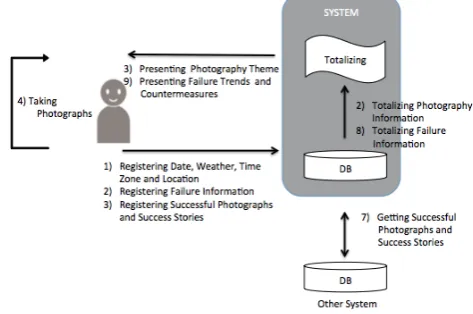
E. Process of Using System
[image:3.595.319.556.601.758.2]Based on the above proposal, the process that takes place when the user uses the system is shown in Fig. 3.
IV. SYSTEM STRUCTURE
In this section, we will explain the structure of a system based on the proposed method described in Section 3.
A. Equipment, Development Environment and Programming Language
As this research deals with photographs, development using equipment with a high-resolution display was a prerequisite. In consideration of this point, we used the fourth-generation iPad device by Apple Inc. to implement this system. For the development environment, it was necessary to use Apple Inc.’s Xcode IDE (integrated development environment), which is used to produce applications for iOS, the iPad’s operation system. For the same reason, we used Objective-C, the official development language for iOS applications, as the programming language in our development of the system.
B. System Structure
The system consists of two parts, “Theme Suggestions” and “Registration/Presentation of Failure Information, Successful Photographs and Success Stories”.
“Theme Suggestions” are proposed using the following two functions.
1. Photography plan information registration function 2. Photography theme selection and display function “Registration/Presentation of Failure Information, Successful Photographs and Success Stories” consists of the following three functions.
1. Failed photograph evaluation registration function 2. Successful photographs and success story registration function
3. Failure trends, successful photographs and success story presentation function
1) Photography Plan Information Registration Function
[image:4.595.322.549.340.550.2]In this function, the user inputs four items necessary for determining the photography theme: the date, weather, time slot, and place of photography. The date is inputted as year, month and day, and the other three input categories are selected from the elements shown in Table 1.
Table. I. Registered elements.
Weather Time Zone Location
Sunny Morning House
Cloudy Daytime Town (Indoor)
Rainy Evening Town (Outdoor)
Snowy Night Nature
2) Photography Theme Selection and Display Function
In this function, eight types of photography theme are shown on the display screen, based on the registered photography plan information. The photography theme selection method is random selection from a collection of adjectives registered to each element of date, weather, time slot, and place of photography that were registered prior to the photography session. These are then presented to the user as photography themes. The user selects several
preferred candidates from the presented photography themes, and attempts to capture the themes in their photography.
The registered adjectives are selected from 180 words registered in the Nippon Color & Design Research Institute’s “Language Image Scale”, which are then assigned to each element [10].
3) Failed Photograph Evaluation Registration Function
[image:4.595.38.296.591.656.2]In this function, the user firstly selects one photograph from a list showing all the photographs they took. The selected photograph is enlarged on the system screen, and if the user evaluates it to be a failed photograph after close observation, they register an evaluation of what kind of failure occurred. The evaluation of the failed photograph is registered by indicating which of six technical elements were used incorrectly: position, zoom, focus, f-stop, exposure compensation, and ISO sensitivity. At the same time, the user indicates the degree of failure by moving a slider on the screen. For example, in the photograph shown in Fig. 4, the user failed with the exposure compensation setting, causing the photograph to be too dark. In this case, the user evaluates by tapping the “exposure” button, and moving the slider in the “minus” (left) direction.
Fig. 4. Input of failure information.
4) Successful Photographs and Success Story Registration Function
In this function, similarly to failed photograph evaluation, the user selects one photograph from a list showing all the photographs they took, and conducts a self-evaluation. If the photograph was successful, the user describes what countermeasures they took against threats or errors. Furthermore, they register the technical element that was key to their success, choosing one element from position, zoom, focus, f-stop, exposure compensation, and ISO sensitivity.
5) Failure Trends, Successful Photographs and Success Story Presentation Function
when the user registered failed photograph information. Then, after finding the total value of the slider range for each technical element, the elements are ranked from highest total value to lowest, whereby elements with high total values are the user’s strongest failure trends. From the results of this failure trend analysis, the highest-ranked element is pointed out to the user as a failure trend in the form of a text notification.
Furthermore, at the same time as the failure trends, successful photographs and success stories from the user and other users are displayed on the same screen as examples of countermeasures to the user’s failure trends. The successful photographs and success stories presented here are randomly selected from those that were registered as having successfully utilized the same technical element as the displayed failure trends.
At this point, the selected other users are determined by their degree of similarity in failure trend ranking. Based on the user’s failure trend ranking, the elements are compared in order from high-ranking to low, and if the same elements appear, the differences in rank are aggregated and stored. If the total aggregated difference is low, the system judges the degree of similarity between users to be high.
[image:5.595.49.286.360.518.2]The system screen for the “failure trends, successful photographs and success story presentation function” is shown in Fig. 5.
Fig. 5. Presentation of failure trends, successful photographs and success stories.
V. EVALUATION EXPERIMENT
In this section, we investigate whether using the system to take photographs actually enables acquisition of photography knowledge.
A. Experiment Overview
The evaluation was conducted with participation from eight university students, all novice photographers. The eight evaluators were beginners who had started using DSLR cameras less than one year prior to the experiment, and had a broad understanding of the technical elements necessary for registration of failure information, such as ISO sensitivity, f-stop, etc.
In practice, the participants should be separated a treatment group and a control group. However, we integrated both groups and conducted the experiment this time as one step to verify the effectiveness of this system.
For the experiment method, we established two patterns: 1) using the system, and 2) not using the system. Each evaluator took 20 photographs for each pattern: firstly with the system, and the second time without the system. After the experiment was completed, we calculated the total numbers of failed photographs and successful photographs, and conducted a questionnaire survey. By categorizing and comparing the aggregated data and the results of the questionnaire, we determined whether the evaluators had acquired photography knowledge.
B. Experiment Method
Prior to the experiment, we gave the evaluators the following instructions.
1. The only camera functions the user can operate in this experiment are zoom, focus, f-stop, exposure
compensation, and ISO sensitivity.
2. During the experiment, the evaluators cannot receive any information relating to photography knowledge or creative assistance from sources other than the system.
The experiment was performed under the condition of following the above instructions. In the questionnaire conducted after the end of the second photography session, we asked questions about whether the evaluators’ photography knowledge had improved by using the system.
C. Experiment and Questionnaire Results
Comparison of the eight evaluators’ first and second photography sessions showed that the number of failed photographs had decreased for all evaluators (Fig. 6).
Fig.6. Change in the number of failed photographs.
As an average of all evaluators, the number of failed photographs decreased by five, from 13.25 in the first photography session to 8.25 in the second session. From this result, we can state that the system was effective in reducing occurrence of failed photographs.
[image:5.595.313.545.437.565.2]From the above results, we can consider that using the system was effective for acquiring photography knowledge.
VI. CONCLUSION
In this study we proposed a system that aims to support learning of heuristic knowledge by novice photographers. We attempted to support this by using a method in which the system suggests photography themes and presents successful photographs and success stories in response to failure information. The results of an evaluation experiment and questionnaire demonstrated that evaluators were able to acquire heuristic knowledge, which led to a reduction in the occurrence of failed photographs. However, as the evaluation period was short, it is necessary to further investigate how the system would affect heuristic knowledge if used for a long period.
Furthermore, although this study targeted novices who take photographs as a hobby, in recent years initiatives have begun in Japanese school education to utilize cameras in art lessons for students who have very little experience of photography. In particular, between 2008 and 2012, 85 elementary and junior high schools across Japan have implemented a program called “Camera in Art Class”, spearheaded by the National Formative Education Union and the Japan Advertising Photographer’s Association. While the class time for art lessons is being reduced in Japan, photography - which enables instantaneous expression following discovery - can cultivate abilities in children to see, feel and create. However, in the current form of the art lessons utilizing cameras, the classes are taught not by art teachers but by professional photographers dispatched by the Japan Advertising Photographer’s Association. As a result, there is a need to create a framework for in-school instruction in the same way as other classes. We will address this point as an issue in future research.
REFERENCES
[1] CIPA: Statistical Data of Digital Cameras http://www.cipa.jp/english/data/dizital.html (refer July. 16 2013). [2] Masaki Suwa, Discussion on Pragmatic Studies to Synthesize
Creative Processes, Journal of the Japanese Society for Artificial Intelligence Vol.19, No.2, pp.205-213, 2004 (in Japanese). [3] Yotaro Hatamura, “Learning from Failure”, Word Association
Publishers, November 2002.
[4] Keiji Abe, Past and Current Approach in aeronautical field, Journal of Human Inter face Society Vol.14 No2 2012, pp89-96, 2012 (in Japanese).
[5] Erik Hollnagel, David D. Woods, Nancy Leveson, ”Resilience Engineering”, Ashgate Publishing, Ltd., 2006.
[6] Mitsuo Nagamachi, “Cognitive Engineering”, Kaibundo Publishing Co., Ltd., November 1989(in Japanese).
[7] Tetsuji Hirano, Role of Selection on Self-choice Effects in Memory, Proceedings of The 68th Conference on the Japanese Psychological Association, pp777, 2004 (in Japanese).
[8] Masahiro Morimoto, “Pain Clinic and Eastern medicine”, Shinko Trading Company Ltd., Publication Department of Medical Books, April 2004 (in Japanese).
[9] Chiaki Ishiguro, Takeshi Okada, “Emergence of control in artistic expression in amateur: The effects of imitation of unfamiliar exemplars”, Proceedings of the 29th Annual Meeting of the Japanese Cognitive Science Society, pp574-582, 2012 (in Japanese). [10] Shigenobu Kobayashi “COLOR IMAGE SCALE”, Kodansha USA,