Abstract—One practical use of tactual sense knowledge in the
context of man-machine interface is for the design of control knobs and related devices. Shaping control devices differently is one method of coding control devices for easy tactual identification. However we still do not know how well people perceive complex shapes. The purpose of this study was to examine tactile discrimination of different geometrical shapes between males and females. Twenty-five Chinese people participated in a tactile symbol matching task. In each trial, participants were given one tactile symbol. They were asked to ‘touch-read’ the symbol with their thumb and index finger of dominant hand and then to match it with the target set placed in front of them as fast and as accurately as possible. The results showed that circle, square and triangle were discriminated significantly faster than other polygons and star shape patterns. Tactile symbols with less number of edges were recognized significantly faster than those with many edges. Tactile features consisting of acute edges were more easily discernible. Significant association between recognition accuracy and response time for geometric shapes was also revealed. The higher the recognition accuracy for a tactile symbol was, the shorter the response time. No significant difference between males and females was found in tactile shape discrimination. The findings of this study are useful as a reference for designers, ergonomists and other practitioners to develop better man-machine interfaces with tactual shape coding so as to improve human operator performance.
Index Terms—cutaneous sense, gender, tactile shape
discrimination, tactual coding, tactual display
I. INTRODUCTION
OUCH is a vital process of everyday life for object manipulation and exploration tasks [1]. Sanders and McCormick [2] pointed out that one practical use of tactual sense is for the design of control knobs and related devices. The primary coding methods for control devices include shape, texture, size, location, operational method, color, and labels. Some general considerations that affect the choice of a
Manuscript received October 28, 2013. The work described in this paper was fully supported a grant from City University of Hong Kong (Project Number 7004079).
Annie W. Y. Ng is with School for Higher and Professional Education (Design), Vocational Training Council (e-mail: [email protected]).
Alan H. S. Chan is with the Department of Systems Engineering and Engineering Management, City University of Hong Kong, Kowloon Tong,
coding method and specific codes include detectability, discriminability, compatibility, meaningfulness, and standardization of the codes selected. But it is also important to consider whether people have the chance to look at the control to identify and operate it or whether they need to work under dark situation. The coding of control devices for tactual identification only includes their shapes, textures, and sizes.
Tactual coding has been used most broadly as a substitute for seeing in man-machine systems. The reaction time in response to tactile stimuli was significantly shorter, followed by auditory stimuli and then visual stimuli [3]. Burnett and Porter [4] indicated that control interfaces for future cars require minimal visual demands. Porter et al. [5] developed an ‘eyes-free’ prototype control interface, enabling drivers to access secondary and ancillary controls inside the car whilst minimizing their eyes off the road. Tactual coding was also used in designing an interactive mouse system in human-computer interface [1], game controllers with buttons of different shapes, and computer keyboards with small projections on the F and J keys to help users maintain the proper location in using a keyboard without looking at it. On tactile object recognition, Kalia and Sinha [6] suggested that people first determine the shape of a stimulus and then associate the shape with a particular object. People recognize objects on the basis of their shape; they feel the shape, texture, and dimensions of objects through the tactile sensory and kinesthetic sensory feedback from mechanoreceptors located both in the skin and in deep structures [1, 7, 8]. Rowell and Ungar [9] examined the importance of each individual aspect of tactile symbol design towards designers, producers, and researchers. Pattern/texture of a symbol and separation/spacing between features of a tactile symbol received the highest importance ratings. Shape, size and type of symbols, on average, were considered quite important. Elevation and standardization were rated no higher than average.
The most basic and most commonly used circular, square, and triangular shapes of tactile symbols were best readable [10, 11]. However it is not entirely known how well people perceive the shapes of more complex tactile images of objects [6]. In addition to the basic geometric patterns, tactile discrimination for more complex polygon shapes (such as trapezoid, pentagon, hexagon and octagon) and star shape patterns (such as four-point, five-point, six-point and
Tactile Symbol Matching of Different Shape
Patterns: Implications for Shape Coding of
Control Devices
Annie W. Y. Ng and Alan H. S. Chan
seven-point stars) are worth to be examined.
Numerous research studies have examined gender differences in tactual discrimination and related tasks. Past studies showed mixed results wherein superior performance from males and females were both found. Gliner [12] showed that females performed better in smooth texture discrimination than in rough texture discrimination. Rexroad and White [13] revealed that male and female errors were virtually identical in both visual and tactual modes of texture discrimination. Goldreich and Kanics [14] showed that females perceived fine surface details better than males in tactile acuity. Heller et al. [15] examined gender differences in haptic change task. Females had a significantly higher number of correct tangible picture location judgments than males. But the differences between males and females on the haptic change task vanished when the task was much more difficult.
The usefulness of a coding method or specific set of control codes is typically evaluated in terms of discriminability, speed of identification, and accuracy of identification [2]. One way used to study the discrimination of shape-coded controls is to present all possible pairs of shapes to blindfolded subjects who are required to indicate whether the shapes are the same or different with the sense of touch. This type of matching task can determine which shapes are easily confused with others and the number of shapes people can recognize.
Through a tactile symbol matching task, this paper was aimed to investigate tactile discrimination of different geometrical shapes between males and females in terms of response time and accuracy. The objectives were to find out which geometrical shapes of tactile symbols can be discriminated accurately and quickly and to examine the possible gender difference in tactile symbol discrimination. The findings of this paper would be useful for designers and practitioners in human-machine interface design with tactual shape coding.
II. METHOD A. Participants
Fifteen male and 10 female Chinese undergraduate students took part in this study. All participants reported having normal or corrected-to-normal vision, and no known conditions affecting tactile perception.
B. Materials
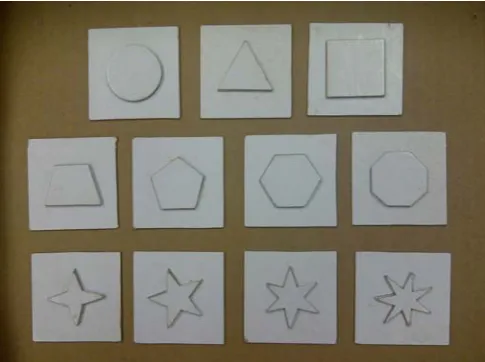
[image:2.595.306.549.50.231.2]Two identical sets of tactile symbols with 11 different shapes viz. circle, square, equilateral triangle, trapezoid, pentagon, hexagon, octagon, four-point star, five-point star, six-point star, and seven-point star were used (Fig. 1). One was test set and the other was the target set. The tactile symbols were made of white cardboard papers and raised 0.4cm from the center of a 5cm square base. The diameter of each tactile symbol was 3cm. A stopwatch was used to time each participant’s response in a matching trial.
Fig. 1. The 11 tactile symbols used in this study.
C. Procedure
Participants were briefed on the objectives of the study and given verbal instructions at the beginning of the experiment. The experiment consisted of a learning phase and a matching phase. The learning phase was to familiarize all participants with the tactile symbols before the matching task.
(i) Learning phase: Participants were seated at a table in a quiet environment. They were required to explore and get familiarized with the set of tactile symbols for one minute both visually and tactually.
(ii) Matching phase: Participants closed their eyes throughout the tactile symbol matching task. In each trial, participants were given one tactile symbol. They were asked to touch and feel the symbol and then to match it with the set placed on the table as fast and as accurately as possible with their thumb and index finger of dominant hand. Their non-dominant hand was used to hold the base of the tactile symbol. This procedure was repeated until all the 11 tactile symbols were tested. The set of symbols on the table was loosely scattered around. Participants were timed from the first contact with the given tactile symbol until they identified the target item from the set of tactile symbols on the table.
III. RESULTS
A total of 265 responses (25 participants x 11 shapes) were recorded. The accuracy and response time of the matching task were examined in terms of gender and shape.
A. Accuracy
To explore whether differences in matching accuracy between male and female and between geometric shapes were statistically significant, Chi-square test was conducted. The results, however, showed that gender and geometric shape did not have any significant influence on recognition accuracy (p > 0.05).
Fig. 2. Matching accuracy for each geometric shape.
B. Response time
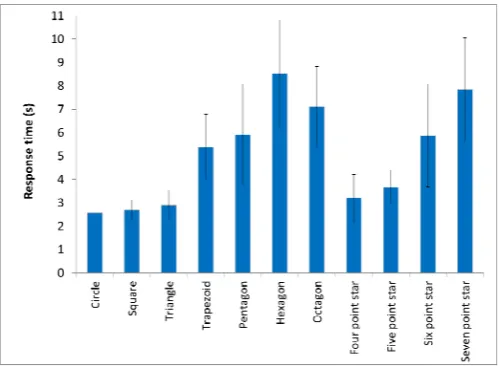
The overall mean response time of the matching task was 5.07s with a standard deviation (sd) of 2.58s (range: 1.47 to 13.09s). The average male and female response times were 5.09s (sd ±2.63s) and 5.03s (sd ±2.51s), respectively. Fig. 3 shows the mean response time and standard deviation for each geometric shape. The response time for circular shape was the minimum (2.59s) while that for hexagon was the maximum (8.53s).
To explore whether differences in response time between male and female and between geometric shapes were statistically significant, Kruskal-Wallis test was conducted. The results showed that gender did not have any significant effect on response time but geometric shape did (χ2 = 206.55, df = 10, p = 0 < 0.05). Post hoc analysis showed that circle, square and triangle were recognized faster than trapezoid, pentagon, hexagon, octagon, five-point star, six-point star, and seven-point star significantly (p = 0). Trapezoid was recognized significantly quicker than hexagon and octagon (p = 0) but was identified significantly slower than four-point star, five-point star and seven-point star (p = 0). Pentagon was more rapidly recognized than hexagon (p = 0), but hexagon was recognized slower than four-point star, five-point star and six-point star (p = 0). Both pentagon and octagon were identified slower than four-point star and five-point star (p = 0), but they were recognized faster than seven-point star (p = 0.002 and 0.003, respectively). Four-point star and five-point star were rapidly recognized than six-point star and seven-point star (p = 0), while six-point star was recognized faster than seven point star (p = 0.001).
C. Relationship between matching accuracy and response
time for tactile symbols
The geometric shapes (circular and triangular) with the shortest response time were 100 % successfully recognized. The hexagon shape was one with the longest response time
whether the association between recognition accuracy and response time was significant, Spearman correlation was conducted. The results showed that recognition accuracy was negatively and significantly correlated with response time (rs = -0.453, n = 275, p < 0.05). The higher the recognition accuracy for tactile symbol was, the shorter the response time.
Fig. 3. Mean response time for each geometric shape.
IV. DISCUSSION
The goal of this study was to examine tactile discrimination of different geometrical shapes between males and females with a tactile symbol matching task. We found that geometric shape had significant influence on response time. Some tactile symbols were more rapidly recognized than others. The most basic and commonly used tactile shapes, viz., circle, square, and triangle were found to be highly discriminable in Rener [10]’s study. The present study extends their findings and shows that circle, square and triangle were recognized significantly faster than other polygons (e.g. trapezoid, pentagon, hexagon and octagon) and star shapes (e.g. five-point star, six-point star and seven-point star).
[image:3.595.305.555.147.330.2]TABLE I
MATRIX OF MATCHING PERCENTAGES FOR SHAPES IN TEST AND TARGET SET
Matched shape
Test shape Circle Square Triangle Trapezoid Pentagon Hexagon Octagon point star Four point star Five point star Six point star Seven
Circle 100%
Square 96% 4%
Triangle 100%
Trapezoid 4% 88% 8%
Pentagon 8% 84% 8%
Hexagon 24% 68% 8%
Octagon 16% 84%
Four point star 100%
Five point star 100%
Six point star 84% 16%
Seven point star 20% 80%
Past studies showed that acute edges triggered a larger neurophysiological response than gradually sloping or curved edges or smooth edges [18, 19]. Thus the tactile features consisting of acute edges would be more discernible than those with smooth edges. These may explain why in this study trapezoid were identified slower than four-point star, five-point star and seven-point star shapes significantly; and pentagon was recognized slower than five-point star, and hexagon was recognized slower than six-point star significantly.
Significant association between recognition accuracy and response time for geometric shapes was found in this study. Kalia and Sinha [6] mentioned that tactile picture recognition is more dependent on the ease of bottom-up integration of shape information. When people move their fingers over an image, local pieces of tactile information are comprehended and retained in memory and then integrated with new incoming inputs. Errors may arise from the process of integrating local pieces of information into a global structure; noisy motor control and poor spatial localization of the hand might be the courses of error during integration. In this study, some participants were found to have difficulty of tactile shape acquisition for complicated polygon and star shape patterns, and inaccurately recognized square shape as trapezoid, trapezoid as pentagon, pentagon as hexagon, hexagon as octagon, and six-point star as seven-point star, or vice versa. Based on such tactile recognition performance, training can be given to help people learn to distinguish geometric patterns with tactile sense.
Gender factor was found to have no significant influence on tactual discrimination in this task. The correct response percentages and response times for males and females were nearly the same. Rexroad and White [13] showed that male and female errors were virtually identical in the visual and tactual modes of texture discrimination. Van Boven et al. [20] revealed no gender difference for the sighted people in tactile grating orientation discrimination. Peters et al. [21] also found that when gender and finger size were both considered in tactile grating orientation, only finger size predicted tactile spatial acuity significantly.
Tactual shape coding is a common means of coding control devices, which in particular is useful for accessing and identification of controls under dark condition and when visual sense is overburdened. The findings of this study provide useful reference for designers to develop a proper human-machine interface with tactile coding. Designers can make use of the difference in geometric patterns of tactile controls in the design of control buttons, control rods or related devices. For example, designers should avoid using shapes that were easily confused. Examples of these pairs include (square shape, trapezoid), (trapezoid, pentagon), (pentagon, hexagon), (hexagon, octagon), and (six-point star, seven-point star). Tactile symbols in basic patterns (circle, triangle and square) should be used as they were recognized faster and more accurate, followed by star shapes (excluding seven-point star which was slower than pentagon but faster than trapezoid), and then polygon patterns (trapezoid, pentagon, hexagon). A good human-machine interface design must consider not only user performance but also user comfort and user satisfaction. Further studies might consider users’ subjective preference tactile symbol discrimination under blindfolded situation.
V. CONCLUSION
In this paper, we investigated tactile discrimination of different geometrical shapes between males and females with a tactile symbol matching task. The present study shows that circle, square and triangle were recognized significantly faster than other complex polygon and star shape patterns. Tactile symbols with less number of edges were recognized significantly faster than those with a number of edges. The tactile features consisting of acute edges would also be more evident. In addition, there was significant association between recognition accuracy and response time. The higher the recognition accuracy for tactile symbol was, the shorter the response time. Gender had no significant effect on geometric shape discrimination. The findings of this study provide some insights into the design of various tactile control interfaces in human-machine systems. Implications of the findings in man-machine design with tactual shape coding had been thoroughly discussed.
ACKNOWLEDGMENT
The authors would like to express their thanks for the data collection done by S.F. Chan, C.K. Leung, U.M. Ao, and W.T. Lau.
REFERENCES
[1] K. U. Kyung, D. S. Kwon, and G. H. Yang, “A Novel Interactive Mouse System for Holistic Haptic Display in a Human-Computer Interface,” International Journal of Human-Computer Interaction, vol. 20, no. 3, pp. 247-270, 2006.
[2] M. S. Sanders and E. J. McCormick, Human Factors in Engineering and Design. New York: McGraw-Hill, 1993.
[3] A. W. Y. Ng and A. H. S. Chan, (2012) “Finger response times to visual, auditory and tactile modality stimuli,” in Lecture Notes in Engineering and Computer Science: Proceedings of the International MutliConference of Engineers and Computer Scientists 2012, Hong Kong, 2012, pp. 1449-1454.
[4] G. E. Burnett and J. M. Porter, “Ubiquitous Computing within Cars: Designing Controls for Non-visual Use,” International Journal of Human-Computer Studies, vol. 55, pp. 521-531, 2001.
[5] J. M. Porter, S. Summerskill, G. Burnett, and K. Prynne, (2005) “BIONIC – ‘eyes-free’ design of secondary driving controls,” Accessible Design in the Digital World Conference 2005, Dundee, Scotland, August 23-25, 2005.
[6] A. A. Kalia and P. Sinha, (2011). “Tactile Picture Recognition: Errors are in Shape Acquisition or Object Matching?,” Seeing and Perceiving,
vol. 24.
[7] J. Voisin, G. Benoit, and C. E. Chapman, “Haptic Discrimination of Object Shape in Humans: Two-Dimensional Angle Discrimination,”
Experimental Brain Research, vol. 145, pp. 239-250, 2002.
[8] Y. C. Chen, C. H. Chiang, and H. C. Chiu, “The recognition of 3D basic patterns and tactile icons for the blind,” Society for Social Management Systems(SSMS) International Symposium 2010, Kochi, Japan. [9] J. Rowell and S. Ungar, “The World of Touch: Results of an
International Survey of Tactile Maps and Symbols,” The Cartographic Journal, vol. 40, no. 3, pp. 259-263, 2003.
[10] R. Rener, “Tactile Cartography: Another View of Tactile Cartographic Symbols,” The Cartographic Journal, vol. 30, pp. 195-198, 1993. [11] S. Jehoel, P. T. Sowden, S. Ungar, and A. Sterr, “Tactile Elevation
Perception in Blind and Sighted Participants and its Implications for Tactile Map Creation,” Human Factors, vol. 51, no. 2, pp. 208-223,
2009.
[12] C. R. Gliner, “Tactual Discrimination Thresholds for Shape and Texture in Young Children,” Journal of Experimental Child Psychology, vol. 5, pp. 536-547, 1967.
[13] K. Rexroad and H. White, “Sex Differences in Visual and Tactual Modes of Texture Discrimination,” The Journal of Genetic Psychology,
vol. 149, no. 1, pp. 131-132, 1988.
[14] D. Goldreich and I. M. Kanics, “Tactile Acuity is Enhanced in Blindness,” The Journal of Neuroscience, vol. 23, no. 8, pp. 3439 –
3445, 2003.
[15] M. A. Heller, M. L. Jones, A. M. Walk, R. Schnarr, A. Hasara, and B. Litwiler, “Sex Differences in the Haptic Change Task,” The Journal of General Psychology, vol. 137, no. 1, pp. 49-62, 2010.
[16] J. Wu, J. Yang, and T. Ogasa, “Raised Angle Discrimination under Passive Hand Movement,” Perception, vol. 39, pp. 993-1006, 2010.
[17] Y. H. Tu, C. F. Wu, and I. T. Yeh, I.T., Evaluation of recognizing tactile pictures in different size display in sighted and blind people. The 6th Asian Design International Conference, Tsukuba, Japan, October 14-17, 2003.
[18] R. H. LaMotte and M. A. Srinivasan, “Tactile Discrimination of Shape: Responses of Slowly Adapting Mechanoreceptive Afferents to a Step Stroked across the Monkey Fingerpad,” The Journal of Neuroscience,
vol. 7, no. 6, pp. 1655-1671, 1987.
[19] M. A. Srinivasan and R. H. LaMotte, “Tactile Discrimination of Shape: Responses of Slowly and Rapidly Adapting Mechanoreceptive Afferents to a Step Indented into the Monkey Fingerpad,” The Journal of Neuroscience, vol. 7, no. 6, pp. 1682-1697, 1987.
[20] R. W. Van Boven, R. H. Hamilton, T. Kauffman, J. P. Keenan, and A. Pascual-Leone, “Tactile Spatial Resolution in Blind Braille Readers,”
Neurology, vol. 54, pp. 2230 – 2236, 2000.
[21] R. M. Peters, E. Hackeman, and D. Goldreich, “Diminutive Digits Discern Delicate Details: Fingertip Size and the Sex Difference in Tactile Spatial Acuity,” The Journal of Neuroscience, vol. 29, no. 50,