Original Article
Deceased expression of prostatic acid phosphatase in
primary sensory neurons after peripheral nerve injury
Bo Huang1, Xia Li2, Xiao-Chun Zhu3, Yi-Sheng Lu1
1The 2nd Department of Orthopaedics, 117 Hospital of PLA, Hangzhou, China; 2Yi Ji Shan Hospital of Wan Nan
Medical College, Anhui, China; 3General Hospital of Tibet Military Area command, Tibet, China
Received September 30, 2014; Accepted November 26, 2014; Epub December 1, 2014; Published December 15, 2014
Abstract: Prostatic acid phosphatase (PAP) is expressed in nociceptive dorsal root ganglion (DRG) neurons and func-tions as an ectonucleotidase that dephosphorylates extracellular adenosine monophosphate (AMP) to adenosine to suppress pain via activating A1-adenosine receptor (A1R) in dorsal spinal cord. However, the effect of peripheral nerve injury on the expression of PAP has not been reported until now. In the present study we found that PAP ex-pression in DRG neurons is significantly decreased from the 2nd day after peripheral nerve injury and reaches the bottom at the 14th. In addition, intrathecal PAP injection can reduce mechanical allodynia induced by spared nerve injury. Our findings suggest that the decrease of PAP is involved in pathophysiological mechanisms of neuropathic pain.
Keywords: PAP, DRG, peripheral nerve injury, neuropathic pain
Introduction
Neuropathic pain occurs when the injury or dis-ease affects the somatosensory system. It may be associated with abnormal sensations called dysesthesia, and pain produced by normally non-painful stimuli (allodynia) [1, 2]. Therefore, it is essential to get a better understanding of pathophysiological mechanisms of neuropathic pain for developing more effective and specific new therapies. Animal models with sciatic nerve injury have been widely used to study the mechanisms of neuropathic pain. Many studies have proved that changes in gene expression in dorsal root ganglia (DRG) of peripherally axoto-mized animal may contribute to the generation and development of neuropathic pain [3-5]. Prostatic Acid Phosphatase (PAP) was originally identified as a secretory protein enriched in the prostate gland and has been used as a marker of diagnosis and therapy control of the prostate gland cancer for many years [6]. Recently the transmembrane isoform of PAP was reported to function as an ectonucleotidase that dephos-phorylates extracellular adenosine monophos-phate (AMP) to adenosine, a neuromodulator
with anti-nociceptive properties, in nociceptive dorsal root ganglia neurons and therefore to suppress pain via activating A1-adenosine receptor (A1R) in dorsal spinal cord [7-9]. Intriguingly intraspinal injection of PAP protein has potent antinociceptive, antihyperalgesic, and antiallodynic effects that last longer than the opioid analgesic morphine [8].
models of acute and chronic pain for a longer period of time [12, 13]. However, the change of PAP expression in DRG after peripheral nerve injury has not been reported until now. Here we examined the change of PAP expression after peripheral nerve injury to explore the physiolog-ical function of PAP in neuropathic pain.
Materials and methods
Animals
All interventions and animal care were per-formed in accordance with the policy of the Society for Neuroscience (USA) on the use of animals in neuroscience research and the guidelines of the Committee for Research and Ethic Issues of International Association for the Study of Pain. The experiments were approved by 117 Hospital of PLA Research Animal Care and Use Committee. All efforts have been made to minimize the number of animals used and their discomfort after peripheral nerve inju-ry. The Sprague-Dawley male rats (200~250 g, Shanghai Center of Experimental Animals, CAS, Shanghai, China) used in this study were main-tained under a 12-h light-dark cycle (lights on from 07:00 to 19:00) with room temperature at 22° ± 1°C. Food and water were available ad libitum.
Animal surgery and tissue preparation
SD male rats were anesthetized with chloral hydrate (300 mg/kg). For sciatic nerve transec-tion (SNT) model, the sciatic nerve was exposed at mid-thigh level. A 5 mm portion of sciatic nerve was transected. For spared nerve injury (SNI) model, left tibial and common peroneal nerves were identified, ligated with 5-0 silk and transected after the exposure of sciatic nerve. After surgery, muscles and skin were sutured in layers, and the animals were allowed to recover from anesthesia in a warmed cage. Then the rats were allowed to survive for 2, 7, 14 and 28 days after nerve injury.
For real-time PCR, L4 and L5 DRGs of these rats and of normal rats were then dissected and frozen on dry ice. For in-situ hybridization, the rats were anesthetized and perfused via the ascending aorta with 50 ml of warm (37°C) saline followed by 50 ml of warm solution com-posed of 4% paraformaldehyde and 0.1% picric acid in 0.1 M phosphate buffer at pH 6.9. The perfusion was then followed by 200 ml of the
same fixative (4°C) for another 5 min. L4 and L5 DRGs and the lumbar spinal cord were then dissected out. The tissues were post-fixed in the same fixative for 90 min at 4°C, and were then immersed in 20% sucrose in 0.1 M phos-phate buffer for at least 1 day. Diethyl pyrocar-bonate (DEPC) water was used for all solutions and appliances necessary for ISH.
Real-time PCR
Total RNA from DRGs (L4 & L5) at different time points was extracted with TRIzol reagent (Invitrogen, USA). The RNA (1 μg) was reverse transcribed (Superscript II, Invitrogen, USA) to cDNA. Quantitative PCR was performed with Premix Ex Taq (Takara) using a 7500 real-time PCR system (Applied Biosystems) according to the protocol of the manufacturer. The data were analyzed by 7500 System SDS Software 1.4.0 (Applied Biosystems) using the standard curve method. Gene expression level was nor-malized to the values for glyceraldehyde-3-phosphate dehydrogenase (GAPDH). The specific primers for detection of gene expres-sion were listed below: for GAPDH 5’CCA- GAACATCATCCCTGCAT3’ and 5’GCATGTCAGAT- CCACAACGG3’; for PAP 5’CTTCTTGCTCCTGC- TATCT3’ and 5’TCCCGTATCTTCTCCTTAT3’.
In situ hybridization
then in NBT/BCIP in alkaline phosphatase buf-fer (100 mM Tris-HCl, pH 9.5, 50 mM MgCl2, 100 mM NaCl, 0.1% Tween-20 in distilled water). Control experiments were carried out using a digoxigenin-labeled sense riboprobe for PAP. The sense probes did not detect any spe-cific signal (data not shown).
For ISH combined with immunohistochemical detection, sections were immunostained with anti-NF200 (mouse, Sigma) or fluorescein-labelled IB4 (1:100; Vector Laboratories) after ISH process. Images were captured with a Nikon microscope using Neurolucida software.
Immunohistochemistry
For all groups, 12 μm-thick sections of the fixed L4 and L5 DRGs, and L4-5 spinal cord seg-ments were cut in series in a cryostat and mounted on same gelatin-coated slides. The sections were processed with indirect immuno-fluorescence histochemistry. The antibodies were diluted in phosphate-buffered saline with 1% bovine serum albumin and 0.3% Triton X-100. Briefly, the sections were incubated with a mixture of goat anti-PAP antibodies (1:500, Sigma) overnight at 4°C. After several rinses in PBS, the sections were incubated with biotin-conjugated goat anti-rabbit second antibodies (1:500; Vector labs) for 2 hours at room tem-perature, then incubated with VECTASTAIN Elite ABC Kit (1:1:500, Vector) at room temperature for 1 hour, then detected with DAB substrate (Vector). The sections were rinsed and mount-ed with a mixture of glycerol/PBS (9:1). Images
were captured with a Nikon microscope using Neurolucida software.
For quantitative analysis, 3 sections from each DRG were representative for each rat and the data were collected from at least three animals at each time point. The same calculation for the percentage and the distribution of labelled neu-ron profiles each DRG was performed as in situ hybridization.
Behavioral analysis
All behavioral tests were performed by observ-ers blinded to experimental conditions. Rodents were habituated to the testing environment daily for 3 d before baseline testing. For evalu-ating mechanical threshold, animals were placed in a plastic cage with a wire mesh floor and allowed to habituate for 30 min before the threshold testing. The hindpaw was pressed with one of a series of von Frey hairs with loga-rithmically incrementing stiffness (0.6, 1, 1.4, 2, 4, 6, 8, 10, 15, and 26 g) (Stoelting), pre-sented perpendicular to the plantar surface (5~6 s for each hair). Dixon’s up-down method was used to determinate the 50% withdrawal threshold.
Purified PAP protein (Millipore) was injected intrathecally in L5-L6 intervertebral space by a microsyringe after rats were anesthetized with sevoflurane (3%, Hengrui Pharmaceutical CO.).
Quantitative analysis
All data were shown as mean ± S.E.M. Differences in changes of values between the intrathecal groups were tested using one-way ANOVA, followed by individual post hoc parisons (Fisher’s exact test) or pairwise com-parisons (t test). P value < 0.05 was considered to be significant.
Results
Decreased expression of PAP in DRG neurons after peripheral nerve injury
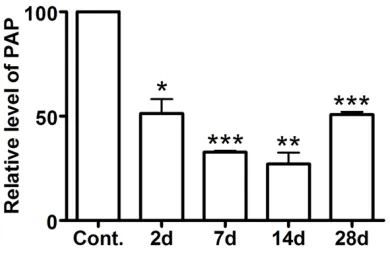
[image:3.612.93.288.73.201.2]Decrease expression of PAP mRNA in the rat DRG after peripheral nerve injury was suggest-ed by previous gene microarray analysis [3]. Real-time PCR was used to confirm the decreased expression of PAP mRNA in lumbar (L) 4 and L5 DRG after sciatic nerve transection (SNT). The level of PAP mRNA is markedly
reduced in the DRG at the 2nd day after periph-eral nerve injury (Figure 1). Such a decreased expression reaches the bottom at the 14th day after SNT (Figure 1). Then the level of PAP mRNA in DRG neurons becomes elevated at the 28th day after SNT but still significantly less than that of controls (Figure 1).
We intended to evaluate the effect of PAP on neuropathic pain induced by spared nerve inju-ry (SNI) model. Then we measured the expres-sion of PAP in rats after SNI. In situ hybridiza-tion experiments were performed to show the expression pattern of PAP mRNA in DRG. ISH data demonstrated that PAP mRNA was expressed in DRG neurons (Figure 2). Under normal condition, PAP mRNA was contained by ~45.8% DRG neurons (Figure 2A, 2D). The number of PAP mRNA-containing neurons was
markedly decreased to ~20% of total neurons at the 14th day after SNI (Figure 2C, 2D). The immunohistochemistry also showed that the number of PAP+ neurons was markedly decreased from about 50% to ~20% of total neurons at the 14th day after SNI (Figure 3). These results revealed that the expression of PAP is reduced in DRG neurons after SNI.
PAP mRNA is primarily expressed in nonpepti-dergic DRG neurons
[image:4.612.94.516.73.438.2]Furthermore, we measured the distribution of PAP mRNA within DRG neurons by ISH com-bined with immunolabeling for neurofilament 200 (NF200), a marker for myelinated sensory neurons [14], or isolectin B4 (IB4) that binds nonpeptidergic neurons [15] to identify the distribution of PAP in the DRG neurons. We
found that only a few PAP (~10%) contained DRG neurons was colocalized with NF200 (Figure 4A-C), while ~15.6% PAP (~10%) con-tained DRG was not labeled with IB4 (Figure 4D-F). These results demonstrate that PAP is mainly expressed in nonpeptidergic small DRG neurons, which is consistent with previous reports [8].
Intrathecal PAP injection can reduce mechani-cal allodynia
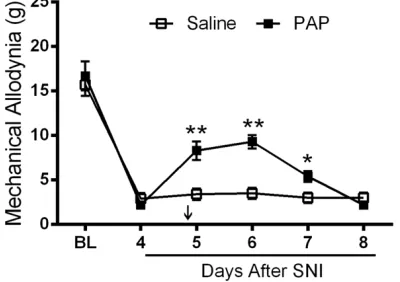
We intended to test the effect of PAP on the development of neuropathic pain. We used SNI model since rats after SNI demonstrated a sta-ble and long-lasting mechanical allodynia (cita-tion). At the 4th day of SNI, rodents showed an obvious decrease in mechanical threshold as reported. Then rats were injected intrathecally with PAP protein (500 ng, or 432 mU). We found that PAP could significantly attenuate mechani-cal allodynia induced by SNI. The analgesic effect lasted for up to 3 days (Figure 5).
Discussion
Here we found PAP mRNA expression in DRG neurons is significantly decreased from the 2nd day after peripheral nerve injury and intrathe-cal PAP injection can reduce mechaniintrathe-cal allo-dynia, which suggest that PAP is involved in
pathophysiological mechanisms of neuropathic pain.
The mechanisms of PAP function in anti-noci-ception and anti-neuropathic pain are very complicated. It was firstly reported to be an ectonucleotidase in nociceptive circuits and dephosphorylate AMP to adenosine [8]. Adenosine activates A1R and acute A1R activa-tion inhibits neurotransmitter release from nociceptive neurons, voltage-gatedcalcium channels, and postsynaptic neurons in spinal cord [16, 17]. In addition, PAP acts via A1R to reduce the levels of PIP2 in cultured cells and in vivo. In turn, this reduction in PIP2 inhibits signaling and sensitization through diverse pro-nociceptive GPCR [10, 18]. More recently PAP was found to be required for antinociceptive effects of BT, TMP and thiamine-a compounds [11]. But this function is not dependent on the ectonucleotidase activity of PAP, but a novel phosphatase independent function. Therefore to examine the expression pattern of PAP mRNA after peripheral nerve injury will help us to understand the antinociceptive mechanisms of PAP. Our study demonstrated that peripheral nerve injury could induce the decrease of PAP expression in DRG, which might result in the decrease of extracellular adenosine. Then the effect of adenosine was reduced. Thus,
[image:5.612.94.519.75.279.2]logical pain induced by peripheral nerve injury became long-lasting.
Besides PAP, it was found that another Ecto-5 -nucleotidase (NT5E, CD73) also contributes to AMP hydrolysis in nociceptive neurons [19]. PAP only locates on peptidergic nociceptive neurons, while NT5E locates on both
peptider-gic and nonpeptiderpeptider-gic nociceptive neurons in DRG. In PAP/NT5E double knockout (dKO) mice, AMP hydrolysis, when measured histochemi-cally, was nearly abolished in DRG neurons and lamina II of spinal cord [20]. In addition, the antinociceptive effects of AMP, when combined with nucleoside transport inhibitors (dipyridam-ole or 5-iodotubericidin), were reduced by 80-100% in dKO mice [20]. Our findings is con-sistent with the previous report that NT5E pro-tein is reduced in lamina II of spinal cord follow-ing nerve injury, which supports the view that PAP and NT5E are the main ectonucleotida- ses that generate adenosine in nociceptive circuits.
Acknowledgements
This work was supported by Science Foundation of Health and Family Planning Commission of Zhejiang Province Grant No. 2013KYB229.
Disclosure of conflict of interest
None.
[image:6.612.94.522.74.333.2]Address correspondence to: Dr. Yi-Sheng Lu, The 2nd Department of Orthopaedics, 117 Hospital of PLA, 14 Lingyin Road, Hangzhou 310013, China.
Figure 4. PAP mRNA is primarily expressed in nonpeptidergic DRG neurons. Data of ISH combined with IHC showed PAP mRNA and NF200 (A-C) or IB4 (D-F) revealed that just most PAP mRNA-containing neurons do not coexpress NF200 (arrows in C) and most PAP mRNA is colocalized with IB4 (arrows in F). Scale bars: 100 μm.
[image:6.612.90.290.402.543.2]Tel: +86-571-87348652; E-mail: luruiwen688@- sina.com
References
[1] Truini A and Cruccu G. Pathophysiological mechanisms of neuropathic pain. Neurol Sci 2006; 27 Suppl 2: S179-182.
[2] Baron R, Binder A and Wasner G. Neuropathic pain: diagnosis, pathophysiological mecha-nisms, and treatment. Lancet Neurol 2010; 9: 807-819.
[3] Xiao HS, Huang QH, Zhang FX, Bao L, Lu YJ, Guo C, Yang L, Huang WJ, Fu G, Xu SH, Cheng XP, Yan Q, Zhu ZD, Zhang X, Chen Z, Han ZG and Zhang X. Identification of gene expression profile of dorsal root ganglion in the rat periph-eral axotomy model of neuropathic pain. Proc Natl Acad Sci U S A 2002; 99: 8360-8365. [4] Thacker MA, Clark AK, Marchand F and
McMa-hon SB. Pathophysiology of peripheral neuro-pathic pain: immune cells and molecules. Anesth Analg 2007; 105: 838-847.
[5] Huang B, Zhao X, Zheng LB, Zhang L, Ni B and Wang YW. Different expression of tissue inhibi-tor of metalloproteinase family members in rat dorsal root ganglia and their changes after pe-ripheral nerve injury. Neuroscience 2011; 193: 421-428.
[6] Ostrowski WS and Kuciel R. Human prostatic acid phosphatase: selected properties and practical applications. Clin Chim Acta 1994; 226: 121-129.
[7] Quintero IB, Araujo CL, Pulkka AE, Wirkkala RS, Herrala AM, Eskelinen EL, Jokitalo E, Hellstrom PA, Tuominen HJ, Hirvikoski PP and Vihko PT. Prostatic acid phosphatase is not a prostate specific target. Cancer Res 2007; 67: 6549-6554.
[8] Zylka MJ, Sowa NA, Taylor-Blake B, Twomey MA, Herrala A, Voikar V and Vihko P. Prostatic acid phosphatase is an ectonucleotidase and suppresses pain by generating adenosine. Neuron 2008; 60: 111-122.
[9] Sawynok J. Adenosine receptor activation and nociception. Eur J Pharmacol 1998; 347: 1-11. [10] Sowa NA, Street SE, Vihko P and Zylka MJ.
Prostatic acid phosphatase reduces thermal sensitivity and chronic pain sensitization by de-pleting phosphatidylinositol 4,5-bisphosphate. J Neurosci 2010; 30: 10282-10293.
[11] Hurt JK, Coleman JL, Fitzpatrick BJ, Taylor-Blake B, Bridges AS, Vihko P and Zylka MJ. Prostatic acid phosphatase is required for the antinociceptive effects of thiamine and benfo-tiamine. PLoS One 2012; 7: e48562.
[12] Goldman N, Chen M, Fujita T, Xu Q, Peng W, Liu W, Jensen TK, Pei Y, Wang F, Han X, Chen JF, Schnermann J, Takano T, Bekar L, Tieu K and Nedergaard M. Adenosine A1 receptors medi-ate local anti-nociceptive effects of acupunc-ture. Nat Neurosci 2010; 13: 883-888. [13] Hurt JK and Zylka MJ. ACPPupuncture has
lo-calized and long-lasting antinociceptive effects in mouse models of acute and chronic pain. Mol Pain 2012; 8: 28.
[14] Lawson SN and Waddell PJ. Soma neurofila-ment immunoreactivity is related to cell size and fibre conduction velocity in rat primary sensory neurons. J Physiol 1991; 435: 41-63. [15] Hu ZL, Huang Y, Tao XR, Qi ZH, Chen JY and
Ding YQ. Inducible Prrxl1-CreER(T2) recombi-nation activity in the somatosensory afferent pathway. Genesis 2012; 50: 552-560. [16] Eisenach JC, Rauck RL and Curry R.
Intrathe-cal, but not intravenous adenosine reduces al-lodynia in patients with neuropathic pain. Pain 2003; 105: 65-70.
[17] Sawynok J. Adenosine and ATP receptors. Handb Exp Pharmacol 2007; 309-328. [18] Dale C and Vergnolle N. Protease signaling to G
protecoupled receptors: implications for in-flammation and pain. J Recept Signal Trans-duct Res 2008; 28: 29-37.
[19] Sowa NA, Taylor-Blake B and Zylka MJ. Ecto-5’-nucleotidase (CD73) inhibits nociception by hydrolyzing AMP to adenosine in nociceptive circuits. J Neurosci 2010; 30: 2235-2244. [20] Street SE, Walsh PL, Sowa NA, Taylor-Blake B,