Making decentralization work
A compliance perspective of decentralization.
Janet Basmatie Boedhoe
Masterthesis
Master Public Administration track Public Management
University of Twente
- 2 -
Making decentralization work
A compliance perspective of decentralization
Masterthesis
Enschede, 14
thof May 2013
Author
Janet Basmatie Boedhoe
Supervisors
Primary assessor: M.R.R. Ossewaarde
Second assessor: V. Junjan
Supervisor: M.R.R. Ossewaarde
University of Twente
- 3 -
Foreword
The course of this study has not been without a struggle. Although it was a conscious decision to choose a non-corresponding master, it was quite difficult to find my way. Looking back in the years that I have studied, it seems that I always – in some way – chose the less obvious path (starting at the MAVO schools to a master study). But looking back, it was worth it. It made me the person who I am today. Now that I am at the end of my life as a college student, it realize that this less obvious path was worth all the struggle, sweats and tears. And I am happy to say that I look back on these years with pleasure.
This development of this master thesis has been with ups and downs. It took me a while to find a subject that fitted me and after several research topics I ended up with the administrative agreements 2011-2015. This research subject gave me the room to make this thesis my own and where I could express myself. The development of this thesis was a constant cycle of continues improvement. I find it to be a continues process of improving myself and the gained insights. The establishment of this master thesis has pushed me to think and learn more and better.
With this, I want to thank my first supervisor Ringo Ossewaarde, who has guided me through this process and has stimulated me to find my passion and continuously develop myself. The support I received of you helped me enormously. I also want to thank Veronica Junjan as my second supervisor for her critical feedback. And without the help of the local governments, I could not have completed my study. So, hereby I would like to thank the municipalities: Enschede, Hengelo, Almelo and Dinkelland. The hospitality and informal setting of the local governments gave me the opportunity to be at ease and have good interviews. The WWB professionals helped me to generate interesting and relevant insights regarding decentralization and the WWB. The comments of the WWB professionals lie at basis of this report, it is however too bad that I can not incorporate all valuable insights.
Finally, it is with great pleasure that I can offer u, the reader, a master thesis about decentralization. A transformation that affects the public sector and society.
”There is no more delicate matter to take in hand, nor more dangerous to conduct, nor more doubtful in its success, than to be a leader in the introduction of changes...”
(N. Machiavelli, in ‘The Prince‘, fourhounderd years ago)
Enschede, April 2013
- 4 -
Abstract
As stated by Machiavelli, it is a delicate, dangerous and doubtful matter to conduct changes. Especially for changes in the public sector since the interest of the public sector is society (van Helden & Jansen, 2003). However, since we live in a complex and dynamic world, the public sector needs to make changes and decentralization is one of the most extensive and comprehensive form of all. According to the administrative agreement 2011-2015, the central government decentralizes tasks and responsibilities to strengthen the economy and restore public finances. In order to make decentralization work, several conditions need to be taken into consideration. These conditions for decentralization are described in the administrative agreement, and are summarized in three decentralization agreements. These are: policy discretion, reducing vertical control and enabling local governments to collaborate with other actors. The compliance issue is pivotal in this research. The decentralization agreements are examined on behalf of the decentralized WWB legislation to see if there is a compliance, allowing decentralization to likely succeed. The NPM influences are also examined with the analysis of the decentralization agreement since NPM plays a leading role in this report to encounter if it is a valid management theory.
The study has been conducted under four local governments in the Netherlands, which are the municipalities Enschede, Hengelo, Almelo and Dinkelland. Several random respondents that are involved with the implementation of the WWB were interviewed to analyze whether or not the decentralization agreements are obtained. If the central- and local governments comply with the WWB to the decentralization agreements, decentralization is likely to succeed since it is generalized to all social legislations. The WWB is examined as a role model for all social legislations since it is a long time (since 2004) in hands of the local government and can therefore function as an example for further decentralizations to come. Besides the interviews, policy documents that were provided by the respondents have also been studied. The results of this study has extended to determine the role of NPM and to the degree that decentralization is likely to succeed, allowing the central government to become a smaller and more powerful government.
- 5 -
Table of contents
Chapter 1. Introducing decentralization 7
1.1 Background information 8
1.2 Problem definition 9
1.3 Approach 11
1.4 Structure 12
Chapter 2. Making decentralization succeed, in theory 13
2.1 New Public Management 13
2.1.1. Transition to NPM 13
2.1.2. Private sector rules for the public sector? 15
2.1.3. Conclusion 16
2.2 Making decentralization work 16
2.2.1 Decentralization 17
2.2.2 Drawbacks 18
2.2.3 Pros of decentralization 20
2.2.4 Conclusion 22
2.3 Managing decentralization 22
2.3.1. Reforms in the public sector 23
2.3.2 Pubic management reforms 24
2.3.3 Conclusion 26
2.4. Conclusion 26
Chapter 3. Field Research 28
3.1. Research design 28
3.2. Data collection 28
3.2.1. Selecting respondents 29
3.2.2. Interview 30
3.3 Data analysis 30
3.3.1. Document analysis 31
3.4. Operationalization 31
3.5. Reflection 33
3.6. Reliability 34
- 6 -
3.8. Conclusion 34
Chapter 4. Analysis 36
4.1. The decentralization agreements 36
4.1.1. Policy discretion 37
4.1.2. Vertical control 42
4.1.3. Collaboration with other actors 47
4.2. WWB and NPM 50
4.2.1. Implementation 50
4.2.2. Managerialization of public services 52
4.2.3. Outcome accountability 53
4.2.4. Conclusion 54
4.3. Implications of the WWB for forthcoming decentralizations like the WJZ 56
4.3.1. Paradox 56
4.3.2. Public Management Reforms 57
4.3.3. Conclusion regarding the lessons for the WJZ 60
Chapter 5. Conclusion 61
5.1. Discussion 63
5.2. Practical implications 65
References 68
- 7 -
Chapter 1. Introducing decentralization
This is the report that constitutes the completion of my Master's degree in Public Administration, Public Management track. This report discusses the ways to make decentralization succeed with reference to the administrative agreement 2011-2015. This administrative agreement is a covenant composed by representatives of government, provinces, municipalities and water boards. In the administrative agreement 2011-2015, the government states that our country faces a major challenge, that is to strengthen the economy and restore public finances. Therefore, the general objective of the Dutch government as stated in the administrative agreement 2011-2015 is to become a small, more vigorously, and public service delivered government. So to face this challenge, a compact and effective government is required. The intention is to decentralize certain policies to the lower levels of government in the period of 2011 till 2015. The main principles of decentralization in the administrative agreement 2011-2015 are freedom and responsibility. When the central government decentralizes their policies, the lower levels of government have the freedom to carry out the policies at its sole discretion provided it is in line with the law and regulations. If the lower levels of government take their responsibility and utilize the freedom effectively, a compact and effective government can be achieved (Rijk, IPO, VNG, UvW, 2011). To decentralize policies, major reforms need to take place in the public sector. In the administrative agreement, the principles and processes of the reforms have been stated in the general- and underlying objectives. To achieve the general objective, decentralization must be properly implemented, which is the essence of this report. Decentralization can only succeed if there is policy discretion, adequate funding, a retreating government, phasing the decentralization process and an adequate performance capability (Rijk, IPO, VNG, UvW, 2011, p. 19). These conditions are made under the principle ‗freedom and responsibility‘ and can be summarized and divided into three decentralization agreements. In this report, the three decentralization agreements are defined as: policy discretion, reduction of vertical control, and enabling local authorities to collaborate with other authorities, citizens and civil society organizations (Rijk, IPO, VNG, UvW, 2011). If these conditions are met, decentralization has a greater chance of success. So, the compliance of the decentralization agreements are key in this study.
- 8 -
NPM therefore plays a leading role since it can be seen as a initiator of decentralization. It can be seen as a theoretical approach that it focuses on increasing efficiency and effectiveness of the state (Aardema, 2010). It pays attention to the managerialization of public services delivery, instead of merely focusing on the productivity. One of the managerial ideas is NPM arose in response to the critiques of the traditional public administration theory. However, this approach – just like the traditional public administration theory, is not without any controversy. Since issues of efficient and effective utilization of public resources will never go away, NPM is frequently taken under attack by critics (Osborne, Radnor & Nasi 2012). This study will therefore determine the role of NPM in the contemporary governance by analyzing the decentralization process of a social legislation. Decentralization will be outlined, which implies the rise and motive of decentralization and the associated implications, all in respect to NPM. In this report, four municipalities will be subjected to qualitative research to assess the effects of decentralization. Due to the complexity and timeframe given for the completion of this report, the implications are limited to analyzing the municipal organization since it is not feasible to examine all the involved agencies, such as provinces and semi-public institutions.
1.1. Background information
The main objective of this report is to examine if there is a compliance of the decentralization agreements based on the administrative agreement 2011-2015. If there is a compliance, decentralization is likely to be successful allowing the central government to become more efficient and effective. The decentralization agreements based on the administrative agreement 2011-2015 will be studied and the role of NPM in the contemporary governance will be determined, by analyzing decentralization of social legislation on local governance. The premises of this report is that if the implementation of a social legislation decentralization complies with the decentralization agreements, the objective of the administrative agreement 2011-2015 is likely to be obtained. With decentralization an efficient division of labour between the governmental actors can be achieved, that is accompanied by extensive reforms in the public sector. Decentralization allows the function of the central government to be limited since it aims to focus merely on the tasks that are desirable for the central government to execute. These functions will be from the perspective of legal equality, effectiveness and efficiency. The central government bears responsibility for matters that cannot be organized at a decentralized level. Examples of these matters are national issues, such as defence and foreign policy. In addition, the central government bears the concern that the administrative system is functioning properly (Rijk, IPO, VNG, UvW, 2011).
- 9 -
accessible for their citizens, several policy areas will be decentralized to the levels of the municipalities. The main objective of decentralization is for local governments to provide customization tailored to the needs of their citizens. The administrative agreement 2011-2015 stipulates that decentralization will take place in the areas of: Ability to work, Counseling AWBZ, Child welfare, Space, nature and economy, and Water. In order for decentralization to succeed, the administrative agreement 2011-2015 incorporated that the local authorities should receive a freedom of policy, and that the vertical control will be reduced, so a retreating central government will occur. With these conditions, local authorities are enabled to seek collaboration with other authorities, citizens and civil society organizations in order to implement the new tasks (Rijk, IPO, VNG, UvW, 2011).
Decentralization processes will be studied with regard to the compliance issue to analyze if the general objective of the administrative agreement is likely to be obtained, and to determine the role of NPM in the contemporary governance. A completed decentralization is going to be analyzed providing recommendations for upcoming legislations. The social legislation that will be studied is the Work and Welfare Act (WWB). The WWB is chosen because it is the first social legislation to be decentralized, making it more accessible to explore. The WWB will provide recommendations for upcoming social decentralization e.g. the Act on Child Welfare (WJZ). The WJZ is the second legislation that will be studied by the means of policy documents since this legislation is in the process of being decentralized. A coalition agreement is reached concerning decentralizing the WJZ but the transition from the WJZ to the municipalities should be completed in 2015. It is therefore a relatively new decentralization in which the WWB can suggest learning points and recommendations for the local implementation of decentralizing social legislation. In January 2004 the first social policy the WWB, was successfully decentralized from the government to the municipalities. The new tasks of the municipalities include policy, implementation and (budgetary) responsibilities (Universiteit Twente & Divosa, 2007). With this decentralization, a new step was taken into the modernization of social legislation. The WWB was the first but not the last social legislation that is to be decentralized to the local governments. In the administrative agreement 2011-2015 the central government states that it aims to decentralize five policy areas to the municipality. One of the to be decentralized policy areas will be the WJZ. With the decentralization of the social legislation, municipalities are responsible for development and implementation of policy for the beneficiaries. They are given more responsibilities and tasks but they receive fewer budgets for implementation compared to the money that was spent by the government. This is in contrast to the course of business before there was a decentralization of policy. Previously, municipalities could declare the costs they made during the service provision because the government was responsible and the municipalities were merely an executive agency on behalf of the government (Manshanden & van der Veen, n.d.).
1.2. Problem definition
- 10 -
is efficient and effective. There is a thin line between creating conditions and requirements which must be fulfilled to enhance legitimacy and counter corruption, and enforce strict rules allowing a centralization to occur. The question central to this thesis refers to how decentralization is operationalized in the light of NPM, utilizing experiences of the decentralized WWB legislation to offer lessons and recommendations for the forthcoming WJZ decentralization. The administrative agreement 2011-2015 is used as the context in which decentralization is studied. With this research, an answer is sought to the following research question:
‗To what extent is compliance of the coherent decentralization agreements based on the administrative agreement 2011-2015 necessary to make decentralization succeed, and to what extent is it based on NPM influences and practices?‘
Decentralization is studied at policy- and organizational level. The aim is to see how the created policies, thus decentralization agreements, take shape at the local level and if there is compliance. It is also relevant in this thesis to study how the agreements are carried out organizational wise. Only then, the conclusion and recommendations can be made in order to make decentralization successful or to conclude that it is successful. The organizational arrangement of local governments is related to what happens at policy level. This study therefore takes the diversity of organizational arrangement into account because differences in implementation may arise between the local governments. Decentralization can only be successful if the decentralization agreements are designed and implemented correctly because it allows the central government to function stronger and more compact. In the administrative agreement 2011-2012 is incorporated that the local authorities should receive policy discretion, that the central government will reduce vertical control so a retreating central government will occur, and that local authorities are enabled to seek collaboration with other authorities, citizens and civil society organizations in order to implement the new tasks and carry out integral and coherent policies. These three elements (policy discretion, reduction of vertical control and enabling municipalities to seek collaboration) are necessary means to make decentralization work. In reference to NPM, the question focuses on NPM since it can validate NPM as a relevant theoretical approach.
In order to answer the research question, the following sub questions are formulated in reference to the decentralization agreements:
1. ‗Taking the decentralization agreement at basis, how is decentralization of social legislation arranged in practice‘?
2. ‗To what extent are local design and implementation of the social legislation in four municipalities characterized by NPM elements‘?
- 11 -
The first sub question refer to the decentralization agreements which will be examined individually. Policy discretion is studied since it is included in the administrative agreement 2011-2015 is that the central government should transfer the tasks and responsibility to the lower levels of government without comprehensive quality requirements and boarded-up regulations. The lower authority is responsible for the implementation and democratic control. Policy discretion explores how municipalities handle this responsibility and if they really receive a freedom of policy executing. The vertical control is analyzed since it refers to a retreating government. The central government can have control by the means of money supply and by obtaining information intergovernmental and inter-administrative supervision. By limiting these three aspects, the degree of government control will be reduced. The final decentralization agreement of collaboration refers to the question if there is adequate performance capability and if local authorities enabled in cooperation with citizens and civil society organizations in a good way to give substance to the new tasks. Only then, an integral, coherent policy can be carried out. The second sub question places the design and implementing phase of the decentralization agreements in the light of NPM. Is this management theory underlying the way policies are executed or has it made way for another ways of carrying out policies. The final sub question establishes the pitfalls and strengths of decentralizing social legislation at a local level and can provide learning points and recommendations for forthcoming decentralizations.
1.3. Approach
For the last thirty years decentralization has made its mark on policy and governance in the Netherlands. A lot of policies have been decentralized, making decentralization an object of research. However, since we live in a dynamic world filled with changing environment and demands, society places a lot of pressure on the government, making them continuously changing their policies and governance (Pollittt & Bouckaert, 2011). The administrative agreement 2011-2015 illustrates the dynamic since the decentralization agreements are adjusted due to the societal developments (Rijk, IPO, VNG, UvW, 2011). To continuously improve decentralization, this administrative agreement 2011-2015 will be studied using social legislations. Leaving the developments in decentralization underexposed can crucial impact the success rate for the forthcoming decentralizations. Successes of the past are no guarantee for the future. It is therefore necessary to discuss every aspect of decentralization to achieve the general objective.
- 12 -
define a framework of background of information to analyze the problem statement. In the next chapter the literature review will provide a basis to answer the central questions of this report and to understand it. This chapter consists of literature about NPM, decentralization, and reforms in the public sector. In chapter three the data collection and the data analysis will be discussed. The methodology will help to translate the background theory into different concepts that can be used to collect and analyze the data. In chapter four the analysis will take place where the collected data will be analyzed. In the final chapter the conclusion follows and the answer will be given to the research question.
The foundation of this study is based on literature about NPM, decentralization, public sector reform, and social legislation. Journals such as Administration & Society, Public Administration Review en Public Management Review are used to gain insight into the aspects relevant for this study. In addition to the use of these journals, other sources are utilized. The university library and catalogue are used to search for books regarding decentralization and public sector reform. Search sites such as PiCarta, Scopus, Web of Science and Google Scholar are used to find recent relevant articles concerning the topics of this report. The various articles and books retrieved from this recourses will be used to achieve a solid theoretical framework that lies at the base of this research. Policy documents and other relevant information concerning the administrative agreement 2011-2015 and the social legislation will also be utilized.
1.4. Structure
- 13 -
Chapter 2. Making decentralization succeed, in theory
In this chapter the foundation is established to find an answer to the research question. The literature review is based on several concepts that are relevant for this report and are in need of further explanation. The concepts are New Public Management (NPM), decentralization and public management reforms. Having these concepts explained and put in to context in reference to the administrative agreement 2011-2015, makes it possible to discover how to make decentralization work. The first paragraph of this chapter will set out the concept of NPM which will identify the influence of NPM on decentralization. The NPM principle, the transition to NPM and link between NPM decentralization and its criticism will also be outlined. The second paragraph will explain the decentralization theory that will form the basis of why decentralization can succeed or fail. Discussed will be what decentralization is, and what pitfalls, benefits and paradoxes are likely to occur. The third and final paragraph will illustrate the ins and outs of public management reforms. This will lead to a better understanding in designing and implementing the decentralization agreements and other principles of the administrative agreement 2011-2015. Scientific articles and books will be used to find theories about (implementing) decentralization, NPM, reforms in the public sector and about organizational change. The administrative agreement 2011-2015 and other relevant policy documents will be used as background information to shape the literature review.
2.1 New Public Management
As mentioned before, New Public Management (NPM) can be seen as an initiator of decentralization. It focuses on increasing efficiency and effectiveness of the state and it pays attention to the way of increasing these elements, the managerial ideas. In this paragraph the essence of NPM is discussed and with this information, the relationship between decentralization and NPM should be exposed. It should also provide a framework in identifying to what extent the NPM influence and practices are present in decentralization. The rise, content and criticism of NPM form the basis of this section. The approach of NPM is relevant for this study since it is an adopted businesslike- style and strategy by many Western countries during the last decade that has been under constant criticism.
2.1.1. Transition to NPM
- 14 -
efficiency and effectiveness of the state which led to the modernization of the state administration. To this shift in paradigm, the ideology of NPM is underlying. NPM occurred as a remedy for ‗a broken system of government‘ to increase the efficiency of the government on political and economic scale as a result of budgetary deficits within the government (Miller & Dunn, 2006, p.3). De Vries and Nemec (2012) agree with Miller and Dunn (2006) and indicated that there is evidence that if NPM tools are properly implemented, important efficiency improvements are supported. Which refer to spending ―better‖ to get the governmental finances in order. Decentralization emerged as one of these tools to increase the efficiency and effectiveness of the state. So, instead of the centralized, uniform decision making and implementation process, the Dutch government utilizes decentralization as principle of state governance (Wallis & Oates, 1998). It represents the central government transferring tasks and responsibilities to the local governments. With decentralization, the central government seems to head in a direction in which the government encourages, facilitates and partially regulates the society to take on certain public services involving social problems. It is a non-hierarchical form of governing for achieving an efficient government, effective civil society and successful private sector. It leads to the government creating more value for money if there is less money to spend.
Decentralization of policies is associated with reforming the public sector. To design and implement the public management reforms that decentralization triggers, the management instrument of NPM can be utilized. The NPM principle is allowing the market to acquire a significant share in the provision of services. It opts for management principles and strategies within the government agencies, and to involve other actors in the public task performance besides the government (Maat, 2003; Miller & Dunn, 2006; Pollitt and Bouckaert, 2011). It is considered to be an assembly of business ideas, methods and techniques for the public sector. The basis lies in decreasing of removing the differences between the public and private sector. A way to achieve this, is to create a shift from process accountability towards output accountability, thus the focus on results (van Helden & Jansen, 2003).
- 15 -
focused on efficiency (Hughes, 2003). NPM argues for cooperation between organizations to achieve the best outcome. The cooperation can be represented in forms of network governance, collaborative government and public-private partnerships (Alford & Hughes, 2008). New public management is according to Kettl (2005) based on six core components, namely: productivity, competition, service orientation, decentralization, policy and accountability. With these elements, new public management creates a new vision in governing the public sector since it has a more external view instead of looking inwards in an organization.
2.1.2. Private sector rules for the public sector?
While there are many reasons why NPM should be applied in the public sector, there is a lot of discussion whether or not NPM is appropriate. Since it is the aim of NPM to apply business ideas, methods and techniques for the public sector, the differences between the public- and private sector can cause a barrier to utilize NPM. Some critics contest the idea of NPM, much debated are the questions ‗if it has a good impact‘ and ‗how far it should go‘. Opponents of NPM believe that the public administration is a ‗unique and separate view and should not be sullied by the methods of commerce‘ (Pollitt & Bouckaert, 2011, p. 14). According to the Sociaal Cultureel Planbureau, the public sector is a constellation of public- and semi-public bodies consisting of the traditional governmental institutions like police and justice and from private institutions that receive governmental grants. The public sector is in service of society and its objective is to safeguard the public interests without any commercial interests. The private sector on the other hand, is guided by commercial interests and activities without governmental managing. It consist of organizations or institutions set by private parties (Smit & van Thiel, 2002).
- 16 -
because it affects the society. Also the final output of the public sector lies beyond the limitations of the private sector and can only be reviewed by the quality of life through public debate (Khan & Chowdhury, 2007;van Helden & Jansen, 2003).
Proponents of NPM believe that business methods and culture are the solution to a lot of problems within the public administration. According to the study of van Helden and Jansen (2003), NPM in the Netherlands is sustainable despite the complications and criticism. The anxiety that the ethics of the public sector will not hold up is proven wrong in this study. Van Helden and Jansen (2003) indicate that there is attention paid towards the ethics of the public sector. This is however probably as a defense shield against the dominance of business ethics. Van Helden and Jansen (2003) argue that public sector needs to deal with the difficulties of applying business style tools in the public sector. According to Pollitt and Bouckaert (2011), Metcalfe and Richards are in the middle of either proposing for or against NPM, along with Pollitt and Bouckaert themselves. Metcalfe and Richards define two layers in the public administration. They identify a microlevel public administration were the business methods and culture can be utilized. In the macrolevel they state that the business concepts can not be included. Pollitt and Bouckaert suggest that utilizing business methods depend on level (micro/marco), technical and political characteristics and on skill factor. Thus, it depends on the specific activity whether it is appropriate or not. According to Petruscu, Popescu, Barbu and Dinescu (2010) and Hood and Dixon (2013) the pitfall of NPM can be by focusing too much on efficiency, thus cost reduction. This could lead to policies with short-term effects undermining long term perspective domains because short-term policies are often cheaper.
2.1.3. Conclusion
New public management is a principle in the public sector and is an instrument to execute public management reforms with the help of business strategies. Decentralization arose in response to NPM and it emerged as an answer to increase the efficiency and effectiveness of the state. NPM focuses on decreasing the gap between the public and private sector. The administrative agreement 2011-2015 also states that the local government should collaborate with relevant actors, other than the central government. The public- and private sector differ from each other in the sense that the public sector‘s objective is to safeguard the public‘s interests and the interests the private sector serve are the commercial interests. Critics believe there is a bridge to overcome to have business style strategies applicable for the public sector since there are differences between the sectors. However, according to van Helden and Jansen (2003) studied NPM in the Netherlands and they concluded that NPM is sustainable in the Netherlands despite the complications and criticism. The public sector needs to deal with the difficulties of applying business style tools in the public sector. (van Helden & Jansen, 2003).
2.2 Making decentralization work
- 17 -
decentralization in general. In this paragraph, the modes of government will be discussed along with a framework of pros and cons of decentralization.
2.2.1 Decentralization
For the state administration, decentralization ensures an increased government responsiveness and accountability (Shah, 1999). The responsiveness is illustrated in the ability for the local governments to provide a better tailored to the needs policy for their citizens due to the approachability of the local government (Wever, Top & Drent, 2011). The accountability regarding the decentralized legislation is displayed in the procedures and control which are created to prevent corruption and ensure good governance (Rose-Ackerman, 2008). However, these issues are not without any negative consequences. In order to ensure a good governance, the central- and local government must comply to certain rules and regulations. According to Darling-Hammond, (1986) ‗the standard for accountability is compliance rather than effectiveness‘ (Darling-Hammond, 1986, p.1). McLaughlin and Thurlow (2003) complement Darling-Hammond (1986) by indicating that compliance focuses on whether the system has complied with procedures and/or rules and regulations as opposed to the objective and outcomes. So, although compliance is a ‗code‘ of good governance (Aguilera and Cuervo-Cazurra, 2009), it can also lead to losing the objective.
The practical implications to decentralization are the changes in the tasks and responsibilities of the municipalities and an increasing role of regional networks in policy implementation (van Kersbergen & van Waarden, 2004). According to Witte (2006) a reason for decentralization is to achieve a better performing government through the transfer of responsibilities to the local government. It is assumed that municipalities are likely to operate more efficient and effectively in contrary to the government because of the increased awareness due to the local responsiveness (BMC, 2009). To make decentralization work, a good relationship and task division between the government and municipalities is necessary. Municipalities are expected to execute the decentralized tasks and responsibilities efficient and effectively in the context of national policy goals and to be able to adapt to the needs of their citizens. They are more able to provide customized service since they are more involved because they function on a local level. It is the governments task to facilitate the municipalities in their new tasks and responsibilities and respond to the capabilities of local authorities taking the administrative strength of the municipalities into account (Keuzenkamp, 2009).
- 18 -
can take place at the level of content and resources. Decentralizing at the level of content refers to the substantial content of policy and transferring the policy-making autonomy and implementation discretion from central to decentralized governmental actor. The decentralization of resources refers to the resources needed for policy implementation, like financial risks and resources, and making the decentralized actor responsible for policy failure and successes (Bannink & Ossewaarde, 2012, p. 602).
The modes of government have implications on the responsibility that comes with the decentralization. With centralization, the traditional sovereignty of the state is supported. The traditional state administration underlines centralization and its sovereign power. The government has a monopoly power in a constellation of governmental functions. With the shift from centralization towards decentralization, sovereignty also shifts and makes a transition since the higher authority, the central government, is not merely responsible for specific tasks/policies and the monopoly of power that comes with the responsibility fades. Decentralizing substantial content refers to responsibility of the actual execution of the tasks and obligations. If the tasks are not fulfilled correct, the central government can step in and deny the lower authority ‗the legal right to act as an implementing agency of local government‘ (Bannink & Ossewaarde, 2012, p. 601). With the remaining part of decentralization, the responsibility of accountability steps in. The agency or local government that is to decentralize is a free agent that is responsible for the outcome that are responsible for the implications of their choices, which indicates accountability by compliance. This is because there are rules to comply by whereby accountability is measured. However, this is in contrast to Darling-Hammond (1986) and McLaughin and Thurlow (2003) because it indicates that effectiveness is less important than the compliance itself.
The final mode of decentralization evokes responsibility as a virtue. This terminology is based on the idea that sovereignty is in transition. The traditional sovereignty is based on the monopoly of the central government being responsible and protecting the citizens wellbeing and interests, and their policy-making capacity. However, since the government is decentralizing certain policies and globalization is upcoming (e.g. the European Union), the central government is no longer the final executive and no longer – as an single actor – is responsive for their citizens. So, since the sovereignty of a state is under much pressure, another more fitting political form has arisen where the elements of increasing local power and influence of globalization are taken into account. ‗Subsidiary implies that no higher authority can legitimately act if a lower authority is able to and that a higher authority van intervene in the affairs of lower authorities only if this enables them to govern themselves‘ (Bannink & Ossewaarde, 2012, p. 600).
2.2.2 Drawbacks
- 19 -
there is an interdependency between the central and local government. Each of the three variants of decentralization can evoke its own specific paradox (Bannink & Ossewaarde, 2012). In table one, a scheme is portrayed that illustrates the coherence.
Table 1. Modes of government with the specific responsibilities and paradoxes (Bannink and Ossewaarde, 2012)
The self regulation paradox occurs when centralized control is too weak. It can happen with partial decentralization of content. The central government provides means for the local government so municipalities can generate relevant information and proper tools to decentralize, without interference of the central government. The paradox occurs when the decentralized actors are unable or unwilling to perform their tasks; the policy making and implementation properly. So, if the local government cannot live up to the central government‘s policy aims, the central government needs to get involved with the policymaking and implementation. The interference of the central government is in conflict with decentralization. ‗Deregulation [of policies] was intended to increase the policymaking and implementation capacity of a central actor only capable of weak control‘ (Bannink & Ossewaarde p.604). Whereas now the central government needs to increase their level of control. The performance paradox can occur when the centralized control is too strong. It can happen with partial decentralization of resources. This paradox ensures tunnel vision since the delegated authority, e.g. municipalities, will focus on a part of the policy that is rewarded by the central government or that is easier to execute instead of focusing on the whole policy. Municipalities are compensated by the central government depending on the efficiency and effectiveness of the municipality. Hence the focus on quickly achieving the preconditions for receiving the compensation. This created imbalance leads to ‗prioritizing the easier cases from a caseload to increase the number of successfully finished cases‘ (Bannink & Ossewaarde, p.603). The difficult cases are thus deprived.
The final paradox that can occur with complete decentralization is the subsidiary paradox. Subsidiarity implies that lower authorities can act legitimately if they are able to, making the higher authority restricted to act whenever the lower authority has the possibility to act. However, higher authorities are able to intervene only when it enables the lower authority to govern themselves. Higher authorities can be the central government, but also the authorities such as the European Union or the United Nations. This paradox refers to transferring central-level conflict to the lower authorities at a decentral-level because local levels of government can only address specific policies that relate to conditions within municipal boarders. The issues of national scope such as protection of the state remain impossible
Modes of government
Responsibility
type
Paradox
Centralization Sovereignty -
[image:19.595.68.525.134.248.2]- 20 -
because it goes beyond the local authorities scope. So when completely decentralizing policies, the lower authorities are functioning as sovereigns but cannot deal with the issues of national scope. A paradox occurs because the government needs to interfere since the local governments foresee their citizens in their needs but they cannot bear the consequence in all respects due to the limited scope. This paradox results in a complete decentralization to never be achieved.
Besides the three paradoxes, there are two drawbacks of decentralization. Decentralization can lead to centralizing policies. An increase of decentralizing policies will centralize the decentralization process at a local level, because decentralization results in a growth of the tasks of the local government. Local authorities receive more tasks and responsibilities, making the municipalities expand in scale. This expansion in scale allows the decentralized tasks to be conducted in larger municipal organizations. So, local governments need to centralize their government making the local government deviate from their residents. The theory that local governments will be closer to the citizens will no longer work because it will create more distance (de Vries, 2000). The remaining drawback of decentralization is that smaller municipalities will be under pressure of the central government making them to merge with other small municipalities. It is the assumption that relatively large municipalities (with 100.000+ residents) can carry out their tasks practically independent because they have enough of the right recourses, like staff, budget and experience (Bekkers and Bouwmans, 2010). The average – smaller – municipalities often lack these resources since smaller municipalities manage less extensive problems compared to the larger ones. Therefore, smaller municipalities are likely to fall back on partnerships with other small municipalities so they can join forces to overcome and carry out the increasing tasks of the government that is subjected to high regulations. According to the VNG (2010) smaller municipalities are because of this under an increasing pressure to merge (de Vries, 2000; Allers & de Kam, 2010).
2.2.3 Pros of decentralization
There are multiple reasons why decentralization is utilized as a form of governance in the Netherlands. It enhances the quality of governance, increases involvement of citizens, creates a greater responsiveness of the local government and decreases the administrative pressure of the central government. These benefits of decentralization will be discussed in this paragraph.
- 21 -
there are governments more honest and responsive. With corrupt governments, there is a neglect in effective government and providing efficient services to the public. More honest and responsive governments are unlike the corrupt states, more effective in their government and service provision (Rose- Ackerman, 2008).
Decentralization can improve the quality of the government for multiple reasons. One is that with decentralization, a government can provide public goods and services more efficient and effectively and can possibly overcome the temptation of corruption since the increasing power and responsibilities of local authorities come with accountability. Since decentralization represents an allocation of the decision making and implementation process to lower levels of authority, the lower level actors should be accountable to their people because of the increase of power. If the actors are not accountable to the people but merely to themselves or their superior authorities, decentralization is not likely to succeed. With horizontal and vertical accountability the actors are accountable for their actions. Horizontal refers to the degree to which local authorities communicate, solve problems and build accountability while vertical accountability refers to the hierarchical power and the superior authorities the local authorities need to answer to (Argawal & Ribot, 2002). This indicate that (especially vertical) accountability is associated with compliance since there are authorities that have a controlling function. Another advantage of decentralization is that there can be a greater involvement of citizens in governance. It is less difficult for citizens to exert influence at the local level than at a national level. According to Halverson (2003) it is important that citizens are able to influence policies that affect them. Due to the possibility of increased involvement of citizens, the policies can be tailored to the needs of the people and can therefore be efficient and effective. Besides the influence of the citizens, the local government shares also the responsibility for efficient and effective policies. It is the task of the local authority to meet the desires of their citizens. It is assumed that the local authority can provide customization, since a local interpretation of policies enable local governments to respond to the needs of the citizens more accurately (Wallis & Oates, 1998). They are closer to their citizens and are more involved and up to date with their needs. The local government can therefore be more responsive than the government itself (van Kersbergen & van Waarden, 2004).
- 22 -
possible to experiment on a local scale since experimenting on national scale would be irresponsible and of high risk (Allers & de Kam, 2010; Treisman, 2002).
2.2.4 Conclusion
Decentralization refers to an interdependency relationship between the central- and local government. It is also the objective of decentralization to bring the government closer to their people and to provide a more efficient an effective service provision for the citizens (Wever, Top & Drent, 2011). It enhances the quality of governance and creates a greater responsiveness of the local government by decentralizing them more policies. This quality of governance associated with compliance which is a delicate matter dependent of the strictness of procedures and control. Decentralization also decreases the administrative pressure of the central government and increases involvement of citizens. There seem to be a lot of benefits to decentralize policy, however due to the interdependency between the central and lower government, paradoxes may occur. The paradox of - selfregulation, - performance, - and subsitiarity are likely to occur depending on the type of decentralization the government utilizes (see table 1). Besides the benefits and paradoxes, there are also drawbacks of decentralization. A drawback can be that the essence of decentralization will be neglected. Decentralization can end up in municipalities centralizing policies to handle the tasks efficient due to an increase in delegating of policies that the municipalities cannot handle. Another drawback can be that (especially) smaller municipalities become overloaded due to the decentralization of policies that they cannot handle. The increase policy decentralization makes the municipalities compelled to merge with other small municipalities to function efficient and effectively since they cannot deal with the pressure of the central government.
2.3 Managing decentralization
- 23 -
2.3.1. Reforms in the public sector
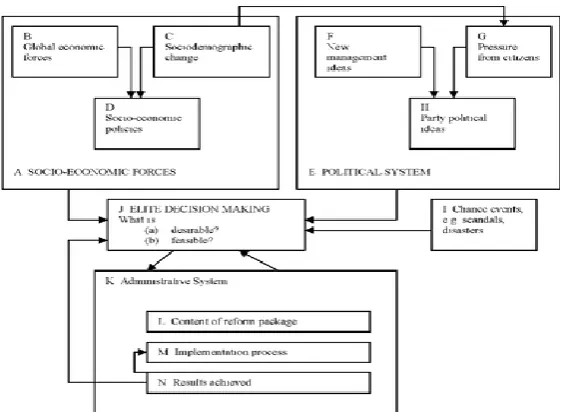
[image:23.595.72.353.285.491.2]Public management reforms are needed in order to make decentralization succeed. The aim of reforming the public sector is according to Pollitt and Bouckaert (2011) changing the government performance. This is exactly what decentralization aims for. The government performance needs to become more efficient and effective at a local level. Public management reform entails management reforms that are combined with other type of policies. The definition of public management reform can be defined in many ways. Pollitt and Bouckaert describe public management reform in the public sector as ―deliberate changes to the structures and processes of public sector organizations with the objective of getting them (in some sense) to run better‖ (Pollitt & Bouckaert, 2011, p. 8). Public management reform take place for multiple reasons. Pollitt and Bouckaert have developed a model of public management reform which consists of the different forces that are responsible for the changes in the public sector (Pollitt & Bouckaert, 2011, p. 33).
Table 2. Model of public management Reform (Pollitt and Bouckaert, 2011, p.33)
- 24 -
decentralization as a result of pressure of the society to create a better governance. Political considerations such as decreasing the administrative burden, have also played a role in the implementation of decentralization. Since decentralization is influenced by the central government, it is important to analyze if the central government reduces their influence and hold up to their decentralization agreements.
2.3.2 Pubic management reforms
In this section, three reform types will be discussed that evoke several trajectories of Pollitt and Bouckaert (2011). These trajectories will be studied in reference to the design and implementation of the decentralized agreements of the municipalities. Analyzed will be whether or not municipalities have the freedom to develop their own policy, are under influence of control by the central government and if they are able to collaborate with other relevant partners, in reference to the trajectories the municipalities will undergo with the public management reform. The framework of trajectories will be discussed in this section and in chapter four the actual analysis will take place as a result of the conducted research.
- 25 -
municipalities and their civil servants. Decentralization ‗makes possible more responsive and speedy public service, better attuned to local and/ or individual needs‘ (Pollitt & Bouckaert, 2011, p. 87). The government executes political decentralization by delegating authority to municipalities. Scale is related with to the size of the public sector organizations and to what extent they should be reduced or increased. Often is downsizing of the public sector on the same foot with the objective of saving. With specializing and decentralizing the scale of public sector organizations will be reduced (Pollitt & Bouckaert, 2011).
The second reform, process change refers to the procedural trajectories. There are three procedural trajectories, namely: top-down/bottom-up, task allocation and legal dimension. According to Pollitt and Boukaert (2011), the generalization of implementation is that in practice, these three aspects are interconnected to each other. These three trajectories also refer to the process change of public management reform since it is in reference to the redesigning of systems to become more efficient and effective. The top-down/bottom-up strategy refers to the ways of implementing and communicating. Is it in a traditional authorical way, than it is top-down implemented by the board. It there is bottom-up strategy, the interaction and communication between the employees and the higher levels (line managers, managers, board) will be better and the lower levels (employees) will have more influence. Task allocation is ‗the extent to which new organizations and structures have been created specifically to advance reform‘ (Pollitt & Bouckaert, 2011, p. 94). New structures can be created to realize the reforms within the public sector. A new structure of can be created in the form of a new department or a new taskgroup to enhance the effectiveness and efficiency. The legal dimension refers to whether or not a reform debate has taken and what the intensity of this debate was. The question central to this procedural aspect is if governments just ‗barged ahead, trampling the opposition underfoot‘ or have they communicated the reform, consulted with other stakeholders and possibly cooperated with relevant partners (Pollitt & Bouckaert, 2011, p. 94). The final reform, management reform, relates to the personnel management/HRM trajectories. In this trajectory it is important to involve the personnel of an organization to accomplish the goals that are set. These trajectories can include, the recruitment of personnel, (extensive) training for personnel and introduction of reward systems. This trajectory is in line with management reform since it refers to managing the people (Pollitt & Bouckaert, 2011).
PM Reform Trajectory Aspects of
analyzing structural change
merging or dividing public agencies in order to improve or encourage coordination and/or specialization.
Organizational trajectory is in line with structural change because certain structures are scrutinized and reorganized regarding to the four elements.
specialization, coordination, decentralization, and scale.
process change
redesigning systems to achieve an more efficient or effective outcome to certain procedures.
procedural trajectory
in practice, the three aspects are interconnected to each other.
top-down/ bottom-up, task allocation and legal dimension.
management reform
embraces changes in the system by which public servants themselves are recruited, promoted, trained etcetera.
personnel management/HRM trajectory
involve the personnel of an
organization to accomplish the goals
- 26 -
that are set. personnel and introduction of reward systems.
Table 3. Public management reforms with the corresponding trajectory (Pollitt and Bouckaert, 2011). 2.3.3 Conclusion
Public management reform has the objective to change government performance. Pollit and Bouckaert (2011) have created a model of public management reform which indicates different forces that are responsible for changes. With regard to decentralization, external factors are in place that influence the decision making process to decentralize certain tasks and it influences municipalities to reform in order to handle the new tasks and responsibility. External factors such as political and socioeconomic factors influence decentralization which in turn influence the municipal structure. Public management reforms can take place when the municipalities need to restructure. There are three reforms, structural-, process-, and management reforms. These three reforms evoke their own trajectories, respectively the organizational-, procedural-, personnel management/HRM trajectory. These reforms and trajectories are build as framework to analyze whether or not the decentralization agreements as stated in the administrative agreement 2011-2015 holds up. Municipalities undergo these trajectories in order to achieve the desired objective, that is to execute the decentralized policies to achieve an efficient and effective government.
2.4. Conclusion
- 27 -
According to the literature review, NPM plays an important role in the administrative agreement. The central government wants to focus on decreasing the administrative pressure by decentralizing; activating the municipalities to take on more tasks and responsibilities. With the decentralization of policies, the government aims to save two billion euros which will most likely corresponds with the NPM principle of creating more value for money. Also, the outcome will probably play an important with the decentralization of policies according to the administrative agreement 2011-2015. Since freedom and responsibility are the core elements of the agreement, local governments should be responsible for the input and output and the central government should control the outcome. The (social) effects and results that are achieved with the decentralization of policies is more important to the central government which will illustrates the influence of NPM on decentralization. However, these assumptions will be examined in the study. Regarding the decentralization mode, decentralization of social legislation according to the administrative agreement 2011-2015 is likely to be implemented by the mode of partial decentralization of resources. The local government is responsible for policy implementation and for the policy failure and successes since the central government implicates financial risks and resources to the performance of the local government.
With decentralization the pressure is on for the local governments. They need to cope with the new tasks and responsibilities that will influence their organizational structure. The public management reform has the objective to change government performance. Placing the administrative agreement 2011-2015 in the model of public management reform, the decentralization is influenced by external forces like the political system and the socio-economic forces. The initiative for decentralizing policy lies with the government. The government initiates decentralization as a result of pressure of the society to create a better governance. Political consideration such as decreasing the administrative burden, have also played a role in the implementation of decentralization. There are three public management reform trajectories that will be studied in reference to the design and implementation of the decentralized agreements of the municipalities. The trajectories are: structural change, process change and management reform. These three reforms evoke their own trajectories, respectively the organizational-, procedural-, personnel management/HRM trajectory. These reforms and trajectories are build as framework to analyze whether or not the decentralization agreements as stated in the administrative agreement 2011-2015 are complied to. Municipalities undergo these trajectories in order to achieve the desired objective, that is to execute the decentralized policies to achieve an efficient and effective government. The trajectories are analyzed by the aspects of analyzing (see Table 3) in the interview study and document analysis.
- 28 -
3. Methods
The purpose of this chapter is to outline the research methodology and to determine the path to obtain the relevant knowledge in order to answer the research question (Lucassen & Olde Hartman, 2007, p.6). This chapter includes the methods for data processing and data analysis. The choice for the data processing will be argued, since the collection of data can be done in various ways. Also the criteria for selection will be discussed. In data analysis the concepts that are important for the analysis will be operationalized according to the theoretical framework. This chapter will display how the data is processed and analyzed and it will help to translate the theoretical framework into the answering of the research questions.
3.1. Research design
For this study, a qualitative research strategy is chosen to study how decentralization works in practice. A qualitative research design is chosen because it is relevant to analyze how the local governments perceive decentralization and how they carry out the decentralized legislation. The views, ability and possibility of the local governments is important because with decentralization, local governments are responsible. In this research, the nature and context of the administrative agreement is studied to become aware what the impact is of decentralization in practice and how it should be arranged. By analyzing how the decentralization agreements are designed and implemented in the local government, the nature and context of the administrative agreement will be exposed because theory will be compared to practice. Besides the nature and context, there are several other reasons why the qualitative approach has been chosen. The main reason is that this study attempts to get an in‐depth understanding of how decentralization works in practice and to determine the extent of the NPM approach as a relevant management strategy. The aim is to see to what extent decentralization of social legislation is initiated by NPM.
- 29 -
which statistical numbers will not suffice since the views of the respondents and their interpretation is pivotal.
3.2. Data collection
In this section the process of collecting data will be explained. Like mentioned in the first chapter, four municipalities will be studied in order to analyze the decentralization of social legislation. The selection of the four municipalities and respondents within these municipalities will be argued. After that, the research design is stated discussing the way of collecting data.
3.2.1. Selecting respondents
To study whether or not the objectives of the administrative agreement 2011-2015 are likely to be achieved, four municipalities will be examined to acquire relevant data to use in this study. Four arbitrary municipalities will be selected depending on size, since the administrative agreement 2011-2015 was implemented at a national level making all municipalities deal with the same directives. The distinction regarding to municipality size will be made since the size of a municipality can provoke decentralization paradoxes. If a municipality is too small, a decentralization paradox can occur due to a lack of capacity which can influence this study. Since there are 415 Dutch municipalities, one rather large-, two medium sized- and one small municipality will be chosen. According to Vliegen and Van Leeuwen (2005) municipalities with a population of 100 thousand or more inhabitants are considered as relatively large municipalities. Municipalities with a population between the 10- and 100 thousand inhabitants are labelled as medium-sized, and municipalities with a population of less than 10 thousand inhabitants are seen as relatively small municipalities. Of the large municipalities, the municipal Enschede is chosen since it has 157.943 residents and is the eleventh large municipality of the Netherlands. The municipalities Hengelo and Almelo are chosen as the medium sized municipalities since they have a population of respectively 80.927 and 72.744 inhabitants. And at last, of the relatively small municipalities, the municipality Dinkelland is chosen. The number of inhabitants of this municipality are 26.087 , which exceed the definition as given by Vliegen and Van Leeuwen (2005).
- 30 -
municipality Dinkelland, due to reorganization of the local government. These respondents will be interviewed to see how decentralization works in practice and what their perception is about if the objectives of the administrative agreement 2011-2015 are likely to be obtained. So in total, eleven interviews will be conducted divided under four municipalities. The respondents received a code that consists of an abbreviation of the municipality in which they work, linked to a number to ensure anonymity of respondents. For example, a professional from the municipality of Enschede will have the code EN01 and a professional from the municipality Hengelo will have the code HE04. The anonymity is to create a sense of trust with the respondents and to prevent socially desirable answers.
3.2.2. Interview
To study the decentralization of social legislation according to the administrative agreement 2011-2015, a interview study is conducted. The interviews are necessary to receive information about the background process of decentralization and to see if the decentralization agreements are met. A one-on-one conversation with the respondents is necessary in order to receive information about the decentralization process of social legislation and how they perceive it. The respondents in this study will be subjected to a semi-structured interview. This semi-structured interview design is chosen because the respondents have the possibility to give their view about how decentralization works in practice and how they experience the way of working. It gives the respondents the opportunity to speak up and talk about their experiences and perceptions. With a structured interview the respondents to not have any room to elaborate on certain issues, that is the reason why the semi-structured interview design is chosen (van Thiel, 2009). With the design of a semi-semi-structured interview, the interview takes place with the help of a topic list that indicates the issues that will be discussed and provides direction to the interview to ensure that all relevant issues will be discussed. The issues that will be addressed in the interview are largely based on the topics discussed in the literature review as in chapter 2. The actual topic list is enclosed in appendix 1. Since it is the aim of a semi structured interview to make the respondents talk freely, the topic list consist of several questions to stimulate the respondents to discuss the issues. There are however no questions predetermined and there is no anticipation for certain answers. (Babbie, 2007; van Thiel, 2009). The interviews will be audio taped and partially transcribed to enhance the reliability of this report. With interviews there is no do-over, there is only one chance conduct the interview right. Since the interviews with the respondents are face-to-face, several test interviews were conducted before actually interviewing the respondents. The test interview was also done to see whether or not all topics were covered with the topic list. The duration of one interview will take around thirty minutes.