POWER SYSTEMS
A thesis
submitted for the Degree of
Doctor of Philosophy in
Operations Research in the
University of Canterbury by
E. G& Read
University of Canterbury
/00
Firstly, I \-lould like to thank my supervisor,
Dr. H.G. Daellenbach, who has been most patient with a
research program which did not often conform to his
expectations.
I would also like to thank Dr. L. Young,
of the Economics Department, for his constructive
criticism of Chapter 10, and Professor R.J-B. Wets of
the University of Kentucky, for his helpful comments
on Chapters 8 and 9.
The New Zealand Electricity Department (NZED)
-now the Electricity Division of the Ministry of Energy)
has been most generous in supplying data, facilities and
finance.
An NZED research grant towards computer funds
enabled the computational tests described in Chapter 7.
Further, the provision of a research fellowship enabled
the author to complete this thesis and initiate
implementation of the model.
Particular thanks are due
to Mr. D.C. Cook and Dr. R.J. Lermit of the Commercial
Section, who were responsible for the research grant and
fellowship arrangements.
Thanks are also due to Mr.
W.A. Lowrie, Mr. M.D. Turner and Mr. M.R. Mayson of
Systems Control Section for their encouragement and
practical assistance.
Also Mr. A.B. Sherlock assisted
with the preparation of the figures for Chapter 4.
I am also grateful to the University Grants Committee
who provided financial assistance in the form of a Post
Graduate Scholarship.
The University of Canterbury
Economics Department have provided excellent study
University Computer Centre have been most co-operative
in providing the extensive
co~putingfacilities and
services required for this project.
Finally, and most importantly, I would like to
thank Mrs. M. Boswell for her patience and persistence
in producing such a-fine job of typing from untidy drafts
of difficult material.
Responsibility for any errors
Section LIST OF TABLES •
CONTENTS
. . .
. .
.
.
. .
. .
. .
. . .
page Xlll
LIST OF FI~URES. • • • • . • • • • • • • • . . • • • • XIV
ABSTR.ACT • • • • • • • • • • • • • • • . • • • • . • • XI.X .
CHAPTER 1 : INTRODUCTION 1.1
1.2
1.3
1.4
1.5
1.1.1 1.1.2
1.2.1 1.2.2 1.2.3
1.2.4 1.2.5
THE POWER SYSTEM
Introduction • • 1
The New Zealand Electricity
System. • • • • • • • • . • ' 3
POWER SYSTEMS OPTIMISATION PROBLEMS
Introduction
The Long-Term Scheduling Problem The Short-Term Scheduling
Problem . • •
. . .
The Optimal Tariff Problem • The Optimal Development Problem.POSSIBLE APPROACHES TO THE LONG-TERM SCHEDULING PROBLEM •
EARLIER WORK IN NEt"} ZEA~..ND. • •
OUTLINE OF THIS STUDY • • • • • •
7 10
12 12 13
14
21
Section
CHAPTER 2 : A COMPLETE ~10DEL 2.1 2.2 2.3 2.4 2.5 2.3.1 2.3.2 2.3.3 2.3.4 2.3.5 2.4.1 2.4.2 2.4.3
INTRODUCTION
.
.
.
. .
.
.
.
.
.
THE MODEL. • • . • • • • . . • •
SOLUTION OF THE C011PLETE The Primal Problem
The Dual Problem
.
Decomposition.The Generation Problem The Exchange Problem
AGGREGATED MODELS Introduction • . The· Model • • Decomposition.
.
.
.
PROBLEM·
. . .
·
.
.
.
· .
CONCLUSION . • • • • • • • • • •
CHAPTER 3 : THE NODAL· THERMAL PROBLEt1
3.1 INTRODUCTION • •
. .
. . . . .
.
3.2 CONVEX COSTS . • • • • . • • • •
3.3 NON-CONVEX COSTS . • • • • • . •
3.4 CONCLUSIONS . • • • • • • • • • •
Section page CHAPTER 4 : THE EXCHANGE PROBELM
4.1 INTRODUCTION 84
4.2 CONVEX LOSSES • • • 86
4.3 NON-CONVEX LOSSES • . 94
4.4 CONCLUSIONS. • . • • . . • • . • 98
CHAPTER 5 : LOCAL HYDRO PROBLEM 5.1
5.2
5.3
5.4
5.5
5.6
5.4.1 5.4.2 5.4.3 5.4.4
5.5.1 5.5.2 5.'5.3 5.5.4
INTRODUCTION
.
.
. .
. . . 100COMPLETE HYDRO VALLEY MODEL. . • 101
APPROXIMATE SOLUTIONS VIA AGGREGATION • • • . . . •
THE LONG-TERM HYDRO PROBLEM. Introduction
107
· 115 A Lagrangian Approach. • • • . . 116 The Trajectory Method • •
Conclusions • •
SHORT-TERril HYDRO SCHEDULING, Introduction • •
Solution Algorithm • •
• • 119 · 124
• 128 • • 132 Utilisation of the Algorithm • • 146
Conclusions • • • 149
6.2 6.3 6.2.1 6.2.2 6.2.3 6.2.4 6.3.1 6.3.2 6.3.3 6.3.4 6.3.5 6.3.6 6.3.7 6.3.8
· .
. . .
.
.
DERIVING DETAILED PRICES FROM AGGREGATE PRICES
Introduction • • 0 a • •
153
155 Temporal Price Distribution. • . 155 Spatial Price Distribution,
Intra-Regional Exchange and Intra-Regional Aggregation
Conc1 usion • .
PRICE AD~TUSTMENT
Introduction
· ·
· ·
· ·
·
·
Properties of
POd
·
·
·
A Solution Strategy.
· · ·
·
The Search Direction·
· ·
·
The Step Size.·
. ·
·
.·
·
·
Accounting for Inter-PeriodInteraction
·
·
. · · ·
Accounting for StorageConstraints
·
·
·
· · ·
· ·
Conclusions.·
·
·
·
159 162 162 165 166 170 173 178 184 188
CHAPTER 7 : APPLICATION TO THE NZED SYSTEM
7.1 INTRODUCTION • • • • • • • * • • 191
Section 7.3
7.4
7.5
7.6
7.7
7.4.1 7.4.2
page THE THER~'I.A.L AND EXCHANGE
SUB-PROBLEr1S . • 196
THE LONG-TERrI( HYDRO SUB-PROBLEf,1
Simplified Sub-l~odels. • 199
The Program. 202 .
THE GLOBAL OPTIMISATION. . • • • 206
THE SHORT-TERM HYDRO SUB-PROBLEM 226
CURRENT RESEARCH • . • • . • • • 235.
CHAPTER 8 : A STOCHASTIC MODEL ' 8.1
8.2
8.2.1
8.2.2
8.2.3
8.2.4
8.3
8.3.1
INTRODUCTION 239
THE OPTIPmL RECOURSE PROBLEM
Introduction • • . . 242. Assumptions for the Model. 243 The Value Function and
Multipliers on the Nonanticipati-vity Restri9tion. . • . . • • • 245 Multipliers on the Inequality
Constraints .
A GENERAL STOCHASTIC MODEL OF A POWER SYSTEf·1
In troduction •
248
Section page
8.3.2 The ~1odel and Its Dual.
·
·
·
·
254 8.3.3 The Thermal Sub-problem· · · ·
2648.3.4 The Exchange Sub-problem. 265
8.3.5 The Hydro Sub-problem
·
2668.3.6 A Water Value Function. 268
8.3.7 Multipliers for Storage
Constraints.
·
.
.
·
·
275 .3.3.8 The:PlJ.ul tipliers on theNon-anticipativity Restriction 279
8.4 CONCLUSIONS . • • • . • • • • . 281
CHAPTER 9 : PRACTICABLE STOCHASTIC :P1ODELS
9.1 INTRODUCTION • • . • 283
9.2 THE LOCAL HYDRO PROBLEM
9.2.1 Introduction.
· . .
·
· · · ·
·
285 9.2.2 Stocqastic Dynamic Programming. 286 9.2.3 Trajectory Methods.· · ·
2889.2.4 A New Method.
·
2969.2.5 Evaluation.
.
·
·
·
·
·
· ·
304 9.3 THE STOCHASTIC DUAL·
·
· · · ·
3159.4 CONCLUSIONS • • . • . • • • • . 320
CHAPTER 10 : ECONOMIC IUPLICATIm;rS OF THE nODEL
Section 10.2
10.3
10.4
10.3.1 10.3.2 10.3.3
10.3.4
page DEVELOPMENT STUDIES • • • • • • • 322
THE OPTlr-TAL TARIFF PROBLEM
Introduction. • 325
The Situation • • • 326 A Price-Elastic Scheduling
Model. • • • • • • 328 The Benefit Function. • • 337
CONCLUSIONS • • • • • • . • • • • 342
APPENDIX A : THE EDF APPROACH , A.l
A.2
A.3
A.3.l
A. 3.2 A.3.3
A.3.4
A.4
INTRODUCTION • • • • • • • • • • • 349
SUCCESSIVE APPROXIMATIONS -GRAF 349
DECENTRALISATION VIA PRICES -SGEP
Introduction.
The Global Problem - P3 The Local Long-term Hydro
Problem - P2 • • ~ • • •
• • • • 352 • 354
. . . .
361 The Short-term Hydro Problem -pI
374Section page
APPENDIX B : A SUMMARY OF NOTATION • • • • • • • • • . 385
APPENDIX C NOTATIONAL COMPARISON OF STOCHASTIC
MODELS . • • • • . • 398
TABLE
( 1-1)
(1-2)
(7.;-1) (7-2) (7-3) (7-4) (7-5)(7-6)
( 7-7)
(7-8) (7-9) (7-10) (7-11) (7-12) (7-13) (7-14) (9-1) (9"""2)LIST
OFTABLES
page
CHAPTER 1
North Island generation •
South Island generation .
CHAPTER 7
Thermal station characteristics •
8 9
• 195
Corners of thermal response curve
•
198Physical characteristics of hydro reservoirs. .
203Average demand and inflow levels • • • • . . . •
208Corners of hydro response curve •
. . 211
Typical blocks from heading diagonal of
Hessian • • • . •
Results from first iteration.
Values for sub-matrices . . .
Results from fourth iteration
Results from (final) eighth iteration
211
• 212
• 215
216
• • 217
Actual and expected streamflows for simulation.
223Results from second week's optimisation
• • 224
Results from third week's optimisation.
. • 225
Waikato station characteristics • • • • . • . •
229CHAPTER 9
Inflows for example in Fi0ure
(9-5)A.vera<;e initial arc lengths .
[image:13.549.22.509.26.817.2]LIST OF FIGURES
FIGURE
CHAPTER 1
(I-I)
Idealised power system • • • • • .
(l-~)
.
NZED system (as at 1/1/79) • . • • . •
(1-3)
Hydro sub-systems (as at 1/1/79).
(1-4)
Regional energy balances for NZED system (in
year ended 31/3/77) . • . • . . .
(1-5)
(2-l)
(2'-'2)
( 2 ... 3)
(2-4)
(2-5)
(2-6) .
(2-7)
(2-8) .
Structure of thesis • . •
CHAPTER 2
Thermal cost function •
Hydro output function •
Transmission loss function.
Energy received function.
Transmission network.
Flow chart, for DC
Decomposition for PC
PA vs PC.
CHAPTER 3·
'.'
. .
page
2 4 5 6 36 43 43 43 43 45 51 53 64(3-1)
(3-2) ( 3-3) (3"';4)Thermal cost function (convex quadratic case) .
75
(3-5) .
(3-6)
(3-7)
Marginal cost curve • •
Thermal response curve . •
Thermal cost function (non-convex quadratic
75
75
case) . • • • • • •
• • . • • • • • . • .
79
Marginal and average cost curves . •
.
....
..
Thermal response curve • •
Aggregate response curve.
.
.
..
...
..
.
79
( 4-1) (4-2) (4~3) (4-4 ) ( 4-5) (4-6) (4-7) (4-8) (4-9) (4-10 ) (4-ll) (4-12) (4-13) (4-14) (4-15) (5-1) ( 5-2) ( 5-3) (5-4) (5-5) (5-6) (5-7) (5-8)
9)
(5-10) 11) (5-12)CHAPTER 4
Loss function.
Energy received function . Net transfer. . .
Projection of net transfer function Exchange response surface for L(e)=~e2 .
.
. .
Loss function . . . • Energy received function
.
.
. .
. . .
87 87 87 88 89 91 91 91Net transfer. . .
Projection of net transfer function . • Exchange response surface for L(e)=~e2+ae. Loss function . • . . . .
Energy received function Net transfer. • .
. . .
.
Projection of net transfer function
Exchange response surface fbr L(e)=~e2+y. CHAPTER 5
Concave approximation for gh(cf. EDF) . . Concave approximation for gh(cf. NZED) Interpretation of release limits . Hydro valley .
92 9.3 95 95 95 96 97
· 104 · 104 · • 104
· 111
Flow chart for long-term hydro problem (PALH). 125
Example trial trajectories in PALH • Short-term network . • . •
• • • • •. 126
• • 133
Feasible release instants for an increment h
arriving in instant r • • • • • 137
Flow chart for short-term hydro problem. • 139 • 143 Initial iterations of PASH .
Further iterations of PASH . • • • 144
[image:15.549.29.510.45.820.2]FIGURE (5-13) (6-1)· (6-2) (6-3) (6-4) (6-5) (6-6) (6-7) ( 6-8) ( 7-1) (7-2) ( 7-3) (7-4) (7-5)
(7-6) .' (7-7) (7-8)
(7-9)
(7-10)
"Value of release" cu~ve. • . •
. . .
.
. .
.
.
'. CHAPTER 6Regional SUb-system
.
.
Thermal response curve.Hessian matrix H(A) • • • • • • • II • • • •
Edges of exchange response surface.
Variation of optimal exchange level with price adjustment. • • .
Alternative Hessian matrix, H' (A)
Constrained storage trajectory . .
page 147 163 163 169 176 176 183 187
Release response curve for constrained period. 187 CHAPTER 7
Simplified model of NZED system • Thermal response curve • . . . . .' Typical hydro response curve. •
Structure of alternative Hessian.
. .
.
194 197 210 214 Structure of alternative Hessian sub-matrices. 215Storage trajectories. 218
Convergence of sum of squared errors. 219
Convergence of prices to optimum. 219 Generation and transfer patterns. 222 Price pattern . • • . •
.
. . . .
223 (7-11) Waikato trajectories - tributary flows only . . 230 (7";12) Value of release..
.
.
.
. .
.
231(7~13) Marginal value of release • 231
FIGURE ( 8-1) (9-1) (9-2) (9-3) (9-4) page
CHAPTER 8
Modified storage constraints. . . • • 261
CHAPTER 9
Comparison of average costs . . Marginal costs for NZED system.
Movement in marginal costs for one sequence Comparison of stochastic and deterministic
291 291 293
averages. . . . 293
(9-5) Trajectories for stochastic algorithm • . • 30S~3l0
CHAPTER 10
(10-1) Supply and demand in scheduling program (10-2) Supply and demand in tariff program. ( 10-3) (10-4) (A-I) (A-2) (A-3) (A-4) (A-5) (A-6) (A-7) (A-8)
The benefit function. . . .
Decomposition of the tariff problem .
.
,.
..
APPENDIX A
Flow chart for P3 . Flow chart for P2 .
Price duration curve.
. . . .
Generation efficiency curve
Marginal value of production from release • Treatment of downstream stations • •
Determination of weekly release • • Typical curves for q(l/J) • • • • •
..
.
. .
.
"ABSTRACT
This thesis is primarily concerned with the solution of the long-term scheduling problem for mixed hydro-thermal systems such as that of the former New Zealand Electricity Department {NZED - now the Electricity Division of the Ministry of Energy).
Chapters 2 to 6 describe our model for the solution of the deterministic version of this problem. This model, an adaptation of the Electricite de France (EDF) models outlined in Appendix A, involves the use of "energy prices"
(Lagrange multipliers) to decompose the problem into
manageable sub-problems. Our model differs from that of the EDF in the following ways. Firstly, instead of
dealing with aggregate national loads, i t is a multi-load model in which losses and restrictions in the transmission
system are e~plic~tly modelled. Secondly, we have
adopted a more flexible scheme to ensure that short-term requirements are met. In particular we have developed a new approach to the scheduling of river chains in the short-term. Thirdly, we have generalised their approach so as to handle more realistic (non-convex) cost {and loss) functions. Finally, the nature of the .NZED system (and of our model) has required the adoption of a more
sophisticated approach to the adjustment of the "prices". Chapter 7 describes the application of this approach to the NZED system.
Chapter 8 uses some recent results on the optimal
model to analyse some earlier approaches and to suggest a
new method for the solution of realistic stochastic
scheduling problems.
Finally, Chapter 10 shows how the prices developed
in the solution of the scheduling problem may be used in
other contexts.
In particular, a simple adaptation
CHAPTER 1
INTRODUCTION
1.1 THE POWER SYSTEM
1.1.1 Introduction
Electricity plays a central role in all modern
industrial societies. Over the years electric utilities have built up large complex systems to produce electrical energy and distribute i t to consumers.
Figure (1-1) illustrates the arrangement of an idealised (mixed hydro-thermal) system. Energy enters the system
in a variety of forms. One important source of energy is the chemical potential energy locked up in fuels such as oil or coal. This energy is converted into electrical energy in conventional thermal power stations. Another important source is the gravitational potential energy of water which has been lifted to some elevation above sea
level by the mechanisms of evaporation and precipitation. This potential may be converted to electrical energy in hydro-electric (hydro) plants. This form of potential energy is highly desirable in that i t can easily be
stored for future use in natural or artificial reservoirs. Other sources of energy include nuclear fission, geothermal . steam, tidal variations and, potentially, solar radiation
and wind. The electrical energy, once produced, is
Losses
Storage from past
Fu 1
al gen at ion
TRANSMISSION
Reservoir releases
NETWORK
FIGURE (1-]): Idealised power system.
Storage for future
Stearn, tides etc.
[image:22.549.17.494.30.819.2]the individual consumers. Some energy is lost at each stage due to the inherent inefficiency of the equipment used while the remainder passes out of the system at the point of consumption. Costs are incurred by the purchase and maintenance of equipment, the administration and
operation of the system and the purchase of fuel.
This study is primarily concerned with the system
operated by" the (former) New Zealand Electricity Department (NZED) (now the Electricity Division of the newly formed Ministry of Energy) . The next sub-section is devoted to a description of this particular system.
1.1. 2 The New Zealand Electricity System
In New Zealand the NZED is responsible for most (about 98%) of the electricity produced. The balance is produced by small plants operated by various local
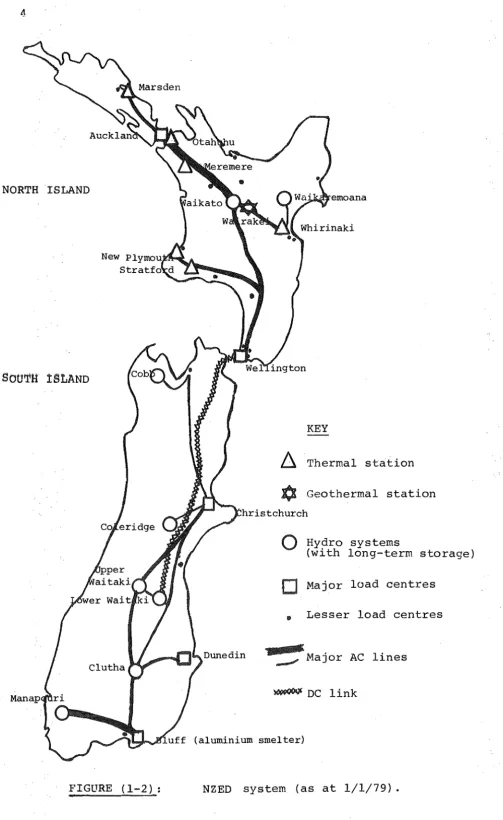
authorities or industries and sold to the national system. Only one of these plants (Waipori, near Dunedin) is at all significant. A simplified version of the system is shown in Figure (1-2). Figure ( 3) shows details of the more complex hydro-electric schemes while Figure (1-4) shows the relative importance of the various generation and load areas. One significant feature of this system is the direct current (DC) link between the North and South Islands. This limited capacity link serves to transfer energy produced by hydro plants in the South Island to the more populous North Island. We have developed a multi-load model partly in order to model this link.
NORTH ISLAND
SouttH
iSLANDKEY
8.
Thermal stationJ)
Geothermal stationHydro systems
(with long-term storage)
Major load centres
Lesser load centres
~ Major AC lines
~DC link
uff (aluminium smelter)
[image:24.554.32.536.13.834.2],
Gibbstown , I (180)
Kawarau ~ ~ (240) Luggate (265) (220)
Clyde Roxburgh Aratiatia (90)
(c) Waitaki River
·Ohakuri (1l2)
Atiamuri (84)
Whakamaru (100) Ohau A Ohau B
Ohau C Upper
t
Maraetai (360) • &eO • • • • • • • • " . " . 44 • • • • • • • • • • • •
. Waipapa (51) Benmore
Aviemore Arapu.ni (lS8)
Waitaki Karapiro (90)
FIGURE(l-~): Hydro sub-systems (as at 1/1/79)
(220)
(lOS)
Lower ~
KEY
0
Power station (MW rating) Water flow___
,'
Under construction
\
-
J(Auckland) G E N E R A
T L
· .
·
"
"
..
I 0
"
..
"
0 p.,
·
..
..
N 0
...
o
-load centre'"
.. oS .. ~ "-
OtherII ~(district office)
1- ...
KEY ~
...
~
....
ft· • ..
f-lellil
l9'
Ie .. .. ..
~
....
....
toncity
....
•••
Taranaki - Wellingto;" ... (Palmerston North) ...
6&::SS~ss:,~JL_:.JJ-
- --_
Nelson (Nelson)
otago (Dunedi n)
FIGURE (1-4): Regional energy balances (in year ended 31/3/77.
[ 46].)
other
Auck land city
East Coast (Napier)
Canterbury
" (Christchurch) \
,
\ \
\ Other \
\ \
, Chris-, churc
city
for NZED system
[image:26.549.47.510.48.712.2]network and the distance of most major generating
plants from major load centres. Thus losses (averaging about 6% over the whole system) and capacity restrictions impose significant limitations on the spatial distribution of generation. This represents a further incentive for the development of a multi-load model.
Note also that the system contains no nuclear or pumped storage hydro plant so that these will not be
considered in our study. There is however one geothermal (steam) plant which is easily incorporated.
Tables (1-1) and (1-2), giving the capacity and
output of each individual station, complete our description of the system. In Section 1.4 we outline the previous optimisation studies carried out on the system while in Chapter 7 we give some results from the application of our model.
1.2 POWER SYSTEMS OPTIMISATION PROBLEMS 1.2.1 Introduction
Naturally, given the expense involved in operating the system and its importance to the nation, a great deal of effort has been expended to ensure that each component is as efficient and reliable as is reasonably possible. In recent years the "energy crisis" has
focussed attention on the problem of ensuring that the best use is made of the resources and equipment available.
"River System"
Waikato (+ Tongariro)
Waikaremoana other NZED Non-NZED Thermal Geo-thermal
Station Capacity (Megawatt rating)
Tokaanu 200 Aratiatia 90 Ohakuri 112 Atiamuri 84 Whakamaru 100 Maraetai 360
Waipapa 51
Arapuni 158 Karapiro 90
Kaitawa
Piripaua 124 Tuai
{
Mangahao } Matahina
92
Marsden 240 Me remere 210 New Plymouth 600 Otahuhu 180 Stratford 208 Whirinaki 108 Non NZED
Wairakei 192
output: Gigawatt-hours (in year ended 31/3/77)
625 363 418 312 539 889 276 884 573
Waikato Total 4,879
594
398
170
Hydro Total 6,041
747 1,104 1,867 39 976 3 19
Thermal Total 4,755
1,233
North IslartdTotal 12,029
"River System" Station
Cobb Cobb·
Coleridge Coleridge Tekapo (A) Benmore Waitaki
Aviemore Waitaki
Clutha Roxburgh
"Msnapouri Manapouri Arnold Other NZED Highbank
Monowai
(Dunedin City Waipori Council)
. Other non-NZED Capacity (Megawatt rating) 32 35 25 540 220 105 320 700 34 91
output: Gigawatt-hours (in year ended 31/3/77)
209 173 113 1,738 723 379
waitaki Total 2,953 1,455
3,717
120
154
104
South Island Total 8,885 New Zealand Total 20,914
TABLB U-2): South Island, generation
(Sources, for both tables, 43 ] and
scale, one may attempt to determine the optimal place of electrical energy in the world economy over the next century, while, at the other end, one may be concerned . with the instantaneous control of a generator or the most
ef~iCient way to boil an egg. Our principal concern in
this study will be with the "long-term scheduling problem". In order to solve this problem accurately we also consider the "short-term scheduling problem". Further, our
solution procedure yields information which can be used to· solve the "optimal tariff problem" and also to make a significant contribution to the "optimal development problem". In the next few sub-sections we outline the
natur~ Of these problems.
1.2.2 :The Long-Term Scheduling Problem
In the long-term scheduling problem the planning horizon is of the order of one year and this is usually divided into weekly or monthly intervals. The objective in this problem is to use the available equipment to meet an. exogenously determined load (or demand) pattern in
suCh a way as to minimise system operating costs, particularly fuel costs. The decision variables, then, are the generation levels of the various plants and the transmission levels
through the various lines of the network. Owing to the Size of the problem one can only deal with aggregate quantities
and limitations on transmission capacity. Non-linearities are introduced by the performance characteristics of
generating plant and transmission lines.
If there were no storage capacity in the system the long-term optimisation problem would become trivial since there would then be no iteraction between the decisions made in successive intervals. Thus we would face in each
interval a short-term problemrindependent of any
consideration of , the future. However the presence of ,long-term storage reservoirs introduces the possibility
of storing potential energy for future conversion to . electricity. Then the long-term problem consists of
finding the optimal balance between production from the various plants in each of the intervals of the planning horizon. This large and complex problem is further complicated by the fact that we do not know what inflows will occur in the future. Whether or not this is taken into account in the optimisation model this means that the model must be regularly re-optimised in order to
provide solutions appropriate to the situations encountered as time progresses. (Unless, of course, the model
involves the optimisation of future utilisation for all ,'possible sequences). So, typically, a long-term
present and future utilisation. Further, in order to
ensure realistic solutions, we must have some model of short-term management.
1.
2.3 The Short-Term Scheduling ProblemHaving decided how much water should be released from each reservoir in a particular interval the utility must then decide a detailed schedule for generation (and
transmission) within the interval. The objective here is to maintain secure supply at minimum·cost.
this as the short-term scheduling problem.
We refer to Typically it will involve determining the optimal generation level at
each
plant for each hour of a day or week .. (With transmission levels to match) • Here again the demand (load) patternand available equipment are considered fixed. Difficulties are introduced by start-up costs in the thermal sector,
flow delays in the hydro-sector and the need to provide "spinning reserve" to cover possible break-downs. Further difficulties arise if the detailed behaviour of the
transmission system is modelled. Again, this problem must be re-optimised frequently to account for variations from the expected demand patterns, tributary inflows or availability of equipment.
1.2.4 The Optimal Tariff Problem
In the scheduling problems already discussed the decision-maker is faced with an exogenously determined
problem, on the other hand, the utility may set tariffs so as to induce the consumers to modify their demand pattern. The objective of this problem may be to set tariffs so as to maximise the utility's profit, to lower costs, to reduce demand or achieve some other policy
objective. Here the operating schedules may be considered constant or they may be decision variables along with the tariffs.
1.2.5 The Optimal Development Problem
Most electric utilities are, in the long run, faced with a steadily rising demand for electricity. In order
~o meet this demand an on-going program of system
development is required. Thus the utility is continually faced with the problem of deciding between alternative expansion plans. We refer to this as the optimal
development problem. Here the planning horizon may be many years long and a fairly aggregated model is required. The decision-maker may be able to exercise some control over demand but in any case there is considerable
uncertainty about his predictions. There is similar uncertainty about future fuel costs, but on the other hand the long-term (aggregate) behaviour of the hydro inflows is basically constant. The decision variables for this problem are the. characteristics of new plant . (constrained by technical considerations) and (possibly)
the operating pattern by which the system would be
is available to meet demands as they occur. The principal difficulties in this problem result from uncertainty about future demand levels coupled with long lead times for the installation of new plant.
1.3
POSSIBLE APPROACHES TO THE LONG-TERM SCHEDULING PROBLEMThis problem concerns any utility whose system
includes long-term reservoirs. Consequently a number of approaches to this problem have been attempted by various groups. In [ 17], we have already evaluated the
approaches taken by Pacific Gas and Electric (PG
&
E) ,the
Swedish State Power Board (SSPB) and E1ectricite deFrance
(EDF). Because our own model is an extension of that developed by the EDF, we have included some relevant portions of [17 ] as appendix A in this study. Another survey, [ 55], classifies a number of techniquesaccording to various criteria without undertaking any detailed analysis. Here we shall briefly indicate some at. least of the approaches which may be taken to schedu~ing
systems such as that of the NZED.
'The long-term scheduling problem in its most general form is a stochastic non-linear problem of huge size. The mu1 tip1ici ty of variables and constraints results from the large number of p1ants,lines, loads and river systems
availability. Each approach to this problem simplifies i t in various ways so as to enable its solution. For instance, in all those reported studies which could be applied to the NZED system, future demand levels have been considered known, as has equipment availability.
All of these models necessarily involve the use of a relatively small number of discrete time intervals rather than a continuous representation. Thus in order to
ensure that the detailed demand pattern within each interval 'can be met the model should incorporate some model of
short-term management. Otherwise, while the release specified by the long-term model may provide sufficient total energy within an interval, the combined effect of storage, release and flow restrictions, along with flow delays, may not allow the energy to be produced when i t is required. Further, even though there may be a feasible short-term production schedule, the thermal costs involved may be much higher than those predicted by a simple
long-term model. Consequently the solution from any model not allowing for this is likely to be rather "over-optimistic" in its predictions.
The construction of a fully stochastic model is made extremely difficult on two counts. The computational requirements are likely to be excessive and in any case the data may not be available. The former problem has
led to a number of investigators adopting purely determistic models.
models.
form of optimal management over all available historically observed inflow sequences. This aspect of these models is discussed and evaluated in Section 9.2.3.
The techniques which have so far been proposed to deal with the long-term problem fall into three categories;
dynamic programming, linear or non-linear programming (without decomposition) and (non-linear) decomposition methods. We give here only a cursory description of the mode1s and their application. Each is designed for a
specific system and has numerous features making i t
particularly useful for that system, but not necessarily for ours. We make no attempt to evaluate their usefulness e~cept inasmuch as they can be applied to our system.
Dynamic programming was first suggested as a solution technique for this type .of problem by Little 32 ]. A modified form of stochastic dynamic programming has been applied in the Swedish model (I 58 ]) discussed in
Section 4 of [ 17]. This model handles non-linear costs by piece-wise approximation and attempts to ensure that the load is met in each load segment of each week of the planning horizon. Its main drawback is the degree of aggregation involved. Not only are all loads
aggregated int6 one, but so are all reservoirs. This model was used principally for development planning and for
setting energy prices. The validity of this approach depends on high correlations between inflows in different reservoirs and a fairly compact high capacity transmission network. These conditions are not really met in our
to allow several reservoirs the "curse of dimensionality" leads to excessive computational requirements. A (multi-reservoir) stochastic dynamic programming model for the NZED system is referred to in the next section.
Linear programming was applied by Pacific Gas and Electric ([ 38 ] and 39 ]) in a model discussed in Section 3 of [ 1 7 ] . This model approximated some non-linear functions by piece-wise linear functions.
Sixteen reservoirs were considered explicitly in the model but all loads were aggregated. The model used monthly intervals and attempted no explicit accounting for short-term requirements, merely using "average" conversion factors etc. It was suggested that a number of
schedules could be prepared,each corresponding to some inflow sequence, and the results combined for scheduling purposes. This model wa& apparently used to some
extent for scheduling purposes. A linear network flow model of the NZED system is referred to in the next section.
Non-linear programming methods have been applied 'directly in a number of studies. three of which are . discussed here. The major drawback with this class
of methods is the incorporation of the stochastic aspects. None of the reported methods has, as yet, attempted to
model this aspect. The solution of large scale non-line~r programs is not generally easy to achieve within reasonable computation times. These models have, however, been successfully applied to realistically sized problems, scheduling weekly
but take no account of the detailed short-term management of river chains. Each deals solely with the
hydro-electric sector, summarising the remainder of the system by the value given to hydro production in the objective fUnction. Loads are aggregated into one and average
losses subtracted, line, capacity restrictions being ignored except for some "bottle-necks" in the Hydro-Quebec model.
The Bonneville Power Administration developed a model of the Pacific North-West System ([ 22 ] and
t
26J) .
This model used a modified conjugate gradient algorithm to solve problems involving as many as thirty-eight long-term reservoirs. The objective used was to minimiseli~h.ergy deficits ", and to spread them as uniformly as
possible through the year. This objective was modified by the use of penalty functions to represent many of the operating constraints. The model was used to determine how much energy could be extracted from the hydro system under specified adverse stream-flow conditions, rather than to directly schedule output so as to meet demand. Thus, in particular~ no account was taken of the necessity of meeting short-term peak power requirements.
Hydro-Quebec have developed a model of their system ([25)} using a reduced gradient approach. This system involved nine "equivalent mid-term reservoirs" (where their "mid-term"reservoirs would be considered IIlong-terml l
were modelled. Run times were "surprisingly good" and this model is intended for use as a scheduling tool.
The Tennessee Valley Authority have developed a model of their system ([ 54]), simplified to consist of six
long-term reservoirs within one river valley_ This model applies a specialised reduced gradient technique to a network
model. The objective function is rather complex, being designed to represent the benefits from the displacement of thermal power by hydro power. Again no explicit
modelling is currently undertaken of short-term management although some account of this is included in the objective function. The transmission network is not (explicitly) modelled. Computa.tion times have been encouraging and i t is intended that this model be extended to model the whole Tennessee Valley system (19 reservoirs) and to incorporate. stochastic inflow data. Currently the model is.used for planning purposes although, when i t is extended, i t is intended to become a scheduling tool.
Finally we consider the (non-linear) decomposition .technique developed by the Electricite de France and
discussed in Section 5 of [ 17 ] (cf. Appendix A) . The central idea of this model is the use ofa system of
"energy prices" (or "dual varjables" or l'Lagrange multipliers" or"shadow prices") to co-ordinate output from the different units. The model involves a hierarchy of programs. The global program,P3,determines a set of trial prices for energy delivered in each load segment of each time
of each long-term reservoir in turn, using a "trajectory method". Another program, P4, sometimes considered as part of P3, determines an optimal long-term thermal schedule on the same basis. The global program then compares total generation with total demand, adjusting the
prices
so as to decrease the difference. This processcontinues until supply and demand are matched in each segment of each interval. During each iteration the local programs make repeated use of tables prepared by a river scheduling program~Pl.
In this model each long-term reservoir is modelled explicitly_ Also the limitations imposed by realistic ehort-term river management are given more weight than in any other reported model. Peak load requirements are treated realistically although all loads are
aggregated into one. Two methods have been proposed for the incorporation of stochastic inflow data. These schemes are discussed in more detail in Section 9.2.3. This model is in the process of being applied to the rather
large EDF system. A fuller description of the model may be found in Appendix A.
The purpose of this study has been to develop a tool"suitable for realistic long-term scheduling in the NZED system. The acceptability of such a model will depend on its modelling of certain key factors. One of these is the stochastic nature of the inflows. Large-scale linear or non-linear programs cannot really model
programming/network-flow model has been developed separately ([ 5 ]). Given the nature of the NZED system the single reservoir approach of the SSPB model seemed inadequate. (AI though, as an interim measure, a single
reservoir adaptation of the EDF method ([ 6 ]) should prove usefuU. We decided to base our approach on that of the EDF because:
(a) it has a natural, intuitively appealing, economic interpretation;
(b) it models the thermal system explicitly; (c) it ensures sufficient peak power;
(d) it models each long-term reservoir explicitly: (e) it models each river chain, and so makes realistic
allowances for short-term requirements;
(f) it can be adapted to account for stochastic inflows, (al though some LP or NLP approaches could be similarly adapted, the resulting programs would be too large for solution by present codes);
(g) it can be adapted to model the transmission network.
1.4 EARLIER WORK IN NEW ZEALAND
The short-term scheduling problem has received the most attention. Turner ({ 62 ]) developed a dynamic programming model for the short-term scheduling of a chain of hydro reservoirs. This model was applied to derive operating rules for the Waitaki river system involving, at that time, three stations in a single chain. This approach was developed further by Green ([ 23 ] and
[ 24 ]), but eventually abandoned, partly because it could not easily schedule river chains with several
stations (in particular the eight stations on the Waikato) . . This method was superseded by a heuristic approach originally developed by Bull ([
10]).
The 06jective of thisheuristic is to use the hydro system to supply peak power, flattening the residual load curve so as to allow
economical operation of the thermal system. Accordingly the algorithm commences by scheduling production from the top station in the chain so as to reduce the peaks as far as possible. It then proceeds to schedule each of the stations down the chain, Cl-ssuming the rele.ases scheduled from the upstream stations, so as to reduce the peaks still further. If the schedule produced by this
The above methods deal only with the short-term
scheduling of individual river systems. Turner ([ 61 ]), on the other hand, developed a short-term scheduling model for an inter-connected system with a simplified hydro sector. This model used the "co-ordination equation" approach,
maximising efficiency by equating the marginal costs of delivered power from all sources. Here "water values" (y)
were adjusted so as to ensure that specified release targets were met, while incremental costs (A) were manipulated in order to satisfy demand. Development work on this
model was halted before i t became fully operational. Currently a simpler model, utilising the previously described heuristic, is used to produce "reasonablelt
short-term schedules ([42]).
Further studies on optimising transmission patterns were undertaken by Boshier ([ 2 ] and [ 3 ]). He
applied a non-linear progranuning method to the "voltage scheduling problem", a sub-optimisation of the short-term scheduling problem. He utilised a "created response"
(or "penalty function") method to produce an unconstrained problem which was solved using a standard IBM "Fletcher-Powell minimisation" package. The method worked well on small problems and certain large ones but could not be applied more generally.
Long-term scheduling has received comparatively little attention until quite recently. Currently ([ 37 and
A minimum storage "guideline" (cf. Basic Rule Curve in 9 ] ) is developed. Starting from any point on this guideline secure supply can be ensured (with 95% certainty) for the remainder of the year by base-loading all thermal plant. A set of such guidelines is produced each corresponding to some lower, and hence cheaper, level of base-loaded thermal plant.
Then, if during the year total storage falls below one of these guidelines, the corresponding thermal stations are base-loaded. This approach is easily seen to be
optimal if, and only if, the adverse inflow sequence on
which the guidelines are based (5% Design Dry Year) actually
odeUra.
Thus this method is designed to ensure systemsecurity rather than to minimise costs.
As with any aggregated equivalent reservoir model the aggregate releases must be apportioned among the
individual reservoirs. For this purpose a program has been developed by Boshier ([ 4 ]) . His approach is to
operate the lakes so that they each have an equal
probability of eventually becoming over full and so being forced to spill water .
. The possibility, and desirability, of developing techniques for optimising. long-term scheduling was
recognised in the late sixties ([ 37 ]) . A number of . techniques were considered ([ 34 ]) with attention being focussed on the methods developed by the Swedish State Power Board and Electricite de France. The former method has been outlined in the previous section and is described
earlier of the two EDF models described in Appendix A (also in [ 17 ]), was adapted for New Zealand conditions by Lusk ([ 33 ]). However research on this model was abandoned before any useable tool was developed.
McKerchar, on the other hand, developed a dynamic programming technique to optimise the long-term management of a chain of reservoirs on one river ([ 35 and [ 36·]). He used synthetic hydrology to generate a large set of
"inflows" then used deterministic dynamic programming to determine optimal decisions for each one, using regression analysis to derive a single resonable decision for the immediate problem. This study was primarily concerned with hydrological considerations and could not, in any
case, be easily generalised to deal with more than one river chain. Thus, although the program was tested on the Waitaki River system, no attempt was ever made to apply i t to the national system.
MOlErecently a number of models including the one reported in this thesis have been developed in parallel. While this has involved a considerable duplication of
research effort i t should in the long run result in the selection of a management tool whose optimality can be checked by other methods, and which is well suited to the NZED.
reservoir releases must again be derived using some
scheme such as that of [ 4 ]). The optimal initial release is found by simulating trajectories for each year of the available historical inflow data. In order to do
this
some hypothesis must be made as to the futuremanagement of the hydro system. The effect of a number of alternative hypotheses is currently being investigated. It is assumed that short-term management will follow certain traditional patterns. The major limitation of this model is its highly aggregated nature. The extent to which this affects the optimality of the solution can only be judged by comparison with a more detailed model such as
that
developed here. We are not yet in a position toundertake any meaningful comparison.
Secondly, a linear multi-reservoir model has been developed by Boshier and Lermit ([ 5 ]). Here the system is represented by a network consisting of a sub-network similar to that of Figure (1-1) for each time interval, the intervals being connected by the arcs representing storage in the various reservoirs. This model allows for several load classes and incorporates
the DC link. It has since {[14]) been generalised to model some of the non-lineari ties by piece-\.;ise linear functions. The network flow solution procedure of [ 5 ] has been
from the LP) and no attempt has been made to use i t for scheduling purposes.
Finally~ Daellenbach ([ 16
J)
has developed amulti-reservoir stochastic dynamic programming model. The purpose of this model was to aid in assessing the gains which could be realised by using various stochastic models. The major drawback of this model is that, even restricting attention to major reservoirs, the dimensionality of the problem is too high to allow reasonable computation times. Thus, while the model should prove useful for its intended purpose of stoc~astic model evaluation, i t is not likely to be adopted for realistic scheduling.
So there is currently no optimal long-term scheduling program in use by the NZED. In view of the importance of the system to the national economy, both in terms of its . contribution and its cost, the introduction of some such
program is clearly desirable. It is intended that
initially the single-reservoir trajectory model will be run experimentally, in parallel with the current management
methods. Hopefully, as management are convinced of the model's reliability, its recommendations will be given greater weight in day to day decision making. During this period, our more detailed model is to be developed
·to the stage of becoming a useful tool for real, week by week, system operation.
of our ,study.
1.5 OUTLINE OF THIS STUDY
The purpose of our study has been to develop a realistic technique which can be applied to determine optimal release, generation and transmission schedules,
week
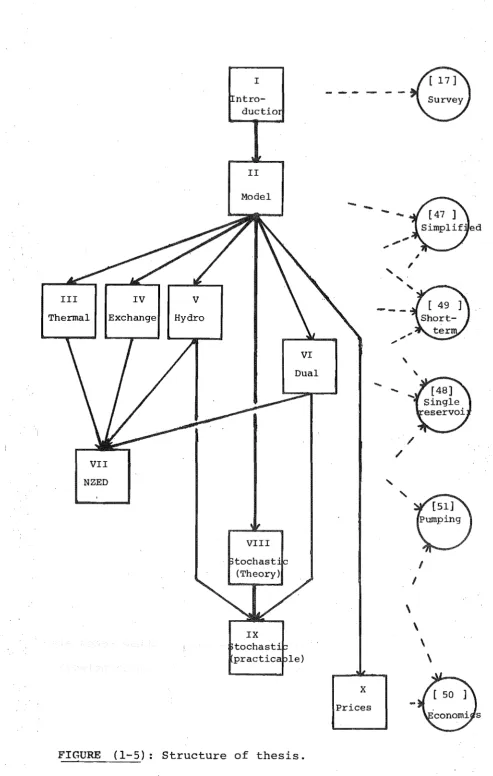
by week, for the NZED system. The development,evaluation. and implementation of such a model is a massive task which will not be complete for some time yet. Our intention here is to present a theoretical model along with some preliminary results from its application to the system. The remainder of this section outlines the content of this thesis, the structure of which is summarised by Figure (1- 5 ) •
Firstly, in Chapter 1 we have outlined the nature
of
the
system and some of the problems involved in operating i t efficiently. We have briefly -outlined some approaches to the long-term scheduling problem. A survey paper([ 17 ]), previously published, considers three of these in more detail. We have adopted the basic approach taken by the EDF
Appendix A. been. outlined.
and so include a description of this as
Previous studies on the NZED system have also
in the right place at the right time.
It
c.:.m dc') this bysetting appropriate "energy prices".
Any particular set
of prices will induce predictable (maximum profit) production
'and transmission schedules for each independently managed
component.
The problem faced by the central authority
consists then of adjusting energy prices until the induced
schedules are satisfactory from a national point of view.
This price adjustment problem is known as the dual problem
(DC or DA), while the optimal response of the system to any
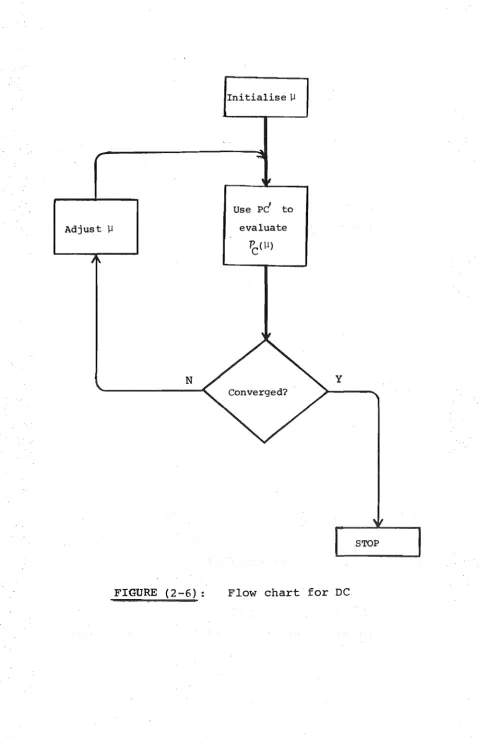
set of prices can be found by solving the Lagrangian problem
(
PC
'or PA ).
tThis latter problem cantof course, be
decomposed into a multitude of smaller problems, each
corresponding to the problem faced by the manager of some
component.
This approach, similar to that of the EDF,
is merely another form of the classical economic concept
of using prices to equate supply and demand in a competitive
economy.
(Note that we do not propose operating the system
in this manner.
We model it in this way in order to derive
optimal policies which are then communicated to the
operators of each component).
Our approach differs from that of ,the EDF in two major
respects.
Firstly, we have generalised their model so as to allow
some representation of the losses and limitations involved in
the transmission system.
This generalisation was motivated
by the presence in the NZED system of the DC link between
the North and South Islands and also by the generally sparse
nature of the transmission network.
The EDF model is a
commodity delivered to a central point to meet a national load (plus fixed losses). Our model, on the other hand1
is a multi-load model in which each load centre or generation plant may be treated separately. It is easy to see that an optimal solution to a single-load model may not be optimal
(because of the losses involved) or even feasible (because of the limited capacity of certain lines) when applied to the real system. These problems are very real in the
NZED system. Thus our model, taking into account both losses and constraints in the network, represents a significant
step towards realistic modelling of this system.
Note that we do not concern ourselves with the type
o~ tailed load-flow calculations commonly encountered
in short-term optimisation. Rather we are concerned with the approximate losses likely to be incurred by major inter-regional energy transfers under "average" conditions. The inclusion of this representation of the transmission system naturally complicates the
solution procedure. The extra computation involved is, however, surprisingly minor. We have an extra set of sub-problems, the exchange problems (PE), which are easily solved via calculus. Apart from this the dual problem (DC or DA) has to adjust more variables, which,
in our method, does not present any significant difficulties. This multi-load model, without the complications discussed below, has previously been presented in [ 47 ].
is supposed to adjust national energy prices (A), for each load segment of each period, so as to ensure sufficient generation in each such segment. In order to model the short-term management of hydro stations, a "price duration curve" is derived from these prices. This curve is then used by a heuristic program (PI) to model the short-term management of each river chain. The results of this
procedure are stored in tabular form and used as input into the long-term hydro scheduling program (P2). We have
generalised this by allowing for the derivation from the ·"aggregate" (>..) prices of a IIdetailed" price curve (ll).
This price curve, unlike a price duration curve, allows us to model exactly the dynamics of short-term management: flow delays and restrictions, storage restrictions and the like in the hydro sector, start-up costs, delays and
restrictions in the thermal sector. (See [ 49 ]). Consequently, in Chapter 5, we are able to develop an
optimal short-term scheduling procedure (PASH) for a river chain (given the II prices), the results of which can be tabulated as a function of the >.. prices for use in the long-term hydro scheduling problem (PALH). Naturally, given our modelling of the transmission network, we have a different set of (>..) prices for each region and allow that the detailed (ll) prices may vary spatially as well as temporally.
corresponding to the global EDF model (or to that of [ 47 ]). In our aggregate model we require, however, that the aggregate quantities determined by this model be managed in accordance wi th the short-·term sub-models. We assume that we can
derive the detailed prices,~(A), from the aggregate prices, A, so that they are sufficiently close to the true detailed price(~ for the complete dual DC) that, at the
optim~l A, the corresponding detailed schedules as determined
by the sub~models on the basis of ~(A), are satisfactorily close to the true optimal schedules. Here, rather than
the arbitrary assumptions made in PI, we allow a flexible price derivation scheme to be based on feed-back from the
ap~lication of the model. This approach allows us not only
to model short-term management more accurately, but because of its flexibility, to match the supply and demand patterns
far more exactly.
This increased accuracy is achieved at no expense at
all in the aggregate problem (which must be re-run frequently). The extra computational burden is incurred entirely in the preparation, via the short-term sub-models,of the tables summarising system response.
Chapters 3 and 4 deal with the solution of the thermal (PAT) and exchange (PAE) sub-models resulting from the
they may be used to build up tables describing the response of each component.
Chapter 5 deals with the solution of the hydro
sub-model. This problem is approximated by a long-term problem (PALH) and a short-term problem (PASH). The short ... term problem, corresponding to PI, is solved by a true
optimisation procedure utilising the detailed prices. It is used to build up tables summarising the output (and its value) from each hydro system, when optimally managed in the short term, as a function of the aggregate prices (and
tributary inflows). The "value of release" functions so determined are used in the long-term problem which
determines the optimal long-term schedule using the "trajectory method" developed by EDF.
Chapter 6 deals with two topics, the derivation of detailed prices from aggregate prices and the adjustment of aggregate prices in the dual problem (DA). In this
latter problem we have adopted a rather more sophisticated approach than that of the EDF model. This is required partly because of our modelling of the transmission network and partly because the small size of the NZED system
results in very "erratic" system response surfaces. This· general approach should, however, produce even better
results when applied to a larger, and hence less "lumpy", system.
Chapter 7 presents some preliminary results from the application of our model to the NZED system. These results
'.
of the deterministic long-term scheduling model.
Chapter 8 summarises some recent results from the theory of optimal recourse problems and then generalises our model into this stochastic framework. This stochastic lonq~term scheduling model can be decomposed analagously to PC, using prices for energy delivered to each region, in each load segment, of each period, under each of the observed historical inflow sequences. The resultant thermal and exchange sub-models are identical to the
deterministic sub-models of Chapters 3 and 4. The hydro sub-model, however, is much more complex than its
deterministic equivalent. Some general principles relating
to
its
solution are developed.Chapter 9 considers the practical solution of this stochastic hydro sub-problem. A number of approaches,. particularly those of the EDF, are evaluated and a,new
method proposed. The chapter concludes with a consideration of ' the "stochastic dual problem" involved in adjusting
the prices involved in the stochastic model. Note that in these two chapters we have ignored any consideration of the short-term problem. Thus this model, a direct extension to that of [ 47 ], can be considered as the
stochastic version of the complete deterministic model (PC), with, rather long "instants", or of the deterministic
![FIGURE (1-]): Idealised power system.](https://thumb-us.123doks.com/thumbv2/123dok_us/9971274.497951/22.549.17.494.30.819/figure-idealised-power-system.webp)