1
Examining Work Framing as a Method to
Explore Cognitive Crafting of One’s Job
Author: Rikke van der Heide Tutor 1: Dr. Mark van Vuuren
Tutor 2: Dr. Jordy Gosselt
Master Thesis Communication Studies | University of Twente 15 April 2013 | Enschede, The Netherlands
Purpose – Exploring the cognitive crafting of one’s job as a social constructivism approach to job design.
Design/methodology/approach – In this study, cognitive crafting is argued to be closely related to how employees frame their work. Hence, capturing how employees frame their work is used to explore cognitive crafting. To do this, 34 mail carriers are interviewed using open interview
techniques, enabling participants to fore- and background aspects of their job which they consider as relevant and irrelevant.
Findings – Mail carriers appear to frame their work in five distinct ways: as (1) an income, (2) a part-time job, (3) a pleasant job/activity, (4) having something to do/remaining socially involved, and (5) having a ‘normal’ job. Moreover, these framing categories appear to relate to job attitudes in general and turnover intention in particular.
Research limitations/implications – The results imply that cognitive crafting is an essential aspect of job crafting and has a considerable effect on job attitudes and behaviour. Besides, it is argued that future studies on cognitive crafting should treat it as a more multidimensional concept. Furthermore, it is argued that clarification is needed on the different cognitive concepts and their interrelation in the job crafting model of Wrzesniewski and Dutton (2001).
Practical implications – Based on the finding that different employees frame their work differently and, thus, are sensitive for different aspects of the job, suggestions are given both for human resource and for operational managers.
2
Introduction
“Truth can be stated in a thousand different ways, yet each one can be true.”
Swami Vivekananda (Indian Hindu monk)
Organizational scholars who are interested in how employees experience a job, traditionally focus on either individual determinants such as expectations or values, or characteristics of the job itself such as the work tasks or social interaction at work (Wrzesniewski and Dutton, 2001). Furthermore, traditional organizational scholars often start with the presumption that these characteristics of the job and the work environment are objective (Daniels, 2006). Although these studies have provided useful insights into how job designs will lead to certain experiences and behaviour for different people, these studies ignore the fact that individuals can have different interpretations of these -commonly assumed to be objective- job characteristics. Therefore, in this study I adopt the idea that job characteristics should not be treated as objective characteristics but rather as subjective characteristics. These characteristics can be interpreted differently by different employees and thus can explain variations in job attitudes and behaviour based on these different interpretations rather than (only) by individual determinants such as personality, expectations or values. The aim of this study hence is to empirically investigate how various employees, having a similar job, differently interpret their work and how this relates to job attitudes and behaviour.
Adopting the idea that job characteristics should be treated as subjective rather than objective characteristics places this study in the research paradigm of social constructivism. In general terms, a research paradigm is a set of basic beliefs that represents a worldview that defines, for its holder, the nature of the world, the individual’s place in it and the range of possible relationships to that world and its parts (Guba and Lincoln, 1994). Each research paradigm consists of particular ontological, epistemological and methodological assumptions (Guba and Lincoln, 1994). In the social
3
A domain of organizational studies that adopts a social constructivism approach, and as a result focuses on how employees use aspects of their work to construct a local reality, are studies about job crafting. Job crafting is the activity in which employees, that are holding the same job, actively craft their job by changing cognitive, task, and/or relational boundaries (Wrzesniewski and Dutton, 2001). People engage in job crafting for three reasons: first, to claim some control about their job and to avoid alienation from their work; second, to create a positive self-image in their work; and third, to fulfil a basic human need for connection with others. (Wrzesniewski and Dutton, 2001). The result of job crafting is that employees experience altered job designs and social environments at the job, which in turn affects the work meaning and work identity of these employees (Wrzesniewski and Dutton, 2001). Since job crafting influences the interpersonal dynamics of the workplace, which tasks are completed and how they are completed, it has the potential to greatly impact individual and organizational performance (Berg et al., 2008).
Empirical studies on job crafting confirm that job crafting occurs (Ghitulescu, 2007, Lyons, 2008). The results of these studies clearly identify two of the three aspects of job crafting: tasks crafting and relational crafting. The third aspect, however: cognitive crafting, is less obviously identified, or is measured in a rather narrow manner. In Lyons’ study, 107 sales representatives were interviewed. The results revealed that 78% of the participants at least once mentioned an attempt for job crafting. Furthermore, he found that a considerable amount of these attempts were directed towards tasks or relationships changes, implying less occurrence of cognitive crafting. In addition, the study conducted by Ghitulescu (2007) did measure cognitive crafting, it was measured, however, using a very limited measurement tool. Her study focused on the antecedents and consequences of job crafting and included the measurement of all three aspects of job crafting and their relation to work outcomes. For measuring cognitive crafting, Ghitulescu (2007) used the task significance measure created by Hackman and Oldham (1976). It can be argued, however, that the task significance measure is a too limited tool to capture cognitive crafting, as it just measures the single dimensioned concept of meaningfulness. It might be argued, however, that cognitive crafting is more dimensional since it does not solely affect the amount of meaning people give to their work, but also the meaning that employees give to their work. The meaning of work for example, can be a job, an income, a higher calling, something to do, etc. On the contrary, task significance can only be more or less meaningful.
These findings ask for further exploration of the cognitive aspect of job crafting. Especially so, since altered work meaning, as cognitive concept, is one of the main outcomes of job crafting and thus might be considered as particular relevant. This presumed relevance of the cognitive aspect of job crafting, in contrast to the less obvious empirical appearance and narrow measurement of the concept in the two studies of Lyons and Ghitulescu, makes exploring the complex phenomenon of the
4
Meaning, Sensemaking and Framing Repertoires
In order to successfully explore the phenomenon of cognitive crafting, it is important to understand the concept. Equally important though, is to determine how it can be measured. Measuring cognitive crafting can be a challenging task considering that it is a mental process and therefore relatively difficult to capture. In the following paragraphs, theory will be presented that serves both goals. First, theory about work meaning is described. Than sensemaking theory is introduced, which can be used to understand how meaning is created. This section ends with elaboration on a specific aspect of this sensemaking process, called framing, which is useful for understanding and eventually mapping out how people actually give meaning to something.
Work meaning is an important concept in the job crafting model as it is depicted as one of the final outcomes of the process (Wrzesniewski and Dutton, 2001). Work meaning, just as cognitive crafting, is a cognitive concept which makes work meaning a good starting point for exploring cognitive crafting. In general, meaning is defined as the output of having made sense of something, or what it signifies. In the context of work, meaning refers to how an individual interprets what the work means to him/her, or what role it plays in the context of his/her life (e.g., work is a pay-check, a higher calling, something to do, an oppression; Pratt and Ashforth, 2003; in Rosso et al. (2010, p. 94)). When a job is perceived as meaningful, it is found to lead to several favourable work outcomes such as motivation (Hackman and Oldham, 1976), job satisfaction (Wrzesniewski et al., 1997) and/or work behaviour (Berg et al., 2010). Another finding from these studies is that similar jobs can have different meanings for different people. Hence, referring to Weick (1995): individuals may share the same experiences but do not necessarily have to share the same meaning. As meaning is the output of job crafting, understanding how (different) meanings are created is a next step that brings us closer to understanding the phenomenon of cognitive crafting.
5
sensemaking, it is suggested that conversations with other people affect how an individual makes sense of something. Knowing how someone makes sense of a situation is useful because depending on how sense is made affects how an individual behaves in that same situation (Weick et al., 2005). Comparing this sensemaking process with cognitive crafting reveals that the bracketing and labelling stage shows great resemblance, or can even be considered as equal, to cognitive crafting, as both aspects affect the way in which people see a situation. Hence, to examine cognitive crafting, theory will be used belonging to this stage of the sensemaking process, called framing.
Framing is defined as: organizing experiences through a certain way of defining what is going on in a situation. This definition occurs retrospectively when people bracket their experience and give it meaning in a particular fashion (Brummans et al., 2008, p. 26). When a person defines what is going on, certain aspects of a situation are foregrounded and other aspects are backgrounded, similar to the bracketing of cues. Subsequently, these foregrounded and backgrounded aspects are given a particular label, similar to the interpretation of cues. These labels are taken from a persons’ framing repertoire. Each individual uses their own framing repertoire to describe a situation. What labels are used, and thus what particular framing repertoire someone has, is determined by a person’s motivation to find plausible explanations for a present situation by taking into account former experiences and events. People, thus, use labels taken from their particular framing repertoire to apply to foregrounded and backgrounded aspects of a situation in order to create a coherent story of ‘what is going on’ and make decisions about ‘what should be done’ in line with this story (Weick 1999, as cited in Brummans et al., 2008, p. 28). Consequently, how a situation is framed affects how people react and behave in that certain situation. It should be noted, however, that the type of framing used in this study -as a way of organizing experience by retrospectively looking for plausible explanations- is distinct from frames as mental structures which facilitate organizing and interpreting incoming information by fitting it into memorised, already learned, schemas or frames about reality (Dewulf et al., 2009).
6
Case introduction: Work Framing of Part-time Postal Workers
The research was conducted amongst mail carriers in a nationwide postal service organization. This organization employs about 25.000 mail carriers. The organization’s policy is to offer no other than temporal or permanent part-time contracts and to pay the statutory minimum hourly wage. For each mail carrier, the job description entails picking up the mail for his/her delivery area from a local depot and subsequently distributing it to the correct address. There is no determined starting or ending time. The only restrictions are that the mail is delivered to the depot around ten thirty in the morning and that it should be delivered before five o’clock in the evening. Additionally, some mail carriers are offered small additional tasks such as cleaning up the depot or training newly hired mail carriers.
At the moment of research, the organization was in the midst of an extensive reorganization in order to respond to, and anticipate on, the declining mail market. This reorganization encompassed three major changes. The first change is that, gradually, all full time contracted mail carriers will be phased out and be replaced by part-time contracted mail carriers. The second change is that the mail carriers are not responsible anymore for their own mail preparation. Instead, the mail is now prepared in central preparation canters and distributed from there to the local depots. The third change has less impact on the daily operation of the organization, but is nonetheless quite influential. This third change is, that in a time span of just ten years, the organization’s name and corporate branding changed four times. This covers the work outfit for all mail carriers, every public mail box, all corporate communication and the branding of the entire vehicle fleet. Hence, the reorganization has both a major impact on the organization’s internal processes and is clearly visible for the public.
Resulting from the strategic decision to replace all full-time mail carriers by newly hired part-time mail carriers, thousands of new mail carriers are hired. This major operation, along with the turmoil and uncertainty inherent to any reorganization, is said to have led to an alarmingly high turnover rate amongst mail carriers. At the moment of this study the organization struggled with an average annual turnover rate amongst mail carriers of around 60%. In some of the bigger cities, the average annual turnover rate even surpassed the 100%. In order to identify and understand why so many mail carriers decided to quit, the organization initiated an exploratory investigation, which consisted of orientating talks with mail carriers from various depots. The results of these talks did, indeed, reveal various reasons why former colleagues had quit. Another highly interesting finding was that a great variety appears to exist in the ways how mail carriers perceived their job. This varied from mail carriers who were very enthusiastic about their job to mail carriers who were so dissatisfied with their job that they were thinking of quitting.
7
someone frames his/her work affects how he/she behaves, as it is stated that sensemaking serves as a springboard into action (Weick et al., 2005). More specifically, Tims and Bakker (2010) suggest that job crafting can lead to positive organizational outcomes, amongst which reduced personnel turnover. Therefore, besides exploring if, and how, mail carriers frame their work in a different way, this research also focuses on how a particular way of framing one’s work relates to job attitudes in general and turnover intention in particular. Hence, in pursuing the main goal of this study which is: exploring cognitive crafting, the following specific research question is formulated: What distinct framing repertoires do mail carriers use to describe their work and how do these relate to turnover
intentions?
Method
The research question: “what distinct framing repertoires do mail carriers use to describe their work, and how do these relate to turnover intentions?” can be divided into two major aspects. The first is whether, or how, mail carriers frame their work differently. The second aspect is whether, or how, these different ways of framing a job relate to the intention to quit. Investigating these questions was done by exploring what different framing repertoires are used by mail carriers when describing their work and whether or not they mention to have the intention to leave the organization or not. In order to find out what distinct framing repertoires are used, an explorative research design was used. An explorative research design facilitates the construction of presumptions of a subject by analysing descriptive data (Baarda et al., 2009). It is assumed that carrying out an explorative research is done best by using qualitative research methods. These methods help to explore and to deeper understand a phenomenon, in contrast to testing and generalizing beforehand formulated hypotheses, as is often the case with quantitative research methods.
Data Collection
8
or exclusion of the time dimension. In a narrative interview, participants are asked for a story that happens over time, in a topic interview the time dimension is largely neglected.
To capture what framing repertoires mail carriers used to describe their job, or in other words: which aspects of the job are foregrounded and backgrounded in describing their work, each
participant was asked to freely respond to four broad interview topics. The four addressed interview topics are:
(1) Questions about the initial motivation for applying to the job and familiarization with the organization. This included that the participant was asked to tell his/her story about how he/she experienced the work. Beginning their story from the first moment they got in contact with the organization and ending at the present moment.
(2) Questions in a more closed form that asked for what the work meant for the participant at this present moment.
(3) Questions in a very open form that asked for their opinions about the job.
(4) Question in a more closed form that asked what expectations the respondent had for the future in regard to staying at or leaving from the job.
The objective of the first interview topic was to gain insight in the background of the participant and the motivations he/she had to apply. Furthermore, this question aimed at identifying what aspects of the job were important for the participant based on the memories that the participants included in his/her narrative. This could include all sorts of memories of their job: remarkable happenings, noteworthy events, negative experiences, positive experiences, etc. The objective of the second topic was to identify what the work meant for the participant. The objective of the third topic was to shine light on whether a particular motivation to apply or meaning of the job could be related to certain opinions about the job. These opinions could include anything, either positive or negative. Obviously, the interviewer asked for reasons behind any given opinions. The objective of the last question was to measure the relative weight of the given opinions, as it might be assumed that the intention to quit could be a strong indication for the impact of those (negative) opinions.
Participants
9
Nonetheless, three mail carriers refused to participate because they did not like to be interviewed or did not want to be slowed down during their work. Two mail carriers had to be left aside because they did not spoke the same language as the interviewer. Lastly, not all mail carriers of the selected depots have been interviewed because some mail carriers only worked one or two days per week. Waiting for them would have cost too much time. Eventually, the number of participants totalled 34, of which 19 (56%) were male and 15 (44%) female. The average age of the participants was 45 year old, with a great age distribution: the youngest participant was 22 years old; the oldest participants 63 years old.
Procedure
With the agreement of the relevant supervisor, each of the selected depots was visited. In some cases the interviewer was introduced to the mail carriers by the supervisor, in other cases the interviewer had to introduce himself. To be recognized and to appear credible, the interviewer wore recognizable company clothing. Before starting the interview, the interviewer introduced himself, explained the goal of the investigation and stated that the interview results would be treated confidentially. After it was agreed to participate in an interview, permission was asked to audio record the interview. On average, the interviews lasted approximately 40 minutes, ranging from 25 to 70 minutes. No specific rewards were offered to the participants. It should be noted, however, that the interviews were conducted during working hours, which makes it likely that the extra time it took to participate in the interview was claimed. Nonetheless, the additional time the interview took could never have exceeded the 30 minutes.
The interviews were conducted during the execution of the mail delivery. This implies that the interviewer was shadowing the participants while simultaneously asking the interview questions. Except for the fact that this was time and cost saving for the participants and the organization, it also served the goal of seeing employees in action in their natural work environment which helped creating understanding of how participants enact their role and/or perspectives (McDonald, 2005). This
shadowing served three specific goals. First, it decreased the tension between the interviewer and the participants since the participants felt more comfortable as they had something to fall back on while taking time to think of an answer. Secondly, it gave more insight into how particular roles or
10
Data Preparation
With one exception, all interviews were transcribed verbatim. In the only case that the participant did not agree on audio recording the interview, notes were taken during that interview and processed directly afterwards. In order to not to forget essential impressions of the interviews, the audio recorded interviews were transcribed as soon as possible after the interview. The transcripts included both the questions of the interviewer and the answers of the participants. Intonation and/or
punctuation were largely excluded from the interview transcripts. In a few transcripts, exceptions were made when the interviewer or the participant laughed before or after an interview fragment, as it could possibly influence the later interpretation of the fragment. Notable moments that happened during the interview were written down as well. In some cases, a participant started a (long) story that had no relation whatsoever with the subject of study. In such cases, it was decided to not describe these fragments verbatim but to only mention that the participant told a story about that irrelevant subject. The data preparation resulted in 34 transcribed interviews covering a total of 184 single spaced A4 pages.
Data Analysis
To manage and analyse the qualitative interview data, several data analysis steps were taken. Analysing multiple interviews can be done by either starting with a cross case analysis or with an individual case analysis (Patton, 2001). Cross case analysis focuses on the variations of answers given to a single topic across all interviews. This can be seen as a horizontal approach. Individual case analysis focuses on the content and patterns of the interview answers of one individual participant. This can be seen as a vertical approach. In this study both analysis have been performed on the interview transcripts, starting with the cross case analysis.
The intent of the cross case analyses was to reveal the variation in responses to each of the four interview topics, as given by all participants. Besides providing an overview of the various specific answers given to the four interview topics, it also offered the opportunity to categorize these specific answers into more abstract response categories. Each of the four interview topics was analysed using the constant comparative method described by Glaser and Strauss (1967). This method entails that when a specific response is identified, it is placed in a more abstract response category. Subsequently, it is determined whether responses from other interviews fit in this already identified category. If so, it is added, if not, a new category is defined. This process continued until all specific responses have been categorized.
11
participant applied for the job and what he/she remembered as noteworthy from the first contact with the organization to this present moment; (2) what the work means for him/her; (3) what his/her opinions are about the job; and (4) what he/she expects from the future in regard to staying at or leaving the job. Each interview summary was scrutinized for recurring patterns in the interrelation between responses to the four interview topics. This was a challenging task since the interview questions had no determined number of responses categories. It was just the opposite: because the interview questions were fairly open, a limitless number of possible combinations between the
answers of the four interview questions was possible. When a possible pattern was identified in one of the interview summaries, it was compared to other interview summaries in order to see whether this pattern also occurred elsewhere. As this constant comparison process proceeded, the identified patterns evolved in such a way that they did not just restrict to relations between two of the interview responses, but that they encompassed all four interview responses. This data analysis stage eventually led to the identification of five distinct response patterns, each of which reflects how participants answered during the interview as a whole. These five patterns, consequently, mirrored how
participants framed their job. The outcome of the analysis was that mail carriers can frame their work in five distinct ways: (1) as an income, (2) as a part-time job, (3) as a pleasant job/activity, (4) as ‘having something to do’/remaining active in society, or (5) as a 'normal' job. Further elaboration of these framing categories can be found in the Result section of this paper.
The identification of different framing categories, as described before, answers the first aspect of the research question: “do mail carriers differently frame their work, and if so, how?” The final data analysis stage focuses on the second aspect of the research question: “do different ways of framing one’s job, relates to the intention to quit, and if so, how?” To answer this question, participants were clustered based on the mentioned intention to quit and related to the identified framing categories. This last data analysis stage, thus, provides information on the possible effects of framing a job in a particular way.
Trustworthiness
To ensure reliable and valid results in qualitative research, methods and analyses should be
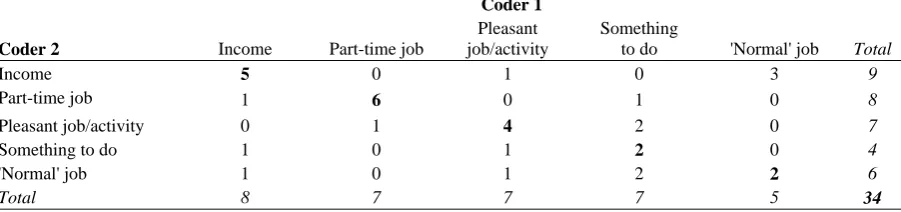
trustworthy (Guba, 1981). To pursue trustworthiness, seven second coders were asked to categorize, the assigned to them transcripts, into one of the five identified framing categories (as introduced above and elaborated in the Result section). Comparison between the categorizations of the researcher and the second coder revealed that there was a moderate inter-rater agreement with a Cohen's Kappa of 0.45, see Table 1.
12
Table 1
Crosstab results of the initial inter-rater agreement for placing mail carriers into framing categories*
Coder 1 Coder 2 Income Part-time job
Pleasant job/activity
Something
to do 'Normal' job Total
Income 5 0 1 0 3 9
Part-time job 1 6 0 1 0 8
Pleasant job/activity 0 1 4 2 0 7
Something to do 1 0 1 2 0 4
'Normal' job 1 0 1 2 2 6
Total 8 7 7 7 5 34
*Cohen’s Kappa is 0.45
A Kappa of 0.45 indicates that there is a moderate inter-rater agreement. The moderate inter-rater agreement may be indicative of unclearly defined framing categories or insufficiently trained second coders. Both arguments seem to apply to this study as the differences between each framing category, on the one hand, are fairly subtle, and on the other hand, that some participants could be placed into multiple framing categories. For example, a participant can frame their work both as ‘a pleasant activity’ and as ‘something to do’. In such cases deciding which category was the dominant one could be challenging, because arguments for both categories can be given.
Closer examination of Table 1 shows that the framing category ‘Part-time job’ is clearly
recognized by both the researcher and the second coders. The framing category ‘income’ also shows a substantial inter-rater agreement. This category illustrates the subtle differences between categories, as it is obvious that many mail carriers mention income as a reason for doing the job. Nevertheless, this doesn’t directly imply that all those mail carriers frame their work as an income. Hence, for a second coder, it is easy to miss such subtle difference in either the framing category description or in the interview transcript. Apparently, the overlooking of these subtle differences also occurred in the framing category ‘Normal job’. It is indicated in the description of the framing category (see the Result section) that people who frame their work as ‘having a ‘normal’ job’ show great resemblance with mail carriers who frame it as an income because they also mention the income as their primary motivation. These categories subtly differ in that people who frame it as a normal job are satisfied by simply having a job. In contrast, people who frame it as an income assume that they can get a better job and therefore are less satisfied.
13
Results
This chapter consists of three sections. First, the results of the cross case interview analysis will be described. This section specifically aims at providing an overview of the variation in responses to each of the four interview topics. The second section has the results of the individual case interview analysis and provides a description of how mail carriers frame their work differently. The third section will focuses on the possible effects of framing the job in a specific way. This is done by clustering the identified framing categories on the basis of the degree of intention to leave or stay with the organization.
Cross Case Interview Results (Horizontal Analysis)
To provide an overview of the variations in interview responses to the four interview topics, a cross case analysis was performed. The first interview topic that is addressed in this analysis is ‘the meaning of work for mail carriers’. This topic contains the interview responses to the first two interview topics: ‘the motivation to apply for the job’ and ‘the meaning of the work’. These topics are combined since the responses to these topics showed great resemblance. The second topic, then, is ‘opinions about the job’ which is divided into positive and negative opinions. The last topic addressed is ‘what mail carriers expect of their future in regarding to staying at or leaving from the job’.
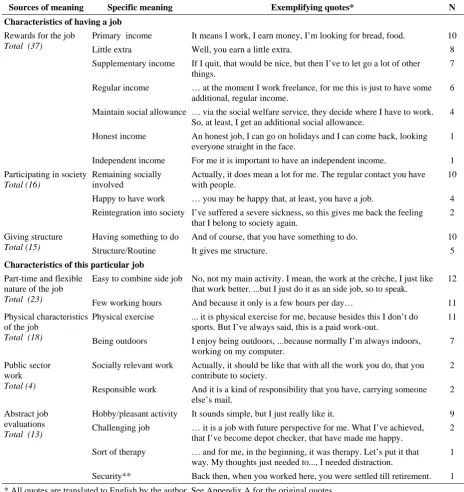
Each topic is briefly introduced, followed by a table showing the abstract response categories, the specific responses with exemplifying quotes and information about the frequency of occurrence of a specific response category. Even though these frequency numbers may be an indication of these responses within the entire population of mail carriers, it should be noted that this data is obtained by qualitative research methods and therefore not suited to draw hard/statistical conclusions based on these figures. Furthermore, it should be noted that the interview questions were very open, which gave participants the opportunity to response freely. Although inherent to this method, it has as side effect that responses of different participants could have a different level of abstraction. For example, whereas one participant might just mention that he/she likes the job, other participants might mention that they like working outdoors and the flexibility of the job. These responses could all be included in the more abstract response of ‘liking the job’. Since the main purpose of this cross case analysis was to obtain an overview of the variation in responses given by the participants, it was decided to include responses of different level of abstraction in one and the same table. A final remark is that the total number of responses displayed in Table 2, 3 and 4 exceeds the number of participants. This is because participants often gave more than one meaning to their job and, obviously, had more than one opinion about their job. Only Table 5 contains exact 34 responses since each participant can only give one answer to the question how he/she sees his/her future in regard to staying at or leaving from the job.
14
question. In the analysis of the responses to this question, it appeared that there was great resemblance with the responses to this question and the answer to the interview questions about their reason to apply for this job. When, for example, the motivation to apply was ‘an income’, than the meaning of the work often also was ‘an income’. Hence, in defining what different meanings the work as mail carrier had, the responses to these two topics were merged. The analysis of the responses to these interview questions revealed that the sources of meaning could either be derived from characteristics of having a job in general or from characteristics of having the job as mail carrier in particular. The sources for meaning derived from having a job in general included: (1) the rewards for the job, (2) participating in society and (3) giving structure. The sources for meaning derived from having the job as mail carrier in particular included: (4) the part-time and flexible nature of the job, (5) the physical characteristics of the job, (6) public sector work and (7) more abstract job evaluations. Each of these sources of meaning led to various specific meanings that were mentioned by different participants. These sources of meaning and its corresponding specific meanings will be described below: first, the meanings derived from characteristics of ‘having a job’ in general, then the meanings derived from characteristics of this job in particular (see Table 2).
For many participants the source for giving a specific meaning to their job derived from
characteristics of having a job, not of having the job as mail carrier. As might be expected, for many participants, the meaning of the job derived from the (financial) rewards that they received for performing that job. Moreover, this source of meaning illustrates that one source of meaning can lead to various, different, specific meanings. As can be seen from Table 2, for some participants the salary meant their main income, for others it meant a little extra or a supplementary income. For yet others, the regularity of the income was what made the reward of the job meaningful. Participants placed at the job by the social service indicated that they could not quit their job, because otherwise their (additional) social allowance would be discontinued. Although this meaning is not directly related to the income, retaining their social allowance is their reward for doing the work. For just two
15
Table 2
Specific meanings and sources of meaning for the job as mail carrier
Sources of meaning Specific meaning Exemplifying quotes* N Characteristics of having a job
Rewards for the job
Total (37)
Primary income It means I work, I earn money, I’m looking for bread, food. 10
Little extra Well, you earn a little extra. 8
Supplementary income If I quit, that would be nice, but then I’ve to let go a lot of other things.
7
Regular income … at the moment I work freelance, for me this is just to have some additional, regular income.
6
Maintain social allowance … via the social welfare service, they decide where I have to work. So, at least, I get an additional social allowance.
4
Honest income An honest job, I can go on holidays and I can come back, looking everyone straight in the face.
1
Independent income For me it is important to have an independent income. 1
Participating in society
Total (16)
Remaining socially involved
Actually, it does mean a lot for me. The regular contact you have with people.
10
Happy to have work … you may be happy that, at least, you have a job. 4
Reintegration into society I’ve suffered a severe sickness, so this gives me back the feeling that I belong to society again.
2
Giving structure
Total (15)
Having something to do And of course, that you have something to do. 10
Structure/Routine It gives me structure. 5
Characteristics of this particular job
Part-time and flexible nature of the job
Total (23)
Easy to combine side job No, not my main activity. I mean, the work at the crèche, I just like that work better. ...but I just do it as an side job, so to speak.
12
Few working hours And because it only is a few hours per day… 11
Physical characteristics of the job
Total (18)
Physical exercise ... it is physical exercise for me, because besides this I don’t do sports. But I’ve always said, this is a paid work-out.
11
Being outdoors I enjoy being outdoors, ...because normally I’m always indoors, working on my computer.
7
Public sector work
Total (4)
Socially relevant work Actually, it should be like that with all the work you do, that you contribute to society.
2
Responsible work And it is a kind of responsibility that you have, carrying someone else’s mail.
2
Abstract job evaluations
Total (13)
Hobby/pleasant activity It sounds simple, but I just really like it. 9
Challenging job … it is a job with future perspective for me. What I’ve achieved, that I’ve become depot checker, that have made me happy.
2
Sort of therapy … and for me, in the beginning, it was therapy. Let’s put it that way. My thoughts just needed to..., I needed distraction.
1
Security** Back then, when you worked here, you were settled till retirement. 1
* All quotes are translated to English by the author. See Appendix A for the original quotes.
** Answer given by a participant who had a full-time contract instead of a part-time contract. In the present organizational strategy only part-time contracts are given. (participant did not belong to the target research population)
A final source of meaning derived from characteristics of having a job is that it gives structure to one’s life. A specific meaning in this category is that participants mentioned that they ‘have
something to do’ and have a reason to wake up in the morning. The, closely related, second specific meaning in this category is that it meant ‘structure’ or daily ‘routine’.
16
participant. This was due to both the part-time nature of the contract and the flexible working hours. Some of the participants mentioning the part-time nature of the job as specific meaning did not explicitly mention the flexible nature. For these participants, the job meant a job with few working hours.
The physical characteristics of the job were also found to serve as a source of meaning. These physical characteristics refer to the physical context in which the job has to be performed and includes the outdoor work and that performing the job requires a considerable amount of physical effort. These physical job characteristics were the source for two specific meanings of the job: ‘working outdoors’ and ‘having a (free) physical exercise’.
Another job characteristic that served as source of meaning was the given that the work is a public service job. This led to the specific meaning of performing ‘socially relevant work’ and ‘having responsible work’ derived from the fact of carrying someone else’s mail.
A final source of meaning has to do with the more abstract job evaluations. This source of meaning is distinct from the ones described above in such that these meanings are overall evaluations of (characteristics of) the job and, therefore, cannot be directly ascribed to a specific source of
meaning. For example, when a participant responded that his/her work meant a ‘pleasant activity’ this could be the result of the outdoor nature of the job, the flexible or part-time nature of the job, the active nature of the job or yet another characteristic of the job. When, during the interview, the participant answered with an abstract job evaluation to the question what their work meant, follow up questions were asked to find out what the specific source of meaning was. The reality however, was that not all participants could clearly define what the specific sources of meaning were. In such cases, the overall evaluations were recorded. The abstract job evaluation that was mentioned most, was that the work meant a ‘hobby’ or a ‘pleasant activity’. Other abstract job evaluations were that the job meant a ‘challenging job’ or a ‘sort of therapy’. One participant also mentioned ‘(life) security’ as the meaning of work. It must be added that this particular participant started this job a long time ago, when only full-time contracts were provided. The present organizational policy is to only hire part-time mail carriers and to gradually phase out full-part-timers. Hence, this meaning is not representative anymore for the target group of this present study: the part-time mail carriers.
17
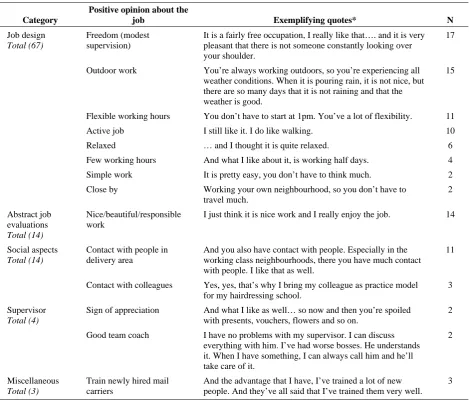
[image:17.595.63.533.153.554.2]aspects of the job, (4) positive opinions regarding the supervision, and (5) miscellaneous positive opinions. The categories will be elaborated below.
Table 3
Positive opinions about the job (categorized)
Category
Positive opinion about the
job Exemplifying quotes* N
Job design
Total (67)
Freedom (modest supervision)
It is a fairly free occupation, I really like that…. and it is very pleasant that there is not someone constantly looking over your shoulder.
17
Outdoor work You’re always working outdoors, so you’re experiencing all weather conditions. When it is pouring rain, it is not nice, but there are so many days that it is not raining and that the weather is good.
15
Flexible working hours You don’t have to start at 1pm. You’ve a lot of flexibility. 11
Active job I still like it. I do like walking. 10
Relaxed … and I thought it is quite relaxed. 6
Few working hours And what I like about it, is working half days. 4
Simple work It is pretty easy, you don’t have to think much. 2
Close by Working your own neighbourhood, so you don’t have to travel much. 2 Abstract job evaluations Total (14) Nice/beautiful/responsible work
I just think it is nice work and I really enjoy the job. 14
Social aspects
Total (14)
Contact with people in delivery area
And you also have contact with people. Especially in the working class neighbourhoods, there you have much contact with people. I like that as well.
11
Contact with colleagues Yes, yes, that’s why I bring my colleague as practice model for my hairdressing school.
3
Supervisor
Total (4)
Sign of appreciation And what I like as well… so now and then you’re spoiled with presents, vouchers, flowers and so on.
2
Good team coach I have no problems with my supervisor. I can discuss everything with him. I’ve had worse bosses. He understands it. When I have something, I can always call him and he’ll take care of it.
2
Miscellaneous
Total (3)
Train newly hired mail carriers
And the advantage that I have, I’ve trained a lot of new people. And they’ve all said that I’ve trained them very well.
3
* All quotes are translated to English by the author. See Appendix B for the original quotes.
By far, most positive opinions about the job were related to the design of the job. Especially the freedom that mail carriers have during the execution of their job is perceived as very positive. Other job characteristics like ‘outdoor work’, ‘flexible working hours’ and the ‘active nature of the job’ are mentioned as positive as well. Another positive opinion is that the job is described as ‘fairly relaxed’. It should be noted that this refers to little stressful, not to psychically relaxing. Although not
18
Some participants mentioned to have a positive opinion about the job, but were not able to explain why. These responses have been placed in the ‘abstract job evaluations’ category, and include the opinions a ‘nice job’, a ‘beautiful job’ and a ‘responsible job’. Social aspects of the job were also perceived as positive. This category distinguishes between ‘contact with people in the delivery area’ and ‘contact with colleagues’. It should be noted that more participants seem to value the social contact with people in their delivery area than the contact with their colleagues. Some participants explicitly mentioned to appreciate the performance of their supervisor. Specifically mentioned in this category were a perceived ‘signs of appreciation’ in the form of a little present or some snacks at depots. Other participants explicitly mentioned to be fairly pleased with their supervisor. It should be noted that opinions about the supervisor differed greatly amongst the depots. This is easy to
understand since each depot has its own supervisor doing his/her work in his own way. Finally, participants who had been given the task to train newly hired mail carriers evaluated this part of the job as very positive.
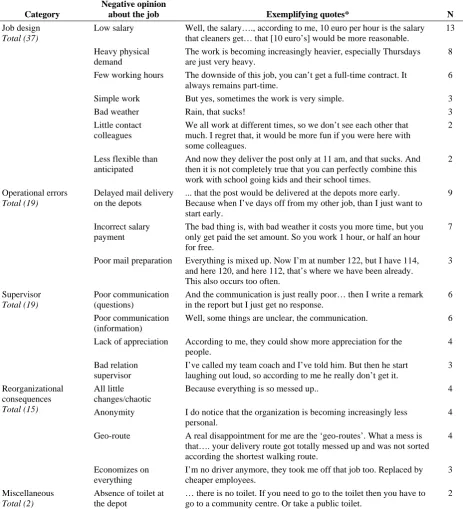
Negative Opinions About the Job: Obviously, the question about a participant’s opinion about the job, resulted in a number of negative opinions as well. These negative opinions could be categorised into negative opinions about: (1) the design of the job, (2) operational errors, (3) the supervisor (4) reorganizational consequences, and (5) miscellaneous negative opinions (see Table 4).
By far, the most mentioned negative opinion about the job was the ‘low salary’, followed by ‘heavy physical demand’ and ‘few working hours’. Although ‘few working hours’ and ‘low salary’ are indicated as separated concepts, respondents often mentioned them together, as both resulted in low earnings. Several participants mentioned that they perceived the job as ‘fairly simple’ which they evaluated as negative. It should be remembered, however, that other participants mentioned ‘few working hours’ and ‘simple work’ as positive characteristics of the job (see Table 3). Few participants indicated to regret that they had little contact with colleagues, as a consequence of the flexible nature of the work. Lastly, negative opinions about the job design also included ‘working in bad weather’ and the discovery that the work was ‘less flexible than expected’.
19
Table 4
Negative Opinions about the Job (categorized)
Category
Negative opinion
about the job Exemplifying quotes* N
Job design
Total (37)
Low salary Well, the salary…., according to me, 10 euro per hour is the salary that cleaners get… that [10 euro’s] would be more reasonable.
13
Heavy physical demand
The work is becoming increasingly heavier, especially Thursdays are just very heavy.
8
Few working hours The downside of this job, you can’t get a full-time contract. It always remains part-time.
6
Simple work But yes, sometimes the work is very simple. 3
Bad weather Rain, that sucks! 3
Little contact colleagues
We all work at different times, so we don’t see each other that much. I regret that, it would be more fun if you were here with some colleagues.
2
Less flexible than anticipated
And now they deliver the post only at 11 am, and that sucks. And then it is not completely true that you can perfectly combine this work with school going kids and their school times.
2
Operational errors
Total (19)
Delayed mail delivery on the depots
... that the post would be delivered at the depots more early. Because when I’ve days off from my other job, than I just want to start early.
9
Incorrect salary payment
The bad thing is, with bad weather it costs you more time, but you only get paid the set amount. So you work 1 hour, or half an hour for free.
7
Poor mail preparation Everything is mixed up. Now I’m at number 122, but I have 114, and here 120, and here 112, that’s where we have been already. This also occurs too often.
3
Supervisor
Total (19)
Poor communication (questions)
And the communication is just really poor… then I write a remark in the report but I just get no response.
6
Poor communication (information)
Well, some things are unclear, the communication. 6
Lack of appreciation According to me, they could show more appreciation for the people.
4
Bad relation supervisor
I’ve called my team coach and I’ve told him. But then he start laughing out loud, so according to me he really don’t get it.
3 Reorganizational consequences Total (15) All little changes/chaotic
Because everything is so messed up.. 4
Anonymity I do notice that the organization is becoming increasingly less personal.
4
Geo-route A real disappointment for me are the ‘geo-routes’. What a mess is that…. your delivery route got totally messed up and was not sorted according the shortest walking route.
4
Economizes on everything
I’m no driver anymore, they took me off that job too. Replaced by cheaper employees.
3
Miscellaneous
Total (2)
Absence of toilet at the depot
… there is no toilet. If you need to go to the toilet then you have to go to a community centre. Or take a public toilet.
2
* All quotes are translated to English by the author. See Appendix C for the original quotes.
20
opinions about the supervisor covered the relation with the supervisor and included ‘perceived lack of appreciation’ and a ‘bad relation with the supervisor’.
Many negative opinions could be related to the aftermath of the present reorganization. These negative opinions included frustrations such as ‘all little changes’ or ‘chaotic working environment’. Another frustration mentioned was the increased anonimisation of the organization; especially mail carriers with longer tenures felt that they were increasingly treated as numbers rather than as appreciated employees. In line with this frustration was the perception of mail carriers that the organization economizes on everything, even on the most basic utilities. A final reorganizational frustration consists of the ‘geo-routes’: computer determined walking routes and delivery order. These were perceived as very negative, because the new geo-routes differed from the walking routes and delivery order mail carriers used to take. Geo-routes were implemented in only one of the five visited depots; hence, mail carriers from four of the five depots did not face problems with the geo-route.
A final negative opinion, which could not be placed into another category, was the absence of a toilet at the depot.
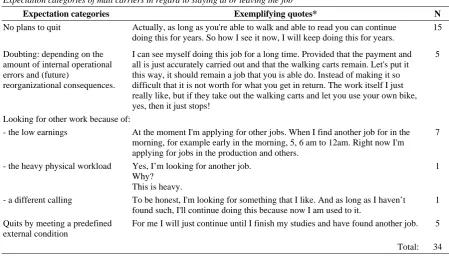
Future Expectations in Regard to Staying at or Leaving the Job: Previous analysis provided information about, (1) what different meanings are given to the work as mail carrier and (2) what negative and positive opinions participants have about their work. Combining the responses of one individual to these two topics, generates insight into whether or not a particular meaning of the work relates to particular negative or positive opinions. It gives little insight, however, into how much weight the opinions bear, or how a particular pattern in these answers relates to the intention to quit. For example, when a participant responded to the first topic that the meaning of the work was an income, and to the second topic that he/she perceived the low income as negative and the part-time and flexible nature of the job as positive, it is not possible to say which opinion is more important and stronger affects the decision to stay or to leave.
21
[image:21.595.69.519.146.403.2] [image:21.595.144.524.147.399.2]give one answer possibility; hence the total numbers of participants placed in a category equals 34, the total number of participants.
Table 5
Expectation categories of mail carriers in regard to staying at or leaving the job
Expectation categories Exemplifying quotes* N
No plans to quit Actually, as long as you're able to walk and able to read you can continue doing this for years. So how I see it now, I will keep doing this for years.
15
Doubting: depending on the amount of internal operational errors and (future)
reorganizational consequences.
I can see myself doing this job for a long time. Provided that the payment and all is just accurately carried out and that the walking carts remain. Let's put it this way, it should remain a job that you is able do. Instead of making it so difficult that it is not worth for what you get in return. The work itself I just really like, but if they take out the walking carts and let you use your own bike, yes, then it just stops!
5
Looking for other work because of:
- the low earnings At the moment I'm applying for other jobs. When I find another job for in the morning, for example early in the morning, 5, 6 am to 12am. Right now I'm applying for jobs in the production and others.
7
- the heavy physical workload Yes, I’m looking for another job. Why?
This is heavy.
1
- a different calling To be honest, I'm looking for something that I like. And as long as I haven’t found such, I'll continue doing this because now I am used to it.
1
Quits by meeting a predefined external condition
For me I will just continue until I finish my studies and have found another job. 5
Total: 34
* All quotes are translated to English by the author. See Appendix D for the original quotes.
Half of all respondents reported to have no plans to quit because they were fairly satisfied with the job. More interesting is the category of participants who doubted whether to stay or not. In general, these were highly motivated employees who often really liked the job and had a long tenure as mail carrier. They doubted whether to continue or not because of the excess of operational errors or other reorganizational consequences. A reasonable number of mail carriers also mentioned to be looking for another job. Several reasons for this were mentioned but the main reason was the low salary. Less interesting for this study is the final category of participants, who mentioned to quit as soon as a predefined external condition was met, as any interventions are likely to have little effect on their decision to stay or leave.
22
Individual Case Interview Results (Vertical Analysis)
In addition to the cross case interview analysis, the interviews were also analysed as individual cases, focusing on the interrelation of interview responses to all four interview topics of a single participant. Analysing these responses as integrated whole made it possible to identify patterns of interrelation between the responses to the four interview topics. These patterns, which consisted of a set of consistent responses to the four interview topics, are suggested to reflect how a specific participant frames his/her work.
From the 34 individual case interview analyses, five distinct response patterns emerged. These response patterns reflected how a participant framed their job, which led to the identification of five framing categories. It was found that mail carriers frame their job as: (1) an income, (2) a part-time job, (3) a pleasant job/activity, (4) having something to do/remaining socially involved, and (5) as having a ‘normal’ job. Each category will be elaborated below. For each category, it will be defined what meaning(s) is/are given to the job, what opinions are fore- and backgrounded and what
expectations of the future exist with regard to staying at or leaving the job. Each framing category will be supported by exemplifying quotes. The exemplifying quotes are translated by the author, see Appendix E for the original versions of the quotes.
Income: Eight participants framed their work as an income. Participants who framed it primarily as an income foregrounded the financial rewards of the job. For them the work meant their primary income or the guarantee that they didn’t lose their (additional) social allowance.
“Necessity, it is a matter of necessity. At a certain point you just need some money. And then you have to work somewhere.”
People who framed their work this way, often mentioned that the reason for applying was that they were assigned to this job by the social welfare service or that, because of (long-term) unemployment, were in desperate need of an income. Asked for their opinion about the job, they foregrounded the low earnings that resulted from the low salary, combined with the limited number of working hours. When asked for positive characteristics of the job, participants did acknowledge the pleasant characteristics, but these characteristics were backgrounded against the foregrounded opinions about the low
earnings.
“Do you like it?” “No, currently not. Because I’m busy looking for another job. …. When I’ve found another job, then, maybe then, I can see this job as a sort of hobby.”
Participants who framed their job as their primary income often showed negative job attitudes and mentioned that they were looking for another job that pays more.
23
Part-time Job: Seven participants framed their work as a part-time job. Participants who framed their work this way foregrounded the part-time and flexible nature of the job. For them the work meant a side job that could be combined easily with other activities.
“No, not my main activity. I mean, the work at the crèche, I just like that work better. ...but I just do it as an side job, so to speak.”
Participants in this category gave as reason why they applied for the job that they were looking for an additional income or a little extra from a job that could be combined with any another activity such as taking care of children, studying or running a small business. Asked for their opinion about the job they, not surprisingly, foregrounded the few and flexible working hours. They also foregrounded negative opinions about operational errors with a negative effect on the part-time and flexible nature of the job. This included errors such as ‘delayed mail delivery at the depot’, ‘poor mail preparation’ or a ‘lack of clarity’ about (new) rules or guidelines.
“It takes quite some time. I live at some distance. In the beginning I thought it would be nice, having a nice bike ride to get you in good shape. But every day it is a ten to fifteen minutes ride and back. So yes, it [the job] often costs me four, five hours a day. So actually, it often costs me an entire day.”
Participants placed in this category, furthermore, backgrounded the contact with colleagues, because apart from this part-time job they often had the social network of their own. People in this category mentioned to quit as the job appeared to be less flexible than was initially assumed. Another often heard reason was when a predefined external condition, such as a graduation or sufficient income from a small business, was met.
“For me, I’ll continue till I’ve finished my studies and found another job.”
Pleasant Job/Activity: Five participants framed their work as a pleasant job or pleasant activity. These participants especially foregrounded the positive job characteristics, such as the ‘freedom of the job’, the ‘outdoor and active nature of the job’, the ‘flexible working hours’, the ‘few working hours’, the ‘relaxed nature of the job’ and the ‘societal relevance of the job’. For this group, the work meant a nice or pleasant activity. For some it even meant a hobby, a therapy or a way to reintegrate into society after a severe mental or physical sickness.
“A, it is an income for me. B, it is a physical exercise for me because I practice no other sports. …. But what I’m always saying, it is a paid workout.”
The motivations mentioned to apply varied from looking for a job with these particular job
24
“I wouldn’t like to give up this job. My situation is like this, I don’t know whether I should mention this, but there is no necessity for me to work. My husband is the breadwinner, so there is no real necessity. I always say: I do it for the fun.”
Participants in this category did the job because they liked it. Hence, events that cause the work to be less enjoyable are foregrounded by participants in this group. Negative opinions foregrounded in this group were problems with the supervisor, operational errors or negative consequences of the
reorganization. Generally, participants framing their work this way showed positive job attitudes and were often perceived as being loyal to the organization. They were not planning to leave the
organization, although, because of the increasing amount of operational errors which made the job less enjoyable, some doubted whether to stay or leave. Several participants in this category had this job for a long time already. Most of them, however, mentioned a decrease in enjoyment because of all the reorganizational consequences.
“I can see myself doing this job for a long time. Provided that the payment and all is just accurately carried out and that the walking carts remain. Let's put it this way, it should remain a job that you is able do. Instead of making it so difficult that it is not worth for what you get in return. The work itself I just really like, but if they take out the walking carts and let you use your own bike, yes, then it just stops!”
This framing category is called ‘pleasant job/activity’. It should be noted that the difference between ‘pleasant job’ and ‘pleasant activity’ is in the fact that when framed as a pleasant job, it is still framed as being a job. This implies that one might still expect a (financial) reward for the work, which makes that a type of income still is the meaning of the job. When it is framed as pleasant activity, the same job characteristics are fore- and backgrounded, only, the financial rewards are totally ignored.
Having Something to Do/Remaining Socially Involved: The seven participants framing their work as ‘having something to do/remaining socially involved’ foregrounded the effects of having a job as such, not specifically the job as mail carrier. For this group the work meant a routine, a structure, something to do, or remaining socially involved. As a reason for applying, these participants
mentioned that they did not want to sit at home, having nothing to do. It predominantly occurred with participants who enjoyed an early retirement or students taking a year off.
“I went in retirement at age of 55, in early retirement actually. I’m not the person to stay at home and get bored. So yes, that was why I applied for the job. … And it is two folded of course, you also earn some money.”
Asked for their opinion about their work, people in this category foregrounded that they appreciate the contact with people in the delivery area and with their colleagues. Several positive opinions about the job were foregrounded, especially overall evaluations like: ‘a nice/beautiful activity’ or characteristics relating to the relaxing nature of the job.
25
In this category as well, operational errors or problematic communication that made the work more difficult to do, were foregrounded. And just as with the preceding category, this framing category too included participants who attach no meaning at all to the financial rewards of the job and people that do attach some meaning to the financial rewards. Some participants placed more emphasis on the income then other, but since participants in this group often had another sources of income, like a pension, parents or a spouse, the income was largely backgrounded. Generally, people in this framing category demonstrated a positive job attitude. Nonetheless, participants in this group also got annoyed by recurring operational errors and could become a reason to look for something else to do. Another reason mentioned by participants in this category for leaving the organization was that a predefined external requirement was met.
“So to speak, as my Nepal project is cancelled, then I could do this job until I’m 60 years old because it is not really a job resulting in a burn-out.”
Having a ‘Normal’ Job: Seven participants framed their work as ‘having a ‘normal’ job’. Participants who framed their work like this were happy that they, basically, had work. They foregrounded the effects of having a ‘normal’ job, such as having a regular income and/or an honest income. For these participants the work meant that it guaranteed an income at the end of the month and/or that they were legally registered as employed.
“An income, an honest job. I can go on holiday and I can come back, looking everyone straight in the face and say, “yes, I’ve a good job”. Some people say it doesn’t pay well, that’s bullshit, I don’t mind.”
Participants placed in this category often mentioned that they applied for the job because they needed an income and that for this particular job no specific education or other requirements were demanded.
“… I kind of like it. Of course, tastes differ, and many colleagues left because of the heavy physical demand. But hey, what should I do? I have no education or anything.”
Asked for their opinion about the job, these participants foregrounded that they appreciated the positive job characteristics such as the freedom of the job, the working outdoors, the flexible working hours and so on. They also foregrounded to be pleased when they were assigned extra tasks, such as training new employees or being responsible for the depot. Although acknowledged by participants placed in this category, the low earnings were not particularly foregrounded by this group. This likely is because, in the light of their limited qualifications, no expectations exist of finding a better job. Generally, the participants in this framing category showed positive job attitudes and indicated to have no intention to quit. Rather the opposite applies as they were hoping that their contract would not be terminated.
26
Relating Framing Categories to Turnover Intention
The results described above show that mail carriers framed their job differently. The second aspect of the research question was whether, or how, these different ways of framing their work, relates to the intention to quit. Hence, the last step in this analysis is to cluster participants based on the mentioned intention to quit and to identify how this relates to the identified framing categories. The analysis revealed that there was a mechanism at play that makes it understandable why mail carriers in a particular framing category get the intention to leave the organization or not.
This mechanism begins with the notion that each participant does this job to satisfy particular needs. It is these needs that influence what aspects of the job are foregrounded and what aspects of the job are backgrounded. In other words, the needs a mail carrier wishes being satisfied by doing their job, affects how the job is being framed. Depending on design and characteristics of the job, participants evaluated the extent to what the job could satisfy their specific needs. It is the result of this evaluation that appears to affect the job attitudes of mail carriers and the final decision to stay with or leave the organization.
The interview analyses showed that the organization, in this case study, could fulfil the needs of: (1) having a ‘normal’ job, (2) having a flexible and part-time side job, (3) doing a pleasant
job/activity, and (4) having something to do. It also became clear, however, that this job of a mail carrier could not successfully satisfy the need for an adequate income. Looking back to the interview responses with respect to future expectations (see Table 5), it appears that the low income is the main reason for looking for another job. Therefore, the perceived importance of income is used as criteria to cluster participants in order to understand mail carriers’ turnover intention. The first cluster contains of (1) participants who framed their work as their primary income. The second cluster contains (2) participants who did value the income, but foreground aspects from other framing categories. The last and final cluster contains (3) participants to whom the income played no role and who only foregrounded aspects from other framing categories. Below the three clusters will be explained.
Cluster 1: Income is the Dominant Framing Category: Participants in this cluster frame their job as primary income. Given that the income is relative little, as a result of the statutory minimum wage and the restrictions of only working part-time, makes it understandable that participants who foreground the income become dissatisfied. Hence, participants falling in this cluster are likely to have a negative job attitude and will constantly be looking for better job options.
27
that they acknowledged that it is not very much. This, however, did not seems to be a problem since participants in this cluster did not frame their work as an income and, hence, foregrounded other aspects of the job. Aspects of the job that could satisfy their needs. For example, people with no education were happy to have a legal and regular income. Although they did acknowledge that the income is very little, for these people, the fact that at least they had a job, apparently weighted more than this low income. Another example consists of participants that had another main activity like a study, children to take care of or a freelance job. These participants considered the income as low as well, but they were happy to have a job that could be combined well with their other activity. A final example consists of participants who liked the characteristics inherent to the job, or the ones who were looking for ‘having something to do’. These needs could be satisfied by the job as well. Since they often had an additional source of income by means of a partner, parents or retirement, these participants see the income more as a little extra and, hence, are not bothered by its relative lowness. Although giving little weight to the low income, participants in this second cluster can get dissatisfied when their primarily needs, which differs per framing category, are insufficiently met.
Cluster 3: Income Plays No Role, Other Framing Categories are Dominant: By the fact that they are not framing their job as income, participants in this cluster generally show positive job attitudes and no intentions to quit. Most participants falling in this cluster frame their work as ‘a pleasant activity’ or as ‘having something to do/remaining active in society’. They see their work as a hobby or as opportunity to reintegrate into society and are mostly happy to have this job. Although rather positive in general, participants in this cluster are particularly sensitive for operational errors or other errors that make the job less ‘fun’ to do.
Summary of the Interview Results
Analysing the 34 interviews was done in three stages, the first of which consisted of a cross case analysis, the second of the individual case analyses and the final third one aimed at identifying whether any relation existed between a framing categories and job attitudes, and in specific turnover intention.