ORIGINAL RESEARCH
Is All “Communicating” Hydrocephalus Really
Communicating? Prospective Study on the Value
of 3D-Constructive Interference in Steady State
Sequence at 3T
A. Dinçer S. Kohan M.M. O¨ zek
BACKGROUND AND PURPOSE:3D-constructive interference in steady state (3D-CISS) sequence has been used to assess the CSF pathways. The aim of this study was to investigate the additive value of 3D-CISS compared with conventional sequences in the diagnosis of obstructive membranes in hydrocephalus.
MATERIALS AND METHODS:A total of 134 patients with hydrocephalus underwent MR imaging examination with a 3T unit consisting of turbo spin-echo, 3D-CISS, and cine phase-contrast (cine PC) sequences. 3D-CISS was used to assess obstructive membranes in CSF pathways compared with other sequences. Cine PC, follow-up imaging, and surgical findings were used to confirm obstructive membranes.
RESULTS: Comparing the number of noncommunicating cases by using the conventional and 3D-CISS images, we found 26 new cases (19.4%) of 134 cases that were previously misdiagnosed as communicating hydrocephalus by conventional images. 3D-CISS sequence identified obstructive membranes invisible in other sequences, which facilitated selection of neuroendoscopy in the treat-ment of 31 patients (23.1%) in total who would have been otherwise treated with shunt insertion. These patients included 26 newly diagnosed noncommunicating cases after demonstration of intra-ventricular and/or fourth intra-ventricular outlet membranes and 5 cases of communicating hydrocephalus with obstructing cisternal membranes. There were obstructions of the foramina of Luschka in 22 of 26 newly found noncommunicating cases.
CONCLUSIONS:Conventional sequences are insensitive to obstructive membranes in CSF pathways, especially in the fourth ventricular exit foramina and the basal cisterns. 3D-CISS sequence, revealing these obstructive membranes, can alter patient treatment and prognosis.
3
D-constructive interference in the steady state (3D-CISS) is a fully balanced and inherently flow-compensated gradi-ent-echo sequence providing fine anatomic details about CSF pathways.1Two true-fast imaging with steady-state precession sequences with differing radio-frequency pulses are combined for strong T2/T1-weighted high-resolution 3D images.1-4The advantage of the 3D-CISS sequence is its combination of high signal intensity levels and extremely high spatial resolution. During the past decade, 3D-CISS sequence has been intro-duced and used in the assessment of normal and pathologic features of intracranial anatomy.1-11In particular, the value of this technique has been demonstrated in hydrocephalus and endoscopic third ventriculostomy.12-17 The T2-weighted turbo spin-echo (TSE) sequence has commonly been used to study the CSF pathway in hydrocephalus; however, it fails to demonstrate thin membranes causing obstruction at various foraminal levels and cisterns.15 From a treatment point ofview, identification of obstructive pathologic processes at any level through the CSF pathway is of significant importance because it can change the mode of management in patients with hydrocephalus, avoiding shunt insertion.
In this prospective study, we aimed to investigate the addi-tive value of 3D-CISS sequence compared with conventional T1-weighted and T2-weighted images at 3T in the diagnosis of obstructive membranes in patients who would otherwise be diagnosed with communicating hydrocephalus.
Materials and Methods
Patients
A total of 134 consecutive patients, 84 male and 50 female, mean age 10.3 years (range, 2 days to 18 years) with hydrocephalus who were evaluated in our MR imaging unit between January 2005 and Febru-ary 2009 were included in the study. All patients were examined with a 3T MR imaging machine with an 8-channel head coil (Trio; Sie-mens, Erlangen, Germany). Our hospital internal review board ap-proved the study. All patients or caregivers were informed about the study and had given consent for participation. All patients younger than 10 years were examined routinely under sedation.
MR Imaging Technique
All patients had completed conventional study including axial TSE T1, and axial, sagittal, and coronal TSE T2, sagittal 3D turbo fast low angle shot (turboFLASH) T1, and sagittal 3D-CISS followed by sag-ittal and axial-oblique cine phase-contrast (cine PC). The 3D-CISS sequence was acquired with 0.6⫻0.6⫻0.6-mm3isometric voxel
Received March 23, 2009; accepted after revision May 4.
From Acibadem University, School of Medicine, Departments of Radiology (A.D.) and Neurosurgery (M.M.O¨.), Istanbul, Turkey; University of New South Wales (S.K.), St. George Hospital, Sydney, Australia; and Marmara University Medical Center, Division of Pediatric Neurosurgery (M.M.O¨.), Istanbul, Turkey.
Paper previously presented at: American Society of Neuroradiology Annual Meeting and Neuroradiology Education and Resarch Foundation Symposium, New Orleans, La, June 5, 2008.
Please address correspondence to Alp Dinçer, MD, Acibadem Kozyatagi Hospital, Depart-ment of Radiology, Inonu Cad. Okur Sok. No:21, Kozyatagı, Istanbul, 34742 Turkey; e-mail: [email protected] or [email protected]
allowing reconstruction in any arbitrary plane for optimal visualiza-tion. The various sequence parameters are summarized in Table 1. If needed, axial TSE T1 and sagittal 3D turboFLASH T1 were repeated after contrast administration. The total scan time for noncontrast examination was approximately 25 minutes depending on the time required for cine PC. All sequences including 3D-CISS sequence and cine PC were obtained at the same session for all patients.
3D-CISS sequence was applied in the sagittal plane to cover the entire ventricular region and the fourth ventricular exits with the following parameters: TR, 10.94 ms; TE, 5.47 ms; flip angle (FA), 50°; FOV 200⫻180 mm; matrix, 320⫻320; bandwidth, 130 Hz/pixels; partition/slab thickness, 0.6/28.8 mm; partition number, 48; section oversampling, 11%; phase oversampling, 25%; and measurement, 1. The 3D-CISS sequence was located at the midline. If needed, the partition number was increased up to 96.
Midline high-resolution sagittal cine PC was obtained for all patients as a standard sequence. The sequence parameters were as follows: TR, 37 ms; TE, 5.6 ms; averages, 3; FOV, 216⫻240 mm; section thickness, 2 mm; FA, 30°; matrix, 256⫻256; voxel size, 0.9⫻ 0.9⫻2 mm3; velocity encoding, 20 cm/sn; direction of flow encoding,
foot to head; and bandwidth, 391 Hz/pixels. Electrocardiogram or pulse trigger was used with a 90% acquisition window. Just after ac-quisition, magnitude images, rephrased, and phase images were re-constructed immediately. According to the anatomic region, the axi-al-oblique or sagittaxi-al-oblique cine PC was obtained with the same parameters except for the velocity encoding direction, which was set to the through plane. Cine PC was evaluated with vendor-supplied, commercially available software (Argus on a Leonardo workstation; Siemens, Erlangen, Germany).
MR Evaluation
Our diagnostic criterion for obstructive membranes depended on demonstration of the membrane itself by both conventional T1-weighted and T2-T1-weighted images and/or by 3D-CISS sequence. Only membranes that could be followed all the way and divided the ana-tomic region completely into 2 or more parts were accepted as ob-structive membranes. The nonobob-structive membranes, which are normal cisternal structures, have been known for more than 100 years.2,18,19An increased number of such normal cisternal structures
such as the Liliequist membrane could be visible with high-resolution cisternal imaging, and these normal structures were not taken into consideration as obstructive membranes. Signal intensity differences were not treated as a primary finding for making a decision as to the existence of an obstructive membrane. A sharp, linear zone of a tran-sition signal intensity difference between 2 sides of the obstructive membrane was considered as only a complementary finding.
Every examination was performed step by step in the following order under close supervision of an experienced radiologist (A.D, 16
years’ experience in neuroradiology). First, routine sequences were obtained. During 3D-CISS sequence imaging, a judgment was made if an obstructive pathologic feature existed, and the diagnosis of com-municating or noncomcom-municating hydrocephalus was made by the radiologist on the basis of conventional T1-weighted and T2-weighted images. During the first step, every effort was made by the radiologist to detect the presence of any obstructive membrane on the basis of routine imaging. The Dandy traditional classification of hy-drocephalus was used.20,21This classification system depends on
ad-ministering a dye into the lateral ventricle and then trying to detect the dye in the CSF sample collected by lumbar puncture. On the basis of this definition, hydrocephalus cases with obstructive cisternal mem-brane only, without accompanying intraventricular or fourth ventric-ular exit foramina obstruction, were defined as a communicating hy-drocephalus. The membranous obstruction at the foramen of Monro, the cerebral aqueduct, foramen of Magendie, foramina of Luschka, and superior medullary velum were defined as intraventricular mem-branous obstruction. The membranes that obscured only the cisterns (ie, interpeduncular, prepontine, and premedullary) were defined as communicating hydrocephalus with cisternal obstruction.22-24The hydrocephalus was categorized as noncommunicating, even if one of the fourth ventricular outlets appeared obstructed while the others were patent. Although this assumption seems to be against traditional concept, a few case reports have been published with only 1 exit fora-men of the fourth ventricle obstructed, causing tetraventricular hy-drocephalus and responding to surgery.23-32These results overlap
with observation in our large study cohort.
The second step was the acquisition of the 3D-CISS sequence to determine whether there was obstructing membrane either within or outside the ventricular system. The 3D-CISS images were examined during acquisition of the standard sagittal cine PC sequence with in-plane flow sensitization gradient. We carefully scrutinized every section and used vendor-provided 3D multiplanar reconstruction software that allows us real-time multi-planar postprocessing.
For the final step, cine PC images were used to confirm the ob-structive nature of the pathologic condition. Cine PC was considered to be the criterion standard. For consideration of a cisternal or ven-tricular membrane seen on 3D-CISS sequence as obstructive, no clear in-plane or through-plane flow had to be demonstrated across the membrane. Every possible region with obstructive membrane was studied carefully with cine PC. Midline sagittal cine PC with in-plane flow-sensitization gradient was obtained for all patients. According to the location of the membrane, axial-oblique or sagittal-oblique cine PC with through-plane sensitization gradient was obtained perpen-dicular to the cerebral aqueduct at the narrowest portion for aqueduct stenosis, below the aqueduct for superior velum medullary synechia, at the fourth ventricle floor for the foramen of Magendie,
parasagittal-Table 1: Sequence parameters for cranial MR imaging
Sequences
Imaging
Plane TR/TE/ETL
Time of Acquisition
Voxel Size (mm3)
Section/Partition Thickness/Gap (mm)
FA/BW (Hz/Px)
TSE T2 Axial 3590/101/13 1.53 1.75 5/0.5 90/100
TSE T2 Sagittal 3000/131/13 1.41 1.2 2/0.2 90/100
TSE T2 Coronal 4850/132/13 1.36 1.08 3/0.75 90/100
Cine PC Oblique 59/11/⫺ 3–5 1.08 3 35/391
3D Turbo flash T1 Sagittal 2000/3.9/⫺ 4.14 0.51 0.8 20/130
TSE T1 Axial 500/13/2 2 2.05 5/0.5 70/155
3D-CISS Sagittal 13.6/5.7/⫺ 4.44 0.216 0.6 50/130
Note:—ETL indicates echo-train length; FA, flip angle; BW, bandwidth; TSE, turbo spin-echo; cine PC, cine phase-contrast; 3D turbo flash T1, 3D turbo fast low-angle shot T1; 3D-CISS, 3D constructive interference in the steady state.
BRAIN
ORIGINAL
[image:2.594.52.535.59.154.2]oblique for the foramina of Luschka and Monro, and perpendicular to the prepontine cistern for cisternal membrane obstruction.
Just after the examination, the radiologist and the neurosurgeon (M.M.O¨ .) made a final decision by consensus to use all of the data together. Both the radiologist and the neurosurgeon knew all patient data available.
Treatment of Patients
According to the type of hydrocephalus, either endoscopic third ven-triculostomy (ETV) was performed or a shunt was inserted. A total of 26 new cases were diagnosed as noncommunicating hydrocephalus with 3D-CISS and were treated with ETV. All patients were fol-lowed-up at 6-months intervals. ETV was used to confirm cisternal membranes, membranes of the foramen of Monro, and aqueduct stenosis. Clinical and MR imaging follow-up findings were used to confirm the obstruction at the superior velum medullary synechia, foramina of Luschka, foramen of Magendie, and foramen magnum alongside the initial cine PC findings.
Results
3D-CISS sequence demonstrated 157 sites of membranous obstruction in 134 patients. The location of these membranes were as follows: 7 at the foramen of Monro (bilateral in 2 cases), 41 at the cerebral aqueduct, 5 at the superior medullary velum, 28 at the foramen of Magendie, 46 at the foramina of Luschka, 2 at the foramen magnum, and 28 in the cisterns. Although conventional images showed only 57 sites of mem-branous obstruction in these 134 patients, the conventional images showed all aqueduct stenosis and membranous ob-struction of the foramen of Monro, 1 of 5 superior medullary velum synechia, 4 of 28 foramen of Magendie membranes, 3 of 46 foramina of Luschka membranes, and 1 of 28 cisternal membranes. In the conventional T1 and T2 images, all mem-branes of the foramen of Monro were diagnosed with indirect findings such as unilateral or bilateral lateral ventricle dilation with a small third ventricle. Indeed, we did not demonstrate any membrane of the foramen of Monro itself with the con-ventional images. The sites of membranous obstruction are summarized in Table 2.
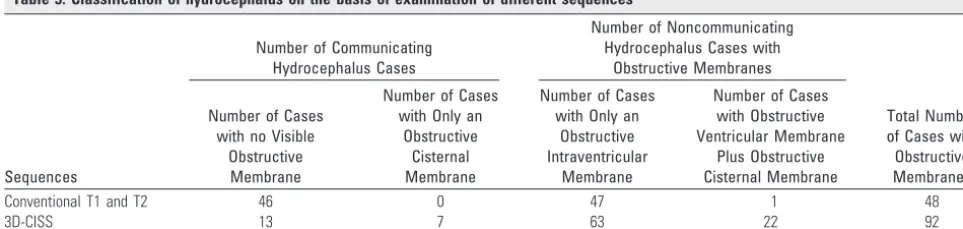
On the basis of the conventional images, there were 46 cases (34.3%) of communicating hydrocephalus and 88 cases (65.7%) of noncommunicating hydrocephalus. Of the 88 noncommunicating cases, only 48 cases (54.5%) were diag-nosed with membranous obstruction (41 of the aqueduct ste-nosis, 5 membranous obstruction of the foramen of Monro, 1 obstruction of the superior medullary velum synechia, and 1 cisternal membranous obstruction). In 40 remaining cases (45.5%) no obstructive membrane was identified (Table 3), and the diagnosis was made on the basis of indirect findings.
Examining 3D-CISS images demonstrated 20 cases (14.9%) with communicating hydrocephalus and 114 cases (85.1%) of noncommunicating hydrocephalus (Table 3). Comparing the number of noncommunicating cases by using the conventional and 3D-CISS images, we found 26 new cases (19.4%) of 134 cases that were previously misdiagnosed as a communicating hydrocephalus on conventional images. In addition to these new 26 intraventricular membranous ob-structions, we found another 7 previously undiagnosed cases with cisternal obstructive membranes, which were not classi-fied as noncommunicating hydrocephalus according to the Dandy traditional concept. Furthermore, by using the 3D-CISS sequence, we were able to demonstrate fine membranous obstructive structures within the CSF pathway in 92 cases (68.7%) of the total number of cases examined. These 92 cases consisted of 33 cases with previously undiagnosed membra-nous structures (26 intraventricular and 7 cisternal obstruc-tive membrane cases), 48 cases that were already identified on conventional images, and 11 with more than 1 obstructive pathologic feature (arachnoid cysts in 7 cases, tectal mass in 4 cases). On the basis of the 3D-CISS images, of the 114 cases of noncommunicating hydrocephalus, 85 had obstructive intra-ventricular membranes, 29 had space-occupying lesions, and 11 had both of these features.
A history of intracranial hemorrhage or infection was noted in 38 of a total number of 134 cases. Cisternal obstruc-tive membranes were demonstrated with 3D-CISS sequence in 28 of these cases. The cisternal localization of obstructive membranes in these patients was as follows: prepontine mem-Table 2: Site of membranous obstruction on the basis of examination of different sequences
Sequences
Localization of Obstructive Membranes
Total Number of Membranes Foramen of Monro Cerebral Aqueducts Superior Velum Medullary Synechia Foramen of Magendie Foramina of Luschka Foramen Magnum Cisterns
Conventional T1 and T2 7* 41 1 4 3 0 1 57
3D CISS 7 41 5 28 46 2 28 157
[image:3.594.54.527.62.117.2]* These cases were indirectly diagnosed on the basis of unilateral or bilateral lateral ventricular dilation. There are 2 bilateral membranes in 5 cases.
Table 3: Classification of hydrocephalus on the basis of examination of different sequences
Sequences
Number of Communicating Hydrocephalus Cases
Number of Noncommunicating Hydrocephalus Cases with
Obstructive Membranes
Total Number of Cases with Obstructive Membranes Number of Cases
with no Visible Obstructive
Membrane
Number of Cases with Only an
Obstructive Cisternal Membrane
Number of Cases with Only an
Obstructive Intraventricular
Membrane
Number of Cases with Obstructive Ventricular Membrane
Plus Obstructive Cisternal Membrane
Conventional T1 and T2 46 0 47 1 48
[image:3.594.52.534.148.262.2]branes only in 9 patients, interpeduncular cisternal mem-branes only in 4 patients, prepontine and interpeduncular cis-ternal membranes in 11 patients, and extensive obstructive cisternal membrane formation in 4 patients. The membranes in patients without a history of infection or hemorrhage were defined as congenital if the membranes were thin and restricted to a maximum of 2 ventricular sites. Of the 92 cases with membranous obstruction, 24 cases had congenital membranes.
Seventeen of 28 cases with cisternal membranous obstruc-tions were proved surgically during the ETV procedures. Four of 5 membranes at the foramen of Monro and 33 of 41 aque-duct stenoses were demonstrated and treated endoscopically. All cases with superior velum medullary synechia were treated with ETV. All cases with foramen of Magendie, foramen of Luschka, and foramen magnum membranes were treated ei-ther with ETV or shunt insertion. Posterior fossa surgery was not performed in these cases.
The location of the membranes in 26 new cases diagnosed only with 3D-CISS sequence as a noncommunicating hydro-cephalus were as follows: membranes of the foramen of Lusch-ka in 6 cases; membranes of the foramen of Magendie in 2 cases; superior medullary velum synechia in 4 cases; mem-branes of the foramina of Luschka and cisterns in 8 cases; and membranes of the foramina of Luschka, Magendie, and
cis-terns in 6 cases. In these cases, ETV was performed. Patients were followed up for 6 months to 3 years. During follow-up, stomal closure was diagnosed in 4 cases. A second ETV proce-dure was attempted in 3 of them. After the second attempt, 1 patient remained well during the 1 year follow-up and the other 3 patients were treated with shunt insertion. The overall success rate of ETV was 88.5% (23/26) in this group, with up to 3 years of follow-up.
Case Illustrations
Case 1.A 3-year-old girl was admitted to the hospital with
[image:4.594.56.536.43.364.2]brane extending from the clivus to the pons, which was again not seen in conventional images (Fig 1E). During the ETV procedure, the floor of the third ventricle and prepontine membrane were dilated with a balloon after perforation with blunt dissection. The 6-month follow-up MR imaging dem-onstrated diminished ventricular size with functional stoma. The parasagittal 3D-CISS reformatted images at 6 months showed a similar appearance of the foramina of Luschka membranes but disappearance of flow void in the fourth ven-tricle compared with the preoperative images (Fig 1F). The patient remained well after 3 years of follow-up.
Case 2.A 17-month-old girl was admitted to the hospital
with weakness of the right hand and foot. She had a history of perinatal intracranial hemorrhage. Neurologic examination revealed right hemiparesis. Conventional images demon-strated asymmetric lateral ventricular dilation, more promi-nent on the left; sequel left basal ganglia lesion; and left cere-bellar hypoplasia (Fig 2A). Sagittal images showed an enlarged third ventricle with extensive downward displacement of the ventricular floor. The cerebral aqueduct was open, and there was mild enlargement of the fourth ventricle, with both dem-onstrating extensive flow void phenomenon. There was no evidence of membrane at the foramen of Luschka on the con-ventional images (Fig 2A), whereas axial-oblique reformatted
images of 3D-CISS sequence clearly demonstrated an out-wardly bulging membrane that obstructed the fourth ventric-ular exits bilaterally (Fig 2B). The 6-month follow-up MR im-aging after ETV demonstrated diminished ventricular size. The patient was well after 1-year follow-up with mild right hemiparesis.
Case 3.An 18-year-old man was admitted to the hospital
with headache. Results of neurologic examination were unre-markable. Conventional images demonstrated mild triven-tricular hydrocephalus. There was no flow void in the cerebral aqueduct, but it appeared to be open in conventional T1 and T2-weighted images (Fig 3A). Sagittal 3D-CISS image demon-strated superior medullary velum synechia below the aque-duct (Fig 3B). Cine PC confirmed total occlusion at this re-gion. ETV was performed and follow-up MR imaging at 6 months showed reduction in ventricular size.
Case 4.A 7-year-old girl was admitted to the hospital with
transient double vision and headache. Results of neurologic examination were unremarkable at admission. Conventional images demonstrated moderate tetraventricular communicat-ing hydrocephalus without evidence of cisternal or intraven-tricular membranes (Fig 4A), whereas the 3D-CISS sequence demonstrated prepontine membranes under the Liliequist membrane, extending from the clivus to the basilar artery. Fig 2.Case 2.A, Axial TSE T2 image through the posterior fossa shows left cerebellar hypoplasia and enlargement of the bilateral cerebellomedullary cistern without any evidence of membrane at the fourth ventricle exit foramina.B, Axial oblique reformatted image of sagittal 3D-CISS reveals obstructing membranes of foramina of Luschka, bulging into the cerebellomedullary cisterns.
[image:5.594.137.453.43.201.2] [image:5.594.134.453.246.404.2]There was clear a difference in intensity between the interpe-duncular and prepontine cisterns with 3D-CISS images (Fig 4B,-C). Hydrocephalus was classified as a communicating one with obstructive cisternal membranes. During the ETV, all membranes defined with 3D-CISS sequence were visualized and fenestrated (Fig 4D, -E). The patient was well without any complaint at 6-month follow-up, and follow-up MR imaging with 3D-CISS sequence demonstrated reduction in size of
lat-eral ventricles and free communication between the third ven-tricle and prepontine cistern (Fig 4F, -G).
Case 5.A 2-month-old girl was admitted to the hospital
[image:6.594.55.534.39.527.2]clearly demonstrated a membrane obstructing the right fora-men of Monro completely (Fig 5C). Endoscopic fenestration was performed, and axial-oblique reformatted images with 3D-CISS sequence demonstrated free continuation between the lateral and third ventricle through the normal-appearing foramen of Monro at 6-month follow-up (Fig 5D).
Discussion
In our prospective study cohort, membranous obstruction was demonstrated in 92 (68.6%) of 134 cases of hydrocephalus with the use of 3D-CISS at 3T. Intraventricular membranous obstruction is the most common pathologic finding to cause noncommunicating hydrocephalus (85/114 total noncom-municating cases). However, except in the cerebral aqueduct region, conventional images are insensitive in detection of ob-structive membranes in the CSF pathway. In this study, they were only demonstrated in 57 (36.3%) of 157 obstruction sites with the use of conventional imaging. In choosing the most appropriate treatment technique and to assess the prognosis in hydrocephalus, the classification of hydrocephalus and dem-onstration of obstruction, if it exists, are of significant impor-tance.20,33The terminology and the classification of hydro-cephalus are still a matter of debate and are not the aims of our study. However, it is obvious that we need accurate neuroim-aging techniques to demonstrate CSF pathways precisely. In-vasive cisternographic methods have been described and used,
such as radionuclide cisternography, CT cisternography with iodinated contrast or air, and MR cisternography with gado-linium-based contrast. However, because of their mainly in-vasive nature, these methods have not gained widespread acceptance.23,34,35
Although conventional T1-weighted and T2-weighted im-ages have been used for diagnosis and classification of hydro-cephalus, it is a far from ideal neuroimaging technique despite many improvements, such as turbo or fast spin-echo se-quence, phased array coil technology, parallel imaging tech-niques, and flow compensation methods eliminating CSF and vascular flow artifacts. The disadvantages of conventional im-ages when investigating cisternal anatomy are poor spatial res-olution, poor contrast-to-noise ratio between the cisterns and neighboring structures, and CSF flow effects when looking at CSF spaces. On the other hand, although cine PC is capable of showing flow as well as quantifying it, there are several disad-vantages.36Cine PC demonstrates only bidirectional flow in a selected direction (eg, craniocaudal or caudocranial flow in the sagittal plane). It is possible to obtain multiple cine PC sequences in different anatomic locations, though not practi-cal. Whereas cine PC shows CSF flow, it is unable to demon-strate cisternal anatomic details.
[image:7.594.134.453.43.377.2]shunt insertion. Adding the cisternal obstruction-only cases, which were visible only on 3D-CISS and were treated with neuroendoscopy (total 5 cases), the total increased to 31 cases, further reducing the number of shunts inserted in our unit. Another advantage of 3D-CISS has been not only demonstrat-ing the membranes within the prepontine cistern, but also guiding the procedure, showing the location, number, and the extent of the membranes. Therefore, ETV was not performed in 2 cases, with only the cisternal membrane that had extended caudally with widespread distribution on the basis of 3D-CISS findings. Fenestration of these membranes is crucial for suc-cess of the procedure. This finding was similar to that of Laitt et al.12Laitt et al described the use of 3D-CISS sequence in 42 patients with hydrocephalus and demonstrated the value of this technique in various patient populations, including those with inflammatory or posthemorrhagic hydrocephalus. In their study, intraventricular cysts were demonstrated on 3D-CISS images, which were not seen on conventional T1-weighted and T2-T1-weighted images.12In this series, 5 of 7 pa-tients with acute shunt malfunction who were investigated with 3D-CISS sequence were treated with endoscopic fenes-tration and became shunt free. The authors hence concluded that patients with communicating hydrocephalus secondary to inflammation or hemorrhage have an obstructive compo-nent that may benefit from endoscopic division of these membranes.
Usefulness of the 3D-CISS images has been shown in de-tailing the microsurgical anatomy in the brain, which aids sur-gical planning and approaches,3,5-8,10,11as well as in evaluation of other neurosurgical pathologic findings such as hypotha-lamic hamartomas in which high CSF/tissue contrast is re-quired.93D-CISS images, originally developed for MR cister-nography, are strongly T2/T1-weighted with extremely high spatial resolution and CSF/brain tissue contrast.12,13The 3D-CISS sequence also avoids the motion-induced signal intensity reduction of CSF with use of symmetric flow-compensating gradient pulses.12Because of these special features of the 3D-CISS sequence, we have been able to demonstrate the site of obstruction and the thin membranous structures at various parts of the CSF pathway.
A disadvantage of the 3D-CISS sequence may be its poor tissue distinction within the brain parenchyma. However, this technique is aimed at tissue/fluid distinction for which it is highly sensitive and specific. Another disadvantage of this se-quence could be banding artifacts. This finding is seen rarely and to make a distinction between banding artifacts and real membrane is relatively easy because of the characteristic shape and periodicity of the artifacts. Lowering the flip angle to 50° instead of 70° helps to eliminate aliasing artifacts and decrease the specific absorption rate at 3T.37,38Furthermore, because of relatively long scanning time, motion artifacts could be prob-lematic; however, when performing the examination under sedation for patients younger than 10 years, we have rarely seen motion artifacts. Although increased signal-to-noise ra-tio and contrast-to-noise rara-tio at 3T could influence the dem-onstration of membranes, the contribution of 3T instead of 1.5T imaging on demonstration of numerous sites of mem-branous obstruction in this study cohort is not obvious. Un-fortunately, we did not perform any comparative study be-tween 1.5T and 3T.
To our knowledge, the current series is the largest prospec-tive study illustrating the value of 3D-CISS in the visualization and diagnosis of thin membranes obstructing CSF pathways. Furthermore, this is the first 3T study on hydrocephalus, in-cluding the 3D-CISS sequence. Identification of the nature and site of the obstruction, as well as distribution, significantly influences the selection of the appropriate management strat-egy by the neurosurgeon because the endoscopic techniques can be used to avoid permanent shunt insertion. The decision to insert a CSF shunt for hydrocephalus is one that is not taken lightly by neurosurgeons. Complications of CSF shunt im-plantation are many and are often significant.39 Approxi-mately 50% of subjects younger than 2 years and 30% of those older than 2 years go on to have complications, including me-chanical malfunctions, followed by infection, overdrainage, and ventricular septation.39 Shunt complications are also found to be responsible for most of the shunt-related deaths.40,41On the other hand, the newer endoscopic proce-dures are found to have significantly less long-term complica-tions, in particular, no risk for mechanical failure and signifi-cantly lower infection risk (1%–5% vs 1%–20% with shunts), whereas the infection in these cases runs a benign course.39 Furthermore, endoscopic management of intraventricular CSF cysts is shown to be effective and safe.42Detailed knowl-edge of intraventricular and foraminal anatomy, which could be supported precisely by 3D-CISS, is crucial because ana-tomic hitches (eg, intraventricular septa, small foramen of Monro, or thick ventricular floor) are responsible for inter-ruption of endoscopic procedures, intraoperatively in many cases.12,43
Awaji et al16recently compared intraoperative endoscopic findings with imaging by using a 3D-CISS sequence in 4 pa-tients with arachnoid cysts. They found exact correlation of CISS imaging and anatomic structures during endoscopic procedure, whereas in only 1 case the T2 image corresponded to the intraoperative findings. Previously, Carpentier et al44 described functional fourth ventricular obstruction by par-tially fenestrated foramina of Luschka and Magendie by their alignment against the dura. Our findings were similar to 4 cases reported by Kurihara et al,13in which thin membranes were demonstrated only on 3D-CISS sequence at the foramen of Monro and superior medullary velum. Aleman et al15 re-ported 14 cases of hydrocephalus investigated with 3D-CISS sequence, all of which were treated with neuroendoscopic procedures. They found 3D-CISS sequence to be superior to conventional MR imaging in the demonstration of thin mem-branes and it allowed better understanding of the cause of hydrocephalus as well as postoperative evaluation. In an ear-lier, similar study, Alemen et al15demonstrated intraventric-ular septa in 11 of 15 neuroendoscopic cases not demonstrated on T2-weighted images, thus showing the potential cause of hydrocephalus.
Conclusions
ob-struction in 31 cases that were appropriate for neuroendo-scopic intervention and avoiding insertion of shunts with their significant associated morbidity and mortality rates. On the basis of these findings, we recommend 3D-CISS sequence as the investigation of choice in all cases of hydrocephalus.
References
1. Casselman JW, Kuhweide R, Deimling M, et al.Constructive interference in
steady state-3DFT MR imaging of the inner ear and cerebellopontine angle.
AJNR Am J Neuroradiol1993;14:47–57
2. Fushimi Y, Miki Y, Ueba T, et al.Liliequist membrane: three-dimensional
constructive interference in steady state MR imaging.Radiology2003;229: 360 – 65
3. Kakizawa Y, Hongo K, Takasawa H, et al.“Real” three-dimensional
construc-tive interference in steady-state imaging to discern microneurosurgical anat-omy. Technical note.J Neurosurg2003;98:625–30
4. Lane JI, Ward H, Witte RJ, et al.3-T imaging of the cochlear nerve and
laby-rinth in cochlear-implant candidates: 3D fast recovery fast spin-echo versus 3D constructive interference in the steady state techniques.AJNR Am J Neu-roradiol2004;25:618 –22
5. Yousry I, Moriggl B, Schmid UD, et al.Trigeminal ganglion and its divisions:
detailed anatomic MR imaging with contrast-enhanced 3D constructive in-terference in the steady state sequences.AJNR Am J Neuroradiol2005;26: 1128 –35
6. Yousry I, Camelio S, Schmid UD, et al.Visualization of cranial nerves I-XII:
value of 3D CISS and T2-weighted FSE sequences.Eur Radiol2000;10:1061– 67
7. Yagi A, Sato N, Taketomi A, et al.Normal cranial nerves in the cavernous
sinuses: contrast-enhanced three-dimensional constructive interference in the steady state MR imaging.AJNR Am J Neuroradiol2005;26:946 –50
8. Hirai T, Kai Y, Morioka M, et al.Differentiation between paraclinoid and
cavernous sinus aneurysms with contrast-enhanced 3D constructive interfer-ence in steady- state MR imaging.AJNR Am J Neuroradiol2008;29:130 –33
9. Yamura M, Hirai T, Korogi Y, et al.Evaluation of small hypothalamic
hamar-tomas with 3D constructive interference in steady state (CISS) sequence. Neu-roradiology2005;47:204 – 08
10. Everton KL, Rassner UA, Osborn AG, et al.The oculomotor cistern: anatomy
and high-resolution imaging.AJNR Am J Neuroradiol2008;29:1344 – 48
11. Davagnanam I, Chavda SV.Identification of the normal jugular foramen and
lower cranial nerve anatomy: contrast-enhanced 3D fast imaging employing steady-state acquisition MR imaging.AJNR Am J Neuroradiol2008;29:574 –76
12. Laitt RD, Mallucci CL, Jaspan T, et al.Constructive interference in steady-state
3D Fourier-transform MRI in the management of hydrocephalus and third ventriculostomy.Neuroradiology1999;41:117–23
13. Kurihara N, Takahashi S, Tamura H, et al.Investigation of hydrocephalus with
three-dimensional constructive interference in steady state MRI. Neuroradi-ology2000;42:634 –38
14. Doll A, Christmann D, Kehrli P, et al.Contribution of 3D CISS MRI for
pre-and post-therapeutic monitoring of obstructive hydrocephalus.J Neuroradiol
2000;27:218 –25
15. Aleman J, Jokura H, Higano S, et al.Value of constructive interference in
steady-state three-dimensional, Fourier transformation magnetic resonance imaging for the neuroendoscopic treatment of hydrocephalus and intracra-nial cysts.Neurosurgery2001;48:1291–95
16. Awaji M, Okamoto K, Nishiyama K.Magnetic resonance cisternography for
preoperative evaluation of arachnoid cysts.Neuroradiology2007;49:721–26
17. Kunz M, Schulte-Altedorneburg G, Uhl E, et al.Three-dimensional
construc-tive interference in steady-state magnetic resonance imaging in obstrucconstruc-tive hydrocephalus: relevance for endoscopic third ventriculostomy and clinical results.J Neurosurg2008;109:931–38
18. Lu¨ J, Zhu XL.Cranial arachnoid membranes: some aspects of microsurgical
anatomy.Clin Anat2007;20:502–11
19. Fushimi Y, Miki Y, Takahashi JA, et al.MR imaging of Liliequist’s membrane.
Radiat Med2006;24:85–90
20. Mori K.Hydrocephalus–revision of its definition and classification with
spe-cial reference to “intractable infantile hydrocephalus”.Childs Nerv Syst
1990;6:198 –204
21. Oi S, Di Rocco C.Proposal of “evolution theory in cerebrospinal fluid
dynam-ics” and minor pathway hydrocephalus in developing immature brain.Childs Nerv Syst2006;22:662– 69
22. Hoare RD, Strand RD.The third ventricle in hydrocephalus due to basal
cis-tern block.Pediatr Radiol1974;2:15–21
23. Yamada H, Nakamura S, Tanaka Y, et al.Ventriculography and cisternography
with water-soluble contrast media in infants with myelomeningocele.
Radiol-ogy1982;143:75– 83
24. Kehler U, Gliemroth J. Extraventricular intracisternal obstructive
hydrocephalus–a hypothesis to explain successful 3rd ventriculostomy in communicating hydrocephalus.Pediatr Neurosurg2003;38:98 –101
25. Longatti P, Fiorindi A, Feletti A, et al.Endoscopic opening of the foramen of
magendie using transaqueductal navigation for membrane obstruction of the fourth ventricle outlets. Technical note.J Neurosurg2006;105:924 –27
26. Inamura T, Morioka T, Nishio S, et al.Diverticular enlargement of the
foram-ina of Luschka and congenital hydrocephalus.Childs Nerv Syst2002;18:652–55
27. Huang YC, Chang CN, Chuang HL, et al.Membranous obstruction of the
fourth ventricle outlet. A case report.Pediatr Neurosurg2001;35:43– 47
28. Rifkinson-Mann S, Sachdev VP, Huang YP.Congenital fourth ventricular
midline outlet obstruction. Report of two cases.J Neurosurg1987;67:595–99
29. Rougier A, Me´ne´gon P.MRI evidence of membranous occlusion of the
fora-men of Magendie.Acta Neurochir2009;151:693–94. Epub 2009 Mar 5
30. Hashish H, Guenot M, Mertens P, et al.Chronic hydrocephalus in an adult due
to congenital membranous occlusion of the apertura mediana ventriculi quartii (foramen of Magendie). Report of two cases and review of the litera-ture.Neurochirurgie1999;45:232–36
31. Caporal R, Segrestaa JM, Dorf G.Endocrine expressions of hydrocephalus. A
case of primary amenorrhoea revealing a stenosis of the foramen of Magendie.
Acta Endocrinol1983;102:161– 66
32. Lukin RR, Chambers AA, Soleimanpour M.Outlet obstruction of the fourth
ventricle in sarcoidosis.Neuroradiology1975;10:65– 68
33. Beni-Adani L, Biani N, Ben-Sirah L, et al.The occurrence of obstructive vs
absorptive hydrocephalus in newborns and infants: relevance to treatment choices.Childs Nerv Syst2006;22:1543– 63
34. Enzmann DR, Norman D, Price DC, et al.Metrizamide and radionuclide
cis-ternography in communicating hydrocephalus.Radiology1979;130:681– 86
35. Joseph VB, Raghuram L, Korah IP, et al.MR ventriculography for the study of
CSF flow.AJNR Am J Neuroradiol2003;24:373– 81
36. Quencer RM.Intracranial CSF flow in pediatric hydrocephalus: evaluation
with cine-MR imaging.AJNR Am J Neuroradiol1992;13:601– 08
37. Wu ML, Ko CW, Chen TY, et al.MR ventriculocisternography by using 3D
balanced steady-state free precession imaging: technical note.AJNR Am J Neuroradiol2005;26:1170 –73
38. Scheffler K, Lehnhardt S.Principles and applications of balanced SSFP
tech-niques.Eur Radiol2003;13:2409 –18
39. Di Rocco C, Massimi L, Tamburrini G.Shunts vs endoscopic third
ventricu-lostomy in infants: are there different types and/or rates of complications?.
Childs Nerv Syst2006;22:1573– 89
40. Bryant MJ, McEniery J, Walker DG, et al.Preliminary study of shunt related
death in paediatric patients.J Clin Neurosci2004;11:614 –15
41. Tuli S, Tuli J, Drake J, et al.Predictors of death in pediatric patients requiring
cerebrospinal fluid shunts.J Neurosurg2004;100(5 Suppl Pediatrics):442– 46
42. Tamburrini G, D’Angelo L, Paternoster G, et al.Endoscopic management of
intra and paraventricular CSF cysts.Childs Nerv Syst2007;23:645–51
43. Jones RF, Kwok BC, Stening WA, et al.The current status of endoscopic third
ventriculostomy in the management of non-communicating hydrocephalus.
Minim Invasive Neurosurg1994;37:28 –33
44. Carpentier A, Brunelle F, Philippon J, et al.Obstruction of Magendie’s and