The Design and Development
of a
Simple Diagnostic Expert System
By David Andreae
Department of Computer Science
University of Canterbury
COSC460
Computer Science Honours Project
J_Jniversity of Canterbury
The Design and Development
of a
Simple Diagnostic Expert System
By
David Andreae
1986
1.
2.
3.
4.
5.
6.
7.
8.
9.
...
Contents
...
...
Introduction .. . ... .. .. . . .... .. ... .. . . ... .. .. . .. ... .... .. . . .. . 1
Mailmerge . . . .. . . .. . . .. . . . .. . . .. . . 2
The Natu.re of fue Problem ... 6
3.1 The Structure of a Diagnosis ... ... ... .. .... .. . . 6
3.2 Experiments wiili a "Test-Client" ... 7
3.3 The Expert's Knowledge ... 10
Requirements of the System ... .. ... . .. .. .. .. .. ... .. .. .. .. .. .. .. . . . 12
Other Expert Systems .. .... ... ... ... ... .... .... . . 14
Knowledge Structure and Control ... . 17
MERMEX ... , ...
22
7.1
Overview ... 22
7.2 Facts .... ... ... ... .... ... .... ... .. .. ... 23
7.3 "Facts-to-Facts" Rules ... 24
7.4 "Facts-to-Actions" Rules ... 26
7.5 Asking Questiotis ... 27
7.6 Different Types of User ... 30
7. 7 Explanation Facilities . ... ... .. .. . ... .. . . 31
7.8 Detecting Inconsistent Answers ... 33
7.9 "I Don't Know" Answers ... 35
7.10 Recognising an Unsolvable Problem ... 37
7.11 An Example Diagnosis ... 39
Evaluation of
MERMEX ...••
41
Conclusion ... 45
References
Appendix-A
Appendix-B
Appendix-C
Appendix-D
Why I did not use YAPS
The MERMEX Reference Manual
The Rules
1. Introduction
Expert Systems are a rapidly growing practical application of Artificial Intelligence techniques, and
opportunities for research and development in this field are likely to increase dramatically over the next few years. The purpose of this project was to gain experience in Expert System design by
developing a small, but practical, diagnostic system.
For the last three years I have been working at a small firm, Systems Software and Instrumentation
Ltd. S.S.I. have a number of clients who use standard software packages such as 'Mailmerge'.
Since there are only one or two people in the firm who know how to operate these packages, they
are regularly required to spend time diagnosing clients' problems. This is usually carried out over
the phone. An Expert System could enable other less experienced employees to answer these
calls. Alternatively, the system could be provided with the software package itself, thus enabling
clients to solve some of their problems themselves. This report describes how a prototype Expert
2.
Mailmerge
The Mailmerge software package [16] was chosen as a suitable domain because it is relatively simple, and yet is a common cause of problems for clients. Mailmerge is a document-formatter
used in conjunction with the 'Wordstar' word-processor. One of its primary uses is to enable
several copies of a letter to be printed with variable data, such as names and addresses. This data is stored in a separate file, and read by Mailmerge at print-time. Letters such as these are normally
called "form-letters". Most of the features in Mailmerge are invoked by inserting 'dot-commands'
into the document-file. Although there are only a small number of dot-commands provided, the scope for misuse is considerable. This is due to the many different types of document, and the
large number of combinations in which the commands can be used. Figure 2.1 below gives a brief description of some of the more important dot commands available .
. RV varl, var2, ...
&varname&
• DF filename
.FI filename
• SV var text
.AV
. PL
n. MT n
. MB
n• PA
• OP
.PN n
Causes data from a data-file (such as names & addresses) to be
read into the specified variables. A document containing a .RV
command ~ill be repeatedly printed until the data is used up.
Inserts the value of a variable into the text.
Specifies the name of the data-file .
Causes another file to be inserted into the document.
(Set Variable) Assigns the text-string to a variable .
(Ask Variable) Asks the operator to enter a value of a variable .
Sets the page-length .
Sets the top-margin size .
Sets the bottom-margin size .
Starts a new page.
Causes page numbers to be omitted .
Since the Mailmerge commands form a kind of very small 'programming language', and because
clients are typically non-programmers, they often find it very difficult to use the dot-commands
correctly. A few examples of the kinds of mistakes which can be made are given below. I have
not given much explanation as to what these mean, but hopefully they will illustrate the general
nature of the different problems that can occur.
Error
Observations
Error
Observations
Error
Observations
Error
Observations
Error
Observations
Variable name (in'& .. &') spelt incorrectly, or has no value. '& .. &' printed literally in the document. (sometimes described
as It rubbish printed" by a client).
Putting .AV (eg. for entering date) in the letter-file, not the
command file.
System asks for date to be entered for every letter.
Too many commas (representing null fields) in a data line.
Variables are missed out, get incorrect values, and so on.
Missing carriage-return at the end of an inserted-file is at
the end of a form-letter.
Missing pagebreaks between form-letters, and a '.PA' printed
at the end of the last line of the letter.
Trailing blanks at the end of the form-letter.
The dot-command from the top line of the form-letter-file are
printed at the
top of all letters except the first. (plus any other effects due to
2.2
A
Sample Diagnosis
Originally I had intended to include a wide selection ofMailmerge knowledge into the system, but
fn a fairly limited amount of detail. However, it soon became obvious that producing a small subset of the knowledge, in much more detail, was a better approach. This meant that I could
become my own expert in that one sub-domain. In fact, the final prototype system only contains knowledge about a subset of problems involving pagebreak:s.
The sample diagnosis below illustrates the types of questions that are asked for a simple pagebreak:
problem.
EXPERT Hello! What is your problem?
SYSTEM My Mailmerge document isn't printing
pagebreaks correctly.
What kind of document are you printing?
I'm printing form-letters.
Are there extra unwanted pagebreaks, or are
pagebreaks being missed out?
Pagebreaks are missing.
Are you printing multipage form-letters?
Yes
Are the pagebreaks missing between each letter?
Yes
Is a "PA" being printed after the last line of
the letter?
SOLUTION
Go into Wordstar and look at the last line of
the letter-file. Is there a "PA" there?
Yes
Is there a " " in front of the "PA"?
If you put a dot in front of the "PA" then
3..
The Nature of the Problem
3.1
The Structure of a Diagnosis
The development of an Expert System is only possible after carrying out a reasonably thorough
analysis of the knowledge and expertise required by the human expert. Such an analysis is often
very difficult, since in many cases the human expert is unable to clearly identify how he performs
his task. Therefore, gaining insight into the nature of the expertise is not usually possible simply
by asking the expert questions. A more successful technique is to record and analyse details of
some sample diagnoses.
My first approach involved pretending to be a client with a problem, and asking the expert to find
the solution by asking me questions. The example diagnosis in Section-2 was based on one of these tests. Obviously this method could not be particularly realistic, but it did give an indication
of the overall structure of a diagnosis, and the types of questions that are asked, as is discussed in
the following paragraphs.
Information acquired by the expert during a diagnosis is usually in one of three categories :
observations of the printed output, information about the document-file, and 'background'
information. Observations of the output can be thought of as 'symptoms', as in a medical
diagnosis, and these are often described by the client in a rather vague or misleading manner.
During the early part of a diagnosis the observations tend to be fairly general descriptions of the problem. It is the expert's task to narrow down these observations so that more precise details can be obtained. For example, the client might say "I'm getting rubbish printed at the end of my file".
After a sequence of questions the expert might obtain a more detailed description such as "The
pagebreak at the end of each form-letter is being missed out, and a '.PA' is being printed on the
last line, with blanks in front of it". The most substantial part of the diagnosis is simply
identifying what the problem is, rather than actually finding the explanation.
Once the description of the problem has been determined in sufficient detail, the expert can usually
form some hypotheses of what the error could be. He then needs to ask questions about the
document file to confirm or deny these hypotheses. If a suspected error is observed in the document-file, then the problem is solved. For example, the last few questions in a diagnosis
:-"Is the last part of your form-letter inserted from another file?''
YES
"Load that file into Words tar, and move the cursor to the end of it using a "QC.
Is the cursor one line below the last line of text?" YES
"Are there blank spaces on the left of the cursor?"
YES
SOLUTION: "You have trailing blanks at the end of the file. Do a AY to
delete these, and this should fix your problem."
The overall structure of a Mailmerge diagnosis, therefore, seems to consist of asking questions
which will narrow down observations of the output and document-file until an actual error is observed. This is slightly different from many other Expert System domains, in which a solution
is not necessarily confirmed at the end of the diagnosis, but is just an 'opinion' based on a whole
selection of symptoms. The issue of 'justifi.cation' [3] is therefore much more important in these systems than in the Mailmege problem.
The expert may also need a certain amount of 'background' information. This might include the
client's level of experience, the kind of document being printed, and so on. This information is usually obtained at the beginning of a diagnosis.
3.2 Experiments with a 'Test-Client'
One of the more successful experiments performed was to create a typical Mailmerge document,
insert a mistake in it, and then ask one of the S.S.I. employees (a non-programmer with very
limited Mailmerge experience) to act as a 'client', with the expert asking him questions. After a
few of these diagnoses I introduced a restriction that the test-client could only answer "yes", "no",
or "I don't know", since it is unlikely that my initial Expert System would have an English
language interface. The expert found this much more difficult due to the lack of feedback from the
client. English responses usually give more information than the expert actually asks for, and this
opportunity for following up some piece of information volunteered by the client. Since every
piece of information must be explicitly requested (and remembered) by the expert, the yes/no
restriction considerably increases the mental effort required. The expert said afterwards that "it required the same knowledge, but a different algorithm".
It was interesting to note, however, that the English diagnoses were no more successful in finding
a solution. In fact, the responses seemed to result in more confusion, due to misleading answers.
The yes/no diagnoses required more effort, but actually solved the problem in a more organised
and precise manner. They also took less time and fewer questions than the English diagnoses, since the expert kept to a fixed line of reasoning, rather than being side-tracked by some irrelevent
observation or comment. Another reason was that questions needed to be worked out much more
carefully so that a yes or no answer would be possible. Similarly, the client needed to think about
his answer more carefully.
One of the most important results of these experiments was to illustrate how unreliable clients'
answers can be. Sometimes this was due to misunderstanding the question, perhaps because of
unfamiliar terminolgy. However, instead of asking the expert to explain the question, the
test-client often just made a guess at what the expert meant. Clients often seem to avoid giving "I
don't know" answers, and this can lead to. much confusion for the expert, due to the resulting
inconsistencies.
Another problem is that clients often give answers based on what they think should be observed, rather than the true situation. For example, when the test-client was asked "Is there a '.PA' at the
end of the file", he answered "yes", when really there wasn't. In fact, the missing .PA was the
solution to the problem. This is why the expert may need to .ask the client to read out, character
by character, particular lines of the document-file or the printed output, rather than asking more
general questions. This is especially true for questions such as "Do the quotes match?", or 11
Do
the two lines of data have the same format?". Since the clients are not usually programmers, they
seem to find this type of question surprisingly difficult to answer correctly. Usually they will just
answer "yes", based on the assumption that the data is correct. Consequently this form of
question is sometimes worse than useless.
The wording of questions is also very important. For example, in one real-life diagnosis the
expert asked "Is the cursor underneath the last line of the file?". The client interpreted this as
meaning "on the same line11
since the cursor (an underscore character) did seem to be
11
An example of how clients do not report observations that they think are unimportant occurred
when I inserted an extra comma into a line of address-data, hence creating a null field (eg. "a,b,c,d" --> "a,b,c,d"). When asked "are there four items in the data line?" the test-client answered (in English) "yes". Afterwards he said that he had in fact noticed the two consecutive
commas, but did not think it was worth mentioning. As a consequence of this problem, it is
often necessary to ask redundant questions to confirm previous answers or to help resolve some
inconsistency. For example, the two questions shown below were both asked by the expert even though they are both asking the same thing
:-(1) "Is there a carriage-return at the end of the file?''
(2) uno a "QC to get to the end of the file. Is the cursor one
line below the last line of text ?"
If a "NO" had been given for the first question, then a solution could have been found without
needing to ask the more complicated second question. A "NO" would have been treated as a
reliable answer, but a "YES" needed to be conf11111ed by asking a second, more precise question.
From these experiments it was clear that clients' answers cannot be treated as factual information,
but only to provide a rough guide for suitable questions to ask next. Since the final solution is
simply a particular observation of the document file, once this found the unreliability of earlier
answers does not really matter.
Occasionally the test-client answered "I don't know" to a question. In this situation the expert
either reworded the question, or split it into several simpler, more specific, sub-questions. An
example of the former occurred when the client was asked "Are there missing pagebreaks?u. The
expert reworded the question to say "Does the second letter start on the same page as the first
letter?".
Sometimes the client realised, after several further questions, that he had given an incorrect
answer earlier in the diagnosis. With the 'yes/no' restriction there was no way he could let the
expert know of his mistake. Therefore, a Mailmerge Expert System should provide some way of reviewing, and correcting, previous answers.
Another result of this experiment was that it illustrated that there really was a need for an Expert System. The human 'expert' is really an expert programmer with experience in using Mailmerge,
not actually solved, although he could probably have solved all of the problems very easily had he
been able to see the document himself. Identifying the error just by asking questions is much more difficult. Although clients do not phone up with problems sufficiently regularly fol' the expert to
b'ecome a 'real' expert, they occur frequently enough to indicate that clients must have quite a large
number of problems which they do not call S.S.I. about, but just try to solve themselves. Therefore, an Expert System provided with the Mailmerge package could save considerable time
for both the company and the clients.
3.3
The Expert's Knowledge
The experiments described above made it possible to identify specific aspects of the knowledge
required by a human expert. These are discussed in the following pages.
Experience with using Mailmerge is obviously essential. The expert needs to know what the
Mailmerge commands do, and how to use them for different types of document. Since a diagnosis
consists largely of forming hypotheses about what kind of mistake in the document could have
caused the incorrect output, the expert also needs to have considerable knowledge about the
relationships between document-errors and observations. This may include simply remembering
typical error-to-observation relationships, but will also require a deeper understanding of how
Mailmerge works, so that new, unfamilar problems can be solved. The frequencies of problems
and errors also forms an important part of an expert's knowledge since this provides a way of
comparing hypotheses. An error which occurs regularly is worth investigating before other less
common errors.
Clients are not usually programmers, and hence they often interpret their problems differently from
the expert. An observation which could be very important to the diagnosis may be ignored, or not
even noticed, by the client (as discussed earlier). Clients may have formed their own idea of what the solution might be, and will therefore tend to interpret observations to fit their own hypotheses.
This can prove very misleading for the expert, and therefore some degree of knowledge about
how clients (mis)interpret things is quite valuable. Obviously this will vary considerably from
client to client, and so the expert may need to be a good judge of character to perform a successful
diagnosis. Clients' differing levels of Mailmerge experience also affect which hypotheses are most
likely. A more experienced client is unlikely to have missed out a '.PA' at the end of a form-letter,
while this error may be quite common amongst novice Mailmerge users.
Incorrect answers may be due to lack ofMailmerge experience, misunderstanding the question, or
even (not uncommonly) because they feel that the correct answer would make them look foolish.
Knowledge of how to resolve inconsistencies, such as by asking 'trick' questions, is therefore
quite important.
Since it is desirable that as few questions as possible need to be asked, knowledge about how
much information a question is likely to give is also important. This involves choosing a question
which will either give the most positive support for a small number of hypotheses, or the most
negative support for a large number of other hypotheses. Additionally, questions should be worded in such a way that the (useful) feedback from the client is maximised.
A general, overall strategy for performing a diagnosis is another important part of an expert's
expertise. This involves (perhaps sub-consciously) knowledge about how the above knowledge
is used. This can be called 'meta-knowledge' [3].
All of the above enables the expert to ask questions which will be most likely to lead to a final
solution. A summary of this is given in figure 3.3.1.
Information acquired during a diagnosis
:-- Observations of the printed output.
- Observations of the document file.
- Miscellaneous 'background' information.
Knowledge required by the expert
:-- Mailmerge commands and their uses.
- Relationships between errors and expected observations.
- The way Mailmerge works.
- Frequencies of problems and their causes. - How observations can be misinterpreted.
- How to ask questions which will obtain the most information.
- Judgement of clients' experience and style.
- How to detect inconsistent answers.
- How to resolve inconsistencies.
- A 'strategy' for evaluating hypotheses
4. Requirements of the Syste1n
This section summarises the main requirements and assumptions (as discussed in the previous
sections) on which the development of a Mailmerge Expert System should be based.
(1) It should be possible to use the system while questionning the client over the phone, or
operated by the client directly. Interaction should be fast and simple, hence English-type
answers are probably not desirable, except maybe for the initial problem description, or
for volunteering information. Yes/No or Menu type questions are easier to implement, and
normally more convenient for the user.
(2) The knowledge structure should be such that rules (or whatever) can be added easily by
someone other than the knowledge engineer (ie.myself). If this is not possible then the
system will rely on an expert knowledge engineer to be available, thus losing much of the
advantage of Expert Systems. This requirement also means that a relatively 'straightforward' technique for acquiring knowledge from the Mailmerge expert should be
developed.
(3) The system should probably be designed as a shell-type of program, rather than
specifically for Mailmerge. Mailmerge was only chosen as a simple example of a typical software package. Ideally the system should be able to be extended to other domains
which have a similar nature.
(4) "I don't know" answers should be catered for.
(5) Inconsistent answers should be able to be detected and resolved.
(6) Sometimes a client realises later that an earlier question was answered incorrectly.
Therefore there should be provision for a user to look at, and correct, any previous
answers.
(7) There should be some sort of explanation facility so that the user can see the current most
likely hypothesis as a way of explaining why a particular question was asked. This might also enable a user to actually solve the problem on her own, rather than continue the
(8) Clients with different levels of experience may need to be asked different types of
questions. Some sort of facility for this should be provided.
(9) The dialogue should be clear and coherent. This is especially important if the system is
being operated over the phone, since the operator will be essentially reading out the
questions appearing on the screen.
5. Other Expert Systems
. There are currently a very large number of Expert Systems which have been built for. a wide variety
of applications. This section gives a very brief description of a few of the systems which have
relevance to the Mailmerge problem.
MYCIN (Shortliffe 1976)
MYCIN is one of the earliest, and most well-known Expert Systems for providing consultative
advice on diagnosis and therapy for infectious diseases. Knowledge is encoded as production-rules, each of which contains premise clauses typically in the form 11
(predicate, object,
attribute, value)". The strength of association between the premise and action clauses in each rule
is specified with the use of 'confidence-factors'. Backward-chaining is used for the basic control
strategy, resulting in an exhaustive depth-first search of the AND/OR goal tree. MYCIN is
organised so that each subject is effectively exhausted as it is encountered, and this tends to group together questions about a given topic. In other words, when a subject is encountered (such as
identifying a particular infectious organsim) a generalised goal is set up so that all of its attributes
are collected before continuing with other goals. This results in a much more focussed and
methodical system, but may collect information which is not strictly necessary. An interesting
conclusion made by Cendrowska (1984) is that much of the effectiveness of MYCIN is due to
fine-tuning and ad hoc modifications, rather than the use of backward chaining and production rules. (references [9], [1], [2]).
INTERNIST (Pople
&Myers 1977)
Internist is a diagnosis program in the domain of internal medicine. One of its main goals was to
model the way clinicians do diagnostic reasoning. It explores ...
- the way that certain symptoms evoke particular disease-hypotheses in the mind of a
clinician.
- how hypothesised diseases give rise to expectations of other symptoms.
- how clinicians focus on particular disease areas and temporarily ignore other symptoms
that they judge to be irrelevent.
- how clinicians decide between competing disease hypotheses.
Internist uses a 'disease-tree' to repreent its knowledge, with leaf-nodes representing actual
diseases, and the higher-level nodes representing more general disease areas. Each of the actual
diagnosis) so that each general disease area is associated with the intersection of the symptoms of that node's offspring. This information is used during consultation for selecting a disease area on
which to focus. The disease-tree provides a means of narrowing down the hypotheses until one is
found which accounts for all of the symptoms. Internist is purely associational. It does not attempt · to model any disease process, but considers a disease to be a static category, and diagnosis as the
task of assigning a patient to one or more of these categories. (references [1], [2], [3])
MUD (Kahn
&
McDermott 1985)
The MUD system is a fairly recently developed drilling-fluid diagnostic and treatment consultant for
'mud engineers'. The designers of MUD used an 'evidential' approach, rather than a 'causal'
approach to diagnosis. This means that instead of reasoning in terms of a causal model, or an explicit representation of how hypothesised causes bring about symptoms, MUD explicitly
represents the weighting of evidence to diagnostic conclusions. The intermediate steps in the
causal path from a hypothesised solution to the expected evidence is not represented. This
evidential approach has the following
structure:-(1) Generate a set of plausible hypotheses.
(2) Order the hypotheses for investigation.
(3) For each hypothesis determine the relevent evidential considerations.
( 4) Accept or reject each hypothesis.
MUD follows this structure fairly closely, as do many other diagnostic systems (including
Internist, described above). One aspect of the MUD system which is worth noting is the
assumption that all data entered is certain. Apparently this has not degraded MUD's performance,
firstly because there are typically several significant observations whch can evoke a hypothesis,
and secondly because small errors in some fraction of several evidential considerations may not
have much effect on the fmal acceptance or rejection of a hypothesis. (reference [ 4])
PIP (Pauker et al. 1976)
The Present Illness Program, or 'PIP', is a medical diagnosis system based on a network of
frames. The frames contain data such as· typical findings, relationships with other frames, and
rules for judging how well a set of findings exhibited by a patient matches the situation described
by the frame. This is stored in slots such as "IS-SUFFICIENT", "MUST-HAVE",
"CAUSED-BY'', "COMPLICATION-OF", and soon. The key strategy in the diagnosis is the
matching of findings with those indicated in a disease frame, and the selection of frames which
question. All the facts relevent to this finding are then located, and the list of active hypotheses is
updated. This is achieved by checking slots such as "MUST-NOT-HAVE" and
"IS-SUFFICIENT", and by scoring the hypotheses with the scoring rules included in each frame. · The highest rated hypothesis then becomes the focus of attention, and a question is generated for
the next unexplored finding. One problem with PIP has been that questioning can be somewhat erratic, due to the top-ranking hypotheses alternating rapidly. (reference [1])
EXPERT (Weiss
&Kulikowski 1979)
EXPERT is not an Expert System itself, but a general-purpose language and notation for
representing expert knowledge. The representation is consistent with the typical diagnostic
structure of interpreting a set of observations, and selecting and investigating an appropriate
hypothesis. One application of EXPERT has been a consultation system for rheumatic diseases.
An EXPERT model consists of three sections: hypotheses, findings, and decision-rules. There
are three types of decision rules for describing the logical relationships among findings and hypotheses
:-FF - Finding-to-Finding rules FH - Findings-to-Hypotheses rules
HH - Hypotheses-to-Hypotheses rules
FF-rules specify the truth-value of findings that can be deduced directly from already established
findings. FH-rules are a logical combination of findings which indicate confidence in the
confirmation or denial of hypotheses. HH-rules enable the model builder to specify inferences among hypotheses. Instead of using a backward-chaining mechanism for production-rule
evaluation, as in MYCIN, EXPERT evaluates rules in an ordered fashion that has been
prespecified by the model designer. It is also possible to form groups of rules to be part of a
'questionnaire', thus avoiding the need for a complicated control mechanism.
6. Knowledge Structure and Control
The most important part of developing an Expert System is deciding on the underlying knowledge representation, and control mechanism. This requires a clear understanding of the nature of the domain knowledge, and a reasonably detailed description of what the system should be able to do.
Unfortunately, defining a suitable knowledge representation can be one of the most difficult parts
of the development process since the nature of the domain knowledge may only become apparent
during the development process, rather than before. Similarly, the requirements of the system cannot usually be specified beforehand, since they constantly change during development. This is
one of the differences between building an Expert System, and writing most conventional
programs [1].
The next few pages give a very brief overview of how a suitable knowledge representation and control mechanism were eventually chosen for the Mailmerge problem.
Originally it seemed that the most important knowledge required in the system would be the relationships between errors in the document, and the corresponding observations of the printed
output. These 'error-to-observation' (or 'disease-to-symptom') relationships are characteristic of
most diagnostic symptoms, as was discussed in Section-5. My first design attempts based on
this used a frame-like system, similar to PIP, with slots such as "CAUSE-OF",
"MUST-OBSERVE", and so on. A more rule-oriented system, similar to the MUD system, was
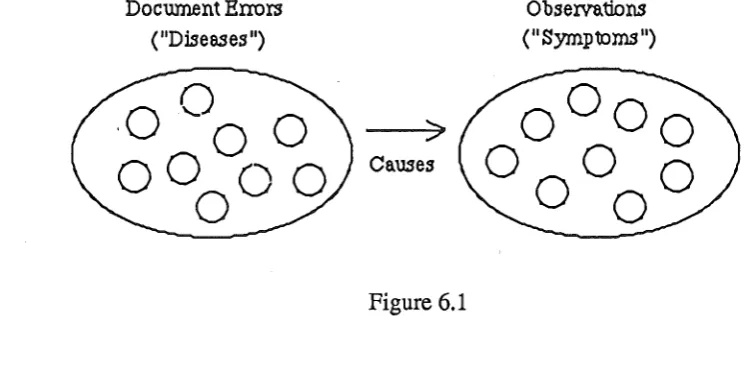
also investigated, but this had essentially the same underlying organisation. Figure 6.1 illustrates
this 'error-to-observation' structure. When an observation is found, this will trigger any relevant
error-hypotheses, which are then evaluated according to the evidence supporting it. The highest
scoring error is investigated further by asking questions about other expected observations.
Document Enors ("Diseases")
>
[image:20.595.84.459.542.728.2]Causes
Figure 6.1
The most important problem with this method is the difficulty of finding a suitable scoring strategy for choosing the best hypothesis. and the next question to ask. In a human expert this evaluation
process may be very complex. and simulating this using some general numericai scoring strategy
.ts probably impossible, although there are many Expert Systems, such as MYCIN, which use this method and perform reasonably successfully. However, they usually employ additional control
strategies or ad hoc techniques, to make the system effective [9].
With a numerical scoring strategy it is usually very difficult to control or predict how the system
will behave, since the declarative error-to-observation relationships (in which the scoring is specified) do not explicitly reflect the structure of a diagnosis. In the Mailmerge system, where
an organised, coherent dialogue is quite important, it is desirable for the knowledge to have some clear structure to it, rather than a hidden structure based on obscure numerical weightings.
The next approach was to make the hierachical (general-to-specific) nature of the Mailmerge
knowledge explicit in the knowledge base. This was based loosely on the 'disease-tree' concept in
Internist, except that two trees were to be used : an error (or 'disease') tree, and an observation
(or 'symptom') tree. · The error-to-observation relationships (and numerical scoring) would still be
represented as before, but questions to ask the user would be chosen in a more structured manner, as controlled by the tree-structure. Questioning would progressively narrow down the relevant
error and observation branches until a leaf-node is found which best explains the given
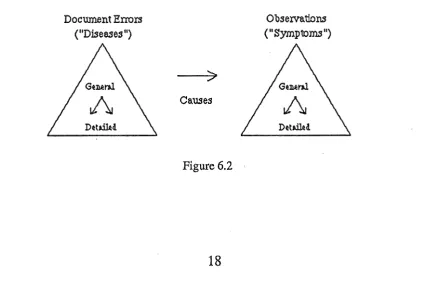
observations. The diagnosis would proceed in a hierarchical manner, starting with a general
problem description and error-hypotheses, and continue until the set of observations were detailed
enough for the final solution to be found. Figure 6.2 illustrates the overall structure of this approach.
Document En:oxs
( "Djsease:J11 )
[image:21.595.91.514.503.786.2]Causes
Figure 6.2
0 'bse:rvation:;
Unfortunately, developing the details of this (rather vague) design-description proved virtually
impossible. Finding a meaningful scoring strategy for evaluating the best branches to explore was no less difficult than the previous method. For example, assigning numerical weights to a general
error such as "missing .PA" is almost pointless since this error can cause so many different
effects, depending on the particular situation and the interpretation of the problem by the user.
Relationships between errors and observations are not precise enough for numerical weightings to be used effectively. It is certainly the case that different observations have different likelihoods of
occuring in particular situations, but it was found that these priorities could only be represented
clearly using explicit ordering.
A more important problem with the tree method is that the knowledge cannot really be represented in a tree form without considerable redundancy, as was found when attempting to develop a tree
structure (using lots of little pieces of paper). This is because most observations and errors can
have several parents, due to many possible ways of interpreting and classifying the knowledge.
It soon became apparent that the whole approach of basing the system on the fairly low-level, purely declarative, error-to-observation relationships was inappropriate for the Mailmerge system.
The method which has proved much more successful is to drive the diagnosis in a
forward-chaining manner, from observations themselves, rather than working back from explicit
knowledge about errors using an indirect and confusing scoring strategy. In other words, the
knowledge in the system consists of rules in the form
:-"If a, b, and c have been observed, then
investigate whether x andy have been observed
If several rules have the same, or similar, left-hand side conditions then the order of the rules can be used to indicate priority. This is preferable to using some sort of numerical scheme, since there
are no problems with inconsistent interpretation of the values (which is particularly relevant in a
hierachicalknowledge structure), and can be much clearer and simpler for the knowledge engineer
and the expert.
One of the important differences between the Mailmerge system and many other expert systems is
that the final solution is not an 'opinion' based on a set of observations, but is the actual
observation of an error in the document file. In other words, any hypotheses can be validated by
questions until a detailed set of observations is obtained. Questions are asked according to how
useful the information will be~ rather than for directly supporting or rejecting particular
error-hypotheses. During this process, whenever there is sufficient evidence for it to be
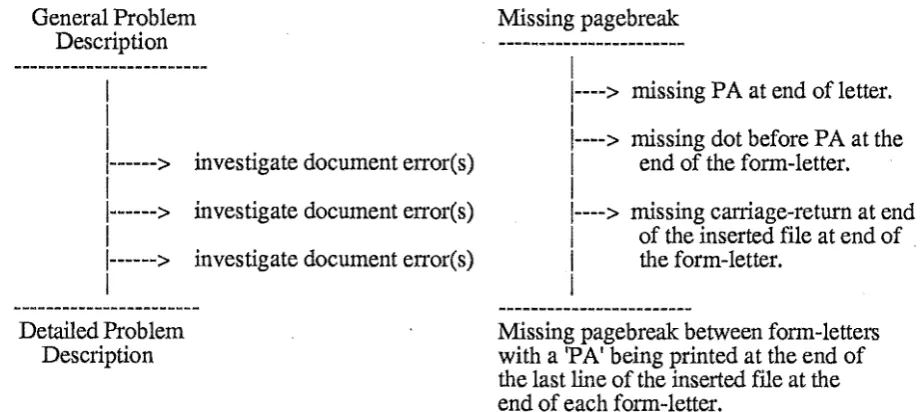
yvorthwhile investigating some particular document error, then the approprate question or questions about the document-file are asked to confirm or deny this error-hypothesis. Figure 6.3
illustrates this process, in general terms on the left, and for a specific Mailmerge example on the
right.
General Problem Description
I
I
I
1--->
investigate document error(s)I
1--->
investigate document error(s)I
1--->
investigate document error(s)I
Detailed Problem Description
Missing pagebreak
I
1---->
missing PA at end of letter.I
1---->
missing dot before PA at theI
end of the form-letter.I
1---->
missing carriage-return at endI
of the inserted file at end of .I
the form-letter.l
[image:23.595.75.536.230.436.2]Missing pagebreak between form-letters with a 'PA' being printed at the end of the last line of the inserted file at the end of each form-letter.
Figure 6.3 - The Structure of a Diagnosis
Rules which directly reflect this structure make controlling and predicting the behaviour of the
system much simpler, which is an advantage for ensuring a coherent dialogue. This is because
more of the control is built into the rules themselves, since they define what to do in a given situation, as opposed to the "error-to-observation" rules which are purely declarative. Each rule
has implicit knowledge about the error-to-observation relationships, which enables the choice of question in a given situation to be explicitly stored in the knowledge base. In other words, most of the knowledge acquired from the expert consists of 'observation-to-action' (or 'stimulus-response')
relationships, as opposed to storing lower-level knowledge with a 'clever' inference mechanism to
model the expert's thought processes. However, this does not mean that the system will just be like a conventional program, since the rules are, on the whole, independent of each other. The
work on the Mailmerge system so far has suggested that this compromise between declarative and
procedural knowledge is more sensible than attempting to make it totally declarative, with a
procedural representations can be found in [8].
Another alternative, still in the early research stage, is to include 'meta-knowledge' to represent
the reasoning process, rather than putting it in the inference mechanism itself. This is discussed by
Hayes-Roth et al. [3].
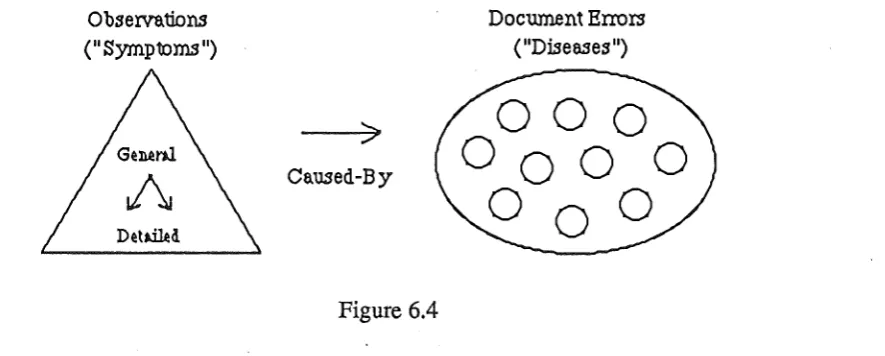
The overall structure for the above approach is illustrated in figure 6.4. This may not be
appropriate for many other diagnostic applications, but it seems to be quite effective for the Mailmerge problem.
Observations ("Symptoms")
>
[image:24.595.97.540.222.400.2]Caused-By
Figure 6.4
Document Errors ("Diseases")
The first 'working' system based on the above structure was written in the production-system
YAPS [17] (which is quite similar to OPS5 [19]). After writing enough of the program to show
7. MERMEX
7.1 Overview
MER.MEX is an Expert System shell designed for applications with a similar structure to the
Mailmerge diagnosis problem. The system is based on facts and production-rules , where the
production-rules operate in a forward chaining manner [10] with priority indicated by the order in
which they were loaded into the system. Knowledge consists primarily of rules which subdivide
an initial general problem description into a detailed set of observations, by asking questions either
in a yes/no form, or a menu structure.. The final solution is obtained when an actual error in the
document-file is observed. Figures 6.3 and 6.4 in the previous section illustrate this process
diagrammatically.
As well as providing the basic knowledge representation and control mechanism, MER.MEX also
includes a number of other features. One of these is the ability to detect inconsistent answers.
These can be reported to the user, who is then given the opportunity of correcting them. There is
also a facility to enable the user to see the list of previous answers, which can then be changed or
corrected.
MER.MEX employs a simple, but effective, technique which will automatically deal with "I don't
know11
responses, in the situation where explicit rules for coping with these have not been included in the knowledge-base.
A simple explanation facility is also provided which allows the user to answer a question with the
response "why". This will cause a message to be printed describing the current hypothesis.
These, and other features, will be explained in detail in the rest of this section. Some of the features are illustrated in the example diagnosis given in Section 7.11. There is also a Reference
manual included in Appendix-B.
Efficiency in MERMEX is achieved because only those production rules relevant to the most
recently acquired facts are examined. This minimises the amount of searching and rule-evaluation
7.2 Facts
As in many production systems, the most basic form of knowledge is a fact. A MERMEX fact is
_simply an association between a name and a value, as shown in the formal definition below :~
fact ::- ( <factname> <value> )
In most MERMEX applications, a typical fact-name would represent some statement about the
world, and the fact-value would indicate a measure of belief. For example, in the Mailmerge
system most facts
are
associated with observations of the printed output or the document-file, and most of the fact-values are one of the following four values, since these have special meaning to MERMEX:-TRUE
FALSEThe statement represented by the factname is true. The statement represented by the factname is false.
It?"
nil
The user answered "I don't know" when questioned about
the fact directly.
No information is known yet.
If the <value> part of a fact is one of the first three values then a slightly more convenient notation may be used, rather than the "(factname, value)" format:~
(x) is equivalent to (x
TRUE)
(NOT x) is equivalent to (x FALSE) [image:26.595.134.533.304.397.2](? x) is equivalent to (x ?)
1---r
(form-letters) "The user is printing form-letters"(NOT msng-pgbrks-btwn-fls)
(? PA-end-fl)
(msng-crgret-end-if 0. 7)
(looking-at end-fl)
"There are NOT missing pagebreaks between the form-letters"
"When the user was asked "Is there a .PA at the end of the form-letter file?" he
answered 'I dont know'."
"There is a 0. 7 probability that there is a missing carriage return at the end of the inserted file". (This sort of fact is not actually used in the Mailmerge system).
"The user currently has the end of the the form-letter displayed on the Wordstar terminal."
Note that the fact-name is 'looking-at', and the value is 'end-fl'.
(NOT looking-at top-fl) "The user is NOT currently looking at the top of the form-letter-file."
[image:27.595.95.527.77.395.2]1---r
Figure 7 .2.1 - Some Mailmerge Facts7.3 "Facts-to-Facts" Rules
Facts-to-Facts rules, or 'FF-rules', provide a means of directly inferring new information from
existing information. When the facts on the left hand side of the FF-rule (surrounded by an
implicit AND) all become true, then the list of facts on the right hand side are asserted into the
knowledge-base. There are rio priorities associated with FF-rules. They simply fire as soon as the
premise conditions are satisfied. For example ...
(FF (it-is-a-bird)
(NOT it-is-an-ostrich) --> (it-flies)
(it-makes-tweet-tweet-noises)
(NOT it-eats-icecream))
The list of facts in the premise of an FF-rule can actually be a list of logical expressions. The right
hand side, however, is restricted to being a single list of facts. The following (rather
:-(FF (AND (x)
(OR (NOT y) (z)))
(OR (? a)
(b 2) (c (+ b 8))
(AND (c) (NOT (d))) ---> (p) (NOT q)
(message 11
hello"))
Note that the expression "(NOT (d))11
in the above example does not mean 11
d is false'', but
rather "dis not known to be true". The formal syntax of anFF-rule is as follows
:-<FF-rule>
::-<fact-exprs>
::-<fact-expr>
::-<facts>
::-( FF <fact-exprs> <facts> )
<fact-expr> <fact-expr> ...
<fact>
I (
AND <fact-exprs> )I (
OR <fact-exprs> )I. (
NOT <fact-exprs> )<fact> <fact> ...
As well as inferring new information, FF-rules serve another important function, namely to detect
inconsistent answers. However, the discussion on this is left until section 7 .8.
FF-rules can also operate in the reverse direction. For example, when the following rule is loaded
into the knowledge base ...
(FF (it-is-a-mouse) -->
... MERMEX will also generate the rules ...
(FF (NOT it-squeaks) (FF (NOT it-eats-cheese)
(it-squeaks)
(it -eats-cheese))
--> (NOT it-is-a-mouse))
--> (NOT it-is-a-mouse))
using the 'FF*' symbol. Note that MERMEX will only generate reverse rules if the premise condition consists of a single fact, since to do otherwise would introduce considerable complexity.
Fortunately a large proportion of Mailmerge rules are in this form, and so the reverse-rule feature
can often be utilised.
7.4
"Facts-to-Actions" Rules
Facts-to-Actions rules, or 'FA-rules', form the most important part of the knowledge base. FA-rules have a similar format to FF-rules, except that the right hand side specifies a sequence of
actions to be performed, rather than a list of facts to be asserted. The purpose of these actions is normally to ask the user a question, or sequence of questions.
The following example shows a very simple FA-rule. The English equivalent of the rule is : "If
there are missing pagebreaks, and form-letters are being printed, then find out if the missing
pagebreaks are occurring between each form-letter (as opposed to half-way through).'' FA-rules
can be much more complex, but it has turned out that most of the Mailmerge rules are quite similar to the one below.
(FA (msng-pgbrks)
(form-letters) --> (QUESTION msng-pgbrks-btwn-fls)
(QUESTION PA-printed-btwn-fls) )
The right-hand-side actions can actually be any lisp function, although normally only the functions
provided by MERMEX would be used. The actions have an implicit AND surrounding them, and
are therefore performed in sequence until one of them returns a nil value. The QUESTION
function shown above will (generally speaking) return a non-nil value if the user answers "yes" to
a question. The general format of an FA-rule is as follows
:-(FA <fact-expression>
<fact-expression>
---> <lisp-expression> <lisp-expression>
If there are several FA-rules ready to fire, the one with the highest priority is chosen first. The
priority of a rule is given by the order in which it was loaded into the system, where the first rule
The production system YAPS [17] (which is based on OPS5) is essentially quite similar to
MERMEX. However, the choice of which rule to fire next is based on how recently the facts in the premise were added to the knowledge-base, which is supposed to result in the system focussing
on one line of reasoning, hence ensuring a coherent dialogue. Although this would be quite easy
to implement in MERMEX, there were several reasons why the simpler rule-ordering method was
chosen instead. For one thing, the Mailmerge FF-rules tend to infer new information in a rather 'unorganised' way. Many of the facts inferred may be quite irrelevent to the current sequence of
questions, and hence could cause the opposite of the desired focussing effect. The YAPS strategy makes controlling, or predicting, the system's behaviour very difficult, as I found when writing
my initial system (the forerunner of MERMEX) in YAPS. For example, in the common situation
where several rules have identical premise conditions, it is desirable for these to be fired in an
explicit order of priority. In MERMEX this is straightforward, but in YAPS it requires all sorts of
'clever' tricks, or extra conditions in each rule.
Using rule-ordering to indicate priority is quite widely used, and has been shown to be reasonably
successful. One example is EXPERT, which was discussed in Section 5. Incidentally, the
similarity (at least in name) between MERMEX's FF and FA rules, and EXPERT's FF and FH rules, is not a coincidence.
MERMEX also allows FA-rules to be explicitly marked with a numerical priority (0, 1, 2, ... ).
When some rules are ready to fire, they are first put into their priority group, with 0 being the
default, and then each group is sorted according to its loading-order. Rules in group N have
priority over rules in group N
+
1. These numerical values can be used to indicate whether a rule is 'weak' or 'strong', and so rather than having to put weak rules at the end of the knowledge-base,they can be grouped with other similar rules. However, I have not yet used this feature, and will
probably remove it, since I do not think numerical values are a particularly appropriate way of organising knowledge. The main reason is the difficulty of maintaining a consistent interpretation
of the numbers. It is relative priority which is important, and this is achieved much more clearly
and easily by the grouping and ordering of the rules.
7.5
Asking Questions
MERMEX provides a variety of functions to enable information to be obtained from the user. For
response to be entered, and will set the specified fact-value accordingly.
(YES-NO msng-pgbrks 11
Are there missing pagebreaks?11 )
Normally, however, questions are defined within a
QUESTION-declaration:-(QUESTION msng-pgbrks
(YES-NO 11
Are there missing pagebreaks?")
The QUESTION-declaration associates a list of actions (in this case a single YES-NO command)
with a fact-name. These can be executed (with an implicit AND around them) by putting a
QUESTION-command, such as "(QUESTION msng-pgbrks)", on the right hand side of an
FA-rule. Often these actions will ask a whole sequence of questions, or "questionnaire". The
function-value returned by a QUESTION-command will be non-nil if the associated fact-value has the value TRUE when the sequence of actions is completed. If the QUESTION-command has
already been performed earlier then the actions are not executed a second time. Additionally, if the
fact-value is already known beforehand, this will prevent execution. Note that if any of the
YES-NO commands do not have a fact-name as the second parameter, as in the example above,
then the fact-name of the enclosing QUESTION is used instead.
There are a variety of other functions also provided by MERMEX for use in QUESTIONs. Some
of these are shown in the example below.
(QUESTION personal-details
(ENTER-VALUE name "What is your name?")
(NO-YES single "Hello 11
name". Are you married?")
(MENU sex-menu)
(IF-YES
(ENTER-VALUE children "How many children do
you have?"))
(YES-NO employed "Are you currently employed?") (IF (AND (employed) (NOT single))
(YES-NO partner-employed "Is your" partner-name
11
also employed?"))
(QVALUE t)
)
(FF (sex male)
(FF (sex female)
(partner-name "wife"))
(partner-name "husband"))
Although most of the questions in the Mailmerge system only require a yes/no response, a few
questions at the start of the diagnosis use a menu structure, since this is more convenient for
determining the initial general problem description. An example of a typical MENU-definition is
given below
:-(MENU problem
(MSG "Which of the following problems are you having?") (OPTION pgbrks
(MSG "Pagebreak problem.")) (OPTION pgsizes
(MSG "Incorrect page-sizes.")) (OPTION dataflie
(MSG "Data-file problems.")))
When the command "(MENU problemt is given in an FA-rule, the following will be
displayed:-Which of the following problems are you having?
( 1) Page break problems. (2) Incorrect page-sizes.
(3) Data-file problems.
>
The user can then enter one or several of the option-numbers, with a"?" preceding a number to
indicate a 'maybe' or 'I dont know' answer. The fact-name associated with each option (eg.
7.6
Different
Types
of
User
The choice of questions, and the way in which they are asked, may need to be different for users
with different levels of Mailmerge experience. The priority of certain rules may also be affected,
since a problem which is common for a novice might be unlikely for a more experienced user.
Since the way in which the level of experience is used will depend very much on the particular
situation, MERMEX cannot cope with this automatically. Instead there must be explicit conditions
in the rules themselves. The Mailmerge system does this by defining three factnames :-NOVICE, INTERMEDIATE, and EXPERT
One of these is set to be true at the start of the diagnosis by asking the user his or her level of
experience (see [18]). Rules can then use these facts as required, as illustrated in the examples
below:-(FA ( ... )
(
...
)(OR (INTERMEDIATE)
(EXPERT))
(QUESTION X
--> (
...
) (...
)...
)(IF (OR (INTERMEDIATE) (NOVICE))
(QUESTION xl)
(QUESTION x2)
(NEWFACTS (x)))
(IF (EXPERT)
(YES-NO" ... "))
...
)Unfortunately, coping with different types of user requires considerably more work on the part of
the knowledge-engineer, since many more rules and questions must be produced. Therefore, the
current Mailmerge system only includes one or two rules such as the above, just to illustrate their
use. A possible extension to MERMEX could determine the user's level of experience
automatically, perhaps by recording how many incorrect or "I don't know" answers have been
7. 7
Explanation Facilities
~y production systems have an explanation facility which displays the rule currently being fired. This is inappropriate for the Mailmerge system (other than for development purposes), since it
would be meaningless to a typical user. Any explanations need to be in pre-written English text, rather than something automatically generated by the system.
The first method which MERMEX supports is the "WHY" command, which simply displays the
current most-likely solution. This is achieved by associating a 'hypothesis-description~ with each
~rule. For example ...
(FA (msng-pgbrk-btwn-fls)
(P A-printed-btwn-fls)
--> (HYPOTHESIS msng-crgret-end-if-end-fl)
(Q inserted-flle-end-fl) (Q msng-crgret-end-if)
(HYPOTHESIS msng -crgret-end-if-end-fl
uYou are probably inserting a file at the end of the form-letter, and have
missed out the carriage return at the end of it. This would cause the .PA to be printed, and the pagebreaks to be missed out11
)
The hypothesis description can be put directly into the rule, but since several rules may be
associated with the same hypothesis it is more desirable to define it separately, as above.
When the user answers uWHY" to a question, MERMEX will just display the associated
hypothesis-description, as illustrated below
:-Is the last part of the form-letter inserted from another file?
>WHY
uy ou are probably inserting a file at the end of the form-letter, and have
missed out the carriage return at the end of it. This would cause the .P A
to be printed, and the page breaks to be missed out.11
Is the last part of the form-letter inserted from another file ?
This not only explains to the user why the question is being asked, but also may enable the user to
solve the problem herself, without needing further advice from the Expert System. Additionally, this feature means that the system could be used as a kind of advice system, rather than just for
diagnosis. In fact, IYIERMEX could be used to create a reasonably effective 'intelligent' on-line
manual, where the goal of the system is to identify what the user wants to know and to print the
appropriate information.
Unfortunately, it is necessary that almost every rule includes a hypothesis description if the WHY
facility is to be effective. Otherwise IYIERMEX will just use the most recent hypothesis definition,
which may not be applicable. However, this is probably a good requirement since it provides
documentation for the knowledge base. If a rule does not specify the associated hypothesis then someone looking at the rule is unlikely to know where the right-hand-side questions are leading to.
Another very useful feature is the "SUMMARY" command, which will display, on request or in a
rule, a list of the information obtained from the user so far. When the user is answering a
question he can type "SUMMARY", and something like this will be displayed ...
The following is a list of what you have told me so far :
(1) There are missing pagebreaks in the output.
(2) You are printing form-letters.
(3) There are missing pagebreaks between each form-letter. (4) There is NOT a missing PA at the end of the form-letter file.
(5) The last part of the letter is inserted from another file.
Which of these are incorrect? (answer 0 for none)
>
This simple feature is very useful in the Mailmerge system since it helps users to clarify to
themselves what their problem really is. Also, as the example indicates, the user is given the
opportunity of correcting any previous answers. A SUMMARY command is executed automatically by IYIERMEX if it gets into a situation where no more rules can fire. Any corrections
made could enable the diagnosis to continue, rather than just declaring the problem as unsolvable.
changes. The method for achieving this will be discussed later.
If a large number of questions have been asked, it might be desirable to suppress some parts of the
summary. Later versions of MERMEX will hopefully include techniques to do this. One possibility is to make use of the hierarchical nature of the Mailmerge knowledge so that only the
most specific interpretation of each observation is displayed. In the above example, (1) is just a
generalisation of (3), and therefore need not be included. To determine this, the FF-rules could be
examined. For example, in the current system there is an FF-rule like the
following:-(FF (msng-pgbrks-btwn-fls) --> (msng-pgbrks))
To make the hierarchical structure more explicit, any FF-rule which represents hierarchical
inferences could be defined with a dfferent symbol, such as "AKO" (A Kind Of). The
SUMMARY mechanism could do some sort of search through these AKO-rules to determine which
of the list of questions to include in the summary. Another possibility is to suppress the questions
which were answered with 'no\ such as (4) above. However, this is not particularly desirable
since it is often these questions which are most likely to have been answered incorrectly.
The way in which MERMEX implements the SUMMARY feature is very simple. Whenever the
user is asked a question, the fact-name associated with that question is added to a list. The
11
SUMMARY" command just prints out the English descriptions of these facts. Facts-descriptions
can be specified using the DESC definition, as in the exmple below
:-(DESC form-letters "You [are/are not] printing form letters.")
Note that if a DESC has not been specified, the SUMMARY command will just display the fact
name. However, a system should normally include a DESCription for every fact, since it provides
documentation for the knowledge base.
7.8 Detecting Inconsistent Answers
One important characteristic of the Mailmerge problem is that clients often give incorrect responses.
However, the only way that MERMEX can detect these is by noticing some inconsistency with
other information. Therefore, to enable incorrect answers to be found, it is necessary to ask
questions would normally only be asked when the system cannot think of any alternative questions,
since this situation indicates that either the knowledge base is incomplete, or the user has made a
mistake.
MERMEX uses FF-rules to detect inconsistencies. Whenever an FF-rule fires causing some fact to
be set to TRUE (or FALSE), when its previous value was FALSE (or TRUE), then something
must be wrong.
Every fact in MERMEX has a flag indicating whether
its
value was 'inferred' (from an FF-rule) or 'asked' (using a question). If the most recent answer shows an inconsistency with a fact whichwas inferred earlier then this earlier fact's value is altered so it is consistent with the new
information. Any relevant FF-rules are then fired. Until the actual source of the inconsistency
(ie. a question) has been identified, earlier facts are corrected automatically, based on the
assumption that recent information is more reliable since the user will have probably gained a better
understanding of his own problem. Note that replacing previous fact-values, and firing
appropriate FF-rules, does not actually maintain a consistent knowledge-base. This would require
an "undo-FF-rule11
function to be produced. However, when the source-question causing the inconsistency is found then the knowledge-base can be corrected properly. This occurs when the
earlier (inconsistent) fact is marked as 'asked', The question which obtained this fact, and the most
recent question, can then be displayed to the user, using the DESCriptions of the two facts. For example ..
The answer you have just given me seems to be inconsistent with what you
told me earlier.
(1) There is not a 'PA' being printed between form-letters.
(2) A 'PA' is being printed at the end of the last line of the form-letter.
Which is correct? (answer '1 ', '2', 'N'one, or 'B'oth)
>
If a correction is made then all inferred facts are removed from the knowledge-base (simply by
incrementing a global 'fact-version-number'), and FF-rules are refired using the new list of
corrected answers.
If, on the other hand, the user says that both of the answers were correct, then the
knowledge-base must remain inconsistent. To prevent the inconsistency being reported again after
'CONFLICT-list'. Later inconsistencies with facts in this list will not be reported after each
question. When (and if) MERMEX gets into a situation where no rules can fire, it will display the
facts in the CONFLICT-list in a similar way to the SUMMARY command, and again ask the user
to check them.
It is somewhat doubtful whether the reporting of inconsistencies to the user is actually desirable. In
the example above it is fairly obvious that the first answer was the incorrect one, since it is easy
not to notice a 'PA' at the end of a line of text if only a general question such as "Is a PA being
printed betwen the letters?" is asked. It is for this reason that the second question is asked. The
second question is itself checking for an incorrect answer, and it is therefore unnecessary to report the inconsistency to t~e user. A better solution might be to always assume that the more recent
answers are correct, and fix up the knowledge-base automatically. If any of these automatic
changes were not justified, then the user is still given the opportunity of changing them back again
when the SUMMARY command is executed at the end of an unsuccessful diagnosis. Corrected
answers could be marked with some appropriate message when the summary is displayed.
The assumption that an answer just received is more likely to be true than earlier answers is not entirely valid, since the user may just make a mistake, ot misinterpret that particular question. A
solution to this could be to resolve incons_istencies according to how many earlier answers it
conflicts with.. If a response is inconsistent with several earlier questions then it could be assumed
incorrect, and immediately reported to the user. If it only conflicts with one, more general,
observation then the earlier answer could be assumed incorrect, and changed automatically.
Whatever solution is chosen it will not be perfect for every situation, and may need to be combined
with specific 'inconsistency-information' associated with those rules which require a different
technique.
7.9
"Don't
Know" Answers
Sometimes a client may answer 11
1 don't know" to a question. One situation when this could arise
is if the required information is unavailable. However, this is assumed not to occur in the
Mailmerge problem, since the output text and document file, to which most questions refer, must
always be available.
The second situation is when the user. cannot understand the question, and it might occur quite
understand fully. Sometimes it is more desirable to have reasonably brief questions which most people can understand most of the time, with special'backup' questions for when a client answers
"I don't know". The following