An evaluation of the Sycamore Tree programme: based on
an analysis of Crime Pics II data
FEASEY, S. and WILLIAMS, P.
Available from Sheffield Hallam University Research Archive (SHURA) at: http://shura.shu.ac.uk/1000/
This document is the author deposited version. You are advised to consult the publisher's version if you wish to cite from it.
Published version
FEASEY, S. and WILLIAMS, P. (2009). An evaluation of the Sycamore Tree programme: based on an analysis of Crime Pics II data. Project Report. Sheffield, Sheffield Hallam University.
Copyright and re-use policy
See http://shura.shu.ac.uk/information.html
Simon Feasey and Patrick Williams
August 2009
An evaluation of the
Sycamore Tree Programme:
based on an analysis of
Crime Pics II Data
An Evaluation of the Sycamore Tree Project
Based on an Analysis of Crime Pics II Data
Simon Feasey and Patrick Williams
ISBN - 978-1-84387-306-8
© 2009 Sheffield Hallam University
Whilst every effort has been made to ensure that the information contained in this book is accurate and up-to-date, neither the author nor the publisher can accept legal responsibility or liability for anything done by readers in consequence of any errors or omissions.
All rights reserved. No part of this publication may be reproduced, stored in a retrieval system, or transmitted in any form, or by any means, electronic, mechanical, photocopying, recording, or otherwise, without prior written permission of the publishers.
Cover design by The Design Studio, Sheffield Hallam University. Printed by The Print Unit, Sheffield Hallam University.
Published by:
Hallam Centre for Community Justice Sheffield Hallam University
Collegiate Crescent Campus Sheffield
S10 2BP
United Kingdom
An Ev a lu a t ion of t h e
Sy ca m or e Tr e e Pr oj e ct
Ba se d on a n An a ly sis of
Cr im e Pics I I D a t a
August 2009
Sim on Feasey and Pat r ick William s
Hallam Cent r e for Com m unit y Just ice
Sheffield Hallam Univer sit y
in par t ner ship w it h
-2-Contents
Introduction ... 3
Crime Pics II ... 4
Using the Crime Pics II Questionnaire ... 4
Methodology ... 6
Results ... 7
Profile of the Sample ... 7
Attitudinal Change ... 8
Analysis of the V and A Scales ... 11
Programme Change by Evaluation ... 16
Discussion ... 17
Key Findings ... 18
-3-Introduction
Sheffield Hallam University, in conjunction with Manchester Metropolitan University, were commissioned to undertake an evaluation of the Sycamore Tree programme by Prison Fellowship England and Wales who have been delivering the programme across a wide range of prisons throughout England and Wales over a number of years. This current evaluation builds on a previous report published by Sheffield Hallam University in 2005 which undertook a similar analysis and identified a positive impact on prisoners who had successfully completed the programme.
Prison Fellowship is a registered charity that trains some 1,200 volunteers from all Christian denominations to support prison chaplains and run programmes in prisons. Support is given to all who request it, regardless of their beliefs. This is this through prayer, practical action and values-based programmes. One such programme is the Sycamore Tree programme, which is the subject of this report.
The Sycamore Tree Programme is a victim awareness programme that teaches the principles and application of restorative justice. The content is covered in six sessions designed to enable prisoners to understand the impact of their crime on victims, families and the community. It also encourages prisoners to accept personal responsibility for their actions and points to the need to make amends. Surrogate victims come into prison to tell their stories. At the end of the programme, prisoners are given the opportunity to make a symbolic act of restitution, taking the first step towards making amends for their past behaviour. The programme is available to all regardless of faith, gender or age and is delivered by trained Prison Fellowship staff and volunteers.
The Programme consists of approximately 15 hours of structured discussion and activities and seeks to enable participants to:
• Understand the wider impact of their criminal behaviour and accept a greater level of personal responsibility.
• Identify with a victim’s experience of crime and the need for victim/offender forgiveness and reconciliation.
• Learn about the process of Restorative Justice and how offenders, victims and the wider community can take part.
• Plan steps to take to reduce offending behaviour whilst still in prison.
-4-Crime Pics II
The Crime Pics II questionnaire was developed by Michael and Associates in 1994. Essentially, Crime Pics II is a 35 item, structured, questionnaire designed to measure an individual’s attitude to offending on a number of distinct scales. It has been employed extensively throughout the National Offender Management Service (NOMS) as a tool to measure the impact of both accredited and non-accredited programmes of intervention. In 2003, the tool was adopted as one of eight measures to evaluate the impact of nationally accredited general offending behaviour programmes.
The following table provides a summary of the ‘attitudes’, which are targeted by the questionnaire and provides an explanation for each of the areas.
Using the Crime Pics II Questionnaire
Within the context of the Sycamore Tree programme, the questionnaire has been used as an evaluative measure, assessing the participating prisoner’s pro-criminal attitudes at both the pre (before programme commencement) and post (following completion of the programme) stages.
In doing so a ‘difference measure’ can be calculated that ascertains the degree of change from before to after the programme and therefore can be used to indicate the impact and effectiveness of the programme on completers. It is anticipated that there will be a positive shift (reduction) in pro-criminal attitudes for programme participants and specifically those attitudes relating to victim empathy and anticipation of future offending. This will be done by measuring prisoner responses to the Crime Pics II questionnaire at the beginning, and then again on completion of the programme.
Psychometric Features
Crime PICS II
General Attitude (G Scale)
Measures the offender’s general attitude towards offending. A low score indicates that the individual believes that an offending lifestyle is not desirable.
Anticipation of future offending (A Scale)
Measures the offender’s anticipation of re-offending. A low score suggests that the individual does not anticipate re-offending.
Victim Empathy (V Scale)
Measures the offender’s attitude towards his / her victims – whether they believe they have caused any harm. A low score indicates that the individual recognises their actions impact on victims, directly or indirectly i.e. higher victim empathy.
Evaluation of Crime as Worthwhile (E Scale)
Measures the offender’s evaluation of crime being worthwhile. A low score indicates that the individual
perceives the cost of crime as being greater than its rewards.
Problem Inventory (P Scale)
-5-As such this evaluation of the Sycamore Tree programme will include analysis of the shifts in pre and post mean (average) scores to explore whether there have been positive changes in the overall scores of programme participants. Secondly, the data will be subjected to further analysis to measure the extent to which any identified change, in mean scores, can be attributed to the programme. Specifically, more detailed analysis will focus upon changes on the ‘victim empathy’ and ‘anticipation of future offending’ scales1.
1
-6-Methodology
In total, 5007 sets of questionnaires were inputted for participants who had both commenced and completed the Sycamore Tree programme.2 Although it has not been possible to ascertain the numbers of prisoners who actually commenced the programme the number of questionnaires for analytical purposes is excellent. A data set of this size enables an analysis whereby it is possible to measure the size of anticipated ‘change’ in scores and the extent to which the change is as a result of the programme. Importantly, given the number of questionnaires for analysis, the analysis will include statistical tests to measure the extent to which any changes in attitudes can be attributable to the Sycamore Tree programme.
To this end, a ‘paired samples t-test’ will be used. Importantly, this test enables the measurement of participant attitudes at two different times, and therefore can indicate if any identified change is firstly significant and secondly, attributable to the Sycamore Tree programme. In addition, this evaluation will examine levels of change against a number of known demographics namely, age, gender, the risk
classification of the prison and the institution. The following section will present the
findings from the analysis of all inputted questionnaires.
2
-7-Results
Profile of the Sample
Gender:
Data was inputted for the 51 prison institutions within which the Sycamore programme was delivered. Drawing upon the institution name, it was possible to identify and isolate those institutions for women prisoners. As such gender was identified by separating out those institutions for women prisoners and those for men. Of the 5007 sets of questionnaires used to inform this evaluation, 567 were completed by women prisoners. This represents 13% of the overall sample with all other questionnaires completed by men (87%).
Adult/Young Offender:
Using a similar approach, a categorisation for age was included by separating ‘Adult’ institutions from ‘Young Offender Institutions’. Crime Pics II questionnaires completed in Young Offenders Institutions (YOI) represented 17% (n= 846) of the overall sample with 83% of questionnaires completed in ‘Adult’ prisons. A YOI categorisation indicates that the prisoners are less than 21 years of age.
Risk Classification of the Prison:
It is likely that the risk classification of the institution partly reflects the seriousness of the offence committed and the risk that the prisoner presents to the prison service in terms of behaviour and security. As such, the sample was again explored to identify the ‘classification’ of the prison institution. The following chart shows the number of questionnaires completed by institution type.
Chart : Questionnaires by Institution Type3
The sample for analysis is predominantly made up of questionnaires completed by prisoners within ‘Category C’ (32%) and ‘Local’ (22%) prison establishments. Also, 6% of the sample represents questionnaires completed by prisoners within ‘High Security’ prisons.
3
-8-Attitudinal Change
As discussed earlier, the measurement of programme impact is undertaken by analysing the (level of) change between pre scores and post scores. Following this, it is important to assess the ‘evidence of change’ by subjecting the data to statistical tests. The following table provides information on the overall mean scores and evidence of change on the five scales of the Crime Pics II questionnaire.
Overall Attitudinal Change - Whole Sample
As can be seen there is a positive shift between the pre and post scores denoted by a reduction in the average scores. Specifically, there was a reduction in the ‘general attitude’ (G Score) of those prisoners who completed the programme from 36.02 to 31.46. A similar trend is evident on all the Crime Pics II scales.
Secondly, a T-Test was applied to the data to measure the likelihood (probability) of the change being due to chance. For the purpose of this evaluation the level of significance applied suggests that where the ‘evidence of change’ is ‘Yes’ then there is a 5 in 100 (5%) chance that the change is due to chance.4 Therefore for the overall sample, it is clear that there was a statistically significant shift in prisoners’ attitudes that participated on the Sycamore programme.
A key objective of the Sycamore Tree programme is to improve the programme participant’s attitude towards the victim(s) of their offending behaviour. Therefore, the primary concern of this evaluation project is the analysis of attitudinal shifts between the pre and post scores on the ‘victim empathy’ and ‘anticipation of crime
as worthwhile’ scales. Commentators have identified two aspects of empathy;
‘cognitive empathy’ refers to the ability to recognise and understand other perspectives, whilst ‘emotional’ or ‘affective’ empathy, relates to the capacity to vicariously experience the emotions of others. Crime Pics II primarily seeks to measure changes in cognitive empathy so that improved scores might indicate a greater awareness of the impact of their crimes on victims and recognition that they are responsible for inflicting harm on others.
Intrinsically, analysis of the V (victim empathy) scale, provides a mechanism for evidencing the extent to which the programme meets the desired outcomes. It is anticipated that an increase in an offender's awareness of the impact of their crime
4
-9-on victims will have a positive effect up-9-on future behaviour and reduce the likelihood of future offending.
Within this context there are clear positive shifts between the pre and post score on the victim empathy scale from 5.23 to 4.44. Similarly a shift from 11.90 to 10.77 was found on the ‘anticipation of future offending’ scale. The above table shows that the shifts in scores are statistically significant and therefore evidence that the change in attitudes is associated with participation on the Sycamore Tree programme.
This is an important finding highlighting the benefits afforded to those prisoners that participated on the programme. Subsequent analysis will incorporate an exploration of both the victim empathy and anticipation of future offending scale as a means of highlighting the targeted impact of the programme.
Overall Attitudinal Change by Gender
Exploration of pre/post programme change by gender highlights a similar pattern as the whole sample analysis above. Attitudinal changes between pre to post scores show a general downward shift in pro-criminal attitudes for both male and female programme participants. Of interest, at both the pre and post stage there is a higher (mean) perception of current problems for female participants. Further, the post score for female participants is higher than the pre score for male offenders. This suggests that for female participants the level of problems that they perceive and in reality face is greater than that for male prisoners. In other words, even though a reduction in perception of problems is evident across gender, women have a greater perception of problems after the programme than men did before. This finding supports previous research that infers the prevalence of problems for female offenders including problems around mental health and the pains of imprisonment generated by a range of factors including children and childcare.
Again, overall there was a statistically significant shift on all attitudinal scales for both male and female programme participants.
Overall Attitudinal Change - Adult/YOI
-10-attitudes are more prevalent for those prisoners categorised as young offenders. This is evident upon all Crime Pics II scales. The most profound difference is found on the G score where younger offenders have a raised general attitude to offending behaviour. In addition, the ‘anticipation of future offending’ and ‘evaluation of crime as worthwhile’ is raised for younger offenders. Again, the shifts from pre to post programme scores highlights a reduction in attitudes which is attributable to participation on the programme for both Adult and Young offenders. Again this supports previous research relating to the correlation between involvement with crime and age5.
Overall Attitudinal Change - Prison Classification
The examination of pre and post mean scores by prison categorisation provides a valuable insight into the levels of pro-criminal attitudes for participants in different prison institutions. The participants with the lowest level of pro-criminal attitude was found within the ‘Category D’ prison institutions, apart from on the V scale where those prisoners within ‘remand centres’ had an overall lower mean. This may reflect the type of offences committed by those held within Remand Centres or the ‘unsentenced’ status of those participating on the programme. Overall prisoners within ‘Local’ prisons appear to present with the higher levels of pro-criminal attitudes. Although requiring further investigation, there is a suggestion that the perception of problems is related to the offender’s general attitudes to offending behaviour. There was again a positive shift between the pre and post programme scores on each scale by prison and again provides evidence of the positive impact of the programme.
5
-11-Analysis of the V and A Scales
Attitudinal shifts in V-Scale and A-Scale by Gender
The above chart shows the scores and attitudinal shifts on the V scale and the A scale. Overall it is evident that the programme has a positive impact on all participants irrespective of gender differences. In relation to the V scale, there is a greater attitudinal shift for female participants than their male counterparts. As such, the regard for victims is slightly higher for male participants prior to programme commencement. However on completion of the programme, regard for victims is increased for both female and male participants.
-12-Attitudinal shifts in V-Scale and A-Scale by Adult/YOI
As shown in the above chart, programme participants within YOI institutions had more negative attitudes than their adult counterparts. Therefore on both the V scale (5.24 vs. 5.23) and the A scale (12.50 vs. 11.79) younger prisoners’ demonstrate higher levels of pro-criminal attitudes. There is evidence that the Sycamore Tree programme has a greater impact upon younger offenders where we measured attitudinal change.
-13-Attitudinal shifts in V-Scale and A-Scale by Prison Category6
The above chart shows the difference between the pre and post scores on the victim empathy scale and the anticipation of future offending scales by prison category. It is evident that the Sycamore Tree programme has a significant impact upon all programme participants with a positive shift in attitudes.
In terms of victim empathy, the largest impact is found for those prisoners who were subjected to the intervention within Category D prisons (0.92) with programme impact was weaker for participants in ‘remand centres’ (0.69), although the impact was still statistically significant. For participants, the programme had a greater impact upon the ‘anticipation of future offending’.
Significantly, the impact is strongest for those participants within remand centres (1.48) and weakest for those participants in Category B prisons. Given that those participants within remand centres demonstrate the weakest shifts in victim empathy, yet the strongest on the A-scale indicates that the relationship between the two scales is not clear. This is supported with the following. For high security, Category C, Local and Remand Centres there were greater shifts on the A scale. For Category B, Category D and the ‘Other’ institutions, attitudinal shifts were more pronounced on the V-scale.
6
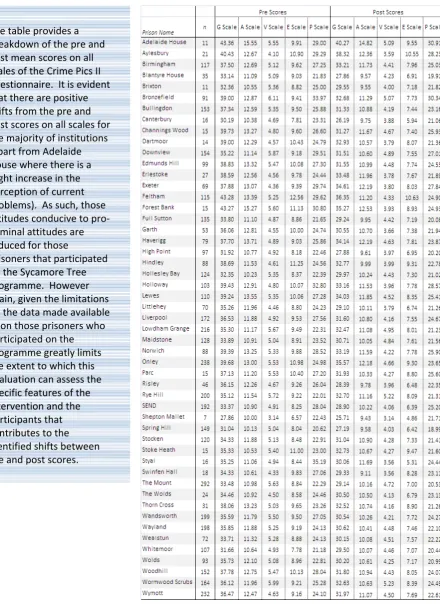
-14-Table to show changes between pre and post scores by Institution
The table provides a breakdown of the pre and post mean scores on all scales of the Crime Pics II questionnaire. It is evident that there are positive shifts from the pre and post scores on all scales for the majority of institutions (apart from Adelaide House where there is a slight increase in the perception of current problems). As such, those attitudes conducive to pro‐ criminal attitudes are reduced for those
[image:17.595.72.513.94.705.2]
-15-Table to show ‘evidence of change’ on the Victim Empathy and the Anticipation of Future Offending Scales by Institution
*Unable to compute differences between pre and post ‘V’ scores for Shepton Mallet.
The table presents the impact of the Sycamore Tree programme on the two key variables of victim empathy and anticipation of future offending. As such, there were statistically significant shifts in victim empathy within 36 institutions where the programme was delivered. This represents a significant shift in 69% of institutions where the programme was delivered. With regards to anticipation of crime as worthwhile scale, there was a statistically significant shift within 65% of the institutions within which the programme was delivered. However, there is little by way of consistency to inform of the factors that results in the statistically significant shifts in pro‐criminal attitudes.
As stated earlier, there are positive shifts in pre and post scores within the institutions where the programme was delivered. However, where evidence of programme change is not significant
then the change in score cannot be attributable to the Sycamore Tree programme. It is worthy of note that where the programme impact is not significant this may be as a result of the reduced numbers of programme participants and the size of the change between the pre and post scores which will have an impact upon the data analysis.
[image:18.595.259.507.110.731.2]
-16-Programme Change by Evaluation
7 [image:19.595.75.478.458.683.2]The Sycamore Tree programme was subjected to a similar evaluation in 2005. This therefore makes possible a comparison of impact between the earlier and more recent delivery of the programme. Again, the following table will examine the mean (scaled) scores between the ‘current’ and ‘previous’ programmes.
Table to show shifts between pre-post scores (scaled)
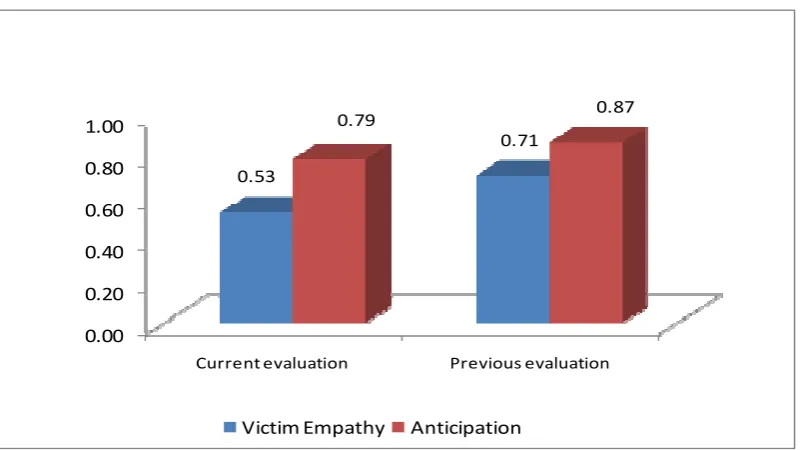
The Sycamore Tree Programme had a statistically significant impact upon both groups incorporated for analysis. The above table however shows that the prisoner group that made up the ‘previous’ evaluation had higher attitudinal scores than those within the ‘current’ sample. Further, the programme had a greater impact upon those participants who incorporated for the first evaluation. This is demonstrated by the following chart where the shifts in victim empathy were larger for the previous programme (0.71 vs. 0.53) and similarly on the anticipation scale (0.87 vs. 0.79).
Chart to show attitudinal shift in V-Scale and A-Scale by Evaluation
7
The Sycamore programme was evaluated in 2005 by Sheffield Hallam. This section incorporates the findings from the 2005 evaluation as a method of comparison for the current evaluation.
Crime Pics II Scores (scaled)
Pre Scores Post Scores
Dimensions Current Previous Current Previous
G Score 1.83 2.32 0.92 1.17
A Score 3.51 3.60 2.72 2.73
V Score 1.51 1.90 0.98 1.19
E Score 2.77 3.07 1.62 1.85
P Score 3.51 3.86 2.80 3.06
0.00 0.20 0.40 0.60 0.80 1.00
Current evaluation Previous evaluation
0.53
0.71
0.79 0.87
-17-Discussion
Using the data from the pre-programme questionnaires it was possible to provide a profile of the participants pre-programme based on the measurement scales within Crime Pics II. The report provides evidence of raised attitudes to offending behaviour for female programme participants (P Scale) and those who undertook the programme within Young Offender Institutions. It is possible that these attitudes are as a result of the levels of problems perceived.
However the profiling of the offenders is somewhat restricted in that there was no available data with regard to static factors such as previous convictions and disposals, index offence, sentence length, ethnicity and age. Similarly we had no information regarding dynamic factors such as substance misuse, emotional/psychological factors, stability of personal and family relationships etc. Further evaluation of the programme would be enhanced by accessing profile information to inform upon offence related needs and risk levels.
Overall there is strong evidence of statistically significant changes in attitudes which can be attributable to participation on the Sycamore Tree programme. This change, across the whole sample, is evident on all the five measurements of change within Crime Pics II.
-18-Key Findings
• Across the whole sample of prisoners there were significant positive attitudinal changes with regard to the five psychometric features of Crime Pics II.
• Statistical analysis indicates that these positive changes are associated with completion of the programme.
• The positive attitudinal changes are associated with all groups of prisoners including male, female, adult and young prisoners.
• The positive attitudinal changes are also evidenced across all institutional categories
• With regard to the V scale both male and female prisoners demonstrated an increased awareness of the impact of their actions on victims, directly or indirectly i.e. higher victim empathy. This positive shift was marginally higher for female prisoners.
• With regard to the A scale both male and female prisoners demonstrated a reduced anticipation of future offending. This positive shift was marginally higher for male prisoners.
• With regard to the V scale both adult and young prisoners (under 21) demonstrated an increased awareness of the impact of their actions on victims, directly or indirectly i.e. higher victim empathy. This positive shift was marginally higher for young prisoners.
• With regard to the A scale both adult and young prisoners demonstrated a reduced anticipation of future offending. This positive shift was marginally higher for young prisoners.
-19-Conclusion
The Sycamore Tree programme has a positive impact on programme respondents with a reduction between pre- and post-programme scores on all scales. However, the analysis of programme impact by institution suggests that some institutions have better results than others. This provides an opportunity to explore the features of the programmes and the participants where improvements were seen in order to improve the programme's effectiveness in all institutions.
Although there are a number of difficulties in measuring impact in isolation of other contextual information, the significant reductions in attitudes illustrate that the programme is having a positive impact on participants.
About the Authors
Simon Feasey joined Sheffield Hallam University in 2002, having previously worked
for the Probation Service. Initially Simon was responsible for the BA (Hons) Community Justice (Probation) course which provides the professional qualification route for Probation Officers. In 2005 Simon became the Deputy Director of the Hallam Centre for Community Justice to develop the Centre's Research and Continuing Professional Development (CPD) portfolios. Simon's research interests include:
• the delivery of services to offenders; effective practice, programmes, evaluation frameworks, managerialism
• the relationship between legal and policy developments and the delivery of services within the community justice sector
• the integration of underpinning and overarching knowledge within offender management
Patrick Williams completed the Social Science degree at the Manchester
Metropolitan University in 1997. In the same year he gained employment with the National Probation Service - Greater Manchester, as an Information Officer, Statistics and then as a Research and Evaluation officer. This role involved undertaking a variety of research and evaluation projects, relating to many areas of offender supervision, rehabilitation and management. Having delivered lectures and teaching at a number of institutions, including the University of Manchester and the University of Hertfordshire, Patrick has now returned ‘home’ to the Department of Sociology at Manchester Metropolitan University.
About the Publisher
Under the direction of Professor Paul Senior, the Hallam Centre for Community Justice is part of the Faculty of Development and Society at Sheffield Hallam University.
The Centre is committed to working alongside community justice organisations in the local, regional and national context in pursuance of high quality outcomes in the field of community justice research, policy and practice. In particular:
• evaluation studies
• scoping and mapping surveys
• full-scale research projects
• continuous professional development
• conference organisation
• Information exchange through the Community Justice Portal (www.cjp.org.uk)
For further information contact:
Telephone: 0114 225 5725 Fax: 0114 225 5800
Hallam Centre for Community Justice 220 Southbourne, Collegiate Crescent Campus Sheffield Hallam University
Sheffield S10 2BP UK