Exploring the potential of the internet of things at a
heritage site through co-design practice
PETRELLI, Daniela <http://orcid.org/0000-0003-4103-3565>, DULAKE, Nick
<http://orcid.org/0000-0003-1841-5848>, MARSHALL, Mark
<http://orcid.org/0000-0002-8875-4813>, ROBERTS, Andrew, MCINTOSH,
Frances and SAVAGE, Joe
Available from Sheffield Hallam University Research Archive (SHURA) at:
http://shura.shu.ac.uk/22639/
This document is the author deposited version. You are advised to consult the
publisher's version if you wish to cite from it.
Published version
PETRELLI, Daniela, DULAKE, Nick, MARSHALL, Mark, ROBERTS, Andrew,
MCINTOSH, Frances and SAVAGE, Joe (2019). Exploring the potential of the
internet of things at a heritage site through co-design practice. In: Proceedings of the
2018 3rd Digital Heritage International Congress. San Francisco, IEEE.
Copyright and re-use policy
See
http://shura.shu.ac.uk/information.html
Sheffield Hallam University Research Archive
XXX-X-XXXX-XXXX-X/XX/$XX.00 ©20XX IEEE
Exploring the Potential of the Internet of Things at a
Heritage Site through Co-Design Practice
Daniela Petrelli Art & Design Research Centre
Sheffield Hallam University Sheffield, UK [email protected]
Andrew Roberts Properties Instorian Team
English Heritage London, UK
Nick Dulake Art & Design Research Centre
Sheffield Hallam University Sheffield, UK [email protected]
Frances McIntosh Corbridge Roman Site
English Heritage Corbridge, UK
Mark T. Marshall Computer Science Sheffield Hallam University
Sheffield, UK [email protected]
Joe Savage
Interpretation and Resources Team English Heritage
York, UK
Abstract—Our multidisciplinary team faced the challenge of creating an engaging visiting experience for Chesters museum that hosts John Clayton’s collection of Roman antiquities found along Hadrian’s Wall. The museum, created in 1896, is still in its original form and has a large collection of altars and religious sculptures displayed in a continuous sequence on several rows, as was the fashion in Victorian and Edwardian times. This layout was overwhelming for most visitors who only spent very little time in the museum. In an iterative co-design process we generated multiple concepts and prototyped the most promising: the aim was to make the visitors slow down and look around in a meaningful way. We assessed three prototypes in place finding physical impediments and management issues for two. The design and implementation then focused on a single concept that explores the relationship between the Romans and their gods. The final interactive installation uses Internet of Things technology to offer a personalised experience that engages visitors at a physical level while simultaneously provoking them to explore and take action. This paper contributes to a better understanding of how design practice can create novel interactive visiting experience centered on meaning making rather than on the latest technology.
Keywords—design-thinking, co-design, internet of things, tangible interaction, visiting experience, archaeology
I. INTRODUCTION
Since the early 90s [1], museums have experimented with the emerging digital technology of the day. The path from pioneering experiments to diffused adoption is not easy, and at time, what seems a promising technology may fail in the market, a recent example is Google Glass [2]. Thus museums may enthusiastically embrace the newest technology to realize later down the line that extended technical knowledge or continuous supervision is needed to sustain its use on the exhibition floor, as it is the case with Virtual Reality [3], or that extra services must be offered such as a reliable and fast WiFi for BYOD [4]. The Internet of Things (IoT) is expected to be the next innovation wave [5]. By connecting the digital with the material, the IoT can transform the visit calling on the physical experience to deepen the engagement with the heritage [6]. By embedding digital technology into objects and spaces we can bring the attention of the visitors back to the heritage, as opposed to the digital devices, and create experiences that go beyond the delivery of information and engage visitors at an emotional level. A call to get back to the material as a way to foster a deeper engagement with the collection comes from several scholars in museum studies
[7]. They see value in revisiting the information-centric approach of cultural heritage in favor of one that enables visitors to be in direct contact with objects and places. This debate on the dominance of communication over emotion to create meaningful displays refers to the presence of information boards [8], but this criticism easily extends to the use of digital devices. Indeed museums have been keen to use digital technology to deliver large amount of information (all the information that did not fit on the panels) despite the fact that only a minority of visitors consume just a fraction of what is available [1, 9]. In a sense, this seems to suggest a conservative attitude: new technology is used to do what was done before only via new means instead of exploiting the new technology to design a radically new visiting experience. However, to embrace a new technology and design innovative experiences requires the involvement of a multidisciplinary team and the safe settings of a research project within which museums professionals feel free to experiment and be creative [10]. This is in contrast with the burden of responsibilities that come with tendering that is likely to push the decision making process toward what is already known as opposed to the radically new. There seems to be a paradox at work: the ambition to be innovative but not groundbreaking as not to take the risk that comes with that. Exploiting new technology means there is no example to follow and therefore it requires the heritage to make a leap of faith [10].
designers and computer scientists over several months. In the following we discuss the process in depth, starting with the review of related work of novel ways of physical interaction in museums and heritage, and co-design practice. Following we discuss the different phases of the co-design process we went through, including concepts we later abandoned. We then present in detail the final design as implemented and installed at the museum. We conclude the paper reflecting on the process looking at how co-design and design-thinking can create radically new visiting experiences while IoT acts as an enabler. We also reflect on the frictions occurring when collaborating across different working practices.
II. RELATED WORK
A. Internet of Things for Musuems and Heritage
Networked objects and the Internet of Things are seen by museums professionals as long term [5]. However, this new technology holds much potential for heritage as it allows embedding sensing and computation into smart objects and spaces and seamlessly create experiences that cross the boundaries between the material and the digital. Tangible interaction fits in this definition: objects with strong material properties conceal digital technology and are therefore reactive to other smart objects or spaces and people [11]. This new form of tangible and embodied interaction has been tested in museums only as part of research projects. In the early experiments of the late 00s, tangible devices to listen (a radio), point (a torch), and read (a magnifying glass) were used to collect items in the museum and complemented mobiles and a tabletop as part of a game for families [12]. Tangibles have also been used to materialise experiences and enable interaction with soundscapes. The ec(h)o cube was used to select topics of audio presentations delivered via headphones [13] in a 3D adaptive soundscape, while replicas of historical cups told their stories when handled [14]. The cups were placed in a soundscape room that reacted to the visitor’s movements and actions: if the visitor was owing ambient sound was played on their headphones; if the visitor was handling a cup the corresponding story was told. Replicas of museum objects have been used in the Atlantic Wall exhibition to represent the stories of different groups of people involved in the events of WWII in the city of The Hague in The Netherlands [15]. Different objects prompted different stories for the same exhibit; their visit was logged and a unique code printed on a souvenir postcard that gave access to a personalized city map to see more content or to share personal and family memories.
Tangible have been developed also as stand-alone interactive piece within a traditional exhibition. The Magic Cauldron (part of a touring exhibition on magic) engaged children in casting spells while throwing objects into the interactive cauldron that reacted with different sounds (e.g. burps) and lights depending on the object thrown in [16]. Spells on display, e.g. from Shakespeare’s Macbeth, inspired children to invent their own and engaged them at length. Another tangible interactive installation is a pair of small scale replicas of the statue of Augustus and the Ara Pacis in Rome augmented with buttons that, when pressed, triggered multimedia content on a display positioned nearby [17].
In summary, tangible interaction and the Internet of Things hold much potential to bring the visitor closer to the heritage itself and engage them in an emotional as well as in a cognitive way. This new technology supports the belief,
shared by many in the museum study community [7], of the need to rediscover the power of materiality and physical engagement as essential to the visiting experience over the information-centric approach that have been prevalent for many years [8].
B. Design-Thinking and Co-Design
“[…] design thinking is fundamentally an exploratory
process; done right, it will invariably make unexpected discoveries along the way […] Often these discoveries can be integrated into the ongoing process without disruption. At other times the discovery will motivate the team to revisit
some of its most basic assumptions.” [18, pg.16] Design
thinking has received much attention in recent years for its power to innovate and its ability to tackle very complex problems for which there is no obvious solution [19]. Museums too have started to explore what a design approach could bring to the planning of an overall new museum experience [20], to foster innovation within a single musuem [21], and to address a single topic in a focussed high-paced activity [22].
Design thinking can be broadly defined as the way in which designers approach the solution of a problem. However, the very first step is not to solve the problem, but to better understand what the problem actually is: it is ‘problem setting’ before ‘problem solving’ [18, 19]. Indeed to design is to create the “ultimate particular” and to immerse oneselves into the uniqueness of each case. Design is a practice-based discipline therefore the making and trying out is engrained in it. It is a non-linear, iterative process (defined with different phases by different authors) that cyclically goes through inspiration and understanding, ideation and implementation, evaluation and reflection. The starting point is always the human experience and some authors use design thinking as synonymous of human-centred design [21, 22]. Very little may be known at the beginning, but this is not a reason to stop a design thinker from prototyping some early ideas and to see what happen when those are taken into the world, starting a process of assessment and reflection that feeds new knowledge into the iterative process. As such, design thinking is a practice-led way of investigating a problem that continuously question the choices made and keeps many options open until empirical evidence is gathered to support decision making. For its flexibility and openness design thinking is very effective in engaging multidisciplinary teams as it empowers each member to act as an equal.
sketching, acting, or post-it comments, co-design enables participants with very different backgrounds to take part and feel they own the outcome.
In summary, when applied to museum practice, co-design can shift the balance from curator-led exhibition design to more creative practices by enabling the fusion of multiple thinking. In an effort of opening up, museums are becoming more experimental and have started to look at design thinking as a good opportunity to embrace change. In the context of our project, the exploratory and experimental nature of design-thinking is ideal to scout uncharted territory such as IoT in museums. In the remain of the paper, we will show how off-the-shelf technology can be used to create a unique, unexpected and engaging visitors experience when design thinking defines the process and design and co-creation are used in the planning and implementation.
III. CHESTERS ROMAN FORT AND MUSEUM
[image:4.595.46.291.451.555.2]The work presented in this paper revolves around The Clayton Museum, a small archaeological museum that is part of an English Heritage property, Chesters Roman Fort and The Clayton Museum, which includes the remains of a fort and bathhouse. The Roman fort at Chesters is part of Hadrian’s Wall, the fortification built by the imperial army across the North of England in c. 122 AD that it is today a UNESCO World Heritage Site. The museum at Chesters was created in 1896 to host John Clayton’s collection of Roman objects, mostly from Hadrian’s Wall and its surroundings. John Clayton is credited with the preservation of Hadrian’s Wall: his country home had the fort of Chesters in the grounds and he began excavating there is 1843. The museum, first opened in 1896 (Fig. 1), retains the late 19th-century style of display used in museums in Victorian and Edwardian times for the pleasure of its owner and the first travelling visitors.
Fig. 1. The inside of the musuem at Chesters Roman Fort and Musuem. The museum layout is a sequence of statues, reliefs and altars displayed on multiple rows. To the untrained eye, the stones themselves with a few exceptions, seem uniform and lacking in colour. Many are fragmentary or shaped in a way that reveals little about their function or meaning without detailed study. They feature seemingly esoteric symbols or figures - many quite rare or unique even to a specialist. Many hold inscriptions, but these are often illegible or partially missing, and all are in Latin. As such, the display is challenging for many of the 60,000 visitors that come every year: most of them enter, spend only a few minutes looking around and leave missing the opportunity to appreciate the richness and relevance of the pieces on display. The aim of designing a new interactive experience was then to slow down the visitors and engage them with the collection in a meaningful and enriching way. We wanted visitors to see the stones as objects of great significance in the lives of their
erstwhile owners, through understanding them as objects that were once interacted with, rather than passively viewed.
The museum posed a major challenge for design: by having been preserved in its original state, Chesters museum is, in itself, an historical artefact that cannot be altered by intrusive technology such as screen-based displays. We considered hanging pico-projectors to the light poles but power limitations prevented this option. We therefore had substantial constraints on what multimedia output could be chosen: as the space is limited, there was the risk of adding to an already busy environment yet another level of interpretation. Design should then be mindful of the settings. In addition, the museum is hosted in a separate building from the ticket desk, the shop or the cafeteria: as personnel are very limited, the museum is unsupervised thus excluding any possibility of taking advantage of facilitators to support visitors. A further constraint was the lack of WiFi on site and a poor phone signal reception within the museum building. These constraints framed our design, as discussed next.
IV. ACESE OF DESIGN-THINKING AND CO-DESIGN The multidisciplinary team encompassed heritage professionals (Collection Curator, Property Historian and Interpretation Manager), designers (product, graphics and interaction design) and computer scientists. We applied design thinking and co-design: in a series of meeting and workshops we discussed ideas and identified concepts, considered their feasibility in-situ taking into account aspects of management and sustainability. Equipped with this solid understanding, we developed the interactive installation that was then deployed and is currently in use.
A. The Coming Together of Different Visions and Expertise
The collaboration was triggered by English Heritage approaching the design team following a conference presentation that introduced the concept of tangible and embedded interaction in museums via a number of exploratory prototypes that included the Loupe, an augmented reality interactive trail implemented via a mobile phone embedded within a wooden case that resembled a magnifying glass [25]. The Loupe was controlled via gestures and presented snippets of text in sequence, revealing more content as the interaction progressed. English Heritage considered the Loupe ideal for Chesters as it would bring innovation (the gesture-controlled device) for a well-known technology (Augmented Reality in museums). A further concept put forward by English Heritage was a book-like interaction: the book could reproduce an archaeological record of the unearthing of Hadrian’s Wall remains or “a guide” from Victorian times. This fit within the constraint of text-based interaction, the type of content considered most suitable for Chesters museum as multimedia could not be easily delivered given the constraints mentioned above.
The concepts put forward show different visions and approaches. The concepts by English Heritage were guided by existing offers: the re-creation of existing museum technology in new forms (the Loupe) or the digitisation of existing analogue forms (the excavation book and travelling guide). Designers were inspired by what they found in place and the stories they were told: the “collector” came from the desire to create engagement via emotions, to instigate discovery, choice and appropriation rather than just receiving information. Thus the two teams came to the collaboration from opposite directions. We found common ground via design practice techniques, design-thinking and co-design. As discussed in II.C, design-thinking is rooted in a process of experimentation that makes use of prototypes to synthesise knowledge and understanding and make it manifest and therefore ready to be critically assessed and evaluated with experts, in the lab or in the field. The first step was then to prototype the concepts to assess them at Chesters museum.
B. From Concepts to Prototype Evaluation In-Situ
The Loupe, the Excavation Journal, and My Precious Collection (Fig. 2) were assessed in place by the multidisciplinary team. These rough prototypes resembled the possible final devices in form and technology. When evaluating them at the Chesters museum, we considered the visitors experience as well as the implications for staff.
The space within the museum was too limited for the Loupe to be used as intended. The crowded space made it impossible to be far enough from the exhibits in order for the camera of the smartphone (encased in the 3D printed frame) to capture the whole altar, statue or plaque. The only exhibits suitable were the items in the historical display cases (in the centre of the museum in, Fig. 1). We then considered where the Loupe could be placed with respect to the display cases, how to charge it and how the instructions could be given. A further iterations of the concept looked at the visual markup that could be easily identified in the display case by both visitors and AR-augmented cameras. All in all the many constraints induced us to abandon the concept.
The Excavation Journal was to replace the A4-size catalogue that was available at the bench (front of Fig. 1). The Excavation Journal was to be less intimidating and easier to handle than the catalogue. Moving the content to a digital format would also give an opportunity to revise the text and add images. The prototype encased a tablet into a book-like cover; tracing paper covered the screen and gave a sense of real paper. How to effectively monitor battery consumption and to charge the Journals when needed was considered too onerous, as the tablets would need at least a check a day. English Heritage then proceeded independently choosing Amazon Kindle for the long battery life and the lower maintenance while providing a similar experience.
My Precious Collection was assessed with respect to the many items on display and the space available in the vestibule for printing the personal catalogue. The layout of the museum allowed only the exhibits in the front to be easily reached while those on the shelves could only be looked at. Instead of a tangible object to carry around and collect exhibits as we had envisaged, we started to consider “pointing tools”, e.g. a torch, which would allow visitors to select exhibits at a distance. While this was not necessarily an impediment, we were not fully convinced and we were keen to revisit the concept in light of our new understanding of how the “collector” could be used and how the layout of
the museum affected its design. A co-design workshop with the whole team was then instrumental to reframe My Precious Collection into the concept of My Roman Pantheon.
V. MY ROMAN PANTHEON
A. Co-Design and Co-Creation
[image:5.595.302.557.338.539.2]In the co-design workshop we started from the observations made during our assessment at the museum and our personal feelings for holding the collector. We initially considered to redesign the collector as a torch-like device that would capture the desired objects at a distance, but the large round form of the collector had a stronger tactile presence: it nests in the palm of the hand and had a nicer feeling than the closed grip needed for the torch. Its aesthetics also clearly show how many items one is allowed to collect (the number of single lights) and the limited number would make the choice more compelling. A further point in favour of a larger form was the easier use: pointing a device at a distance aiming for a tag (e.g. pointing the torch to a visual marker) is less reliable than a direct scan. The tactile stronger feeling, a higher degree of novelty, and ease of use convinced the team it was worth redesigning the experience around the round bowl of the collector as opposed to changing the device (to a torch) to fit the initial concept (creating a personal collection).
Fig. 2. Early concepts: Loupe (top); Excavation Journal (mid); My Collection precious (bottom).
co-design process was a concerted effort that created a bespoke experience via the particular content and the story in equal measure to the experiential considerations of the interaction mechanics and the sensory.
As the decisions were made, we started to shape the overall visiting experience: in the vestibule the visitor would collect the votive lamp from the shrine; they would have a small number of offerings to take to the altars (marked by stands in the museum); visitors would then have to choose, among the many, which ones they wanted to give their offering to; on returning to the shrine, on their way out, with the now empty offering vessel the visitors would receive their personal “oracle”, a personalised reading of one’s character and needs based upon the choices of gods.
The discussion at the workshop was very open with equal contribution from each partner. Sketches and props enabled us to imagine the interaction in some detail, to reach a general agreement as to start the next stage, the development: each partner carried out their own work independently but meet regularly to synchronise their effort and share decisions [10]. Thus the heritage partners selected the deities within the museum, the designers sketched the shrine and the offering, and the computer scientists looked at the best technology to use and code the system. In this phase, only limited information was exchanged when needed, for example the photos of the exhibits selected by the museum professionals were passed to the designers to create the drawings for the stands. Each team member had a specific task, but we also relied on one another for details that could affect our work, for example the heritage partners provided an image of a household shrine from Pompeii as inspiration to the designers as well as the precise size of the space available in the vestibule for the shrine to fit in. While the key elements have been decided by the team, other decisions were taken by the individuals or a sub team: the heritage team selected the deities, prepared snippets of content, and chose images to represent each deity on the postcard; the designers defined the offering vessel, the shrine and the stands (product design) as well as the phases of the interaction in the vestibule and the museum including instructions (interaction design); and finally the computer scientists worked on the system design, hardware assembly and the logic for the production of the personalised postcard.
B. Visiting Experience
This section describes the interactive experience as deployed. As said in session III, there are no personnel in the museum and therefore the installation had to be self-explanatory. An effort was made to include instructions at critical points without compromising the layout of the museum display. From previous experience we know it is essential that instructions are delivered precisely where
needed as they can be easily overlooked [15]. Thus the instructions for My Roman Pantheon are displayed on the screen that is concealed inside the shrine (Fig. 3) placed in the vestibule of the museum. The instructions tell the visitor to pick up a votive lamp from the shrine’s shelves and place it in the bowl in the shrine. Juno then appears welcoming the visitor and “charging” their votive lamp and instructing them to use the lamp to gift those gods that would help them the most on Hadrian’s Wall. She also says to come back later to receive the “oracle”. At the start the lamp was blank, now it shows three flickering lights, the three offerings given by Juno. The shrine then goes back to show the instructions so that the visitors can see the different steps as many times as needed before entering the museum.
Inside the museum, the visitors find 13 stands, one for each of the deities to whom they can offer their lights (as illustrated in the instructions). Gods and goddesses have been carefully chosen to represent the peculiarity of the Roman Empire that absorbed the religion of the conquered land as part of their ever-expanding system of beliefs. Therefore the deities to choose from included Mercury and Minerva, gods from Rome, but also Cautes (an attendant of Mithras) from the Middle East, Mars Thinscus from Germany, and Coventina from a sacred well along Hadrian’s Wall. As Roman religion was transactional, meaning an offering implied a return of favour from the deity, the gods and goddesses chosen in the museum represented different goals and needs people could desire, from health (Aesculapius) to wealth (Mercury), victory in gambling (Fortuna) or the battlefield (Victoria). Romans believed that the divine inhabited people, places and objects; this is represented in the museum by Genius Loci (the spirit of the place) and the cult of the emperor (Emperor Genius). Such a variety of deities was intended to stimulate curiosity, questioning and, ultimately, to impact on the visitors’ choice: would they seek protection? Or success in business or war? Or be intrigued by unknown gods from far lands in the empire?
Apart from a few panels with the curator’s choice, the only labels are a few lines of text written on the stand that holds every exhibit. We expected the visitors to first go around looking for the stands, find the deities and read their labels as to make up their mind on which three to honour. To offer a light to a god the visitors put the lamp closer to the stand: a flash sparks from one of the lights in the votive lamp and then it is off. This is repeated until all three offerings have been given. Now it is time to return to Juno.
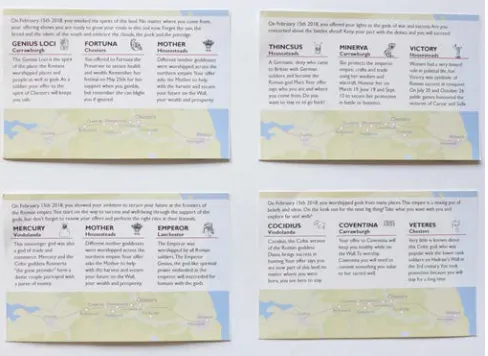
When the votive lamp, now empty, is placed back in the shrine, Juno reads the offering and gives back a postcard that describes the deities and how this will affect their lives on the Wall. As there are 13 deities, choosing only 3 generates 289 different combinations giving visitors the impression of
a unique experience. The date printed on the postcard (Fig. 4) adds to the impression of a personalised souvenir.
C. Implementation
We used Integrative Thinking as a way to guide our implementation of the described interaction. An essential part of design thinking (II.C), integrative thinking synthesises multiple strands of knowledge and analyses or even apparently contradictory factors into a seamless solution to the given problem. In this section we discuss how the content, the tangible components and the technology were interwoven in the implementation.
1) Designing the Content
Section V.B above gives an account of the rationale for selecting which deities from the collection become part of the installation. Such a variety was instrumental to create the 289 combinations that reflected very different needs or ambitions Romans at the frontiers of the empire might have. Each deity was tagged with characteristics that represented its role in the Roman pantheon. Six characteristics were defined: local – gods that are connected with Hadrian’s Wall specifically; tradition – the cornerstone of the Roman pantheon; acculturation – gods that Rome embraced from various origins; success – in various form, life, afterlife, health, war and trade; victory – literally and very important for the military; comradeship – gods that show concern or will help with a military career. For example, the Emperor, Genius Loci, and Cautes were all tagged as ‘comradeship’, but the Emperor was also tagged as ‘tradition’, Genius Loci as ‘local’ and Cautes as ‘acculturation’. When selected by the choices of the visitors the deities would compose a group of tags; the dominating tag-type would determine which oracle would be printed on the postcard. Fig. 4 shows examples of postcards generated by different tags combinations.
[image:7.595.46.290.488.666.2]The variety of deities that aimed to invite visitors to explore the Roman pantheon before choosing their own, supported the tagging system that transformed the visitors’ choices into the personalised postcard.
Fig. 3. A few of the 289 different oracles (postcards) Juno gives.
2) Crafting the Shrine, the Votive Lamp, the Postcard
The shrine, the votive lamp with the stands, and the postcards are the components of the tangible experience. The back of the shrine frames a screen while a small bowl in walnut wood is placed at the threshold. When the lamp is placed in the bowl, the information displayed on the screen disappears and an animation of Juno starts to play. A
photograph of the statue of Barberini Juno was the starting point for the animation: a 3D model of the statue was created by manually selecting points from the photograph; the statue was animated with movements of the arm holding the staff, the feet, the head, mouth and shoulders, and the extension of the arm holding the patera toward the visitor. The animation is synchronised with the lighting up of the lamp when Juno says “…the light I now put in your votive lamp”.
The shelves for the lamps, below the shrine, were inspired by the layout of Roman aqueducts and conceal a system of inductive charging, a charging pad for each lamp. For a lucky coincidence, the conductive charging warms the lamp so one has the impression of really holding a small flame. The lamp is a contemporary interpretation of a ‘lucerna’: round on the bottom to fit the hand and flat on the top with three slits to show the flickering lights. Made of vacuum cast polyurethane resin (bottom part) and polished American black walnut wood (top), the lamp has a very smooth finish but has some weight too. When lit up, the flickering light on the dark wood feels precious and real.
The stands are located as close as possible to the exhibits they map. The label is divided in three parts: the name of the deity; the symbol of the lamp (with instructions around it inviting the visitors to place the lamp there to make an offering); and a drawing of the altar, statue or relief (to help the visitors to identify the exhibit among the many).
At the end of the visit the oracle is printed on a postcard: text and images are generated on the fly from the visitors’ choices and printed on a coloured postcard that shows the map of Hadrian’s Wall on the front and an abstraction of Chesters ruins on the back. The printer and the roll of tickets are concealed within the body of the shrine; the printed postcard comes out from a slit above the lamps.
The design of the physical components of My Roman Pantheon combined product design (the shape and feeling of the lamp) with aspects of engineering (to position the printer inside the shrine) as to create immersion and magic.
3) Assembling Technology, Designing Software
The technology that pulls the different components together is an implementation of an Internet of Things system. NFC tags are concealed in the stands and below the offering bowl in the temple; the lamps are an assembly of: an NFC reader, a wirelessly-enabled Arduino Fio, a lithium ion battery, an inductive charger, and 3 programmable RGB LEDs. Hosted within the body of the shrine are: a USB wireless receiver that communicates with the Arduinos in the lamps, a PC to respond to the communications from the Arduinos, play the videos, generate the postcards and control the commercial ticket printer that produces the postcards. In addition, a commercial Uninterruptible Power Supply (UPS) guarantees a smooth booting and shut-down of the system when the power is switched on in the morning and off at closing time so museum personnel do not have any duty.
stored for each offering, the PC then generates the postcard and sends it to the printer, and plays the closing animation with Juno handing out the oracle.
Although at a small scale, My Roman Pantheon captures the main elements of the Internet of Things: the technology is embedded in the real world and events are sensed and logged; the different elements (sensors, screens, printer, boards, PC) seamlessly communicate with each other to exchange data and complete actions. A further opportunity to exploit the power of IoT would have been to use the log of the interaction at Chesters museum to personalise the interaction online, e.g. by providing further information on the deity selected in a personalised website. This transition between the experience onsite and the interaction online, despite feasible [28], was not implemented due to the lack of Internet connection at Chesters (see section III).
D. Technical Assessment and Feedback
My Roman Pantheon was installed at Chesters Museum in February 2017. In this year of deployment, there have been a few calls for maintenance, due to visitors tampering with the installation (e.g. coins were put through the slit for the postcard thus blocking the printer) and to few unexpected technical hiccups that were easily fixed. However, the need for a long drive to reach Chesters made us acknowledge the power of IoT if an Internet connection were possible.
Informal feedback from the personnel at Chesters indicates visitors appreciate the new experience commenting on its uniqueness and ease of use. As the majority of visitors at English Heritage properties are middle age and older or families with young children, we can consider this a measure of success. We were reported that many visitors wish there was more information available for them to better understand and choose. As the exhibits all have a few lines of explanation, we believe this is due to visitors missing it. This could be easily addressed by changing the stands with content labels: in this way the information will be placed where the action of offering takes place and there will be fewer opportunities for missing it. Chesters personnel also report that only a few postcards are found left behind indicating visitors are keen to take away a souvenir of their visit, thus confirming previous findings [29].
My Roman Pantheon has been designed for minimum maintenance. No special technical expertise is required from the personnel that have only to load a new roll of postcards when needed and to turn on and off the power.
VI. LESSONS LEARNT
A. The Perspective of the Computer Scientists
From a technical perspective, My Roman Pantheon offered a number of challenges with regards to the development and deployment of IoT technologies on a heritage site. Mostly, these revolved around issues of repair, maintenance and updates. As already discussed, the museum at Chesters where this installation took place does not offer an Internet connection. As such, there were limits in our ability to monitor, diagnose and update the system in the case of any issues. All changes required an engineer to drive for 3 hours each way in order to visit the site. Indeed, this particular installation proved more difficult and time consuming to maintain than previous exhibitions that took place in other European countries, thousands of kilometres away, where a remote diagnostic connection was available.
We attempted to enable Internet through the use of a 3G wireless adapter, but the remoteness of the site meant that we were unable to get a stable connection even in this way. These issues were also exacerbated by the fact that the small museum does not have any local technical staff who could facilitate debugging when problems arose. This resulted in being unable to diagnose the issue beforehand thus at time needing 2 trips to fix an issue.
The construction of the museum itself also had an unexpected impact. The shrine (in which the PC was installed) was in a separate room to the altars at which visitors would make their offerings. The original code, that worked perfectly in lab conditions, called for each offering to be wirelessly communicated in real time to the PC. However, we found that the thick walls and general layout of the museum building made this wireless communication unreliable, resulting in some offerings being missed by the system and an inconsistency between the state of the lights on the lamp (that shows all the offerings made) and the resulting printed postcard (that printed fewer deities than chosen). This was solved by storing each offering on the Arduino in the lamp and then sending the log to the PC in a batch when the lamp is returned to the shrine. This was a case when two trips to Hadrian’s Wall were needed, one to diagnose the problem and one to update the system with the new communication code.
B. The Perspective of the Heritage Professionals
To the heritage professionals the project offered an opportunity to get a new perspective on what could be done at Chesters. To be part of a creative team experienced on creative methods was very positive; the professionals became aware of new opportunities and ways of creating innovation for museums. The creative workshops were much appreciated as the foundation of the process. There was a feeling of empowerment and ownership that goes beyond what is generally experienced as part of a tendering process.
A few elements of frustration emerged. The project was quite delayed: the perception of the heritage professionals was that this was due to both sides not having the time to dedicate earlier on to the project (designers had a different opinion), however this was not too much of an issue for EH. There was also the perception of having faced quite a lot of teething problems after the shrine was first installed, and the distance between the site and the technical team contributed to the delays in getting these fixed. However, when all the issues with the installation were solved, the appreciation of the visitors made it all worthwhile.
C. The Perspective of the Designers
A few of the issues reported in the early weeks were due to visitors tampering with the shrine, including the already mentioned “offering” of coins that blocked the printer or the breaking of the bowl in the shrine. Part of the delay in fixing the shrine was due to the poor communication between the museum personnel and the designers. When the opportunities for the visitors to tamper with the shrine were eliminated and enough information to regularly check the printer was left with the museum personnel the reasons for calling ceased.
VII. CONCLUSIONS
The ever-expanding range of elementary computational elements and the pliability of digital content allows us to radically rethink interactivity in museums away from mobile technology (phones or tablets) and toward multi-sensory experiences [30]. Pervasive computing (the digital technology that underpins the Internet of Things, IoT) then becomes an addition to the exhibition designers’ toolbox: it offers new ways of engaging visitors with digital content through tangible means. We used IoT to crate radically new experiences, bespoke for the place and appreciated by visitors where content works in synergy with the physical and material elements and the underpinning technology. This work was instrumental to identify what needs to be done to take full advantage of IoT. First of all, the peculiarities of the place can affect the installation in unexpected ways and exhaustive tests should be carried out in-situ in precisely the final configuration. Secondly, the power of IoT to enable remote monitoring and self-reporting should be implemented as part of the deployed system as a way to reduce costly in-situ interventions. An Internet-enabled installation shifts the responsibilities of monitoring and maintenance from the museum personnel to the technical team. This is particularly important in the early days when unexpected issues are likely to emerge and solutions can be put in place on a timely manner. The remote access and distance maintenance could change the tendering practice as post-installation updates and management can be part of the initial project planning.
ACKNOWLEDGMENT
We acknowledge the support of NoReal.it in the creation of the 3D animation of Juno.
REFERENCES
[1] B. Serrell and B. Raphling “Computers on the exhibit floor”. Curator – The Museum Journal, vol. 35 (3) 181-189, 1992.
[2] Archeomatica “Museo Glass Beacon: indagine sul gradimento della visita in realtá aumentata ai Mercati di Traiano”. July 2016. https://www.archeomatica.it/musei/museo-glass-beacon-indagine-gradimento-della-visita-realta-aumentata-mercati-di-traiano (accessed 15.5.2018)
[3] J. Rae and L. Edwards “Virtual reality at the British Museum: What is the value of virtual reality environments for learning by children and young people, schools, and families?”. MW2016: Museums and the Web 2016. https://mw2016.museumsandtheweb.com/paper/virtual- reality-at-the-british-museum-what-is-the-value-of-virtual-reality- environments-for-learning-by-children-and-young-people-schools-and-families/ (accessed 25.5.2018)
[4] S. Sayre “Bring it on: Ensuring the success of BYOD programming in the museum environment”. MW2015: Museums and the Web 2015. https://mw2015.museumsandtheweb.com/paper/bring-it-on-ensuring-the-success-of-byod-programming-in-the-museum-environment/ (accessed 15.5.2018)
[5] L. Johnson, S. Adams Becker, V. Estrada, and A. Freeman “NMC Horizon Report: 2015 Museum Edition”. Austin, Texas: The New Media Consortium. (accesses 15.5.2018) from http://www.nmc.org/publication/nmc-horizon-report-2015-museum-edition/
[6] D. Petrelli and S. O’Brien, “Tangible vs. phone in museum: A comparative study,” Proc. of ACM CHI Human Factors in Computing Systems, 2018.
[7] S. Dudley (ed.) “Museum materialities: Objects, engagements, interpretations” Rutledge, 2010.
[8] K.Wehner and M. Sear “Engaging the material world: object knowledge and Australian Journeys”. In Dudley, S. (ed.) Museum Materialities: Objects, Engagements, Interpretations. Routledge. 2010 [9] E. Hornecker “I don’t understand it either but it’s cool” – Visitor Interactions with a Multi-touch Table in a Museum. IEEE Tabletop, 121-128, 2008.
[10] D. Petrelli, N. Dulake, M. T. Marshall, H. Kockelkorn, A. Pisetti "Do it together: The effect of curators, designers, and technologists sharing the making of new interactive visitors’ experiences." MW2016: Museums and the Web 2016. (accessed 15.5.2018)
[11] E. Hornecker and J. Buur “Getting a Grip on Tangible Interaction: A Framework on Physical Space and Social Interaction”. Proc. of CHI 2006. Montreal, Canada. ACM Press, pp. 437-446, 2006.
[12] R. Wakkary et al. “Kurio: A Museum Guide for Families”. ACM TEI’09 Tangible, Embedded and Embodied Interaction, pp. 215-222, 2009.
[13] R. Wakkary and M. Hatala. “Situated play in a tangible interface and adaptive audio museum guide” Personal and Ubiquitous Computing, 11, 171-191.
[14] Lotte de Reus, Jouke Verlinden, Maaike Roozenburg. “Nonlinear stories told by cups and saucers: Smart Replicas with responsive 3D audio.” Ar[t] Magazine, vol. 3, pp. 34-39, 2013.
[15] M. T. Marshall et al. “Using Tangible Smart Replicas as Controls for an Interactive Museum Exhibition.” ACM TEI '16: Tangible, Embedded, and Embodied Interaction, pp. 159-167, 2016.
[16] R. Taylor et al. “Making Magic: Designing for Open Interactions in Museum Settings.” ACM SIGCHI Creativity and Cognition (C&C '15), pp. 313-322, 2015.
[17] C. Capurro, D. Nollet and D. Pletinkx “Tangible interfaces for digital museum applications The Virtex and Virtex Light systems in the Keys to Rome exhibition.” IEEE Digital Heritage, 271-276, 2015. [18] T. Brown “Change by design: How design thinking transforms
organizations and inspires innovation”, Harper-Collins, 2009. [19] R. Buchanan “Wiked problems in design thinking” Design Issue, vol
8 (2), pp. 5-21, 1992.
[20] S. MacLeod, J. Dodd and T. Duncan “New museum design cultures: harnessing the potential of design and ‘design thinking’ in museums” Museum Management and Curatorship, vol 30(4), pp. 314-241. 2015. [21] Derby Museums “Human-centred design handbook”, 2014
https://www.derbymuseums.org/wp-content/uploads/2016/01/Derby-Museums-HCD-Handbook.pdf ) accessed 15.5.2018)
[22] D. Mitroff Silvers, M. Wilson and M. Rogers “Design Thinking for Visitor Engagement: Tackling One Museum’s Big Challenge through Human-centered Design.” Museums and the Web 2013, 2013. (accessed 15.5.2018)
[23] G. Taxen “Intriducing participatory design in museums”, Proc. Participatory Design Conference, pp. 204-213, 2004.
[24] C. Bossen, C. Didler and O. S. Iversen “Impediments to user gains: experiences from a critical participatory design project” Proc. Participatory Design Conference, pp. 31-40, 2012.
[25] L. Ciolfi et al. “Articulating co-design in musuems: Reflections on two participatory processes” ACM Computer Supported Coopearative Work CSCW’16, 2016.
[26] L. Maye, D. Bouchard, G. Avram and L. Ciolfi “Supporting cultural heritage professionals adopting and shaping interactive technologies in musuems” ACM Designing Interactive Systems DIS’17, 2017. [27] M. Van der Vaart and A. Damala “Through the Loupe: Visitor
engagement with a primary text-based handheld AR application” IEEE Digital Heritage 2015, pp. 565 – 572, 2015. [28] D. Petrelli et al. “Tangible data souvenirs as a bridge between a
physical museum visit and online digital experience” Personal and Ubiquitous Computing, vol. 21 (2), pp. 281-295, 2017.
[29] E. Not, M. Zancanaro, M. T. Marshall, D. Petrelli and A. Pisetti “Writing postcard from the msuuem: composing personalised tangible souvenirs” CHItaly ’17, 2017.