Convention Paper
Presented at the 118th Convention2005 May 28–31 Barcelona, Spain
This convention paper has been reproduced from the author’s advance manuscript, without editing, corrections, or consideration by the Review Board. The AES takes no responsibility for the contents. Additional papers may be obtained by sending request and remittance to Audio Engineering Society, 60 East 42nd Street, New York, New York 10165-2520, USA; also see www.aes.org. All rights reserved. Reproduction of this paper, or any portion thereof, is not permitted without direct permission from the Journal of the Audio Engineering Society.
Frequency Modulation Tone Matching Using a
Fuzzy Clustering Evolution Strategy
Thomas J. Mitchell1
, J. Charles W. Sullivan1
1
Faculty of Computing Engineering and Mathematical Sciences, University of the West of England, Bristol, UK
Correspondence should be addressed to Thomas Mitchell ([email protected])
ABSTRACT
Frequency Modulation parameter estimation has provided a continual challenge to researchers since its first application to audio synthesis over thirty years ago. Recent research has made use of basic evolutionary optimisation algorithms to evolve sounds produced by non-standard Frequency Modulation arrangements. In contrast, this paper utilises recent advances in multi-modal evolutionary optimisation to perform dynamic-sound matching with traditional arrangements. In doing so, a technique is developed that is not synthesiser dependent, and provides the potential for alternative methods of synthesis control.
1. INTRODUCTION
There is now an abundance of (complex) synthesis methodologies, each of which are capable of pro-ducing a diverse assortment of timbres. Often the synthesiser interface is a reflection of the underlying synthesis process, and rarely do its parameters re-late to sound in human terms. Consequently, there is often a large discrepancy between the dimensions of the synthesiser parameter space and the perceived sound space. When such a discrepancy exists, syn-thesiser control is often unintuitive and difficult to learn. Inexperienced users/programmers would ben-efit from a procedure that relates to their mental pic-ture of timbre. For example, it may be desirable to specify a ‘brassy’ tone, the spectral characteristics
close match to a given target sound. It is the later that is of interest here.
This work applies an advanced form of Evolution Strategy (ES) to optimise simple dynamic-spectra Frequency Modulation (FM) parameters that syn-thesise good matches to randomly generated target sounds. It builds upon the previous work, presented by Horner [11] [12], and has wider implications as a platform for a generic synthesiser interface that is not specific to the underlying synthesis type. Ultimately, this technique will allow users to specify target spectral characteristics, which a synthesiser (of any type and known form) will approximate. At present, that technique is able to match target spec-tral forms with an FM synthesiser, where it is pos-sible to accurately match the target. That is, when the target spectrum was originally generated with an FM synthesiser.
The next section of this paper will introduce FM au-dio synthesis, the dynamic-spectra FM models im-plemented for sound matching, and early attempts at parameter estimation. Section 3 will introduce previous evolutionary sound matching work. Section 4 will provide some background information on EC, specifically for the ES. Section 5 will outline the opti-misation engine utilised for this work, and Section 6 will outline FM sound matching procedure, followed by results and plans for future developments.
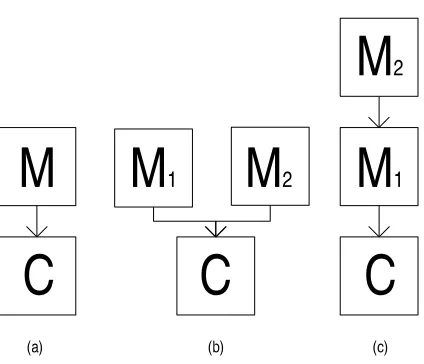
2. FREQUENCY MODULATION SYNTHESIS FM audio synthesis, presented originally by Chown-ing [13], provides a synthesis method by which com-plex spectra can be created simply and efficiently. In what is termedsimple FM, the instantaneous fre-quency of one oscillator is modulated by another, to produce a tone with multiple frequency partials Fig. 1(a). The amplitude function forsimple FM is given by the formula
e=Asin(ωct+I sinωmt). (1)
where e is the modulated carrier amplitude, A the
peak amplitude of the carrier,ωc andωmthe carrier
and modulator angular frequency, andImodulation
index, given by ratio of the frequency-deviation to the modulating frequency.
[image:2.595.316.528.104.286.2]Modulation produces side-bands in the frequency domain, with partials deviating from the carrier at
Fig. 1: Simple, double-modulator and nested FM arrangements
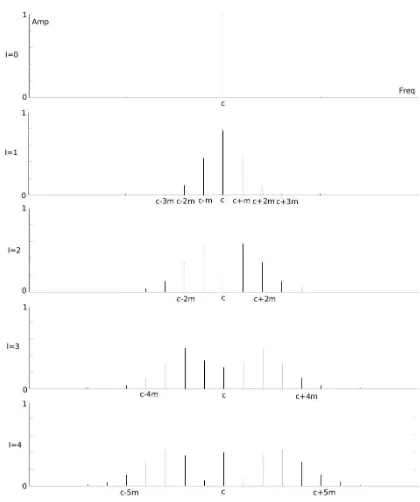
integer multiples of the modulating frequency. The amplitudes of frequency partials are determined by the Bessel functions of the first kind and nth order. The bandwidth of the output signal increases as the modulation index is raised, as can be observed in Fig. 2. Notice that as I is raised the amplitude of
each partial varies according to a non-linear (Bessel) function. This can make it hard to achieve a target sound when altering parameters by hand. For fur-ther reading into the spectral decomposition of FM signals, the reader is referred to [14].
Schottstaedt [15] extended Chowning’s basic FM ar-rangement developing models that allowed string in-strument tones to be simulated, specifically the pi-ano. In doing so, he introduced two important forms of FM synthesis with complex modulation.
The first of these models, namelydouble-modulator
FM (Fig. 1(b)), instantaneously modulates the car-rier frequency with the sum of two modulating sinu-soids; given by
e=Asin(ωct+Im
1sinωm1t+Im2sinωm2t) (2)
withIm
1 andIm2 the modulation indices, andωm1 andωm
Fig. 2: Synthesised FM spectra with increasing mod-ulation indexI
ulation of the carrier by one modulating oscilla-tor, are modulated (as carriers) by the second. For the mathematical derivation of thedouble-modulator
FM spectrum, in terms of the Bessel Functions, the reader is referred to [14] and [15].
The second arrangement, nested-modulator FM (Fig. 1(c)), modulates the carrier with a modulat-ing sinusoid, which is itself modulated by a third modulating sinusoid; given by the equation
e=Asin[ωct+I1sin(ωm
1t+I2sinωm2t)] (3)
The carrier side-bands are positioned as they would be in simple FM, however, the partials each have their own side-bands at frequency intervals of the second modulator frequency. The full mathematical derivation of the nested-modulator spectrum can be found in [12].
Thedouble-modulator andnested-modulator FM ar-rangements are of great significance to the work pre-sented in this paper, as they are both implemented
within an algorithm that is able to decompose tar-get sounds into FM parameters, using an evolution-ary computation process. Details of this matching method will be outlined in Section 6. First we shall look at some of the early FM matching methods that have been documented.
2.1. Frequency Modulation Sound Matching As can be observed in Fig. 2, there is a complex map-ping between FM parameters and the spectral form of the corresponding sound. As such, FM parame-ter control may appear random and complicated to inexperienced users. The desire to control the sonic diversity that FM provides has motivated a series of studies intent upon providing a systematic means by which FM synthesis can be used to simulate real acoustic instruments. Chowning’s original paper ini-tiated interest in this direction, providing example parameters that simulate brass, woodwind and per-cussive tones.
The earliest attempts at automating sound design with FM were made by Justice [16], creating a phase-analysis procedure, based upon the Hilbert transform, that attempts to decompose signals into
nested-modulator FM parameters. To verify the cess of his algorithm, Justice presented some suc-cessful experimentation extracting the parameters of
contrived nested-modulator target FM signals. How-ever, if the signal does not conform exactly to a prod-uct of the nested FM model (eq. (3)), unavoidable error in the approximation is observed. Some the-oretical analysis is provided for the application of the model to general signals, but further experimen-tation is left as future work. Justice suggests that such a system may provide users with a means by which they can jump to approximate regions of the synthesis sound space, leaving finer adjustment to be performed by hand. The process is specific to nested-modulator FM, works only with slow moving oscillator envelope shapes, and does not allow for the FM phenomenon of spectral wrapping1
.
Justice’s analytical process of parameter derivation was later extended by Payne [17] to process multiple-carrier nested-modulator FM arrangements. The paper outlines in detail numerous restrictions to
1where side-bands synthesised with negative frequency are
[image:3.595.79.289.111.362.2]which the target signal should conform, but, even when all are met, the process is not always success-ful. A comparable technique of FM parameter de-composition was proposed by Delprat [18]. FM law-extraction interprets formations in the Gabor trans-form coefficients of the analysed signal to estimate FM parameters. Experimental results are presented that show promising partial interpretation of the co-efficients, however the system is not complete and, like many of the procedures outlined in this section, full development is left as future work.
Recent advances, matching target signals with FM, have applied the robust optimisation techniques of evolutionary computation to match time-variant sounds. This is the discipline within which the present work resides.
3. EVOLUTIONARY FREQUENCY MODULA-TION SOUND MATCHING
Research at the intersection of artificial intelligence and music has provided a collection of studies intent on providing intuitive synthesiser control with evolu-tionary computation [4] - [10]. The most relevant to the presented work, and indeed the work on which it is based, are the evolutionary FM matching systems of Horner [11] [12].
To facilitate the matching of acoustic instrument tones, Horner’s algorithm optimises a set of static basis-spectra generated via FM, which are dynami-cally recombined to simulate a given harmonic target tone. The synthesis process is therefore very close to that of wavetable synthesis, with FM used only in the production of basis-spectra. The basis-spectra is generated using a simple FM arrangement where the modulator is tied to the fundamental frequency, and the carrier frequency is set to integer multiples thereof, known as formant FM. This arrangement is excellent for use in conjunction with wavetable synthesis, as regions of the target spectrum can be reproduced by individual basis-spectra, allowing the optimum spectral envelopes to be established. The restriction of the carrier frequency to an integer mul-tiple of the modulating frequency ensures that all of the basis-spectra are harmonic, and supports the use of a Genetic Algorithm (GA) for optimisation purposes: GAs perform their genetic operations on bit-strings, which make them ideal for integer based combinatorial search domains, such as this.
Whilst Horner’s synthesis method provides a means by which static FM spectra can be combined to produce dynamic sounds, dynamic-spectra FM syn-thesis arrangements have existed for many years. A simple model is provided in Chowning’s origi-nal paper, where the modulation depth is controlled by a simple envelope to produce dynamic sounds (Fig. 1(a)). The models presented by Schottstaedt [15], also allow such spectral control (Fig. 1(b) and (c)). Combined, Chowning and Schottstaedt’s mod-els have formed the basis on which commercial FM has evolved. Consequently, Horner’s model cannot be applied directly to explore the sound space of regular FM, as it exploits an alternative synthesis paradigm.
In [11] Horner does experiment with non-static mod-ulation indices interpolating parameters across fixed spectral matches that are made throughout the du-ration of the target tone. This method proved prob-lematic, as parameter variation from one spectral match to the next is non-continuous, and the per-ceived tone travels through harsh transitions be-tween the points at which the static matches are made.
The work presented here utilises the basic dynamic-spectra FM configurations outlined above, repre-senting parameters with real valued numbers. When the synthesis variables are not limited to integer numbers, the search is performed across the entire parameter space to locate optimal solutions. This operation is a non-trivial process, as the FM object landscape is extremely complex and multi-modal2
. Early attempts with simple evolutionary optimisers, like thesimple-GAand basic ES proved insufficient for the FM matching problem. As such, a specialised optimisation algorithm known as FCES is employed for this work that is designed to operate within such harsh conditions. Before the FCES can be described, the next section will provide a brief overview of evo-lutionary computation, introducing the basic evolu-tion strategy, the model on which the FCES is built.
4. EVOLUTIONARY COMPUTATION
Evolutionary computation is now a well established research field that has derived inspiration from bio-logical evolution. Three main branches of this dis-cipline, developed independently and
contempora-2
neously, are concerned with function optimisation: evolutionary programming [19], genetic algorithms [20] and evolution strategies [21]. The genetic al-gorithm has been mentioned already as it was the optimisation engine chosen by Horner in his match-ing work. For further information on evolutionary programming or genetic algorithms the reader is di-rected to the associated references; this section will expound only on the basic evolution strategy as this is the general model to which the FCES conforms.
4.1. Evolution Strategies
The Evolution Strategy was originally developed in the 1960’s by two students of the Technical Univer-sity of Berlin [21] [22]. Presented as an automatic engineering design optimiser, shown to outperform traditional gradient oriented techniques, evolution strategies have since undergone numerous modifica-tions and enhancements.
The original evolution strategy used a simple iter-ative mutation-selection mechanism in which a sin-gle ‘parent’ generates a sinsin-gle offspring, the latter is subject to a mutation operator and the stronger individual forms the parent of the next generation. This formed the precursor of a series of more elabo-rate stelabo-rategies which allowed first multiple offspring, then the concept of limited life-span, and finally a population of ‘parents’ to form the gene pool from which the next generation inherits.
Search points in ESs are usually n-dimensional vec-tors (object variables) of real valued (in practice fixed-length floating point approximations) parame-ters. Additionally, each individual normally includes a vector of strategy variables which evolve together with the object variables in a process which has been termedself-adaptation by Schwefel [22].
Mutation consists of the addition of a normally dis-tributed (zero mean) random number to each com-ponent of the object variable vector, corresponding to a step in the search space. The variance of the step-size distribution is itself subject to mutation as a strategy variable.
Recombination normally takes one of two main classes:
• Intermediate - the genotype/phenotype vector
of each offspring is obtained by taking the mean vector of its parents’ vectors.
• Discrete - dynamic n-point crossover: each
com-ponent of the genome of the offspring is pro-duced by choosing either the vector component of the first or the second parent with equal prob-ability.
Selection operators choose the best individuals from the current generation to act as parents for the next, those not ‘fit’ enough to reproduce, are simply moved from the population through the natural re-placement processes of the ES. A range of strategies are possible here, dependent upon the maximum al-lowable age of the parents. The extremes (and the most usual in practice) are:
• extinctive strategies - parents live for a single
generation only.
• preservative strategies - selection operates on
the joined set of parents and offspring, very fit individuals may survive indefinitely.
4.2. MultiModal Evolution Frequency Modula-tion Object Landscape
The compact FM synthesis model is well suited to evolutionary optimisation, as a broad range of tim-bres can be accessed via a relatively small number of object parameters. That is not to say that the task of matching tones with FM is trivial, the vary-ing success of the work reviewed in sections 2.1 and 3 informs us that this is not the case. The FM model, in fact, presents an extremely complex real world multi-modal optimisation problem that, un-til recent developments, would, in all likelihood, be insurmountable by early optimisation engines.
In order to prevent such premature convergence and stagnation, a number of operators have been de-signed with the aim of adapting the search strategy to evolve stable separate sub-populations, each of which can converge on a different sub-domain. Ex-amples of such techniques include crowding [23], Re-stricted Tournament Selection [24], and fitness shar-ing [25]. The method chosen for this work is an extension to the standard ES known as FCES, de-veloped by Sullivan [26], which uses fuzzy cluster-ing and recombination operators to exploit the par-titions of the ES population. The choice has been made as the FM model is both real-valued and multi-modal, domains within which FCES is designed to function.
5. FUZZY CLUSTERING EVOLUTION STRAT-EGY
FCES combines the powerful local search proper-ties of the evolution strategy with the strengths of Fuzzy Clustering, by partitioning the search pop-ulation into fuzzy sub-poppop-ulations that locally re-combine and progress. With a sufficient number of clusters, and an adequate population size, all of the locally optimal peaks can be identified and thus, a global optimum is consistently found.
Clustering, as a tool for global optimisation [27], was previously utilised to provide multiple start points for a local hill-climber optimisation. FCES follows essentially the same framework but uses a stochas-tic population-based search (the ES) in place of the local optimisation algorithm and proceeds by alter-nate application of optimisation and clustering. The aim is to achieve the reliability of clustering meth-ods with the efficient self-adaptive search behaviour of the ES approach.
The basis of the approach is that a clustering algo-rithm is used to form a partition of the parent pop-ulation in a regular ES. The algorithm, therefore, is consistent with the standard generational model of an Evolutionary Algorithm with global selection. Subsequent recombination blends genetic material from all parents in proportion to their degree of membership of a particular cluster (fuzzy cluster-ing). This allows clusters, within the population, to form independently at regions of high fitness within the object landscape, preventing premature global convergence at locally optimal peaks.
6. FREQUENCY MODULATION SOUND MATCHING WITH FUZZY CLUSTERING EVOLUTIONARY STRATEGY
This section will provide an overview of the FCES tone matching procedure providing details relevant in its application to dynamic-spectra FM arrange-ments.
6.1. Target Selection
For the matching procedure to commence, the algo-rithm requires a target. It is possible to insert any sound into the model at this point; however, for test-ing purposes, it is useful to follow the methodology presented by Justice [16] and Payne [17]: matching
contrived target sounds produced by a FM model identical in structure to the matching synthesiser. In such circumstances, a successful match will yield parameters equal to those with which the target tone was produced and, with repeated tests with a vari-ety of targets, demonstrates that any point within the sound space is accessible via the matching pro-cess. The alternative, if non-FM target sounds are matched, would be to perform an enumerative search in parallel with with the evolutionary match, to en-sure that the ‘fittest’ evolved solution is indeed glob-ally optimal. Even at a very low search resolution of 0.5 (in the range 0-5), models with 18 dimensions (the maximum that will be optimised at this stage) would require assessment in the order of some 1018 potential solutions, an infeasible task. In contrast, where a large number ofcontrived target sounds are consistently and accurately matched, it may be pos-tulated that an optimal match forany target sound is feasible. For non-FM target sounds the optimal match may not be an exact simulation, rather, it would be the best match that could be found within the synthesis sound space.
6.2. Synthesis Components
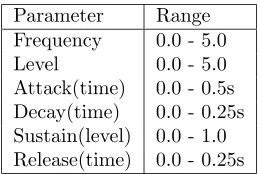
Each dynamic-spectra FM circuit is constructed from two or three sinusoidal oscillators. The param-eters of each FM oscillator are provided in Table 1.
The ‘Frequency’ parameter controls the oscillator frequency expressed as a multiple of the of the syn-thesiser fundamental3
, ‘Attack’ is the time taken for the output of the oscillator to reach the ‘Level’ value from its starting point of zero, and the ‘Sustain’ is represented as a percentage of the ‘Level’ parameter.
3
Parameter Range Frequency 0.0 - 5.0 Level 0.0 - 5.0 Attack(time) 0.0 - 0.5s Decay(time) 0.0 - 0.25s Sustain(level) 0.0 - 1.0 Release(time) 0.0 - 0.25s
Table 1: Oscillator Component Parameters
In practice the envelope parameters are all scaled onto the range 0-5 so that all parameters operate within the same limits.
The output from each sinusoidal component can be connected to either the audio output, or the input of another oscillator, to modulate its instantaneous frequency. In the latter connection, the ‘Level’ pa-rameter forms the Modulation Index.
6.3. Fitness Assessment
The FCES requires a means by which good and bad solutions can be differentiated. A metric is required to provide the ‘distance’ between (the synthesis of) a potential solution and the target sound4
. The objec-tive function identifies strong offspring, facilitating their selection as parents from which subsequent off-spring can be produced.
Within this work, the ‘distance’ is measured by accu-mulating the squared error that is measured between the target and candidate spectra at multiple points throughout their duration. This error measure has proved effective in previous studies [8] [9] [11] [12] and offers an excellent balance between detail and execution speed.
The squared error is given by the equation
error=
NXbin
b=0
(Tb−Sb)
2
(4)
Where T is a vector of the target spectrum
ampli-tude coefficients,Sa vector of synthesised candidate
spectrum amplitude coefficients andNbin the
num-ber of frequency bins produced by spectrum analy-sis.
For the matching of instrument tones Horner ob-tained good results by placing ten snap-shots
4
where a good match is positioned ‘close’ to its target
throughout the perceptually critical initial transient and another ten equally spaced throughout the re-mainder of the sound [12]. In this work, matching
contriveddynamic tones, twenty spectral snap-shots are taken at fixed intervals throughout the target sound. This may be reduced by placing snap-shots at regions of the target sound where fast changes can be observed, however, further investigations into ‘intelligent’ snap-shot placement is, at this point, a future plan for this work.
A complete cycle of the objective function is as fol-lows:
1. Insert candidate solution into the FM model,
2. Subject the corresponding synthesised wave-form to spectral analysis,
3. Calculate SSE between target and synthesised candidate spectra.
A variant of the squared error has been developed that allows error to be measured across a weighted band, details of this process can be found in [28]. Thewindowed squared error smooths the surface of the fitness landscape. Consequently, the search com-plexity is reduced, lowering the population size that is required for a successful match. However, this er-ror metric addresses issues specific to the FM prob-lem and has, thus, not been been impprob-lemented in the results presented here as it compromises the generic nature of the matching procedure.
6.4. Processing
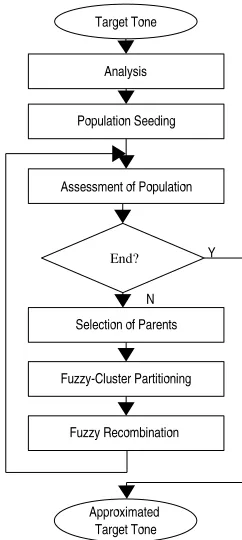
With the target sound, matching synthesiser and fit-ness function in place, the matching process of Fig. 3 can begin.
Fig. 3: Matching Procedure
again selected and partitioned, their cluster mem-bership calculated, recombined, and so forth. The loop continues until some end criterion is met: ei-ther the generational limit is reached or a sufficiently strong solution located.
7. RESULTS
This section provides the early (promising) results obtained when a FCES algorithm is applied to match
contrivedsounds with dynamic-spectra FM arrange-ments. One single run of the matching process is as follows:
1. Generate acontrived target sound.
2. Extract spectral snap-shots from the target.
3. Match the target tone by searching the relevant FM parameter space for an optimal match.
Contrived target sounds are produced by randomly generatingNdim synthesis parameters (where Ndim
is the number of input parameters to the model
-Parameter Target Match
Carrier Parameters
Frequency 2.290531 2.289480
Level 4.830795 4.816228
Attack(time) 1.045151 1.039380 Decay(time) 4.228095 4.248294 Sustain(level) 2.264006 2.279245 Release(time) 3.952239 3.961980 Modulator Parameters
Frequency 3.270365 3.268940
Level 4.356868 4.334636
[image:8.595.322.536.112.292.2]Attack(time) 3.565976 3.510057 Decay(time) 0.772121 0.860160 Sustain(level) 4.254643 4.307577 Release(time) 2.135209 1.499094
Table 2: Target and Matched parameters of a suc-cessful run
the dimensionality of the problem) in the range of 0-5 (the parameter limits for the current arrange-ments), and inserting them into the matching model to produce a target tone. For experimental practi-cality, the target tones are limited to one second in duration.
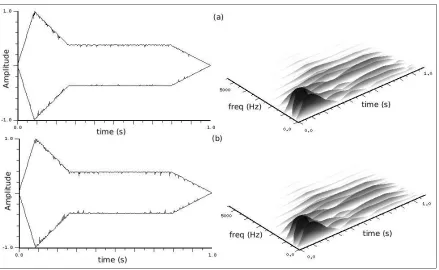
7.1. Chowning’s Dynamic-Spectra models Chowning’s [13]simple dynamic-spectra FM model Fig. 1(a), presents a 12 dimensional matching prob-lem. Fig. 4 provides the waveform and spectrogram of a typical simple FM target sound, and the cor-responding match. The FCES is able to match the target tone to this accuracy in 50 generations, with parent size of 300, offspring size of 1500 and 100 clus-ters, which currently takes approximately 2 minutes on a 2.4GHz Pentium 4 processor. The two plots dis-play remarkable similarity, and indeed sound iden-tical. To confirm the accuracy of the match, the target tone parameters can be directly compared to the matched parameters. Table 2 provides the car-rier and modulator parameters for the waveforms in Fig. 4.
Fig. 4: (a) target sound and (b) matched sound; time and spectrogram plots
the spectral error is minimal.
Not all matches are quite as successful. As the tar-get tone dictates the complexity of the search, in some circumstances the match may be poor. This is because the surface of the object landscape varies significantly from one target to the next. In the example provided in Fig. 4 the population sizes are well suited to the complexity presented by the target tone. With a more complex target, larger popula-tions may be required, and conversely, simple tones may be adequately matched with a smaller popula-tion.
Tone matching is usually more difficult when cer-tain parameters lie close to the limits of their range. For example, tones with a very low carrier frequency may have many partials that wrap around from the negative frequency range on to the positive, these in-terfere with positive frequency partials producing a particularly noisy region of object space around the optimum. Whilst the FCES is equipped to deal with such environments, it may require more clusters to ensure that the global optimum is located. An
in-crease in the number of clusters requires an inin-crease in the number of parents, which, in turn, requires an increase in the number of offspring, which all result in a prolonged search time.
Occasionally, the carrier ‘Level’ or modulator ‘Index’ parameters may converge on a non-optimal region of the search space; this may be the consequence of a short ‘Attack’ time in the target that is not repre-sented well by the uniform placement of the spectral snap-shots. Solutions may escape via mutation, but often the ‘Sustain’ parameter is able to compensate with an opposing error. If the amplitude ‘Level’ is low the ‘Sustain’ level will automatically evolve to an increased value, to make up the difference through-out the sustain period.
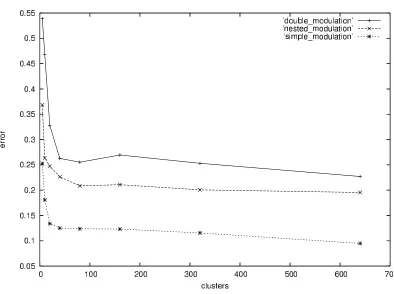
[image:9.595.89.528.109.379.2]Fig. 5: Normalised error with increasing number of clusters.
applications, but if an exact match is required, the process may be repeated with a larger population size.
7.2. Schottstaedt’s Dynamic Spectra models Schottstaedt’s [15] dynamic FM tone arrangements,
double-modulator and nested-modulator (Fig. 1(b) and (c) respectively), each present interesting 18 dimensional optimisation problems. Despite the drastically increased complexity of the search space, early experimentation matching contrived
FM sounds has produced excellent results; although accurate matching with this model comes at a cost: matches with the current arrangement can take up to 10 minutes (again on a 2.4GHz Pentium 4 pro-cessor). To regularly obtain good matches from the model 500 clusters are required with a parent size of 2000, and an offspring size of 10000.
One notable observation in the early matching
ex-periments with contrived target tones, is that oc-casionally an excellent (analytical) match is made, but with vastly different parameters to the target tone. This suggests that as the model becomes more complex, not only is the potential for matching a wider diversity of sounds increased, but there may be many regions of high fitness in the search space. The advantage of using the clustering algorithm is that many of the strong regions are located concur-rently, a synthesiser user may benefit from a choice between several sounds that are all similar, in some way, to their target.
matched tones contribute to the error. An exact match produces an error of zero. The populations are proportioned to allow three parent solutions per cluster, with a offspring population that is five times the size of the parent population. From these early results it appears that the easiest problem to solve accurately is thesimple FM followed by the nested-modulator anddouble-modulator models.
8. CONCLUSION
A new matching method has been presented that applies the FCES optimisation engine to the prob-lem of FM sound matching for dynamic sounds. The early results are promising and, with suitable opti-misation, may provide a platform for new, intuitive, synthesiser interfaces. Matching is carried out on three different dynamic-spectra FM configurations:
simple,double-modulator andnested-modulator. 9. FUTURE WORK
The work presented here reports upon the initial steps that have been taken to develop a synthesis matching tool. In the future the model will be ex-panded to operate upon wider parameter ranges and larger, more complex FM arrangements. Work will be done to optimise the process to allow faster con-vergence that may allow for real-time tone searching. It will also be investigated as to whether the model could be applied to alternative synthesis methodolo-gies. It is planned to arrange perceptual tests with participants, to quantify the accuracy of the algo-rithm.
ACKNOWLEDGEMENTS
The first author would like to thank the supervisory team, Tony Pipe, David Creasey, Marcus Lynch and Stephen Allan for their constant support, inspiration and help with this work.
10. REFERENCES
[1] D. Morrill, Trumpet Algorithms for Com-puter Composition, Computer Music Journal, 1(1):46-52, 1977.
[2] J. Ethington, D. Punch,SeaWave: A system for Musical Timbre Description, Computer Music Journal, vol. 18, no. 1, 1994.
[3] E. R. Miranda, Striking the right note with ARTIST: an AI- based synthesiser, M. Chemil-lier and F. Pachet (editors), Recherches et ap-plications en informatique musicale, Paris: Edi-tions Hermes, pp. 227- 239. 1998.
[4] I. Fujinaga, and J. Vantomme. Genetic algo-rithms as a method for granular synthesis reg-ulation Proceedings of the International Com-puter Music Conference, 1994.
[5] C. G. Johnson, Exploring the sound-space of synthesis algorithms using interactive genetic algorithms, Presented at Proceedings of the AISB Workshop on Artificial Intelligence and Musical Creativity, Edinburgh. 1999.
[6] J. P. Mandelis, Genophone: Evolving Sounds and Integral Performance Parameter Map-pings, Applications of Evolutionary Comput-ing, EvoWorkshops2003, pp538- 549, 2003.
[7] E. R. Miranda,On the Music of Emergent Be-haviour: What can Evolutionary Computation Bring to the Musician? Leonardo, Vol. 36, No. 1, pp. 55-58. 2003.
[8] K. Wehn,Using Ideas from Natural Selection to Evolve Synthesized Sounds, Proc.Digital Audio Effects (DAFX98), Barcelona. 1998.
[9] R. Garcia, Growing Sound Synthesizers using Evolutionary Methods, European Conference in Artificial Life ECAL2001. Artificial Life Mod-els for Musical Applications. University of Eco-nomics, Prague, Czech Republic. 2001.
[10] J. Manzolli, A. Maia, J. Fornari and F. Dami-ani, The evolutionary sound synthesis method, Proceedings of the ninth ACM international conference on Multimedia, Ottawa, Canada 2001.
[11] A. Horner, J. Beauchamp, and L. Haken, Ma-chine Tongues XVI: Genetic Algorithms and Their Application to FM, Matching Synthesis, Computer Music Journal, 17(4), 17-29. 1993.
[13] J. Chowning, The Synthesis of Complex Au-dio Spectra by Means of Frequency Modulation, Journal of the Audio Engineering Society, vol. 21, pp. 526-534. 1973.
[14] LeBrun, Marc. A Derivation of the Spectrum of FM with a Complex Modulating Wave, Com-puter Music Journal, 1(4):51-52, 1977.
[15] B. Schottstaedt,The Simulation of Natural In-strument Tones Using Frequency Modulation with a Complex, Modulating Wave. Computer Music Journal, 1(4):46-50. 1977.
[16] J. H. Justice,Analytic Signal Processing inMu-sic Computation, IEEE Transactions on Acous-tics, Speech, and Signal Processing,Volume ASSP-27, Number 6, 1979.
[17] R. Payne, A microcomputer based analy-sis/resynthesis scheme for processing sampled sounds using FM, Proc. Int. Computer Music Conf., San Francisco, CA, 1987, pp. 282 289. 1987.
[18] N. Delprat,Global frequency modulation law ex-traction from the Gabor transform of a signal: A first study of the interacting components case, IEEE Trans. Speech Audio Processing, vol. 5, pp. 64 71, Jan. 1997.
[19] L. J. Fogel, A. J. Owens, and M. J. Walsh,
Artificial Intelligence through Simulated Intel-ligence. New York: John Wiley. 1966.
[20] J. H. Holland, Concerning Efficient Adaptive Systems, Pages 215-230 of: M. C. Yovits, G. T. Jacobi and G.D. Goldstein (eds), Self-organizing Systems. Washington,DC: Spartan Books. 1962
[21] I. Rechenberg,Cybernetic solution path of an ex-perimental problem, Tech. rept. RAE Transla-tion 1122. Farnborough, Hants. 1965.
[22] H. P. Schwefel,Collective phenomena in evolu-tionary systems. Pages 1025-1032 of: Preprints of the 31st Annual Meeting of the International Society for General Systems Research, 1987.
[23] K.A. De Jong,An analysis of the behaviour of a class of genetic adaptive systemsPh.D. thesis, University of Michigan, 1975.
[24] G. Harik, Finding multi-modal solutions using Restricted Tournament Selection. In: Proc. 6th Int. Conf. on Genetic Algorithms, 1995.
[25] J. H. Holland,Adaptation in Natural and Arti-ficial Systems. Ann Arbor: University of Michi-gan, 1975.
[26] J. C. W. Sullivan, An Evolutionary Computing Approach to Motor Learning with an Applica-tion to Robot Manipulators, PhD Thesis, Uni-versity of the West of England, Bristol, 2001
[27] A. A. Torn, and A. Zilinskas,Global Optimiza-tion. Lecture Notes in Computer Science, no. 350. Berlin: Springer-Verlag. 1989.