Top Management Team attributes and the probability of
firm default
BHAIYAT, Firoz Haroon
Available from Sheffield Hallam University Research Archive (SHURA) at:
http://shura.shu.ac.uk/25155/
This document is the author deposited version. You are advised to consult the publisher's version if you wish to cite from it.
Published version
BHAIYAT, Firoz Haroon (2019). Top Management Team attributes and the probability of firm default. Doctoral, Sheffield Hallam University.
Copyright and re-use policy
See http://shura.shu.ac.uk/information.html
Sheffield Hallam University Research Archive
Top Management Team attributes and
the probability of firm default
Firoz Haroon Bhaiyat
Sheffield Business School
Sheffield Hallam University
A thesis submitted in partial fulfilment of the requirements of Sheffield
Hallam University for the degree of
Doctor of Philosophy
I would like to dedicate this thesis to my late father, Haroon Bhaiyat and mother, Fatima
Bhaiyat. They have always given me unconditional love, encouragement and support.
I would also like to dedicate this thesis to my beloved wife, Sara Bhaiyat and my son,
Haroon Bhaiyat. Without Sara’s love, patience, sacrifice and trust throughout this process,
this thesis would not have been possible, and without Haroon’s inspiration to remind me
of what is truly important I would have found it so much harder to carry on.
And finally, I would also like to dedicate this thesis to my brother, sister, father in law,
mother in law and my entire family. I thank all my family, Faisal, Sofia, Farhana, Rashid,
Aalia, Sana, Farhan, Mohammad, Yakoob and Salma for their wonderful contribution and
encouragement.
Thanks to all my friends and colleagues who gave me their unwavering support and
Declaration
I hereby declare that except where specific reference is made to the work of others, the
contents of this thesis are original and have not been submitted in whole or in part for
con-sideration for any other degree or qualification in this, or any other university. The findings
of this research have been presented via one conference paper and two emerging papers.
This dissertation is my own work and contains nothing which is the outcome of work done
in collaboration with others, except as specified in the text and Acknowledgements. This
thesis contains fewer than 80,000 words not including appendices, bibliography, footnotes,
tables and equations.
The researcher undertook research ethics, research design and execution, philosophy of
business research, survey methods 1 and 2 training at Sheffield Hallam University. The
researcher also attended training provided by Dr Chris Stide at the University of Sheffield
on Multilevel modelling and Structural Equation Modelling using Mplus. For the purposes
of this thesis, the researcher self-taught SPSS, Bloomberg Certification, R-programming
and Latex.
Firoz Haroon Bhaiyat
Acknowledgements
Firstly, I would like to express my sincere gratitude to my director of studies Dr Malihe
Shahidan for her continuous support of my PhD study, for her patience and motivation.
Her guidance helped during this research and writing this thesis. I have truly enjoyed
having her as my director of studies and mentor for my PhD.
I would also like to thank my Supervision team: Prof. Nigel Garrow and Dr Dora Chan for
their insightful comments and encouragement. Their comments and immense knowledge
provided me with guidance and direction to view my research from different perspectives.
My deepest appreciation also goes to Dr John Fry for his insightful comments with the
statistical analysis and R coding. His expert opinion with quantitative methods has helped
me develop as a researcher and allowed me to reflect a new set of skills in this research.
I would also like to thank all my friends and colleagues from room 7217, the Finance,
Accounting and Business Systems department and the Sheffield Business School for
their continuous support and encouragement throughout this research journey. I would
like to specifically thank the staff from room 7217 who have provided me with a forum
for intellectual discussion, questioned my perspectives and provided me with differing
perspectives.
Finally, I would like to thank all participants and attendees to the BAM Corporate
Gover-nance SIG in 2016 and 2018 for their valuable feedback, comments and support. Their
specific comments have helped develop this research by providing additional perspectives
Abstract
This PhD research investigates the effects of the key top management team (TMT) attributes
on the probability of a firm’s default. Specifically, the study pursues motivation, loyalty
and effectiveness as the key characteristics to analyse. Synthesising the Behavioural theory
of the firm, Upper Echelons theory, Resource Based View, Agency theory and Seasons
of tenure alongside other key TMT theories this research develops a theoretical model.
The literature on TMT and financial distress has focused mostly on the role of the CEO or
different definitions of the TMT, however, the role of the CFO is very rarely studied. This
research argues that the role of the CFO is extremely important when a firm faces financial
difficulties and is key to the definition of TMT that influence the financing decisions of
the firm. In addition, this research uses both accounting based measures and market based
measures for predicting the likelihood of default while a majority of the literature in this
field has used either accounting based measures or market based measures. This research
uses multilevel modelling on a hierarchical dataset to address some of the limitations of
previous research by modelling for the variability of regression intercepts and slopes and
addressing the violation of the independence assumption. Using a sample of UK listed
companies, on the FTSE 100 index for the period 2013 to 2016, this research uses OLS
regression, Polynomial regression, Random Intercept model and Random Intercept and
Random slope models as robustness checks to test the theoretical model developed. The
study concludes that there is a relationship between key TMT attributes and the likelihood
of default. The effect of the attributes varies for the short-term, long-term and accounting
measures of the probability of firm financial distress. The study provides models that will
List of Abbreviations
AIC Akaike information criterion
AIM Alternative Investment Market
ANOVA Analysis of Variance
BAM British Academy of Management
BB Bloomberg
BBC British Broadcasting Corporation
BIC Bayesian informaiton criterion
CBI Central dei Bilanci
CDS Credit Default Swaps
CEO Chief Executive Officer
CFO Chief Finance Officer
COO Chief Operating Officer
CSR Corporate Social Responsibility
CVA Creditor Voluntary Arrangement
DRSK Default Risk Bloomberg Function
EDF Expected Default Frequency
EM Emerging Market
EU European Union
FT Financial Times
FTSE Financial Times Stock Exchange
GICS Global Industry Classification Standard
GM General Manager
GMM Generalised Method of Moments
HR Human Resource
ICC Intracalss Correlation
IPO Initial Public Offering
ISC Institutional Shareholders Committee
KMV Kealhofer Merton Vasicek model
LLP Limited Liability Partnership
LME Linear Mixed Effects
LOGIT Logistic Regression
LogLik Log-likelihood
LSE London Stock Exchange
M&A Merger and Acquisition
MANOVA Multivariate Analysis of Variance
MBA Masters of Business Administration
ML Multilevel model
NN Neural Network
NPI Narcissistic Personality Inventory
OFT Office for Fair Trading
OLS Ordinary Least Square regression
OPEB other employment benefits
OTC Over the counter
PLC Public limited company
PPI Payment protection insurnace
PR Public Relations
R&D Research and Development
RBV Resource Based View
RIM Random Intercept Model
RISM Random Intercept and Slope Model
ROA Return on Asset
ROE Return on Equity
ROI Return on Investment
RPA Recursive Participating Analysis
S&P Standard and Poor’s
SIG Specian Interest Group
SOX Sarbanes Oxley
SPSS Statistical analysis program in social sciences
TMT Top Management Team
UK United Kingdom
US/USA United States of America
VAT Value added tax
VRIN Valuable, Rare, Inimitable and Non-substituable
Table of contents
List of figures xx
List of tables xxi
1 Introduction 1
1.1 Background . . . 1
1.2 Recent UK Corporate Insolvency cases . . . 5
1.3 Scope . . . 10
1.4 Rationale . . . 10
1.5 Aim . . . 11
1.6 Objectives . . . 12
1.7 Research Questions . . . 13
1.8 Hypotheses . . . 14
Table of contents
1.10 Some Key terminology in the study . . . 16
1.11 Structure . . . 17
2 Theoretical Literature Review 18 2.1 Introduction . . . 18
2.2 Theoretical Framework . . . 18
2.3 Behavioural theory of the firm . . . 22
2.4 Theoretical perspective for Executive Motivation . . . 23
2.4.1 Agency Theory . . . 24
2.4.2 Entrenchment Theory . . . 26
2.4.3 Stewardship Theory . . . 27
2.4.4 Hypotheses linked to Executive motivation . . . 29
2.5 Theoretical perspective for TMT Loyalty . . . 29
2.5.1 Seasons of Tenure . . . 29
2.5.2 Upper Echelons Theory . . . 31
2.5.3 Service Profit Chain . . . 34
2.5.4 Hypothesis linked to TMT loyaly . . . 35
Table of contents
2.6.1 Resource Based View . . . 36
2.6.2 Knowledge Based View . . . 41
2.6.3 Stakeholder Theory . . . 42
2.6.4 Social Identity Theory . . . 45
2.6.5 Hypotheses linked to TMT effectiveness . . . 46
2.7 UK Corporate Governance . . . 47
2.7.1 Stewardship Code . . . 48
2.8 Conclusion . . . 49
3 Empirical Literature Review 50 3.1 Introduction . . . 50
3.2 UK Corporate Insolvency . . . 51
3.2.1 Creditors and Bank . . . 54
3.2.2 Unsecured Creditors . . . 56
3.2.3 Other Stakeholders . . . 57
3.3 Background on TMT research . . . 57
3.4 Role of the CEO and the TMT . . . 59
Table of contents
3.6 Corporate Governance and Credit Risk . . . 70
3.7 TMT and Financial Distress . . . 73
3.8 Empirical Evidence relating to Executive Motivation . . . 77
3.8.1 Development of Executive Compensation . . . 77
3.8.2 Executive compensation and firm outcomes . . . 80
3.8.3 Executive compensation and failing firms . . . 82
3.8.4 Operationalising Executive motivation . . . 85
3.8.5 Operationalising the hypothesexss linked to Executive motivation 87 3.9 Empirical Evidence relating to TMT Loyalty . . . 87
3.9.1 TMT Demographics and firm outcomes . . . 88
3.9.2 TMT background, experience and firm performance . . . 90
3.9.3 TMT Tenure and firm outcomes . . . 93
3.9.4 Operationalising TMT Loyalty . . . 95
3.9.5 Operationalising the hypothesis linked to TMT Loyalty . . . 98
3.10 Empirical Evidence relating to TMT Effectiveness . . . 98
3.10.1 CEO Duality, Succession and Firm Performance . . . 98
3.10.2 Reduced autonomy and Increased scrutiny . . . 100
Table of contents
3.10.4 Operationalising TMT Effectiveness . . . 104
3.10.5 Operationalising the hypotheses linked to TMT effectiveness . . . 107
3.11 Predicting the likelihood of Default . . . 107
3.11.1 Altman Z-score . . . 109
3.11.2 Altman’s Z-score vs Merton’s probability of default . . . 112
3.11.3 Merton’s probability of default and the Bloomberg probability of default . . . 113
3.11.4 Default prediction models in recent literature . . . 116
3.11.5 Operationalising the probability of default . . . 117
3.12 Conclusion . . . 120
4 Research Methodology and Design 123 4.1 Introduction . . . 123
4.2 Research Philosophy . . . 123
4.2.1 Philosophical consideration . . . 124
4.2.1.1 Ontological consideration . . . 124
4.2.1.2 Epistemological consideration . . . 124
Table of contents
4.2.2 Philosophical approaches . . . 125
4.2.2.1 Research Philosophy adopted . . . 126
4.3 Research strategy . . . 129
4.3.1 Deductive approach and Quantitative method . . . 130
4.4 Research methods and methodologies . . . 131
4.5 Methodological approach in this research . . . 133
4.6 Research Questions . . . 138
4.7 Research Objectives . . . 140
4.8 Research Setting . . . 140
4.9 Research Design . . . 141
4.9.1 Justification for using multilevel modelling . . . 142
4.10 Population, sample and sampling techniques . . . 145
4.11 Measures and justification of variables . . . 148
4.11.1 Dependent Variables . . . 148
4.11.2 Independent Variables . . . 150
4.11.2.1 Executive Motivation . . . 150
4.11.2.2 Management Team Loyalty . . . 151
Table of contents
4.11.3 Control Variables . . . 152
4.11.3.1 Sector . . . 152
4.11.3.2 Profitability . . . 153
4.11.3.3 Firm Size . . . 153
4.11.3.4 Gearing . . . 154
4.12 Summary of variables and abbreviations . . . 155
4.13 Method of data collection . . . 157
4.13.1 Learning from the pilot undertaken . . . 157
4.13.2 Data collection process . . . 158
4.14 Research Hypotheses . . . 162
4.15 Ethical consideration . . . 166
4.16 Method of data analysis . . . 166
4.16.1 Stages of data analysis . . . 166
4.16.2 Multiple Linear Regression assumptions . . . 172
4.16.2.1 Normality . . . 172
4.16.2.2 Homogeneity of variance or Homoskedasticity or ab-sence of hetroskedasticity . . . 173
Table of contents
4.16.2.4 Absence of collinearity and Correlations . . . 174
4.16.2.5 Linearity . . . 175
4.16.2.6 Absence of influential data points . . . 175
4.16.2.7 Independence . . . 175
4.17 Generalisability, Validity and Reliability . . . 176
4.17.1 Generalisability . . . 176
4.17.2 Validity . . . 176
4.17.3 Reliability . . . 177
4.18 Conclusion . . . 178
5 Presentation of results 179 5.1 Introduction . . . 179
5.2 Descriptives . . . 179
5.2.1 Descriptives by year . . . 180
5.2.2 Descriptives by Sector . . . 182
5.2.3 Transformed Descriptives by year . . . 185
5.2.4 Transformed Descriptives by sector . . . 186
Table of contents
5.4 Categorical Variables Descriptives . . . 192
5.5 Linear Model . . . 196
5.6 Bloomberg 1 year probability of default linear regression . . . 199
5.7 Bloomberg 5 year probability of default linear regression . . . 203
5.8 Altman Z-score probability of default linear regression . . . 208
5.9 Multilevel Linear Modelling (Linear Mixed Effects) . . . 214
5.10 Random Intercept model . . . 217
5.11 Significance test of Random Intercept model . . . 219
5.12 Random Intercept and Random Slope model . . . 221
5.13 Significance test of Random Intercept and Random Slope model . . . 222
5.14 Conclusion . . . 223
6 Analysis and Discussion 225 6.1 Introduction . . . 225
6.2 Summary of Key Literature . . . 227
6.3 Summary of Key models . . . 231
6.4 Background to the analysis . . . 235
Table of contents
6.5.1 Short-term motivation (Salary) . . . 240
6.5.2 Long-term Motivation (Bonus) . . . 244
6.6 Loyalty . . . 249
6.6.1 Tenure . . . 250
6.7 Effectiveness . . . 254
6.7.1 Board Level Effectiveness (Board Size) . . . 254
6.7.2 Firm Level Effectiveness (Number of Employees) . . . 260
6.8 Control Variables . . . 264
6.9 Conclusion . . . 268
7 Conclusion and Recommendations 269 7.1 Introduction . . . 269
7.2 Research aim and hypotheses . . . 269
7.2.1 Aim . . . 269
7.2.2 Hypotheses . . . 270
7.3 Contribution of this research . . . 270
7.4 Summary of key findings . . . 273
Table of contents
7.4.2 Loyalty . . . 274
7.4.3 Effectiveness . . . 274
7.4.4 Probability of default measures . . . 275
7.5 Limitations of the research . . . 277
7.6 Recommendations for further research . . . 277
7.7 Thesis summary . . . 279
References 282 Appendix A Supporting Material 320 A.1 UK Corporate Governance . . . 320
A.2 Other Theories . . . 322
A.2.1 Development of Leadership theories . . . 322
A.2.2 Narcissism, Hubris and Animal Spirits . . . 324
A.3 Pilot study . . . 327
A.4 Findings in the literature . . . 332
Appendix B Graphs and Tables 339
List of figures
1.1 Company Liquidation rate in England and Wales (Source: McDaid, 2018) 2
2.1 The Theoretical Framework (Source: Author’s own collection) . . . 21
2.2 The Agency model (Source: Abdullah and Valentine, 2009) . . . 24
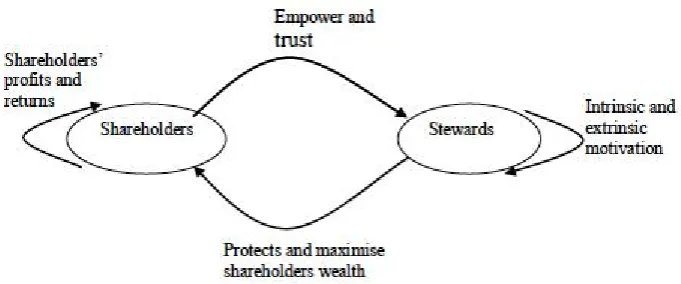
2.3 The Stewardship model (Source: Abdullah and Valentine, 2009) . . . 27
2.4 The Five Seasons of CEO Tenure (Source: Hambrick and Fukutomi, 1991) 30 2.5 Perceptual Model of Strategic Choice (Source: Hambrick and Mason, 1984) 32 2.6 The Service Profit Chain (Source: Loveman, 1998) . . . 34
2.7 Firm Resources (Source: Sudarsanam, 2012) . . . 37
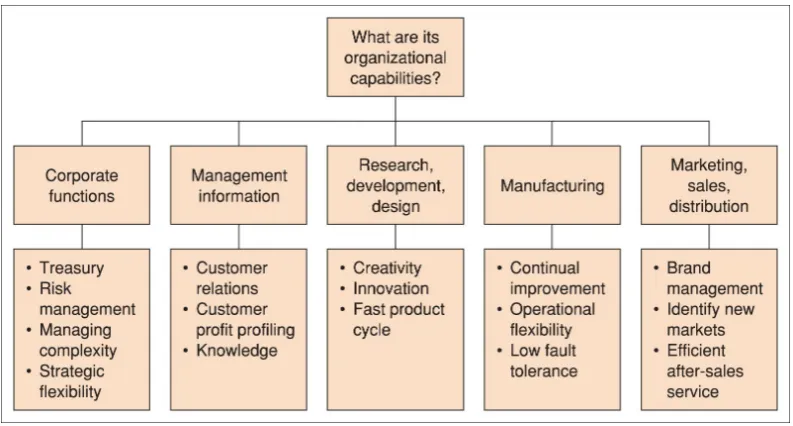
2.8 Organisational Capabilities (Source: Sudarsanam, 2012) . . . 37
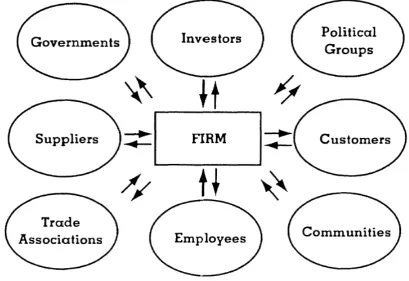
2.9 The Stakeholder model (Source: Donaldson and Preston, 1995) . . . 43
List of figures
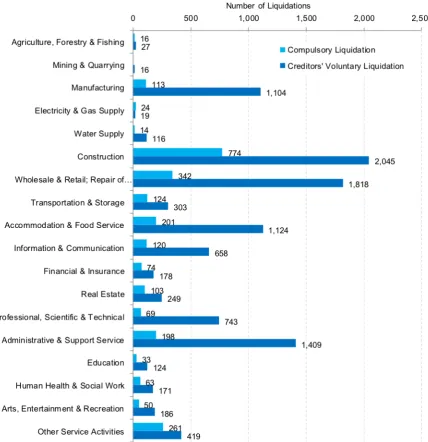
3.2 Number of Liquidations by Sector in Q3 2013 (Source: The Insolvency
Service, 2014) . . . 52
3.3 Average Debt owed to different creditor groups (Source: Companies
House, 2014) . . . 56
3.4 Average recovery rate for different creditor groups (Source: Companies
House, 2014) . . . 56
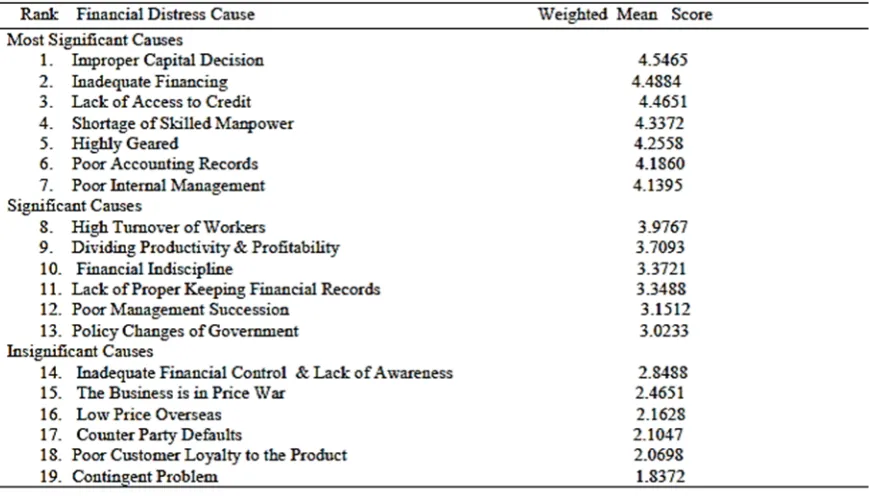
3.5 Causes of Financial Distress (Source: Memba and Job, 2013) . . . 63
3.6 Items Likely to be affected by financial distress (Source: Memba and Job,
2013) . . . 64
3.7 Latent Factors for Financial Distress identified by Memba and Job (2013) 65
3.8 Firm specific explanatory variables used in papers focusing on the
devel-opment of models of default risk (Source: Jacobson et al., 2011) . . . 69
3.9 The "Vicious Circle" of TMT Divergence and Poor Performance (Source:
Hambrick and D’Aveni, 1992) . . . 75
3.10 Petrobas market capitalisation and Bloomberg 1 year probability of default
(Source: Bloomberg Professional Service, 2018) . . . 114
3.11 Collapse of Carillion plc share price (Source: Bloomberg Professional
Service, 2018) . . . 119
4.1 Philosophical approaches in Management research (Source: Kamil, 2011) 125
4.2 Process of Deduction in research developed from Gill and Johnson (2010) 130
List of figures
4.4 Theories used in TMT research (Source: Nielsen, 2010a) . . . 133
4.5 Focus of TMT research (Source: Nielsen, 2010a) . . . 134
4.6 Diversity variables studied in TMT research (Source: Nielsen, 2010a) . . 134
4.7 Methodological approach employed in TMT research (Source: Nielsena,
2010a) . . . 135
4.8 Data collection method employed in TMT research (Source: Nielsen, 2010a)135
4.9 Statistical techniques employed to analyse TMT research (Source: Nielsen,
2010a) . . . 136
4.10 Methodological challenges for TMT research (Source: Nielsen (2010a)
adapted from Ireland, Webb and Coombs (2005)) . . . 137
4.11 Hierarchial structure of the Data (Source: Author’s own collection) . . . . 143
4.12 Key revisions to the UK Corporate Governance Code (Source: FRC, 2018) 146
4.13 Hypothesis Development (Source: Author’s own collection) . . . 165
4.14 Methodological Approach employed (Source: Author’s own collection) . 169
B.1 Annual Receivership, Administration and CVA in England and Wales
(Source: The Insolvency Service, 2014) . . . 339
B.2 Compulsory Liquidations vs Creditors Voluntary Liquidations between
1960 and 2013 (Source: The Insolvency Service, 2014) . . . 340
B.3 Receivership, Administration and CVA between 1987 and 2013 (Source:
List of figures
B.4 Bloomberg default likelihood categorisation (Source: Bloomberg
Profes-sional Service, 2018) . . . 341
B.5 Eddie Bauer default probability (Source: Bloomberg Professional Service,
2018) . . . 341
B.6 Lehman Brothers default probability (Source: Bloomberg Professional
Service, 2018) . . . 341
B.7 Oleo e Gas Partipacoes S.A default probability (Source: Bloomberg
Pro-fessional Service, 2018) . . . 342
B.8 Examples of North American companies with high default probabilities
and subsequent corporate actions (Source: Bloomberg Professional
Ser-vice, 2018) . . . 342
B.9 Examples of Chinese, Japanese and Korean companies with high default
probabilities and subsequent corporate actions (Source: Bloomberg
Pro-fessional Service, 2018) . . . 343
B.10 Carillion plc’s competitors, suppliers and lenders default probability (Source:
List of tables
1.1 Recent cases of UK Corporate Insolvency (Source: Author’s own
collec-tion adapted from various news sources listed above) . . . 9
3.1 Different Default scoring models (Source: adapted from Altman and
Hotchkiss, 2006) . . . 109
4.1 Research Philosophy summary adopted from Crotty (1998) and Saunders
et al. (2012) . . . 126
4.2 Sample sizes in previous studies (Source:Authors own collection) . . . . 147
4.3 List of key variables and their abbreviations (Source: Author’s own
collec-tion) . . . 156
4.4 Variables in this study (Source: Author’s own collection) . . . 167
4.5 Multilevel modelling approach (Source: Author’s own collection) . . . . 170
5.1 Descriptive statistics split by each year (Source: Author’s own collection,
created using data collected from Bloomberg) . . . 181
5.2 Descriptive statistics split by each sector (Source: Author’s own collection,
List of tables
5.3 Descriptive statistics of transformed variables split by each year (Source:
Author’s own collection, created using data collected from Bloomberg) . . 186
5.4 Descriptive statistics of transformed variables split by each sector (Source:
Author’s own collection, created using data collected from Bloomberg) . . 188
5.5 Correlation Matrix (Source: Author’s own collection, created using data
collected from Bloomberg) . . . 191
5.6 Number of firm year observations in each sector (Source: Author’s own
collection, created using data collected from Bloomberg) . . . 192
5.7 Gender of the CEO and the Chairman (Source: Author’s own collection,
created using data collected from Bloomberg) . . . 193
5.8 Number of female executives on the board (Source: Author’s own
collec-tion, created using data collected from Bloomberg) . . . 193
5.9 Duality of CEO (Source: Author’s own collection, created using data
collected from Bloomberg) . . . 194
5.10 Number of female executives on the board in each sector (Source: Author’s
own collection, created using data collected from Bloomberg) . . . 194
5.11 Number of female executives on the board split by each year (Source:
Author’s own collection, created using data collected from Bloomberg) . . 195
5.12 Correlation of variables with the number of female executives on the
board (Source: Author’s own collection, created using data collected from
Bloomberg) . . . 196
5.13 Bloomberg 1 year probability of default linear model (Source: Author’s
List of tables
5.14 Variables entered in each linear model for Bloomberg 1 year probability
of default (Source: Author’s own collection, created using data collected
from Bloomberg) . . . 203
5.15 Bloomberg 5 year probability of default linear model (Source: Author’s
own collection, created using data collected from Bloomberg) . . . 206
5.16 Variables entered in each linear model for Bloomberg 5 year probability
of default (Source: Author’s own collection, created using data collected
from Bloomberg) . . . 207
5.17 Altman Z-score probability of default linear model (Source: Author’s own
collection, created using data collected from Bloomberg) . . . 210
5.18 Variables entered in each linear model for Altman Z-score probability of
default (Source: Author’s own collection, created using data collected
from Bloomberg) . . . 212
5.19 Variables entered in final linear regression models (Source: Author’s own
collection, created using data collected from Bloomberg) . . . 213
5.20 Bloomberg 1 year: intercept only model vs intercept varying across
com-pany and time model (Source: Author’s own collection, created using data
collected from Bloomberg) . . . 216
5.21 Bloomberg 5 year: intercept only model vs intercept varying across
com-pany and time model (Source: Author’s own collection, created using data
collected from Bloomberg) . . . 216
5.22 Altman Z-score: intercept only model vs intercept varying across company
and time model (Source: Author’s own collection, created using data
List of tables
5.23 Bloomberg1 year Random Intercept: Null vs Control vs Final model
(Source: Author’s own collection, created using data collected from
Bloomberg) . . . 220
5.24 Bloomberg5 year Random Intercept: Null vs Control vs Final model
(Source: Author’s own collection, created using data collected from
Bloomberg) . . . 220
5.25 Altman Zscore Random Intercept: Null vs Control vs Final model (Source:
Author’s own collection, created using data collected from Bloomberg) . . 220
5.26 Bloomberg 1 year Random Intercept and Random Slope: Null vs Control
vs Final model (Source: Author’s own collection, created using data
collected from Bloomberg) . . . 223
5.27 Bloomberg 5 year Random Intercept and Random Slope: Null vs Control
vs Final model (Source: Author’s own collection, created using data
collected from Bloomberg) . . . 223
5.28 Altman Zscore Random Intercept and Random Slope: Null vs Control vs
Final model (Source: Author’s own collection, created using data collected
from Bloomberg) . . . 223
6.1 Summary of hypotheses and key findings (Source: Author’s own collection)226
6.2 Summary of key literature (Source: Author’s own collection) . . . 230
6.3 Bloomberg 1 year probability of default linear regression and multilevel
models (Source: Author’s own collection) . . . 232
6.4 Bloomberg 5 year probability of default linear regression and multilevel
List of tables
6.5 Altman Z-Score probability of default linear regression and multilevel
models (Source: Author’s own collection) . . . 234
6.6 Classical Linear Regression modelling vs Multilevel/Hierarchial
Mod-elling (Source: Adapted from Gelman (2008)) . . . 235
6.7 Key literature linked to findings relating to salary in this study (Author’s
own collection) . . . 244
6.8 Key literature linked to findings relating to bonus in this study (Author’s
own collection) . . . 249
6.9 Key literature linked to findings relating to tenure in this study (Author’s
own collection) . . . 254
6.10 Key literature linked to findings relating to board size in this study
(Au-thor’s own collection) . . . 260
6.11 Key literature linked to findings relating to the number of employees in
this study (Author’s own collection) . . . 264
6.12 Key literature in support or against Control Variable findings . . . 267
B.1 Variables used in key literature (Source: Authors own collection) . . . 344
B.2 Variable abbreviations (Source: Author’s own collection) . . . 345
B.3 Bloomberg 1 year Linear Regression models - forward/backward selection
(Source: Author’s own collection) . . . 346
B.4 Bloomberg 5 year Linear Regression models - forward/backward selection
List of tables
B.5 Altman Z-score Linear Regression models - forward/backward selection
Chapter 1
Introduction
1.1
Background
The beginning of (quarter 1) 2018 saw the number of company insolvencies in England
and Wales at the highest level in the first quarter of a year since 2014 (McDaid, 2018).
Between January and March 2018, there were 4,462 company insolvencies as opposed to
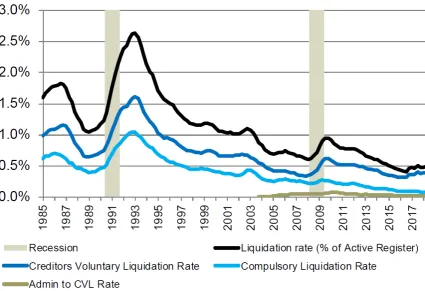
3,964 during the same period in 2017. Fig. 1.1 shows the number of company insolvencies
in England and Wales since 1985 and highlights the two main recessions faced by the
UK economy. It shows that immediately after the two previous recessions the number of
1.1. Background
Fig. 1.1Company Liquidation rate in England and Wales (Source: McDaid, 2018)
The global financial crisis (2007/2008) proved to be a difficult trigger point for many
companies and eventually played a big role in the collapse of many. The landscape of
the UK high-street retailers has been continuously changing with each year providing a
further challenge to these companies. The years that followed, the financial crisis has seen
big retail brands, such as Woolworths, Comet, JJB and Phones4U, file for administration
(Ruddick, 2015). The British Retail Consortium also warned that closures of retail outlets,
2 out of 3 town shops, further caused a loss of 800,000 jobs (Tugby, 2015). In a study
undertaken, by Riley et al. (2014), to assess the impact of the global financial crisis on the
supply side of the UK economy, found that bank lending to businesses had declined.
However, they did not find much evidence to support that the banking sector impairment
and the lack of reallocation of resources to businesses had been the key factor in holding
back productivity growth. This could lead to the argument that the companies that kept
afloat compared to the companies that failed, within this difficult environment, was as a
result of strong management skills and management decisions relating to various aspects
1.1. Background
A company going through insolvency or nearing default has far-reaching effects beyond the
company itself. It has an effect on the workforce, customers, the economy, the taxpayers
etc. There have been countless examples where corporate failure has led to the taxpayer
paying redundancy costs for the failing business. One such example was the insolvency
of Comet, which left taxpayers with a £49.4m bill (Neville, 2012). Recently the discount
chain Poundworld announced the closure of nearly 100 stores putting over 1,500 jobs at
risk as part of an insolvency procedure (Cahill, 2018). TPG Capital (owners of Prezzo
restaurants) went through a similar procedure of closing nearly a third of their stores losing
around 500 jobs. The impact of corporate insolvency was further noted in one of UK’s
biggest collapse in a decade, Carillion a FTSE 350 construction business. The collapse
of this construction business led to over 2,300 job losses, it had a knock-on effect on the
entire sector and caused financial difficulty for firms within its supply chain (Thompson,
2018).
The case of Carillion is especially interesting as currently, the government is investigating
the behaviour of its directors and the corporate culture that existed within the business.
The directors of the firm were accused of driving the company off a cliff and making
a relentless dash for cash by taking low-margin contracts, which did not make money
(Thomas, 2018).
Trends in corporate failure show that firms that fail to perform are usually followed
by Top Management Team (TMT) turnover and it is seen that firms performing above
expectation usually reward their TMT. Firms in financial distress usually did not prepare
for management succession (Dua and Singh, 2010). In addition, the most significant causes
of financial distress identified by Memba and Job (2013) can be attributed to the TMT
of a firm. They also found that the most likely impact of financial distress was the TMT
turnover or replacement. This shows that responsibility of firm performance is given to
the TMT of the firm and therefore supporting a hypothesis that there are key management
1.1. Background
There has been considerable academic and professional debate in the recent years around
the role of the TMT and their relationship with the performance of a firm. There is
evidence to show that there was considerable improvement in the performance of a firm
once incumbent management was replaced (Denis and Denis, 1995; Huson et al., 2004).
High levels of management turnover have also been associated with fraud (Sun and Zhang,
2006) and default or bankruptcy (Gilson, 1989, 1990; Ofek, 1993). There have been
various studies investigating different management attributes and their relationship with
the performance of a firm. However, only a few studies have focussed on the relationship
between the TMT and the probability of firm default. A majority of the focus within the
TMT has been on the CEO and Chairman with only a few studies focusing on the role of
the CFO.
The primary financial objective of a public listed company is the maximisation of
Share-holder wealth (Watson and Head, 2013). When a company becomes insolvent the
share-holders have everything to lose and nothing to win and maybe the culture of maximisation
of shareholder wealth in return has led to the management of companies not being keen to
accept insolvency. It was noted in a study by Franks and Sussman (2000a, 2000b), that
bankruptcy is considered as an option of last resort by management. Therefore posing
the question, when should a company’s primary objective change from ‘maximisation of
shareholder wealth’ to ‘maximisation of creditor wealth’? This conflict has given rise to
what Harner and Griffin (2013) call the ‘Ostrich Syndrome’. They noted that management
of troubled companies often bury their heads in sands until it is too late to remedy. But is
this syndrome a result of the management trying all possible options to work towards its
primary goal of shareholder wealth maximisation? This could also possibly be a conflict
between the agency theory and the stakeholder theory i.e. when should the managers work
towards the interest of the shareholders and when should they shift their focus to another
stakeholder’s interest.
This study develops a theoretical model emerging from key management theories: Resource
Based View, Resource Dependence Theory, Knowledge Based View, Entrenchment Theory,
1.2. Recent UK Corporate Insolvency cases
theory, Upper Echelon Theory, Seasons of Tenure, Ostrich Syndrome, Animal Spirits,
Hubris and Narcissism. These theories have been selected through the literature review
undertaken in order to provide a model of the TMT of the firm.
This research aims at exploring the relationship between key TMT attributes and the
probability of default of a firm. A significant relationship and theoretical model will help
understand specific reasons attributable to management for the failure of an organisation.
In addition, it will provide specific reasoning to ensure that firms are able to work towards
reducing their probability of default by addressing the key attributes.
1.2
Recent UK Corporate Insolvency cases
Ralph (2018) reported that a string of bankruptcies in the UK was driving up costs of credit
insurance. The Association of British Insurers identified that over £340bn of UK trade was
covered by trade credit policies. In the article, it was further highlighted that the collapse
of Carillion, Toys R Us, HMV, Game and Woolworths had led to large losses across the
trade credit insurance industry.
Below are a few recent cases of corporate insolvency that highlight a range of causes but
most importantly the effect of administration on the employees of the company in the UK.
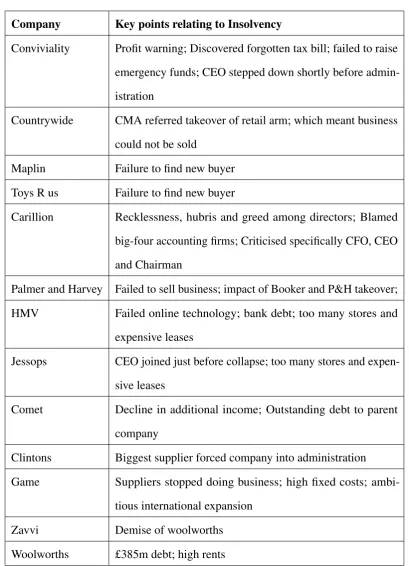
These are summarised in Table 1.1 where some key points are listed that were discussed in
the media.
• Conviviality (Rovnick, 2018) - The previously AIM-listed owner of Bargain Booze,
employing approximately 2500 employees, filed for administration in March 2018.
Just prior to the administration, the company had provided two profit warnings,
declared that they found a forgotten tax bill and failed to raise additional funding from
shareholders. The CEO, who was previously decorated for the above-market growth,
resigned just prior to the administration announcement. The FT article further
1.2. Recent UK Corporate Insolvency cases
the management team and specifically the chairman. Conviviality forecasted a profit
of around £50m and days later made the administration announcement.
• Countrywide (BBC, 2018) - Countrywide Farmers PLC, employing approximately
700 people, filed for administration in March 2018. The company had been looking
at restructuring options for a 12-month period and successfully sold its LPG business.
The company had identified a purchaser for its retail business, however, this was
referred to phase 2 by the Competition and Markets Authority. The sale could not
be completed due to the referral and given the company had an ongoing trading
difficulty and cash flow pressure the only option left was to file for administration.
This has led to a number of staff redundancies as the company had to make cost
savings. The Chief Executive of the firm quit in January 2018 (Rovnick, 2018)
following a profit warning that caused a sharp decline in its shares.
• Maplin (Wood, 2018) - Maplin, a UK electronics retailer employing approximately
2300 employees, filed for administration in March 2018. The company was owned
by private equity investors and had been looking for a buyer for 12 months. The
company felt a financial squeeze after the credit insurance on the suppliers was
removed. The company made 63 people redundant with significant effects to its
headquarters in London and Rotherham.
• Toys R Us (Ralph, 2018) - Toys R Us UK, a giant toys retailer, collapsed in February
2018 which led to the closure of all its stores and approximately 2000 employees
made redundant. The collapse caused a shortfall of approximately £1.1 billion which
included £23.7 million owed to suppliers, approximately £22.1 million of unpaid
VAT, £8.4 million in redundancy payments, £80 million of pension scheme deficit
and £2.5 million in gift cards. Similar to Maplin, the loss of credit insurance was a
factor in the failure of Toys R us as the company failed to find a buyer.
• Carillion (Davies, 2018) - Carillion, a FTSE 350 construction business employing
approximately 19,500 employees, collapsed in January 2018. The company relied
on large contracts with very low margins and when the contracts underperformed
1.2. Recent UK Corporate Insolvency cases
enter liquidation rather than file for administration. This was due to the lack of cash
to continue trading in administration and the funding for the public services contracts
funded by the government could only be received by an official receiver which was
only possible in a liquidation. Recklessness, Hubris and Greed among directors
were noted in reports compiled by two select committees. The big-four accounting
firms were also blamed in this report as they enjoyed a parasitical relationship with
their clients. The committee specifically identified and criticised the Chief Financial
Officer (CFO), Chief Executive Officer (CEO) and the Chairman and recommended
that they are banned from holding future directorships.
• Palmer and Harvey (Vandevelde, 2017) - Palmer and Harvey PLC, a food wholesaler
employing approximately 3400 employees, entered administration in November
2017. A combination of cash squeeze and the Booker-Tesco merger meant that P&H
was struggling and this eventually led to a loss of 2,500 jobs.
• HMV (Robinson, 2013), an entertainment retailer employing 4,500 employees, filed
for administration in January 2013 which led to the closure of more than 100 stores
and a loss of more than 1,400 jobs. Banks and suppliers refused to provide additional
funding which led to a cash squeeze and the company eventually collapsing. Hilco
UK purchased the £176m debt of HMV for around £40m from Lloyds and RBS in
order to take control of the retailer and eventually to become the new owner.
• Jessops (BBC, 2013), a high street camera retailer employing over 2,000 staff, filed
for administration in January 2013. The company struggled to meet its profit targets
and due to substantial cash outflows relating to rent, they got into a financial squeeze
leading to the firm filing for administration.
• Comet (BBC, 2012a), an electrical retailer employing over 6,500 employees, filed
for administration in November 2012 due to stiff competition. The company had
been struggling for some time and was sold for £2 to OpCapita a year before its
collapse.
• Clinton Cards (Felsted and Thompson, 2012), a greeting cards retailer employing
1.2. Recent UK Corporate Insolvency cases
debt and high rents from its large store portfolio. This resulted in 3,000 job losses
and a closure of 350 stores.
• Game (BBC, 2012b), a video game retail company employing over 8,000 employees,
filed for administration in March 2012 which led to an immediate closure of 277
stores and redundancy of 2,104 employees. The company suffered from high fixed
costs relating to rents and ambitious international expansions which led to a cash
squeeze.
• Zavvi (BBC, 2008b), a music, games and DVD chain employing over 3,400 staff
filed for administration in December 2008. It was hit by the default of Woolworths
(its main supplier) which led to the firm struggling to source stock through new
arrangements adding to the working capital pressure.
• Woolworths (BBC, 2008a), a store chain and supplier (entertainment UK) employing
over 30,000 staff through 815 stores filed for administration in November 2008. The
company struggled with mounting amounts of debt and a liquidity squeeze brought
1.2. Recent UK Corporate Insolvency cases
Table 1.1Recent cases of UK Corporate Insolvency (Source: Author’s own collection adapted from various news sources listed above)
Company Key points relating to Insolvency
Conviviality Profit warning; Discovered forgotten tax bill; failed to raise
emergency funds; CEO stepped down shortly before
admin-istration
Countrywide CMA referred takeover of retail arm; which meant business
could not be sold
Maplin Failure to find new buyer
Toys R us Failure to find new buyer
Carillion Recklessness, hubris and greed among directors; Blamed
big-four accounting firms; Criticised specifically CFO, CEO
and Chairman
Palmer and Harvey Failed to sell business; impact of Booker and P&H takeover;
HMV Failed online technology; bank debt; too many stores and
expensive leases
Jessops CEO joined just before collapse; too many stores and
expen-sive leases
Comet Decline in additional income; Outstanding debt to parent
company
Clintons Biggest supplier forced company into administration
Game Suppliers stopped doing business; high fixed costs;
ambi-tious international expansion
Zavvi Demise of woolworths
1.3. Scope
1.3
Scope
The research focuses on the probability of default measured, as a measure of firm
perfor-mance, by the Bloomberg 1-year, Bloomberg 5-year and Altman Z-score probability of firm
default for UK public listed companies. The Bloomberg default probability is developed
using the Merton (1974) model and is a market based measure of default prediction and
the Altman (1968) Z-score is an accounting based measure of default prediction. The TMT
from the perspective of this research is the CEO, Chairman and CFO. The Executives of
the firm from the perspective of this research are the CEO and the CFO. The key TMT
attributes the research focuses on are Motivation, Loyalty and Effectiveness. Motivation is
broken down into short-term motivation, measured by average Salary paid to the executives
and Long-term Motivation, measured by average Bonus paid to the executives. Loyalty is
measured by the average tenure of the TMT. Effectiveness is broken down into
effective-ness at board level, measured by the number of directors on the board, and effectiveeffective-ness at
the firm level, measured by the average number of employees.
1.4
Rationale
A majority of previous literature in the context of the TMT and firm performance focussed
on different measures of profitability. There has been little research undertaken on the
effect of TMT on the probability of firm default. The research has focussed on the US
(Schultz et al., 2017) or East Asian (Ting, 2011) markets and research in this field from the
context of the UK listed companies is almost non-existent. In addition, the TMT has been
previously defined mostly only as CEO and Chairman or the entire board of directors. The
focus of this research is on the CEO, Chairman and CFO as the TMT. The CFO would
play a key role in corporate finance strategies and decisions, which would have a direct
1.5. Aim
There is a lack of an existing theoretical model addressing the relationship between TMT
attributes and the likelihood of default for UK listed companies. This research will provide
a theoretical model developed from previous theories to explain the relationship of key
TMT attributes and the probability of default. A majority of the research studying the
relationship between different TMT attributes and the likelihood of firm default uses a
single measure i.e. either accounting or market based measures for the likelihood of firm
default. This research develops empirical models using both accounting and market based
measures of probability of firm default which allows a much better understanding of the
relationship.
A large amount of research within the TMT and the probability of firm default has used
regular regression for time series or cross-sectional data. This research uses multilevel
modelling on a hierarchical dataset which allows the research to address some of the flaws
of the earlier models when the independence assumption of linear regression is broken.
It would be of importance to regulators and academics to compare the theoretical and
empirical model with key current corporate governance initiatives. It would also be useful
to shareholders and the management to consider how this theoretical model may be applied
in practice and would it generate results as predicted by the model. The principal argument
behind the existence of this relationship is that the increase in default probability increases
the TMT turnover. This would lead to the argument that there must be distinct attributes
that distinguish the TMT of a firm with a high default probability and a firm with a low
default probability within the same industry.
1.5
Aim
The overall aim of the research is to explore the relationship between the TMT attributes
1.6. Objectives
1.6
Objectives
The key objectives of the research are:
1. To critically review and synthesise the literature on key TMT theories.
This objective aims at establishing the scope of the TMT and reviewing the literature
on key theories to understand the different attributes of the TMT.
2. To critically review and synthesise the literature on the TMT and firm performance.
This objective undertakes a critical review of the recent academic literature on the
relationship between various attributes of the TMT and various measures of firm
performance. It helps in clearly identifying the research gap the thesis addresses and
the relevance of the research to key stakeholders.
3. To critically review and synthesises literature: establishing the scope, conceptualising
and classifying the determinants of the probability of firm default.
This objective provides a framework of definitions within which the focus on the
probability of default operates. It primarily aims at reviewing academic literature
on the key determinants and key measures of the probability of firm default. To
critically review and synthesise literature comparing and contrasting accounting
based probability of default vs market based probability of default.
4. To develop a Theoretical model to test the relationship between TMT and the
probability of firm default.
This objective provides a theoretical model developed from the critical review of
literature that explains the relationship between the TMT and the probability of firm
default. The theoretical model then provides the research with key hypothesises that
allow for it to be tested within the context of UK public listed companies.
5. To empirically test the theoretical framework model using the UK FTSE 100 listed
1.7. Research Questions
6. To identify future corporate governance recommendations for listed companies
facing financial distress. And, to provide recommendations based on the analysis of
the key findings.
Finally, this objective aims at bringing the above objectives together in order to
provide some key recommendations of relevance to key stakeholders to the research.
1.7
Research Questions
• Is there a relationship between key TMT attributes and the likelihood of firm financial
distress?
– Is there a relationship between executive motivation and the likelihood of firm
financial distress?
– Is there a relationship between TMT loyalty and the likelihood of firm financial
distress?
– Is there a relationship between TMT effectiveness and the likelihood of firm
1.8. Hypotheses
1.8
Hypotheses
This research identifies key hypotheses to test through the review of theoretical and
empirical literature. The hypotheses tested are as follows:
Hypothesis 1a There is no relationship between executive short-term motivation and the likelihood of firm financial distress
Hypothesis 1b There is a negative relationship between executive long-term motivation and the likelihood of firm financial distress
Hypothesis 2 There is a negative relationship between TMT loyalty and the likelihood of firm financial distress
Hypothesis 3a There is no relationship between TMT board level effectiveness and the likelihood of firm financial distress
Hypothesis 3b There is a positive relationship between TMT firm level effectiveness and the likelihood of firm financial distress
1.9
Contribution
There is lack of clarity on the relationship between key TMT attributes and the probability
of firm default within the UK. There is considerable academic literature on the impact of
the TMT on the profitability or performance of a firm and a majority of this research is
within the US context. This research aims to contribute to existing literature by developing
a theoretical model that explains the relationship of the TMT and their impact of the
probability of firm default. The research further introduces a new key management role
in the TMT definition i.e. the CFO that has previously not been studied within a similar
context. The findings of this research answers some key questions and raises some further
1.9. Contribution
be of primary relevance to Investors (Shareholders and Debtholders), TMT of a firm,
regulators and other researchers with an interest in the subject.
This research uses a multilevel modelling approach on a hierarchical dataset which helps
overcome breaking the independence assumption of linear regression. The research uses
multidisciplinary theories to develop a theoretical model on TMT and the likelihood of
default. This model is then developed empirically using a dataset of UK listed companies.
The empirical model is then tested on an out of sample case to test its reliability and validity.
The model would help in future identification of strengths and weaknesses within a firms
TMT and allow the firm to specify its key management attributes to the firms required
level of the probability of firm default.
The findings contribute to the UK corporate governance code by undertaking a further
scrutiny and providing a better understanding of the role of the CFO. In addition, the
findings provide some further clarity on the debate around board size, salary and tenure as
indicated by the corporate governance code and previous literature.
This research argues that the role of the CFO is extremely important when a firm faces
financial difficulties and is key to the definition of TMT, which has rarely been addressed
in the prior literature. In addition, this research uses both accounting based measures and
market based measures for predicting the likelihood of default whereas a majority of the
literature in this field has used either accounting based measures or market based measures.
There is very little literature on the effect of TMT attributes on financial distress or the
likelihood of financial distress for the UK, which is addressed by this research. The most
important contribution is the contribution of the research to the UK corporate governance
code to ensure a better understanding of the effect of the key management attributes and
the role played by the CFO.
The model developed in this study allows stakeholders to identify the likelihood of default
based on key management attributes earlier than that indicated by the accounting and
1.10. Some Key terminology in the study
governance to ensure a financially healthier corporate environment, designing optimal
executive contracts and remuneration, and timely response to signs of financial weakness.
1.10
Some Key terminology in the study
TMT: The TMT for the purpose of this study refers to the position of the CEO, the CFO and
the Chairman. The research does refer to other studies and definitions used by researchers
of the TMT and this will be clarified in those instances.
The probability of firm default: This is the likelihood that a firm will default on its debt and
enter into a formal insolvency process. This term is interchangeably used with financial
distress. A company gets into financial distress if it is unable to pay its debts as they fall
due. Once a company is in financial distress, insolvency law starts casting its shadow. In
the UK the insolvency law imposes collective governance mechanisms on the insolvent
company and its creditors. The insolvency laws provide a range of choices between a
liquidation procedure for an orderly winding up of the insolvent company’s affair and a
rescue or reorganisation procedure. (Armour et. al., 2008)
Executives: The executives for the purpose of this study refers to the position of the CEO
and the CFO. The research does refer to other studies and definitions used by researchers
1.11. Structure
1.11
Structure
This thesis is structured as follows:
Chapter 2 Theoretical Literature Review This chapter develops a theoretical model by
undertak-ing a review of the literature on key TMTs. This chapter identifies the hypotheses to
be tested and establishes the concepts in the research emerging from the theoretical
model.
Chapter 3 Empirical Literature Review This chapter undertakes a critical review of the literature
on determinants of firm default and its relationship with corporate governance and
the TMT. This chapter further explores prior literature within the context of the
theoretical model developed in the previous chapter and critiques its findings within
the context of this study.
Chapter 4 Methodology This chapter identifies the measures used for each of the individual
con-cepts identified in chapter 3 through a discussion of the various measures previously
used in academic literature and in practice.
Chapter 5 Presentation of results This chapter presents the results of the empirical models
developed by introducing the theoretical model to a sample dataset.
Chapter 6 Analysis and Discussion This chapter analyses the results of the models developed
and discusses the key results within the broader context of existing prior literature.
In addition, this chapter also presents an out of sample test of the empirical model
on a recently failed listed company.
Chapter 7 Conclusions and Recommendations This chapter summarises the key findings of the
study, critiques some of the key limitations of this research, provides
recommenda-tions for further research and provides a thesis summary.
Bibliography
Chapter 2
Theoretical Literature Review
2.1
Introduction
This chapter reviews key theories used in Top Management Team (TMT) research and
critiques them using theories from other disciplines to develop a theoretical framework.
This framework identifies three broad categories of TMT attributes namely: Motivation,
Loyalty and Effectiveness. The sections that follow identify a key theory for each of
these attributes and reviews other theories that further develop our understanding of the
key theory and the TMT attributes. Finally, the theoretical framework underpinning this
research is presented.
2.2
Theoretical Framework
The theoretical framework for this study is developed through the review of these key
theories discussed above and how they are categorised within the different aspects of the
behavioural theory of the firm. A diagrammatic representation of the theoretical framework
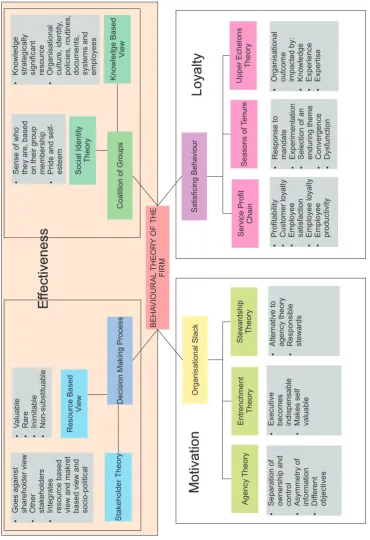
is presented in Fig. 2.1. The behavioural theory of the firm is the key underpinning theory
2.2. Theoretical Framework
broad attributes of the TMT. Hence, this research argues that firstly the TMT of a firm set
the goals and make key strategic decisions to achieve these. Secondly, the TMT are leaders
of a coalition of individuals within a group i.e. the organisation. Thirdly, the TMT are
provided with compensation in excess of what would be deemed sufficient for the efficient
running of the organisation. And finally, the TMT of a firm may undertake behaviour or
actions that may be deemed as "good enough" as opposed to undertaking behaviour or
actions to maximise the wealth of the shareholders or the returns to the organisation. These
four arguments relate to the four attributes of the behavioural theory of the firm and are
broadly categorised as TMT effectiveness at board level, TMT effectiveness at the firm
level, TMT Motivation and TMT Loyalty.
The framework underpins further four key theories for each of the four attributes of the
Behavioural theory of the firm. These are Resource Based View for Decision Making
Process, Knowledge Based View for Coalition of groups, Agency Theory for Organisational
Slack and Seasons of Tenure for Satisficing Behaviour. In addition to these four key
theories, additional relevant theories are attached to help better understand each of the four
attributes. These are the Stakeholder Theory for Decision Making Process, Social Identity
Theory for Coalition of Groups, Entrenchment and Stewardship theory for Organisational
Slack and Service Profit Chain and Upper Echelons Theory for Satisficing Behaviour.
Using the Resource Based view, the framework argues that the TMT is a VRIN resource
within the organisation that make key decisions which give the organisation a sustained
competitive advantage. The stakeholder is a further combination of the Resource Based
view and the market based view which identifies key stakeholders to the firm beyond the
shareholders and the TMT are one of these key stakeholders.
Using the Knowledge Based view, the framework argues that knowledge within the
organisation gained by the individuals within the organisation is the most important
resource available that allows a firm to gain a sustained competitive advantage. This within
2.2. Theoretical Framework
pride and self-esteem by their membership in the group and identifying differences from
other groups.
Using the agency theory, the framework argues that due to the existence of the agency
problem within organisations executives have to be compensated more than what would
be considered an appropriate amount for the successful running of the firm. The excess
amount that is paid is to ensure that the executive directors do pursue own objectives
and goals but instead pursue the objectives and goals of the shareholders. This is further
supported by the Entrenchment theory, which argues that executives will ensure that
the firms or its resources are more valuable under their control, therefore, making them
indispensable. However, the stewardship theory is an alternative to the agency theory as
this argues that the executive directors are responsible stewards to the shareholders and do
not need to receive excess compensation.
Finally, using the seasons of tenure the framework argues that the TMT of an organisation
goes through different seasons the length of which would be different based on the
individual, team and organisations. The strategy and action adopted by the TMT are
influenced by the season they are currently in and as the tenure of the team increases the
seasons could change. This importance of tenure within the theory is further highlighted by
using the Service-Profit Chain as a theory which clearly links employee satisfaction within
a firm to employee loyalty to the firm which is further linked to employee productivity
for the firm. Finally, the Upper Echelons theory, the roots of which can be drawn back
to the behavioural theory of the firm, further argues that TMT experiences and expertise
2.2. Theoretical Framework
BEHA
VIOURAL
THEOR
Y OF THE
FIRM
Decision Making Process
Organisational Slack
Coalition of Groups Satisficing Behaviour
Agency Theory Entrenchment Theory Stewardship Theory Upper Echelons Theory Seasons of T enure Service Profit Chain Resource Based V iew Knowledge Based V iew Stakeholder Theory Social Identity Theory Ÿ V aluable Ÿ Rare Ÿ Inimitable Ÿ Non-substituable Ÿ
Knowledge strategically significant resource
Ÿ
Organisational culture, identity
,
policies, routines, documents, systems and employees
Ÿ
Goes against shareholder view
Ÿ
Other stakeholders
Ÿ
Integrates resource based view and makret based view and socio-political
Ÿ
Sense of who they are, based on their group membership
Ÿ
Pride and self- esteem
Ÿ
Separation of ownership and control
Ÿ
Asymmetry of information
Ÿ
Dif
ferent
objectives
Ÿ
Executive becomes indispensable
Ÿ
Makes self valuable
Ÿ
Alternative to agency theory
Ÿ
Responsible stewards
Ÿ
Profitability
Ÿ
Customer loyalty
Ÿ
Employee satisfaction
Ÿ
Employee loyalty
Ÿ
Employee productivity
Ÿ
Response to mandate
Ÿ
Experimentation
Ÿ
Selection of an enduring theme
Ÿ
Convergence
Ÿ
Dysfunction
Ÿ
Organisational outcome impacted by:
[image:51.595.121.492.149.690.2]2.3. Behavioural theory of the firm
2.3
Behavioural theory of the firm
The behavioural theory of the firm (Cyert and March, 1963; March and Simon, 1958)
emphasises the role of individuals within the economic theory of the firm. It acknowledges
that organisational goals are often conflicting as they are defined at the individual level
rather than at the organisational level. The theory further stresses the limitations of human
rationality and stresses that individuals do not always strive to maximise their utility but
attempt to attain realistic goals. The alternative solutions available to problems faced by
the firm are limited to the definition of the problem and the individuals understanding of
these definitions. This is how human limitations affect firm decision making and behaviour.
Kaczmarek (2017) argued that there has been an increase in the utilisation of multiple
and cross-disciplinary theories in corporate governance research, specially the behavioural
theory of the firm which draws from both social psychology and sociological theories.
March and Simon (1958) state that the managers bring their own set of “given” skills or
knowledge to a decision-making situation. This is further supported by Sutton (1987) who
states that this decision-making is based on the managers “construed reality” rather than a
“real” situation. A key distinction of the upper echelons theory is that the focus is solely
on the TMT of the firm. A key criticism of the research developing on upper echelons
theory was highlighted by Cannella and Holcomb (2005), i.e. as the upper echelons theory
relates to the TMT, “team” being the focus, a majority of the research fails to focus on this
element and only focusses on the individual perception element.
The behavioural theory of the firm (Cyert and March, 1963) suggests that managerial
decisions are not always based on rational motives but are influenced by the natural
limitations of managers as human beings. This is the root of the upper echelons perspective
and in order to study the complex psychological dimensions of managers, one can use their
demographic attributes as proxies (Hambrick and Mason, 1984).
Nielsen (2009) undertook a review of literature on TMT over a 22 year period and found
2.4. Theoretical perspective for Executive Motivation
combined with social psychological theories and in some cases, it was combined with
strategy process or firm internationalisation. The research also found that only a few studies
applied agency, entrepreneurship, change, signalling, firm growth, Resource Based view
and social network theories. Nielsen (2009) found that in almost half the studies reviewed
the dependent variables were organisational level outcomes (firm innovation, strategic
reorientation, the degree of diversification and internationalisation, and organisational risk
and crisis). In addition, it was found that performance was the most common outcome
variable and that only 3 of the articles reviewed theoretically modelled and empirically
tested upper echelons outcomes.
Pettigrew (1992, pg163) introduces the term ‘managerial elites’ to TMT and therefore
includes those who occupy a formally defined position or those at strategic positions in
the definition of TMT. Hambrick and Mason (1984, pg193) define TMT as the ‘powerful
actors in an organisation’ and Finkelstein and Hambrick (1994, pg 8) define the TMT as
the most influential executives at the head of an organisation the ‘. . . top three to ten’.
Origins of the Upper echelon and firm process Internationalisation perspectives can be
traced back to the Behavioural Theory of the Firm. This theory highlights the relevance of
the role played by individuals in the firm by introducing the social aspect to the economic
theory of the firm and argues that organisational goals are defined at the individual level
rather than at the firm level. The Behavioural Theory argues that management, as
hu-mans, do not have rational motives and maximising behaviour, instead they have bounded
rationality (Simon, 1947) which influences their decision-making.
2.4
Theoretical perspective for Executive Motivation
This section reviews theories relating to TMT loyalty and its relationship to organisational
outcomes. It commences with a discussion of the agency theory which is the key theory
underpinning this attribute. This is then followed by a critique of the agency theory under
2.4. Theoretical perspective for Executive Motivation
2.4.1
Agency Theory
“If both parties to the relationship are utility maximisers there is good reason to believe that the agent will not always act in the best interest of the principal” (Jensen and Meckling, 1976)
Berle and Means (1932) in their book ’The Modern Corporation and Private Property’
highlighted the issue around monitoring of executive autonomy with an increase in the wide
dispersion of ownership. This idea was further developed by Jensen and Meckling (1976)
into a very widely used theory today, namely ’agency theory’. The key argument behind
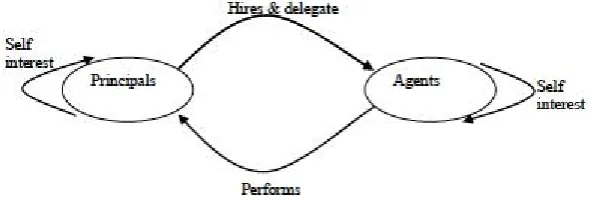
this theory, as presented in Fig. 2.2, is that in modern day corporations the ownership
and control of the organisation is widely separated i.e. the principal (owner) employs the
agent (manager) to control or run the firm. The k