cognitive-behavioural framework
MALTBY, John, LEWIS, C. A. and DAY, LizaAvailable from Sheffield Hallam University Research Archive (SHURA) at: http://shura.shu.ac.uk/6056/
This document is the author deposited version. You are advised to consult the publisher's version if you wish to cite from it.
Published version
MALTBY, John, LEWIS, C. A. and DAY, Liza (2008). Prayer and subjective well-being : the application of a cognitive-behavioural framework. Mental Health Religion and Culture, 11 (1), 119-129.
Copyright and re-use policy
See http://shura.shu.ac.uk/information.html
Prayer and subjective well-being: The application of a cognitive-behavioural framework
John Maltby (1)
School of Psychology, University of Leicester, University Road, Leicester, LE1 7RH,
England. Email: [email protected]
Christopher Alan Lewis
School of Psychology, University of Ulster at Magee College, Londonderry, BT48 7JL,
Northern Ireland. Email: [email protected]
and
Liza Day
Psychology Subject Group, School of Social Science and Law, Sheffield Hallam University,
Sheffield, S10 2BP, England. Email: [email protected]
WORD COUNT: 4011
(1) School of Psychology, University of Leicester, University Road, Leicester, LE1 7RH,
England, United Kingdom. E-mail: [email protected]. Address correspondence to the first
Abstract
The aim of the present study was to examine the relationship between a model of prayer and a
measure of subjective well-being within the context of a cognitive-behavioural framework. A
community sample of 173 (77 males and 96 females) UK adults completed measures of
prayer activity and the General Health Questionnaire-28. The present findings suggest that
meditative prayer, frequency of prayer, and prayer experience account for unique variance
(among other measures of prayer) in a general measure of subjective well-being. The results
demonstrate the potential usefulness of a cognitive-behavioural framework to help better
1. Introduction
For many religious faiths the power of prayer has been long acknowledged; and the role of
praying for oneself and others, and the possible positive effects that surround mental health
and wellbeing are well explored and debated within the media (Tessman & Tessman, 2000).
Recent empirical research tends to support this view rather than challenge it. There are studies
that suggest prayer has a beneficial effect on subjective well-being, in terms of both mental
health and health variables. In terms of mental health variables, prayer, as part of the
measurement of a general religious faith, has been found to be related to better mental health
(Koenig, 2002) and frequency of prayer or meditative prayer have been shown to be related to
better mental health (Herbert, Dang, & Schulz, 2007; Poloma & Gallup, 1991; Poloma &
Pendleton, 1991). In terms of health variables, prayer is associated with fewer self-reported
health symptoms (Banthia, Moskowitz, Acree, & Folkman, 2007) and perhaps more
controversially, there is some evidence to suggest that praying for others may aid the health of
those being prayed for (Tloczynski & Fritzsch, 2002).
Moreover, there is evidence that prayer may be a dominating variable in the
relationship between religion and subjective well-being. Maltby, Lewis, and Day (1999)
compared a number of religious measures (religious orientation, religious coping, and
religious behaviours [i.e., church attendance and personal prayer]) in terms of their ability to
predict unique variance in mental health. Among the religious measures, frequency of
personal prayer was found to be the best predictor of better mental health.
However, these findings are difficult to bring together as they often employ
single-item measures of prayer that are independent of the theoretical models of the different
psychological components of prayer. Up to now, there is a tendency to attribute significant
positive relationships between prayer and subjective well-being within a coping model, by
an important daily meditative process alleviating stress. However, the current literature
doesn’t seek to directly test psychological models of coping. Therefore, there is a need to
examine the relationship between prayer and mental health and health using conceptual
measurement of the variables and theoretical frameworks to encompass the area.
There is an opportunity for the development of empirical research in this area from the
potential use of a cognitive-behavioural framework (James & Wells, 2003). James and Wells
propose two basic mechanisms, in the form of hypotheses that underlie the relationships
between dimensions of religiosity and mental health that promote positive mental health: (a) a
mental model that provides guidance for appraising life events, and (b) religious behaviours
that provide self-regulation of cognitive, specifically thinking, processes.
The first cognitive-behavioural hypothesis is based on theoretical perspectives of
Peterson and Roy (1985) and McGuire (1981) who suggest religiosity provides an
interpretative framework that allows the individuals to make sense of their existence and
contributes to an individual’s self-perception, their own importance within the world, and the
meaning and purpose behind life events (James & Wells, 2003). The second
cognitive-behavioural mechanism is religious behaviours that contribute to self-regulation, or
meta-cognitions, by reducing self-focus, worry, and stress, and therefore, lead to better subjective
well-being. This hypothesis is based on the findings that some religious beliefs may increase,
or be the result of attention to oneself, and that this is related to emotional disorder,
obsessiveness, guilt, and worry (Wells, 1997; Wells & Hackman, 1993). James and Wells
(2003) have suggested that meditative prayer may enable individuals to reduce self-focus, to
engage mentally with stress, and therefore, lower worry and rumination. Research notes that
meditation can aid mental health by way of the individual spending time in quiet reflection,
being allowed to spend time to understand a context to the world and deal effectively with
There is reason to think that the cognitive-behaviour framework model can be
elaborated upon and applied to examine the relationship between prayer and subjective
well-being. Poloma and Pendleton (1991) present a model of different types of prayer. This model
suggests that prayer is made up of the following elements: frequency of prayer, praying with
others, colloquial prayer (telling God of one’s love and asking for blessing), petitional prayer
(asking God for material things), ritual prayer (reciting prayers), meditative prayer (quiet
thoughts and reflection), and prayer experience (inspired thoughts and deeper insight). Such a
model contains two measures, prayer experience and meditative prayer, which are consistent
with James and Wells’ (2003) general cognitive-behavioural framework and the two specific
hypotheses proposed by these authors.
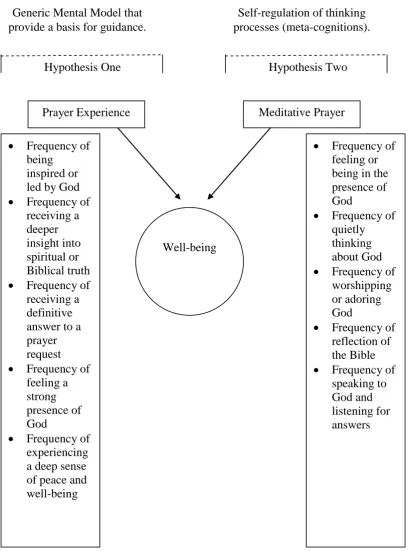
- Figure 1 about here -
Figure 1 shows the integration of James and Wells’ (2003) cognitive-behavioural framework and Poloma and Pendleton’s (1991) prayer model in predicting better mental
health. Within this model it is proposed that two particular dimensions of prayer (experience
and meditative) will be shown to be important in predicting subjective well-being. First,
Poloma and Pendleton’s (1991) measurement of prayer experience contains items that reflect
the frequency to which prayer leads to inspiring thoughts, provides answers to questions, and
deeper insight to life. Therefore, within Poloma and Pendleton’s (1991) model, prayer experience would seem to reflect James and Wells’ (2003) first mechanism that suggests
religiosity provides an interpretative framework that allows the individual to make sense of
their existence and contributes to an individual’s self-perception. Furthermore, and as James
and Wells (2003) suggest prayer meditation reflects their second mechanism (self-regulation
of thinking processes) whereby frequent quiet thinking about God, listening to God, and
reflecting on the teachings of the Bible, provide the self-regulation by which individuals are
Attention to the cognitive-behavioural framework and the elements within prayer will
provide a sounder theoretical context to understand why prayer may help people, and as such,
begin to describe the processes which aid mental health and health. Consequently it is
hypothesised from the cognitive-behavioural framework, and by using Poloma and
Pendleton’s (1991) model of prayer, prayer experience and meditative prayer would account
for unique variance in mental health, over other indices of prayer.
2. Method
2.1 Sample
The sample comprised a community sample of 173 (77 male and 96 female) United
Kingdom respondents aged from 18 to 51 years, with a mean age of 24.63 years (SD = 5.8
years). Respondents were sampled from a number of workplaces and church groups in the
South Yorkshire area of the United Kingdom by the researchers approaching the heads or
leaders of those groups or organisations and asking them to ask for volunteers for the study.
2.2 Questionnaires
All respondents were administered the following measures.
1. A measure of prayer activity (Poloma & Pendleton, 1991). The scale was developed
among 560 USA adults and contains seven subscales. Each item is prefixed with a statement
that refers to a frequency of a particular prayer behaviour or experience. The seven subscales
are:
1. Colloquial Prayer (six items): talking to God in own words, asking for guidance,
loved. Responses for this scale are scored on a 4-point response format, with available
responses being (1) Never, (2) Rarely, (3) Sometimes, and (4) Often.
2. Petitional Prayer (two items): asking for material things for oneself and for friends or
relatives. Responses for this scale are scored on a 4-point response format, with
available responses being (1) Never, (2) Rarely, (3) Sometimes, and (4) Often.
3. Ritual Prayer (two items): frequency of reading a book of prayer and reciting prayers
that the individual has memorised. Responses for this scale are scored on a 4-point
response format, with available responses being (1) Never, (2) Rarely, (3) Sometimes,
and (4) Often.
4. Meditative Prayer (five items): ‘feeling’ God, thinking quietly about God, spending time worshipping God, reflecting on the Bible, and listening to God for his answer to
prayers. Responses for this scale are scored on a 4-point response format, with
available responses being (1) Never, (2) Rarely, (3) Sometimes, and (4) Often.
5. Prayer Experience (five items): being inspired or led by God, receiving a deeper
insight into spiritual or Biblical truth, receiving a definitive answer to a prayer request,
feeling a strong presence of God and experiencing a deep sense of peace and
well-being. Responses for this scale are scored on a 5-point response format, with available
responses being (1) Never, (2) Once or Twice, (3) Monthly, (4) Weekly, and (5) Daily.
6. Frequency of Prayer (one item): “on average how often do you pray?”. Responses for this item are scored on a 7-point response format, with available responses being (1)
Never, (2) Less than monthly, (3) At least monthly, (4) At least weekly, (5) Several
times a week, (6) Once a day, to (7) Several times a day.
responses being (1) Never, (2) Occasionally, (3) At least monthly, (4) At least weekly,
and (5) At least once a day.
The only psychometric data reported previously on the scales is that for the multi-item
measures (Poloma & Pendleton, 1991). Internal reliability statistics were satisfactory for all
the subscales of prayer, exceeding the criteria offered by Kline (1986) for scales with few
items (Colloquial Prayer, =.85; Petitional Prayer, =.78; Ritual Prayer, =.59; Meditative
Prayer, =.81; and Prayer experience, =.87).
2. The General Health Questionnaire – 28 (Goldberg & Williams, 1991) asks respondents how they felt in accordance to 28 items over the last seven days. Each of these scales
comprise 7-item measures of depressive symptoms (e.g., “Felt that life is entirely hopeless” [item 23]), anxiety symptoms (e.g., “Been getting scared or panicky for no good reason” [item
12]), social dysfunction (e.g., “Been taking longer over the things you do” [item 16]), and somatic symptoms (e.g., “Been feeling run down and out of sorts” [item 3]). A higher score
indicates poorer well-being. The scale demonstrates satisfactory reliability and validity across
a number of samples (Goldberg & Williams, 1991).
This measure of well-being was used as it reflects subjective well-being (shorter-term
evaluation of well-being) as it refers to symptoms over the last seven days. The General
Health Questionnaire can be used in two forms, subscales and overall form.
3. Results
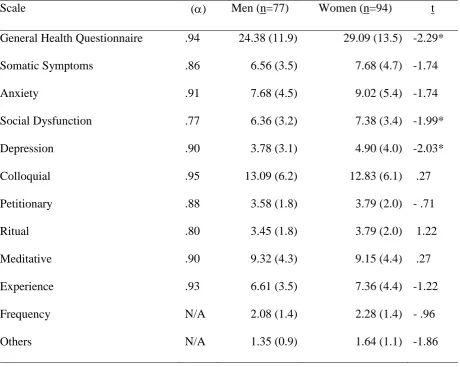
Table 1 shows the internal reliability statistic for all the subscales. The Cronbach’s alpha
coefficients for the multi item scales are above .7, suggesting that all the multi-item scales
- Insert Table 1 about here –
Table 1 also shows mean scores and standard deviations for all the scales by sex. No
significant difference occurs between males and females on any of the prayer measures.
However, females were found to score significantly higher than males on the General Health
Questionnaire, and the social dysfunction and depression subscales of this measure.
- Insert Table 2 about here –
Table 2 demonstrates the Pearson product-moment correlation coefficients between all
the variables. A significant positive correlation occurs between all the prayer scales. In terms
of the main aim of the study, higher scores on the General Health Questionnaire had a
significant negative correlation with ritual, meditative, prayer experience and praying with
others. In terms of providing a full consideration of the variables, the somatic symptoms, and
anxiety and depression subscales of the General Health Questionnaire demonstrate a similar
pattern of correlations, sharing significant negative correlations with ritual, meditative, prayer
experience, and praying with others.
- Insert Table 3 about here –
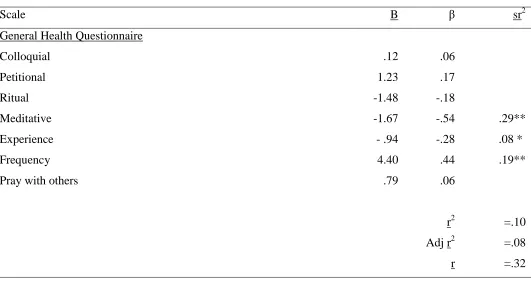
However, to test the main hypothesis of the study, one multiple regression was performed to
test the model. This analysis required two considerations to be made. The first consideration
concerned the high correlation between all the subscales of the General Health Questionnaire,
and the direction and significance of the correlation of each of the subscales of the General
Health Questionnaire with the measures of prayer are very close. Moreover, the items of the
number of components suggested to be extracted by a Scree Test. The Scree Test suggested
one component to be extracted and loadings on the first component were all above .40,
suggesting that among the present sample the General Health Questionnaire comprised one
dimension. Consequently, overall scores were computed for the General Health
Questionnaire with higher scores indicating poorer levels of subjective well-being. This
integration of measures to form a general underlying factor of subjective well-being (present
day balance between positive and negative affect) is consistent with the findings of Ryff and
Keyes (1995). The second consideration was that the religious prayer measures also showed
high inter-correlations and therefore entering them as separate measures into the model
increased the risk of problems associated with multicollinearity. However, incorporating the
measures or removing the measures to avoid multicollinearity (Tabachnick & Fidell, 1989)
were not deemed appropriate solutions as this would threaten the testing of the main
hypothesis using Poloma and Pendleton’s (1991) model of religiosity. Therefore, in line with
Poloma and Pendleton (1991), the present authors believe that the degree to which the
independent variables are multicollinear is not detrimental to the analysis.
Therefore, overall scores on the General Health Questionnaire were used as the
dependent variable and all of the religious prayer measures were used as independent
variables. The regression statistic (R) was significantly different from zero for scores on the
General Health Questionnaire (F(4,166)=6.38, p < .01). Table 3 shows the full results for an
unstandardised multiple regression. Included in this table are the unstandardised regression
coefficient (B), the standardised regression coefficients (β), the semipartial correlations (sr2), r, r2 and adjusted r2. Among the present sample, meditative prayer, frequency of prayer, and
prayer experience accounted for unique variance in scores on the General Health
4. Discussion
The aim of the present study was to examine the relationship between Poloma and
Pendleton’s (1991) model of prayer and a measure of subjective well-being within the context
of a cognitive-behavioural framework. The correlations between the variables suggest that
ritual prayer, meditative prayer, prayer experience, and praying with others were all
associated with better mental health scores. However, the results of the multiple regression
suggest that meditative prayer, frequency of prayer, and prayer experience all account for
unique variance in subjective well-being. That is, individuals who through their prayer, feel
and think quietly about God in quiet reflection, who pray regularly, or who have feelings of
deep well-being or deep experience of God report better subjective well-being.
This finding fits well within the James and Wells’ (2003) cognitive-behavioural framework set out for this research, that Poloma and Pendleton’s (1991) model of prayer
contains both mechanisms that provide a basis for guiding appraisals of life events (prayer
experience) and self-regulation of thinking processes (meditative prayer).
However, the findings from the multiple regression show that frequency of personal
prayer also predicts unique variance with General Health Questionnaire scores, even though
these variables do not show a significant correlation by way of the Pearson product moment
correlation coefficients. Multiple regressions often reveal such relationships as the proportion
of shared variance of such an emerging predictor variable will increase substantially after the
other predictor variables shared variance have been removed. Subsequently, the present
findings suggest that frequency of personal prayer is important to the current model. Within
this context, it is not unexpected to find that frequency of personal prayer predicts unique
variance in subjective well-being as all the measures of prayer used in the study refer to
frequencies of prayer activity, feeling and behaviours and, therefore, frequency of prayer
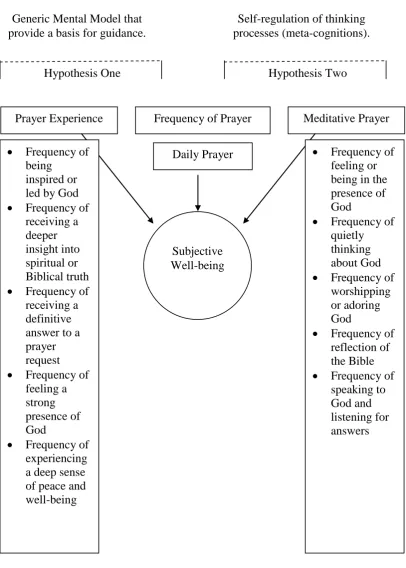
within the cognitive-behavioural framework, but bridges both hypothesis 1 and 2. Figure 2
presents an amended model, suggesting the frequency of personal prayer as central to both
cognitive and behavioural aspects of James and Wells’ (2003) cognitive-behavioural
framework when considering subjective well-being. The inclusion of frequency of prayer here
is conceptually and empirically interesting as engaging in any prayer types in Poloma and
Pendleton model reflects increased activity and frequency around prayer. Conceptually the
findings suggest that an increased frequency of prayer activity in itself, regardless of the
particular nature of prayer (with the exceptions of prayer experience and meditative prayer) is
a central factor to consider when predicting relationships between religiosity and well-being.
- Insert Figure 2 about here -
In terms of future empirical research, the present study has provided an important step
in providing a theoretical and empirical framework by which to understand the relationship
between religiosity and subjective well-being that has both empirical and practical
implications which has been absent from the psychology of religion literature. Consequently,
future research should seek to expand on the present cognitive-behavioural model and
compare these prayer measures against other theoretical domains of mental-health, such as
psychological well-being (the longer term outcome of the engagement with wider individual
development and the existential challenges within life, Keyes, Shmotkin, & Ryff, 2002).
In summary, the present findings suggest that meditative prayer, frequency of prayer,
and prayer experience account for unique variance (among other measures of prayer) with a
standardised measure of subjective well-being (depression, anxiety, somatic symptoms, social
dysfunction). Therefore, the present study provides a potentially reliable and valid model that
may aid practitioners to understand why praying may be crucial to better subjective
References
Banthia, R., Moskowitz, J.T., Acree, M. & Folkman, S. (2007). Socioeconomic differences in
the effects of prayer on physical symptoms and quality of life. Journal of Health
Psychology, 12, 249-260.
Goldberg, D., & Williams, P. (1991). A user's guide to the General Health Questionnaire.
London: NFER: Nelson.
Hebert, R.S., Dang, Q.Y. & Schulz, R. (2007). Religious beliefs and practices are associated
with better mental health in family caregivers of patients with dementia: Findings
from the REACH study. American Journal of Geriatric Psychiatry, 15, 292-300.
James, A., & Wells, A. (2003). Religion and mental health: Towards a cognitive-behavioural
framework. British Journal of Health Psychology, 8, 359-376.
Keyes, C. L. M., Shmotkin, D., & Ryff, C. D. (2002). Optimizing well-being: The empirical
encounter of two traditions. Journal of Personality and Social Psychology, 82,
1007-1022.
Kline, P. (1986). A handbook of test construction. London: Methuen.
Koenig, H. G. (2002). Religion, congestive, heart failure, and chronic pulmonary disease.
Journal of Religion and Health, 31, 263-278.
Maltby, J., Lewis, C. A., & Day, L. (1999). Religious orientation and psychological
well-being: The role of the frequency of personal prayer. British Journal of Health
Psychology, 4, 363-378.
McGuire, M. B. (1981). Religion: The social context. Belmont, CA: Wadsworth.
Monk-Turner, E. (2003). The benefits of meditation: Experimental findings. Social Science
Journal, 40, 465-470.
Peterson, L. R., & Roy, A. (1985). Religiosity, anxiety, and meaning and purpose: Religion’s
Poloma, M. M., and Gallup, G. H. (1991). Varieties of prayer: A survey report. Harrisburg:
Trinity Press.
Poloma, M. M., & Pendleton, B. F. (1991). Exploring neglected dimensions of religion in
quality of life research. Lampeter, Wales: Edwin Mellen Press.
Ryff, C. D., & Keyes, C. L. M. (1995). The structure of psychological well-being revisited.
Journal of Personality and Social Psychology, 69, 719–727.
Tessman, I., & Tessman, J. (2000). Efficacy of prayer: A critical examination of claims.
Skeptical Inquirer, 24, 31-33.
Tabachnick, B., and Fidell, L. (1989). Using Multivariate Statistics. New York: Harper &
Row Publishers.
Tloczynski, J., & Fritzsch, S. (2002). Intercessory prayer in psychological well-being: Using a
multiple-baseline, across-subjects design. Psychological Reports, 91, 731-741.
Wells, A. (1997). Cognitive therapy of anxiety disorders: A practice manual and conceptual
guide. Chichester, UK: Wiley.
Wells, A., & Hackman, A. (1993). Imagery and core beliefs in health anxiety: Content and
Tables
Table 1
Mean (standard deviation) scores by sex and Cronbach’s alpha coefficient for all the multi
-item scales.
Scale () Men (n=77) Women (n=94) t
General Health Questionnaire .94 24.38 (11.9) 29.09 (13.5) -2.29*
Somatic Symptoms .86 6.56 (3.5) 7.68 (4.7) -1.74
Anxiety .91 7.68 (4.5) 9.02 (5.4) -1.74
Social Dysfunction .77 6.36 (3.2) 7.38 (3.4) -1.99*
Depression .90 3.78 (3.1) 4.90 (4.0) -2.03*
Colloquial .95 13.09 (6.2) 12.83 (6.1) .27
Petitionary .88 3.58 (1.8) 3.79 (2.0) - .71
Ritual .80 3.45 (1.8) 3.79 (2.0) 1.22
Meditative .90 9.32 (4.3) 9.15 (4.4) .27
Experience .93 6.61 (3.5) 7.36 (4.4) -1.22
Frequency N/A 2.08 (1.4) 2.28 (1.4) - .96
Others N/A 1.35 (0.9) 1.64 (1.1) -1.86
Table 2
Pearson moment correlations coefficients between all the variables.
Scales 1 2 3 4 5 6 7 8 9 10 11 12
(n=173)
1. GHQ -- .87** .90** .83** .71** -.13 -.10 -.24** -.31** -.25** -.07 -.21**
2. Somatic Symptoms -- .73** .62** .47** -.06 -.05 -.17* -.23** -.25** -.07 -.19*
3. Anxiety -- .68** .47** -.16* -.14 -.24** -.33** -.22** -.08 -.19*
4. Social Dysfunction -- .49** -.03 -.05 -.21** -.19* -.08 .05 -.11
5. Depression -- -.18* -.07 -.18* -.27** -.25** -.12 -.18*
6. Colloquial -- .80** .65** .84** .56** .81** .59**
7. Petitional -- .62** .73** .43** .62** .60**
8. Ritual -- .68** .39** .51** .53**
9. Meditative -- .69** .71** .69**
10. Experience -- .73** .65**
11. Frequency -- .53**
12. Pray with others --
Table 3
Regression analysis for General Health scores with prayer measures (centred around the mean) used as predictor variables.
Scale B β sr2
General Health Questionnaire
Colloquial .12 .06
Petitional 1.23 .17
Ritual -1.48 -.18
Meditative -1.67 -.54 .29**
Experience - .94 -.28 .08 *
Frequency 4.40 .44 .19**
Pray with others .79 .06
r2 =.10
Adj r2 =.08
r =.32
Figure 1
The application of James and Wells’ (2003) cognitive-behavioural framework in
hypothesised relationships between Poloma and Pendleton’s (1991) model of prayer and
well-being.
Prayer Experience Meditative Prayer
Hypothesis One Hypothesis Two
Generic Mental Model that provide a basis for guidance.
Self-regulation of thinking processes (meta-cognitions).
Well-being Frequency of
being inspired or led by God Frequency of
receiving a deeper insight into spiritual or Biblical truth Frequency of
receiving a definitive answer to a prayer request Frequency of
feeling a strong presence of God
Frequency of experiencing a deep sense of peace and well-being
Frequency of feeling or being in the presence of God
Frequency of quietly thinking about God Frequency of
worshipping or adoring God
Frequency of reflection of the Bible Frequency of
Figure 2
Empirical findings supporting the application of James and Wells’ (2003) cognitive -behavioural framework to the relationship between Poloma and Pendleton’s (1991)
model of prayer and subjective well-being.
Prayer Experience Meditative Prayer
Hypothesis One Hypothesis Two
Generic Mental Model that provide a basis for guidance.
Self-regulation of thinking processes (meta-cognitions).
Frequency of Prayer
Daily Prayer Frequency of
being inspired or led by God Frequency of
receiving a deeper insight into spiritual or Biblical truth Frequency of
receiving a definitive answer to a prayer request Frequency of
feeling a strong presence of God
Frequency of experiencing a deep sense of peace and well-being
Frequency of feeling or being in the presence of God
Frequency of quietly thinking about God Frequency of
worshipping or adoring God
Frequency of reflection of the Bible Frequency of
Footnotes
(1) To use the definition applied by (Ryff & Keyes, 1995) in making the empirical
distinction between measures of shorter term evaluation of the balance between positive
and negative affect (subjective well-being) and the longer-term well-being reflection,