Autonomy Research
O'LEARY, ChristineAvailable from Sheffield Hallam University Research Archive (SHURA) at:
http://shura.shu.ac.uk/22859/
This document is the author deposited version. You are advised to consult the publisher's version if you wish to cite from it.
Published version
O'LEARY, Christine (2018). Postmodernism as a Theoretical Framework for Learner Autonomy Research. Studies in Self-Access Learning (SISAL), 9 (3), 342-370.
Copyright and re-use policy
See http://shura.shu.ac.uk/information.html
ISSN 2185-3762
Postmodernism as a Theoretical Framework for Learner Autonomy Research
Christine O'Leary, Sheffield Hallam University, UK
Corresponding author: [email protected]
Publication date: September, 2018.
To cite this article
O’Leary, C. (2018). Postmodernism as a theoretical framework for learner autonomy
research. Studies in Self-Access Learning Journal, 9(3), 342-370. To link to this article
http://sisaljournal.org/archives/sep18/oleary
This article may be used for research, teaching and private study purposes. Please contact the author for permission to re-print elsewhere.
342
Postmodernism as a Theoretical Framework for Learner Autonomy
Research
Christine O'Leary, Sheffield Hallam University, UK
Abstract
The multidimensional nature of current conceptualisations of learner autonomy combined with the need to access both individual and social constructions presents both ontological and epistemological challenges when researching a pedagogy for learner autonomy. This paper will discuss the advantages and challenges to exploring the development of learner autonomy and its implication for practice from a postmodernist and social constructivist perspective, based on a qualitative case study of the development of advanced specialist and
non-specialist foreign language learners and their teacher as a learner practitioner-researcher, in a large Higher Education Institution in England. It will show, in particular, how such
methodology facilitates a dynamic research design, providing an opportunity to adapt and use existing theories whilst maintaining a strong emphasis on the learner's 'voices'. It will
conclude with a set of recommendations together with the limitations of such an approach.
Keywords: Postmodernist research, Learner voices, Learner autonomy, Learner development
The growing recognition within current educational literature that student engagement and motivation are essential to successful learning (Coates, 2006; Zepke & Leach, 2010) supports a student-centred approach to teaching and learning. Cognitive and more particularly constructivist views of student learning suggest that learners’ active and independent/
interdependent involvement in their own learning increases motivation to learn (Hoidn & Kärkkäinen, 2014; Raya & Lamb, 2008) and develops their autonomy (Benson, 2011).
Therefore as a cornerstone to successful lifelong learning, the development of autonomous language learners has been explored in many studies (e.g. Benson & Nunan, 2005; Benson, 2011; Everhard & Murphy, 2015; Raya & Lamb, 2008;) since Holec defined the term as learners taking charge of their learning in 1981. However, many authors such as Little (2000) have stressed the social dimension of the process, highlighting that the
development of a capacity for autonomy happens through interactions involving peers and teachers (Raya & Lamb, 2008; Raya, Lamb, & Vieira, 2007) as well as individually. To become autonomous, therefore, learners need to develop the psychological and emotional capacity to control their own learning collaboratively as well as independently (Kohonen, 1992; O’Leary, 2014; Oxford, 1990, 2016).
343
epistemological challenges. Learner autonomy and its development have been studied using a variety of paradigms and theoretical frameworks ranging from positivist quantitative
approaches such as Fazey and Fazey’s (2001) study of the autonomy of first year
undergraduates, to narrative qualitative ones (e.g. Benson, 2006; Karlsson & Kjisik, 2009). Although Curtis (2004) has associated postmodern theory with practical applications for promoting learner autonomy, no studies appear to have researched the development of learner autonomy using a postmodern orientation.
This paper aims to examine the advantages and challenges of using a postmodernist approach to exploring the development of learner autonomy, in undergraduate specialist and non-specialist language learners, studying advanced level French modulesi within a large UK Higher Education Institution, within a social constructivist perspective, from a practitioner researcher's perspective. After some consideration of the study's context and of the learner autonomy construct, the paper will discuss the benefits and inherent challenges of using postmodernist methodology, within a multifaceted and multi-dimensional theoretical
framework. It will also discuss briefly how it was applied in practice, using a few illustrative extracts from the study's data analysis, although a more detailed account is clearly beyond the scope of this paper. The paper will conclude with some recommendations for using
postmodernism as a research design as well as consideration of the limitations of such an approach.
Context of the Study
The research focused on a case study of undergraduate specialist and non-specialist students studying French at the advanced stages of the University Language Scheme (ULS) -Stage 5 (CEFRii B2/C1) and Stage 6 a or b (CEFR C1).
The ULS, as an Institution-wide Language Programme (IWLP), offers a choice of language modules to students of other disciplines (non-specialists) as well as core language modules to students majoring or minoring in Languages (specialists), alongside other specialisms such as International Business, Tourism or TESOL, in six stages of languages, loosely based on the CEFR, from ab-initio (A1) to degree standards (C1/ C2). Although the ULS offers seven languages, only Spanish, French, German and Italian are available at the two most advanced levels due to insufficient demand in other languages.
344
• the development of language skills to enable students to function in both a social and business environment, including mediation (Route 6b only);
• the acquisition of general knowledge of the country/countries where the target language is spoken, together with the development of students’ awareness of its/their society, traditions, customs and business culture;
• the development of autonomous language learners.
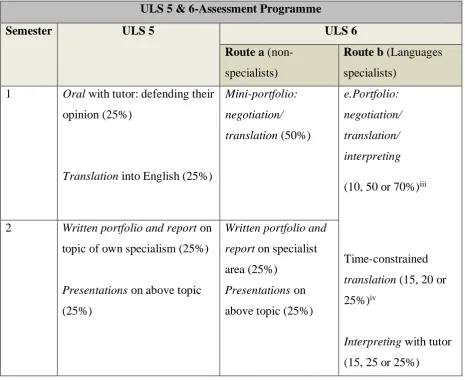
345 Table 1. Assessment Programme
ULS 5 & 6-Assessment Programme
Semester ULS 5 ULS 6
Route a (non-specialists)
Route b (Languages specialists)
1 Oral with tutor: defending their opinion (25%)
Translation into English (25%)
Mini-portfolio: negotiation/ translation (50%) e.Portfolio: negotiation/ translation/ interpreting
(10, 50 or 70%)iii
Time-constrained translation (15, 20 or
25%)iv
Interpreting with tutor
(15, 25 or 25%) 2 Written portfolio and report on
topic of own specialism (25%)
Presentations on above topic
(25%)
Written portfolio and
report on specialist
area (25%) Presentations on
above topic (25%)
Learner Autonomy as a Construct
Individual level
346
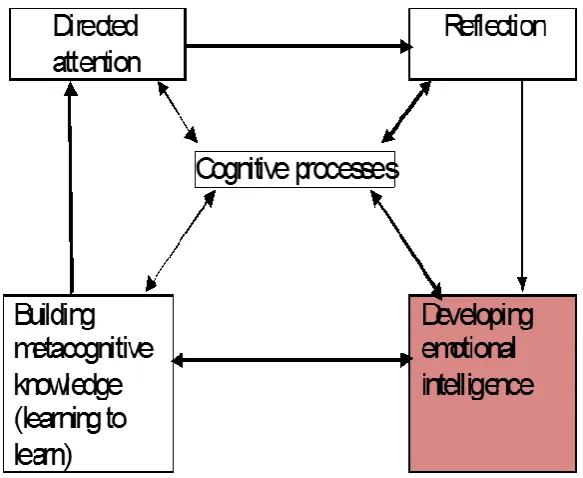
Benson identifies control over cognitive processes as probably “the most fundamental level” (2001, p. 87). His model covers three key areas for control over cognitive processes:
• attention- active engagement with linguistic input, involving conscious apprehension
and awareness of specific aspects of the language;
• Metacognitive knowledge at task level encompassing any evidence of: decision to
carry out the task, decisions about content, progression, place and time of learning, the selection and use of cognitive strategies, and the criteria selected for evaluation; • reflection- any form of reflection on the language, the learning process, their role
within that process, (pp. 86-87).
Social level
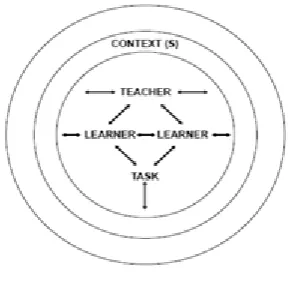
[image:7.595.223.372.434.575.2]William and Burden’s (1997) social model of the teaching and learning process emphasised the role of the learning environment and that of learner-teacher interactions with this environment. I added the learner to learner dimension as shown below (see Figure 1) to highlight the role of peers in the process, in line with the importance accorded to peer to peer learning in existing literature in the field and beyond (e.g. Boud, Cohen, & Sampson, 2013; Kohonen, 2002; Little, 2000).
Figure 1. A Social Constructivist Model of the Teaching-Learning Process, Adapted From Williams and Burden (1997, p. 43) by O'Leary (2014, p. 22).
The importance of metacognition
347
Postmodernism as a Theoretical Framework for Research in Learner Autonomy
Other studies
Past and recent studies on learner autonomy have employed a wide variety of methodologies. Psychometric approaches using and/or developing rating scales as part of a study of the development of autonomy were popular with many researchers (e.g. Cotterall, 1995; Guglielmino, 1978; Lai, 2001). More recently, mixed methods have been adopted as a variation to more positivist methodologies (see Cooker, 2015 or Tassinari, 2015).
Constructivist qualitative practitioner action research involving a strong reflective/reflexive element gained popularity with authors such as Champagne et al. (2001) and Karlsson (2008). Complexity theory seeking to grapple with the multi-faceted and multi-dimensional aspects of the construct has also gained ground as a theoretical paradigm (see for instance Dörnyei, Macintyre & Henry, 2015). Narrative and highly inductive qualitative stories have also been used to privilege participants' voices (Benson, 2006; Benson & Cooker, 2013). In my own study, I was seeking a way that would enable me to represent all the voices,
including the teacher's, without favouring any particular world view at the outset. I also sought to reflect the social dimension of the research and its close relation to practice, within a social constructivist paradigm. My main concern was to avoid framing participants'
responses within a pre-existing theoretical framework. Although accessing voices suggested a phenomenological/ interpretivist methodological approach, concerned with discovering the interconnected whole of the phenomena under investigation (Denzin & Lincoln, 2005; Maykut & Morehouse, 1994), rather than a positivist one looking at component variables to understand the whole phenomena, this approach needed to be articulated within a theoretical framework that could accommodate the various perspectives and constructions emerging from all the 'voices', including student learners, myself as the learner- practitioner researcher as well as theorists/ authors from the literature, without privileging any.
I was also aware that my own conceptualisation (and attraction to the concept in learning and teaching) was strongly influenced by the ideological and political dimension of learner autonomy reflected in work such as Pennycook (1997) together with critical
348 Postmodernism as a research paradigm
Postmodernism tends to be described in relation to its antonym, Modernism, which is underpinned by a belief in the power of science to deliver unified and legitimate knowledge (Sarup, 1993). In contrast, Postmodernism tends to reject "metanarratives" which offer this unified and monolithic view of the world (Lyotard, 1984). Stronach & MacLure (1997) identify deconstructive approaches to meaning as a key feature of postmodernist thinking. Deconstruction defined by Johnson (1994) as “opening up meaning as a question, as a non given, as a bafflement” (p, 39) challenges assumptions about the stability of meaning and points to a plurality of perspectives or constructions of the world we live in. The postmodern approach therefore entails a pluralist perspective and multiple ‘truths’ contingent to specific settings. Haber (1994, p. 13) asserts that Postmodernism is both “committed to” and
349
research questions and “their theoretical consequences will be of direct practical relevance to practice” (p. 20).
There were, therefore, four key reasons for adopting a postmodernist research approach in my study:
• the need not to privilege individual or groups of individuals’ constructions of the world reflecting a ‘pluralist perspective’;
• the situated nature of the study focusing on the participants’ constructions of reality within their specific learning context;
• my wish to move away from macro theories, such as critical theory, as a theoretical framework to a ‘micro logical/theoretical’ level, aligned with the study’s participants’ personal theory and closer to practice;
• the dynamic nature of the research, and the possibility of change at a micro level working within the constraints imposed by the wider society, rather using a critical theory of resistance or conflict approach, in order to seek an ideal practice (Brown & Jones, 2001) or an absolute solution to the development of autonomy.
The political and ideological nature of the concept of autonomy as Pennycook (1997, p. 35) highlights as central cannot be denied. Clearly, the psychological dimension of
autonomy does not operate in a vacuum, independently of the cultural and social values of the broader society (Pennycook, 1997, p. 44). Brown and Jones (2001) mention “critical
pedagogy in a postmodern world” because we need to recognise that these values will vary between individuals and communities depending on their context and prior experience.
The Study
Questions
The key questions posed in the case study relating to the development of autonomous language learners were:
1) What do undergraduate language students believe about learning and their role within the process?
350
3) What implications might this have on the conceptualisation of learner autonomy, and associated operationalisation of the construct within the language curriculum and beyond?
4) Is it possible to influence students’ constructions of learning, particularly in relation to tutor dependence?
5) What is the impact of students’ beliefs/constructions of learning on their learning, in relation to the development of autonomy in practice, within the languages curriculum? (O'Leary, 2010, pp. 7-8)
A Postmodernist Stance
Methodology
A postmodern research orientation has a range of practical implications for the research design as well as the data collection and analysis. The literature review had to be approached in a way that would avoid framing the participants’ responses around particular theories. The research was divided into two phases. Phase 1 would focus on the learners’ voices prior to any literature being considered, answering question 1 and starting the literature review from a learner perspective i.e. based on the key themes emerging from the learner’s voices rather than dominant theories or my own beliefs on the centrality of
metacognition within the process. The literature review and its implications would respond to questions 2, 3 and 4. The second phase would concentrate on the practical implications in answer to questions 5 from a (learner) practitioner-researcher perspective.
Dealing with language
A postmodernist research design entails giving due consideration to language and the plurality of meaning implied in this theoretical orientation. This means problematising the language used in participants’ responses through disassociating words and their meanings, i.e. participants may ascribe different meanings to the same word.
This meant taking a poststructuralist rather than a structuralist perspective i.e. moving away from Saussure’s (1910-11) structuralist theory of language to poststructuralist plurality of meanings and shifting meanings. Signifiers and signified are no longer stable but
351
written or an oral discourse. Whilst Brown and Jones (2001, p. 98) emphasise the intolerance of poststructuralist theories relating to ‘accurate expositions’ or ‘conclusive definitions’, Spivak (1980) points to the usefulness of a poststructuralist stance in potentially unsettling and questioning “our mindset in the way we account for what we see” (p. 75). This will impact on the way the data can be collected and analysed as clarifying meanings and
identifying themes, for instance, has to involve all participants. This was particularly true for Phase 1 which dealt with the students’ perspective as opposed to Phase 2 which was solely concerned with the practitioner-researcher perspective.
Postmodernism and a social constructivist approach
Candy (1991, p. 252) broadly describes constructivism as “a cluster of approaches which hold that knowledge cannot be taught but must be constructed by the learner”. Linking constructivism with psychological theories of learning, Benson (2001) citing Paris and Byrnes (1989, p. 170) stresses that “knowledge is produced through socially conditioned processes of interpretation” (p. 36). The social constructivist approach to knowledge and its acquisition fitted the postmodernist /poststructuralist stance adopted in the study, in that it implied a local and individual/ group construction of the social context, including the relativity of the language used by participants to articulate these constructions.
My role as a researcher-practitioner
352 Scope and limitations of the research
Maykut and Morehouse (1994, p. 145) identify the “trustworthiness” of the research as an indication of validity. Credibility can be assessed via a detailed description of the research process and its expected outcomes (Maykut & Morehouse, 1994; Nunan, 1992). Transparency, particularly a clear audit trail, will enable readers to “walk through the work from beginning to end” (Maykut & Morehouse, 1994, p. 145). Given its postmodern
orientation, how this study’s findings resonate with the readers’ experiences and perceptions of ‘reality’, i.e. its face validity (Krueger, 1994, p. 32) helps ‘validate’ its results as well as its process of enquiry. In relation to a postmodernist approach, Smith and Hodkinson (2009, p. 38) point out that external evidence cannot force or coerce individuals’ agreement to “see the social and educational world in the same way”. The reader needs to be taken through the research process and be convinced by the author’s arguments and evidence.
Using a Postmodernist and Social Constructivist Perspective in Practice
Data collection methods and analysis for Phases 1 and 2
As stated earlier, the research was subdivided into two Phases:
• Phase 1 which focused on accessing learners’ ‘voices’ through focus groups, i.e. the student learners’ and through the learner practitioner-researcher’s reflective diary as well as other ‘voices’ from the literature, leading to a revised construct;
• Phase 2 which analysed 28 self-evaluation reports and five detailed research diaries, drawn from the same learners as the Phase 1 focus groups’ participants, including the learner practitioner-researcher, for evidence of ‘autonomy in practice’, in order to assess the usefulness of the revised construct as well as the autonomy of all the learners involved. The outcome of Phase 2 would determine further intervention through curriculum and assessment design at the advanced stages on the ULS.
Outline of Phase 1 data collection process and data analysis extracts
353 Focus group process
Phase 1 used focus group described by Krueger (1994, p. 19) as group
interactions aimed at identifying feelings, ways of thinking and perceptions which may differ between participants. Focus groups are distinct from group interviews in that they include participants with common characteristics. They are repeated several times, with similar participants, to identify themes and patterns in perception (Krueger, 1994, p. 19).
During Phase 1 of the study, four focus groups of between two (group 2) and five participants (group 3) met between one and three times over one academic year (see O'Leary, 2010), for a duration of one to one and a half hours as recommended by Krueger (1994). Student volunteers, all experienced language learners, were grouped by language stage (Stage 6- Groups 1 & 3 and Stage 5- Groups 2 & 4). Group members were in the same class with me as their teacher, with the exception of Group 4 (3 students).
The focus groups discussions were carried out in line with standard ethical
consideration. I produced an interview guide before each group meetings with a summary of the outcomes of previous meetings and/or other focus groups as applicable, included at the start of each meeting (Arskey & Knight, 1999; Banister, Burman, Parker, & Taylor, 1994; Krueger, 1994). In order to access their constructions of the learning process both generally and with regards to languages, participants were asked to: identify the characteristics of a
good teacher/language teacher; a good learner/language learner; describe successful and
unsuccessful learning experiences both generally and for languages; reflect on their own acquisition of language proficiency and outline their plan for future language learning
after University. These questions were kept sufficiently broad to cover their
learning/language learning experience in HE, rather than focusing on the last two years when I taught most of them. This was intended to mitigate the inequalities in the power
relationship, as I taught some of them. Krueger (1994) suggests that the researcher may wish to modify the question structure and timing to get “confirmation of emerging themes and ideas” (p. 145). He points out that “typically the first focus group yields a considerable
354 Recording and analysing the data
In relation to the data collection, Krueger (1994, pp. 143-144) suggests five possible options: 1) a transcript-based analysis; 2) a taped-based analysis using an abridged transcript based on careful listening of the tape; 3) a note-based analysis; 4) a debriefing session and summary comments at the conclusion of the focus group; and 5) memory-based analysis where an oral account is presented. I opted for a mixture of the second and third options, with some further adaptation to suit the poststructuralist approach to language: part of the analysis and the ‘debriefing’ elements of the third option took place with the
participants as co-constructors/ co-researchers in relation to the preliminary findings, as recorded on the flip charts. I used the tape to produce partial transcripts of detailed interactions to complement the thematic analysis done with the participants, during the meetings.
I conducted the interviews in their L1 (English) using a ‘brainstorming’ approach with each participant’s contributions recorded on the flip chart, in the participants’ own words, for instance Approachability (Scottv, Group 1, meeting 1) and Self-motivated (Lesley, Group 3). I recapped the student’s responses, throughout the interview, using the statements written on the flip charts to further clarify meanings and identify emerging themes with the students as the following extracts from Group 3, meeting 1 shows:
[Researcher writes charts headings what makes a good learner?/ what makes a good teacher? on different pages of the flip chart.]
Researcher (COL): COL: Right, so the first one I think I would like you to think
about is what makes a good learner. As I say no right or wrong answers, what do
you think makes a good learner?
[..]
LESLEY: Self-motivated.
[ COL writes on the chart Self-motivated] • Self-motivated (LESLEY)
JOCELYN: A good listener. [COL writing a good listener] • A good listener (JOCELYN)
355
LESLEY: To be a good learner, you have got not just to go to your lessons. You have to be able to be motivated at home to do the work and to learn yourself.
SIAN: You have got to want to learn.
COL [clarifying]: want to learn is that self-motivated? SIAN: Yeah.
[COL starts writing underneath bullet point-self motivated]
COL: So want to learn, able to be motivated, is that what you were saying? ALL: Yes.
• want to learn (SIAN)/ able to be motivated and learn yourself (LESLEY)
COL: A good listener?
DAVID: I am thinking you need to be open-minded.
[COL writing open-minded underneath bullet point- a good listener] • open-minded (DAVID)
COL: In what way, would you say?
DAVID: You have to be able to take stuff in, others’ opinions, not to be stuck in your own thing.
COL: Accept others’ opinions, is it? Is it accept, understand or both? DAVID: Both probably.
JOCELYN: Both, yes.
[COL writes on the chart next to open-minded]
• understands and accepts others’ opinions (DAVID/ COL (for summary)?)
(O'Leary, 2010, Vol iii, pp100-101)
I also asked students to rank each theme in order of importance at the end of the session. I noted all differences of opinion on the flip chart reflecting the plurality of perspectives rather than trying to reach a consensus.
Findings
356
an awareness of the benefits of collaboration/peer support.
The literature review
Based on the main themes identified in Phase 1, the review of existing literature focused, more particularly, on theories and case study research relating to affect, including motivation, and cognition/metacognition both from individual and collaborative
perspectives, together with the role of the teacher within the learning process. Although some of the responses were not unexpected, I found the importance
attributed to affect in the participants’ responses, particularly in relation to the teacher's role, particularly puzzling. The affective dimension is not usually considered in relation to learner development/ training at these levels. The findings from Phase 1, including motivation and the importance of collaboration, led to a revised definition and model which gave 'affect' a stronger emphasis, as shown in Figure 2.
[image:17.595.98.390.425.664.2]A revised conceptualisation and theoretical model
357
Phase 2 outline of data collection and extracts from the data analyis
Based on the revised model of control over cognitive processes, I analysed twenty-eight self-evaluation reports (students produce only one per portfolio-based assessment) and five learner diaries from the student learners (diaries were not compulsory and only five students completed theirs) as well as entries from my own research diaries, as a learner practitioner-researcher, for evidence of control over cognitive processes, in line with Benson (2001, 2011), with affect now within a separate category:
• control over cognitive processes using the broad categories of attention, metacognitive knowledge at task level and reflection;
• emotional intelligence or affect, including evidence of addressing their own anxiety, encouraging themselves, awareness of their own emotional temperature as well as evidence of empathy and cooperation with others.
The analysis, although done purely from the perspective of the (learner) practitioner researcher contained a number of challenges, particularly from a language perspective. Some of the diaries were written in the target language (L2 for the learners) and translated, adding further layers of interpretation. This was mitigated by including the raw data in the
appendices but, as in L2, the written statements may not have accurately reflected the meaning intended by the learners. There was no opportunity to discuss the analysis with the student participants, in order to explore potential interpretations as they had already left.
Self-evaluation reports and Learner diaries
The findings suggested that, in practice, the student learners displayed some degree of autonomy. Reliance on tutor support and subject expertise appeared to be more limited than expected, although there was a discrepancy between the diary entries and the self-evaluation in this area, with most diaries referring to the tutor. A few extracts below illustrate the data analysis:
Attention Although perhaps most difficult to identify, 25% of the self-evaluation reports
358
“I also learnt a lot of new vocabulary as the medical and legal French was quite complicated” (SE9)vi
Task Knowledge (Metacognitive knowledge at task level) was quite complex since the task’s
aims included more than just linguistic development. The task knowledge implicit in the students’ self-evaluation could relate to generic skills, subject knowledge as well as language learning.
“In doing the portfolio, I found a new way of working: research then write. When I write
something for my law course, I write, and then I find examples or quotations to support what
I think” (SE 12)
Reflection All the self-evaluation reports contained some form of reflection which is to be
expected since their stated purpose is reflection.
54% of the reports highlighted linguistic progress as part of their reflection. 21% focused on the acquisition of specialist language, particularly vocabulary:
“I have learnt more vocabulary relating to my subject and I have developed my skills.”
(SE10)
Emotional intelligence (affect) was limited to motivation/engagement:
“This project has given me a sense of achievement; also I have put a lot of time and effort
into the project” (SE9).
The role/influence of the tutor, was not as prominent as might have been expected from Phase 1 findings. Despite the central role given to the teacher in Phase 1, only two students referred to the influence of the tutor on their progress such as:
“[..].the meetings with my tutor ensured that I made regular progress” (SE14)
Learner-researcher practitioner diary
359
Reflection as in the case of the students is wide-ranging. In addition to reflection on concepts
and theories, my research diaries included some observations/ commentaries on the data collection process:
“[…] The mix of the group was very different from the previous ones- [..] they were
all reasonably cosmopolitan- an ‘independent’ group who were confident of their
language ability. They also must have learnt an awful lot of the language whilst
abroad and yet were still prepared to assert the centrality of the teacher in the
learning process” (DOL 10)
Whilst Phase 2 concluded that there was some clear indication of the students demonstrating their autonomy in relation to other cognitive processes, evidence of control
over the affective dimension was very limited. With the exception of one or two of the Learner-researcher practitioner's diary entries, there was no evidence in relation to
cooperation or other relational aspects, despite the importance expressed by the focus groups’ participants who were the authors of the majority of the self-evaluation reports. These findings suggested the need for collaborative activities and for paying more attention
to the affective dimension of the learning process, through creating more opportunities for collaboration with peers and encouraging students to articulate the emotional dimension of their learning experience. This led to the addition of peer feedback and collaborative learning activities such as group interpreting as part of an e.portfolio (see O'Leary, 2014).
Conclusion
As highlighted in the above discussion of the methodology and the brief
summary of its outcomes, I found that a moderate postmodernist approach, albeit challenging, can yield useful insights into a phenomenon through avoiding closing down or limiting the ways in which participants can be understood or 'conceive of themselves' at the start of the research process. Despite the inherent relativity of postmodernism and the ever shifting meaning of language from a poststructuralist perspective, the approach enabled qualitative data to be questioned/ explored in different ways, facilitating understanding rather than co-construction of meaning in respecting individual differences. It also created an opportunity for my own voice to be heard openly through the analysis of my own diary entries and reflection sections, rather than covertly.
360
The change of emphasis from my own perspective on autonomy and the focus of my research is reflected in the final broader title of‘Developing autonomous language learners within the HE curriculum: a postmodern and social constructivist perspective’ chosen for the study.
The outcome influenced my own practice (and hopefully that of some of my colleagues/ readers), particularly in relation to affective considerations which now forms an integral part of class activities and assessment preparation with some degree of success (see O'Leary, 2014). The relativism inherent in a postmodernist research design together with its limited context, however, means that this study's findings need to be constantly challenged in ‘conversation’ with other and newer studies and theories, rather than simply adopted.
Notes on the Contributor
361
References
Arskey, H. & Knight, P. (1999). Interviewing for social scientists. London, UK: Sage. Bandura, A. (1977). Self-efficacy: Toward a unifying theory of behavioral change.
Psychological Review, 41(2), 191-215. doi:10.1037/0033-295x.84.2.191
Bandura, A. (1986). Social foundations of thought and action: A social cognitive theory. Englewood Cliffs, NJ, USA: Prentice Hall.
Banister, P., Burman, E., Parker, I., & Taylor, C. (1994). Qualitative methods in psychology: a research guide. Buckingham, UK: Open University Press.
Benson, P. (2001). Teaching and researching autonomy in language learning. Harlow, UK: Longman.
Benson, P. (2011). Teaching and researching autonomy in language learning. Harlow, UK: Longman (2nd Ed.).
Benson, P., & Cooker, L. (Eds) (2013). The applied linguistics individual: Approaches to identity, agency and autonomy. Sheffield, UK: Equinox Publishing.
Benson, P. & Nunan, D. (Eds.) (2005). Learners’ stories: Differences and diversity in language learning. Cambridge, UK: CUP.
Best, S. & Kellner, D. (1991). Postmodern theory: Critical interrogations. New York, USA: Guildford Press.
Boud, D. (2012). Developing student autonomy in learning. London, UK: Taylor & Francis. Boud, D., Cohen, R., & Sampson, J. (Eds.) (2013). Peer learning in education: Learning
from and with each other. Oxford, UK: Routledge.
Brown, T., & Jones, L. (2001). Action research and postmodernism: Congruence and critique. Milton Keynes, UK: Open University Press.
Candy, P. (1991). Self-direction for lifelong learning. San Francisco: Jossey Bass.
Champagne, MF., Clayton, T., Dimmitt, N., Laszewski, M., Savage, W., Shaw, J., Stroupe, R., Thein, M. M., & Walter, P. (2001). The assessment of learner autonomy and language learning. In L. Dam (Ed.) Learner autonomy: New insights. AILA review 15 (pp. 34-44). Milton Keynes, UK: The AILA Review.
Council of Europe (2000). Common European Framework of Reference for Languages. Retrieved from http://www.coe.int/t/dg4/linguistic.
362
Cotterall, S. (1995). Readiness for autonomy: Investigating learner beliefs. System, 23(2), 195-206. doi.10.1016/0346-251X(95)00008-8.
Curtis, B. (2004). Practical applications of postmodern theory for promoting learner autonomy in a foundation studies program. Printed proceedings of the Independent Learning Conference 2003. Retrieved from
http://citeseerx.ist.psu.edu/viewdoc/download?doi=10.1.1.138.757
Dam , L. (2011). Fostering learner autonomy in language learning. In D., Gardner (Ed) Developing learner autonomy with school kids: Principles, practices and results
(pp40-51). Gaziantep, Turkey: Zirve University Press.
Derrida, J. (1976). Of Grammatalogy. Baltimore, ML: John Hopkins.
Dörnyei, Z, MacIntyre, P. D., & Henry, A. (2015). Introduction: applying complex dynamic systems principles to empirical research on L2 motivation. In Z. Dörnyei, P. D. MacIntyre & A. Henry (Eds.), Motivational dynamics in language learning (pp. 1-7). Bristol, UK: Multilingual Matters.
Fazey, D., & Fazey, J. (2001). The potential for autonomy in learning: Perception of competence, motivation and locus of control in first year undergraduate students. Studies in Higher Education, 26(3), 345-361. doi.10.1080/03075070120076309
Feuerstein, R., Klein, S., & Tannenbaum, A. (1991). Mediated learning experience: theoretical, psychological and learning implications. London, UK: Freund.
Findley, M., & Cooper, H. (1983). Locus of control and academic achievement: A literature review. Journal of Personality and Social Psychology, 44(2): 419-427.
doi.10.1037/0022-3514.44.2.419
Fox, N. (2000). Social research in postmodern mood: Reflexivity, collaboration and
transgression. Paper presented at Current issues in Qualitative Research Conference, University of East Anglia, UK, 24-25 July.
Freire, P. (1974) Education for critical consciousness. London, UK: Sheed and Ward. Guglielmino, L. M. (1978). Development of the Self-Directed Learning Readiness Scale.
(Doctoral dissertation, University of Georgia, 1977). Dissertation Abstracts International, 38, 6467A.
Haber, H. (1994). Beyond postmodern politics. Lyotard, Rorty, Foucault. New York, NY: Routledge.
Hill, D., McLaren, P., Cole, M., & Rikowski, G. (Eds.) (1999). Postmodernism in
educational theory: Education and the politics of human resistance. London, UK: Tufnell Press.
363
http://www.oecd.org/officialdocuments/publicdisplaydocumentpdf/?cote=EDU/WKP( 2013)15&docLanguage=En
Karlsson, L. (2008). Turning the kaleidoscope: (E)FL Educational Experience and Inquiry as Auto/ biography. Helsinki, Finland: Helsinki University Language Centre
Publications.
Krueger, A. (1994). Focus Group: A Practical Guide for Applied Research. London, UK: Sage (2nd Ed.).
Karlsson, L., & Kjisik, F. (2009). Whose story is it anyway? Auto/biography in language learning encounters. In F., Kjisik, P., Voller, N., Aoki, & Y., Nakata (Eds.), Mapping the Terrain of Learner Autonomy (pp. 168-179). Tampere, Finland: University of Tampere.
Kohonen, V. (1992). Experiential language learning: Second language learning as
cooperative learner education. In D. Nunan, D. (Ed), Collaborative language learning and teaching (pp.14-39). Cambridge, UK: Cambridge University Press.
Lai, J. (2001). Towards an analytic approach to assessing learner autonomy. In L. Dam (Ed) Learner autonomy: New insights. AILA review 15 (pp. 34-44). Milton Keynes, UK: The AILA Review.
Lamb, J. (2009). Controlling learning: relationships between learners' voices and motivation. In S., Toogood, R., Pemberton and A. Barfield (Eds). Maintaining control: Autonomy and Language Learning (pp 67-86). Hong Kong, China: Hong Kong Press.
Little, D. (2000). Learner autonomy and human interdependence: Some theoretical
consequences of a social-interactive view of cognition, learning and language. In B. Sinclair, I, McGrath, & T. Lamb (Eds.), Learner autonomy, teacher autonomy: Future directions (pp 15-23). London, UK: Longman.
Lyotard, J. F. (1984). The postmodern condition: A report on knowledge. Manchester, UK: Manchester University Press.
Macaro, E. (1997). Target Language, collaborative learning and autonomy. Clevedon, UK: Multilingual Matters.
Maykut, P. & Morehouse, R. (1994). Beginning qualitative research: A philosophic and practical guide. London, UK: Falmer Press.
Nunan, D. (1992). Research Methods in Language Learning. Cambridge, UK: Cambridge University Press.
364
O'Leary, C, (2010). Developing autonomous language learners within the HE curriculum: A postmodern and social constructivist perspective. Unpublished thesis. Sheffield: Sheffield University Library.
O'Leary, C. (2014). Developing Autonomous Language Learners in HE: A social constructivist perspective. In G Murray (Ed). Social dimensions of autonomy in language learning. London, UK: Palgrave Macmillan.
Oxford, R. (1990). Language learning strategies: What every teacher should know. Rowley, MA: Heinley and Heinley.
Oxford, R. (2016). Powerfully positive: Searching for a model of language learner well-being. In D. Gabrys_Barker & D. Galajda (Eds.), Positive psychology perspectives on foreign language learning and teaching (pp. 21-37). Heldelberg, Belgium: Springer International.
Paris, S., & Byrnes, J. (1989). The constructivist approach to self-regulation and learning in the classroom. In B. Zimmerman and D, Schunk (Eds). Self-regulated learning and academic achievement (pp. 169-200). New York, NY: Springer-Verlag.
Pennycook, A. (1997). Cultural alternatives and autonomy. In P Benson & P Voller (Eds). Autonomy and independence in language learning (pp. 35-53). London, UK: Longman.
Raya, M. J., Lamb, T., & Vieira F. (2007). Pedagogy for autonomy in language education in Europe: Towards a framework for learner and teacher development. Dublin, Ireland: Authentik.
Raya, M. J. & Lamb, T. (2008). Pedagogy for autonomy in language education. Dublin, Ireland: Authentik.
Roseneau, P. (1992). Postmodernism and the Social Sciences. Princeton, NJ: Princeton University Press.
Sarup, M. (1993). Post-structuralism and post-modernism. Hemel Hempsted, UK: Harvester-Wheatsheaf.
Saussure, F. (1910-11). Third course of lectures on general linguistics. New York, NY: Pergamon.
Smith, J., & Hodkinson, P. (2009). Challenging neorealism: A response to Hammersley. Qualitative Inquiries, 15(30), 30-39. doi.10.1177/1077800408325416
Spivak, G. (1980). Revolutions which as yet have no model. In D. Landry & Mclean (Eds.), The spivak reader (pp. 29-49). London, UK: Routledge.
365
Tassinari, M. G. (2015). Assessing learner autonomy: A dynamic model. In C. Everhard & L. Murphy (Eds.), Assessment and autonomy in language learning (pp 64-88). London, UK: Palgrave Macmillan.
Wenden, A. (1995). Learner training in context: A knowledge-based approach. System 23(2): 183-94.doi.10.1016/0346-251X(95)00007-7
Wenden, A. (1998). Metacognitive knowledge and language learning, Applied Linguistics, 19(4), 515-37.doi.10.1093/applin/19.4.515
366 Appendix
Focus group 1- - Stage 5- meeting 1 Present: Scott , Janine and Anna-Marie
What makes a good teacher?
• Somebody who cares about students’ progress/ students’ experience • Approachability
• Good listener
• Somebody who understands students/ what they do/ What they want
➢ understands different students and their objectivesvii ➢ being aware of the needs of students
➢ needs to be able to reach the students to inspire them
• Break down barriers between students and teachers- encourages (social worker sort of role)
• Teacher should have an interest in the subject-/passion & enthusiasm which is transmitted to students
• Help should be readily available- they should make time. Job= teaching students therefore should be a priority
• Recognition & rewards to good students
➢ prizes/ certificates
➢ a word of praise/ book tokens
➢ motivation-competition between students
• Main role of the teacher is to get the students to learn
• Ask the students what would motivate them/ setting achievable goals • Teaching style on the level with their students
• Patience- empathy with students’ difficulties
• Know how to handle different students- more experienced teachers appear more confident
• Classroom management/ discipline • Organisation
What makes a good learner?
• Hard-work
➢ make sure you do your homework +reading round or doing something extra ➢ ask for help and advice
➢ look what you are supposed to have learnt from homework • Willingness to work
• Learner aware of objectives given by teacher/ to make themselves acquainted with the subject
367
• Main objectives= to pass the subject/ to know enough about the subject to pass (major) • Understanding the subject for further studies (minor)
• the ability to prioritise what they need to learn • Making friends (minor)
• Enjoying the subject
• Doing extra work to find out more • Relating to real life
• Looking at background/ concrete examples from
Good teacher (follow-up from last focus group)
• Subject knowledge- 1= (link to enthusiasm for their subject/ teaching) • Empathy (understanding student needs/ objectives) 4=
• Approachability 4= (link with empathy)
• Experience 3= (link classroom management/ knowledge of teaching methodologies/ how to teach)
• Good preparation 2= (link with organisation)
• Classroom management 3= ((link experience/ knowledge of teaching methodologies/ how to teach)
• organisation 2=(link with good preparation)
• Enthusiasm for their subject/ teaching 1= (link with subject knowledge) • Knowledge of teaching methodologies/ how to teach 3= (link classroom
management/experience)
Good learner- More general points applying to both School and HE
• Willing to do (hard)- work- willingness to learn/ motivation/ organisation/ target setting 1
• Ability to prioritise what they need to learn HE 3= (equal to recognition motivator/ pressure)
• Willing to do extra work/ to find out more -using theory + applying own experience 4=
• Interest in the subject studied 2 (interest=experience)
• School different from HE- HE requires self-motivation/ learning to be independent. Independence taught gradually.
Think of activities when you really learnt something-What/ how/ where/why
Example 1- Working for a seminar. Had to do research and then present it at University. Worked because there was structure and discussion. You did your research, shared ideas and took time.
Example 2- Revision for an exam. Involved group work and discussion in bedroom in France. Successful because worked together as a team / shared
Example 3- Research. Had to visit various places/ sites around the region-to be completed
368
Focus group 1, meeting 2 (continued)
Think of activities when you didn't learn What, how, where and why
Focus Group 3- Stage 5- Meeting 1 (only one meeting with this group) Present: David, Sian, Lesley, Jocelyn and Frances .
Good Learner
• Self-motivated 1
➢ want to learn
➢ able to be motivated & learn yourself
• Good listener 3= ( equal to attendance/ participation)
➢ open-minded- understands & accept others' opinions
• Take time to understand 2= (equal to well-organised)
• Well-organised- organisation/ time management 2= (equal to take time to understand)
• Attendance 3= (equal to take time to understand/ participation) • Participation 3= (equal to attendance/ good listener)
Good language learner (additional characteristics) • Time out of lesson- learning vocab and grammar.
• Interested in the subject 1 (Sian/ Jocelyn)/ 1/ 2 (Frances) [also valid outside of languages] • Very attentive- pronunciation 1 (David)
• Immersion in the target language 1 (Lesley)
➢ Language- listening to radio/ reading etc..
• Need to sustain effort- learning process gradual
Good Teacher
• Able to come down to the level of the learner 2= (equal to patience)
Example 1-Law lesson in France. Couldn't understand. Paid no attention/ switched off/ confused. At university in France. Couldn't engage in the learning.
369 • No favouritism- no preference for more able people
• Patience 2= (equal to able to come down to the level of the learner/ Relate to students/ Confident)
• Good in-depth knowledge of the subject 1= • varies the lesson 3=
• involves the student in the lesson- encourage participation 3
➢ by not talking too much ➢ ask students' opinion
➢ group work- classroom discussion
➢ move around the class to individual students ➢ uses visual aids rather than talking
• Relate to students 2= (equal to able to come down to the level of the learner/ patience/ Confident)
➢ not too serious ➢ approachability ➢ personality
• Confident 2= (equal to able to come down to the level of the learner/ patience).
370
End notes
iModules refer to the constitutive elements of a course or programme of study.
Undergraduates students typically study 6 X 20 credit modules a year or a total of 18 (360 credits) for a three year undergraduate degree.
ii Common European Framework for Languages
iii The percentage has varied every year based on module review across all languages. iv When the portfolio was worth 10% of the overall module mark, the negotiating oral and reports were done outside the portfolio as summative tasks worth 25% each.
v Different Christian names were used to preserve confidentiality vi Self-Evaluation- Portfolio 9