Service-Oriented Design of a Command and Control
Intelligence Dashboard for Crisis Management
DOMDOUZIS, Konstantinos <http://orcid.org/0000-0003-3679-3527>,
ANDREWS, Simon <http://orcid.org/0000-0003-2094-7456>, GIBSON, Helen
<http://orcid.org/0000-0002-5242-0950>, AKHGAR, Babak
<http://orcid.org/0000-0003-3684-6481> and HIRSCH, Laurence
<http://orcid.org/0000-0002-3589-9816>
Available from Sheffield Hallam University Research Archive (SHURA) at:
http://shura.shu.ac.uk/10723/
This document is the author deposited version. You are advised to consult the
publisher's version if you wish to cite from it.
Published version
DOMDOUZIS, Konstantinos, ANDREWS, Simon, GIBSON, Helen, AKHGAR, Babak
and HIRSCH, Laurence (2014). Service-Oriented Design of a Command and Control
Intelligence Dashboard for Crisis Management. In: Big Data, Intelligence
Management and Analytics Workshop (BDIMA 2014), 7th IEEE/ACM International
Conference on Utility and Cloud Computing (UCC 2014), London, 8-11 December
2014.
Copyright and re-use policy
See
http://shura.shu.ac.uk/information.html
Service-Oriented Design of a Command and Control
Intelligence Dashboard for Crisis Management
Konstantinos Domdouzis1, Simon Andrews2, Helen Gibson3,
Babak Akhgar4, Laurence Hirsch5
Centre of Excellence in Terrorism, Resilience, Intelligence & Organised Crime Research (CENTRIC) Faculty of Arts, Computing, Engineering and Sciences (ACES), Sheffield Hallam University
Sheffield, United Kingdom
[email protected], [email protected], [email protected], 4. [email protected], [email protected]
Abstract—The number and intensity of crisis incidents that have happened worldwide in the last decade, such as the Haiti earthquake and the Mumbai bombings, have revealed the need for an organized system to support search and rescue operations. This paper presents such a system and focuses on one of its central elements, the Crisis Management Command and Control Intelligence Dashboard (CCCID). The paper presents the Service-Oriented Architecture (SOA) approach that was followed for the design of the dashboard and explains its specialized functionalities. A number of conclusions are drawn in relation to the efficiency of the dashboard for crisis management.
Keywords—Crisis, CCCID, ATHENA, SOA, FCA, Maps, Twitter
I. INTRODUCTION
The ATHENA Project is a European Union project that aims to develop a crisis communication and management system that enables the public to participate, in an ethical and lawful way, in the process of emergency communication for the purpose of community members' security in emergency situations and for search and rescue actions. The goal of the ATHENA project is the delivery of two major outputs. Firstly, a set of guidelines for Law-Enforcement Agencies (LEAs), police, first responders for the use of social media in crisis situations. Second, a set of software tools to increase and improve the options for LEAs, police, first responders and community members using mobile devices in crisis situations.
The ATHENA Project includes nine work packages (WPs). These work packages cover areas such as Crisis Communication Requirements and Ethics, and human factors and best practices. Significant focus is also set on the development of mobile tools for crisis management that allow direct communication of community members with Law Enforcement Agencies (LEAs) and the police during crisis periods. Furthermore, a core element of the ATHENA Project is the Command and Control Centre Intelligence Dashboard (CCCID). The dashboard will provide crisis summary information, direct communication between community members and first responders, and a content management system to monitor the dedicated crisis social media pages, headlines and alerts. The development of a framework that will support secure information flow between information
sources and analysis services is also part of the ATHENA project. The overall software infrastructure of ATHENA uses advanced data mining algorithms and techniques, such as Formal Concept Analysis (FCA), Natural Language Processing and Sentiment Analysis in order to extract and validate data from social media related to crisis incidents.
The paper presents a concise overview of the different parts of the ATHENA project. It has however, as a specific focus the Command and Control Centre Intelligence Dashboard (CCCID).
II. THE ATHENA CRISIS MANAGEMENT SYSTEM
The ATHENA Crisis Management System includes four main components which are listed below:
1. Crisis Mobile: This is a web-based service to be used by community members that includes data sending and receiving tools. The sending tools include a point & shoot system which is a simple interface for live streaming of photos, videos and sounds from places of crisis, a tool for capturing GPS and temporal data, a tool for transmitting requests for help by citizens based on crisis taxonomies and a life support system that enables the communication of community members with first responders when land lines and cell communication lines are disabled. The receiving tools include a Crisis Map which is used on mobile devices of community members, crisis alerts, crisis headlines display and links to crisis pages in the social media.
credibility scoring system to determine the merit of information, and a sentiment analysis tool that is used to determine public opinion and emotion in relation to the progress of a crisis.
3. Crisis Command and Control Intelligence Dashboard: This is the interface used by LEAs and the police to interact with the ATHENA system. It includes the Crisis Map, a Messaging Tool for sending and receiving Crisis Management Language-based messages, a Crisis Headlines tool for populating crisis headlines, the Social Media Content Management tool which allows the communication with dedicated crisis social media, and the Crisis Summary and Query tools used for the display of crisis information
4. ATHENA Cloud Secure Information Centre: This is the Cloud platform used for the storage of data.
III. REVIEW OF LITERATURE
Advanced Information and Communication Technologies (ICT) are currently used in the field of Crisis Management. Information and Communication Technologies have presented a number of benefits with respect to crisis decision making, knowledge management, coordination and situational awareness [1]. Robot-sensor networks are used to locate victims within a search space during a search and rescue operation [2]. An energy efficient mechanism for processing spatial queries on wireless sensor networks to detect dangers in disaster situations has been developed by [3]. Such networks are very useful in the protection of rescue teams operating in an area where disaster has occurred.
An information system to design and run the workflows of the responses to a crisis has been presented by [4]. The suggested information system is based on the combined use of Service Oriented Architecture (SOA) and Event Driven Architecture (EDA) principles leading to easier organization and real-time monitoring of the workflows. [5] suggest the use of a flexible service-oriented architecture for decision support in the management of environmental crises, such as forest fires. The suggested architecture uses real-time geospatial data sets and 3D presentation tools integrated with simulation models for assisting decision making in case of emergency.
IV. THE ATHENA COMMAND, CONTROL & INTELLIGENCE DASHBOARD (CCCID)
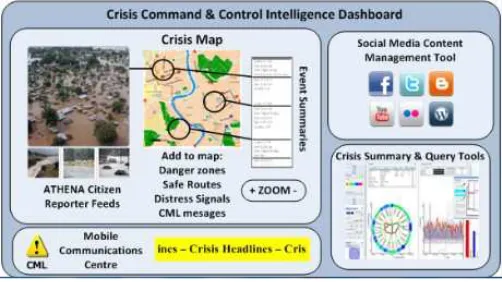
[image:3.612.315.566.55.196.2]The ATHENA Command, Control & Intelligence Dashboard is the main interface of LEAs and the police to the ATHENA system. Figure 1 shows the main elements of the CCCID.
Fig. 1 CCCID elements (Andrews et al., 2013) The CCCID elements are the following:
•Crisis Map: This is a crowd-sourcing information-based crisis map. Crisis information combined with geospatial and temporal information are used to display crisis event information, danger zones, and safe routes. A symbology is used to visualize the degree of credibility of crisis-generated information, the severity of crisis events, and the types of events. The crisis information available depends on ethics protocols and the clearance level of the users.
•Mobile Communications Centre: This is a tool to communicate with mobile devices of citizens in order to send them alerts and messages. The messages use a Crisis Management Language and a real-time headline banner. •Social Media Content Management Tool: This tool offers a set of links to dedicated social media pages.
•Crisis Summary and Query Tool: This tool is necessary for the visualization of crisis information, such as casualty statistics and availability of first responder resources.
The Command Control and Intelligence Dashboard is characterized by a number of functionalities, such as the real-time Crisis Monitoring through filtered messages (Photos, Videos, Sound), the provision of a timeline of the crisis progress, the provision of geo-location of crisis incidents, the mapping of Danger Zones, Safe Routes, Distress Signals, and the provision of summaries of crisis events. Furthermore, the CCCID will provide crisis alerts and headlines for community member protection, communication capabilities among the police, LEAs and first responders, communication capabilities even at places which are characterized by lack of Internet and cell connectivity, and statistical analysis of crisis data.
Fig. 2 CCCID interconnection with ATHENA elements According to Figure 2, community members can post live photos, videos or sound using the Crisis Mobile Citizen Reporter 'Point & Shoot' system. The posted messages are transferred to the ATHENA CIPC Citizen Report Streaming/Recording Centre. The messages are then stored in the ATHENA Cloud and if geo-located, displayed on the ATHENA CCCID Crisis Map and/or at the ATHENA CCCID Crisis Summary and Query Tools. When the community members use the Crisis Mobile Sending Tools Taxonomised/CML Crisis Information Tool, they can send text-based messages using a crisis taxonomy and/or Crisis Management Language (CML) selection/menu system. These messages are also transferred to the ATHENA CIPC and since being text messages, they will be filtered using Natural-Language Processing. The filtered messages are then analysed by the ATHENA CIPC Aggregation & Analysis Tools for credibility scoring and sentiment analysis purposes. After the filtering, the messages are stored in the ATHENA Cloud. The messages are then displayed in the ATHENA CCCID Mobile Communications Centre. The police and LEAs can use the CML button to send messages to the Crisis Mobile Receiving Tools Crisis Alerts. Furthermore, they can use the Crisis Headline Tool in order to populate and manage the Crisis Headlines Display.
Service-oriented Design principles were used in the development of the architecture of CCCID. SOA is a very efficient way for the design and development of distributed
systems. Service-oriented solutions include reusable services with well-defined, published interfaces. The development of an architecture based on services for the CCCID components clarifies the role of each component, how this role affects the other components of the ATHENA system and how it is affected by the roles of the other ATHENA components. The service-oriented design of the CCCID functionalities clarifies the interfaces between the ATHENA components as distinctive elements of the system. The developer of the ATHENA system can provide full maintenance of the ATHE- NA system by intervening directly to the interfaces when this is required. The developer can also re-use the same interfaces in different scenarios and can even modify the architecture of the system by adding or extracting interfaces and thereby adjusting the whole system to the requirements of a specific scenario.
V. CCCID Service-Oriented Architecture (SOA) Design The stages on which the SOA-based design of the CCCID was based were the following:
•Business Process Modelling
A business process is the combination of a set of activities within an enterprise with a structure that shows the logical structure of these activities. An enterprise can be analysed and integrated through its business processes. A process model can provide a common understanding of a process. Business Process Modelling enables a common understanding and analysis of a business process [6].
•Business Architecture Modelling (BAM)
Business Architecture Modelling (BAM) identifies the business perspectives of a Service-Oriented Architecture, captures its business requirements and specifies the business community and its services. The steps of BAM include the specification of the participants in a specific service, the services architectures and the service contracts which represent the collaborations/transactions between the different participants [7].
•System Architecture Modelling (SAM)
System Architecture Modelling (SAM) represents the IT perspective of a SOA. It partitions the system into software components and interfaces. SAM is based on structural and behavioural modelling. Structural modelling specifies system components, their interfaces and their dependencies. Behavioural modelling specifies component interactions and protocols.
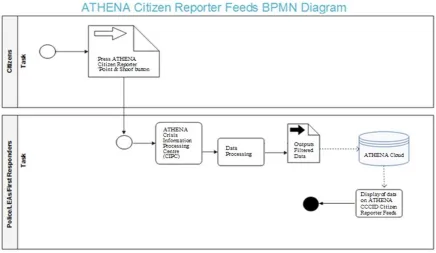
process of displaying citizen reporter feeds on the CCCID and it is part of the CCCID Business Process Modelling.
Fig. 3 Citizen Reporter Feeds BPM In the Business Architecture Modelling (BAM) stage,
the service contracts must be specified. The service contracts specify how a user of the ATHENA system interacts with the other users through a specific service.
Fig.4 ATHENA Citizen Reporter 'Point & Shoot' system Button Service Contract
The user of the ATHENA system uses the ATHENA 'Point & Shoot' button in his/her mobile device in order to capture a photo, video or sound. The captured file will be displayed on the CCCID. This button is the SOA interface which initiates the service contract entitled "ATHENA Citizen Reporter 'Point & Shoot' system Button". This service contract initiates the service entitled 'ATHENA CCCID Citizen Reporter Feeds' which is shown in Figure 6.
The interface between the 'Citizens' and the ATHENA 'Point & Shoot' System is specified in Table 1.
[image:5.612.46.303.432.566.2]Fig. 5 ATHENA Citizen Reporter Feeds Service Contract The interface between Police/LEAs and the ATHENA Citizen Reporter Feeds is specified in Table 2.
Table 2 Police/LEAs interface to ATHENA Citizen Reporter Feeds
The architecture of the service that describes the 'ATHENA CCCID Citizen Reporter Feeds' element of the CCCID includes the two service contracts and the communication mechanism between the two service contracts.
Fig. 6 CCCID ATHENA Citizen Reporter Feeds Service VI. Specialized Functionalities related to the CCCID
This section presents current work-in-progress on several functionalities of CCCID. Examples are listed below:
•Geo-tweeting: This functionality is related to the display of filtered real-time Twitter messages on a crisis incidents map. Specifically, a Google map is used in order to display a specific area of a city where crisis incidents have been caused. The map includes a number of markers which correspond to the locations of users. These users provide updates for the crisis incidents through social media, such as Twitter. By clicking on one of those markers, the respective tweet appears.
•Display of scanned and filtered crisis-dedicated Social Media information: The use of the CIPC tools allows the near real-time acquisition of voice and video messages from crisis-dedicated social media. The filtering of the collected information is based on the use of crisis taxonomies and Twitter hash-tags. Data analysis and aggregation will be realized through the use of text mining and clustering techniques, such as data fusion, Formal Concept Analysis (FCA), and rule-based inference. Formal Concept Analysis (FCA) is an emerging data analysis technology with growing popularity across various domains. FCA analyzes data that describe the relationship between a set of objects and a set of attributes. It produces two types of outputs. The first type is a concept lattice. This is a collection of formal concepts that are hierarchically ordered by a subconcept-superconcept relation. The second output is a collection of attribute implications [8]. FCA has many applications in biological sciences, music, linguistics, data mining and semantic searching [9]. InClose2 is a characteristic FCA algorithm [10].
Fig. 7 Example of Geo-tweeting
[image:6.612.315.579.398.612.2] [image:6.612.46.296.457.632.2]•Display of Live Crisis Updates: The CCCID provides updates from crisis incidents in the form of a timeline and crisis event summaries or using videos from the places of the crisis incidents.
•Connection to advanced processing capabilities: The CCCID is connected to the Crisis Information Processing Centre (CIPC). CIPC provides a set of acquisition and pre-processing tools as well as aggregation and analysis tools. The acquisition and pre-processing tools include a social media scanner, a citizen report streaming/recording centre, a speech recognition system, a filter system and a crisis taxonomy system. The aggregation and analysis tools include a classification/clearance system, a FCA summarizing system, a data fusion system, a credibility scoring system and a sentiment analysis tool. The social media scanner uses crisis taxonomies and crisis hash-tags in order to detect and collect crisis information. The citizen report streaming/recording centre receives streamed photos, videos or sound messages from the mobile devices of citizens and either directs them as
feeds to the CrisisMap or records them for pre-processing if there is not available bandwidth for streaming. The aggregation and analysis tools also include a speech recognition system for the transformation of voice messages to text, a Natural-Language Processing-based filer system and image recognition software, and a crisis taxonomy system in order to acquire and recognize crisis messages.
VII. CONCLUSIONS
The use of an automated system for search and rescue operations during crisis incidents is of critical importance for their management. CCCID is a front-end graphical user interface which is connected to a set of advanced tools that allow the smart filtering of information and the extraction of useful conclusions in relation to crises. The dashboard will help in the more efficient distribution of tasks for the first responders and it will allow better cooperation of the different services. The design of the CCCID is based on Service-oriented Architecture (SOA) principles. The use of Service-oriented Design allows modularisation of the ATHENA system. As a result, the system is characterised by transparency for both the users and the developers. This provides easy intervention of the developer to the system and better comprehension of the functionalities of the system by the users. Furthermore, the use of SOA approaches enables re-usability of the system and provides the clarification of the data workflows among the different ATHENA components.
ACKNOWLEDGMENT
The presented work is funded by the European Union Athena Project under EC grant number ATHENA 31322 (European Union Seventh Framework Programme SEC Call 1 - FP7-SEC-2012.6.1-30).
[1] K. Rinkineva, “The Role of Information Technology in Crisis Management”, The 14th European Information Network on International Relations and Area Studies (EINIRAS) Conference, 30 September - 1 October 2004, Helsinki, Finland.
[2] Reich, J. and E. Sklar, “Robot-sensor networks for search and rescue”, Proceedings of the IEEE Int'l Workshop on Safety, Security and Rescue Robotics, 2006.
[3] R.I. da Silva, V. Del Duca Almeida, A.M. Poersch and J.M.S. Nogueira, “Wireless sensor network for disaster management”, 2010 IEEE Network Operations and Management Symposium (NOMS), April, 19-23, 2010, Osaka, Japan, pp. 870-873.
[4] A.-M. Barthe-Delanoë, F. Bénaben, S. Carbonnel and H. Pingaud, “Event-Driven Agility of Crisis Management
Collaborative Processes”, Proceedings of the 9th International ISCRAM Conference –Vancouver, Canada, L. Rothkrantz, J. Ristvej and Z. Franco, eds., April 2012.
[5] V. Vescoukis, N. Doulamis and S. Karagiorgou, “A service oriented architecture for decision support systems in environmental crisis management”, Future Generation Computer Systems, vol. 28, no. 3, pp. 593-604, doi:10.1016/j.future.2011.03.010.
[6] R.A. Aguilar-Savén, “Business process modelling: Review and framework”, International Journal of Production Economics, vol. 90, no. 2, pp. 129-149
[7] B. Elvesæter, “Service Modelling with SoaML”, tutorial at the SSAIE 2010 Summer School, Heraklion, Crete, Greece, 2 July 2010. [Available at:
http://heim.ifi.uio.no/briane/presentations/ be_ssaie_2010_soaml_presentation.pdf].
[8] R. Belohlavek, “Introduction to Formal Concept Analysis”, Technical Report, Palacky University, Olomouc, 2008. Available at: http://phoenix.inf.upol.cz/esf/ucebni/formal.pdf [Accessed: June 20, 2014].
[9] S. Andrews, “Aligning the Topic of FCA with Existing Module Learning Outcomes”, Proceedings of the
International Workshop CS-LTA 2010 The First Conceptual Structures – Learning, Teaching and Assessment Workshop, 26 July 2010, Kuching, Malaysia.