Doctors' perspective on obstetric ultrasound: concept,
knowledge and practice
EDWARDS, Julie
Available from Sheffield Hallam University Research Archive (SHURA) at:
http://shura.shu.ac.uk/17101/
This document is the author deposited version. You are advised to consult the publisher's version if you wish to cite from it.
Published version
EDWARDS, Julie (2012). Doctors' perspective on obstetric ultrasound: concept, knowledge and practice. Doctoral, Sheffield Hallam University.
Copyright and re-use policy
See http://shura.shu.ac.uk/information.html
; Sheffield Hallam University
Learning and IT Services
! Collegiate Learning Centre
jCollegiate Crescent Campus
Sheffield S10 2BP
10 2 083 19 2 8
“ I \ C1
Doctors’ Perspective on Obstetric
Ultrasound: Concept, Knowledge and Practice.
Julie Edwards
A project report submitted in partial fulfilment of the
requirements of Sheffield Hallam University for the
degree of Doctor of Professional studies.
Acknowledgements
There are special people that I must acknowledge due to their importance in my work. I wish to thank the staff and fellow students involved in the Professional Doctorate Programme for all their support and friendship. In particular I wish to thank Dr Christine Ferris, Dr Hora Soltani and not least Professor Mavis Kirkham for the sound advice they have provided throughout the write up.
I wish to thank Dr David McCallam for his advice when writing on the ideas of Foucault and my gratitude is also offered to Dr Patricia Foster, who has provided a great support especially toward the end, offering a huge amount of encouragement that enabled me to complete the work.
I wish to thank the doctors for volunteering their time and speaking honestly and openly when interviewed and in particular, my thanks go to Mr Stanley Whittaker for his support behind the scenes.
I am deeply indebted to several others who I can collectively call my family. First, my heartfelt thanks and gratitude must go to my husband Richard, who has provided on going support and humour when it has been needed most. I fear that I may have driven him to golf. For his technical support, I am most truly grateful.
Secondly, I would like to thank the two mums in my family, Rosemary, who has devoted her time proof reading and providing a useful perspective on my writing and not least, Violet, who has had to put up with losing the time we usually share together. It will feel good to return to gardening together again.
Abstract
Problems arise when women attend for obstetric ultrasound scans, not always fully aware of the purpose of the examinations they have chosen to opt for and sometimes experience
anxiety, as their expectations are not met. This study has explored, through in- depth interviews and ‘framework’ analysis, whether doctors are actively engaged in unbiased information- sharing with pregnant women during their consultations. Through exploration of the literature on women’s and health professionals’ perspective on the use of obstetric ultrasound, a gap is seen in the knowledge regarding the medical perspective on ultrasound use in pregnancy. Results of this study revealed three themes relating to the doctor’s experiences of offering obstetric ultrasound: doctors’ knowledge and understanding, their views on the practice of obstetric ultrasound use and their ideas on the concept of ultrasound. These themes been considered alongside the writings on power/knowledge, govemmentality and self-surveillance through risk theory, by the philosopher Michel Foucault (1926-84), as his ideas have been central to this research question. The conclusion reached is that, although making changes to doctors’ in house training may increase their knowledge of obstetric ultrasound, it may still be the case that their professional position within society will still create a barrier to women making informed decisions when requiring to consider opting for ultrasound scans during their
Contents
Introduction Page No. 7 Glossary 9List of Figures and Tables 13
Chapter One-Background to the research
14Introduction 14
1.1 Underlying motivation for the study-‘an encounter’ 15
1.1.1
Ultrasound imaging in maternity care 171.1.2
Avoiding conflict 181.1.3
Information-sharing about fetal anomaly screening 191.2
The role of health professionals in supporting women in 221.2.1
decision-making
Opportunities for dialogue within the antenatal care pathway 23
1.2.2
Fetal anomaly screening (The 20-week scan) 261.3 Maternal perspective on obstetric ultrasound 28
1.3.1
Medicalization of pregnancy 301.4 Opportunities for information sharing via the hospital antenatal 32
1.4.1
care pathways
Opting for prenatal tests 34
1.4.2
Defining the research question 36Conclusion 37
Summary of Chapter One- Background to the study 39
Chapter Two- Literature Review
40Introduction 40
2.1
Conducting the literature review 402.1.1
Selecting the keywords 412.1.2
Critiquing the literature 422.1.3
Additional parameters 432.2
What women expect from ultrasound imaging in obstetrics 442.1
Psychological aspects of obstetric ultrasound 452.1.2
Obtaining reassurance in pregnancy 482.3.1 The views of midwives on obstetric ultrasound 51 2.3.2 Position of ultrasound practitioners (sonographers) 54 2.3.3 The task of offering fetal anomaly screening to women 55
2.3.4 Styles of communication 58
2.3.5 ‘Informed choice’ 59
2.4 The development of obstetric ultrasound 60 2.4.1 Demand for obstetric and gynaecology services in England and
Wales
61
2.4.2 The use of ultrasound as a screening tool 63
Conclusion 64
Summary of Chapter Two- Literature review 65
Chapter Three-Methodology
66Introduction 66
3.1 Choice of research method 66
3.1.1
How best to answer the research question 663.1.2
Structuring of the method 673.1.3
Choosing a research strategy 703.2 ‘Applied framework’ strategy 71
3.2.1
‘Applied framework’ analysis 713.2.2
Technique of data generation 723.3 Generating the data 74
3.3.1
Study setting 743.3.2
Participants 743.3.3
Sample size and selection criteria 753.3.4
Interviews 773.3.5
Verification technique 793.4 Data analysis 79
3.4.1
Issues from the literature 803.4.2
Managing the data 823.5 Rigour and trustworthiness 84
3.5.1
Researcher involvement 873.5.2
Audit trail 883.5.3
Finding a way through the method 883.6 Ethical issues 90
3.6.1
Seeking approval 903.6.2
Ethical issues pertinent to this study 91Conclusion
Summary of Chapter Three-Methodology
94 95 4.1 4.2
4.2.1
4.2.2
4.2.3
4.34.3.1
4.3.2
4.3.3
4.3.4
4.3.5
4.44.4.1
4.4.2
4.4.3
4.54.5.1
4.5.2
4.5.3
4.5.4
4.6 4.6.1Chapter Four- Results
96Introduction 96
Initial results-five topics 97
Doctors’ experience of discussing ultrasound in early 99 pregnancy assessment (Topic 1)
Doctors’ knowledge from clinical care pathways 99
Negative feelings working in early pregnancy assessment 100
Doctors’ views on what is driving demand for ultrasound 101 scanning
Doctors’ perspective on fetal ultrasound screening (Topic 2) 104
Other professionals’ role in offering fetal anomaly screening 104
Doctors’ knowledge of fetal anomaly screening 106
Doctors’ thoughts on women’s expectations of anomaly 107 screening
‘Informed choice’ 107
Women’s expectation of doctors’ knowledge 109
What doctors want from obstetric ultrasound imaging? (Topic 111
3)
When doctors feel reliant on obstetric ultrasound 111
Women’s reliance on obstetric ultrasound 112 Doctors feel a duty to reassure women 113
Doctors’ perspective on what women expect from obstetric 113 ultrasound imaging (Topic 4)
Women’s satisfaction 113
Doctors’ thoughts on women’s and the communities 114 perception of ultrasound availability
Doctors’ thoughts on women’s knowledge of the fetal anomaly 115 screening (20 week scan)
Doctors’ thoughts on fetal ‘sexing’ 116
Doctors’ personal and professional experience of obstetric 117 ultrasound (Topic 5)
4.6.2
Doctors’ thoughts on in house training 1184.6.3
Support for junior doctors 1204.6.4
Doctors’ experience of discussing ultrasound imaging with 121 women4.6.5
Doctors’ own personal experiences of obstetric ultrasound 1234.7
Three emergent themes 125Conclusion 126
Summary of Chapter Four- The Results 127
Chapter Five-Discussion on the three themes
128Introduction 128
5.1
Doctors’ knowledge and understanding of obstetric ultrasound 133 (first theme from the data analysis)5.1.1
The title ‘Doctor’ 1365.1
.2
How knowledgeable are junior doctors about obstetric 138 ultrasound imaging?5.1.3
A gap in doctors’ knowledge 1405.2 Doctors’ views on the practice of obstetric ultrasound imaging 142 (second theme from the data analysis)
5.2.1
Clinical governance and the development of ‘Pathways of 144 Care’5.2.2 Working within a ‘care pathway’ framework 146
5.2.3
The idea o f ‘risk’ 1505.3 Doctors’ ideas on the concept of ultrasound imaging (third 153 theme from the data analysis)
5.3.1
Reassurance through the act of ‘seeing’ 157Conclusion 159
Summary of Chapter Five- Discussion on the three themes 160
Chapter Six-Changing Working Practice
161Introduction 161
6.1 Voluntary influence-What doctors say and how they say it 161 6.1.1 How professionals offer information on ultrasound scanning 163 6.1.2 How professionals might support women in making ‘informed 164
choices’
6.1.3 How professionals might communicate 168
6.2.1
The professionals’ role in counselling 1746.3
Answering the research question 1756.3.1
Developing doctors’ knowledge may not be enough 1766.4
Recommended changes to professional practice 177Conclusion 182
Summary of Chapter Six-Changing working practice 184
Chapter Seven-Summary of the Doctoral Project
185Introduction 185
7.1
Background to the research 1857.2
Review of the literature 1867.3
Research method and analysis undertaken 1877.4
Results of the study 1887.5
Discussion and conclusions drawn from undertaking this doctoral project189
7.6
Outcome from undertaking the study 1927.7
Study limitations 1927.7.1
Accuracy of the study 1927.7.2
Benefits from performing the doctoral project 1947.7.3
Future research 1957.7.4
Dissemination 195Chapter Eight-Reflexivity
197Introduction 197
8.1
Past professional experience 1988.1.1
Radiographer to ultrasound practitioner 2008.2
Clarkson’s four stages of learning 2018.3
Who am I? 2038.3.1
A Woman/ Mother 2038.3.2
The Professional-competence 2048.3.3
The Learner-continuing professional developer 2058.3.4
The Researcher 2068.4
Developing reflexivity 2071 2
3
4
5
67
89
10a 10b 11 1213
14
15
16
17
18
19
20 21 210 237 238 239 240 241 241 243 244 246 260 262 274 277 323 324 344 347 348 351 355 358 361 366 References AppendicesKolb’s Experiential Learning Cycle
NHS FASP standards for obtaining consent NHS FASP timeline for screening in pregnancy UK NSC FASP Detection rates for fetal anomalies The researcher’s reflective piece on the response to the concrete experience (encounter)
Examples of searches with keywords initially performed (1995-
2002)
Articles critiqued using Greenhalgh’s check list (2006) Table of papers taken from Garcia et al. (2002) systematic review
Search strategy for the literature review The analytical framework
‘Familiarisation’ process- notes from interviews 11 and 12 Charts from the five initial topics of discussion
Table of participants interviewed Transcripts 11-18
Table showing dynamics between the concepts of doctors’ knowledge and the value they place on ultrasound use Copy of the participants’ consent form
Copy of the participants’ information sheet
Results of the five initial topics summarised, colour coded Examples of charting showing a) the variation in what and how much knowledge doctors have of obstetric ultrasound and b) the differing levels of training.
Transcript of ‘Member checking’ interview-19
Excerpt from the Induction handbook (resource pack) for doctors
Introduction
This report set out to identify whether doctors are actively engaged in unbiased
information sharing, of obstetric ultrasound use, with pregnant women. Using ‘framework
analysis’ to explore the medical perspective, it has emerged that not all doctors discuss
ultrasound use during their consultations. Philosophical background, a lack of knowledge
about ultrasound’s limitations and constraints from care pathways all play a role in why
this may be the case. Through exploration in Chapter Two, of the existing literature on
women’s and health professionals’ perspective on the use of obstetric ultrasound, it was
revealed that there is a gap in the knowledge regarding the medical perspective on
ultrasound use in pregnancy. Through in depth interviewing and ‘framework analysis
described in Chapters Three and Four, three themes: doctors’ knowledge and
understanding, their views on the practice of obstetric ultrasound use and their ideas on
the concept of ultrasound use, emerged and in Chapter Five, these themes have been
considered alongside the writings of the philosopher Michel Foucault (1926-84), as his
ideas have been central to this research question. Chapter Six concludes that although
implementing changes to working practice might increase junior doctors’ knowledge of
obstetric ultrasound, it may be that their professional position and stance within society
may still provide a barrier to women making informed decisions when requiring to
This study was undertaken in a district general hospital that provides antenatal services
for women residing in a town in the north of England. At the time of conducting this
research the author was employed at this hospital as an ultrasound practitioner,
providing ultrasound obstetrics and gynaecology ultrasound services.
Within this writing, research undertaken to formulate this doctoral project report will be
referred to as the current study in order to protect the confidentiality of the organisation
and research participants and to distinguish the research from references made to other
already published studies in the literature. Clarifications of alternative terminology and
Glossary
Experiential learning theory (ELT) describes learning as a process whereby knowledge
is created through the transformation of experience. Knowledge results from the
combination of grasping and transforming experience (Kolb, 1984, p 41).
Fetal anomaly screening test (20 week scan) is an obstetric ultrasound examination,
offered between 18 and 20 weeks and 6 days of pregnancy, to survey’ the fetal and
placental anatomy. Several terms are used for ultrasound fetal anomaly screening: mid
pregnancy fetal anomaly scan, 20-week scan, and the second-trimester scan.
This project will refer to the fetal anomaly scan as the 20-week scan.
Good Medical Practice sets out the principles and values on which good practice is
founded; these principles together describe medical professionalism in action.
Green-top guidelines are concise documents, providing specific practice
recommendations on focused areas of clinical practice. These guidelines are produced
under the direction of the Guidelines and Audit Committee of the RCOG (2007).
MIDIRS (midwives information resource services) that supplies vital education and
practice development resources to assist midwives and student midwives in their
practice and studies. Available to both health professionals and prospective parents on
National Institute for Health and Clinical Excellence (NICE) to help those working in
the NHS, local authorities and the wider community deliver high-quality healthcare. It
develops evidence- based guidelines on the most effective ways to diagnose, treat and
prevent disease and ill health. Patient friendly versions of the guidelines can help
educate and empower patients, carers and the public to take an active role in managing
their conditions.
National Pathways Association (NPA), established in 1996, supports the development
of care pathways and covers England, Wales and Northern Ireland. It provides a
knowledgeable resource with expertise on the implementation, development, education
and strategic development of care pathways.
NHS Cancer Plan (2000), built on existing cancer initiatives, to provide a comprehensive
strategy to tackle cancer across the whole patient pathway. It established 34 cancer
networks in England, to lead the improvement of cancer services in each locality.
NHS Fetal Anomaly Screening Programme (NHS FASP) The Programme Centre in
Exeter is responsible for both the NHS Fetal Anomaly Ultrasound Screening Programme
and the Down's syndrome Screening Programme. The NHS National Fetal Anomaly
Screening Programme is part of the overall structure of the UK National Screening
Programme’s Directorate of the NHS. The remit and aim of the programme is to set
standards and oversee the implementation of a screening programme, which conforms
to an agreed level of quality for all pregnant women in England. The screen is for certain
chromosomal and structural abnormalities in their unborn babies. This includes the offer
NHS Plan outlines the vision of a health service designed around the patient: a new
delivery system for the NHS as well as changes between health and social services,
changes for NHS doctors, for nurses, midwives, therapists and other NHS staff, for
patients and in the relationship between the NHS and the private sector.
NT screening, where the measurement of the Nuchal Translucency (NT) is used as one
of the factors to calculate a women’s level of risk for carrying a fetus with Down’s
syndrome. The measurement is taken during an ultrasound scan (between 11 weeks
plus 2 days and 14 weeks plus 1 day gestation)
Nuchal Translucency (NT) refers to the subcutaneous space between the skin and the
cervical spine of the fetus and an increased NT is associated with an increased risk of
aneuploidy, (fewer or more chromosomes than usual) particularly trisomy 21 (Down’s
syndrome). An increased NT is also said to identify a high proportion of other
chromosomal abnormalities and is associated with major cardiac abnormalities and a
wide range of skeletal dysplasias (unusual growth of a part of the body, including the
total absence of such a part) and genetic syndromes.
RADIUS (Routine Antenatal Diagnostic Imaging Ultrasound Study)--was a large
randomised clinical trial to assess the effectiveness of routine ultrasound screening for
women who are at low risk for poor pregnancy outcomes. The principal investigators
designed the study in response to a recommendation by the 1984 NIH Consensus
Development Conference on Diagnostic Ultrasound Imaging in Pregnancy for studies "to
and mortality." The preliminary results of RADIUS have been reported in the American
Journal of Obstetrics and Gynecology and in the New England Journal of Medicine in
September 1993.
UK National Screening Committee (UK NSC) is recognised as the source of expert
advice on screening, advising ministers and the NHS in all four UK countries. Its advice
is based on latest research evidence and is informed by multidisciplinary groups
including patient representatives.
Ultrasound Practitioner (sonographer)
A non-medically qualified professional, performing, interpreting and reporting on
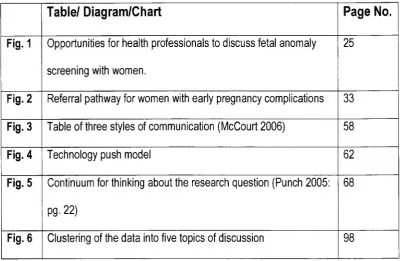
List of Figures and Tables
Table/ Diagram/Chart
Page No.
Fig. 1 Opportunities for health professionals to discuss fetal anomaly screening with women.
25
Fig. 2 Referral pathway for women with early pregnancy complications 33
Fig. 3 Table of three styles of communication (McCourt 2006) 58
Fig. 4 Technology push model 62
Fig. 5 Continuum for thinking about the research question (Punch 2005: P9- 22)
68
[image:18.559.80.485.122.383.2]Chapter One: Background to the research
Introduction
The chapter opens with a description of ‘an encounter’ between an ultrasound
practitioner and a woman and her partner attending for an obstetric scan (a fetal anomaly
scan, commonly referred to as the 20 week scan) and where a difference in
understanding as to the purpose of the examination between the ultrasound practitioner
and the prospective parents occurred. It was the need to reduce any future occurrence of
conflict (a difference in understanding) that arose from this situation that has provided the
underlying motivation for this research project.
Ultrasound practitioners are faced with the problem that some women attend for obstetric
ultrasound scans having little understanding of the purpose for which they are offered.
This difference in understanding (conflict) can create levels of anxiety and distress to the
women and their partners. The second section of the chapter describes the practice of
incorporating ultrasound imaging in routine antenatal care and focuses on the issue of
how women are provided with information in order to make informed decisions about
whether to opt for ultrasound screening during their pregnancy. It explores the role of the
health professionals in supporting women in the act of decision-making and considers
the opportunities health professionals have, within the antenatal care pathways, for
information sharing about the capabilities and limitations of ultrasound imaging. The third
section, reviews the existing literature on women’s perspective on obstetric ultrasound
use in relation to the described workplace problem, as depicted earlier, through the
passage recalling the ‘encounter’ (p. 15). This literature review has helped to define the
research problem. The chapter concludes by considering the need to look at how health
published data on the doctors’ feelings and experiences of offering ultrasound imaging to
pregnant women, demonstrating the need for research into whether women are
supported by doctors when making decisions surrounding opting for fetal ultrasound
scanning. The focus of this study has been to explore the medical perspective on
obstetric ultrasound use and to determine whether doctors are active agents in providing
women with unbiased information about routine ultrasound imaging. The aim of the study
is to consider what changes may be made to current working practice within the hospital
undertaking the study and whether these changes may help women feel better prepared
for the antenatal ultrasound scans for which they opt.
1.1 Underlying motivation for the study- ‘an encounter’
The continuation in the drive for improvements to antenatal service delivery together with
personal reflections of an encounter with a woman at the end of my ultrasound training
has provided the underlying motivation for this study.
It was over ten years ago that I was faced with a scenario that still re-occurs today, of the
dilemma of women consenting to fetal ultrasound screening without appearing to
understand the purpose of the examinations for which they have opted.
An encounter:
Like all sessions it was busy; women had been seen and many were still waiting
to be scanned. Thinking back, they were all just a number. As we checked on
the list to see whether we were keeping ahead of schedule, we considered
whether there was time for me to scan the next woman. I was still in my training
typical day in the department when the couple entered the scan room, my scan
room, where I felt reasonably confident as a professional providing an ultrasound
service. Before starting a scan, it is routine to confirm the woman’s details, check
that she understands what the examination is about and ask if she has any
questions prior to performing the examination. It was at this moment that the
unexpected happened! The woman stated that she wanted to have this 20- week
scan, but after being informed that the purpose of performing the scan was to
screen for fetal abnormalities, declared that she did not want me to look for any
abnormalities in her baby. The woman was asking to just look at the baby! I was
taken aback at this request and asked her if she understood the purpose of the
scan and that it was purely a screening test to look for structural abnormalities of
the fetus that women are invited to accept. From the response, it appeared that
both the woman and her partner clearly misunderstood the purpose of being
offered the scan. When I tried to explain that I was unable to just “look” at her
baby without possibly identifying a problem or a concern, the lady became
distressed and angry that I was denying her the right to “see” her baby.
This scenario is what Kolb (1984) described as a ‘concrete incident’ in his Cycle of
learning, a process whereby knowledge is created through the transformation of
experience. A full explanation of Kolb’s cycle of learning is given in appendix 1 (p 238)
Over a decade later ultrasound practitioners working in an ultrasound department serving
a hospital in the north of England, are still faced with similar incidents, where some
women do not seem fully aware of the purpose and limitations of the scans for which
1.1.1 Ultrasound imaging in maternity care
In pregnancy a healthy woman will be offered routinely, two ultrasound examinations
(NICE, 2008). As seen on the antenatal timeline (appendix 2, p 239) depicting routine
screening tests offered in pregnancy, the first examination, the Dating scan, is to
establish the gestation of the pregnancy, whether it is a singleton or multiple pregnancy
and establishes the expected delivery date. During this scan, women are able to opt for
Down’s syndrome screening where, during the dating scan, measurements of the nuchal
translucency are taken. The second ultrasound scan offered occurs between 18 and 20
weeks plus 6 days of pregnancy, commonly referred to as the 20- week scan and is
offered to all women to look for abnormalities of the fetus. The decision to undergo an
antenatal ultrasound scan is up to the individual. The duty of health care professionals is
to provide pregnant women with adequate information to make an informed choice. The
NHS Fetal Anomaly Screening Programme (NHS FASP) has set auditable standards
(appendix 2, p 239) regarding seeking consent to screen for abnormalities and make it
clear that women should have more than one opportunity to discuss the idea of fetal
anomaly screening before attending for the scan. Preparation for the screening starts at
the point of ‘first contact’ and should be revisited at subsequent appointments with the
midwife or doctors in clinic. Throughout antenatal care health professionals fulfill different
roles in supporting women in pregnancy and information regarding ultrasound screening
is passed on to prospective parents, both verbally and via leaflets at different times by
health professionals. The timeline for screening tests depicts the number and timings of
screening tests available to women along the routine antenatal care pathway. In the early
stages of pregnancy, before women attend for their first hospital antenatal appointment,
a community midwife sees them. During this ‘booking’ visit, often undertaken at the
related topics. Women are provided with information about the ultrasound screening
tests in “The pregnancy book” (Department of Health, 2009) and they can access other
relevant resources such as, NHS FASP publications and the Midwives Information and
Resource Service (MIDIRS) information leaflets.
1.1.2 Avoiding ‘conflict’
Before any ultrasound examination can be performed, the ultrasound practitioner must
be assured that the woman is sufficiently informed about the fetal anomaly scan (as
stated in the NHS FASP consent standards, appendix 2, p 239) Women sometimes
describe unrealistic expectations of the ultrasound scan. Dealing with both formal and
informal complaints regarding the issue of women’s dissatisfaction can cause
prospective parents distress, delays in the department’s appointments and potentially
lead to other women becoming distressed by being kept waiting. These factors may
create conflict within the workplace. The key to reducing the possibility of ‘conflict’ in this
situation is the delivery of ‘consistency’ in communication to women prior to them
attending for the scan. Both doctors and midwives have opportunities within the care
pathways to provide women with information about obstetric ultrasound imaging and
much work has been undertaken by NHS FASP, with the midwifery and ultrasound
professions, to support women in their decision making. The area of knowledge that is
missing within the existing literature is the evidence to suggest that the medical
profession is also actively engaged in providing women with support and information
about the application of ultrasound examinations in pregnancy. This study aims to
answer the research question: are doctors actively engaged in unbiased information
An initial search in the literature found that most of the evidence sourced applied to the
midwives feelings on dealing with information sharing and tended to fit with the social
model of care and that the results appeared to highlight a paradox. On the one hand,
many doubted that informed choice could be achieved, whilst on the other hand, many
saw the expansion of prenatal screening as an inevitable and uncontrollable process
(Williams 2002a). Much work has been and is still being undertaken by the midwifery and
the ultrasound professions, through collaboration with the NHS FASP, on improving the
aspects of supporting prospective parents in decision-making. However, exploration of
the antenatal care pathways has shown that, at several points, doctors also have the
opportunity to discuss the role of ultrasound scanning and screening with women, but on
searching the literature, there is limited knowledge available surrounding their feelings in
communicating information about obstetric ultrasound to women. One study by Williams
et al. (2002b) reported that professionals commonly thought that women attended for the
scan for two reasons; to ‘see’ their baby and to confirm that everything was ‘normal’, but
in contrast, professionals recognised that their motives for screening were very different;
it was to check for abnormalities. Williams and colleagues’ data came from both
midwives and obstetricians with some professionals explaining their difficulty in balancing
the need to promote pregnancy as a ‘normal’ time with the delivery of information about
fetal screening for abnormalities.
1.1.3 Information-sharing about fetal anomaly screening
Within the antenatal pathway, the role of offering ultrasound screening by the midwifery
profession has become standard practice. Midwives work closely with the ultrasound
practitioners to provide an effective counselling service under the guidance of the NHS
midwives suggested that, as many other issues are raised during the ‘booking’ visit, they
feel that even if they counselled women appropriately, women may not remember
everything they have been told from the booking appointment. If the midwives in the
study by Smith et al. (2004) feel that women may not remember all that has been
discussed at the midwives visit, then in accordance with the antenatal care pathway, a
further opportunity for dialogue with the health professionals should be possible during
the women’s first antenatal clinic appointment. Guidelines from NHS FASP (appendix 2,
p 239) are clear in that this opportunity should be available to all women in order to help
them make a fully informed decision about whether to opt for fetal ultrasound screening.
Some studies also indicate that the knowledge of some midwives who offer screening is
sometimes inadequate for the purpose of informing prospective parents (Tyzack and
Wallace 2003; Ekelin and Crang-Svalenius 2004). In a more recent study by Skirton and
Barr (2010), both parents and professionals overestimated the ability of the screening
tests to detect a range of abnormalities, including Down’s syndrome and only two-thirds
of the midwives in their study cited Down’s syndrome as one of the conditions that could
be detected using the current screening procedures. Since these studies, back in early
2000, there still seems a similar concern, discussed by Skirton and Barr (2010), that if
not all health professionals are fully conversant with the facts surrounding ultrasound
imaging capabilities or that women require further information about fetal anomaly
screening, then women should have a further opportunity to discuss any issues or
concerns before they attend for the scan. At present, in the department that undertook
this study, the request for the 20- week scan is generated prior to the women attending
the antenatal clinic, and therefore creates the impression of the screening test being not
something that requires the women to choose, but rather that it is a test that they have to
notes and received by the ultrasound department prior to the women attending their first
antenatal clinic appointment, therefore, the ultrasound department receives the request
to generate the screening test appointment before the women have an opportunity to
refer any questions or concerns they may have about choosing to opt into the screening
programme, with a midwife or doctor in the antenatal clinic. The present system, within
this hospital’s care pathway relies upon the ultrasound practitioners asking the women,
when they attend for their dating scan whether they have chosen to opt for fetal anomaly
screening. There is no time set aside to allow women the chance to talk over any
concerns and it is often the case that women have presumed that the fetal anomaly scan
is standard practice and that they have not realised that they have needed to consider
whether to accept or decline the test. It is sometimes the case that when asked, their
expectations of the test are at odds with the realistic purpose of the scan being offered.
This can create, in some instances, distress for the women as the only opportunity for
women to seek further information before choosing fetal anomaly screening is
immediately after the completion of their dating scans and as explained, at this point,
there is little time available for the ultrasound practitioners to explain in any detail without
sometimes causing ‘conflict’ (a difference in understanding) as well as a delay in the
commencement of the next appointment. Within this hospital, ultrasound practitioners are
placed in a difficult position of performing scans to screen for fetal abnormality for women
who sometimes perceive the scan as more of a ‘social experience’ and feel undermined
when challenged with questions from the ultrasound practitioner, who is required to seek
their consent to perform the screening test. This can sometimes lead to a difficult
situation where women’s expectations are not met and have led, on occasion to ‘conflict’.
The problem of women appearing unaware about the limitations of fetal ultrasound
profound values associated with the creation of new life. The point made by Lupton
(1999) that having healthy children is highly valued, and these values may be intensified
as women are having fewer children and are waiting until later in life to become mothers.
As a result, “children have become viewed as a ‘scarce resource’, whose success must
be ensured”(Lupton 1999, p. 67) Thus, any threat to the health of a fetus can create
intense concerns with which parents somehow have to cope. Being informed by the
ultrasound practitioner that the use of ultrasound in identifying problems in pregnancy is
limited can create a great deal of anxiety, especially if the women are not aware of this
prior to attending for the scan. The problem of women attending for examinations
unprepared has also been reported in a document by NHS Quality Improvement
Scotland (NHS QIS 2004). This report supports the view that women do not feel they
have explicitly consented to undergoing screening and do not fully understand the risks
or the purpose of the tests. It highlights the need for more research on the issue of how
to improve the sharing of information in hope that women may feel better informed when
they attend for their scans.
1.2 The role of health professionals in supporting women in
decision- making
In the management of pregnancy, health professionals owe a duty of care to an
expectant mother and her developing fetus. Apart from ensuring the physical and
psychological wellbeing of the mother, they have to protect the fetus. Based on the
principles of beneficence and non-maleficence, it is not ethically justifiable for health
professionals to perform ultrasound on expectant mothers without medical indications
(BMUS 2009). Another duty of health professionals involved in obstetric ultrasound is to
consist of three elements: threshold, including competence and voluntariness;
information, including disclosure, recommendation and understanding; and consent,
including decision and authorization (Beauchamp and Childress 2001). In accordance
with the principle of respect for autonomy, health professionals have a positive obligation
to disclose information, to probe for and ensure understanding and voluntariness of the
women, and to foster adequate decision- making. The core set of information should
include those facts or descriptions that mothers usually consider to be material in
deciding whether to refuse or consent to ultrasound, information the professional
believes to be material, and the professional’s recommendation. They must educate
expectant mothers on the use and safety of ultrasound, so that they can realistically
modify their expectations and perceptions. An example of the information that should be
relayed to women includes information on the limitations of ultrasound screening for fetal
anomalies. The recent expected detection rates for fetal abnormalities during the fetal
anomaly scan, given by NHS FASP (2008) are shown in the appendix 4, p. 241. The fact
that only 50% of major cardiac abnormalities are identified during fetal ultrasound
screening is an example of the type of information women should be made aware of, but
it is possible that other health professionals, such as some doctors working within the
antenatal setting, may not be aware of these facts.
1.2.1 Opportunities for dialogue within the antenatal care pathway
Women accessing antenatal care are visited by a community midwife early in their
pregnancy and are given information about various aspects of antenatal care, including
information about obstetric ultrasound scanning. An appointment is made to attend for
an ultrasound scan to date the pregnancy by measuring the fetal size to establish the
expected date of delivery (EDD). This usually occurs around 12 weeks of pregnancy. At
Down’s screening programme and are also asked for their decision as to whether they
wish to opt for the 20-week scan. After the establishment of the EDD by the ultrasound
scan, women are seen in the antenatal clinic to discuss various aspects of their care in
their pregnancy. Between 18 and 20 weeks plus 6 days of pregnancy, women who have
opted for fetal anomaly screening (20 week scan) will attend for an ultrasound
examination (scan) to screen for fetal abnormalities. It is often at this point in the care
pathway when some women seem unprepared for the examination that they have
consented to and where conflicts arise. In the hospital’s antenatal care pathway, where
the study was undertaken, there are three opportunities for health professionals to
communicate information about ultrasound imaging, with regard to fetal ultrasound
screening (Figure 1 p 25), shows diagrammatically ‘when’ and which health professional
may be involved.
(In figure 1. the term low risk refers to a pregnancy that is anticipated to be
problem free. This assessment is based on a woman’s past medical,
gynaecological and obstetric history and any other relevant issues as the
pregnancy continues. A high- risk pregnancy refers to a pregnancy that is
thought from the outset to be more at risk of complications before, at or after
the delivery. A woman deemed to be low risk could be cared for by
midwives and family doctors. However, high-risk pregnancies may require
consultant care with regular visits to the hospital. An initially low risk
At some point in the pathway, women will find themselves in consultation with a midwife,
an ultrasound practitioner and/or a doctor and in order to establish whether doctors are
engaged in information sharing, this study aims to explore their experiences of offering
obstetric ultrasound to women. At a seminar in the early 1980s, someone asked a
popular obstetrician and professor at Georgetown University, "What are the three most
significant technological advances in obstetric and gynaecology in the last 30 years?"
The answer came quickly from Dr. John T. Queenan: "Ultrasound, ultrasound, and
ultrasound." By then- and since then even more -this diagnostic modality has
transformed the practice of obstetrics and gynaecology, not to mention its effect on other
specialties (Abramowicz 2010).
1.2.2 Fetal anomaly screening (20-week scan)
The screening emphasis has increased in recent years, so that it takes considerable time
and attention if tackled with any regard to informed choice (Pilnick 2004). The Maternity
and Newborn clinical pathway group recommended that the quality and consistency of
information for pregnant women should be improved (Yorkshire and Humber 2009). As
Pilnick (2008) states, while there has been much discussion and debate about informed
choice in health services, very little attention has been given to ‘how these policies are
practically applied and how they are talked into being’. A report by Watkins and Hamilton
(2008) for the Maternity and Newborn Clinical Pathway Group (CPG) summarised their
findings in the need for a code of behaviour for staff within organisations linked to
customer service training. Included within this it is recognised by the members of the
professionals know what women want. Within the department’s antenatal care pathway,
the communication of antenatal screening is overseen by the midwifery and medical
professions; however, the examination and the ultimate responsibility for reporting of the
findings of the ultrasound scans to the women lie with the ultrasound professionals
carrying out the examinations. Confirming that women understand the purpose of any
ultrasound scan is an important first step towards seeking consent. Experience in the
field of obstetric ultrasound imaging suggests that some women see the ultrasound scan
as primarily, a social experience for their family to ‘see’ the baby and find out the ‘fetal
sex’ (Williams 2002a), rather than its actual role which is to screen for fetal abnormality
and others who may identify the true purpose of the scan often have little knowledge of
its limitations in identifying fetal abnormalities. In these situations there is much time
spent explaining to the women the purpose of ultrasound screening and the limits to
which problems can be visualised. This extra time before the examination is rarely
available and can cause delays in the department’s appointment system. There can be
many appointments for fetal screening within the workload and the need for women to
discuss the implications of opting for screening can cause a delay, but more importantly,
can also cause the women distress as their initial expectations of the examinations may
not always be met. This feeling of the need to improve the information sharing process
within this hospital has exerted a motivation to look at how women receive information
from doctors within the care pathway, prior to attending for ultrasound examinations. This
need to improve the service is one of the three key attributes of clinical governance: -
recognisably high standards of care, transparent responsibility and accountability for
1.3 Maternal perspective on obstetric ultrasound
Understanding maternal perceptions, expectations and knowledge of obstetric ultrasound
is cardinal in this ethical analysis. Many studies have revealed that ultrasound is a very
attractive proposition to pregnant women (Garcia et al. 2002). This may be due to three
elements provided by the scan: - ‘meeting’ the baby; having visual confirmation of the
reality of pregnancy; and gaining reassurance about the wellbeing of the fetus (Clement
1998). However, pregnant women may have feelings of anxiety, shock and
disappointment when the scan shows a problem (Eurenius et al. 1997). Regarding
knowledge about obstetric ultrasound, studies have shown that there is some deficit in
women’s knowledge concerning indications (Dixon 1994), safety (Kohut at al. 2002) and
the diagnostic capabilities and limitations of the procedure (Lalor and Devane 2007).
Some researchers have related this to inadequacy of the information they receive during
consultation (Kohut et al. 2002; Proud and Murphy-Black 1997). The amount of
information given to expectant mothers is closely linked to the knowledge and attitude of
the health professionals. It is clear, within the working standards developed by FASP
followed by midwives and ultrasound practitioners, what information should be offered to
women and in this study the aim is to consider whether doctors are active agents in the
process of information sharing about ultrasound examinations with women.
To make the issue more complicated, some studies have shown that most women have
expectation exceeding the purpose and ability of the examination (Lalor and Devane
2007). Before the routine use of ultrasound, the first outward signs of pregnancy were
the “quickening” which usually occurred at around 16 weeks. Duden (1993) based her
observations upon women’s sensory experiences, but in contrast, with the evolution of
experience and one that is to be shared by the public. There is evidence that clearly
demonstrates that women are particularly vulnerable in a hospital setting, primarily due
to the hegemonic gender beliefs that are embodied in public institutions (Eagly, Wood
and Dickman 2000) which create “power relationships and influence the behaviour of
both the health professional and the woman during the consultation. In the field of
obstetrics, as in many areas of medicine, doctors often grapple with uncertainty in
making difficult decisions. Medical science offers incomplete knowledge of fetal
development and physical functioning, a fact regularly demonstrated in litigation claims.
The obstetrician cannot master the entire body of medical knowledge. Rather than
searching for the one absolute truth regarding a mother’s situation, he or she must deal
with probabilities and then render a professional judgment that carries legal liabilities. It is
possible that the routine use of ultrasound has created false expectations, that by having
repeated screenings it may give the illusion of perfectibility, but like most medical assays,
ultrasound is imperfect, as demonstrated by NHS FASP detection rates (appendix 4, p
241).This, as well as the in built need of “visual “ proof of pregnancy (Duden 1993) may
combine to act as an obstruction to achieving informed choice. In addition, the
medicalization of childbirth may add to the reason why women comply and as Nicol
(2007) states, as individuals, women have to create the reality of their pregnancy from
the abstract, with a need to conform to their social and cultural expectations and be open
to surveillance. To achieve this, they are forced to comply with medicalization of their
1.3.1 Medicalization of pregnancy
In many ways the modern world is risk averse. More and more we believe we can
prevent, manage and control risk and risky situations and if we cannot we seek legal
redress. It is no surprise then that contemporary midwifery is largely governed by risk
assessment and systems that are driven by clinical governance (NHS QIS 2005).
Midwives assess women and allocate them into evidence-based risk categories (Scottish
Executive Health Department (SEHD) 2002 and NHS Quality Improvement Scotland
(NHS QIS 2009) and by doing so, influence the choices available to women throughout
pregnancy and, most notably, around birth. This development of risk management
systems is often explained as a result of the increasing risk of litigation in health care
(Crawford 2004; Skinner 2008). Although risk management can be interpreted as
supportive of development of midwifery care for low risk women (SEHD 2002) Dowie
(1999) argues that it has restricted rather than progressed how we deal with critical
incidents, whereas others (Benoit et al. 2005) suggest that risk management may have
contributed to the slow implementation of UK policy which advocates normality and
midwife-led care (SEHD 2001; SEHD 2002). The development of ultrasound imaging has
contributed considerably to an increasing ‘medicalization’ of pregnancy, and has
developed into a highly sophisticated method allowing detailed visualisation of the
growing fetus. Ultrasound is employed for a variety of reasons such as determining
malformations and monitoring fetal growth and wellbeing. Over the twentieth century, as
our society became more aware of risk, there has also been a movement from a social to
a medical model of maternity care. Mackenzie, Bryers and Teijlingen (2010) argued that
the latter change occurred in parallel with wider medical, economic and political reforms
and that as state-organised health services developed over the past century, the concept
the understanding that populations in communities and as individuals require to be
measured, managed, and protected to maximise productivity, wealth, health and welfare
(Foucault 1991). The view that childbirth is risky fits within this ideology and this has
brought about a culture of managing pregnancy and birth (Alderson et al 2004). In
maternity care, De Vries (1993 p.141) argued that professional groups gained control by
‘creating’ risk - that is by emphasizing risk, by redefining life events as ‘risky’.
• The research question
Within this study, exploring what information is shared by individual doctors and
prospective parents, in comparison to how information is shared by midwives, may only
provide part of the answer to whether doctors are actively sharing unbiased information,
as there may be a key difference between the subconscious practice of the two
professional groups due to a key difference between social and medical models from
gender-based practice, which essentially sees medicine as male and midwifery as
female (Williams 1997). The medical profession and its scientific philosophies are
gendered male by their history and development, and this situation is not altered by the
presence of female doctors. The profession of medicine is masculinist in that it is
considered objective and objectivist, rational and measurable, and female doctors are
socialised through their training into this mode (Davis-Floyd 1990). Mason (2000)
considers that male thought is predominantly equated with scientific thought and from a
political standpoint, this situation appears to have been exacerbated by the governmental
tendency to allocate power to doctors in the management of health and reproduction,
thus creating a cultural norm of high-tech medical management of pregnancy and birth.
Graham and Oakley (1986) stress that the medical and social models’ perspectives on
maternity care do not just contradict each other; they can be in conflict. This is partly due
which pregnancy and childbirth is assessed. However, Porter (2000) believes that not all
midwives adhere to the social model and not all doctors to the medical model, but that
along a continuum of practice from midwifery to obstetrics, all working practice is
somewhere in between. Within this study, it may show that this is an obstacle to
overcoming the research problem.
1.4 Opportunities for information sharing via the hospital
antenatal care pathways
Care Pathways coordinate the care of all the health professionals having them all
working toward common goals or outcomes for the women and two such pathways in the
care of pregnant women are important in this study: a referral pathway for women
accessing care with symptoms of suspected pregnancy loss or early complications
(figure 2, p 33) and the routine pathway for antenatal screening in pregnancy (appendix
3, p 240). There are several situations where midwives, doctors and ultrasound
practitioners can offer information about the use of ultrasound imaging in both pathways.
When women are referred for complications in early pregnancy, the hospital provides
support through an early pregnancy assessment care pathway, that is a nurse led
service, accessible by referral from a GP, community midwife or the hospital accident
and emergency department. The doctors work alongside nursing staff to provide medical
care and give support to women who have symptoms that may indicate a threatened
miscarriage or other related pregnancy problems. Through the development of a
Figure 2 Referral pathways for women with early pregnancy complications
Antenatal clinic (ANC)
Women attend appointments for
dating scan and first ANC visit. Community midwife
makes a booking visit with the women if pregnancy is 'ongoing'
IK
---GP
provides access to thehospital via an early pregnancy clinical pathway
▼ V
Women seek advice when
reporting symptoms o f'
threatened pregnancy loss in early pregnancy
Doctors and gynaecology nurses working in
an early pregnancy assessment clinic, refer women for u/s scans
Ultrasound Practitioners when appropriate, perform an ultrasound scan
This referral pathway (figure 2) demonstrates the opportunity health professionals have
to participate in dialogue with women (demonstrated by the blue lines) about the benefits
and limitations of ultrasound imaging when they present with early pregnancy
complications. Campbell et al. (1998) stated that one of the aims of implementing a care
pathway is to ‘improve clinician-patient communication and patient satisfaction’, however,
as described earlier, some women do not seem adequately prepared for ultrasound
scans when they attend for their appointments, which raises the question, ‘are the
opportunities for dialogue with the women within the existing antenatal pathways
effective? In 1997, Clement et al. (1998) examined a range of methods of providing
identified three strands of material: antenatal psychological need, information and
support, and reassurance. They argued that the professional emphasis of routine
antenatal appointments was often non-medical issues where women needed time to ask
questions, be reassured about symptoms and think through concerns. This study aims to
look at what information is offered by doctors during their consultations about the
ultrasound scans women are required to consider.
1.4.1 Opting for prenatal tests
Prenatal tests of which ultrasound is one, can help identify and sometimes treat health
problems that could endanger both the mother and the unborn child, however, they do
have limitations. Prenatal testing is further complicated by the fact that approximately
250 birth defects can be diagnosed in a fetus — many more than can be treated or cured
(Birth Defects Centre Research 2003). Garcia et al. (2002) concluded that the one key
finding for clinicians was the need for all staff, women and partners to be well informed
about the specific purposes of ultrasound scans and what they can and cannot achieve.
A survey by Green (1994) highlighted by Michie et al. (1999) in their paper that
investigated how women make the decision to have prenatal screening found back then
that 25% of obstetricians said that their policy was to give a serum screening test
routinely without offering women any explanation of its purpose, or any choice about
whether or not they participated in the screening program. In light of this, a search for
more recent obstetrician’s views and protocols on offering ultrasound examinations found
little information, except with regard to non-clinical 3D scanning, promoted by private
companies and individuals of which some advocates were obstetricians (Campbell
2004). There is a large volume of data in the literature reporting the write up of case
described a quantitative methodology, demonstrating the identification of fetal
abnormalities with no studies undertaken that provided an in depth account of doctors’
experiences of their role in offering ultrasound to women in obstetrics. As explained,
NHS FASP (appendix 2, p 239) provides standards that require all health professionals
to provide unbiased information and support. However, there may be difficulty with
different professional groups working together here if they have differing perspectives on
antenatal care as the doctors approach may be perceived as bound by the medical
model of care, where as the midwives approach may be described as delivering care via
a social model. Mackenzie, Bryers and Teijlingen (2010) use Oakley’s (1999) description
of the social model as founded on the idea that childbirth is a natural physiological event:
that is, the majority of pregnant women will have a normal and safe childbirth with little or
no medical intervention and that those women who are not expected to have a normal
childbirth can be predicted and selected and that both Graham and Oakley (1986)
recognised that whereas the birth of a healthy baby is a priority, it was also important to
consider the experience of the woman in childbirth. From this perspective, informed
decision making by prospective parents is paramount in conforming to the social model
of care. From the perspective of the medical model, childbirth requires medical control
over and monitoring of the situation in order to guarantee safety. If the doctors’ ideas of
concept and practice on ultrasound use fits with the medical model then they may feel
uncomfortable with the idea of providing prospective parents with the option to decline
ultrasound scans such as fetal screening. By the nature of their profession, doctors may
see ultrasound testing as an important part of pregnancy and may consider it a vital tool
for delivering a healthy baby. The results of this study may identify how true this
statement is. However, the difficulty surrounding fetal ultrasound screening lies in the fact
the examination. On the one hand they have to perform a screening test (fitting in with
the medical model) whilst adopting a social model of care in direct response to the
prospective parents questioning and their ultimate decision-making.
1.4.2 Defining the Research Question
Due to a gap in the present knowledge surrounding doctors’ experience of offering
obstetric ultrasound to prospective parents, the focus of this study has been to explore
the medical perspective on obstetric ultrasound use, to determine whether doctors are
active agents in providing women with unbiased information on routine ultrasound
imaging. The aim of the study was to consider whether any changes may be made to the
current working practice, at the hospital that undertook the study, in order to help women
feel better prepared for the antenatal ultrasound scans for which they opt.
The research method involved analysis of data from in-depth qualitative interviews taken
from doctors working in the hospital antenatal department to understand their
experiences about the role of ultrasound imaging. It was not within the remit of this study
to debate the strengths and weaknesses of ultrasound use in obstetrics, nor was it aimed
at attempting to influence the ultrasound referral process.
The distinction between this doctoral project and other previous research is reflected by
the fact that it is a qualitative study that reflects the medical perspective about the
realities of using ultrasound examinations in a maternity setting. Through exploring the
medical perspective, this work aimed to explore the possibility of making changes to
professional practice within one hospital’s antenatal service, in order to improve the
attempt to reduce the number of ‘conflict’ situations occurring, within the ultrasound
department, such as the ‘encounter’ described in the introduction
Conclusion
This chapter has considered the motivation behind undertaking this study and the
context and evidence, which generated the research question. It has highlighted a
difficulty in obstetric ultrasound provision, through exploration of ‘an encounter’ and from
an initial review of the related literature, it has revealed a need to consider how women
are informed about the uses and limitations of ultrasound imaging. This has identified a
research project that explores the role the doctors play in women’s decision making,
when opting for obstetric ultrasound examinations. Through a qualitative study, doctors
experience of discussing obstetric ultrasound examinations with prospective parents, is
explored, with the aim of providing knowledge to inform future discussions over
improvements to practice and collaborative working amongst professionals working in
antenatal care. In order to consider changes to the practice of information -sharing about
the purposes of ultrasound scans, it has been considered useful to explore the doctors’
experiences in order to debate whether the changes that may be recommended, will in
fact reduce the chances of ‘encounters’ (misunderstandings) arising in future practice.
Following Kolb’s cycle of learning (1984) (appendix 1, p 238) a personal reflection, on the
encounter described earlier in this introduction, was undertaken (appendix 5, p 241) and
from this key points (typed in bold text) were drawn and formulated into three broad
areas identified for the initial literature review. The next chapter considers these three
obstetrics, the professionals’ role in information sharing with women and the
Summary of Chapter One- Background to the study
Ultrasound practitioners are faced with the problem of some women consenting to ultrasound imaging with no real idea of the purpose or more importantly, its limitations. Prospective parents interact with a variety of health professionals along dedicated antenatal care pathways, where each interaction may have some influence on what and how much information women receive about prenatal ultrasound.
The decision to undergo an antenatal ultrasound scan is up to the individual. The duty of health care professionals is to provide pregnant women with up to date information to allow them to make a fully ’informed choice’, however, some literature suggests that not all women feel they have explicitly consented to undergoing ultrasound imaging and do not fully understand the purposes or limitations of the scans.
Chapter Two- Literature Review
Introduction
An important part of designing this study was the investigation of existing knowledge and
current research surrounding the workplace problem. Due to the vast store of knowledge
that had been accumulated, it was important to understand what knowledge was relevant
to the research question and the need for thoroughness in searching the existing
literature. In order for the search to not be a haphazard one, a research strategy was
used that was most likely to provide depth and scope to the acquisition of related
knowledge. This chapter focuses on the literature, which substantiates the research
study. In light of the research question, an in depth search was undertaken using
keywords generated from the researcher’s reflection (appendix 5, p 241) on the
‘encounter’ on which the research question was based. Section One describes the
search process that was undertaken. Section Two explores the literature surrounding
women’s perception of the use of obstetric ultrasound in pregnancy. Section Three
considers the health professionals’ role in providing information supporting women in
informed decision making. Section Four describes the development of obstetric
ultrasound, and the chapter concludes with a description of the gap in the existing
literature regarding the medical perspective on the role of sharing information about
obstetric ultrasound with prospective parents.
2.1 Conducting the literature review
The following process was used:
Selecting the databases Using the Sheffield Hallam University Literature Search facility
(subcategories- Evidence Based Practice and Nursing and Midwifery. The following
databases were selected:
CINAHL (EBSCO), Medline (OVO