Degradation medium of agrocomplex – adhesive bonded
joints interaction
M. Müller, P. Valášek
Department of Material Science and Manufacturing Technology, Faculty of Engineering,
Czech University of Life Sciences Prague, Prague, Czech Republic
Abstract
Müller M., Valášek P., 2012. Degradation medium of agrocomplex – adhesive bonded joints interaction. Res.
Agr. Eng., 58: 83–91.
Research of degradation medium occurring in agrocomplex at the current interaction with bonded joints strength and lifetime is desired owing to the possibilities of bonding applications in this dynamically developing field. The bonding technology is used in construction of machines, lines and devices of agriculture, forestry and food industry. Among the perspectives of bonding technologies the adhesive bonding can be considered thanks to its predominant pluses. At the bonding technology or more precisely adhesive bonding technology application the limits must be character-ized, which occur in the process of application in the concrete medium. On the basis of characteristics and analyses the countermeasures eliminating the negative factors can be taken. Published results set themselves the goal to know degradation processes taking place in bonded joints contemporarily with taking account of adhesive/adherend interac-tion with accent on applicainterac-tion in agriculture. Experimentally found results confirm the presumpinterac-tion of a significant portion of the adhesive layer on the adhesive bond strength decrease in the practice due to the degradation processes.
Keywords: liquid contaminants; bonding method; cyclic degradation; bond strength; bond lifetime
Adhesive bonding technology is carried out in cases when it is necessary to join materials (ad-herends) or at renovations at contemporarily tak-ing account of economic and technological factors compared with other joining methods.
By the bonded joints analysis Messler (2004) found out four main reasons of failure, among which he classified “operation medium conducting to degradation of adhesive or of adhesive/adherend boundary”.
The external medium factors act especially by the temperature or humidity changes, possible contact with water, chemicals and by atmospheric corro-sion. These factors can be considered as uninflu-enceable, but their effect is relatively significant.
Therefore it cannot be expected that the bonded joint will keep its properties during the whole mor-al or physicmor-al lifetime of bonded assemblies.
To determine limits of a concrete application of bonding technology it is necessary to analyse spe-cific degradation conditions affecting the bonded joint during its whole or partial lifetime. In the worldwide bench mark the degradation processes cause significant material and economical losses. On the one hand various climatic changes have a different effect on products (Herák et al. 2008), on the other hand there are different specific degrada-tion media which occur in the concrete field of hu-man activity, as e.g. specific media of agricultural, forestry and food branches. Owing to the influence
of degradation media the change of colour, viscos-ity, hardness and the loss of cohesive and adhesive strength can occur. The knowledge of condition of the occurring degradation and the means of the joints protection are very valuable from the view of users (Ducháček 2006; Müller et al. 2009).
There is no doubt about harmful effects of neigh-bouring medium on the bonded joint (Kinloch 1987). The main problem is to determine which part of the joint is affected by the neighbouring medium, whether the adhesive, adhesive/adherend boundary or adherend (Court et al. 2001). If the affected part of the joint cannot be identified, the joint failure cannot be prevented (Kinloch, Osiye- mi 1993; Kinloch et al. 2000).
Crocombe (1997) found out that bonded joints degradation depends on the adherend and adhesive types, adherend surface preparation, stress config-uration and curing conditions.
Today no technique of bonded joint creation is ac-cessible, which can foresee the degradation of bonded joints by media. Most experience of joints failure come from mechanical characteristics and fracture surfaces research. Armstrong (1997) and Davis and Bond (1999) state that the main reason of the joint failure is the degradation of the boundary between adhesive and adherend. Studies of Gledhill and Kinloch (1974) and Aglan et al. (1999) also showed that ow-ing to ageow-ing often the change in a way of joint failure occurs. The main change occurs from the cohesion failure (adhesive as well as adherend) to the failure in boundary, so called adhesive failure (Gledhill, Kinloch 1974; Aglan et al. 1999).
Sargent (2005) and Gerald and Pethrick (2009) claim that changes of medium can have effect on both the way how the adhesive physical properties are changing in time and on the strength in the boundary between adhesive and adherend.
The reduction of the initial and failure strengths is caused by the adhesive curing effect in the area near of the joint boundary owing to the change of adhesive mechanical properties. The change of failure mechanism is the proof, as mentioned in Court et al. (2001).
The exposure of bonded joints to water, extreme temperatures or chemicals can influence the joint failure process by the adhesive and/or joint weak-ening (Rushforth et al. 2004; Nolting 2008). Colak et al. (2009) claims that the liquid contami-nants as fuels and antifreezes are of the analogous tendency. Contaminants attack the adhesive/ad-herend bond and destroy the joint integrity. The
join can be attacked also by next chemical media (e.g. degreasers) (Sonawala, Spontak 1996), to which bonded joints are resistant only ca. 30 days.
Bonded joints exposed to “natural environment” conditions are attacked by many degradation fac-tors. The influence of heat, humidity, atmospheric oxygen, ozone and microorganisms is outstanding (Ducháček 2006).
Generally all above mentioned authors agree with the assertion that the bonded joints behaviour depends on a row of factors and each adhesive/ad-herend system must be specifically examined on the basis of laboratory experiments. By the analysis of current scientific knowledge and of conclusions presented in references it is evident that from the long-term point of view the bonded joint proper-ties are influenced by operational conditions and also by related degradation processes.
Authors occupying themselves with the bonded joint degradation are concentrated primarily on degradation processes, which affect and influence the bonded joint as whole, i.e. as the set adherend/ adhesive. This orientation works on the assump-tion that the bonded joint strength is influenced by degradation processes and above all by the proper-ties of adherend/adhesive boundary. The results of these researches, as the authors state, are consider-ably influenced by specialization and by adhesive use in concrete applications.
But the present well-known research of degrada-tion processes in the field of bonding technology feels the lack of information about this influence. By the partial and contemporarily total view on the degra-dation process influence it comes to the elimination, eventually quantification of the share of the adherend and adhesive influence. On the basis of this knowl-edge it will be possible to deduce relevant measures which prevent or minimize the degradation process influence. The primary aim is to define the interac-tion porinterac-tion of layers of the adherend, the adhesive and the adhesive forces, and secondary regarding the liquid contaminants occurring in the agriculture.
MATERIAL AND METHODS
labo-ratory experiments and to obtain further knowl-edge about measured data sets the numerical and graphical statistical characteristics were used. Sin-gle influences were analysed on the basis of labo-ratory experiments carried out according to the relevant standards using the test samples having demanded shapes and sizes.
The mastering of injection/casting of the adhesive in prepared moulds, which meet the standard ČSN EN 3167:2004 was the substantial step. Moulds for casting were made from Lukopren N using ready models. Injection of the ready composite mixture was carried out using the syringe of 20 ml volume.
Within the solution the laboratory experiments were carried out using samples prepared according to the standards ČSN EN 1465:2009 and ČSN ISO 10365:1995. The shear stress of lapped assemblies belongs to the most frequently applied test methods of bonded joints destructive testing, which is direct-ly successive and utilizable by the processing sphere. The test assemblies are prepared by bonding of two adherends of dimensions 100 ± 0.25 × 25 ± 0.25 × 1.6 ± 0.1 mm and lapped length of 12.5 ± 0.25 mm. The bonded material was the steel S235J0.
After the bonded joint failure the maximum force is read, real lapping length measured and failure type determined according to ČSN ISO 10365:1995. Then the overlapped surface S [Eq. (1)] and bonded joint strength τ [Eq. (2)] are calculated.
S = Lu × b (1)
where:
S – bonded joint surface (mm2) Lu – overlapping length (mm)
b – overlapping width (mm)
τ = F (2)
S where:
τ – bonded joint lap-shear strength (MPa)
F – acting force (N)
S – bonded joint surface (mm2)
The failure surface will be qualitatively and quan-titatively evaluated using the image analysis.
The tested assemblies for the tensile properties determination according to the standard ČSN ISO 527-1:1997 were prepared according to the stand-ard ČSN EN ISO 3167:2004. By the destructive testing the tensile strength σM was determined. The tensile strength σM calculation was carried out us-ing the Eq. (3):
σM = F (3)
A where:
σM – tensile strength (MPa)
F – acting force (N)
A – initial cross section of the test sample (width × thickness) (mm2)
At defining the comparative strength accord-ing to Moor, it is possible to transform the state of stress theory; tensile strength σM in the reduced lap-shear strength τred according to the Eq. (4) (Müller, Herák 2010)
τred = 0.5 × σM (4)
where:
τred – reduced lap-shear strength (MPa) σM – tensile strength (MPa)
The hardness was measured using the Shore D method according to the ČSN EN ISO 868:2003. The test samples were of dimensions 25 × 25 × 17 mm. The use of the Shore A method was not possible with regard to the measured values over 90.
Occurring degradation processes were related to the given medium at the current time. In the test program the test bodies made in accordance with the above mentioned standards were used. The ex-periments were oriented on the specification of the degradation medium influence and on the course of degradation processes, which affect substantially the adhesives and bonded joints mechanical prop-erties during the whole lifetime.
At experiments oriented on the degradation me-dium influence the bonded joints were exposed to water bath, solution of the Cererit mineral fertiliz-er, water salt solution and diesel oil.
Testing adhesive bonded and hardened samples were dipped into 33.3% solution of the Cererit fer-tilizer–water salt solution. The degree of the degra-dation potential is influenced by the content of oxy-gen and other aggressive gases, amount and type of dissolved salt, presence of organic substances and microorganisms, pH, temperature, speed of flow-ing and contents of hard particles. Namely admix-tures are responsible for the course of corrosive reactions in water, which water always contains in various rates under natural as well as under opera-tion condiopera-tions (Novák 2002).
zinc) used for the basic fertilizing. The chemi-cal characterization of Cererit is following: 10.0% Ca(H2PO4)2, 12.0% CaSO4, 30.0% (NH4)2SO4, 22.0% K2SO4, 12.5% NH4H2PO4, 0.8% AlPO4·2H2O, 0.8% (NH4)2SiF6, 6% MgSO4 (Cererit 2001). The influ-ence of the salt solution on degradation process de-pends on the concentration. The corrosion aggres-sively rises with increasing concentration of salt in the water solution (till given limit). The degrada-tion process is caused namely by chlorides because they accelerate the uniform corrosion and they also cause the rise of the paint and slot corrosion. The sour solution comes into being by dissolving the salt, its aggression corresponds to the acid solution (Novák 2002).
Single runs of tested assemblies were left in the relevant degradation medium during the graded time interval of 15, 25 and 50 days. Nowadays the experiments are going on.
The second direction of the experimental research oriented on the degradation process influence was the cyclic exposure to the given medium, accord-ing to the standard ČSN EN ISO 9142:2004. The bonded joints were exposed for four cycles, namely to the bonded assemblies dipping in the given me-dium during 7 days and subsequently to the plac-ing into the chamber tempered to 55 ± 2°C durplac-ing 7 days. The transformational diagram (Fig. 1) dem-onstrates the one cycle course.
RESULTS AND DISCUSSION
In literary sources different limits of the “optimal adhesive layer thickness” are stated. But all authors agree with the fact that at the optimal adhesive layer thickness exceeding the bonded joint strength a de-crease occurs.
At their experiments the authors (Brožek, Mül-ler 2004; MülMül-ler, Chotěborský 2007) deter-mined that the lapped single-shear joint strength increases from the very thin layer thickness to the optimum, when the joint strength is the highest. At the next adhesive layer thickness increase the joint strength decreases. It is caused by the effect of the interface area adhesive/adherend reinforcing influ-ence, when the higher adhesive forces occur com-pared to the cohesive forces inside the adhesive. The laboratory experiments results specify clearly the bonded joint strength decrease after reaching the maximum. At the comparative tests of 8 epoxy adhesives the bonded joints reached their maxi-mum in the range of 0.1 to 0.2 mm adhesive layer
Laboratory medium 22 ± 2°C Given medium
Temperature chamber 55 ± 2°C
1 cycle Temperature (°C)
Time (days)
[image:4.595.67.291.81.225.2]7 days 7 days
Fig. 1. Transformational diagram of the bonded joints test-ing at the exposure to different media
R2 adhesive – reduced lap/shear strength = 0.726
R2 adhesive – tensile strength = 0.725
R2 bonded joint – lap/shear strength = 0.950
0 10 20 30 40 50
0 1 2 3 4 5
Test sample/bonded joint thickness (mm)
Te
ns
ile
st
re
ng
th
(M
Pa
)
0 10 20 30 40 50
La
p-sh
er
st
re
ng
th
(MP
a)
Adhesive – reduced lap/shear strength Adhesive – tensile strength
Bonded joint – lap/shear strength
[image:4.595.93.487.553.737.2]R2 adhesive – reduced lap/shear strength = 0.997
R2 adhesive joint – lap/shear strength = 0.999
R2 adhesive – tensile strength = 0.997
0 10 20 30 40 50 60
0 10 20 30 40 50 60
Exposure time (days) – water
La
p/
sh
ea
r s
tr
en
gt
h
(M
pa
)
0 10 20 30 40 50 60
Te
ns
ile
st
re
ng
th
(M
Pa
)
Adhesive – reduced lap/shear strength Adhesive joint – lap/shear strength Adhesive – tensile strength
R2 adhesive – reduced lap/shear strength = 0.992
R2 adhesive joint – lap/shear strength = 0.996
R2 adhesive – tensile strength = 0.992
0 10 20 30 40 50 60
0 10 20 30 40 50 60 Exposure time (days) – water and salt
La
p/
sh
ear
s
tre
ng
th
(M
Pa
)
0 10 20 30 40 50 60
T
en
si
le
s
tr
en
gt
h
(M
P
[image:5.595.98.489.85.252.2]a)
[image:5.595.95.488.306.499.2]Fig. 4. Influence of degradation medium on the bonded joint and adhesive strength Fig. 3. Influence of degradation medium on the bonded joint and adhesive strength
R2 adhesive – reduced lap/shear strength = 0.999
R2 adhesive joint – lap/shear strength = 0.974
R2 adhesive – tensile strength = 0.999
0 10 20 30 40 50 60
0 10 20 30 40 50 60
Exposure time (days) – cererit
La
p/
sh
ea
r s
tr
en
gt
h
(M
Pa
)
0 10 20 30 40 50 60
Te
ns
ile
st
re
ng
th
(M
Pa
)
Adhesive – reduced lap/shear strength Adhesive joint – lap/shear strength Adhesive – tensile strength
Fig. 5. Influence of degradation medium on the bonded joint and adhesive strength Cererit
(MP
[image:5.595.91.499.564.738.2]thickness. At three epoxy adhesives after exceeding 0.3 mm, cohesive fracture surface changed to the adhesive or combined adhesive/cohesive.
Müller and Chotěborský (2007) reported an evident decrease of the bonded joint strength up to 36% at the unsuitable adhesive layer thickness.
At the single lapped bonded joint the influence of the increasing adhesive layer thickness is simulta-neously affected by the increasing ratio of the bend-ing moment, which shows itself by the strength decrease. This negative influence was eliminated by casting the test samples. In this way the two-component epoxy adhesive Lepox was tested (in the foregoing experiments marked by “L”).
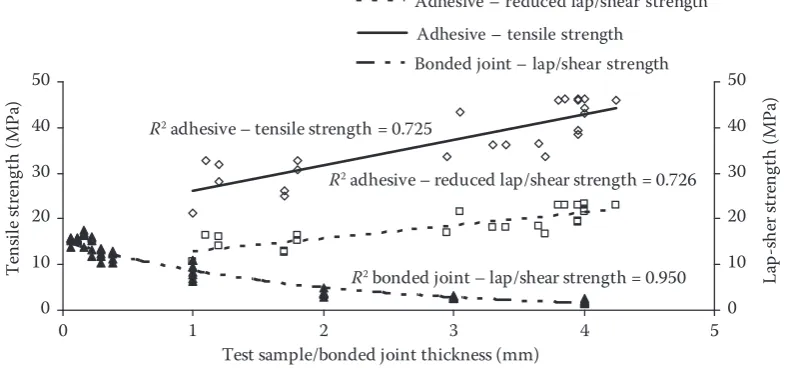
The flat test samples were cast in thickness from 1 to 4 mm. It was not possible to cast smaller thick-ness. From the results presented in Fig. 2 the adhe-sive strength decrease with increasing thickness is evident. This trend is quite opposite compared with the bonded joint, where the interaction between adherend and adhesive occurs.
From the above mentioned results it follows that the determination of the adherend/adhesive boundary unambiguous interaction on the basis of bonded joint strength is impossible.
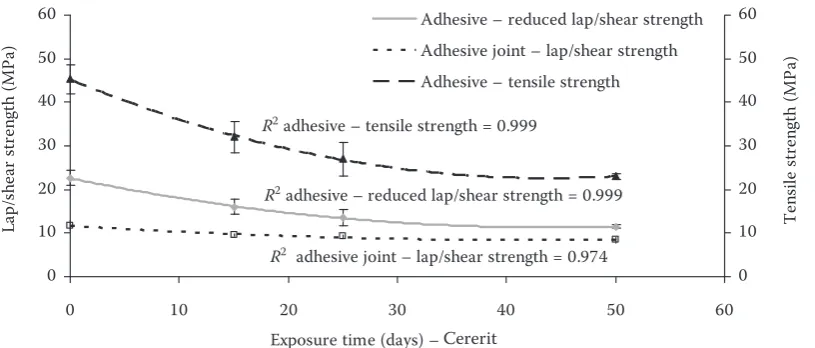
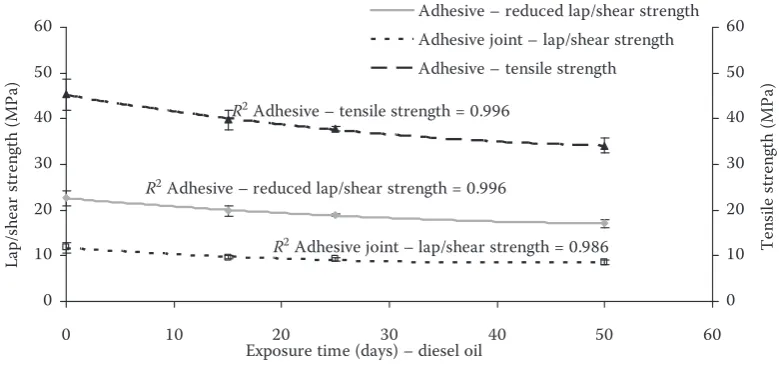
Results of the bonded joints applied in relevant degradation medium are evident from Figs 3–6. The functional dependence is expressed by the polynomial function of the second degree. The function type is derived from the correlation field, which consists of points on the intersection of the dependent and independent variables. In the graph mentioned points are the arithmetic means of the given runs, where the standard deviations are
stat-ed, too. For the correct evaluation it is also impor-tant to determine the determination index R2 of the
given dependence using the correlation analysis. According to the functional dependence the common characteristic of the degradation medium is a considerable decrease of single joints strength, which is evident from Figs 3–6. The considerable strength decrease occurred at the flat samples ex-posed for a certain period to the given medium. Diffusion seepage of the given degradation medi-um occurred in the cross section of test samples.
Analogically the same principles were noticed at the bonded joints. The functional surface, i.e. the lap length, became incessantly smaller and in this way the bonded joints strength rapidly decreased. So the cohesion strength decreased not only by the humidity and chemical substances diffusion in bonded joints, but also the adhesion decrease oc-curred.
On the basis of experiments carried out it is pos-sible to say that the final strength of bonded joints during the time and at the contemporary ambient medium influence decreases. The strength decrease rate depends on specific conditions of the ambient medium. But the sufficient finding is the fact that the more expressive strength decrease occurs at the cast samples from the adhesive. This fact confirms the assumption of the substantial adhesive layer thickness influence on the bonded joint strength decrease owing to the degradation processes in practice.
The strength decrease of bonded joints and cast test samples from the adhesive were not consider-ably different at samples exposed to diesel oil. The
R2 Adhesive – reduced lap/shear strength = 0.996
R2 Adhesive joint – lap/shear strength = 0.986
R2 Adhesive – tensile strength = 0.996
0 10 20 30 40 50 60
0 10 20 30 40 50 60
Exposure time (days) – diesel oil
La
p/
sh
ea
r s
tr
en
gt
h
(M
Pa
)
0 10 20 30 40 50 60
Te
ns
ile
st
re
ng
th
(M
Pa
)
[image:6.595.101.491.86.269.2]Adhesive – reduced lap/shear strength Adhesive joint – lap/shear strength Adhesive – tensile strength
average strength decrease after 50 days of expo-sure ranges from 23.5 to 24.5%. The considerable differences occurred at other media. The average strength decrease ranged from 24 to 28%. At the cast samples from adhesive the strength decrease was more considerable. It ranged from 42 to 63%.
With the adhesive strength decrease the mild hardness decrease was connected. The results are evident from the line graph (Fig. 7). The turn-ing point of the hardness decrease occurred after 15 days of exposure in the given medium. After 50 days the average hardness decrease ranged from 2.6 to 3.7%. The considerable hardness decrease was determined at the water–salt and water–Cererit media. The swelling and adhesive softening con-nected with it was the reason of the gradual hard-ness decrease.
In Fig. 8 the cross sections of the bonded joint are presented. The failure surface with the diffuse
seepage of the given medium into the bonded joint can be seen.
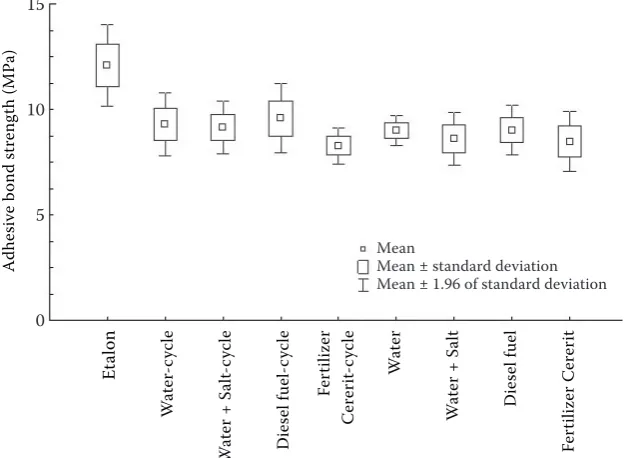
The bonded joints exposed to the degradation process of the given medium and to the increased temperature are evident in Fig. 9. The samples are marked as “cycle”. In Fig. 9 the final values of bond-ed joints exposbond-ed for 50 days to the given mbond-edium are presented. Compared with the etalon “0 days exposure” the bonded joint final strength decrease is evident. At the degradation process in the form of the alternative dipping in the given medium and drying, the average strength decrease is by 2.6% smaller compared with the direct contact with the given medium during the whole exposure time.
[image:7.595.66.290.84.201.2]The corrosion influence was studied on the ba-sis of the bonded joints surface examination and on the basis of material weight loss evaluation. The bonded material (steel S235J0)/bonded joint decline showed itself by its weight loss and by the
Fig. 7. Influence of degradation medium on the Shore D adhesive hardness
82 83 84 85 86 87
0 10 20 30 40 50 Exposure time in the given medium (days)
H
ar
dn
ess
Shore
D
Diesel oil Cererit Water and salt Water
[image:7.595.308.535.89.211.2]Fig. 9. Influence of degradation me-dium on the bonded joint strength Fig. 8. Cross-section of the bonded joint
5 mm
Mean
Mean ± standard deviation Mean ± 1.96 of standard deviation 15
10
5
0
A
dhe
sive b
ond str
eng
th (MP
a)
Et
alon
W
at
er
-c
yc
le
W
at
er + S
alt
-c
yc
le
Die
se
l f
ue
l-c
yc
le
Fer
tili
zer
Cer
er
it-c
yc
le
Wa
te
r
W
at
er + S
alt
Die
se
l f
ue
l
Fer
tili
zer Cer
er
[image:7.595.63.379.525.754.2]change of appearance. The highest weight losses of bonded samples came at the exposure to the Cererit fertilizer and to the solution of water and salt.
CONCLUSIONS
On the basis of evaluation of the experiments car-ried out it is possible to say that the bonded joints final strength decreases with the time together with the influence of surrounding medium. The strength decrease rate depends on specific conditions of the surrounding medium.
Experimental results determined at four me-dia confirm the assertion of Kinloch (1987) and Court et al. (2001) about the negative and harmful effect of a surrounding medium on the bonded joint.
Environment/media influencing the bonded joints are significant components acting on the joints long-term quality and strength. Often the spontaneous destruction of bonded joints occurs already after a very short time of the exposure to degradation me-dia. This dangerous phenomenon should lead to the prevention/elimination of the access of the men-tioned degradation media to bonded joints, or to the limitation of their time of influence.
From the results it is evident that corrosion is mostly not fully unambiguous factor influencing the bonded joint strength. Yet, the assumption was con-firmed that the adherend corrosion can cause a cohe-sive failure and change to the adhecohe-sive one; in this way the bonded joint strength secondarily decreases. Also Messler (2004) reached the similar assertion when he stated that mostly the corrosion of adherend or in the adhesive/adherend boundary contributes to the joint degradation and related strength decrease.
The adhesive saturation with humidity (given medium) causes lower joint strength and especially lower adhesive strength. The experiments carried out with the tensile strength test samples specified clearly a significant adhesive participation on the strength decrease of the complete bonded joint.
References
Aglan H., Rowell T., Ahmed T., Thomas R., 1999. Dura-bility assessment of composite repairs bonded to aircraft
structures. Journal Adhesion Science Technology, 1:
127–148.
Armstrong K.B., 1997. Long-term durability in water of alu-minium alloy adhesive joints bonded with epoxy adhesives.
International Journal of Adhesion & Adhesives, 17: 89–105.
Brožek M., Müller M., 2004. Mechanické vlastnosti spojů lepených sekundovými lepidly (Mechanical properties of adhesive bonds glued by cyanoacrylate adhesive).
Strojí-renská technologie, 1: 9–15.
Cererit, 2001. Bezpečnostní list pro Cererit (Safety data sheet for Cererit). Available at http://mercata.cz/pdf/bl/ Cererit.pdf
Colak A., Cosgun T., Bakirci A.E., 2009. Effects of envi-ronmental factors on the adhesion and durability charac-teristics of epoxy-bonded concrete prisms. Construction
and Building Materials, 23: 758–767
Court R.S., Sutcliffe M.P.F., Tavakoli S.M., 2001. Ageing of adhesively bonded joints – fracture and failure analysis using video imaging techniques. International Journal of
Adhesion & Adhesives, 21: 455–463.
Crocombe A.D., 1997. Durability modelling concepts and tools for the cohesive environmental degradation of bonded structures. International Journal of Adhesion &
Adhesives, 17: 229–238.
ČSN EN 1465, 2009. Lepidla – Stanovení pevnosti ve smyku při tahovém namáhání přeplátovaných lepených sestav (Adhesives – Determination of tensile lap-shear strength of bonded assemblies).
ČSN ISO 10365, 1995. Lepidla – Označení hlavních typů porušení lepeného spoje (Adhesives – Designation of main failure patterns).
ČSN EN ISO 527-1, 1997. Plasty – Stanovení tahových vlast-ností – Část 1: Základní principy (Plastics – Determination of tensile properties – Part 1: General principles). ČSN EN ISO 3167, 2004. Plasty – Víceúčelová zkušební tělesa
(Plastics – Multipurpose test specimens).
ČSN EN ISO 9142, 2004. Lepidla – Směrnice k výběru labo-ratorních podmínek stárnutí pro hodnocení lepených spojů (Adhesives – Guide to the selection of standard laboratory ageing conditions for testing bonded joints).
ČSN EN ISO 868, 2003. Plasty a ebonit – Stanovení tvrdosti vtlačováním hrotu tvrdoměru (tvrdost Shore) [Plastics and ebonite – Determination of the indentation hardness by means of a durometer (Shore hardness)].
Davis M., Bond D., 1999. Principles and practices of adhesive bonded structural joints and repairs. International Journal
of Adhesion & Adhesives, 19: 91–105.
Ducháček V., 2006. Polymery – výroba, vlastnosti, zpra-cování, použití (Polymers – Production, Properties, Pro-cessing, Uusing). Prague, Kanag Tisk: 278.
Gerald D., Pethrick R.A., 2009. Environmental effects on the ageing of epoxy adhesive joints. International Journal
of Adhesion & Adhesives, 29: 77–90.
Gledhill R.A., Kinloch A.J., 1974. Environmental failure of
structural adhesive joints. Journal of Adhesion, 4: 315–333.
conditions of Indonesia, North Sumatra province. In: EngOpt2008 – International Conference on Engineering Optimization, June 1–5, 2008. Rio de Janeiro: 5.
Kinloch A.J., 1987. Adhesion and Adhesives – Science and
Technology. 1st Ed. London, Chapman and Hall: 425.
Kinloch A.J., Osiyemi S.O., 1993. Predicting the fatigue
life of adhesively-bonded joints. Journal of Adhesion, 43:
79–90.
Kinloch A.J., Little M.S.G., Watts J.F., 2000. The role of the interphase in the environmental failure of adhesive
joints. Acta Materialia, 48: 4543–4553.
Messler R.W., 2004. Joining of Materials and Structures from Pragmatic Process to Enabling Technology. Burlington, Elsevier: 790.
Müller M., Chotěborský R., 2007. Možnosti hodnocení tloušťky lepené vrstvy (Possibilities of adhesive layer
thick-ness evaluation). Jemná mechanika a optika, 9: 247–249.
Müller M., Herák D., 2010. Dimensioning of the bonded
lap joint. Research in Agricultural Engineering, 56: 59–68.
Müller M., Chotěborský R., Hrabě P., 2009. Degradation processes influencing bonded joints. Research in
Agricul-tural Engineering, 55: 29–34.
Novák P., 2002. Korozní inženýrství (Corrosive engineer-ing). Available at http://www.vscht.cz/met/stranky/
vyuka/labcv/korozni_inzenyrstvi_se/koroze/p_prumys. htm; http://www.vscht.cz/met/stranky/vyuka/labcv/ko-rozni_inzenyrstvi_se/koroze/p_vody.htm
Nolting A.E., Underhill P.R., Duquesnay D.L., 2008. Variable amplitude fatigue of bonded aluminum joints.
International Journal of Fatigue, 30: 178–187.
Rushforth M.W., Bowen P., McAlpine E., Zhou X., Thompson G.E., 2004. The effect of surface pretreatment and moisture on the fatigue performance of adhesively-bonded aluminium. Journal of Materials Processing
Tech-nology, 153–154: 359–365.
Sargent J.P., 2005. Durability studies for aerospace applica-tions using peel and wedge tests. International Journal of
Adhesion & Adhesives, 25: 247–256.
Sonawala S.P., Spontak R.J., 1996. Degradation kinetic of glass-reinforced polyester in chemical environments.
Journal of Material Science, 31: 4757–4767.
Received for publication April 5, 2011 Accepted after corrections October 4, 2011
Corresponding author:
assoc. prof. Ing. Miroslav Müller, Ph.D., Czech University of Life Sciences Prague, Faculty of Engineering, Department of Material Science and Manufacturing Technology, Kamýcká 129, 165 21 Prague-Suchdol, Czech Republic