Changes of botanical composition of grass stands
under different types of management
J. Šantrůček, M. Svobodová, V. Brant
Czech University of Agriculture in Prague, Czech Republic
ABSTRACT
A field trial with Bromus catharticus Vahl. cv. Tacit, Arrhenatherum elatius (L.) P. Beauv. ex J.S. et K.B. Presl cv. Median, Festuca pratensis Huds. cv. Otava and Dactylis aschersoniana Graebn. cv. Tosca sown in rows 125 mm, was estab-lished in the year 1996 in Prague (chernozem, altitude 281 m a.s.l., average precipitation 472 mm per year, average year temperature 9.3°C). The stands were cut one or three times per year. The mass was removed or once or twice mulched. The share of the botanical species (by weight method), number of present species and agrobotanical groups (grasses, legumes, other dicotyledonous) coverage were measured from the third to the sixth year of vegetation. The results were evaluated by the analysis of variance (Tukey α = 0.05) and by time series analysis (forecasting) by the Statgraphics Plus programme, version 4.0. The species number increased rapidly with the three times cut variant during the four years, from 4 to 25 species, under the other management it was in average from 7 to 14 species, in the sixth year. The highest share of the sown species with the lowest reduction during the years was at Arrhenatherum elatius (41–72% in the sixth year). Bromus catharticus was extinct in the fifth year. The species chosen had a higher importance for conserving of the original botanical composition than the way of harvest. There was the significantly lower ground cover with the variant one cut per year (on average less than 70%). Mulch covered 15–64% of the surface in dependence on the dry mass yield and mulching frequency. The plants coverage was highest on the two or three times harvested variants (75–80%D). Keywords: arable land; setting-aside; grass; cutting; mulching; botanical composition; coverage
The questions of the suitable ways of arable land or grassland setting aside are examined by many research establishments in the Czech Republic as well as abroad. A lot of research work is aimed at the nutrients, especial-ly nitrate leaching risk on the set-aside land as well as after the ploughing the stand. From this point of view, grass stands appear as the most suitable (Koch 1998, Opitz Von Boberfeld and Schultheiss 1994). The influence of the way of setting the land aside on the following crops, its effects on their nutrition and weed control re-quirements, is often investigated. Opitz Von Boberfeld and Jasper (1994), Opitz Von Boberfeld and Schultheiss (1994) consider Festuca rubra as a suitable species from these points of view. In some cases even the possibili-ties of natural regeneration of the non-used land are com-pared, but it is clear that it brings a lot of problems and the species succession in the direction to a typical mead-ow stand lasts, according to the individual conditions and stand treatment, many years (Critchley and Fowbert 2000). The utilisation of the produced biomass is the oth-er problem. If it is not used for example as a source of bioenergy, it is necessary to leave it on the field surface, best cut up as a mulch, that is a source of nutrients and organic matter for the soil microflora, microfauna and plants. The influence of mulching on perennial grass stands yields and botanical composition was studied for example by Kvítek et al. (1998), Fiala and Gaisler (2000), on the arable land, including the possibilities of spread-ing of various weed species and their control, by Brant et al. 2001a, b, 2002. The relations among grasses
(Arrhe-natherum elatius) and weed species (Elytrigia repens, Rumex crispus) in grass stands studied Klimeš (1988).
MATERIAL AND METHODS
A field trial (1 plot dimensions 3 × 10 m) was established in the year 1996 on the experimental field of the Universi-ty of Agriculture in Prague (chernozem, altitude 281 m a.s.l., average annual precipitation 472 mm, average year temperature 9.3°C). Bromus catharticus Vahl. cv. Tacit (20 kg.ha–1), Arrhenatherum elatius (L.) P. Beauv. ex J.S. et K.B. Presl cv. Median (20 kg.ha–1), Festuca pratensis Huds. cv. Otava (20 kg.ha–1) and Dactylis aschersoniana Graebn. cv. Tosca (15 kg.ha–1) were sown in rows 125 mm apart without a companion crop in spring. The stands were cut (one or three times per year) with removing of the mass or mulching (one or two times per year) by a mulcher AS 27/2 Enduro (BRD). The last harvest was done always at the end of vegetation period.
RESULTS AND DISCUSSION
This article is aimed to the state and development of the swards in the years 1998–2001 (the third to sixth year of vegetation), it means after their complete establishment and after a complete year cycle of the searched way and frequency of harvesting in the year 1997. Dry mass yields of the grass stands ranged in average from 3.2 to 5.4 t.ha–1 in the third to sixth year. The stands of Arrhenatherum ela-tius produced the significantly largest amount of dry mass (with the exception of the year 2000 more than 5 t.ha–1). The stands of grasses of less growing capacity (Festuca pra-tensis and Dactylis aschersoniana) produced 2.2– 4.8 t.ha–1 per year in average of the third to sixth year.
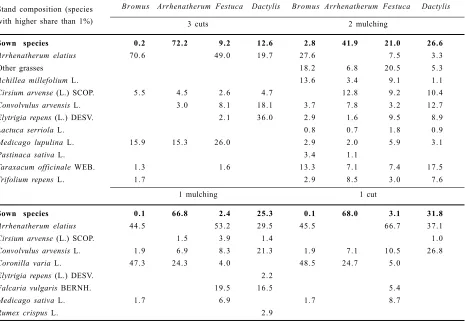
The stands botanical composition (Table 1) developed in dependence on the sown species and the way of har-vest. The present species number increased from 3–5 spe-cies to 19–30 (Table 2) on the three times cut variant during four years of vegetation. Statistically significant depen-dence was linear (number of species = –2.875 + 6.95t, P = 0.010, 0.0002). The number of species was lower and its year increasing slower (by 3.15 per year on the two times mulched plots, by 2.3 and by 1.1 on the one times mulched respectively cut ones) under lower harvest frequency (cal-culated by the times series analysis). The influence of the sown grass on the species number trend during the years was less considerable. The number of species increased most quickly in Bromus catharticus stands (4.8 per year), Table 1. Botanical composition of the stands (% of dry matter) in the 6th year of vegetation
Stand composition (species Bromus Arrhenatherum Festuca Dactylis Bromus Arrhenatherum Festuca Dactylis
with higher share than 1%) 3 cuts 2 mulching
Sown species 0.2 72.2 9.2 12.6 2.8 41.9 21.0 26.6
Arrhenatherum elatius 70.6 49.0 19.7 27.6 7.5 3.3
Other grasses 18.2 6.8 20.5 5.3
Achillea millefolium L. 13.6 3.4 9.1 1.1
Cirsium arvense (L.) SCOP. 5.5 4.5 2.6 4.7 12.8 9.2 10.4
Convolvulus arvensis L. 3.0 8.1 18.1 3.7 7.8 3.2 12.7
Elytrigia repens (L.) DESV. 2.1 36.0 2.9 1.6 9.5 8.9
Lactuca serriola L. 0.8 0.7 1.8 0.9
Medicago lupulina L. 15.9 15.3 26.0 2.9 2.0 5.9 3.1
Pastinaca sativa L. 3.4 1.1
Taraxacum officinale WEB. 1.3 1.6 13.3 7.1 7.4 17.5
Trifolium repens L. 1.7 2.9 8.5 3.0 7.6
1 mulching 1 cut
Sown species 0.1 66.8 2.4 25.3 0.1 68.0 3.1 31.8
Arrhenatherum elatius 44.5 53.2 29.5 45.5 66.7 37.1
Cirsium arvense (L.) SCOP. 1.5 3.9 1.4 1.0
Convolvulus arvensis L. 1.9 6.9 8.3 21.3 1.9 7.1 10.5 26.8
Coronilla varia L. 47.3 24.3 4.0 48.5 24.7 5.0
Elytrigia repens (L.) DESV. 2.2
Falcaria vulgaris BERNH. 19.5 16.5 5.4
Medicago sativa L. 1.7 6.9 1.7 8.7
Rumex crispus L. 2.9
Table 2. Number of present species in the stands (pcs.)
Variant
Bromus Arrhenatherum Festuca Dactylis
Year of vegetation
3 . 6 . 3 . 6 . 3 . 6 . 3 . 6 .
3 cuts 5 2 6 3 3 0 4 2 4 4 1 9
2 mulching 4 1 6 3 1 1 6 1 1 5 1 6
1 mulching 2 1 5 4 7 7 1 3 4 9
[image:2.595.60.525.76.397.2] [image:2.595.57.523.657.759.2]slowest in Dactylis aschersoniana stands (number of species = 4.25 + 1.125t, P = 0.052, 0.004).
The number of species with the share higher than 1% was 11–15 (Table 1) on the three times cut variant in the sixth year, they represented 91–99.9% of the biomass. It increased in average by 11 from the third year, by 1.9 on the other variants.
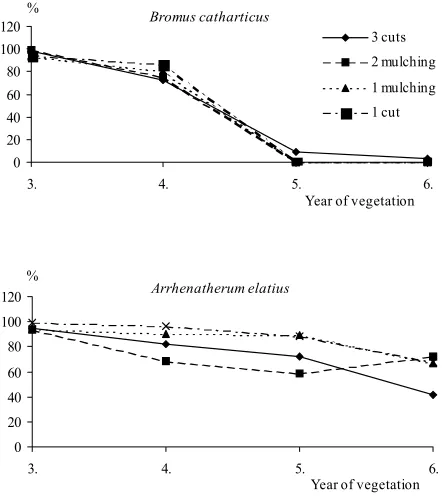
The share of the sown species (measured by weight method) during the years is shown in the Figure 1. Ar-rhenatherum elatius shared by more than 94–99% in the third year (Figure 1), in the following years it decreased to 40–70%, especially on the two or three times harvest-ed plots. Its share on the plots harvestharvest-ed once per year maintained on the level about 90% until the fifth year. The decreasing of this species share was statistically the slowest one from those of all the used species (Table 3). Bromus catharticus disappeared most quickly. In the fourth year, it formed 72–86% of the stand, in the
follow-ing years (fifth and sixth) only 8.6%-0% of the total dry mass. Festuca pratensis and Dactylis aschersoniana share was highest in the third year (85%), in the follow-ing years decreased until less than 3% (Festuca praten-sis). Dactylis aschersoniana always created the highest part of the dry mass on the one times cut variant (25–31% in the sixth year) – Figure 1, Table 1.
In the sixth year of vegetation there were also present other grass species in the stands, especially Arrhena-therum elatius invaded the stands of Bromus catharti-cus and Festuca pratensis and its share (up to 70%) increased with the sown species share decreasing (Table 1). Arrhenatherum elatius had a relatively lower presence in the Dactylis aschersoniana stands. The share of Elytrigia repens was low in grass stands (with the ex-ception of two times mulched stand of Dactylis ascher-soniana). Neither the dicotyledonous weeds as Cirsium arvense (L.) SCOP., Convolvulus arvensis L., Falcaria
Bromus catharticus
0 20 40 60 80 100 120
3. 4. 5. 6.
%
3 cuts 2 mulching 1 mulching 1 cut
Year of vegetation
Arrhenatherum elatius
0 20 40 60 80 100 120
3. 4. 5. 6.
%
Year of vegetation
Festuca pratensis
0 20 40 60 80 100
3. 4. 5. 6.
%
Year of vegetation
Dactylis aschersoniana
0 20 40 60 80 100
3. 4. 5. 6.
%
Year of vegetation
Figure 1. The share of the sown species (weight %) in the stand
Table 3. Sown species share decreasing in the stand in dependence on the time (% of dry matter) – times series analysis
Sown species, variant Equation P constant P slope Significance
Bromus catharticus y = 134.8 – 36.17t 0.038 0.066
Arrhenatherum elatius y = 106.4 – 10.66t 0 . 0 0 0 6 8 0 . 0 0 8 9 2 +
Festuca pratensis y = 107.3 – 21.93t 0 . 0 2 5 6 0.075
Dactylis aschersoniana y = 104.1 – 18.22t 0.012 0.047 +
3 cuts y = 117.9 – 23.63t 0 . 0 0 1 9 0 . 0 0 6 3 +
2 mulching y = 106.2 – 21.68t 0 . 0 0 3 5 7 0 . 0 1 1 3 +
1 mulching y = 112.8 – 20.96t 0 . 0 0 6 3 0 . 0 2 3 8 +
[image:3.595.59.280.56.308.2] [image:3.595.56.525.637.760.2]vulgaris BERNH., Rumex crispus L. or Taraxacum offici-nale L. did share considerably in the sixth year, it means after a considerable decreasing of the sown species share, their share mostly was not higher than 10% (by weight method). Dactylis aschersoniana was the excep-tion again with 12–26% of Convolvulus arvensis share under all types of management, with Taraxacum offici-nale on the three times cut plot and Falcaria vulgaris presence on the one times mulched plot. The level of weed infestation, it means the danger of weed seeds or other reproduction organs store increasing in the soil or weed infestation of the neighbourhood areas, never-theless, has to be evaluated by other complementary methods.
The importance of grass stands for setting a land aside is based among others in its function preventing erosion,
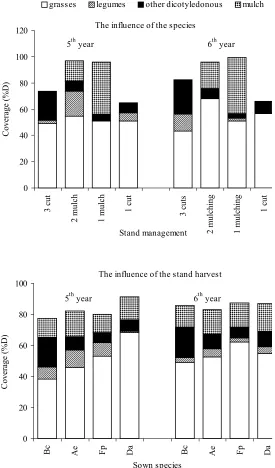
decreasing of nutrients leached to the underground wa-ter and in the land protection against a weed infestation. To fulfil these functions the sward has to create a certain amount of biomass, as far as possible equally distribut-ed in lower levels of the canopy for as long as possible during a year. The sward coverage after a harvest (Fig-ure 2) depended not only on the mass yield of the stand, but it was influenced also by its height and density in the time of the harvest and by the botanical composition (Table 1). The architecture of the aboveground parts of the plants was different with distinct species of dicotyle-donous – some of them create flat leaf roses, so as with different grass species with more or less dense tufts, conceivably species with long rhizomes (Elytrigia repens L. Desv. etc.), that create relatively thin stands. That was why only the dry mass yield respectively the Figure 2. Coverage (%D) of agrobotanical groups and mulch in the 5th and 6th year of
vegetation
Bc – Bromus catharticus Ae – Arrhenatherum elatius Fp – Festuca pratensis Da – Dactylis aschersoniana
5th year: D
minα0.05 (Tukey) = 7.2 (grasses),
1.7 (dicotyledonous) 6th year: D
minα0.05 (Tukey) = 7.6 (grasses),
1.7 (dicotyledonous)
The influence of the species
0 20 40 60 80 100 120
3 cut
2 mulch 1 mulch 1 cut 3 cuts
2 mulching 1 mulching
1 cut
Stand management
Coverage (%D)
grasses legumes other dicotyledonous mulch
5th year 6th year
The influence of the stand harvest
0 20 40 60 80 100
Bc Ae Fp Da Bc Ae Fp Da
Sown species
Coverage (%D)
[image:4.595.60.335.58.526.2]share of grasses and dicotyledonous species in the yield were not in a close dependence with the stand coverage (correlation coefficient of the relation between domi-nance and yields was only 0.07) and they could not be considerable indices for the stand function against ero-sion. That was the reason of stand coverage measuring closely before onset of winter, it means after the end of vegetation (Figure 2).
It is obvious from the results, that the coverage of all the present grass species was highest on the three times cut variant till the third year of vegetation. However, in the following years this frequency of harvesting proved less suitable for grasses development in the moist con-ditions. The highest grass coverage was found on the two times mulched variant from the fourth year. The gaps left by grasses were filled by dicotyledonous species and so the total plant coverage on the three times cut vari-ants did not change (74–82%D) and it was nearly always significantly higher than on the one times cut plots, where the share of gaps mostly exceeded 30%. The sig-nificantly highest coverage of grasses had the stands of Dactylis aschersoniana, where this sown species direct-ly predominated also because of its competitive ability (low growth, intensive sprouting with creeping sterile sprouts) limited spreading of other grass species, till the fifth year even Elytrigia repens. A very good coverage was found because of its tuft character also at Bromus catharticus until the year 1998, but later it disappeared from the stand. It corresponds also with its share in the mass.
The share of gaps on the mulched plots was small (Fig-ure 2), mostly 0–9%D. The mulch coverage, in depen-dence on the year and mulching frequency (mass quantity) was in average 15–35% on the plots two times mulched and 32–64% on the one times per year mulched. The mulch coverage during a winter period is no less important for the soil protection against an erosion, es-pecially against the wind one, than plants coverage. Be-sides it, it influences the microbial activity in the soil, emerging of seeds of different species etc.
CONCLUSIONS
The results have shown the differences in the devel-opment, persistence, competitive ability etc. of the inves-tigated grass species under distinct ways of management of stands on the temporarily set-aside land. We have come to the conclusion that mulching two times per year is a suitable way of such stands management from the point of view of the mass distribution and decomposi-tion, sown grass coverage and gaps minimisation. Har-vesting (cutting) one time per year was a good way for maintaining as high as possible share of grasses. The way of the stand management had a less impact on the sown species share decreasing than the chosen grass species, but it significantly influenced the total dry mass. The time of the setting the land aside and especially the
species adaptation to the soil – climate conditions have to be taken into account for choosing the most suitable grass species. The grasses that produce a big amount of the biomass, as for example Arrhenatherum elatius, can be seen less suitable for non-production purposes. How-ever, this species distinguished itself by a strong com-petitive ability against weeds under all types of management. Taking into account the other points of view (underground water protection etc.), it is evident, that it is necessary to adapt the choice of the species and way of stand management above all to the given stand conditions, the intended time of setting the land aside and to the possibilities of the farmer.
The results were obtained with the support of the re-search project of NAZV QC 0242.
REFERENCES
Brant V., Svobodová M., Šantrůček J. (2001): Lactuca
ser-riola L. presence on the set-aside soil. Rostl. Výr., 47:
63–69.
Brant V., Svobodová M., Šantrůček J., Markvartová P. (2002): Elytrigia repens (L.) Beauv. spreading in legumes and grass stands on set-aside land. Proc. 12th Int. Symp.
Eur. Weed Res. Soc., Wageningen/Arnhem, The Nether-lands: 42–43.
Brant V., Šantrůček J., Svobodová M. (2001): Occurence of
Cirsium arvense (L.) Scop. in grass and legume stands in
dependence of stand management way. Zesz. Nauk. Akad. Roln. H. Kollataja, Krakow, 76: 109–112.
Critchley C.N.R., Fowbert J.A. (2000): Development of veg-etation on set-aside land for up to nine years from a nation-al perspective. Agric. Ecosyst. Envir., 79: 159–174. Fiala J., Gaisler J. (2000): The production of biomass by
dif-ferent management of grasslands without using for forage production. Rostl. Výr., 46: 269–272.
Klimeš F. (1988): The effectiveness of temporary prato-cenoses in the control of Agropyron repens (L.) P. Beauv.
and Rumex crispus L. Rostl. Výr., 34: 169–177.
Koch H.J. (1998): Rotational set-aside proceeding sugar beet – Effect of set-aside position in the rotation and cover crop on soil nitrogen leaching risk and sugar beet yield and quali-ty. Zuckerindustrie, 123: 894–898.
Kvítek T., Klímová P., Šonka J. (1998): The influence of mulching on botanical composition and coverage of mead-ow stand, evapotranspiration and soil moisture. Rostl. Výr., 44: 553–560.
Opitz Von Boberfeld W., Jasper J. (1994): Effect of rota-tional fallows (set-aside land) on subsequent winter-wheat. J. Agron. Crop Sci., 173: 125–134.
Opitz Von Boberfeld W., Schultheiss U. (1994): The influ-ence of undersown green manure crops for fallows – set-aside land – in view of vegetation-development and dynamic of nitrate. J. Agron. Crop Sci., 172: 52–61.
Corresponding author:
Ing. Miluše Svobodová, CSc., Česká zemědělská univerzita v Praze, 165 21 Praha 6-Suchdol, Česká republika, tel.: + 420 224 383 037, fax: + 420 220 921 639, e-mail: [email protected]
ABSTRAKT
Změny botanického složení porostů trav při různých způsobech využívání
V roce 1996 byl založen polní pokus na černozemi (nadmořská výška 281 m n. m., průměrná suma ročních srážek 472 mm, průměrná roční teplota 9,3 °C) se čtyřmi druhy trav (Bromus catharticus Vahl., odrůda Tacit, Arrhenatherum elatius (L.) P. Beauv. ex J.S. et K.B. Presl, odrůda Median, Festuca pratensis Huds., odrůda Otava a Dactylis aschersoniana Graben, odrůda Tosca) vysetými do řádků 125 mm. Porosty byly sečeny jedenkrát nebo třikrát ročně s odvozem hmoty nebo mul-čovány (jedenkrát nebo dvakrát ročně). Poslední sklizeň probíhala vždy na konci vegetačního období. Ve třetím až šestém roce vegetace bylo váhovou metodou sledováno zastoupení jednotlivých druhů, počet zastoupených druhů a pokryvnost agrobotanických složek (trávy, jeteloviny, ostatní dvouděložné druhy), mulče a podíl prázdných míst na konci vegetace. Výsledky byly vyhodnoceny analýzou rozptylu (Tukey α = 0,05) a analýzou časových řad programem Statgraphics verze 4.0. Nejrychleji se zvyšovala druhová pestrost u trojsečné varianty v průběhu čtyř let ze 4 na 25 druhů, u ostatních způso-bů sklizně byl počet druhů v šestém roce v průměru 7 až 14. Největší podíl setého druhu s nejpomalejším poklesem v průběhu let byl u Arrhenatherum elatius (v šestém roce 41 až 72 %). Bromus catharticus zcela ustoupil v pátém roce vegetace. Výběr druhu měl pro zachování původního botanického složení porostu větší význam než způsob sklizně. Na jedenkrát ročně sečené variantě byl průkazně největší podíl prázdných míst (v průměru 30 %). Mulč pokrýval 15 až 64 % povrchu v závislosti na výnosu hmoty a frekvenci mulčování. Pokryvnost porostu byla nejvyšší na dva- až třikrát ročně sklízených parcelách (75–80 %D).