The primary aim of this paper is to add to the team effort in building a competency model. The second-ary aim is to put together a method, namely a set of scales to measure attitudes to work and organization1.
The competency model will be shortly dealt with in the following paragraph. The main part of the paper, however, will be committed to its second aim.
THE COMPETENCY MODEL
The present authors assume that a competency model could cover not only a manager, but a general
employee. The differences between a manager and an employee of a different rank might concern specific skills and knowledge, which are necessary for the performance on a specific job and/or assignment. Different kinds of skills and knowledge, however, do not have to make it necessary to construe competency differently in specific cases. When attempting to model an employee competency, several facets of this theo-retical construct could be identified. First of all, the efficacy of an employee will be an important aspect of the model. Efficacy is connected to self-efficacy, which in turn produces motivation (Wall et al.2004). In this way, work motivation makes a second part of
Attitudes to work and organization as a part
of a competency model
Postoje k práci a organizaci jako součást modelu kompetence
L. KOLMAN, P. RYMEŠOVÁ
Czech University of Life Sciences, Prague, Czech Republic
Abstract:When modelling an employee competency, several facets of this theoretical construct could be identified. One of them is grounded in the employee’s attitudes to work and organization, namely in her/his job involvement, organizational commitment, responsibility etc. The paper deals with results of a survey comparing work and organizational attitudes of four groups of subjects. The groups differed in age (20–30 and 50–60) and gender. The survey was a part of a wider research effort aimed at building up a new method of work attitudes measurement. The previous research has shown a rather speci-fic response pattern in the Czech respondents. The survey dealt with presently tries to find more details as goes about the patterns mentioned and to help in constructing a final version of the method. The authors expect that the method will pro-ve to be useful both in theory depro-velopment and in the field.
Key words: competency, attitude, job involvement, organizational commitment
Abstrakt: Při modelování kompetence zaměstnance lze identifikovat několik aspektů tohoto teoretického konstruktu. Jeden z nich je dán postoji zaměstnance k práci a organizaci, zejména jeho zaujatostí prací, oddaností organizaci, odpovědností apod. Stať se zabývá výsledky dotazníkového výzkumu, ve kterém byly porovnávány postoje k práci a organizaci čtyř skupin respondentů. Skupiny se lišily věkem (20–30 a 50–60) a v rodu. Výzkum byl součástí širšího výzkumného úsilí věnovaného tvorbě metody měření postojů k práci. Předchozí výzkum vykázal u českých respondentů dosti specifický vzorec odpově-dí. Současná studie se zaměřuje na upřesnění detailů tohoto vzorce a na pomoc při návrhu finální verze metody. Autoři předpokládají, že metoda bude užitečná pro výzkum i praxi.
Klíčová slova: kompetence, postoj, zaujatost prací, oddanost organizaci
1 The method mentioned is a questionnaire which consists from a number of scales, where every scale is a set of
the competency model. Third component of the model stems from the mutual relations of the employee and the organization. The relations of the employee and the organization disclose themselves in things like psychological contract (Kolman 2005, pp. 15–18) and organizational citizenship (Parks, Kider 1994; Kolman 2006, p. 39). It might be shown that both self-efficacy and employee-organization relationships manifest themselves in attitudes. Because of this connection, the present authors deem it important to produce an instrument enabling to measure attitudes of people to work in general and the organizations they work for in particular.
Secord and Backman (1969) have put forward their definition of attitude almost half a century ago. Even so, it is widely accepted as valid to these days. According to them, attitudes ‘are certain regularities of an individual’s feelings, thoughts and predisposi-tions to act to some aspects of her/his environment’. As ensues from the definition quoted, an attitude has got three components, namely an affective, a cogni-tive and a behavioural one. The affective component refers to the feelings of the subject as concerns the object of her/his attitude. The cognitive component, correspondingly, concerns what the person thinks or believes about the object and the behavioural component is about the subject’s behavioural re-sponses which the object might elicit. Attitudes are evaluative, i.e. they reflect the person’s tendency to respond positively or negatively to the object of the attitude. An attitude refers to a specific target, be it a person, group of people, social institution, object or concept. Attitudes at work may comprise work itself, pay, supervision, colleagues, customers and/or physical environment. Some of the employee’s attitudes to work and organization are important part of her/his work motivation contents, namely her/his job involvement, organizational commitment, responsibility etc.
SCALES TO MEASURE ATTITUDES
The paper deals with results of two surveys which employed Kolman’s work attitude questionnaire (Kolman et al. 2003). The first survey aimed at iden-tifying the general patterns of work attitudes in the Czech work-force, the second survey compared work and organizational attitudes of four groups of subjects. In the second case, the groups differed in age and gender. Both surveys were a part of a wider research effort aimed at building up a new method of work attitudes measurement. The surveys will be referred to as Survey 1 and Survey 2 further in the text.
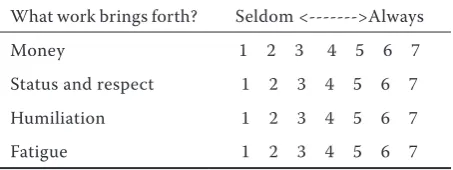
Kolman’s work attitude questionnaire (WAQ) con-sists of four parts. The questions of the first part are just common general information questions. The following three parts are built in a very similar way. Every one of the three last questionnaire parts starts with a general question and this question is subsequently specified. So, the second part of WAQ starts with a question “What does work bring forth?”
and this is followed by specific entries like “money”, “status and respect”, “humiliation”, etc. In such a way, the general question forms together with the specific entry a statement of sorts. The respondents were asked to determine the probability of the specific statements being true on a seven-point scale. The third and fourth parts begin respectively with ques-tions, as follows:
“If somebody fares well, it is caused by …” “If somebody is badly off, it is so because …”
Survey 1 has shown a rather specific response pat-tern in the Czech respondents, as will be described in the following paragraph. This result let to a conclu-sion that it might be fruitful to continue with further research on the matter. The Survey 2, conducted in the previous year, tried to find more details as goes about the pattern mentioned and to help in construct-ing a final version of the method. The authors expect that the method will prove to be useful both in theory development and in the field (Table 1).
SURVEY 1 The sample:
Survey 1 was conducted in the year 2002. Altogether there were collected and analyzed questionnaires filled in by 449 respondents. 18.3% of the respondents were women and 81.7% men. The age structure of the respondents is shown in Table 2.
[image:2.595.305.532.479.564.2]About half of the respondents graduated from high-school and another 25% graduated from a university. 75% of the respondents were employees; 54.6% of the
Table 1. A specimen of a questionnaire scale. Subjects were asked to mark the degree of their agreement with a statement.
whole sample of respondents was employed in business or industry and the remaining 25.4% was in public administration. About 50% of respondents lived in towns of 10 or more thousands of inhabitants. One general information question asked on the respondent occupation. The answers to this question were very diverse and the occupational categories seemed to be evenly spread through the sample. Considering all the information on the respondents, it could be said that the data collected refer to adult population of the country of people in their productive years. With the exception of men being strongly over-re-presented, the sample seems to reflect the structure of this part of the nation as goes about education level, means of living, occupation and size of the place of inhabitation.
Analysis and results
In the analysis of the questionnaire data, there were found no differences between the respondents based on differences of gender, age, living means, occupa-tion or the size of the place of inhabitaoccupa-tion.
The data were analyzed separately for the above mentioned three sets of questions. The method uti-lized was one-way (one factor) ANOVA. This method was utilized to determine if the differences of means of the specific sub-questions were due to chance or not. In all the three cases, the results of the analysis were highly significant. This, the present authors deem, means that the differences of mean scores of the questions in the respective subsets hardly might have happened by chance. We believe that so strong results reflect on something important in the atti-tudes to work and the perceived locus of control of the persons in the sample studied.
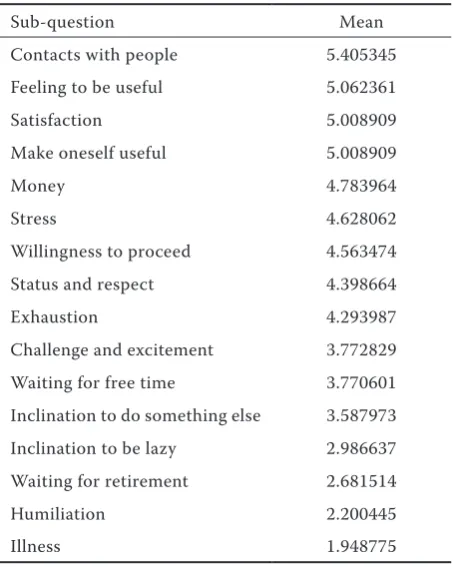
The Table 3 comprises answers to “What does work bring forth” questions. These questions pertain to attitudes to work. In this table, the mean scores are ordered in diminishing order, from those which were given high scores, like ‘contacts with people’ or ‘satisfaction’ (the first and third place) to those which get low scores, like ‘illness’ and ‘humiliation’. We understand these results as showing both involve-ment and commitinvolve-ment to be very important for the respondents. Satisfaction does not to be discussed at any length here, we expect.
The next two sections of the questionnaire contain questions which were derived from the daily experi-ence of living in the country and many complains and/ or excuses one might hear Czechs to make. However, the pattern emerging in both these tables is a bit dif-ferent from the complainants’ staple (more detailed data could be found in Kolman et al.2003). Czechs, it seems, believe that chance, luck and opportunity are important. On the other hand, they seem to be-lieve in industry, self-determination, education and experience, as well. Based on it, it seems apparent that the respondents attribute a relatively high pro-portion of control over their own destiny to their own efforts and intentions. Their locus of control seems to be prevalently internal. Such people would be interested in and motivated by achievement and they might develop high degree of involvement in their work.
SURVEY 2
Survey 2 was conducted in the fall of 2005. Its aim was to find more details on age and gender
differ-Table 2. Age structure of the survey 1 respondents
Twenty years of age or less 3.8%
21–30 39.6%
31–45 25.2%
46–60 29.2%
[image:3.595.66.291.84.170.2]61 and more 2.2%.
Table 3. Mean scores of sub-questions of the “What does work bring forth” section
Sub-question Mean
Contacts with people 5.405345 Feeling to be useful 5.062361
Satisfaction 5.008909
Make oneself useful 5.008909
Money 4.783964
Stress 4.628062
Willingness to proceed 4.563474
Status and respect 4.398664
Exhaustion 4.293987
Challenge and excitement 3.772829 Waiting for free time 3.770601 Inclination to do something else 3.587973 Inclination to be lazy 2.986637 Waiting for retirement 2.681514
Humiliation 2.200445
Illness 1.948775
[image:3.595.64.291.451.735.2]ences in answer to the WAQ scales. The main reason was that based on data from another kind of survey, it was hypothesized that such differences could be expected, even if there were found none in Survey 1 (Kolman 2001).
The sample:
The questionnaire data were obtained from 872 respondents. The respondents approached were from two contrasting age groups and about half of them were male. The sample structure is shown in Table 4.
Analysis and results:
The first thing which was checked on in the analysis was the agreement of the findings of Survey 1 with
the answers in this second WAQ application. It might be said, that the response patterns of the respondents in both the surveys are reasonably similar. E.g. for the 16 sub-questions of the “What does work bring forth” set it was found the orders of sub-question means correlate a bit over 0.80. A higher agreement hardly could be expected, as there is a gap of sev-eral years between the two surveys and the sample structures differ.
The answer patterns of both the genders and the age groups were compared by means of the Student’s t statistics. The t-test has not yielded statistically significant results in any pair of means. This means the results of the Survey 1 were fully corroborated by Survey2. The sample studied in Survey 2 was about twice as numerous as the sample of Survey 1. This might have helped to bring to surface differ-ences which were too small to be found significant in Survey 1. It seems, however, that there are no differences in work attitudes, as measured by the WAQ, to be found between genders and age groups in the Czech Republic.
DISCUSSION AND CONCLUSIONS
As it was shown in the preceding paragraphs, Survey 2 corroborated the Survey 1 results, even as there was a four years gap between the times the surveys were carried out. The sample studied in the Survey 2 was twice as numerous, as the sample used in the Survey 1 and the structures of samples were different. Clearly, even under such conditions, both the surveys yielded similar, even if not identical results. Based on this finding it seems reasonable to assert, the research instrument, referred here as the WAQ, shown stabil-ity of results over time, age and gender differences. This, according to the present authors, seems rather promising. They assume the scales of the WAQ could make a reliable method to measure work attitudes and some other motivational characteristics, as well.
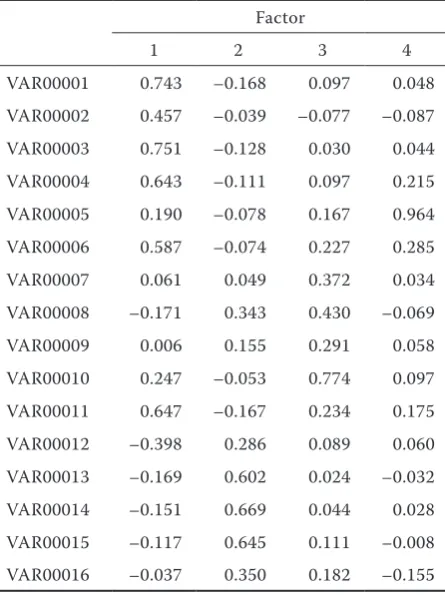
[image:4.595.63.292.264.297.2]Table 5 shows a rotated factor matrix of the ‘What does work bring forth’ sub-questions. We understand it as another evidence for the viability of the WAQ scales as a measurement method. The next step for the present authors is to formulate, based on the results obtained so far, a next version of the question-naire, gather data using it and continue this way with building the method. The reason the authors think so is based on rather big factor loads in the specific sub-questions, which it makes it feasible to assume that the continuation of sub-questions elaboration will make it possible to build a strong and reliable based on these, perhaps meager so far, beginnings.
Table 4. Survey 2 sample structure
Male Female Age 20–30 Age 50–60
425 447 439 433
Table 5. Rotated factor matrix of the ‘What does work bring forth’ sub-questions
Factor
1 2 3 4
VAR00001 0.743 –0.168 0.097 0.048 VAR00002 0.457 –0.039 –0.077 –0.087 VAR00003 0.751 –0.128 0.030 0.044 VAR00004 0.643 –0.111 0.097 0.215 VAR00005 0.190 –0.078 0.167 0.964 VAR00006 0.587 –0.074 0.227 0.285 VAR00007 0.061 0.049 0.372 0.034 VAR00008 –0.171 0.343 0.430 –0.069 VAR00009 0.006 0.155 0.291 0.058 VAR00010 0.247 –0.053 0.774 0.097 VAR00011 0.647 –0.167 0.234 0.175 VAR00012 –0.398 0.286 0.089 0.060 VAR00013 –0.169 0.602 0.024 –0.032 VAR00014 –0.151 0.669 0.044 0.028 VAR00015 –0.117 0.645 0.111 –0.008 VAR00016 –0.037 0.350 0.182 –0.155
[image:4.595.65.288.437.735.2]REFERENCES
Kolman L., Michálek P., Chamoutová K., Gruber J. (2003): Work motivation in the Czech countryside (in Czech). Agrární perspektivy XII., ČZU, Praha, pp. 812–818; ISBN 80-213-1056-1.
Kolman L. (2005): Výcvik zaměstnanců (Management training). Linde, Praha, pp. 15–18.
Kolman L. (2006): Determinanty pracovního chování Work behavior determinants). II. část, ČZU PEF, Praha, p. 39.
Parks J.M., Kider D.L. (1994): Till death us do part …: Changing work relationships in the 1990s’. In:
Cooper C.I.; Rousseau D.M. (eds.): Trends in Or-ganizational Behaviour, Vol. 1. John Wiley, Chi-chester, pp. 111–136.
Secord P.F., Backman C.W. (1969): Social Psychology. McGraw Hill, New York.
Wall T.D., Wood S.J., Leach D.J. (2004): Empowerment and Performance. In: Cooper C.L., Robertson I.T. (eds.) (2004): International Review of Industrial and Organizational Psychology 2004. John Wiley, New York, pp. 1–46; ISBN 0273655442.
Arrived on 15th November 2006
Contact address: