Basic company’s sources and the elements of evalua-tion have a very old history. The usage of informaevalua-tion technologies substantially speeded up the realisa-tion of single company operarealisa-tions, but actually the essence of management has not changed. in reality, there are the basic principles on which any successful company must be based. The principles according to which the success of any company is judged can be set according to its demands. criteria can be various – short-term profit, long-term profit, market share or ratio indicators – return of investment (roi), Free cash Flow (FcF), the index of customer satis-faction, frequency of repeating purchases, costs for education, number of improving proposals. Some technical indicators can be used as an evaluating criterion – for instance the share of administrative
work realised by the means of modern information technologies, the number of contacts with business partners realised by means of the most modern in-formation technology. however, the evaluation of the firm must be unambiguous. Quality data and information are necessary for the overall evaluation of the firm. The quality of the documents is fully dependent on the quality of the company’s data and information, then on the information system quality. The information system of the company is fully dependent on the human factor, it means on the managers of the company and on the ability of users to use the system. The contribution solves the issue of the management of information and com-munication technologies and information systems in the chosen sample of a company.
Knowledge and information systems
Znalosti a informační systémy
E. Šilerová, L. Kučírková
Faculty of Economics and Management, Czech University of Life Sciences,
Prague, Czech Republic
Abstract: We can see that the today’s management level of informations is not quite fully controlled in most businesses. nowadays generation of information systems creates support for business processes with the aim of optimalization of these processes on the bases of experiences with similar business processes. Today’s information systems are at the level of data management or information management. Quite a few manage information processes in the area of tactical and strategic planning and almost no one manages processes in the areas of gathering, distribution and sharing of knowledge in business. We can say, that investments to the information technologies do not guarantee the successful way to the management of information and knowledge in business.
Key words: information technology, communication technology, internet, information system, data, information, know-ledge
Abstrakt: V současné době není ve většině podniků plně kontrolována úroveň řízení informací. informační systémy vytvá-řejí podporu pro obchodní procesy s cílem optimalizovat tyto procesy na základě zkušeností s podobnými obchodními procesy. Dnešní informační systémy jsou na úrovni řízení dat nebo řízení informací. Málo z nich řídí informační procesy v oblasti taktického a strategického plánování a téměř žádný neřídí procesy v oblasti shromažďování, distribuce a sdílení znalostí v podniku. Lze konstatovat, že investice do informačních technologií nezaručují úspěšný způsob řízení informací a znalostí v podniku.
Klíčová slova: informační technologie, komunikační technologie, internet, informační systém, data, informace, znalosti
on today’s global market, companies from different countries with various production meet and compete. The question remains why some companies are able to improve and innovate, and find better sources of a competitive advantage. Maintaining or getting the competitive advantage is dependent on a number of elements. Among them, we find the following: – Level of the company management
– Quality of managers – character of the demand
– Quality and ability of information and communica-tion technologies usage
– globalisation, intelectualisation
The basic condition of the successful realisation of business strategy is a clear idea for what result we will use information and communication technologies and also information systems. information systems used in firms nowadays are relatively complicated, they are created by a big functional spectrum, they do not often have user hand-books, the management of informatics departments is not on a sufficient level. The quality of the whole life cycle of the information system will be strongly influenced by the way of the informatics department management and then by the work with the data and information and their other usage.
global economy is about business with goods, services, labour, funds and information. globalization is ruled by new technologies, which enable many new businesses. global businesses have the need to be interconnected with their customers, suppli-ers, employees and partners all around the world (Sodomka 2006).
The undergoing changes are characterised by great superlatives like “tectonic moves, revolutionary chang-es, and the whole new paradigm”. it is said that the digital economy is the economy of a new age. in the “classical” economy the whole information flow was realised by physical means: cash money, checks, bills, personal meetings of business partners. in the “new” economy, the basic design of information is a digital shape – this kind of information is reduced to mere bits saved in a computer and transferred through the network in the speed of light. Thanks to the men-tioned binary coding and computers, the information is changed to an organized sum of zeroes and ones. Suddenly the whole new world full of new possibilities sprung up (Prahalad, ramasvamy 2005).
The “new” economy is slowly but inevitably becom-ing a “qualified” economy – the economy of knowledge because more and more human advanced discoveries and developments are applied to all kinds of goods and procedures of manufacturing.
Aim And methodology
information systems and information and com-munication technologies are an important source of competitiveness. The quality of every information system is given by a number of factors and can be judged according to measurable and non-measurable contributions. one of the non-measurable contri-butions is the quality of the provided information and knowledge for the management. This indicator is deduced from the ability of users to define the demands for their needs. The quality of the whole information system is fully dependent on the ability to manage the informatics department, to manage the creation of information strategy, architecture of information systems and the whole life cycle in the information system. The quality of the acquired data, information and knowledge is influenced by the ability of their usage by managing workers. The contribution solves the approaches to information systems by means of portal solutions and in the way of information usage and by the principles of the approaches to this company and supracompany in-formation by the managing workers.
The article’s aim is to characterize the possibilities of the usage of the same information as knowledge offered by information systems. Today, most busi-nesses use information systems which provide data and information. The work’s aim is also to create the possibilities for usage of information and commu-nication technologies in businesses to create access to knowledge.
The task or problem is methodically solved by the migration from data to information and knowledge with the possibility of information systems usage.
Results
information becomes one of the most closely watched products. The oncoming age of economy focuses on information and knowledge, which are going to be used by responsible managers to gain the competitive advantage. The new information and communication technologies are useful only if they are used by many of people. in other words, the more people use the network, the more valuable and useful the network becomes. Usefulness of network is specified by the square matrix of the number of users.
and business power because the one who gets the right information in advance has a great competitive advantage. So we can also say that the one who does not have the information in the required time and place loses his position and rank. The one who has the information at the “right” time also acquires a competitive advantage in gaining access to another new information.
Another insight was carried out by the artificial intel-ligence which places the knowledge as an abstraction form above the information itself. The “knowledge” term is understood as an interlinked (and change-able) structure of findings. To know something means its representation in the shape of a cognitive model including the ability to do cognitive operations. on the basis of these operations we can assume what can happen.
The interlinked chain of events, data, informa-tion and knowledge can be interpreted as follows: Technologies work with data, people interpret them as information with meaning which is next processed and the decisions are built on the results. The proc-ess of interpretation is a cognitive procproc-ess where knowledge has the most important role.
Today’s priority during the implementation of new information systems is not only the lowering of expenses and increasing of production. one of the important today‘s tasks during the implementa-tion of new informaimplementa-tion systems is the gathering of information and knowledge. in businesses, there are created large databases, which enable an online data access, the access to information and often to knowledge itself.
For preserving and passing knowledge, it is impor-tant to create the data and information by linking much information together to a specific context, so knowledge based on the context value of information is formed. here we can find problems with today’s information systems, which are created by the help of relation databases, which do not create enough room for the interception of more complex context. The convergence of information, communication and media technologies enables a real information explo-sion. But we should never forget the meaningful data fulfillment. This creates problems during the manage-ment of intellectual funds which is based on: – employees knowledge and information
– information found in transactional oLTP and oLAP databases of organization information systems – rules saved to the business logic of business
ap-plications
The today’s approach to the building of information systems is oriented to the implementation of portal solutions, which enables web access to information
and to applications with the possibility to manage and administrate such a system. here we can find typical groups of users with rather specific information needs, which find the specialized portal very handy. it could offer almost all services and information which they need “at one place”, so that they do not have to waste time looking for information and services somewhere else (Dudeney 2006).
Unlike public portals, it should not be a problem to find a good economic model and implementation of such company business portals can significantly save the expenses.
There is another important question: does a plat-form, a suitable environment and tools for devel-opment, operating and administration of portals servicing the business needs exist? if so, then we can think about businesses building such portals for different groups of users, the same as for their business partners. This way everyone gets just the information and services he needs.
it would be good to say that the “just” in this case does not mean to restrain someone in accessing the information. it is about the effectiveness, so that the user does not have to deal with the huge amount of information, but only with the piece of information he really needs.
Portal of knowledge
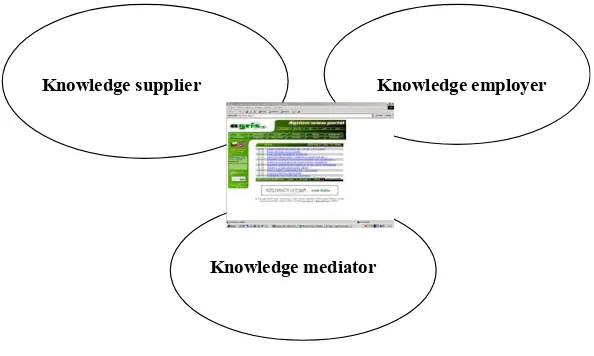
The knowledge portal supports as a basic element the “knowledge”. The basic aim of knowledge portal is to interconnect users who have user knowledge, and it is also important to use this knowledge of in-dividuals for the knowledge of business. The portal of knowledge works with the particular knowledge, which can be gained from documents and with the informal knowledge, which is the unspoken knowl-edge of business employees. The interconnection of individuals is important because very often it is true that to find the right information means to find the right person first. The portal enables users to find the information about those who have the information he seeks for and where the persons can be found (Figure 1).
learning portals and the european e-learning programme
information and communication technologies con-tribute to the higher quality of training and education. Ján Figel, commissioner for Education, declared:
developments constitute an enormous challenge; one of the answers to this problem is the access o lifelong learning.”
“The eLearning initiative of the European commis-sion seeks to mobilise the educational and cultural communities, as well as the economic and social players in Europe, in order to speed up changes in the education and training systems for Europe’s move to a knowledge-based society” (hughes 1994).
The EU member states are supported by the European commission in this field. Through the eLearning ini-tiative, they could gain experience in encouraging cooperation, and exchange of good practice, it is a further step towards the vision of technology serving life-long learning.
Four lines can be followed:
– promoting digital literacy (icT contribution to learning particularly to those who have not an easy access to the traditional education and training)
– european virtual campuses (this line builds on the existing cooperation programmes such as Erasmus with an e-learning component, encourages new organisational models for European universities: virtual campuses, virtual mobility)
– etwinning of schools in europe and the promo-tion of teacher training (the aim is to support networking among schools: taking part in educa-tional projects with counterparts in other Euro-pean countries, fostering a EuroEuro-pean dimension in education and awareness of multilingual and multicultural societies, updating teachers’ profes-sional skills in the pedagogical and collaborative use of icT (hughes 1994).
Learning portal can depict and provide information for users according to their educational plan or their personal priorities. The following characteristics will be important for a final user:
– report setups about every training course
– tools for communication among participants of the training
– support in a form of hints
– providing the users with a certain space for storing of adjusted materials
– it can contain the tool for content creation and an electronic signature
– search possibility
– personalisation possibility
– well-arranged
Learning portals can be divided into internal and external ones. The external portal is a public envi-ronment which is accessible to most organisations by the means of the internet.
The internet is often described as the biggest com-munication revolution since the advent of the printed book. nowadays it is a thriving community with many millions of people exchanging information, ideas and opinions (Dudeney 2006). The internet is the largest, most powerful computer network in the world connecting personal computers, sophisticated mainframes and high speed supercomputers around the globe. With access to the internet, educators and students can use the World-Wide Web (WWW). officially WWW is described as a “... wide-area hy-permedia information retrieval initiative aiming to give universal access to a large universe of documents” (hughes 1994).
in 1989, a group of scientists at the European Labo-ratory for Particle Physics (cErn) in geneva started to develop an internet tool that would link informa-tion produced by all of the cErn researchers. The tool provided a way to link textual information on different computers and created by different scien-tists. The objective was to overcome the issues of incompatibility and utilize a new way of linking made possible by computers, called “hypertext”. rather than Knowledge supplier Knowledge employer
[image:4.595.69.366.68.246.2]Knowledge mediator
presenting information in a linear or hierarchical way, hypertext permits information to be linked in a web-like structure. Users can dynamically criss-cross the information web in the order most convenient to them. The cErn project resulted in an innova-tive front-end to the internet, now referred to as the World-Wide Web.
in 1993, the national center for Supercomputing Applications (ncSA) at the University of illinois pushed the cErn scientists idea further by creating a software tool called Mosaic. it is a tool that permits text, graphics, sound and video to be hyperlinked. Mosaic was the first of the internet tools that are now referred to as “Web browsers”. other well-known browsers include netscape and Microsoft’s internet Explorer. Web browsers permit users to connect to the internet and facilitate access to information located on another remote computer.
The WWW provides users with convenient means of accessing the wide variety of resources available on the internet.
The advantage of the external portal for organisa-tions consists in the possibility to insert the content externally and not to overload the capacity of inter-nal sources. By the means of the portal, there are generated topical data for the creation of teaching materials.
on the contrary, the internal portal is a private and secured environment, which only the employees of the given firm, which runs the portal for its own purposes, have the chance to access. The internal portal will be integrated with the information system of the human resources department.
The following conditions will be important for an educational portal:
– fewer costs for education
– more topical information
– absorption of information dependent only on a student
– the form of information that can be better re-tained
– more possibilities to test the knowledge
– removal of psychical barriers
– an equal content for all students
– the higher level of interactivity.
discussion
All managers require quality information to make their decisions, which should be the most responsible. however, information without context is of just a little value. The context is given by a particular content or question which require an active intervention. Let
us follow for instance a hypermarket. The manager would like to get the information about the sale of dairy products last week and about the subsidiaries that reached 75% of the forecast sale.
The context has three dimensions:
– theme – the volume of dairy products sale against the prognosis
– time – last week
– space – situation in the czech market, situation in Europe.
As the example shows, such a manager needs to have the access to information which helps him to find the answer for the whole number of continu-ously changing questions – is the situation caused by the competition approach, did the changes in the approach of customers occur, was the change caused by a price rise? From this example, it is clear that the manager needs information and knowledge embedded into proper consequences, and also the information and knowledge which exceed this area of consequences. The manager must be able to join both these areas and find solutions which will keep a company minimally on its competition level.
getting the approach to information in a proper con-text is a necessary, however not sufficient, condition of the real active acting. Managers must be capable of entering into the interactions with the informa-tion system, ask new quesinforma-tions and formulate new hypotheses. it requires creating such an information strategy, which enables to establish contacts with other managers, to use other specialist knowledge and to cooperate with them on the conclusions formulation. Managers are of a diverse character, they differ from each other in the access to information, knowledge formulation and in finding solutions. The systems supporting managerial decisions usually minimalize this difference. During the effort to meet the manag-ers’ demands, other functions are incorporated into the system, and this system becomes too difficult, less user friendly, and it does not meet the needs of managers.
if the managers are to create the value, they must be able to join the dialogue in the context of the particu-lar event. That of course means that they must have the access to information and knowledge about the best and also new practical approaches. The system should support the context demands for a dialogue. The demands can be different with various individuals and they will differ from project to project. Managers must have access to information on different levels of details. Various managers in the same organization will have different information needs. There will be different needs with the managers who decide about the investment into the construction of new produc-tion equipment, and those who ensure daily running of the production.
however, the support of a general context of an event has the essential significance. one manager can devote to different activities in a different period of time – once to everyday running activity, once to the optimalization of sources and once to planning. The system must enable managers the access into the system according to their roles.
one of the most important activities of every man-ager is to ask new, unusual questions. however, most information systems are created in such a way in order that they could provide the answers for the already known questions, presented in a standardised form. if the experience should be in the centre of the man-ager’s attention, he must be able to understand the context of events. if the firms want to concentrate on experience, their information systems must be focused on the needs of managers and they must strengthen their personal efficiency, while co-form-ing the value.
At the end of 2006 and in the first half of 2007, the examination in a randomly chosen sample of the firms was carried out. Middle-size firms and large-size firms were examined. The examination was focused on finding out in which way the managers of the firms get the information for managing. The examination was carried out in 148 firms. The respondents an-swered the question in what way the managers get information for the management.
The way of getting information for the management
– External and internal
– regular reports
– on-line + inquiries
– Excell
– Meetings
– Business intelligence
Acquiring information for managing in the firms is diverse. nowadays most users use information
acquired directly from an information system. only 13% of the respondents get the information for man-aging from regular meetings that are held once in a week at a minimum, from that 67% of the respond-ents answered that the meetings were held twice in a week or more often, particularly in the firms that are oriented on business activity. Most of the respondents (59%) work with information got on the basis of a regular report. The quality of these reports is dependent on the ability of the managing worker to define his requirements as far as the content is concerned. regular reports are not able to support context requirements for the dialogue. They are di-rectly dependent on the skills of the worker who defines them. An ideal situation occurs when the managing worker directly defines his/her dialogue demands that correspond to the particular situation. Such a solution offers the usage of on-line inquiries, or the usage of Business intelligence module. From the stated sample of the respondents, 16% use direct inquiry, 8% when forming inquiries work in Excel environment, and 8% take use of software created for this type of a task – Business intelligence.
information needs in the firms and institutions are directly dependent on the orientation of their activities and the position of workers who use infor-mation sources as a tool for managing and planning. The orientation of firms’ and institutions’ activities is given by the stipulated strategy, mission and aims of every subject. The firms must create the system which enables the managers to develop their inquiries on the basis of the particular situation:
(1) information acquired on the basis of context – the managers should have the information connected with the real situation for their effective decision making
(2) individually created notice – every manager must have particularly addressed notice in order that he/she could act on the basis of the real situa-tion
(3) creating rules and procedures coming from ex-perience
conclusion
web access to information and application with the effective possibility of managing and administra-tion. There are groups of users with rather specific information needs for whom a specialized portal is very useful and it is a great contribution for the users, as it follows from examples. it offers “in one place” nearly all services and information that are needed by users for their activities – so that they do not have to waste time searching for this information and for services somewhere else, and can concentrate on their own activities.
RefeRence
Dudeney g. (2006): The internet and the Language classroom, 5th Edition. cambridge University
Press; iSBn 10 0-521-78373-9.
hughes K. (1994): Entering the World-Wide Web: A guide to cyberspace. Enterprise integration Tech-nologies.
Prahalad c.K., ramasvamy V. (2005): Budoucnost konkurence (Future of the competition). Manage-ment Press, Prague; iSBn 80-7261-126-7.
Sodomka P. (2006): informační systémy v podnikové praxi (information systems in a company practice). computer Press, Brno; iSBn 80-251-1200-4.
http://ec.europa.eu/education/programmes/elearn-ing
Arrived on 4th February 2008
Contact address:
Edita Šilerová, czech University of Life Sciences, Faculty of Economics and Management, Department of Agricultural Economics, Kamýcká 129, 165 21 Prague 6-Suchdol, czech republic