Supported by the Ministry of Agriculture of the Czech Republic, Projects No. QH91148 and QJ1210184, and by the Infrastructure of the programme No. CZ.1.05/2.1.00/03.0116.
Development of a System for Testing Apple Resistance
to
Erwinia amylovora
using
In Vitro
Culture Techniques
Jiří SEDLÁK 1, František PAPRŠTEIN 1, Josef KORBA2 and Jana ŠILLEROVÁ2
1Research and Breeding Institute of Pomology Holovousy Ltd., Hořice, Czech Republic; 2Division of Crop Protection and Plant Health,Department of Phytobacteriology,
Crop Research Institute, Prague, Czech Republic
Abstract
Sedlák J., Paprštein F., Korba J., Šilerová J. (2015): Development of a system for testing apple resistance to Erwinia amylovora using in vitro culture techniques. Plant Protect. Sci., 51: 1–5.
The suitability of different in vitro artificial inoculation methods for testing apple resistance to fire blight was evaluated. Six proliferation MS media containing BAP, TDZ or 2iP were tested to determine favourable conditions for shoot development. Out of the tested cytokinins, only media with BAP proved to be useful for all tested cultivars for artificial inoculation with
Erwinia amylovora. Out of three tested inoculation methods, removal of 3 mm of the shoot apex with scissors and transfer of bacterial suspension by pipette (method 1) appeared to be the most suitable technique. This method enabled the deter-mination of susceptibility of two cultivars due to the different speed of fire blight symptom development.
Keywords: fire blight; Malus L.; cultivar; artificial inoculation; medium; growth regulator
Fire blight is caused by the bacterium Erwinia amylovora (Burrill) Winslow et al., a Gram-negative polyphagous bacterium belonging to the family Ente- robacteriaceae (Zwet & Beer 1995). The pathogen commonly infects flowers and shoots of susceptible rosaceous hosts and systemic (whole-tree) invasion sometimes follows (Billing 2011). Fire blight is especially damaging to Maloideae (Pomoideae) sub-family, which includes the pome fruits pear (Pyrus) and apple (Malus) (Momol & Aldwinkle 2000). During the last four decades the pathogen has spread throughout Europe. In recent years, severe infesta-tions have destroyed entire orchard blocks in the Czech Republic and the disease became one of the most serious and hard-to-control threats for com-mercial fruit growing (Blažek 1999; Paprštein & Patzák 2007; Korba & Šillerová 2010, 2011).
To reduce the risk of fire blight incidence and spread in the orchard, several management practices are recommended. One of the best ways to avoid fire blight is not to plant cultivars that are
suscepti-ble. In the long term, the use of fire blight resistant cultivars can be a key sustainable strategy for fire blight control. Most of the current commercial apple cultivars are susceptible or highly susceptible to this destructive disease. On the contrary, several older apple cultivars and landraces exhibited some level of resistance to fire blight (Paprštein & Patzák 2007). Reliable tools for identifying the pathogen and a satisfactory system for cultivar susceptibility testing can play a major role in the management of the disease. This was the reason why a project aimed at testing the resistance of apple landraces and older cultivars grown on the territory of the Czech Republic to fire blight has been started.
rapid multiplication and thousands of plants can be produced per square meter. Recently methods for artificial inoculation with E. amylovora onto plant tissues maintained in safe and controlled in vitro conditions have been the focus of investigation in a number of laboratories worldwide (Hanke & Geider 2002; Abdollahi et al. 2004; Kokošková et al. 2010; Hevesi et al. 2011). The purpose of this study was to test the suitability of different in vitro culture media and methods of artificial inoculation for testing apple resistance to fire blight.
MATERIAL AND METHODS
Proliferationin vitro. The shoot cultures of five apple cultivars (Blenheim, Chodske, Malinove holo-vouske, Boikenapfel, Winter Citronenapfel) used in this study had been established six months prior to the experiment after 1-min sterilisation of initial explants with 0.15% aqueous solution of HgCl2. Ex-plants were taken from shoots sprouting in laboratory conditions. The donor shoots originated from field collections of Research and Breeding Institute of Pomology (RBIP) Holovousy Ltd., Czech Republic. Cultures had been grown on 25 ml culture medium in 100-ml Erlenmeyer flasks (5 shoots/flask) capped with aluminium foil. The basal culture medium con-tained MS salts and vitamins (Murashige & Skoog 1962) supplemented with 100 mg/l inositol, 2 mg/l glycine, 30 g/l sucrose, 1.5 mg/l 6-benzylaminopurine (BAP), and 7.0 g/l Difco Bacto agar. The medium was adjusted to pH 5.8 with NaOH. All shoot cultures were kept in growth chamber at 22 ± 1°C with a 16-h photoperiod. Illumination was provided by Sylvania F18W cool white fluorescent tubes 30 cm above the level of cultures. For a period of six months, all shoot cultures were serially subcultured in monthly intervals on a fresh medium. This provided a stock collection of shoots for proliferation studies.
To determine favourable conditions for shoot initiation and development, six proliferation MS media containing 1, 2, and 4 mg/l BAP, 0.5 and 1 mg/l thidiazuron (TDZ) or 10 mg/l 2iP (6-(γ,γ-di- methylallylamino purine) were tested. The medium and specific concentrations of growth regulators were chosen based on the results of our previous studies with pome fruitmicropropagation. One hundred uniform single shoot tips (5–10 mm in length) ex-cised from apical parts of established proliferating cultures were used in all multiplication experiments. After four weeks the explants were removed and
dis-sected to determine the number of shoots (> 10 mm) that had proliferated from the initial single shoot. Treatment means were compared with the standard error (SE) of the mean.
In vitro inoculation with E. amylovora. The isolate of E. amylovora used in this study was a virulent strain (Ea 8/95). The strain was obtained from necrotic tissues of hawthorn (Crataegus × monogyna). The inoculum was prepared from 24 h cultures grown at 27°C on meat infusion agar. The cultures were rinsed with distilled water and bacterial suspension collected.
Three methods of artificial inoculation of in vitro shoot cultures were investigated regarding their reli-ability in the estimation of E. amylovora resistance of apple cultivars: (1) removal of 3 mm of the shoot apex with scissors and careful transfer of bacterial suspension (3 μl) to the cut area by pipette, the devel-opment of the infection was observed after 3, 5, and 9 days, (2) crushing the leaf blade with forceps that had been dipped into the inoculum prior to crushing, the development of the infection was observed after 1, 5, and 9 days, and (3) injecting 250 µl of inoculum into the cultivation flask containing in vitro shoot tip cultures by spray, the development of the infection was observed after 1, 5, and 9 days. Based on the results of our previous experiments (data not shown), methods 2 and 3 were more destructive for in vitro plants than method 1 and the first symptoms were therefore observed already after one day.
Three concentrations of inoculum 103, 106, and 109
colony forming units (CFU) per ml and ten actively growing in vitro shoots of each cultivar were used in each inoculation experiment. Each experiment was repeated three times. Proportion of bacterial lesion in % to the total length of the shoots was calculated. Two apple cultivars – Blenheim as resistant and cv. Boikenapfel as susceptible – were selected for artificial inoculation experiments with E. amylovora. The level of resistance of these two cultivars was previously verified by artificial inoculation in field conditions.
RESULTS
On all media with BAP, cv. Chodske was the cultivar with the highest multiplication intensity. BAP in higher concentrations of 2 or 4 mg/l induced sufficient multipli-cation also in cvs Blenheim and Holovouske malinove. TDZ in concentration of 0.5 mg/l for cvs Blenheim and Winter Citronenapfel and 1 mg/l for cv. Holo-vouske malinove was superior to BAP and 2iP in the ability to induce the production of new shoots.
The lowest proliferation rates (1.1 and 1.2) were noted for cvs Winter Citronenapfel and Chodske on medium containing 10 mg/l 2iP. In vitro plants of these cultivars on medium with 2iP were of poor quality and developed symptoms of yellowing and necrosis. Phytohormone 2iP also did not promote marked multiplication of the remaining three apple cultivars and multiplication rates were relatively low in comparison with BAP and TDZ. On media with 2iP, cvs Blenheim and Malinove holovouske, moreover, produced excessive callus at the lower third of explants.
In vitro inoculation with E. amylovora. Out of the tested cytokinins, only media with phytohormone BAP proved to be useful for all tested cultivars for artificial inoculation with E. amylovora. Callused shoots of cvs Blenheim, Boikenapfel, and Winter Citronenapfel from media with TDZ could not be used directly in subsequent artificial inoculation studies. Medium with phytohormone 2iP (10 mg/l) did not promote satisfactory proliferation and ad-ditionally necrotic shoots were observed in the case of cv. Winter, cvs Citronenapfel and Chodske, and excessive callusing in the case of cvs Blenheim and Malinove holovouske.
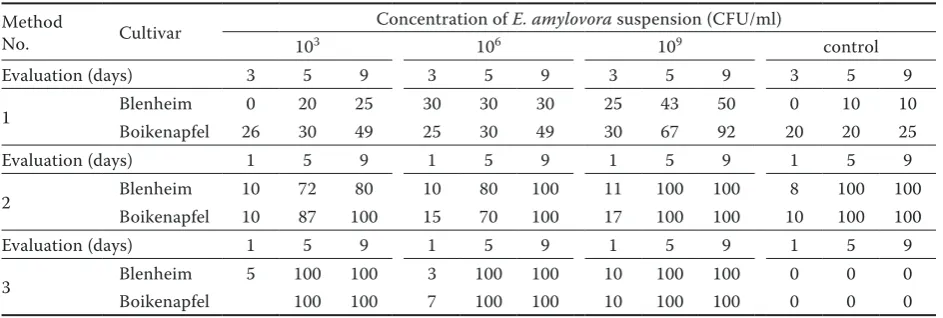
[image:3.595.64.536.123.267.2]Out of the three tested artificial inoculation meth-ods, removal of 3 mm of the shoot apex with scissors and careful transfer of bacterial suspension (3 µl) to the cut area by pipette (method 1) appeared to be the most suitable technique. After three days, the proportion of bacterial lesion was between 25% and 30% according to inoculum concentration in Table 1. Shoot multiplication rates for apple genotypes ± SE
Cytokinin (mg/l) Blenheim Chodske Malinove holovouske Boikenapfel Winter Citronenapfel BAP
1 1.5 ± 0.1 2.0 ± 0.1 1.7 ± 0.1 1.7 ± 0.1 1.4 ± 0.1
2 3.5 ± 0.2 4.1 ± 0.1 2.3 ± 0.1 2.4 ± 0.1 1.9 ± 0.1
4 2.7 ± 0.2 5.0 ± 0.2 2.6 ± 0.1 1.8 ± 0.1 2.1 ± 0.1
TDZ
0.5 3.9 ± 0.1z 3.1 ± 0.1 1.7 ± 0.1 2.0 ± 0.1z 2.7 ± 0.1
1 2.4 ± 0.1z 4.3 ± 0.1 4.3 ± 0.2 2.1 ± 0.1z 1.3 ± 0.1z
2iP
10 1.9 ± 0.1z 1.2 ± 0.0y 2.5 ± 0.1z 1.8 ± 0.1 1.1 ± 0.0y
ynecrosis; zcallus formation at the base of explants; BAP – 6-benzylaminopurine; TDZ – thidiazuron; 2iP – (6-(γ,γ-dimethyl-
allylamino purine
Table 2. Comparison of methods of in vitro inoculation by E. amylovora (Ea 8/95) according to proportion of bacterial lesion (in %)
Method
No. Cultivar
Concentration of E. amylovora suspension (CFU/ml)
103 106 109 control
Evaluation (days) 3 5 9 3 5 9 3 5 9 3 5 9
1 Blenheim 0 20 25 30 30 30 25 43 50 0 10 10
Boikenapfel 26 30 49 25 30 49 30 67 92 20 20 25
Evaluation (days) 1 5 9 1 5 9 1 5 9 1 5 9
2 Blenheim 10 72 80 10 80 100 11 100 100 8 100 100
Boikenapfel 10 87 100 15 70 100 17 100 100 10 100 100
Evaluation (days) 1 5 9 1 5 9 1 5 9 1 5 9
3 Blenheim 5 100 100 3 100 100 10 100 100 0 0 0
[image:3.595.63.535.611.770.2]the case of susceptible cv. Boikenapfel (Table 2). The first symptoms of E. amylovora infection were in the form of droplets of bacterial exudate. Nine days after inoculation, symptoms reached levels of 490–92% and fully developed into typical fire blight necrosis. In the case of more resistant cv. Blenheim, the first symptoms were noted as late as the 5th day
after inoculation in the case of the lowest inoculum concentration (103). The further development of
symptoms was slower, when compared to susceptible cv. Boikenapfel in all concentrations. The method 1 enabled the determination of susceptibility of two cultivars due to the different speed of fire blight symptom development.
The remaining two methods were not suitable, because they did not enable discrimination of cul-tivars according to their susceptibility. Concerning method 2, extensive necrosis of plants caused by the forceps was indistinguishable from the reaction to pathogen. In the case of both cultivars, the length of bacterial lesion exceeded two thirds of in vitro shoot length in all inoculum concentrations on the 5th day after inoculation.
In the case of method 3, excessive bacterial con-tamination of plant material and cultivation media was noted after injection of bacterial suspension into the cultivation vessel. On the 5th day, this
con-tamination reached 100% of the plant surface and cultivation media.
DISCUSSION
Sufficient multiplication on media containing BAP in higher concentrations of 2 or 4 mg/l is in accord-ance with the results of previous studies (Sarwar et al. 1998; Sedlák & Paprštein 2008; Jafarkhani Kermani et al. 2009) that adenine-type synthetic cytokinin BAP significantly stimulate adventitious in vitro shoot formation and axillary bud growth in rose family.
TDZ as a substituted phenylurea compound was reported to be a highly efficacious bioregulant of morphogenesis in the tissue culture of many plant species (Murthy et al. 1998; Bommineni et al. 2001). Our study proved that TDZ can be used in vitro as a substitute for purine based cytokinins in the cultural phase of shoot multiplication. However, in vitro cultures of cvs Blenheim, Boikenapfel, and Winter Citronenapfel produced excessive callus at the lower third of explants on media with TDZ. Similar results were obtained in our previous experiments with pear
cultivars (Sedlák & Paprštein 2009). It seems that increased TDZ content is also highly associated with in vitro formation of callus in responsive genotypes in Maloideae subfamily.
A low shoot number obtained on media with 2iP is not satisfactory for larger in vitro shoot production needed for artificial inoculation with E. amylovora.
Only method 1 (removal of the shoot tip with scissors and careful transfer of bacterial suspension to the cut area by pipette) appeared to be a suitable technique enabling discrimination of cultivars ac-cording to their susceptibility. Our results are in accordance with results of Kokošková et al. (2010), who also noted extensive injury of in vitro pear plants as a result of crushing with forceps.
CONCLUSION
Apple cultivars in this study differed in their mul-tiplication and development potential. The observed differences in multiplication under the influence of exogenous cytokinins could result from the different genetic composition and related control of auxin and cytokinin metabolisms of apple tissue.
Results of artificial inoculation of in vitro cultures by E. amylovora indicate the possibility of using in vitro plants for testing pome fruit for resistance to fire blight. The advantage of the in vitro cultivation system is the possibility to test all year round in an area of only several square metres. Moreover, the influence of rootstock or interstem on the level of resistance of the tested cultivar is eliminated with this method.
References
Abdollahi H., Rugini E., Ruzzi M., Muleo R. (2004): In vitro
system for studying the interaction between Erwinia amylovora and genotypes of pear. Plant Cell, Tissue and Organ Culture, 79: 203–212.
Billing E. (2011): Fire blight. Why do views on host inva-sion by Erwinia amylovora differ? Plant Pathology, 60: 178–189.
Blažek J. (1999): Hodnocení citlivosti odrůd a genotypů hrušní po přirozené infekci spálou růžovitých (Erwinia amylovora). Vědecké práce ovocnářské, 16: 91–101. Bommineni V.R., Mathews H., Samuel S.B., Kramer M.,
Wagner D.R. (2001): A new method for rapid in vitro propa-gation of apple and pear. HortScience, 36: 1102–1106. Hanke V., Geider K. (2002): A new approach to evaluate
Hevesi M., Végh A., Tóth M., Benczur E., Palkovics L. (2011): Investigating the virulence of Erwinia amylovora
isolates by using apple tissue culture and pear fruit. Acta Horticulturae (ISHS), 896: 223–230.
Jafarkhani Kermani M., Hosseini Z.S., Habashi A.A. (2009): A refined tissue culture medium for in vitro proliferation of apple rootstocks. Acta Horticulturae (ISHS), 829: 313–318.
Kokošková B., Marhulová G., Zouhar M. (2010): New test of patogenity for the causal agent of fire blight. Za- hradnictvi, 7: 51–53.
Korba J., Šillerová M. (2010): Bakteriální spála ružovitých rostlin. Zahradnictví, 6: 11–13.
Korba J., Šillerová M. (2011): First occurrence of fire blight on apricot (Prunus armeniaca) in Czech Republic. Acta Horticulturae (ISHS), 896: 289–292.
Momol M.T., Aldwinkle H.S. (2000): Genetic diversity and host range of Erwinia amylovora. In:Vanneste J.L. (ed.): Fire Blight: The Disease and its Causative Agent
Erwinia amylovora. Wallingford, CABI Publishing: 55–72. Murashige T., Skoog F. (1962): A revised medium for rapid
growth and bioassays with tobacco tissue cultures. Physio- logia Plantarum, 15: 473–497.
Murthy B.N.S., Murch S.J., Saxena Praveen K. (1998): Thidi-azuron: A potent regulator of in vitro plant
morphogen-esis. In Vitro Cellular & Developmental Biology – Plant, 34: 267–275.
Paprštein F., Patzák J. (2007): Spála růžovitých u jádro- vin a molekulární genetika. Holovousy, Výzkumný a šlechtitelský ústav ovocnářský Holovousy s.r.o..
Sarwar M, Skirvin M.R., Kushad M., Norton M.A. (1998): Selecting dwarf apple (Malus domestica Borkh.) trees
in vitro: multiple cytokinin tolerance expressed among three strains of ‘McIntosh’ that differ in their growth habit under field conditions. Plant Cell Tissue and Organ Culture, 54: 71–76.
Sedlák J., Paprštein F. (2008): In vitro shoot proliferation of sweet cherry cultivars Karesova and Rivan. Horticultural Science, 35: 95–98.
Sedlák J., Paprštein F. (2009): In vitro proliferation of newly bred Czech pear cultivars. Acta Horticulturae (ISHS), 839: 87–92.
Zwet van der T., Beer S.V. (1995): Fire Blight – Its Nature, Prevention, and Control: A practical guide to integrated disease management. Agriculture Information Bulletin No. 631. Washington, United States Department of Ag-riculture.
Received December 2, 2013 Accepted after corrections December 4, 2014
Corresponding author: