The main role of organic mulches in vegetable crops cultivation is to protect the soil surface from the influence of unfavorable factors and to improve the growing conditions for the crop plants (Derek et al. 2006, Olfati et al. 2008). They reduce soil wind and water erosion (Feldman et al. 2000), conserve soil moisture (Sinkevičienė et al. 2009) and help maintain stable soil temperature (Kar and Kumar 2007). Mulch increases soil poros-ity and suppresses weed growth (Uwah and Iwo 2011). Björkman and Pearson (1998) and Tan et al. (2000) claim that plant’s growth conditions are the main determinant of the quality of their yield. The application of plastic covers can have a sig-nificant influence on the vegetables yield. Covers are used to modify plants environment in order to optimize plants growth, increase yields and improve their quality. The profitable conditions under the covers resulted in higher yield for sweet pepper (Ibarra-Jimenez and Rosa-Ibarra 2004), Chinese cabbage (Moreno et al. 2002), early
po-tato (Hamouz et al. 2007). According to Gordon et al. (2010) an increase in soil temperature and moisture under covers will not always cause an increase in the yield of plants.
The study aimed to determine the effect of plant covering with polypropylene fibre and soil mulch-ing with organic mulch on the yield and quality of broccoli cultivated for early harvest.
MATERIAL AND METHODS
Experimental site. The experiment was car-ried out between 2010–2012 at the Experimental Station of the Siedlce University of Natural Sciences and Humanities, which is located in central-east-ern Poland (52°03'N, 22°33'E). According to the international system of FAO classification, the soil was classified as Luvisol (WRB FAO 1998). The total contents of macroelements in mg/L air dried matter amounted to 34 for phosphorus,
The yield and quality of broccoli grown under flat covers
with soil mulching
E. Kosterna
Siedlce University of Natural Sciences and Humanities, Siedlce, Poland
ABSTRACT
The experiment was carried out between 2010 and 2012. Effect of plants covering and the kind of organic mulch applied to soil mulching on the yield and selected component of nutritive value in Milady F1 broccoli cultivated for early harvest was investigated. The application of polypropylene fibre contributed to a significant increase in the marketable yield of broccoli on average by 5.25 t/ha, weight of head by 0.10 kg and length of arc by 1.44 cm. Increase of the content of chemical components as a result of plants covering amounted to 1.76% for dry matter, 2.50 mg/100 g fresh matter (FM) for ascorbic acid, 0.65% FM for total sugar and 0.15% FM for monosaccharides. All kinds of straw contributed to an increase in the broccoli yield and improvement its parameters. The highest mar-ketable yield and weight of head was obtained in the plots mulched with buckwheat straw. Irrespective of covering, cultivation on the mulch with buckwheat straw contributed to a slight decrease in dry matter, total sugars content, whereas cultivation on the rye straw decreased ascorbic acid content.
Keywords: polypropylene fibre; organic mulch; Brassica oleracea L. var. italica Plenck; Lycopersicon esculentum
Mill.; chemical composition; vegetable
83 for potassium, 36 for magnesium, 14 for NO3-N, 7 for NH4-N and 260 for calcium.
Experimental design. The experiment was estab-lished as a split-block design with three replicates. Effect of plants covering (without cover, under polypropylene fibre) and the kind of straw ap-plied to soil mulching (rye, corn, rape, buckwheat) was investigated. The effect of straw mulch was compared to a control plot without mulch. The influence of examined factors on the yield and selected component of nutritive value in Milady F1 broccoli was investigated.
Field work. The forecrop for broccoli was triti-cale. In the autumn preceding broccoli cultivation, ploughing was performed and organic manure at a rate of 30 t/ha was incorporated. In the spring, two weeks before seedlings were planted, disc harrowing was applied. After that, mineral fertil-izers were applied in the amount of supplementary content to the optimal level for broccoli: 110 kg N, 43 kg P, 183 kg K per 1 ha.
Before the seedlings were planted, a particular type of straw at a dose of 10 t/ha was applied. In the case of rye and rape straw, the thickness of the mulch layer amounted, on average, to 7–8 cm. In the case of corn straw, the mulch layer amounted to about 5 cm, however for buckwheat straw the average was 8–10 cm.
Broccoli seedlings were grown in a non-heated greenhouse. Seeds were sown in the successive study years on the 19th, 18th and 20th of March. Plants were
planted on the 19th, 18th and 23rd of April, at a
spac-ing of 50 × 50 cm. After plants where planted suit-able combinations were covered with polypropylene fibre Pegas Agro 17UV (Rybnik, Poland). The cover
was removed after 4 weeks. After that 50 kg N/ha was applied (top dressing).
Sample collection and laboratory analysis. Broccoli was harvested by hand on 30 June in 2010, and 28 June in 2011 and 2012. During the harvest was determined: marketable yield, weight of marketable head, length of broccoli arc and stalk diameter. From each plot a head sample was taken to perform chemical analyses. The following was determined:
– dry mass – by drying to the constant weight at 105°C;
– l-ascorbic acid – by the Tillmans method (Polish Standard PN-A-04019);
– total sugars and monosaccharides – by the Luff-Schoorl method.
Statistical analysis. The results were statisti-cally analysed by means of the analysis of variance (ANOVA) following the model for the split-block design. The significance of differences was deter-mined by the Tukey’s test at the significance level of α = 0.05.
Weather and soil conditions. Years 2010 and 2012 were characterized by a similar temperature during the growing period and favorable rainfall distribution for growing and development of broc-coli (Figure 1). The least favorable conditions for broccoli growth were in 2011, which was charac-terized by high mean air temperatures compared with the other study years but insufficient quantity of rainfall.
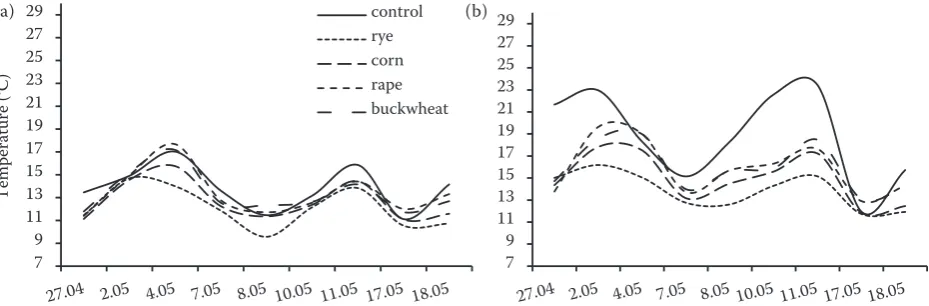
During the plant’s growing period, measurement of the soil temperature was performed at a depth of 10 cm in all objects of experience, at 800 a.m.
and 200 p.m. (Figures 2 and 3). Soil temperature
0 5 10 15 20 25
0 5 10 15 20 25 30 35 40 45 50
1 2 3 1 2 3 1 2 3
April May June
A
ir
te
m
pe
ra
tu
re
(ºC
)
Pr
eci
pi
ta
tio
n
(mm
)
2010 2011 2012
2010 2011 2012
[image:2.595.137.455.557.734.2]Month/decade
in the cultivation under polypropylene fibre was higher than in non-covered plot. The increase in soil temperature under cover amounted to 1.2°C in the morning and 1.8°C in the afternoon. The soil temperature in the plots without straw mulch, both at 800 a.m. and 200 p.m. in non-covered plot
and under polypropylene fibre was higher than in plots mulched with straw.
RESULTS AND DISCUSSION
The highest yield (23.15 t/ha) and weight of head (0.64 kg) was obtained in 2010, the most favorable for broccoli cultivation (Figures 4 and 5). In 2010 significantly higher yield and weight of head was obtained from the plots mulched with rye, corn and buckwheat straw. The yield and weight of head achieved from objects with buckwheat straw were 1.5 times higher compared to those without straw. In 2012 all kinds of straw contributed to a significant increase in the marketable yield and weight of broccoli head. The yield of broccoli in the plots mulched with buckwheat straw was
almost 2.0 times higher and weight of head was above 1.5 times higher. In the study by Awodoyin et al. (2007) mulching increased growth of plants and yield of tomato fruit. According to authors it was possible through modification of the growing environment. In the studies by Samaila et al. (2011a) mulching increased total yield of tomato compared with non-mulched plot. Sinkevičienė et al. (2009) reported that yield of vegetables depended on the kind of mulch application to soil mulching. The authors found that yields of vegetables from plots mulched with grass were the highest, from the objects with straw and peat substrate mulch they were similar – however, sawdust was less useful as mulch.
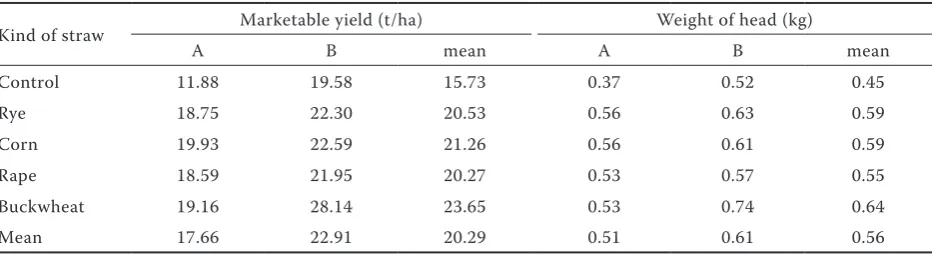
The study results showed a significant influence of the interaction between the covering and the kind of straw on the yield level and weight of head (Table 1). In the non-covered combination all kinds of straw contributed to a significant increase in the marketable yield and weight of head compared to a control plot. In the covered plots the highest yield and weight of head was obtained from the plots mulched with buckwheat straw. The increase 7
9 11 13 15 17 19 21 23 25 27 29
Tem
per
at
ur
e (
°C)
control rye corn rape buckwheat
8a.m.
7 9 11 13 15 17 19 21 23 25 27
[image:3.595.66.530.83.231.2]29 2 p.m.
Figure 2. Soil temperature on different kind of straw at (a) 800 a.m. and (b) 200 p.m. in non-covered combination
7 9 11 13 15 17 19 21 23 25 27 29
Tem
per
at
ur
e (
°C)
control rye corn rape buckwheat 8a.m.
7 9 11 13 15 17 19 21 23 25 27
29 2 p.m.
Figure 3. Soil temperature on different kind of straw at (a) 800 a.m. and (b) 200 p.m. in covered combination
(a) (b)
[image:3.595.67.532.589.742.2]in the marketable and total yield of Chinese cab-bage as a result of plant covering was reported in the study by Moreno et al. (2002). The marketable yield was higher by 486% and total yield by 108%. In the study by Gordon et al. (2008) early mar-ketable yields of squash were lowest from plants grown on bare soil with a row cover followed by bare soil alone. The highest early marketable yield was obtained from combined cultivation of black mulch with a row cover.
A significant influence of the investigated fac-tors on the length of arc and stalk diameter was found (Table 2). In the cultivation without cover the best length of arc was observed at heads from plots mulched with rye straw. However, all kinds of straw contributed to an increase in the stalk diameter compared to non-mulched control. In the cultivation under cover broccoli heads cul-tivated on the corn and buckwheat straw longer arc had. The heads with higher stalk diameter were obtained from objects mulched with
buck-wheat straw. Olfati et al. (2008) showed that all organic mulches had a significant influence on the increased length of carrot roots. However, the authors did not find differences in the height of plants or root diameter. The increase of tomato fruits diameter as a result of soil mulching with straw was found by Samaila et al. (2011a). In the study by Gordon et al. (2008) squash plants grown with mulch and row covers were taller and have higher stalk diameter than those grown with plastic mulch alone or on bare soil.
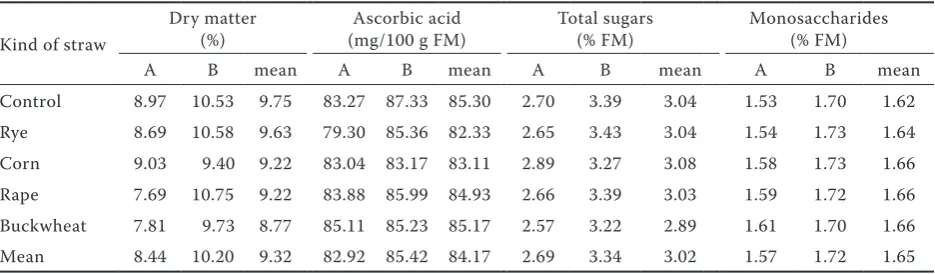
The chemical composition of vegetables is geneti-cally determined as well as it is modified by factors affecting the plant during growth (Lee and Kadar 2000). At conducted research the content of dry matter in broccoli ranged from 7.69% to 10.75% (Table 3). A similar content of this component was found by Grabowska et al. (2009). The con-tent of ascorbic acid amounted to 84.17 mg/100 g fresh matter (FM). In the study by Yildirim et al. (2007), the content of vitamin C ranged from 81 to 0
5 10 15 20 25 30
2010 2011 2012
Yi
eld
(t
/ha
)
control rye
corn rape
buckwheat
a a
bc bc ab
c
a a a a
a
b bc bc
c
0 0.1 0.2 0.3 0.4 0.5 0.6 0.7 0.8
2010 2011 2012
W
ei
gh
t (
kg)
control rye
corn rape
buckwheat
a a
b b
a b
a a a a a
[image:4.595.64.289.83.223.2]b b b b
[image:4.595.308.532.87.214.2]Figure 4. Marketable yield of broccoli depending on the kind of straw in the successive years of study. Val-ues in rows followed by the same letters do not differ significantly at α = 0.05
Figure 5. Weight of marketable head depending on the kind of straw in the successive years of study. Values in rows followed by the same letters do not differ sig-nificantly at α = 0.05
Table 1. Marketable yield of broccoli and weight of marketable head (mean for 2010–2012)
Kind of straw Marketable yield (t/ha) Weight of head (kg)
A B mean A B mean
Control 11.88 19.58 15.73 0.37 0.52 0.45
Rye 18.75 22.30 20.53 0.56 0.63 0.59
Corn 19.93 22.59 21.26 0.56 0.61 0.59
Rape 18.59 21.95 20.27 0.53 0.57 0.55
Buckwheat 19.16 28.14 23.65 0.53 0.74 0.64
Mean 17.66 22.91 20.29 0.51 0.61 0.56
HSD0.05 for marketable yield: covering – 3.77; kind of straw – 2.54; interaction covering × kind of straw – 3.54;
[image:4.595.65.532.584.711.2]115 mg/100 g FM. An average content of total sug-ars and monosaccharides in broccoli amounted to 3.02% FM and 1.65% FM, respectively. In the study by Grabowska et al. (2009) the content of mono-saccharides amounted from 0.54% to 1.53% FM.
A significant influence of the covering and kind of straw on the content of investigated components in broccoli was found (Table 3). In the study by Moreno et al. (2002) an application of polypro-pylene fibre contributed to increased dry matter content in the Chinese cabbage on average by 18% and ascorbic acids content by 7%, which is confirmed in the present study.
In the cultivation without covering more dry matter was found in heads from plots mulched with rye and corn straw and control plot. In turn, ascorbic acid content decreased at soil mulching with rye straw. The highest content of total sugars was found in heads from the plots mulched with
corn straw and monosaccharides with corn, rape and buckwheat straw. Parmar et al. (2013) were found that soil mulching with straw and dry leaves slightly reduced flesh acidity of melon but caused an increased monosaccharides and total sugars contents. In the studies by Samaila et al. (2011b) mulch with straw contributed to increased dry mat-ter, protein and carbohydrate content in tomato.
[image:5.595.64.532.101.229.2]In the cultivation with polypropylene fibre broc-coli from the plots mulched with rye and rape straw and from control plot accumulated more dry matter than cultivated on the corn and buckwheat straw. The higher ascorbic acid content was found in the broccoli from plots mulched with rape straw and non-mulched control. Higher total sugar content was observed in heads from plots mulched with rye than buckwheat straw. In the study by Majkowska-Gadomska (2010) the highest dry matter accumula-tion was noted in the fruit of melon grown in mulched Table 2. Length of broccoli arc and stalk diameter (mean for 2010–2012)
Kind of straw Length of arc (cm) Stalk diameter (cm)
A B mean A B mean
Control 24.02 24.68 24.35 4.11 3.86 3.98
Rye 26.95 26.42 26.68 4.57 4.12 4.35
Corn 24.43 27.01 25.72 4.67 3.95 4.31
Rape 24.56 26.57 25.56 4.76 3.91 4.34
Buckwheat 24.47 26.97 25.72 4.63 4.51 4.57
Mean 24.89 26.33 25.61 4.55 4.07 4.31
HSD0.05 for length of arc: covering – 0.35; kind of straw – 1.54; interaction covering × kind of straw – 0.25; HSD0.05
for stalk diameter: covering – 0.28, kind of straw – 0.27, interaction covering × kind of straw – 0.43. A – without cover; B – under polypropylene fibre
Table 3. The content of selected components of nutritive value of broccoli (mean for 2010–2012)
Kind of straw
Dry matter
(%) (mg/100 g FM)Ascorbic acid Total sugars (% FM) Monosaccharides (% FM)
A B mean A B mean A B mean A B mean
Control 8.97 10.53 9.75 83.27 87.33 85.30 2.70 3.39 3.04 1.53 1.70 1.62 Rye 8.69 10.58 9.63 79.30 85.36 82.33 2.65 3.43 3.04 1.54 1.73 1.64 Corn 9.03 9.40 9.22 83.04 83.17 83.11 2.89 3.27 3.08 1.58 1.73 1.66 Rape 7.69 10.75 9.22 83.88 85.99 84.93 2.66 3.39 3.03 1.59 1.72 1.66 Buckwheat 7.81 9.73 8.77 85.11 85.23 85.17 2.57 3.22 2.89 1.61 1.70 1.66 Mean 8.44 10.20 9.32 82.92 85.42 84.17 2.69 3.34 3.02 1.57 1.72 1.65
HSD0.05 for dry matter: covering – 0.73; kind of straw – not significant; interaction covering × kind of straw – 0.72; HSD0.05 for ascorbic acid: covering – 2.04, kind of straw – 1.23, interaction covering × kind of straw – 2.76; HSD0.05 for total sugars: covering – 0.18; kind of straw – 0.15; interaction covering × kind of straw – 0.19;
[image:5.595.64.532.552.689.2]soil under non-woven polypropylene cover (7.36%), and the lowest (6.15%) – in plants grown under non-woven PP cover only. Plant and soil covering had no significant influence on the ascorbic acid, sugars and organic acids changes.
REFERENCES
Awodoyin R.O., Ogbeide F.I., Oluwole O. (2007): Effects of three
mulch types on the growth and yield of tomato (Lycopersicon
esculentum Mill.) and weed suppression in Ibadan, rainforest-savanna transition zone of Nigeria. Tropical Agricultural
Re-search and Extension, 10: 53–60.
Björkman T., Pearson K.J. (1998): High temperature arrest of
inflorescence development in broccoli (Brassica oleracea var.
italica L.). Journal of Experimental Botany, 49: 101–106. Derek M.L., Rowell A.B., Snyder J.C., Williams M.A. (2006): Weed
control efficacy of organic mulches in two organically managed
bell pepper production systems. HortTechnology, 16: 225–232.
Feldman R.S., Holmes C.E., Blomgren T.A. (2000): Use of fabric and compost mulches for vegetable production in a low till-age, permanent bed system: Effects on crop yield and labor.
American Journal of Alternative Agriculture, 15: 146–153.
Gordon G.G., Foshee W.G., Reed S.T., Brown J.E., Vinson E.L. (2010): The effects of colored plastic mulches and row covers
on the growth and yield of Okra. HortTechnology, 20: 224–233.
Gordon G.G., Foshee W.G., Reed S.T., Brown J.E., Vinson E., Woods F.M. (2008): Plastic mulches and row covers on growth and production of summer squash. International Journal of
Vegetable Science, 14: 322–338.
Grabowska A., Kunicki E., Libik A. (2009): The effects of differ-ent methods of cultivation and plant spacing on the chemical
composition of broccoli heads. Folia Horticulturae, 21: 25–34.
Hamouz K., Dvořák P., Erhartová D. (2007): Effect of polypropyl-ene covering on the yield formation dynamics of early potatoes.
Acta Fytotechnica et Zootechnica, 3: 57–60.
Ibarra Jimenez L., Rosa Ibarra M. (2004): Comparison between microtunnels with polyethylene and polypropylene in cucumber and sweet pepper with plastic mulching. Revista Chapingo,
Serie Horticultura, 10: 133–139.
Kar G., Kumar A. (2007): Effects of irrigation and straw mulch on water use and tuber yield of potato in eastern India.
Agri-cultural Water Management, 94: 109–116.
Lee S.K., Kader A.A. (2000): Preharvest and postharvest factors influencing vitamin C content of horticultural crops.
Posthar-vest Biology and Technology, 20: 207–220.
Majkowska-Gadomska J. (2010): The chemical composition of fruit in selected melon cultivars grown under flat covers with soil mulching. Acta Scientiarum Polonorum, Hortorum
Cul-tus, 9: 39–52.
Moreno D.A., Víllora G., Hernández J., Castilla N., Monreal L.R. (2002): Yield and chemical composition of chinese cabbage in relation to thermal regime as influenced by row covers. Journal of the American Society for Horticultural Science,
127: 343–348.
Olfati J.A., Peyvast Gh., Nosrati-Rad Z. (2008): Organic mulching on carrot yield and quality. International Journal of Vegetable
Science, 14: 362–368.
Parmar H.N., Polara N.D., Viradiya R.R. (2013): Effect of mulching
material on growth, yield and quality of watermelon (Citrullus
Lanatus Thunb) cv. Kiran. Universal Journal of Agricultural
Research, 1: 30–37.
PN-A-04019 (1998): Determine of vitamin C content using the Tillman method.
Samaila A.A., Amans E.B., Babaji B.A. (2011a): Yield and fruit
quality of tomato (Lycopersicon esculentum Mill) as influenced
by mulching, nitrogen and irrigation interval. International Research Journal of Agricultural Science and Soil Science,
1: 90–95.
Samaila A., Amans E.B., Abubakar I.U., Babaji B.A. (2011b):
Nutritional quality of tomato (Lycopersicon esculentum Mill)
as influenced by mulching, nitrogen and irrigation interval.
Journal of Agricultural Science, 3: 266–270.
Sinkevičienė A., Jodaugienė D., Pupalienė R., Urbonienė M. (2009): The influence of organic mulches on soil properties and crop
yield. Agronomy Research, 7: 485–491.
Tan D.K.Y., Wearing A.H., Rickert K.G., Birch C.J. (2000): Broccoli yield and quality can be determined by cultivar and temperature but not photoperiod in south-east Queensland. Australian
Journal of Experimental Agriculture, 39: 901–909.
Uwah D.F., Iwo G.A. (2011): Effectiveness of organic mulch on
the productivity of maize (Zea mays L.) and weed growth. The
Journal of Animal and Plant Sciences, 21: 525–530.
World Reference Base for Soil Resources (WRB FAO) (1998): World Soil Resource Reports FAO, International Soil Refer-ence and Information Centre, International Society of Soil Science, Rome.
Yildirim E., Guvenc I., Turan M., Karatas A. (2007): Effect of foliar urea application on quality, growth, mineral uptake and yield
of broccoli (Brassica oleracea L., var. italica). Plant, Soil and
Environment, 53: 120–128.
Received on February 25, 2014 Accepted on April 9, 2014
Corresponding author: