Prediction Model for Student Dropout Analysis using Data
Mining Algorithms
R. Preethi
1, S. Priyadharshini
2, E. Balraj
31, 2UG Student, 3Assistant Professor, Information Technology, M. Kumarasamy College of Engineering, Karur
Abstract: Online instruction oftentimes manages the high rate of dropout amid a course. There is a colossal measure of chronicled data put away in on the web. Consequently, it winds up important to extend effective technique to predicate the understudies in danger of dropping out. In this paper, we manage the issue by proposing prescient models to give instructive framework the obligation to recognize understudies whom are in as far as possible. Subsequently, this examination work recommend a model which can naturally perceive whether the understudy will proceed with their investigation or drop their examination utilizing arrangement procedure dependent on choice tree. The dropout chance components are recognized by utilizing the information mining properties, for example, visit designs, connections, comparability measures, affiliations rule mining,
I. INTRODUCTION
There are many research thinks about important to e-learning field that exhibits the diverse method for applying AI procedures for different instructive purposes. The principle goal of these examinations are anticipating the rate of dropouts or in danger understudies in remote courses by inspecting the log information gathered from different Learning Management Systems.(LMS). The examination led by Kotsiantis is one of the underlying investigations which researched use of AI strategies in separation learning for dropout expectation. In this examination, time-invariant and time-changing information were incorporated and absolutely six AI systems was utilized, which are Decision Trees, Neural Networks, Naïve Bayes calculation, Instance-Based Learning Algorithms, Logistic Regression and Support Vector Machines. This investigation was made out of two test stages, preparing and testing. Amid these stages, number of properties was expanded well ordered. For instance, while as it were statistic information was incorporated into the initial step, information from the main up close and personal gathering was included the subsequent stage. Six calculations were tried for each these ensuing advances and afterward they were looked at. The vital finish of this investigation is that Naïve Bayes calculation is effective in the expectation of dropouts; it predicts with 83% precision.
II. LITERATURE REVIEW
Bharadwaj and Pal [1], proposed the novel methodology utilizing the choice tree strategy for order to assess the understudies execution. This contextual investigation is to decide the information that portrays understudies' execution in end semester examination. This investigation was very helpful to recognize the dropout's understudy in prior stage and understudies who need extraordinary consideration and enable the guide to take prior regard for the understudies.
El-Halees [2], anticipated a straightforward contextual investigation that usea instructive information mining to break down conduct of understudies learning. The target of his investigation is to indicate how helpful information mining can be utilized in advanced education to improve understudy's execution. They connected systems of information mining to reveal pertinent data from extensive database, for example, affiliation tenets and order rules utilizing choice tree, grouping and exception examination.
Fadzilah and Abdullah [3], They connected information mining methods to enlistment information. Illustrative Analysis and prescient Analysis approaches were utilized. To gather the information into groups dependent on their likenesses, bunch investigation is utilized. For prescient examination, Neural Network, Logistic relapse, and the Decision Tree have been utilized. In the wake of assessing these procedures, Neural Networks classifier was found to give the most elevated outcomes in term of order precision.
III. TECHNIQUE
Achievement rate of any instructive foundation can be dissected by knowing the purposes behind dropout understudy. In this examination, understudy data on different parameters was gathered through Machine Learning archive by Predicting the understudies dropout status whether they intrigued to proceed with their investigation or not, needs heaps of parameters, for example, individual subtleties, scholarly subtleties , family foundation, social, natural, and so on factors are fundamental data for the
successful forecast of properties . Since the present investigation is in connection to arrange and relapsing thedifferent quantitative
and subjective components to recognize the reasons for dropout in the point of view of information revelation and information
mining. To achieve the above goals the accompanying advances were pursued (Fig.1)
A. Preparation of Information
The dataset utilized for this investigation was set up from the UCI Machine Learning Repository. The information traits incorporate understudy grades, statistic, social and school related highlights) and it was gathered by utilizing school reports and surveys. Two datasets are given with respect to the execution in two particular subjects: Mathematics and Portuguese language. In the Two datasets were displayed under paired/five-level grouping and relapse assignments.
Figure 1 - Work Methodology
After accumulation of information, the dataset was set up to apply the information mining systems. Prior to utilization of endorsed demonstrate, information preprocessing was connected to quantify the quality and reasonableness of information. For this, evacuate missing qualities; smoothing uproarious information, choice of applicable characteristic from database or expelling insignificant properties, recognizing or expel anomaly esteems from informational collection, and settling irregularities of information. A portion of the insignificant parameters was expelled from database, for example, ID, age, date of birth, class, conjugal status, condition of residence, first language, religion, the sexual orientation field containing just a single esteem female, since college concerns just female understudies, the conjugal status field containing one esteem unmarried, and so on. An evaluation scale is utilized for assessment of understudy execution at school. "Evaluation An" understudies are viewed as the individuals who have a rate more noteworthy
Formulation of the Problem
Dataset
Pre Processing or Data Cleaning
Data Mining
Data Classification Association Rules
Evaluation of result set
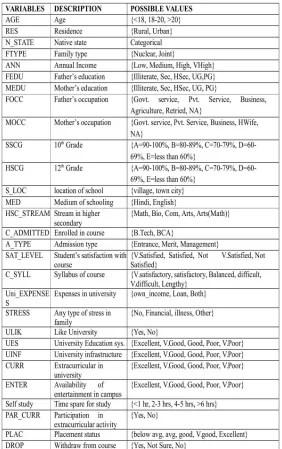
Table 1 – Variables in dataset
Than 8.5, "Evaluation B"- in the range somewhere in the range of 7.5 and 8.5, "Evaluation C"- in the range somewhere in the range of 6.5 and 7.5, and "Grade D" in the range beneath 6.5. A four dimension scale is utilized in the family yearly pay. "VHigh" yearly pay are viewed as the individuals who have salary more prominent than 6 lakhs, "High" yearly pay extend between 4 lakhs and 6 lakhs, "Medium" yearly pay run between 2 lakhs and 4 lakhs and "Low" yearly pay in the range beneath 2 lakhs. A straight out target variable "Dropout status" is built dependent on the perspective on respondents; it has two conceivable qualities "Yes" (understudies who are totally chosen to pull back from their course) and "No" (understudies who are need to proceed with their investigation).
The last dataset utilized for the investigation contains 220 occurrences (183 in the "No" class and 37 are in "Yes" classification) each portrayed with 34 qualities (1 yield and 33 input factors), ostensible and numeric. The examination is restricted to the understudy information for undergrad. At long last, the pre-prepared information were changed into a reasonable configuration to
B. Data Analysis Techniques
After appropriate accumulation, information mining grouping calculations and choice tree approach were utilized to foresee understudy dropout rates and reasons for dropout in starting phase of their examination either previously or after fruition of their first year of their investigation program. Characterization model will be executed by utilizing R instrument. Increasingly number of classifiers accessible in R however ID3 was utilized to actualize this contextual analysis. Trait critical examination was completed to rank the characteristics by importance utilizing data gain. Relationship based Feature choice (CFS) utilizing BFS procedure and Discriminant examination were utilized to rank and choose the characteristics that are generally helpful. A portion of the affiliation rule mining procedure was utilized to find connection between irrelevant factors in vast database.
1) Correlation-Based Feature Selection(CFS): Highlight choice is the procedure to choose a subset of info information examination and future expectation by taking out insignificant data in indicator characteristics. It lessens the intricacy and increment the prescient data. In proposed strategy, the CFS approach is utilized to distinguish include subset which is exceptionally connected with class and least related with traits by utilizing best first inquiry technique. Best First Search strategy starts with void arrangement of highlights and creates all conceivable single component developments. The subset with most noteworthy assessment is picked and extended in a similar way by including single highlights. On the off chance that growing a subset results in no improvement, the hunt back to the following best unexpanded subset and proceeds from that point.
Mi=
( )
Where Mi is the heuristic "merit" of highlight subset S containing K highlights, r_cfis the mean component class relationship
and r_ff is the normal element include between connection. 3.2.2ID3 (Iterative Dichotomizer 3)
ID3 (Iterative Dichotomizer 3) calculation is concocted by J. Ross Quinlan in 1979. It is utilized for building the choice tree utilizing data hypothesis. It manufactures the choice tree from best down methodology with no backtracking. Data Gain is utilized to
choose the best characteristic for order. Calculation:
figure grouping entropy. For all qualities
Ascertain data gain for each property
Select the characteristic with most elevated Information gain Expel the trait
End
2) Entropy: Entropy proportion of vulnerability about a wellspring of message. It lies between 0 to 1.When entropy is 1 implies dataset is homogenous. Entropy is determined by recipe:
E(S) = ∑ −
Where E(S) is the Entropy of S, Pj is the likelihood of S having a place with class j.
3) Information Gain: It gauges the normal decrease in entropy. ID3 figures the Gain everything being equal, and select the one with most noteworthy increase.
G(S,A) = E(S) – ∑ | |
| |
( ) ( )
Where G(S,A) is Information gain ,Sv is the subset of S for which the property A has esteem v, values(A) is the arrangement of every single imaginable incentive for trait A.
C. Evaluating Performance
To assess the execution of grouping rule F-Measure, review, exactness techniques are utilized.
Genuine Positive =
False Negative =
Review =
Exactness =
IV. RESULT & DISCUSSION
The accompanying table speaks to the statistic data's, for example, Age, Category, Martial Students, Resedential Status, Mother Tongue, Relegion, and Family Type of about understudies.
Table2 - Demographic Details of Student
[image:5.595.137.464.177.649.2]
The accompanying diagram speaks to the Educational subtleties of guardians
Figure 2 – Educational Details of Parents
The accompanying table speaks to the dropout rates because of the course picked. Table 3 – Dropout Vs Course Opted
Degree Dropout Due to Course
No Yes Total
BCA 97 31 128
B.Tech 86 6 92
Total 183 37 220
The Following table speaks to the understudies are drop out because of the family reasons. 4.1
10
41.4 44.5
13.6 14.5
42.3 29.5
0 20 40 60
SSLC HSC UG PG
Mothers Education
Fathers Education Demographic
factors
Particulars Frequency
(no. of students)
Percent
Age
Below 18 70 31.8
18-20 131 59.5
20 & Above 19 8.6
Category
General 172 78.2
OBC 45 20.5
SC 3 1.4
Conjugal Status Unmarried 220 100
Private Status Urban Rural 169 76.8
51 23.2
Mother Tongue Hindi Others 209 95
11 5
Religion
Hindu 204 92.7
Jainism 7 3.18
Sikh 7 3.18
Muslim 2 0.9
Family Type Nuclear Joint 115 52.3
Table 4 –
Dropout Family Problem Total
No Yes
No 142 41 183
Yes 18 19 37
Total 160 60 220
Dropout Vs Family Problem
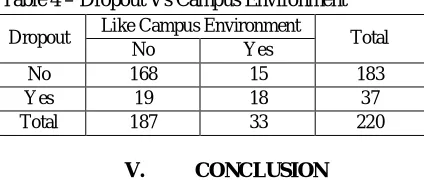
[image:6.595.194.406.241.331.2]The Following table speaks to the understudies are drop out because of abhorrence of grounds condition.
Table 4 – Dropout Vs Campus Environment
Dropout Like Campus Environment Total
No Yes
No 168 15 183
Yes 19 18 37
Total 187 33 220
V. CONCLUSION
The principle reason for the examination was to explore the central point causing the dropout of understudies in undergrad ICT Courses at Residential University. In light of the audit of the related writing, essential inquiries were defined (see Annex-I) to demonstrate the idea of expected connections among different parameters considered in this investigation. To confirm the expressed suppositions, the Study had utilized diverse strategies and procedures. Specifically, the examination was led taking 220 examples from first year of BCA and B.Tech understudies of Computer office at Residential University. Information were gathered in pre-planned arrangement which was given over to the understudy's alongside directions. The produced data will be very valuable for the executives of college to create arrangements and techniques for better arranging and usage of instructive program and framework
under quantifiable condition to expand the enrolment rate in University and to take powerful choice to lessen understudy dropout.
VI. FUTURE WORK
Future work is to contemplate on huge database of dropout understudy at the college utilizing other information mining methods, for example, Logistic Regression, Clustering and Neural Network so as to decide likenesses and connection between different elements.
REFERENCES
[1] Alaa el-Halees (2009) Mining Students Data to Analyze e-Learning Behavior: A Case Study.
[2] Bharadwaj B.K. what's more, Pal S. "Mining Educational Data to Analyze Students? Performance", International Journal of Advance Computer Science and Applications (IJACSA), Vol. 2, No. 6, pp. 63-69.
[3] Fadzilah S. what's more, Abdoulha M. (2009), "Revealing Hidden Information Within University's Student Enrollment Data Using Data Mining", In Proceedings of the Third Asia International Conference on Modeling and Simulation Conference, IEEE PC society.
[4] Ramasubramanian, P. Iyakutti, K. what's more, Thangavelu, P. (2009) "Upgraded Data Mining Analysis in Higher Educational System Using Rough Set Theory", African Journal of Mathematics and Computer Science Research Vol. 2(9), pp. 184-188.
[5] Agrawal, R. what's more, Srikant, R. 1994. Quick calculations for mining affiliation rules. In Proc. twentieth Int. Conf. Large Data Bases, VLDB, J. B. Bocca,
M. Jarke, and C. Zaniolo, Eds. Morgan Kaufmann, 487-499.
[6] Al-Radaideh, Q. An., Al-Shawakfa, E. M., and Al-Najjar, M. I. (2006). Mining understudy information utilizing choice trees. In the Proceedings of the 2006
International Arab Conference on Information Technology (ACIT'2006).
[7] Ayesha, S. , Mustafa, T. , Sattar, A. what's more, Khan, I. (2010) "Information Mining Model for Higher Education System", European Journal of Scientific Research, vol. 43, no. 1, pp. 24-29.
[8] Bharadwaj B.K. what's more, Pal S. "Mining Educational Data to Analyze Students Performance", International Journal of Advance Computer Science and Applications (IJACSA), Vol. 2, No. 6, pp. 63-69.
[9] Blazenka Divjak. "Forecast of scholastic execution utilizing discriminant examination", Proceedings of the ITI 2009 31st International Conference on Information Technology Interfaces, june 22-25,2009 pp. 225-229
[10] Boero, G., Laureti, T., and Naylor, R. (2005). An econometric investigation of understudy withdrawal and movement in post-change Italian colleges. Centro Ricerche Economiche Nord Sud - CRENoS Working Paper 2005/04.
[11] Dr.S.Chitra,Mrs.G.Mohanaprabha "Plan and Development of an effective various leveled approach for multi mark protein work predicition" ,Biomedical Research Special Issue.India 2017 PP-S370-379..