Shortest Distance based Multi-Hop Leach Protocol
for Wireless Sensor Networks
Shashi Singh1, Hari Mohan Singh2 1, 2
Dept. of Computer Science and I.T. SHUATS, Allahabad, India
Abstract: In recent years, Wireless Sensor Networks is regarded as most vital technology. One of the important problems for wireless sensor networks is increasing the network lifetime. Data aggregation has significant part in Wireless Sensor Network and this is because it compresses the amount of data to be sending over the network. Clustering is an efficient Data aggregation technique for prolonging the lifetime of wireless sensor networks. LEACH routing protocol extensively explored for Wireless sensor networks. It is used in single hop communication and thus more effective in case of small networks. This paper, proposes a Shortest Distance Based Multi-Hop LEACH Protocol for energy saving in WSNs. The most feasible and shortest path is selected for that CH which is far from the base station. Simulation results show that the proposed protocol increases the network lifetime.
Keywords: Wireless sensor networks, Data Aggregation, LEACH protocol, Multi-hop routing,
I. INTRODUCTION
Today sensors are everywhere, the idea of Internet of Things (IoT) was developed in parallel to Wireless Sensor Networks (WSNs). The term IoT refers to uniquely identifiable objects and their virtual representations in an “internet-like” structure.
There are three essential elements in the wireless network: sensor nodes, object that is sensed in the monitoring area (such as temperature, humidity, infrared, sound wave, radar, wind speed and light intensity) and observer or monitoring center. The sensor nodes are solely devoted to the duty of sensing data from the environment, perform aggregation on those data and direct that to the sink in a power efficient manner.
The nodes of the sensor network are equipped with limited power, low computational ability and less memory. Thus routing algorithms of wireless networks should be energy efficient as well as should have low computational cost, Xiangning and yulin (2007).
Limin, (2005) reported that in the wireless sensor networks sensor sense the environment and send the information to the base station. The communication of data to the base station requires significant amount of energy. Thus efficient routing algorithm required to increase lifetime of the network.
Heinzelman et al. (2000) proposed the cluster based routing protocols such as LEACH serves this purpose where a head node, also called the cluster head, gathers data from its cluster members, aggregate that and sends that to the base station. This helps to conserve energy by transmitting the data from the cluster heads only instead of sending from each individual node. This reduces redundant data, controls the congestion of the network and increases network lifetime. In cases of larger networks this scheme is not always feasible.
The multi-hop routing is more energy efficient than direct transmission routing under large scale network. Thus, it is better to let CH cooperate with each other to forward their data to the BS. Multi-hop communication can avoid the whole network from dying quickly and prolong the network lifetime by balancing the energy consumption among the network.
On studying the various papers on multi-hop LEACH protocol, we found most of the multi-hop routing protocols won’t choose the path with minimum communication cost.
Even if minimum communication cost path is chosen, multi-hop path is decided by the base station that requires state of each node to be sent to the base station in every round which is more energy consuming. Thus, we propose new routing protocol which reduces the more communication cost and multi-hop path is decided by CHs, without sending information of every node to BS which will thus reduce the energy consumption.
II. RELATED WORKS
Routing protocol in wireless sensor network has been an active area of research since last decade. Currently, there are a lot of researchers do many researches about WSN protocols. They propose some new methods to improve the routing algorithm in clustering algorithm.
Rathi, jyoti and et al. (2016) introduces a new version of LEACH protocol known as VLEACH which targets to decrease energy consumption throughout the wireless network. In VLEACH protocol, along with having a CH in the cluster, there is a vice-CH that takes the CH role when the CH dies. XingGuo, Li and et al. (2016) introduced an energy factor when choosing a cluster head, which can avoid a node with very low-energy to be a cluster head.
Xu, jia and et al. (2012) proposes E-LEACH where the researchers have used the minimum spanning tree between cluster heads thus choosing the cluster head which has largest residual energy as the root node. Xiangning, fan and et al. (2007) proposes a hierarchical routing improved algorithm based on the LEACH algorithm each cluster head directly communicates with sink no matter the distance between cluster head and sink is far or near. It will consume lot of energy if the distance is far. A further modified LEACH protocol (denoted as multi-hop-LEACH protocol) which selects optimal path and adopts multi-hop between cluster head and sink is presented here. First, multi-hop communication is adopted among cluster heads. Then, according to the selected optimal path, these cluster heads transmit data to the corresponding cluster head which is nearest to sink. Finally, this cluster head sends data to sink.
III. CLUSTERING ROUTING PROTOCOL
The theory of clustering routing protocol in WSN is to divide the network into many small areas, and we regard each small area as a cluster. Each cluster is consisted of one cluster head and many non-cluster nodes (normal nodes) and many cluster heads make a higher level network, which can be divided into clusters again until there is only one node (sink node or base). It is a key factor to build clusters and select cluster heads in clustering routing protocol. Cluster heads are responsible not only for collecting and integrating data, but also for sending the processed data among clusters or to the sink node or the base. Information collection, procession and transmission will consume much energy of cluster heads; hence their liability and stability will surely and greatly affect the network performance; while the form of clusters is based on the energy of the node itself and the distance from the cluster head. The benefits of clustering routing protocol are: data integration which removes redundant data reduces the amount of sent data and therefore saves its energy. The function of nodes is very simple, and we needn’t to maintain complex routing information, thus lowering down the amount of network communication. In addition, the clustered network topology is simple and has many layers with better extensions. This function enables us to manage the network easily and make quick response to the system. Common clustering routing protocols are: LEACH (Bailinlin, 2012), PEGASIS (lindsey, 2002), HEED (Bailinlin, 2012) Among them, the LEACH protocol is the most typical and basic routing protocol in cluster based routing protocol.
A. LEACH (Low-Energy Adaptive Clustering Hierarchy)
LEACH protocol is the first clustering protocol proposed by Heinzelman et al. (2000) it provides a conception of round. LEACH protocol runs with many rounds. Each round contains two states: cluster setup state and steady state.
1) In cluster setup state, it forms cluster in self-adaptive mode;
2) in steady state, it transfers data.
The time of second state is usually longer than the time of first state for saving the protocol payload.
The decision of working as a CH is made by the node n choosing a random number between 0 and 1 with a probability p. If number is less than threshold T(n), the node becomes a cluster-head for the current round. The threshold is determined by equation 1 given below:
( ) = { ⁄ −1 ( 1⁄ )
£ ℎ 0 ……..(1)
Figure 1. Architecture of LEACH protocol
B. Advantages and Disadvantages of LEACH Protocol
1) LEACH Has The Following Advantages: LEACH protocol carries out data fusion during data transmission, which reduces the
redundant data and conserves the energy. LEACH protocol adopts the mechanism of MAC layer based on CDMA, effectively avoiding signal interference when transmitting data between clusters; while in the cluster, this protocol adopts the mechanism of MAC layer based on TDMA to avoid information conflict sent by nodes, making nodes to sleep when they are not in their own time gaps, so as to save energy. In LEACH protocol, after each round, the protocol will reselect cluster nodes and form new clusters. Thus, each node in the network has the chance to be a cluster head, and the load of the whole network will evenly distribute on each node.
2) Also, There Are Some Disadvantages in LEACH Protocol: The existing low energy adaptive clustering protocol (LEACH) is single hop communication, there is an edge positioning of CH, selection of CH is probability based in heterogeneous network, uneven distribution of CH, thus LEACH is not suitable for large area network. LEACH protocol didn’t consider the trust of the node when selecting cluster heads, which may result in some malicious nodes to be cluster heads thus distorting the data collected or sending false information.
IV. SHORTEST DISTANCE BASED MULTI-HOP LEACH PROTOCOL FOR WSN
We propose a Shortest Distance Based Multi-Hop LEACH Protocol, addresses the common issue of one hop communication.
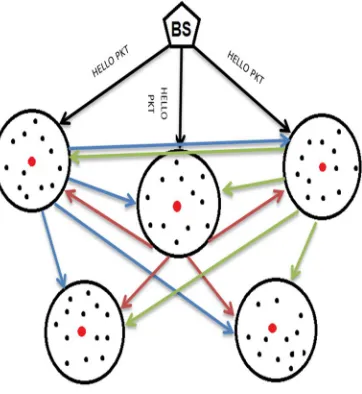
Figure 2. Architecture of proposed protocol
[image:3.612.218.399.425.622.2]A. Set-Up Phase
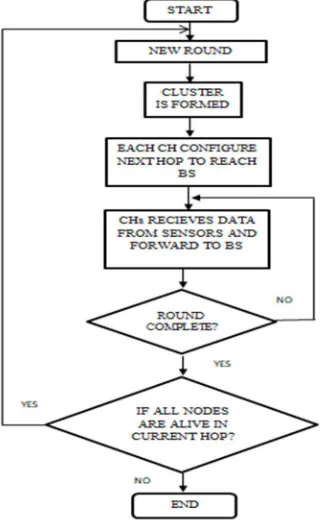
The set up phase started with the selection of cluster heads based on residual energy. After that, cluster heads broadcast advertisement message to its neighbouring nodes. On receiving the message from neighbouring cluster heads, normal sensor nodes select the cluster head has lowest distance and sends reply message “join” to CH. In this clusters are formed.
When clusters formed. CH creates TDMA schedule telling each node when it can transmit data.
After that, Each CH configure address of next hop with minimum distance for transferring data Base station sends message to nearest CH, after receiving the message CH knows the distance between base stations to itself. CH sends message to nearest CH, but the CH whose hops are not established will only read the message. The process continues till all CHs maintain their path for transmission.
B. Steady Phase
[image:4.612.223.384.246.506.2]During steady state phase, the non-cluster head nodes send their data to the CHs. The CHs aggregate and transmit that data towards the base station directly or through other CHs.
Figure 3. Working flow of proposed protocol
V. ALGORITHM FOR PROPOSED WORK
In the beginning, the base station creates a hello packet with its node_id, position of node (axis x and y) and distance of the node from its base station (in first case distance is 0), and broadcast the hello packets to its nearest cluster head, after receiving the message CH knows the distance between base stations to itself. CH sends message to nearest CH, but the CH whose hops are not established will only read the message. The process continues till all CHs maintain their path for transmission, after that. non-cluster head nodes send their data to the CHs. The CHs aggregate and transmit that data towards the base station directly or through other CHs same as LEACH protocol, algorithm for this proposed work given below:
// Base Station broadcast the hello packet after each completion of each round Broadcast_Hello_Packet()
Begin
Pkt Base station create a packet with node id, position (x,y) and distance 0
Base Station broadcast hello packet pkt end
Begin
dist_base infinity
perm 0
nextHop id of Base station
End
// On receiving a hello packet pkt, cluster head executes the function Set nextHop (pkt)
Begin
if (MEMBER = FALSE) then
(x1,y1) extract position of source cluster head / base station from pkt
Let position of current cluster head c is (x2,y2)
dist sqrt (( x1-x2)2 + (y1-y2)2)
temp_dist_base distance(pkt) + dist;
if( dist_base > temp_dist_base)
dist_base temp_dist_base
nextHop node_ id(pkt)
endif
if ( dist < d0)
if ( dist_base < temp_dist) then
MEMBER = TRUE nextHop = id(pkt)
pkt current node creates a packet with id and position
Broadcast hello pkt else
dist_base temp_dist_base
nextHop node_ id(pkt)
endif endif endif
VI. SIMULATION RESULT
The performance of the proposed shortest distance based multi-hop clustering algorithm in WSN is evaluated using MATLAB. at first, we select the reference network consisting of 200 randomly generated nodes over an area of 100 X 100 meters. Secondly, we select base station at the position of 1.5 at x and 0.5 at y axis. The initial energy of node is set 0.5 joules in network, transmission, receiving, free space and multipath energy is also set in network. Probability of becoming cluster head is set as 0.5. Network will be set for 3000 rounds.
Table1: Simulation parameters
Number of nodes 200
Number of base station 1
Network area size 100 x 100m
Probability 0.05/0.5
Initial energy 0.5joule
Transmission energy 50*0.000000001
Receiving energy 50*0.000000001
Multipath energy 0.0013*0.000000000001
Aggregation energy 5*0.000000001
Free space energy 10*0.000000000001
Graphs at probability 0.05 for 200 nodes
Figure 5. No. of dead nodes LEACH vs LEACH-M
The Figure 5; is the comparison of LEACH protocol and LEACH-M algorithm. The Figure represents a graph for probability at 0.05. The number of nodes chosen for the graph are 200 nodes for 3000 rounds. We can see in the LEACH protocol nodes are start dying at the round no.1600 however in LEACH-M nodes are dying at the round no. 1800. This shows that the proposed protocol is better than existing protocol as it improves the network lifetime and is energy efficient.
Figure 6. Number of received data at base station LEACH vs LEACH-M
The following Figure 6; is the data package comparison of LEACH protocol and its improved algorithm. From the Figure in the beginning, there is no much disparity about the amount of data package between the two protocols. However, with the time running, we found that the amount of data package sent by improved algorithm is gradually larger than that of LEACH protocol. This graph is represented for probability at 0.05 for 200 nodes for 3000 rounds which as a result, we see no. of received data packet at the base station is same at the starting rounds but after 1600 rounds there are some difference in LEACH 21000 and LEACH-M 26000 packet received.
Figure 7. Average residual energy of nodes LEACH vs LEACH-M
0 500 1000 1500 2000 2500 3000
0 20 40 60 80 100 120 140 160 180 200 Time(round) N u m b e r o f n o d e s d e a d LEACH LEACH-M
0 500 1000 1500 2000 2500 3000
0 0.5 1 1.5 2 2.5
3x 10
4 Time(round) N u m b e r o f re c e iv e d d a ta a t b a s e s ta ti o n LEACH LEACH-M
0 500 1000 1500 2000 2500 3000
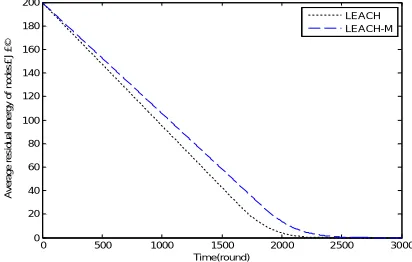
The comparison of residual energy between the LEACH and LEACH-M protocol represented in this Figure 7, for probability at 0.05 for 200 nodes for 3000 rounds. This shows that the average residual energy of nodes in case of LEACH protocol is lesser than average residual energy of nodes in proposed LEACH-M protocol which means proposed protocol is more efficient than existing protocol.
Figure 8. Avg mean square deviation of residual energy of nodes LEACH vs LEACH-M
The Figure 8, shows the comparison between LEACH and LEACH-M protocol and the probability is set up at 0.05 for 200 nodes for 3000 rounds. The average mean square deviation of residual energy of nodes is highly consumed at the 1500 rounds and finished at the 2200 rounds whereas in LEACH-M protocol average mean square deviation of residual energy of nodes are highly consumed at the 2000 rounds and finished at the 2600 rounds. This thus shows that the proposed protocol is alive for long time than LEACH thus improving the network lifetime.
[image:7.612.183.420.141.310.2]Graphs at probability 0.5 for 200 nodes
Figure 9. No. of dead nodes LEACH vs LEACH-M
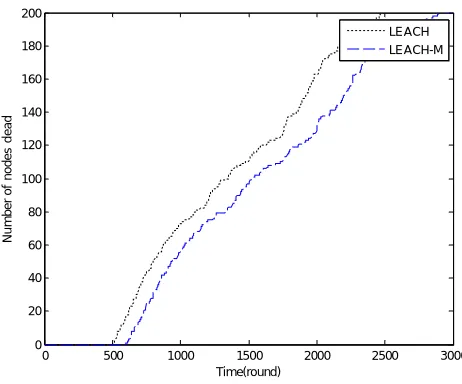
Figure 9; shows the comparison of the number of dead nodes in both protocols. The number of dead nodes reflects the network lifetime and stability in some degree. Form the picture, we know that in the running time of about 500 rounds, the nodes start dying in LEACH whereas in case of LEACH-M nodes are dying at the round no. 650 comparison between LEACH and LEACH-M protocol represent in this graph for probability at 0.5 for 200 nodes for 3000 rounds. The proposed protocol is better than existing protocol it improves the network lifetime and energy efficient.
0 500 1000 1500 2000 2500 3000
0 0.5 1 1.5
Time(round)
A
v
e
ra
g
e
m
e
a
n
s
q
u
a
re
d
e
v
ia
ti
o
n
o
f
re
s
id
u
a
l
e
n
e
rg
y
o
f
n
o
d
e
s
LEACH LEACH-M
0 500 1000 1500 2000 2500 3000
0 20 40 60 80 100 120 140 160 180 200
Time(round)
N
u
m
b
e
r
o
f
n
o
d
e
s
d
e
a
d
[image:7.612.186.417.440.632.2]Figure 10. Number of received data at base station LEACH vs LEACH-M
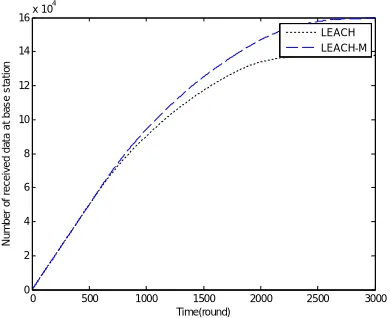
The comparison between LEACH and LEACH-M protocol is shown in Figure 10; for probability at 0.5 for 200 nodes for 3000 rounds. We see in the beginning, the no. of received data packet at the base station is merely the same at the starting rounds but after 600 rounds there are some difference. The amount of data received at the base station in the proposed protocol is much more as compared to in existing LEACH.
Figure 11. Average residual energy of nodes LEACH vs LEACH-M
The comparison between LEACH and LEACH-M protocol is represented in this graph 11, for probability at 0.5 for 200 nodes for 3000 rounds. We see in the beginning there is not much difference but as we move further, we can see average residual energy of nodes in LEACH is lesser then average residual energy of nodes in proposed LEACH-M protocol which means proposed protocol is efficient than existing protocol.
Figure 12. Avg mean square deviation of residual energy of nodes LEACH vs LEACH-M
0 500 1000 1500 2000 2500 3000
0 2 4 6 8 10 12 14 16x 10
4 Time(round) N u m b e r o f re c e iv e d d a ta a t b a s e s ta ti o n LEACH LEACH-M
0 500 1000 1500 2000 2500 3000
0 20 40 60 80 100 120 140 160 180 200 Time(round) A v e ra g e r e s id u a l e n e rg y o f n o d e s £ ¨J £ © LEACH LEACH-M
0 500 1000 1500 2000 2500 3000
The Figure 12; shows comparison between LEACH and LEACH-M protocol for probability at 0.5 for 200 nodes for 3000 rounds then we see in LEACH protocol average mean square deviation of residual energy of nodes are highly consumed at the 600 rounds and finished at the 2200 rounds but in LEACH-M protocol, the average mean square deviation of residual energy of nodes are higher consumed at the 1000 rounds and finished at the 2700 rounds that means proposed protocol is alive for long time then LEACH it improves the network lifetime.
VI. CONCLUSION
Low energy adaptive clustering protocol (LEACH) is the basic protocol. There is a single hop communication, edge positioning of CH, probability based selection of CH in heterogeneous network, uneven distributed of CH, Energy efficiency, LEACH is not suitable for large area network. Therefore, after the detailed study of LEACH protocol, we proposed Shortest Distance Based Multi-Hop LEACH protocol. This proposed algorithm increases the overall performance of the network or network lifetime.
The proposed work increases the network lifetime by 10% as there is an increment of 200 rounds in LEACH-M as compared to existing LEACH. In LEACH protocol, nodes start dying at round no. 1600 whereas in LEACH-M, it starts dying at round no. 1800. LEACH-M is more beneficial and scalable than existing LEACH protocol. LEACH consumes larger amount of energy. So in proposed protocol, we go through multi-hop communication in which less energy is consumed. LEACH-M shows better results as the number of packets received in LEACH-M are 1,60,000 whereas in LEACH, it is 1,41,000 as there is a difference of 19000 packets. Proposed protocol is also suitable for larger area network.
REFERENCES
[1] Agrawal, T., Kushwah, R. S., & Tomar, R. S. (2014, November). An Energy Efficient Routing with Range Switching in WSN. In Computational Intelligence and Communication Networks (CICN), 2014 International Conference on (pp. 354-357). IEEE.
[2] Al-Karaki, J. N., Alrousan, M., & Khasawaneh, S. (2010, November). On the development of adaptive and self-dependent secure routing for wireless sensor networks. In Proceedings of the 8th International Conference on Advances in Mobile Computing and Multimedia (pp. 288-294). ACM.
[3] Enam, R. N., Qureshi, R., & Misbahuddin, S. (2014). A uniform clustering mechanism for wireless sensor networks. International Journal of Distributed Sensor Networks, 2014.
[4] Heinzelman, W. R., Chandrakasan, A., & Balakrishnan, H. (2000, January). Energy-efficient communication protocol for wireless microsensor networks. In System sciences, 2000. Proceedings of the 33rd annual Hawaii international conference on (pp. 10-pp). IEEE.
[5] Limin, Sun, Jianzhong, Li and Yu, Chen, (2005). “Wireless Sensor Network” [M]. Beijing: Tsinghua Press: 1-25.
[6] Lindsey, S., & Raghavendra, C. S. (2002). PEGASIS: Power-efficient gathering in sensor information systems. In Aerospace conference proceedings, 2002. IEEE (Vol. 3, pp. 3-3). IEEE.
[7] Li, Y. Z., Zhang, A. L., & Liang, Y. Z. (2013, September). Improvement of LEACH protocol for wireless sensor networks. In Instrumentation, Measurement, Computer, Communication and Control (IMCCC), 2013 Third International Conference on (pp. 322-326). IEEE.
[8] Patel, R., Pariyani, S., & Ukani, V. (2011). Energy and throughput analysis of hierarchical routing protocol (LEACH) for wireless sensor network. International Journal of Computer Applications, 20(4).
[9] Rathi, J., & Dagar, M. S. Improving LEACH Protocol in Wireless Sensor Networks.
[10] Tsai, Y. R. (2007). Coverage-preserving routing protocols for randomly distributed wireless sensor networks. IEEE Transactions on wireless communications, 6(4).
[11] Wei, C., Yang, J., Gao, Y., & Zhang, Z. (2011, December). Cluster-based routing protocols in wireless sensor networks: a survey. In Computer Science and Network Technology (ICCSNT), 2011 International Conference on (Vol. 3, pp. 1659-1663). IEEE.
[12] Xu, J., Jin, N., Lou, X., Peng, T., & Zhou, Q. Yanmin Chen, Y. (2012, May). “Improvement of LEACH protocol for WSN,” Fuzzy Systems and Knowledge Discovery (FSKD). In 2012 9th International Conference on (p. 2174).
[13] XingGuo, L., JunFeng, W., & LinLin, B. (2016, October). LEACH Protocol and Its Improved Algorithm in Wireless Sensor Network. In Cyber-Enabled Distributed Computing and Knowledge Discovery (CyberC), 2016 International Conference on (pp. 418-422). IEEE.