The impact of information technology on the HR
function transformation
By
Yu Long 0123404
Graduation Committee:
First supervisor: Dr. T. Bondarouk Course coordinator: Pro. Dr. J. K. Looise
Master Thesis, Business Administration HRM University of Twente
Preface
This master thesis concludes my life as a student, which is performed under the supervision of Twente University in the Netherlands. The research is the terminal of the program Human Resource Management. Doing this research not only improves my skill on literature searching, information analysis, but helps me to gain more profound knowledge about e-HR.
During the research, I have got great support from several persons, and now, here is the opportunity to thank them.
At first, I give special thanks to Jiajie Li, my boyfriend. He accompanies with me during the whole research period. Besides dealing with my impatient and anxious attitude, he also put great effort on improving my thesis. His optimistic and serious attitude influences me, and makes me continue the research with better and better results every time. His support is very meaningful for my research period.
Secondly, I would like to thank Ms. Tanya Bondarouk, and Prof. Jan Kees Looise for their excellent support, feedback and guidance. Both of them give me fruitful advice on how to improve my work. And they always give me timely feedback on my work, which encourages and makes me belief that I can hand in a satisfactory report under the effort.
At last, I would like to thank my family and friends for supporting me not only during this research period, but also throughout my life, my study and everything I undertake.
Yu Long
Management Summary
Information technology is expected to improve the performance of Human Resource Management (HRM) by shifting its focus from administration or personnel management to strategic HRM. The strategic role of HRM is supposed to add value to the HR function, and leads the essence of HR function to transform.
This study examines HR function, HR function transformation and Human Resource Information Technology (HRIT), by investigating the role of HRIT playing in HR function transformation process, and the interrelationship between them.
The research consists two parts: a theoretical review and a meta-analysis of empirical data. For both parts, all the research data comes from peer-review academic papers, and 43 of them are used.
In the theoretical chapter, HR function, HR function transformation and HRIT are conceptualized. Firstly, the HR professional is moving from operational level to strategic and managerial levels. Line managers have taken an important part of HR function. Secondly, HR function transformation is a business process that changes the HR tasks and expands the involvement of actors in HR function, and that makes HRM concentrate more on strategic, value-creating activities for the long-term business objective. Thirdly, HRIT is supporting and forcing the traditional HR function to transform, and changes the way of management. However, HR professionals need to pay attention to deal with the drawbacks brought by HRIT, which might leads negative effect on both social interaction and information accuracy.
In the second part, the analysis of empirical evidence provides insight into the practice role of HRIT in HR transformation.
The empirical evidence shows that the devolution and decentralization of HR function is leading to role dissonance between HR professionals and line managers, and the HR professionals do not always focus on strategic issue but still put attention to daily managerial and operational tasks. On the other hand, the HRIT is considered as indispensable parts on supporting HR function transformation. It is because HRIT provides the platform and
Table of Contents
Chapter 1 Introduction ...1
1.1 Research Background ...1
1.2 Statement of the Problem ...2
1.3 Research Questions ...3
1.4 Research sketch ...3
1.5 Structure of the thesis ...4
Chapter 2 Structured literature search ...6
2.1 Methodology of research ...6
2.2 Selection of Journals and articles ...6
2.2.1 Parameters for searching journals and literatures ... 6
2.2.2 Journal search ... 7
2.2.3 Article search ... 8
2.3 Review Process ...9
Chapter 3 Theoretical overview ...10
3.1 Concept of HR function...10
3.1.1 The definition of HR function ... 10
3.1.2 The traditional HR function ... 11
3.1.3 The new HR function ... 13
3.2 HR function transformation ...17
3.2.1 The demand for HR function transformation ... 17
3.2.2 HR function transformation process... 19
3.3 IT in HR function transformation ...23
3.3.1 Form of HRIT ... 23
3.3.2 HRIT in HR function transformation ... 24
3.4 Research frameworks on HR transformation ...27
Chapter 4 HR function transformation: Meta-analysis of empirical data ...30
4.1 Actors involved in HR function nowadays ...30
4.2 HR function transformation ...35
4.3 Role of IT in the transformation process ...40
4.4 Chapter summary ...44
Chapter 5 Discussions and conclusions ...46
5.1 Discussions...46
5.2. Future research ...50
Chapter 1 Introduction
1.1 Research
Background
The competition among the companies is actually the competition of human resources, as the market reveals. A company, as a profit-pursuing organization, is always under the pressure of delivering new products to win market share. Without high quality human resources and its effective functioning, a company can hardly endure the profit pressure and pursue its long term business strategy. The past decades has witnessed the transition of employee becoming the most precious capital in the company and the ascent of Human Resource Management (HRM) (Schuler, 1990). The strengthened management of human resources is now the very essence of a successful business story.
Nowadays, business world is undergoing a substantial change: the employee turn-over rate becomes high, and both the organization structure and management pattern change as well. The traditional HRM style fails to catch up with such rapid changes: the traditional style mainly focuses on supportive personnel activities for a company, for example, collecting employee information, monitoring individual performance, and implementing organization policies. It is a passive, submissive execution, without self-motivated participation into strategic issue to foresee the challenges of tomorrow. Therefore, there comes a demand for the new HRM that should understand the business strategy, formulate the corresponding management strategy on human resources to improve delivered service, and act as a strategy partner with top management team (Beer, 1997; Mohrman & Lawer, 1997).
To meet the demand, there is an increasing pressure on HRM to support strategic objectives and to focus on value-adding activities, which consequently leads to the change in the job content and the expectations on
Human Resource (HR) professionals. Shrivastava et al. (2003) and Stone et al.
recent theoretical development, Ulrich and Brockbank (2005) emphasize the need for HR professionals to become business strategic partners.
These phenomena arouse a few questions about the interrelationship between the HR function and the emerging HRIT:
• Does the HRIT have the impact on the changing HR function?
• In which ways does HRIT support the changing role of HR function?
• How does HRIT influence the HR function transformation?
Driven by these questions, I start to explore the interrelationship between the HRIT and the HR function transformation, which is the purpose of this research.
1.2 Statement of the Problem
Many researchers have studied the changing of HR function. The most significant change is that the HR professionals now focus more on business strategic issue from a “human resource” aspect with the top managers rather than only dealing with personnel administration (Jacoby, Nason & Saguchi, 2005; Bjorkman, 2006; Valverde, Ryan & Soler, 2006). Meanwhile, part of the HR tasks, such as routine administration and individual performance management, are decentralized to line managers (Hales, 2005). Such extensive change in the HR function can hardly be described as simple as “change”, but “transformation” instead. It involves reinvention, reposition, and reconstruction of the HR roles, task and responsibility (Appelbaum & Wohl, 2000; Svoboda & Schroder, 2001; Knapp, 2004).
On the other hand, companies nowadays are thirsty for the IT to reduce cost, improve service, and achieve effectiveness (Yeung, Brockband & Ulrich, 1994). With appropriate information tools, managers, employees and customers can quickly response to market change, and control risk cost. To reveal the adding value of IT application in HRM, it is necessary to clarify how IT can advocate the HR function, for example, in strategic task or administrative task, and how IT can advocate its transformation. Therefore, this thesis originates from following research goal: to investigate how HRIT advocates the HR function transformation.
1.3 Research Questions
Since the transformation of HR function and the influence of HRIT on this transformation are the focuses of this research, the discussion points in this research paper are designed to gain insight into HR function, HRIT and HR function transformation. The main research question is stated as below:
What is the role of HRIT in the transformation of HR function?
Further more, a series of stepwise sub-questions are designed to explore the main question from various aspects:
1. What is HR function?
2. What has been changed in HR function, and why it is considered as a “transformation”?
3. What is expected from a theoretical point of view on the impact of HRIT on the changing HR function?
4. What are the findings in the current literatures?
1.4 Research sketch
In order to depict a clear image of this research, a roadmap is developed to understand the research procedure and how it is organized.
to the HR function described from the Ulrich’s Model (1997). The second step is to investigate the transformation process of HR function, and the final step is to find out how the HRIT affects HR function and impacts its transformation.
Figure1.1 Research sketch
1.5 Structure of the thesis
Figure 1.2 Research pathway of this thesis
Chapter 2 Structured literature search
This chapter focuses on the research methodology of this thesis, on which the research in following chapters is based. The general idea of the research method is explained in 2.1. The literature search procedure is presented in 2.2. Finally, the research methodology is briefly concluded in 2.3.
2.1 Methodology of research
This thesis adapts critical literature review method to develop deep understanding of previous researches which provide the cornerstone for this research. Both the literature devoting to theoretical reasoning or empirical data is considered. The theoretical literature summarizes the related theories discussed from literatures, including books and peer-review papers. The empiric literature collects academic evidences from published papers of case study, and qualitative/quantitative data analysis. These empiric evidences is then examined to justify the theories related to the research questions.
2.2 Selection of Journals and articles
The search for both theoretical and empirical literature is described. The initial step is to determine the literature coverage by defining the searching parameters, including publication language, source media, keywords, and period. With these parameters, a selection pool of journals is determined, and interested papers are fished from this pool.
2.2.1 Parameters for searching journals and literatures
each studied filed, which is the trade-off between the availability and the up-to-dateness.
2.2.2 Journal search
The search of the journals is a multi-step process which contains key-words screening, citation search and coverage extension. Due to the accessibility, the searched journals are limited to the e-journal list of the library of University of Twente.
In the first step, the journals which contain key words “Human Resource (HR)” or its synonyms (personnel, manpower, etc.) directly in their titles are selected,
which include Human Resource Management, Human Resource Management
Journal, International Journal of Human Resource Management, Personnel Review, and International Journal of Manpower. A number of interested papers are selected from them (detailed in 2.2.3 Article search).
Second, a citation search is performed on these interested papers, and
additional journals are obtained: Human Resource Planning,Human Resource
Management International Digest, Industrial Relations, Employment Relations Today, Employee Benefit Plan Review, European Journal of Innovation Management, Journal of Knowledge Management, Managing Service Quality,
and Facilities.
In the last step, in order to ensure that relevant journals are not missed, the
coverage is extended to the journals regarding general management: Journal
of Management Studies, and Academy of Management Executive.
The academic quality of the selected pool of journals is high. Most of the chosen journals belong to Social Sciences Citation Index® (SSCI®), which is the world leading database about social sciences. These journals includes:
Human Resource Management, International Journal of Human Resource Management, Personnel Review, International Journal of Manpower and
2.2.3 Article search
The search for articles is a two-step procedure: first, the articles are selected from both rough and refined screening; second, a citation search contributes additional articles.
In the first step, a rough screening is first performed, and articles are searched within the obtained journal pool. The articles in the filed of “HR function” are from the publication year 2002 to 2007 in order to track the latest development. The rough search method is to screen articles’ title one-by-one from each journal. The literature related to “HR function transformation” is very limited. Therefore, the publication period is extended to 1990~2007; and it also does not limit to HR function, but includes the transformation in management-related fields as well: knowledge, work, strategy, etc. As the result, there are 29 articles in total that are selected for “HR function” and “HR function transformation” after the first rough screening.
An improvement is made for the later searching for HRIT: besides the key words “e-HR” and “HRIT” used for screening the journals, additional key words are assigned for article search: “HRIS”, “HRM system” and “virtual HR”. Finally, 12 articles are chosen.
In total, 41 articles are found after rough screening. In the refined search, not only the abstracts and key words, but the table of contents, introduction, and conclusion of the article are inspected carefully to filter out the little related articles. Finally, as the result of the first step search, 30 articles are obtained.
In the second step, 13 additional papers are attained by citation search of aforementioned 30 articles. In total, there are 43 articles that are chosen for literature review.
Table 2.1 List of chosen journals and number of articles for HR function, HR function transformation, and HRIT, after both rough and refined screening, and citation search
Journal No. of Articles
(1st rough run)
No. of Articles
(2nd refined run)
Human Resource Management 16 11
Human Resource Management Journal
3 3
Personnel Review 8 5
Academy Of Management Executive 3 3
International Journal of Manpower 3 3
Journal of Management Studies 2 2
Review
Employment Relations Today 1 1
Industrial Relations 1 1
Human Resource Planning 1 1
Employee Benefit Plan Review 1 1
Human Resource Management International Digest
1 1
International Journal of Human Resource Management
2 1
European Journal of Innovation Management
1 1
Facilities 1 1
Journal of Knowledge Management 1 1
Managing Service Quality 1 1
Public Personnel Management 1 1
Journal of Vocational Behavior 1 1
2.3 Review Process
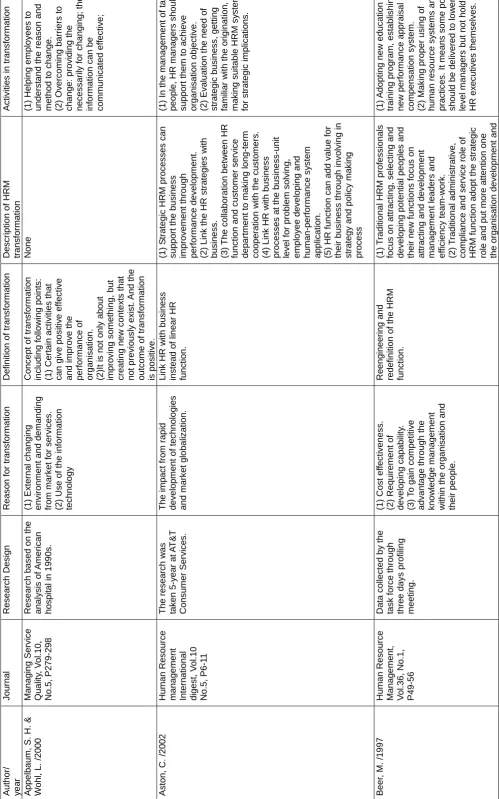
Three analytical tables are built up to summarize the research findings from each article. Each table collects essential information, including: authors, source journal, research method, research objective, and results. With such information, the criticism can be reasoned out by summarizing, comparing and contrasting with others, and it helps to discuss the theories in depth and finally to depict a comprehensive picture of the research question. The analytic tables are listed in appendix.
Chapter 3 Theoretical overview
This chapter is to answer the research questions regarding to “HR function”, “HR function transformation”, and “HRIT”. In the section 3.1, the concept of HR function is defined from both traditional and current interpretation. The section 3.2 presents the theoretical concern of HR function transformation: first, the necessity of “transformation” is presented in 3.3.1; then, the generic definition of transformation is discussed in 3.3.2; last but not least, the definition of HR function transformation is discussed. The theoretical study of HRIT is examined from its form and function in HR activities in the section 3.4.
3.1 Concept of HR function
There are two axes to understand the HR function: one axis is a philosophical axis, which deconstructs the function into its actors and corresponding activities, the other axis is a time axis where the difference between the traditional (past) and current interpretations of the HR function is regarded. Therefore, this section includes two parts: a philosophical description part (3.1.1) and an interpretation comparison part based on Ulrich’s models (3.1.2 and 3.1.3); and it is prepared for the theoretical discussion on the transformation of HR function and HRIT.
3.1.1 The definition of HR function
According to Valverde et al. (2006), HR function is “all managerial actions
carried out at any level regarding the organization of work and the entry, development and exit of people in the organization so that their competencies are used at their best in order to achieve corporate objectives”. It includes the actors, as well as their relevant responsibilities and tasks.
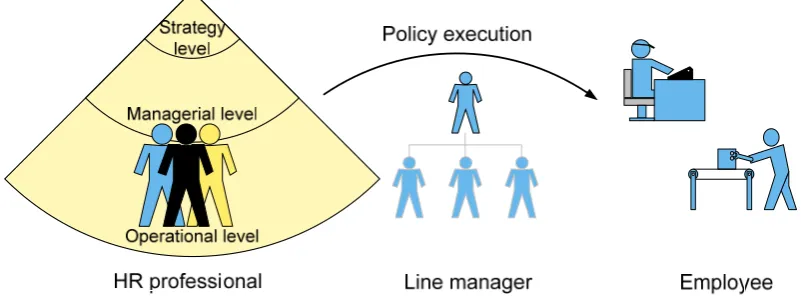
The actors of HR function
Employee HR
Professional
Line manager
Major
actors
Figure 3.1 Major actors involved in HR function, at different level of a company
The activities of HR function
The concept HR function can also be deconstructed into three components – the factors reflecting who perform the function (role), why they perform (responsibilities), and what activities are taken to carry the responsibilities (process) (Gutierrez, 1995; Svoboda & Schroder, 2001; Caldwell, 2003; McConville, 2006). Each actor (HR professional, for example) can play one or a few roles, and each role participates in certain process to fulfill its responsibilities. Based on above interpretation, the following picture is developed to give an impression of it.
Figure 3.2 Components of HR function
3.1.2 The traditional HR function
welfare and industrial relationship. The HR department was treated less important than financial and marketing departments, because it did not create direct value, nor have any decision power on strategic issue (Fombrun, Tichy, & Devanna, 1984; Hall & Goodale, 1986).
The traditional personnel managers paid attention to labor management, but did not participate into a company’s planning and strategy decision. They paid great attention to control their employees, including carefully designing the contracts and rules for monitoring the employees (Storey, 1995).
[image:19.595.89.490.329.479.2]The line managers at this moment played passive roles on the personnel management (Storey, 1995). The line managers were the transactor of the decisions made by the personnel managers, and they were the industrial relationship builders through the negotiation with employees and employers.
Figure 3.3 Scheme showing the traditional HR function
Since early 1980s, the personnel management started to shift to “human resource management”, due to the fact that HR professionals were considered to involve in strategic business decisions (Fombrun, Tichy, & Devanna, 1984; Hall & Goodale, 1986). The main tasks of HR professionals still focused on the daily administration, but broadened management activities are involved in the HR function, which reflected that the HRM began to pay its attention to the relationship with strategic business issue.
function paid attention to the future development of business. The main responsibility was to get the qualified people, and set the policies and programs for long-term human resources demand.
However, the lacks of the integration with the line management level, and the lack of the power were the two major obstacles affecting the effectiveness of HR function. The elaborate routine tasks and overloaded paper work also made the HR function inefficient. To be more effective on service delivery, HR function needed to be strategic on operational and managerial level, and to become more mission-oriented (Hall & Goodale, 1986).
3.1.3 The new HR function
Human resource management has developed for almost twenty years; and the HR function has changed a lot from the activities to management level. It makes the traditional structure of HR function different that the line managers and employees involve in HR issue. But HR professionals are still considered as the core of workforce management, especially towards the strategy aspect. Thus, Ulrich has defined the “four roles of HR professional model” in 1997, and later develops the model in 2005 to examine the changing of HR professionals. In the following paragraphs, the goal of understanding HR function is separated into these three levels: HR professional, line manager and employee, through Ulrich’s model and theories from literature.
The role of the HR professional
Ulrich’s model 1997
In 1997, Ulrich defines four roles of HR professionals involved in the HR function performance (Figure 3.4).
According to Ulrich (1997), “strategic partners” are the HR professionals, who work together with top executives to make competitive business strategies and to figure appropriate HR strategies, policies, practices and tasks to support the business strategies. And they should also make sure the implementation of the strategies. At the same time, they should develop certain evaluation method to estimate business results.
The second role of HR professional is “administrative experts”, who should make HRM works more effective and efficient. This can be achieved through reengineering organizational processes, improving the capacity of organizations to gain competitive advantages, reducing cost, adding value, and determining insourcing and outsourcing strategies for better HR services delivery.
“Employee champions” is the deputation of employees. That means, at this position, the first thing HR professionals should do is to understand and find out the demand of employees, by taking friendly and useful communication with them frequently. At the same time, they should provide necessary resources to employees. The HR professionals should motivate their employees, and provide certain training and learning programs to help employees realize their potential. Employee champion also means that HR professionals represent the voice of employees in the organization, and they are responsible for enhancing employee commitment, developing employees’ competence, and enhancing the capability of employees for the competitiveness of organization.
“Change agents” are the HR professionals that support and manage the organization transformation and the changes. In the changing process, “change agents” need to create new culture to help organization members get enough motivation to participate in the new situation.
Ulrich and Brockbank’s model 2005
functional expert, employee advocate, human capital developer and HR leader. At the same time, the responsibilities are also specified to each role.
Figure 3.5 Five roles of HR professional (Ulrich, 2005)
The strategy partner has multiple roles according to Ulrich and Brockbank’s (2005) new opinion: it includes the business expert, change agent, and knowledge manager. The change agent that exists in the previous model now becomes part of the strategy partner. The strategy partner should help line managers to reach their goals.
Functional expert is responsible for the HR practices delivery. Besides the traditional function of administrative expert, the role of “functional expert” is broadened by using technologies for administrative efficiency.
Employee advocate and human capital developer both concern employees. The difference is that the employee advocate focuses on current employees, to make sure that the relationship between employees and employers is meaningful and friendly. The human capital developer puts attention to the future workforce, including acquiring external suitable workforce and helping today’s employees for future development.
HR leader is the people who control the whole situation. The leadership is the sum of above four roles. Being an HR leader, he/she should set the relationships among each HR function, and supervise the whole HR community.
financial, and manufacturing departments to ensure that HRM helps to create business value (Ulrich & Brockbank, 2005). When they act as value creators for an organization and provide positive outcome for key stakeholders
(customers, investors, line managers, and employees) (Stone et al., 2006),
they involve as strategic contributors and create competitive advantage in business.
The role of the line manager
Line managers are the final executive of HR policies and activities on operational level, whom HR professionals coach and assist (Ulrich, 2005). They are the direct contact people regarding to HRM, and their HR tasks are to manage the employees’ motivation, communication, authorization, training and so on. The core value of them is to lead their employees to achieve the objective of a department, which can be only completed by the leadership, and the plan, coordination and control on their employees (Storey, 1995).
From the investigation of Nehles, et al. (2006), line managers are perceived as
an important role in HR practices. Most line managers are willing to perform and spend time on HR activities, and they invest a lot of time in guiding, monitoring, coaching and motivating employees. They, however, are not the specialists on HRM, and they thus need training and support from HR professionals. HR professionals should make clear about line managers’ responsibility, and help them to fulfill HR roles.
However, sometimes line managers might not take their responsibilities on
performing HR tasks (Nehles, et al., 2006). The reason can be that the main
duties of them is not HR issues, and they lack of personal incentives to participate in HR practices: when they do not have enough time to implement HR activities, and think business issues are more important, HR activities are postponed. They may also not have sufficient HR-related competencies, or the policies and procedures are unclear for them, which indicates a lack of support from HR professionals. All these may cause role dissonance (McConville, 2006).
The role of the employee
to compete for the goal and which kind of training program is needed. This kind of positive attitude can help employees to endeavor on the career development, and to create greater value for organization rather than passively taking some constrained learning programs. In other words, the change of HR function makes employees independent, and makes them take the initiative to participate into both individual and organization development.
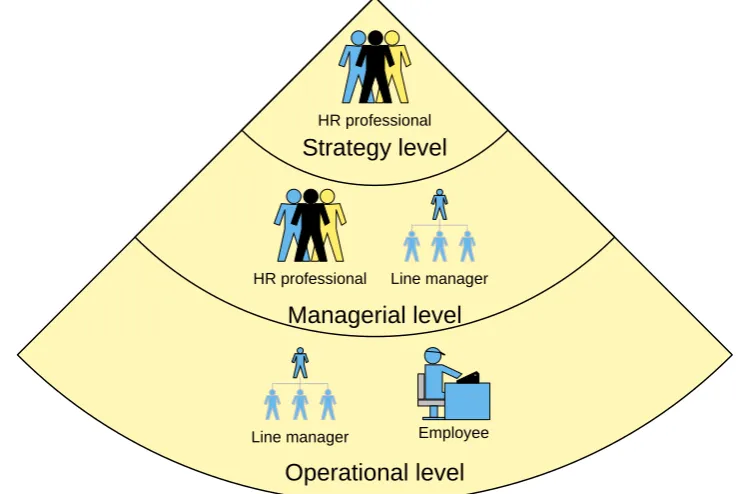
Operational level Managerial level
Strategy level HR professional
Line manager HR professional
[image:24.595.110.483.195.442.2]Employee Line manager
Figure 2.6 New HR function, with participation of line managers and employees along with HR professionals
3.2 HR function transformation
In this section, two parts are organized to make deep exploration of HR function transformation. The first part is about the necessity of transformation, and the second part mainly focuses on the definition of HR function transformations.
3.2.1 The demand for HR function transformation
Appelbaum & Wohl, 2000; Stockport, 2000; Sagie & Weisberg, 2001; Knapp, 2004).
Furthermore, there are other driving forces pushing organizations to reconsider their HR function to meet the strategic business demands and the future corporate success, such as business environmental change, customer satisfaction, management diversification, and development of knowledge and technology (Yeung, Brockbank & Ulrich, 1994; Beer, 1997; Robertson, 2000; Appelbaum & Wohl, 2000; Aston, 2002). These driving forces press the HR function to evolve under the pressure of environment and to avoid the downside of existing systems.
Business environmental change
The fundamental changes in business world have forced the HR function to shift and put the HR function into an important status (Schuler, 1990). These changes include the uncertainty of personnel management caused by the rapid business change. They also include the increasing competitive pressure on profit forces the organizations to reduce the cost from various aspects including personnel management cost. The last but not the least change is the complex situation on employee management when there are more organizations running global business: such as managing employees of different business function, in different product lines, or with different culture background, etc. All these changes demand flexible and effective management style.
Service improvement
A basic function of HRM is to delivery its services to both internal and external customers, and it should ensure that the services are effectively delivered (Yeung, Brockbank & Ulrich, 1994). However, the traditional HR function only concerns the basic services such as selecting the right people for organizations, managing the database of employees, or assessing the employees. Now, the increasing demands from the customers force the HR function to be more valuable on its tasks. The value-creating activities, such as standardizing the work process and coordinating the tasks, can be done by HR professionals to help to resist the pressure from business environment (Mohrman & Lawler, 1997; Beer, 1997; Robertson, 2000).
People are always the first priority of the business success. With the international business development, the workforce can be divided based on universal variables as gender, socio-economic status, geography, and generation gaps (Sagie & Weisberg, 2001). For example, the increasing number of aging people in the developed countries and changing values of the young generation in the under-developing countries require fundamental change of the tasks of the personnel management (Selmer, 2001). The multi-classifications of employees lead to diverse value and multi-cultural working environment, which asks the HR professionals to create harmonious organization culture and widely acceptable work values.
Development of technology
The last driven force for HR function transformation is the technology advancement. The technology enables organizations to improve their business competence through various aspects.
For example, technology changes the management of information, and releases the burden of publishing information of HR department. The rapid technology changes also ask for HR professionals to get new skills through
education, or sourcing HR professionals who have certain IT ability. Yeung et
al. (1994) report that more than half of the companies which they interview
have used the HRIT to integrate their databases, and their information system provide better information access for managers and employees. Moreover, Sagie and Weisberg (2001) perform research about HR function in companies in Israel and find out that the technology levels have divided the HR department into two parts: the high-tech and low-tech sectors. The high-tech sector focuses on the strategic issues while the low-tech sector deals with traditional tasks. The HR function needs to adjust itself to maximize the benefit of using HRIT.
3.2.2 HR function transformation process
Definition of transformation
English Language, Fourth Edition”1. When we look at the word root of “transform”, it can be divided into two word roots – “trans” and “form”. “Trans” means “change” while “form” is “the shape and structure of an object” or “the essence of something”. Thus, “transformation” can be comprehended as “the changing of appearance or form”, and it can also be “the changing of nature, function, or condition” (Hornby, A. S. & Wehmeier, S. 2000).
Appelbaum and Wohl (2000) define transformation based on the meaning of change. They consider that both change and transformation are making something different from previous status. Change offers the development in certain fields when such alternation is required. The objective of changing should already exist and the result of change is to make things dissimilar or even better. On the other hand, transformation focuses on creating new things that do not exist before besides improving (they also define continuous transformation as “reinvention”). Thus transformation emphasizes making new context to make thing work better.
Stockport (2000) thinks that transformation is also a kind of change but more radical, and more likely to happen internally, concerning an organization. Such transformation may occur in the systems, structures, employees or culture. It is a wisdom way for long-time survival.
Stockport (2000) divides transformation into four stages, namely “unconscious incompetence”, “conscious incompetence”, “conscious competence” and “unconscious competence”. In the beginning stage, most people in the organization do not feel necessary to transform, nor do they have the relevant ability to manage it. After this period, they start to consider the possibility of changing although still no action is taken, which is marked as “conscious incompetence”. The third stage is the core of whole transformation process. The factors, such as the participated mangers and employees, information technology, and knowledge management, need to be taken into account at this stage, and to develop a “conscious competence” to make the transformation happen. Finally it is the maturation stage – “unconscious competence”. The transformation is finished, and new system replaces the old one in daily business.
1 Transformation. (n.d.). The American Heritage® Dictionary of the English Language,
Fourth Edition. Retrieved October 19, 2008, from Answers.com Web
Stage 1 Unconscious Incompetence
Stage 2 Conscious Incompetence
Stage 3 Conscious Competence
Stage 4 Unconscious Competence
Figure 3.7 Transformation development process (Stockport 2000)
Transformation of the HR function
A transformation in HR function can be interpreted two aspects, according to the etymology: firstly, the main tasks of HR professionals have changed. A slow and gradual change in HR department, by redesigning its structure, or out-sourcing the whole HR department (Mohrman & Lawler, 1997; Knapp, 2004), happens to meet the demand of the organization (Selmer, 2001; Rowley & Bae, 2002). The center of the HR work is no longer the basic administration, but it moves toward the management consultant and strategy aspects.
[image:29.595.98.495.325.513.2]Secondly, it is a change of management level. An obvious change is the participation of line manager and employees into the staffing issue along with the HR professionals.
Figure 3.8 Transformation of the HR function (no exact percent of distribution should be drawn from it)
3.3 IT in HR function transformation
3.3.1 Form of HRIT
HR data has various forms, including historical and current policies, job records, employees’ personal data, training programs, individual performance details and so on.
The HRIT provides the possibility to store and repeatedly use the information as electronic database, which could be accessible by anyone, anytime and anywhere within the organization. For HR function, the HRIT can be applied into HR tasks and help improving the HR service delivery. The application of IT into HR process can be done via the web-based tasks application. The information publishing, for instance, is a simplest and easiest implementation of the HRIT (Gardner, Lepak & Martol, 2003), which is kind of one-way communication from the higher management level to lower ones. The information can be the policies, news, and publications from the organization. Although this simple function only needs to provide the information through the website, it benefits the organization through the reduction of printing cost, the instant delivery of the information on-line, and re-accessibility to information at any time.
The higher-level application of HRIT is the automation (Gardner, Lepak & Martol, 2003): to use IT to manage the workforce data. At this level, the HRIT uses the intranets together with internets. There are two kinds of data: one is the individual data of all employees, and the other is the business data, such as the structure of the organization, position arrangement, wage scale and so on. These basic data are used for all the HRIT applications for HR function. HRIT automation can reduce the amount of the routine works, such as business records maintenance, which previously must be done manually by HR professionals. Now, employees can update their information by themselves, and HR professionals can be freed from the time-consuming tasks, and focus on interpreting the information (Gardner, Lepak & Bartol, 2003).
HRIT platform, but can return their feedbacks. By selectively filtering information, employees can take the initiative to self-plan their career, which turns the job planning from department-orientated to employee-orientated. Moreover, the interaction function can link the different departments together to share the service and use the public information to reach harmonious work flow. Through the interaction of work flow and exchange of data, both internal and external HR professionals can carry on the cooperation of the ceaseless HR program.
The highest-level of HRIT application involves envision of the HR function. From the information to automation to interaction and then to envision, HRIT starts to move the HR function beyond the traditional focus, out of the boundaries of HR department, and towards a strategic one. Based on the abundant data, HR professionals can obtain the information through data statistics and analysis, like program achievements assessment, employee training, appraisal record, and so on. Further, they can use statistics results to formulate strategy to meet with the future demand on the human resource of an organization, and plan salary-scale of employees regarding to financial balance trend.
Both the HRIT application and the HR function transformation have impact on each other. The transformation of HR function requires powerful tools to assist and help managers and employees to do things better and do better things. On the other hand, the application of HRIT makes the transformation of HR function become realistic, and to some extent, changing the HR function radically – it requires HR professionals to learn the new and mixed skills for HRIT, and attracts HR professionals to pay attention to HRIT supportive and transformational activities. As a kind of the new HR function pattern, the HRIT is the software platform that moves HR function toward the network and knowledge based activities.
3.3.2 HRIT in HR function transformation
While the application of HRIT in human resource services has been developed since 1990s, the effects of IT on HRM are broadening over years (Florkowski, Olivas-Lujan, 2006). Considering its ability of contributing to the overall performance of organization, HRIT supports the fundamental transformations concerning the HR function.
Hempel (2004) has developed a model of the interactions between the technology and the HRM, including the design of the organization and work, the HR professionals, and employees. According to the model, a new development of technology can cause the changes in reengineering the organization and work design, which changes alter the outcome of HR practices. HR professionals get more powerful technologies to foster changes happened within organization, through managing the innovative and knowledgeable employees. From this opinion of view, the relationship between HRIT and HR function is kind of interaction. Hempel (2004) considers that the HR professionals are on the catch-up position. Due to the fact that the technologies first change the structure of the work, such as virtual global work groups, HR function needs to evolve in order to support these changes. HR professionals already involve into the redesign process, thus they need deep understanding of the business on both operational and strategic sides to handle and support the innovation.
HRIT functions
When considering the impact of HRIT on the HR daily activities, some researchers have examined HRIT from its functions, such as the e-recruiting system, e-selection system e-performance system, and e-compensation system, and pointed out that HRIT can have both positive and negative influences on HR function (Stone, Romero & Lukaszewski, 2006). Through the investigation on these functions, the understanding of HRIT influence on the transformation of HR function can originate from the information flows, social interaction patterns, perceived control of individuals and system acceptance (Ashbaugh & Miranda, 2002; Stone, Romero & Lukaszewski, 2006).
Information flows
an organization’s ability on data collection and management, there still some limitation on this aspect. For instance, the e-performance management system may not have the capacity to measure all the behaviors of the employees
(Stone, et al., 2006). The system can measure the quantity, but not the quality.
Thus, HRIT allows the HR professionals to manage large amount of information with great accuracy. The automation of HRIT is thought to be the best way to improve the effectiveness, and it becomes a valuable contributor of HR function. But in some cases, the system may not be as useful as traditional methods (Haines & Lafleur, 2008).
Social interactions
The HRIT reduces the face-to-face interactions in organizations. Each member can be connected through internet, such as internal email and telecommuting system, so that work can be cooperated without the location constrain (e.g. working at home, international company). From this point of view, the HRIT broadens the interaction among the employees within the organization. However, on the other hand, due to the face-to-face interactions are decreased, HRIT may have negative effects on trust levels among managers and employees (Stone, Romero & Lukaszewski, 2006), which requires the HR professionals to rebuild the trust and relationship among employees.
Perceived control
make them look good from the systems also damage the organization in the long run (Stone, Romero & Lukaszewski, 2006).
To sum up, HRIT forces the traditional HR function to transform, and changes the way of management. HRIT brings the ability for all members to simplify work, measure activities, provide instant feedback, and reduce wasted time (Ashbaugh & Miranda, 2002). The application of HRIT meets the need of end-users and real situation of organization. Otherwise, the decreased social interactions and negative effect on both quality control and information accuracy can damage the benefit of organization (Stone, Romero & Lukaszewski, 2006). HR professionals need to pay attention to deal with the drawbacks when enjoying the benefits brought by HRIT.
3.4 Research frameworks on HR transformation
The HR function is shifting from a traditional one to a strategic one, especially in the large organizations. In the small and medium companies, the HR function is likely to be the same as before, but the application of HRIT makes some parts of HR function, such as training system, information management, etc., changing towards the effective performance, better services and more profitable to organization. From the powerless and unvalued personnel management to the business partner and strategy developer, the HR function is broadening while the tasks division is clearer. To be specific, the HR function nowadays is adding with the new factors.
The internal performance of the transformation is the embodiment of multi-role of the managers; because new works and responsibilities are emerging, they start to shoulder emerging works, or change their objectives due to facing different tasks.
The devolution and decentralization of HR function indicates that quite some parts of HR tasks are separated out from HR professionals, specially being apart away from the center of HRM. More and more sub-units with their own HR specialists or line managers take the duty from the higher levels of the HR department.
the right direction. The transformation of HR function is a continuous process. No matter which forms of HR function transformation take place, the final aim of HRM is to serve their internal and external customers better and better.
A radical transformation of the HR function is happening for the sake of adding value to business, improving service quality, or keeping organizational changes. That’s why the HR function transformation is a popular topic in organization research for recent years. Most of authors argue about HR function transformation that HR professionals play a more strategic role in the organization. By contrast, other non-strategic roles are less concerned, making the relevant HR tasks and responsibilities transformed simultaneously. HR professionals are the valued member of management teams. They contribute to both the decision making and business strategy. The traditional HR function is to manipulate people under business policy, whereas, HR function now should motivate the performance and development of employees.
On the other hand, HR professionals integrate the performance management of line managers and employees. Line managers are important partners on helping HR professionals and are the direct contactors of employees. They implement the strategy and policy from HR professionals, and help employees to achieve the objectives of organization. Line managers take more responsibilities to handle HR tasks; the increasing burden of line managers also ask for tight relationship with HR professionals to get more assistance. HR professionals need to acquire new knowledge to understand the business and work with line managers, to satisfy customers and to create a committed and motivated workforce. Through playing the new role and gaining the new ability, the HR function becomes more important and strategic than ever before.
It should be noticed that some researches have put it as the way to reduce
cost of HR activities (Mohrman & Lawler 1997; Brewster et al. 2006), although
there is not much research from the searched literature about the outsourcing parts of the HR activities. The outsourcing can be the strategic activities, such as recruitment, training program, and acquisition of expertise from external experts who are not easily involved in the organization.
positively take part in some HR activities. Hereby, the next chapter examines the empirical research about the HR function, its transformation and HRIT.
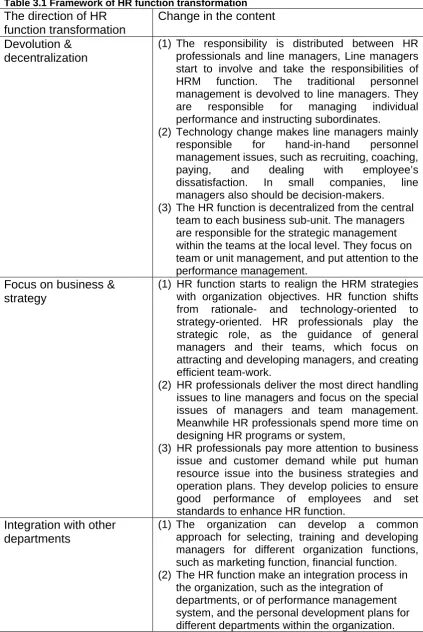
Table 3.1 Framework of HR function transformation
The direction of HR function transformation
Change in the content
Devolution & decentralization
(1) The responsibility is distributed between HR professionals and line managers, Line managers start to involve and take the responsibilities of HRM function. The traditional personnel management is devolved to line managers. They are responsible for managing individual performance and instructing subordinates.
(2) Technology change makes line managers mainly responsible for hand-in-hand personnel management issues, such as recruiting, coaching, paying, and dealing with employee’s dissatisfaction. In small companies, line managers also should be decision-makers.
(3) The HR function is decentralized from the central team to each business sub-unit. The managers are responsible for the strategic management within the teams at the local level. They focus on team or unit management, and put attention to the performance management.
Focus on business & strategy
(1) HR function starts to realign the HRM strategies with organization objectives. HR function shifts from rationale- and technology-oriented to strategy-oriented. HR professionals play the strategic role, as the guidance of general managers and their teams, which focus on attracting and developing managers, and creating efficient team-work.
(2) HR professionals deliver the most direct handling issues to line managers and focus on the special issues of managers and team management. Meanwhile HR professionals spend more time on designing HR programs or system,
(3) HR professionals pay more attention to business issue and customer demand while put human resource issue into the business strategies and operation plans. They develop policies to ensure good performance of employees and set standards to enhance HR function.
Integration with other departments
(1) The organization can develop a common approach for selecting, training and developing managers for different organization functions, such as marketing function, financial function. (2) The HR function make an integration process in
Chapter 4 HR function transformation:
Meta-analysis of empirical data
The HR function plays a critical role in contributing to the effective management and development of employee performance for an organization. As HR function is undergoing the transformation process, a stronger workforce can help improve the efficiency of the organization as a whole. And a more efficient and productive business can quicker and better respond to the changing circumstance, and gain more profit. The traditional time-consuming works, paper-based processes, frequent daily meetings, or skilled personnel losing can make it difficult for HR professionals to focus on value-creating business.
To improve the efficiency and capability of the organization, the transformation process of HR function has shown the direction to provide higher quality services. The future trend of HR function is to widely utilize information technology.
This chapter focuses on reviewing empirical data from literature, to find out how the HR function is transformed in organizations, and how information technology impacts on HR function transformation.
4.1 Actors involved in HR function nowadays
Based on the definition of Valverde et al. (2006), the understanding of HR
function should consider all the levels of people in the organization that participate into the HR activities. In the following paragraphs, the HR function is explained according to each role, or each management level, to find out how the HR function distributed among different agencies.
The role of the HR professional
There are many research investigations proving the existence of continuous transformation in HR function nowadays. Some of them show that the HR function tends to be more strategic, especially on internal professional consulting and decision making.
discusses two models concerning the development of HR function: the Storey’s “four roles of personnel managers” and Ulrich’s “four roles of HR professionals”, which are the starting points to understand the trend of the role of HR professionals. He also surveys 350 UK companies and finds out that the
most significant role of HR professionals is advisor. They act as internal
consultants to serve internal customers through consultancy or advice. They also assist line and general managers in the organization to make management decision. They tend to be potentially strategic and business-oriented to have more influence by holding resources or power.
Another important role of HR professionals is HR director, who is considered
as the similar function of HR service provider. Both roles are responsible to
make the HR management activities effective, to enhance HR function within organizations and to restructure HR process to achieve higher level of service
standard. Whereas, beyond the role of service provider, Truss et al. (2002) find
out that HR director should develop policies, be responsible for decision-
making under the changing business environment, and set standard to ensure
the performance of employees. The last role is the HR executive, who works
as strategic decision-maker (Beatty, Ewing & Tharp. 2003). He/she sets new strategic objectives and involves in decision process, and influences the final
business strategy setting. Being different from previous models, the HR
executive not only focuses on strategic issue, but also needs to participate in individual management. He/she should assist employees to solve personnel problem, increase communication within organization and help managers to work more flexible.
Andolsek and Stebe (2005) mention another role of HR professionals in their
research: mediator in the industrial relations between managers and employee
in organizations. The mediators are relationship builders. (Lengnick-Hall & A.
Lengnick-Hall, 2003). They are responsible for developing, nurturing, mentoring and supporting the relationship among the top, senior and line managers. This can be achieved through training, coaching and supporting to ensure that the relationships between every party are in the right direction. HR professionals should foster the organization culture, develop common working process, and ensure the communication and interaction is positive. Although
the communication function is on the transaction direction (Lepak, et al., 2005),
The factors that affect HR function have been studied as well: the organization size, different sections within organizational and national locations, and the strategic choices of organizations all have influence on HR function. Brewster
et al. (2006) survey by sending questionnaires in 17 European countries in 1999 and 2000, and find out that the large organization turns to have small HR department and to concentrate on the basic HR function such as administration. Most HR function is outsourced, such as recruitment, training program, and even strategy exploration. The small or medium-sized organizations hold large HR department to be responsible for the internal relationship, staff development and commitment enhancement to keep their employees. Also, Som (2003) reports the research at Lafarge: the HR in Asia mainly acts as business partner and culture builder; in Europe and the US mainly it works as trainer and in Africa plays as change-agency to lead the changing activities. The HR roles are transformed from the parent company in French and have their own significant roles in each region.
Truss et al. (2002) have done the research about different roles of HR
professionals in different types of organizations (profit vs. non-profit) for eight years, from 1992 to 2000. They study the HR function in two organizations, National Health Service (NHS) and Citibank. In NHS, the HR professionals assist the employees, by creating effective communication channels between different work levels, and by making flexible working arrangement. Meanwhile in Citibank, the senior HR managers work as the internal consultant in stead of assistant for their employees. Another factor, the national difference also contributes to the functional distinction in HRM. Jacoby, Nason and Saguchi (2005) have studied the national difference in HR function. They make mail survey to 229 Japanese firms and 145 U.S. firms. The results show the HR departments in both countries are responsible for executive decision-making. In Japanese, the main tasks of HR executives are responsible for employment administration and labor relations, that is to say, they put attention to individual employees. But in U.S. companies, the functions of HR executives have changed a lot. In the past, it provided services to help the career development of employees, coordinated line management, and supported employees; now, the executives focus more on executive and strategic issues.
level. Nevertheless, the HR professionals work more as consultants for subordinates with the devolution of HRM tasks to line managers, and employees.
The role of the line managers
The most important change of HR function is the participation of line manager and it even becomes the priority responsibilities of line manager. In recent years, many organizations have started to decentralize the management functions and the role of management has also been redefined. The fundamental and traditional role of HR professionals as administrative expert does not shift to strategic focus, but basically it is delivered to line managers.
Hales (2005) has made face-to-face interview in 135 organizations in London and the southeastern part of England to study the supervision and find out that the supervisory function is the main function of line manager, which was done by HR professionals. This traditional function includes translating the organization policies into action and operations, helping smooth the production process and giving support to their employees. The role of the line managers is defined as routine administrator, or consultant for their employees. He also finds that most of the researches about management after 1980s have pointed out that the traditional type of direct supervisory is under modification to suit the changing situation. The supervisory is still the core function of line managers but they also involve in business and personnel management as the role and management responsibilities are broadening. These management activities mainly concern the administration of individual employee performance, such as motivation, communication and monitoring. The line managers are more like the team leaders and “unit managers”. Francis and Keegan (2006) also find the same phenomenon in their 200 interviews on HR professionals in UK and Ireland. With the technological change, lots of HR professionals’ tasks and hand-in-hand jobs are transferred to line managers by devolution, and the line managers are dealing with employees’ personnel issue, such as coaching, and handling employees’ dissatisfaction.
management activities and responsibilities in HR function. In the three studied cases, the middle line managers participate in the management activities of their staffs, such as appointing, training, and translating policies. They hold the role as co-coordinators between top managers and employees, at the same time they collect and distribute information for both parties. The middle line managers should take the responsibilities for those activities; however, they lack of power and authority to performance the managerial tasks. Such situation often makes the role of middle line manager ambiguous and powerless. That’s why the relevant power and competencies of the line managers, who are involved in the personnel issues, should be enhanced.
In short, the line managers start to take additional responsibilities. Although in different organizations, the role and tasks of line mangers are not exactly the same, most of them focus on the daily personnel issue, and have to build the relationship with both HR professionals and employees. To some extend, line managers are the “bridge” between the higher management level and lower working level.
The role of the employee
The HR function is shared by employees as they are taking the responsibilities of self-management and self-service. This is more notable when the HRIT is applied for supporting HRM. The information technology enables employee to access and manage their own records, get welfare information, and arrange the travel or vacation issue. Thus, the employees can provide the information instantly, and the HR professionals are free to focus on other activities (Ashbaugh & Miranda, 2002).
The role of other participants
Apart from HR professional, line manager and employee, Valverde, Ryan and Soler (2006) say the other agents may be involved in the management of people, including top manager and external HR agencies.
They also find out the fact that there are external agencies participating in most of HR activities. This does not imply that the degree of outsourcing is very high, but it covers a wide range of HR activities. And the research results show the training, administration and technical activities are the most outsourcing HR activities.
External HR agency
Employee HR
Professional
Line manager
Actors
Top managers
Figure 4.1 Actors involved in HR function nowadays
As conclusion, to broaden managerial levels participated in the HR activities is the trend of future HRM. The HR function nowadays is shared by HR professionals, line managers, and employees. In some organizations, the external HR experts are also invited to take some tasks, being an important actor of HR function.
4.2 HR function transformation
Despite different descriptions about the HR function nowadays, however, the trend of HR function transformation is basically similar, which can be summarized as following three key points.
Devolution and decentralization HR function
Both devolution and decentralization refer to delivery the tasks and responsibilities to lower level (Yeung, Brockbank, & Ulrich, 1994; Beer, 1997; Ashok, 2003; Hales, 2005; Andolsek & Stebe, 2005; Björkman & Soderberg, 2006). This distribution of HR responsibilities shows the trends and reveals the transformation direction of HR function.
The devolution is not as easy as the HR professionals hand out the tasks to their line managers; HR professionals should also learn to work with line managers to integrate the management practice of whole organization (Yeung, Brockband & Ulrich 1994; Mohrman & Lawler, 1997). Furthermore, HR professionals still hold their duties to help line managers to attract and retain core staffs for organization. When HR professionals make job devolution, they should bear in minds how to organize a better way for management. Since their time and energy are released from the daily, repeating work, it is the time to gain more competencies on workforce diversity management, talent management, and plan development (Schuler, 1990).
On the other hand, line manager has been the main partaker in HRM today. When the HR tasks and hand-in-hand jobs are devolved to line managers (Hales, 2005), they work both as the daily supervisors and the administrators to deal with employees’ personnel issues, such as recruiting, coaching, supporting routine practices, and managing individual performance (Francis & Keegan, 2006). They join the advisor role of HR professionals to give instruction to their subordinates.
Line managers also involve in the tasks such as recruiting management. In 1990, Schuler has found that recruiting management become a job of the line managers in a 10 year survey. Since then, there are more literatures concerning with line managers’ involvement in HR function, which shows that line managers had shared more or even integrated the management practice of whole organization with HR professionals (Yeung, Brockbank & Ulrich, 1994; Mohrman, & Lawler, 1997).
case (Bjorkman & Soderberg, 2006). Apart from this, Hales (2005) has made the interview in 135 organizations, and reveals that the central task of line managers is daily supervising, and the rest tasks are associated with more diverse roles: coordinator, trainer and foster which have been part of the HR professionals. Most of the time, line managers decide the number of employees, meanwhile, HR professionals maintain the relationships between employees and employers (Andolsek & Stebe, 2005; Francis & Keegan, 2006).
Furthermore, line managers are also responsible for personnel issue, which has been handled by HR professionals (Andolsek & Stebe, 2005; Björkman & Soderberg, 2006). In some organizations, the line managers are even responsible for the strategic management within the teams at the local or unit level; HR professionals should act as consultants to assistant their line
managers (Truss et al., 2002). But sometimes, line managers need to take
more tasks when HR professionals leave to them.
Comparing to devolution, decentralization not only concerns about the tasks being delivered to line managers, but also devolves HR function onto sub-units. It relocates the HR function within different business levels or business units (Bjorkman & Soderberg, 2006). This happens due to the fact that the organization is an international one which requires each subsidiary company has its own HR professionals to meet the local requirement, or other departments with special requirements on HR issues also need own HR professionals. For the multinational or global HRM, HR professionals must learn the local political environment and law to build their own HRM system legally and obey local rules; on culture aspect, to build enterprise culture is deeply influenced by the local society and culture. The differences exist not only between countries, but within different national interior areas as well.
executiving still are hold by HR professionals in core position of organization (Yeung, Brockband & Ulrich 1994).
Strategic and business focus
No matter whether it is devolution or decentralization of HR function, the significant benefits brought to HR professionals is to gain more time to concentrate on the strategic issues.
In 1990s, there are many researchers focusing on the changing of HR professionals. Jumping out from the bounds of supervisor role, HR professionals act as consultants for the line managers instead of program-delivery role, and HR professionals involve in strategic planning from people-management point (Schuler, 1990; Yeung, Brockbank, & Ulrich, 1994). Bjorkman and Soderberg (2006) collect their research data through 60 interviews with HR managers in Nordea, and disclose that the HR department has more influence on strategy making and implementation. HR managers work mostly as the business partner, while other functions are declined or delivered to line managers.
At the same time, start realignment the HRM strategies on business issue, which mean there are additional new tasks, such as plan development, talent management, etc. The traditional personnel management focuses mainly on managing employees, and pays attention to their inherent capabilities. The HR professionals nowadays not only needs to control the employees, but focuses on the development of employees with potential and constantly stimulation of their motivation, while the final aim is to serve the whole organization. They provide training and studying program to help workforce to reach new qualification level, keep competitive knowledge and skills, and maintain the advance of business (Gutierrez, 1995). Moreover, the HR professionals should also make forecast and plan to meet the various demands of present and future human resource of organizations (Ulrich, 1997).
Diversified and dissonant roles
Lepak et al. (2005) claim that the traditional HR function has diversified into two directions: a transactional one and a transformational one. The transactional activities include employee services, record keeping, benefits administration, and performance management. The transformational activities focus on the strategic planning, organizational development and knowledge management. The HR function is considered to be more likely to retain service delivery internally when it become more transformational; while it turns to be transactional, it is outsourced for cost reduction. Many researchers have considered the transaction is part of the transformation process, based on the fact that HR professionals can use outsourcing or HRIT to deal with the
activities in a more strategic and valuable way (e.g. Truss et al.2002; Brewster
et al. 2006). When the dividing of tasks into transactional or transformational ones is not clear, HR professionals have to go back to do the routine work, which is supposed to shift to line managers.
At the same time, the roles of the HR professionals are dissonant. In 1997, Ulrich publishes the four-role HR professional model, which broadens the jobs and responsibilities of HR professionals, and all basic issues of personnel management are considered to belong to HR department. But some researches have found the HR professionals are not exactly the four roles that they are supposed to play, and the administrative and strategic roles are not always assigned in the same function (Beer, 1997). At the same time, the line managers start to handle some of the personnel issue.
Caldwell (2003) has found that the HR roles are more multiple and conflicting than before. The study is based on a survey of 350 UK companies, and the results show the HR roles are not exactly the four mentioned in Ulrich’s theory (1997). The most notable point is that the service provider and regulator are declined in Caldwell’s result. Some HR managers see their main role as advisor or change agent, and the respondents also think that they have at least two other significant roles; by contrast, many people claiming that they do not have a main role.