Character Sequence-to-Sequence Model with Global Attention for
Universal Morphological Reinflection
Qile Zhu, Yanjun Li, Xiaolin Li Large-scale Intelligent Systems Laboratory
NSF Center for Big Learning University of Florida
{valder, yanjun.li}@ufl.edu, [email protected]
Abstract
This paper presents a neural network
based approach for the
CoNLL-SIGMORPHON-2017 Shared Task 1 on morphological reinflection. We pro-pose an encoder-decoder architecture to model this morphological reinflection problem. For an input word, every char-acter is encoded through a Bi-directional Gated Recurrent Unit (GRU) network. Another GRU network is deployed as a decoder to generate the inflection. We participate in Task 1, which includes 52 languages without using external resources. In each language, three training sets are provided (high, medium, and low respectively represent the amount of training data; Scottish Gaelic only has medium and low), totally 155 training sets. Due to time constraints, we only search for optimized parameters of our model based on the Albanian dataset. The source code of our model is available at https://github.com/valdersoul/conll2017.
1 Introduction
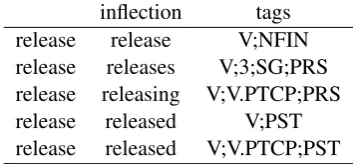
A linguistic paradigm is the complete set of re-lated word forms associated with a given lexeme. Within the paradigm, inflected word forms of lex-emes are defined by the requirements of syntactic rules. A word’s form reflects syntactic and seman-tic features that are expressed by the word, such as the conjugations of verbs, and the declensions of nouns (Cotterell et al., 2017). For example, every English count noun has both singular and plural forms, known as the inflected forms of the noun. Different languages have various degrees of inflection. Some can be highly inflected, such as Latin, Greek, Spanish, Biblical Hebrew, and San-skrit, and some can be weakly inflected, such as English. An example is shown in table1.
inflection tags
release release V;NFIN
release releases V;3;SG;PRS release releasing V;V.PTCP;PRS
release released V;PST
[image:1.595.327.506.205.287.2]release released V;V.PTCP;PST
Table 1: An example of an inflection table from word “release”.
The issue of analyzing and generating differ-ent morphological forms has received consider-able critical attention. Errors in the understand-ing of morphological forms can seriously harm performance in the machine translation and ques-tion answering systems. On the other hand, apply-ing inflection generation as a post-processapply-ing step has been shown to be beneficial to reducing the data sparsity when translating morphologically-rich languages (Minkov et al.,2007).
For the CoNLL-SIGMORPHON-2017 Shared Task 1 (Cotterell et al., 2017) on morphological reinflection, given a lemma (the dictionary form of a word) and target morphosyntactic descrip-tions, a target inflected form is required to be gen-erated across 52 different languages. In each of these languages, there are three training sets (high, medium, and low) representing different amount of training data (Scottish Gaelic only has medium and low).
2 Related Work
Inflection generation can be modeled as string transduction and consists of three major compo-nents: (1) Aligning characters forms; (2) Extract-ing strExtract-ing transformation rules; (3) ApplyExtract-ing rules to new root forms (Faruqui et al.,2016).
Recently, end-to-end deep learning approaches achieve state-of-the-art performance across many different datasets. LMU system ranked first in SIGMORPHON shared task (Kann and Sch¨utze,
2016). It used an encoder-decoder structure with attention mechanism to do translation from root word to its inflection. At the same time, convo-lutional neural networks have been leveraged to extract features from root words (Ostling, 2016).
Faruqui et al. (2016) added language model in-terpolation into the encoder-decoder structure and trained the neural network in both supervised and semi-supervised settings, and achieved state-of-the-art performance in Spanish verb and Finnish noun and adjective datasets.
Our system leverages a sequence-to-sequence model similar to Faruqui et al. (2016). For each language and training set, we train a separate model using a character-level bidirectional GRU encoder and a single layer GRU decoder with a global attention model (Luong et al.,2015).
3 Model
Our system for this Shared Task 1 is based on an encoder-decoder model proposed byBahdanau et al. (2014) for neural machine translation. The RNN unit we use in our system is GRU (Cho et al.,
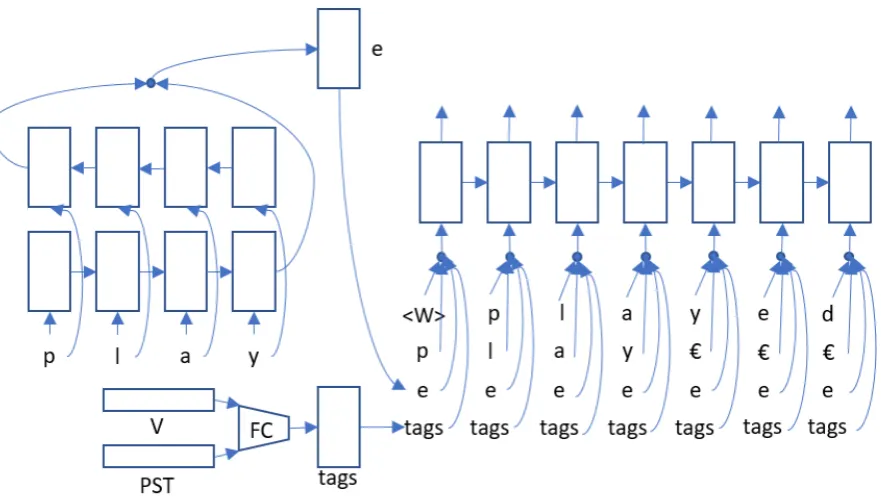
2014). Fig.1shows our overall architecture. The GRU reads an input sequence and encodes each input as a fixed length vector hi, which is
computed by
zt=σg(Wzxt+Uzht−1+bz) (1)
rt=σg(Wrxt+Urht−1+br) (2) ˆ
ht=tanh(rt◦U ht−1+Whxt) (3)
ht= (1−zt)◦ˆht+zt◦ht−1 (4)
To obtain global information of each input, we use a bidirectional GRU and concatenate each hidden state as one vector,hi = [−→hi;←−hi]to be the
out-put of encoder’s hidden state. For the decoder, we use a single layer GRU. Our model has two in-put streams, one is the characters and the other is the morphological tags. We only encode the input characters, and make the morphological tags as another input feature to contribute to the outputs. We pad the morphological tagging sequences to the length of the longest tags in the training sets, and feed them into a fully connected network to produce the feature.
In neural machine translation, the input and out-put sequences are semantically equivalent. How-ever, morphological inflection of a word has differ-ent semantics (Faruqui et al.,2016). So we make the encoded input sequence as a part of the input of
decoder together with the morphological tags (in-cluding part-of-speech; POS). To get the hidden state of decoder at time stept, we use the previ-ous hidden stateht−1, the decoder inputyt−1, the
encoder state of the root worde, and the represen-tation of morphological tagging sequence of target formpto compute:
ht=g(ht−1,{yt−1, e, p}) (5)
wheregis the GRU decoder function.
Another difference from machine translation is that our input and output sequence characters may be very similar except the inflections. Take the words release, releasing, and released from En-glish as an example, these three words only dif-fer in the ending characters. To make full use of this similarity, we also add the corresponding in-put character as a part of the decoder’s inin-put, soht
is computed as
ht=g(ht−1,{yt−1, xt, e, p}) (6)
To solve the variable length of input and output sequences, we add paddings asxtindicating null
input.
In the decoding phase, we use a global attention model based on the hidden state of decoder and all the hidden states from the encoder (Luong et al.,
2015) to calculate the context vectorctat time step
tas:
ct= Tx
X
j=1
αtjhj (7)
whereαtj is the attention weights, hj is the
out-put of each hidden state from the encoder. The weights are computed as
scoretj=tanh((Waht+ba)T ·hj) (8)
αtj=
exp(scoretj) P
iexp(scoreti) (9)
This context vector can be treated as a fixed rep-resentation of what has been read from the source for this time step. We concatenate it with the de-coder state ht and feed it through another fully
connected network to produce the output distribu-tion (Fig.2):
Py =sof tmax(W[ct;ht] +b) (10)
The loss for time steptis the negative log likeli-hood of the targetwt:
Figure 1: The overall architecture of our approach (without the global attention model and is the padding character).
Figure 2: The attention model.
and the overall loss for the whole sequence is com-puted by:
loss= 1
T
T X
t=0
losst (12)
When decoding, we use beam search of size 4 to generate possible output character sequences and rank them by the average probability of characters.
4 Experimental Evaluation 4.1 Data Format
The data provided by Task 1 is the root word and its target morphological tags. We add some spe-cial symbols to the character set for every lan-guage: “UNK” represents the unknown character, “PAD” is the padding character, “START” denotes the starting of a sequence and “END” represents the ending of a sequence. We only add “START” and “END” to the output sequences. Because the input is fixed, and it is not necessary to make the encoder aware of when the sequence will finish. Although the starting character is not considered in the loss, the ending character is taken into ac-count.
4.2 Training Setting
Embedding Size Hidden Size
High 100 200
Medium 100 50
[image:4.595.329.505.59.189.2]Low 50 20
Table 2: The embedding size and hidden size for three different settings.
Dropout Rate
High [0.55, 0.6, 0.65, 0.7, 0.75, 0.8, 0.85] Medium [0.4, 0.45, 0.5, 0.55, 0.6, 0.65, 0.7]
[image:4.595.81.281.63.119.2]Low [0.3, 0.35, 0.4, 0.45, 0.5, 0.55, 0.6]
Table 3: The dropout rates used for three different settings.
For training, we use Adam algorithm (Kingma and Ba, 2014) and set different minibatch sizes according to various training settings (high/medium/low). Compared to high setting, there are much less training samples in the medium and low. Thus it will take more time to converge if we set the minibatch size too large. We also use early stopping (Caruana et al.,2000) based on the performance of development sets.
4.3 Ensemble
We use different dropout rates to train multiple models in the same training set. Table 3 shows our dropout rates for different models. To select the best result, we use the voting strategy from dif-ferent models and pick up the answer that appears most likely.
4.4 Results
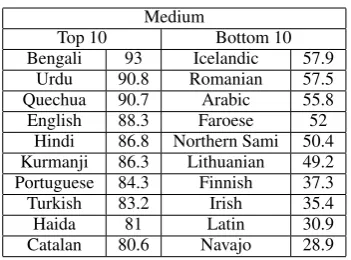
All the results in this section are evaluated in ac-curacy for different languages, computed over the official test data. Tables 4,5, and6 show the re-sults of our model in different settings.
High
Top 10 Bottom 10
Urdu 99.4 French 79.1
Hindi 99.1 Hungarian 78.7 Welsh 98 Serbo Croatian 78.6 Quechua 97.1 Icelandic 78
Haida 97 Romanian 77.3
Khaling 96.6 Faroese 77 Persian 96.3 Finnish 74.4
Basque 96 Irish 73.1
Bengali 96 Navajo 68.5
[image:4.595.313.519.235.361.2]Estonian 94.8 Latin 54.7 Table 4: Top 10 and bottom 10 performance in the high setting of Task 1.
Medium
Top 10 Bottom 10
Bengali 93 Icelandic 57.9 Urdu 90.8 Romanian 57.5 Quechua 90.7 Arabic 55.8 English 88.3 Faroese 52
Hindi 86.8 Northern Sami 50.4 Kurmanji 86.3 Lithuanian 49.2 Portuguese 84.3 Finnish 37.3 Turkish 83.2 Irish 35.4
Haida 81 Latin 30.9
Catalan 80.6 Navajo 28.9 Table 5: Top 10 and bottom 10 performance in the medium setting of Task 1.
Low
Top 10 Bottom 10
English 74.7 Finnish 7.6
Norwegian Bokmal 73.6 Latin 7.4
Kurmanji 71.1 Haida 7
Danish 59.7 Northern Sami 4.9
Wwedish 51.7 Albanian 4.5
Urdu 46.9 Khaling 3.2
French 46.2 Arabic 1.5
Norwegian Nynorsk 45.8 Basque 1 Portuguese 44.5 Navajo 0.3 Scottish Gaelic 44 Sorani 0.1 Table 6: Top 10 and bottom 10 performance in the low setting of Task 1.
In each training setting (high/medium/low), we use the same parameters for all languages, instead of optimizing parameters based on different lan-guage. It means that our model may not be optimal for some languages, which is the reason why the performance differed a lot from each other. The top languages may have some related properties with Albanian. However, languages like French, Romanian and Latin may not be correctly modeled by our model.
In the low setting of Task 1, we only get 100 training samples for each language. Deep learn-ing may easily overfit and can not generate good results when testing. That is why Haida performs well in high and medium settings while staying at the bottom 10 in the low setting.
5 Conclusion
[image:4.595.98.265.602.730.2]interest-ing to add some linterest-inguistic features to improve the performance and the generalization of our system.
Acknowledgements
The work presented in this paper is sup-ported in part by National Science Foundation (CNS-1624782) and National Institutes of Health (R01GM110240). The content is solely the re-sponsibility of the authors and does not necessarily represent the official views of the granting agen-cies.
References
Dzmitry Bahdanau, Kyunghyun Cho, and Yoshua Ben-gio. 2014. Neural machine translation by jointly learning to align and translate. InICLR 2015.
Rich Caruana, Steve Lawrence, and Lee Giles. 2000. Overfitting in neural nets: Backpropagation, conju-gate gradient, and early stopping. InNIPS. pages 402–408.
Kyunghyun Cho, Bart van Merrienboer, Caglar Gul-cehre, Fethi Bougares, Holger Schwenk, and Yoshua Bengio. 2014. Learning phrase representations using rnn encoder-decoder for statistical machine translation. InConference on Empirical Methods in Natural Language Processing (EMNLP 2014).
Ryan Cotterell, Christo Kirov, John Walther G´eraldine Sylak-Glassman, Ekaterina Vylomova, Patrick Xia, Manaal Faruqui, Sandra K¨ubler, David Yarowsky, Jason Eisner, and Mans Hulden. 2017. The CoNLL-SIGMORPHON 2017 shared task: Universal mor-phological reinflection in 52 languages. In Proceed-ings of the CoNLL-SIGMORPHON 2017 Shared Task: Universal Morphological Reinflection. Asso-ciation for Computational Linguistics, Vancouver, Canada.
Manaal Faruqui, Yulia Tsvetkov, Graham Neubig, and Chris Dyer. 2016. Morphological inflection genera-tion using character sequence to sequence learning. InProceedings of NAACL.
Katharina Kann and Hinrich Sch¨utze. 2016. MED: The LMU system for the sigmorphon 2016 shared task on morphological reinflection. ACL 2016page 62.
Diederik P. Kingma and Jimmy Ba. 2014. Adam: A method for stochastic optimization. In Proceed-ings of the 3rd International Conference on Learn-ing Representations (ICLR).
Minh-Thang Luong, Hieu Pham, and Christopher D Manning. 2015. Effective approaches to attention-based neural machine translation. arXiv preprint arXiv:1508.04025.
Einat Minkov, Kristina Toutanova, and Hisami Suzuki. 2007. Generating complex morphology for machine translation. InACL. volume 7, pages 128–135.