An Improved Java Programming Learning
System Using Test-Driven Development Method
Nobuo Funabiki, Yuuki Fukuyama, Yukiko Matsushima, Toru Nakanishi, Kan Watanabe
∗Abstract— To enhance educational effects of Java programming by assisting self-studies of students and reducing teaching loads of teachers, we have proposed a Web-based Java programming learning system using the test-driven development method. In this system, a teacher should register Java programming assign-ments with stateassign-ments, model source codes, and test codes using a Web browser. Then, a student can submit a test code and an answer source code for each assignment, where both codes are tested auto-matically by a testing tool called Junit at the server. Unfortunately, the current system cannot identify an incomplete test code that does not contain the com-plete test procedures if it has no grammatical error. In this paper, we introduce a code coverage measure-ment tool called Coberturato detect such a test code by measuring the coverage rate when the submitted test code tests the model source code. We evaluate the effectiveness of our improved system through ex-periments with two simple assignments to11students who have studied Java.
Keywords: Java education, Web system, test-driven development method, verification, code coverage
1
Introduction
Recently, with penetrations of the information and com-munication technology (ICT) into our societies, adverse affects of system failures due to software bugs have be-come intolerable. From this trend, the software test has been regarded as the last crucial process to avoid pro-ductions of software bugs in systems. Then, atest-driven development (TDD) method has been focused as an ef-fective software developing method that can avoid bugs by writing and testing source codes at the same time [1]. In the TDD method, a test code should be written be-fore writing a source code. Atest codeis a program code to verify the correctness of the outputs of the methods implemented in thesource codeto be tested.
Javais a useful and practical programming language that has been used in a lot of important systems including Web systems and embedded systems. Thus, the Java programming education in schools has been important so
∗Dept. of Electrical and Communication Engineering, Okayama
University, 3-1-1 Tsushimanaka, Okayama, 700-8530, Japan Email: [email protected]
as to foster professional Java programmers. To enhance educational effects of the Java programming by assisting self-studies of students and reducing teaching loads of teachers, we have proposed a Web-based Java program-ming learning system using the TDD method[2]. In this Web application system, a teacher first should register assignments with their statements, model source codes, and test codes using a Web browser. Then, a student can submit a test code and an answer source code for each assignment. At the submission, these codes are tested automatically by using the code testing tool calledJunit [3] at the Web server.
Unfortunately, the current system cannot identify an in-complete test code that does not contain the in-complete procedures of testing a source code if it has no grammat-ical error. In the TDD method, normally, the test code should generate an object of any class that is defined in the source code, and execute any path of the methods in the class for their tests. In our system, a test code from a student is tested through testing the model source code registered by a teacher. Even if this test code lacks some of the procedures for testing the methods in the model source code, it is passed. As a result, the correctness of the test code cannot be guaranteed in our current system.
In this paper, we additionally introduce a code cover-age measurement tool called Cobertura [5] to detect an incomplete test code of a student by measuring the cov-erage rate of the model source code that is executed or covered by the test code. When the rate is not 1.0, the test code lacks testing procedures for some paths in the model source code. This means that the test code is in-complete, assuming the model source code is complete. Besides, this tool is used to find unnecessary descriptions in the source code of a student by measuring the cover-age rate at the source code test by the teacher test code. When the rate is not 1.0, the source code contains un-necessary procedures that are not executed by the test code. We evaluate the effectiveness of the improved sys-tem through experiments to 11 students who have studied Java.
evalu-ation result. Section 6 concludes this paper with some future works.
2
Test-driven Development Method
In this section, we introduce the test-driven development method and its features.
2.1
Outline of TDD Method
In the TDD method, the test code should be written be-fore the source code is implemented, so that it can verify whether the source code satisfies the required specifica-tions during its development process. The basic cycle in the TDD method is as follows:
(1) to write the test code to test every specification,
(2) to write the source code, and
(3) to repeat modifications of the source code until it passes every test by the test code.
2.2
Junit
In our system, we adopt Junit as an open-source Java framework to support the TDD method. Junit can as-sist an automatic single test of a Java code unit or a class. Because Junit has been designed with the Java-user friendly style, its use including the test code pro-gramming is easy for Java programmers. InJunit, a test is performed by using a method whose name starts from ”assert”. This paper adopts the ”assertEquals” method to compare the execution result of the source code with its expected value.
2.3
Test Code
The code test should be written using libraries inJunit. Here, by using the following MyMath class source code, we explain how to write a test code. MyMathclass returns the summation of two integer arguments.
1: public class Math{
2: public int plus(int a, int b){
3: return( a + b );
4: }
5: }
Then, the following test code can test theplusmethod in theMyMathclass.
1: import static org.junit.Assert.*; 2: import org.junit.Test;
3: public class MathTest {
4: @Test
5: public void testPlus(){
6: Math ma = new Math();
7: int result = ma.plus(1, 4);
8: asserEquals(5, result);
9: }
10:}
The names in the test code should be related to those in the source code so that their correspondence becomes clear:
• The class name is given by the test class name + Test.
• The method name is given by thetest + test method name.
The test code imports Junit packages containing test methods at lines 1 and 2, and declares MathTestat line 3. @Testat line 4 indicates that the succeeding method represents the test method. Then, it describes the test method.
The code test is performed as follows:
(1) to generate an instance for the MyMathclass,
(2) to call the method in the instance in (1) using given arguments, and
(3) to compare the result with its expected value for the arguments in (2) using theassertEqualsmethod.
2.4
Features in TDD Method
In the TDD method, the following features can be ob-served:
1. The test code can represent the specifications of the program, because it must describe any function to be tested in the program.
2. The test process for a source code becomes efficient, because each function can be tested individually.
3. The refactoring process of a source code becomes easy, because the modified code can be tested in-stantly.
Therefore, the study of the test code description is use-ful even for students, where the test code is equivalent to the program specification. Beside, students should ex-perience the software test that has become important in companies.
3
Java Programming Learning System
NOBASU (JSP / Servlet)
Tomcat (Web server)
MySQL (Database)
Linux (OS) NOBASU (JSP / Servlet)
Tomcat (Web server)
MySQL (Database)
[image:3.595.113.226.72.141.2]Linux (OS)
Figure 1: Server platform.
3.1
Server Platform
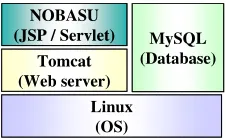
The Java programming learning system is implemented as a Web application. As the server platform, it adopts the operating system Linux, the Web server Apache, the application server Tomcat, and the database system MySQL, shown in Figure 1.
3.2
Two Learning Steps for Java
Program-ming Self-studies
This system provides two learning steps for Java pro-gramming self-studies by students. One is a Java code learning step that allows students to write Java source codes by referring the test code made by a teacher. An-other is aTDD method learning stepthat allows students to write both test code and source code, so that they can study the TDD method.
3.3
Java Code Learning Step
The Java code learning step consists of user functions for teachers and students. The user functions for teachers include the registration of new classes, the registration and management of assignments, and the verification of source codes submitted from students. To register a new assignment, a teacher needs to submit an assignment ti-tle, a problem statement, a model source code, and a test code, which are disclosed to the students except for the model source code after the registration. Note that the test code must test the model code correctly. Using the correspondence between a source code and a test code in Sect. 2.3, our system automatically generates a template for the test code from the model source code. Thus, a teacher only needs to specify figures for the arguments in each test method to complete the test code.
To evaluate the difficulty of assignments and the com-prehension of students, it allows a teacher to view the number of submissions for code testing by each student. If a teacher finds that a lot of submissions have been tried by many students for an assignment, it can be considered too difficult for them and should be changed to an easier one. If a teacher finds a student who submitted codes many times whereas other students did so fewer times, the student should be cared specifically.
The user functions to students include the view of the
[image:3.595.313.539.73.212.2]Five string arguments for “encrypt” method
Figure 2: Test code from teacher.
ElGamal encryption
Figure 3: Source code from student.
assignments and the submission of source codes for the assignments. A student should write a source code for an assignment by referring the problem statement and the test code, where he/she must use the class/method names, the types, and the argument setting specified in the test code. Our system implements a Web-based source code editor calledCodePress[4] so that a student can write codes on a Web browser. The submitted source codes are stored in the database at the server so that they can view old ones.
Figures 2 and 3 show the test code and a source code from a student for theElGamalencryption programming assignment. Figure 4 shows the test result, where one error is detected because the last argument of the ”en-crypt” method in the source code is different from the specification given in the test code.
3.4
TDD Method Learning Step
3.4.1 Name List
[image:3.595.314.525.253.377.2]Compile success
No main method for Encryption class
One error detected Compile result
Execution result
[image:4.595.320.531.73.233.2]Test result
Figure 4: Test result for source code.
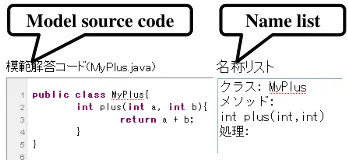
types, and the argument setting in the model source code to students by using the name list. The name list con-tains every class and method name, the configuration of the arguments, and the return value type. To reduce the teacher load, our system automatically extracts the necessary information to generate the name list from the model source code, shown in Figure 5
[image:4.595.53.285.76.246.2]Model source code Name list
Figure 5: Model source code and name list.
3.4.2 Test Code Submission and Verification
A student should write a test code first by referring the problem statement and the name list from a teacher, and submit it to the server using the interface in Figure 6. Then, it is verified by testing the model source code of a teacher.
3.4.3 Source Code Submission and Verification
Then, a student writes a source code by referring the problem statement and his/her test code, and submits it. The source code is verified by both test codes from the teacher and the student. If both tests are passed, the test code and the source code can be regarded as correct ones. Otherwise, they are regarded as incorrect ones, and the student needs to fix the problems in them.
Source code file upload
Compile & test
Test code
Figure 6: Test code submission.
3.4.4 Problem in Test Code Verification
Unfortunately, this test code verification is not sufficient because it can be passed even if the test code lacks some necessary codes to test the corresponding functions in the source code. Junittests the functions of the source code only if they are described in the test code, and cannot detect the lacks of testing even important functions. The improvement of this test code verification is actually a contribution of this paper, which will be discussed in the next section.
3.5
Secure Test Environment
Here, we should note that source codes from students may contain defective commands such as an infinite loop and an illegal file access. To protect the server from them, two methods, namely a code analysis and anexecution time monitoring, are adopted in our system. The code analysis analyzes the source code form a student to find whether it contains commands that may give adverse effects to the server. Specifically, if it contains a class for the file access such as ”Buffered Write” and ”PrintWriter”, and a class for using external commands such as ”Process” and Runtime”, the test for this code is aborted and the test failure is returned to the student. The execution time monitoring executes the source code on a thread so that the execution time is observed from the main program. If the time exceeds a given limit or an exception is detected from the source code, the test is aborted and the failure is returned.
4
System Improvement by Code
Cover-age Measurement
[image:4.595.82.256.398.481.2]4.1
Outline of Cobertura
[image:5.595.360.497.71.220.2]Coberturacan analyze the test coverage rate in the source code that is tested by the test code. The measurement report from Coberturaincludes line-rate that represents the rate of the tested code lines in the source code, and branch-ratethat represents the rate of the tested branches when branches exist. As these values approach to 1.0, the test coverage rate is improved. The result can be reported by an XML format or an HTML format so that it can be viewed graphically using a Web browser as shown in Figure 7.
Figure 7: Coverage report by Corbertura.
4.2
Application of Cobertura
Cobertura is used when Junit tests a source code. In this subsection, we describe when this tool is used in our system.
4.2.1 Assignment Registration by Teacher
When a teacher registers a new assignment, Cobertura is used to verify whether the test code covers the tests of the model source code, so that errors in them can be avoided as best as possible.
4.2.2 Test Code Submission by Student
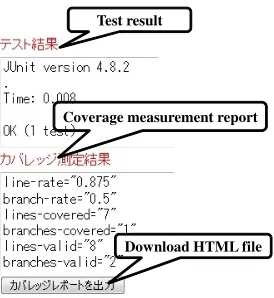
When a student submits a test code,Coberturais used to verify whether the test code covers the tests of the model source code. The report is output with the test result as shown in Figure 8. If line-rate is 1.0, the test code covers the whole tests of the source code. If it is smaller than 1.0, the test code does not cover some tests. In this case, the student can download the coverage report of the HTML format. Here, we note that this report excludes the model source code by a teacher.
4.2.3 Source Code Submission by Student
When a student submits a source code,Coberturais used to verify whether the source code contains unnecessary codes that are not tested by the test code from a teacher.
Test result
Coverage measurement report
Download HTML file
Figure 8: Test result of test code.
Table 1: Completions for two assignments.
Item Assign. 1 Assign. 2 # of test code completions - 8 # of source code completions 11 8
If the test code contains such unnecessary codes, they should be removed.
5
Evaluation
In order to evaluate the improvement of the Java learning system, we applied it to 11 students as experiments in our laboratory who have Java programming experiences.
5.1
Assignments and Test Results
For each of the two steps in our system, we prepared one assignment at the beginner level that is easy but re-quires multiple test methods in the test code. Specifi-cally, assignment 1 for the Java code learning step asks a source code for handling two-dimensional arrays, and assignment 2 for the TDD method learning step asks a test code and a source code for extracting the maximum and minimum among the integer arrays. The completion results for them are shown in Table 1.
5.2
Questionnaire Results for Java Code
Learning
[image:5.595.50.293.236.291.2]more than half of the students replied 2 or 3, indicate that the evaluation of the coverage measurement tool in writing a source code is not sufficient. The reason may be that the source code is short and can be written without modifications because the assignment is very easy. The evaluation using harder assignments will be necessary in future works. The results to Q6, where more than 80% of the students replied 4 or 5, indicate that this system helps students to understand the TDD method.
Table 2: Questions for questionnaire for Java code learn-ing.
Question
Q1 Do you think to use the system is easy ? Q2 Do you think to read the test code is helpful in
understanding the assignment specification ? Q3 Do you understand the system outputs of the
compiling and verification results easily ? Q4 Do you think the coverage measurement tool in
the system is helpful in learning Java codes ? Q5 Do you think the graphical coverage report
is useful ?
[image:6.595.52.287.232.371.2]Q6 Do you understand the TDD method by using this system ?
Table 3: Questionnaire results for Java code learning.
1 2 3 4 5 Q1 no 1 3 0 4 3 yes Q2 no 0 3 0 2 6 yes Q3 no 0 1 2 5 3 yes Q4 no 0 0 6 2 3 yes Q5 no 0 1 6 3 1 yes Q6 no 0 0 2 5 4 yes
5.3
Questionnaire Results for TDD Method
Learning
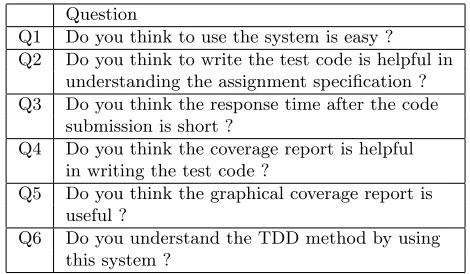
Then, we asked them to reply the six questions in bles 4 for TDD method learning with five grades. Ta-ble 5 shows the results to the questions. The results to Q4 and Q5, where more than half of the students replied 4 or 5, indicate that the coverage measurement tool is useful in writing the test code. Because no student in this experiment has experience in the TDD method, the coverage report can help them to write a correct test code of testing every required specification of the assignment. The results to Q3, where more than half of the students replied 3 or smaller grades, indicate that many students felt the response time of the system is long. Actually, in our measurement, the response time for one code sub-mission becomes nearly 10 seconds. The reduction of this time by improving codes of the system and adopting mul-tiple servers will be in our future studies.
Table 4: Questions for questionnaire for TDD learning.
Question
Q1 Do you think to use the system is easy ? Q2 Do you think to write the test code is helpful in
understanding the assignment specification ? Q3 Do you think the response time after the code
submission is short ?
Q4 Do you think the coverage report is helpful in writing the test code ?
Q5 Do you think the graphical coverage report is useful ?
Q6 Do you understand the TDD method by using this system ?
Table 5: Questionnaire results for TDD method learning.
1 2 3 4 5
Q1 no 0 4 2 2 3 yes
Q2 no 1 0 4 4 2 yes
Q3 no(long) 1 2 3 1 4 yes(short)
Q4 no 0 0 4 2 5 yes
Q5 no 0 1 3 5 2 yes
Q6 no 0 0 3 6 2 yes
6
Conclusion
This paper presented an improvement of the Web-based Java programming learning system using the test-driven development method by introducing a code coverage mea-surement tool called Cobertura. It can detect an incom-plete test code through measuring the coverage rate of testing the model source code by the test code. The eval-uation results through experiments confirmed the effec-tiveness of the improved system. Improvements of user interfaces by using a code editor for multiple browsers, evaluations using harder assignments, and reductions of the system response time will be in our future studies.
References
[1] K. Beck, Test-driven development: by example, Addison-Wesley, 2002.
[2] N. Funabiki, T. Nakanishi, N. Amano, H. Kawano, Y. Fukuyama, and M. Isogai, ”A software architec-ture and characteristic functions in learning manage-ment system ”NOBASU”,” Proc. SAINT 2010, pp. 109-112, July 2010.
[3] Junit, http://www.junit.org/.
[4] CodePress, http://sourceforge.net/projects/codepress/.
[image:6.595.93.246.424.510.2]