Computational Intelligence Based Optimization of
Energy Aware Routing in WSN
Rabia Iram, Muhammad Irfan Sheikh, Sohail Jabbar, Abid Ali Minhas
Abstract—The researches inclined towards intelligent behavior of the nature to explore architecture for intelligent systems. Artificial intelligence (AI) brings evolution to computational intelligence (CI) emergence which is highlighted in this article .CI gives a picture of the nature’s supremacy of being the ultimate intelligent optimizer for human made solutions. A complete picture of energy awareness factor in CI with respect to wireless sensor network (WSN) is also explained. Bio inspired computing escorts us towards the era of bio inspired optimization techniques which enables the technology to handle issues in an optimal and reliable fashion. It ultimately helps to optimize other issues in WSN. The ideology behind making CI the choice of the hour instead of AI for solving energy aware routing is the features which prevails its authenticity and adoption of hybrid approach using different classes of CI to achieve more deterministic and optimized results. Last but not the least researchers are provided with more specific directions and commitment to the solution of energy aware optimized routing in WSN with a true synergy of CI classes.
Keywords—wireless sensor network (WSN) , computational intelligence(CI), computational intelligence(CI) for energy aware routing in WSN,comparative analysis of computational intelligence(CI) paradigms.
I. INTRODUCTION
Future technology i.e. ubiquitous computing also refers to Wireless Sensor Network (WSN) .The sensor nodes gather sensed data which are deployed in remote or populated environment, communicate and process data with other sensor nodes in a network of tens or thousands of nodes in a wireless fashion, helps to construct WSN. It provides endless opportunities in various fields and in different applications. Some important real world projects of WSN are Bathymetry [1], Ocean Water Monitoring [2], ZebraNet [3], Cattle Herding [4], and Bird Observation on Great Duck Island [5], Grape Monitoring [6], Rescue of Avalanche Victims [7], and neuRFon [8].
Technology driven archaic is actors and enablers
for the development of innovative applications and services in sensor environment. Routing is the most vital issue in WSN like the traditional data communication in the wired network. Energy consumption of communication among nodes, residual energy and path length are the issues involved in energy efficient routing. Researchers have to cope with the challenging problem of routing for prolonged life of data communication between the nodes.
Optimal energy aware routing in WSN through bioinspired algorithms is really a fascinating area with great potential. Routing in WSNs is different from the conventional IP based networks as each node serves as independent identity in WSN network formation. Either it could act as a sensor and transmission node only or could be a router which also works as a gateway, an interface with network outside the WSN. The main focus resides on the network layer to maximize the network lifetime for congestion avoidance and maintaining connection among nodes in an energy efficient way. The two main issues relevant to routing for increased network lifetime, need to be focused are optimal path selection (path discovery, choice of route) and energy efficiency (comparable rate of nodes depletion).
As far as solution with respect to bio inspired algorithms is concerned, it enables the problem to solve according to the principles evolved from nature. This can be achieved by understanding nature‘s rule to solve the complex problems. Keeping in view researchers inclined towards the principles, and mechanisms which lead to develop computationally efficient and intelligent algorithms. The distinguishing trait of bio inspired computing in terms of behavior and architect helps to evolve bio inspired computing. Computationally intelligent algorithms are inspired by the mechanism of the nature. Pinching prongs of limited energy supply, limited computing power, limited memory and limited bandwidth causes frequent and unpredictable changes in WSN. Wireless networking among the sensors, computational capability and the uniform energy awareness among nodes in a distributed environment has posed many challenges among sensors in the network depending upon application and architecture. Affecting factor of energy in many challenges of WSN can be catered with the help of Computational Intelligence (CI) paradigm algorithms which helps in prolonging the lifetime of the network.
The rest of the paper is organized as follows; section II summarizes the CI paradigms and WSN energy aware issues respectively. Section III is based on Future directions with respect to CI techniques based optimization of energy aware routing in WSN. We will present the conclusion in section IV.
Manuscript received July 3, 2011; revised August 6, 2011. This work was done by MS and PhD Students during their thesis with Bahria University Wireless Research Center, Bahria University Islamabad, Pakistan. Corresponding author are:
Rabia Iram ([email protected]) is a MS student doing thesis in wireless sensor network with the department of graduate studies and applied sciences Bahria University, Islamabad, Pakistan
Muhammad Irfan Sheikh ([email protected]) is a MS student doing thesis in wireless sensor network with the department of graduate studies and applied sciences Bahria University, Islamabad, Pakistan
Sohail Jabbar ([email protected]) is a PhD student doing thesis in wireless sensor network with the department of graduate studies and applied sciences Bahria University, Islamabad, Pakistan
II. COMPUTATIONAL INTELLIGENCE AND ENERGY CONSERVATION SCHEMES IN
WIRELESS SENSOR NETWORK
Machine intelligence, the advanced form of the technology has two flavors in terms of solution inspired by nature i.e. Artificial Intelligence (AI) and CI .Endeavour of intelligence from both the flavors can be defined as “The ability to use memory, knowledge, experience, understanding, reasoning, imagination and judgment in order to solve problems and adapt to new situations” [9].The history of modern digital computers and machines laid the foundation of AI as they both complement each other. AI is a vast field of knowledge mimicking ways of problem solving in humans and human intelligence i.e. it follows the architecture of human intelligence system and works on how the mind works .The ways of problem solving can be possible through a cognitive approach and an algorithmic approach, where as intelligence can be achieved through inductive and analogy based learning processes. Few traits such as reasoning, planning, machine learning, intelligent search, perception building provides the strength to AI in computer science related fields. The pitfall of AI lies in solving the optimization problems as it just deals with heuristic search methods. Optimization is one such approach that could be defined as the process to find the optimal solution of the problem among alternatives. The optimal solution could be an extract/merger of the multiple solutions at hand which might lead to solve more than one issues of the problem at a time. As the computing machines or devices flourish in their development, researchers found that the living systems are flexible enough to adapt the environmental changes so paradigms are constructed with the help of biological inspired solutions. AI has fueled the need for the development of CI paradigms as AI is insufficient to deal with optimization problems. Nugget of information about CI has been elaborated by Poole et al. as “CI is the study of the design of intelligent agents. An intelligent agent is a system that acts intelligently and what it does is appropriate for its circumstances and its goal, flexible to changing environments and goals, learns from
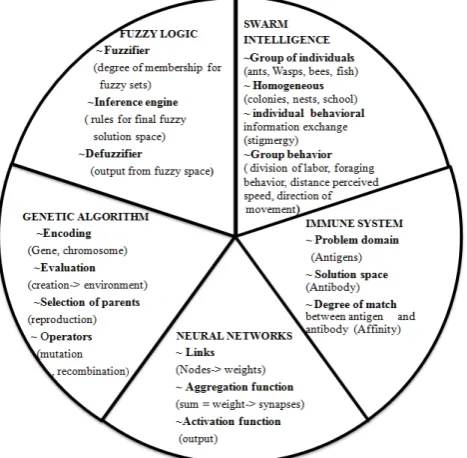
[image:2.595.53.287.525.754.2]Figure 1: Computational Intelligence paradigms from
real to artificial systems.
experience, and appropriate choices given perceptual limitations and finite computation.”[10].Better computer systems and improved performance of computational tasks such as flexibility, adaptability, decentralization and fault tolerance are few important traits of CI.
The computational intelligent paradigm involves artificial neural network (ANN), artificial immune system (AIS), swarm intelligence (SI), Genetic Algorithms (GA), and fuzzy logic (FL) system. CI has been a source of providing solutions in various fields. The real systems in CI paradigms help to introduce algorithms which mimic their real behavior. The CI paradigms address a multidisciplinary, rich, and, diverse area of research in a number of applications in various fields. Such as WSN, digital communications, RF and microwave communication, radars communication, signal processing, acoustics, power, and lots more. Fig. 1 elaborates the key features of real systems on which the algorithms are developed which are explained below.
ANN system comprises of graph theory based connected neurons which are capable of parallel or distributed processing mechanism. Neurons are connected together using subjective connections called synapses. These connections also impersonate the behavior of human brain, an inspiration from biological neural system to the implementation in modern WSN technology forming base for optimization problems.
Biological immune systems protect the body from external assailant using the intrinsic immunity and adaptive immunity methodologies. So the AIS mimic the same principle solving optimization problems due to its adaptive nature and distributive system properties. WSN nodes based on AIS using Antigen expressions, antibody expressions and the initialization of antibody optimizes the problems.
The idea of genetic evolution of nature has immensely impressed the humans to use the ideology behind them in different disciplines of life and this gave birth to the energy awareness. These algorithms gave life to such real worlds problems which require contemporaneous optimization of multiple objectives problems.
SI is a CI technique, inspired from ant colonies, bird flocking, animal herding, and bacterial growth and fish schoolings. A collective behavior in each BI system shows that single agent is not efficient and so their collective collaboration makes system intelligent. Decentralized and self organized behavior of SI helps to solve the various optimization problems. Example algorithms solving WSN challenges as shown in Table among the WSN challenges routing is the core issue which is based on stringent challenges more as of SI are Ant colony Optimization (ACO). The ACO algorithm is based on foraging behavior of ants like in real ant colonies. The Ants communicate via stigmergic information. River Formation Dynamics (RFD), Particle Swarm Optimization (PSO), The PSO algorithm analogous to sophisticate distributed, interactive problem solving strategies of agents with their environment optimize the problems, Stochastic Diffusion Search (SDS), Gravitational Search Algorithm (GSA), Intelligent Water Drop (IWD), Charged System Search (CSS) etc.
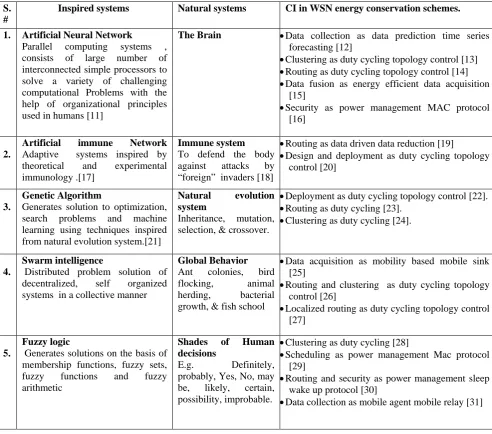
Table 1.Real to Artificial CI Paradigms in Solving Various WSN Issues Using Energy Conservative Schemes.
domains and membership functions of optimization capabilities of the FL has dramatically optimized the problems. Table 1 show that the inspired solutions in CI are linked with real systems and also its vast applications in WSN challenges as energy conservative approaches. The structure of node is designed as having computation, sensing and processing systems which utilizes energy with respect to their functionality. So this make the energy conservation is a most stringent issue in WSN. Anastasi et al. in [10] shows taxonomy of energy conservation schemes used in WSN. There are three main energy conservation schemes which are listed as duty cycling based, data driven based and mobility based. Duty cycling energy conservation schemes deals with the active and passive modes of node during their lifetime to conserve the energy is further categorized in terms of topology control and power management, where as the data driven energy conservation schemes address the data reduction and energy efficient acquisition approaches and lastly the mobility based energy conservation schemes corresponds to mobile sink and mobile relay related energy conservation approach. Paradigms of CI are solving the energy relevant issues in a variety of approaches to conserve the energy and increase the lifetime of the nodes and the
network vice versa. ANN, AIS, GA, FL and SI algorithm shows different variation of energy conservation compared to other challenges prevailing in WSN. Optimized energy aware routing through CI algorithms helps to increase network life time in WSN and makes it efficient by utilizing the optimized algorithm. The algorithm should be computationally efficient, solving multiobjective nature of routing, its guarantee to provide the solution in optimized right dimension depending upon features of the CI paradigm.
III. COMPUTATIONAL INTELLIGENCE IN WSN FOR
OPTIMIZING ENERGY AWARE ROUTING Factors affecting the routing protocol design are energy, scalability, data assembly, network life span, fault tolerance, latency, design and deployment, quality of service, data delivery models and operating environments. Based on the characteristics of routing protocol generic routing characteristics involve the application specific, data centric, capability of aggregating data and capability of optimizing energy consumption. Both Conventional and bio inspired solutions for routing have different sort of impacts
S. #
Inspired systems Natural systems CI in WSN energy conservation schemes.
1. Artificial Neural Network
Parallel computing systems , consists of large number of interconnected simple processors to solve a variety of challenging computational Problems with the help of organizational principles used in humans [11]
The Brain Data collection as data prediction time series
forecasting [12]
Clustering as duty cycling topology control [13]
Routing as duty cycling topology control [14]
Data fusion as energy efficient data acquisition [15]
Security as power management MAC protocol [16]
2.
Artificial immune Network
Adaptive systems inspired by theoretical and experimental immunology .[17]
Immune system
To defend the body against attacks by “foreign” invaders [18]
Routing as data driven data reduction [19]
Design and deployment as duty cycling topology control [20]
3.
Genetic Algorithm
Generates solution to optimization, search problems and machine learning using techniques inspired from natural evolution system.[21]
Natural evolution system
Inheritance, mutation, selection, & crossover.
Deployment as duty cycling topology control [22].
Routing as duty cycling [23].
Clustering as duty cycling [24].
4.
Swarm intelligence
Distributed problem solution of decentralized, self organized systems in a collective manner
Global Behavior
Ant colonies, bird flocking, animal herding, bacterial growth, & fish school
Data acquisition as mobility based mobile sink [25]
Routing and clustering as duty cycling topology control [26]
Localized routing as duty cycling topology control [27]
5.
Fuzzy logic
Generates solutions on the basis of membership functions, fuzzy sets, fuzzy functions and fuzzy arithmetic
Shades of Human decisions
E.g. Definitely, probably, Yes, No, may
be, likely, certain, possibility, improbable.
Clustering as duty cycling [28]
Scheduling as power management Mac protocol [29]
Routing and security as power management sleep wake up protocol [30]
on different performance parameters like congestion control, packet size, end to end Packet delay, flow control, packet delivery, throughput, scheduling, energy consumption and etc. results in high energy efficiency in bio inspired solution. So the protocol which can properly handles these performance parameters in routing may come up with the energy efficient route. Therefore collective effort of nodes to transfer collected data to the base station reliably defiantly requires a smart routing protocol which makes efficient use of the Mote hardware to conserve energy. The above parameters will priorities the possibility of the energy efficiency in WSN.
The CI paradigms untie the limitation of obstruction by its vast and multiobjective nature. Iram et al. [32] shows that WSN optimization is used to solve the most highlighted issue at the cost of computational efficiency involving design and deployment as multiobjective, localization as multidimensional, security as combinatorial ,routing and clustering as multiobjective, data aggregation as combinatorial scheduling and MAC as combinatorial ,QoS as combinatorial optimization problems. Whetting appetite shows that the parameters which are involved in energy aware routing can be end to end delay, throughput, energy consumption, packet drop ratio, and protocol overhead.
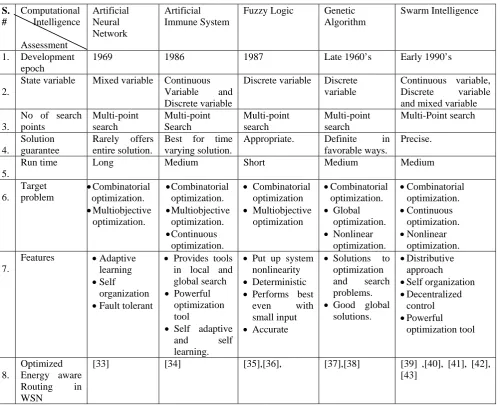
State variables, no of search points, runtime, target problem, features, are efficient to compare and analyze CI paradigm algorithms to solve WSN issues .It can also be
applied to a variety of fields to optimize and solve the issues of different application fields of CI. Here optimized energy aware routing is considered. These are all helps to optimize a certain problem. Table 2 shows a comparative analysis of each CI paradigms algorithms .The important subheads are discussed below.
State variables:
They can change over time and they are the searching points in the search space. Due to its nature, state variables can have internal and external influences. It helps to describe occurrence of complex behavior in a biological inspired algorithm. Continuous variables, Discrete variables and mixed variables are usually sighted in CI paradigms. A mixed variable has zero-one, continuous variable and discrete variable. Continuous state variables deal with velocity, internal energy and spatial position which usually deal the external influences. The discrete state variables show choices among different design objectives. Whereas the direct, indirect interaction between agents in internal influence can be discrete or continuous state variables.
No of search points
[image:4.595.45.546.387.793.2]Multipoint search is utilized in all CI based algorithms Where the search point states a framework to construct an
Table 2 Comparative analysis of CI paradigm algorithms for evaluation of optimized energy aware routing in WSN.
S. #
Computational Intelligence
Assessment
Artificial Neural Network
Artificial Immune System
Fuzzy Logic Genetic
Algorithm
Swarm Intelligence
1. Development epoch
1969 1986 1987 Late 1960’s Early 1990’s
2.
State variable Mixed variable Continuous Variable and Discrete variable
Discrete variable Discrete variable
Continuous variable, Discrete variable and mixed variable
3.
No of search points
Multi-point search
Multi-point Search
Multi-point search
Multi-point search
Multi-Point search
4.
Solution guarantee
Rarely offers entire solution.
Best for time varying solution.
Appropriate. Definite in
favorable ways.
Precise.
5.
Run time Long Medium Short Medium Medium
6.
Target problem
Combinatorial optimization.
Multiobjective optimization.
Combinatorial optimization.
Multiobjective optimization.
Continuous optimization.
Combinatorial optimization
Multiobjective optimization
Combinatorial optimization.
Global optimization.
Nonlinear optimization.
Combinatorial optimization.
Continuous optimization.
Nonlinear optimization.
7.
Features Adaptive learning
Self
organization
Fault tolerant
Provides tools in local and global search
Powerful optimization tool
Self adaptive and self learning.
Put up system nonlinearity
Deterministic
Performs best even with small input
Accurate
Solutions to optimization and search problems.
Good global solutions.
Distributive approach
Self organization
Decentralized control
Powerful optimization tool
8.
Optimized Energy aware Routing in WSN
[33] [34] [35],[36], [37],[38] [39] ,[40], [41], [42],
optimal solution of a problem among existing solutions to find optimality .
Solution guarantee.
It deals with the efficiency of the algorithm that under what conditions it is working and how its performance is evaluated based on the computational cost and optimality.
Run time
The run time feature of CI based algorithm is the measure of the time taken to compute the job at hand unlike FL which has short run time due to the fact that it works on initial subset selection from the actual data and then compute the deterministic results efficiently, all others ANN, AIS, GA and SI have the runtime of long to medium respectively. Though AIS has more computation then GA but proves to be more optimal in results then GA. Similarly the distributed and decentralized feature of the SI gives the cutting edge superiority as optimizer among others for routing in CI paradigm.
Target problem
There are certain optimization problems in the CI focused as combinatorial optimization, multi-objective optimization, continuous optimization, nonlinear optimization and global optimization. Each paradigm in Table 2 shows a variation of optimization problems. A continuous optimization and combinatorial optimization problem varies in respect to their feasibility of available solutions by maximizing and minimizing of continuous and discrete function values respectively i.e. in continuous optimization an infinite feasible solutions are available for selection of an optimal solution, and in combinatorial optimization an optimal solution is selected from a finite number of solutions . Multiobjective optimization problems deals with the multitudes objectives, which are to be optimized simultaneously or a trade off exists between the multiple objectives for an optimal solutions. Nonlinear optimization problems are used to optimize the problems of non linear objective functions. Similarly the global optimization is responsible for the problems of certain criteria which need to be optimized.
Optimized energy aware routing in WSN.
Authors findings in Table 2, shows that these all will help the researchers to optimize any issue in any field. Routing issue is solved best by SI as it deals with adaptive, robust, scalable and distributive properties. A variety of algorithms are involved in SI i.e. fish schooling, bee colony and ACO algorithms. ANN, GA, PSO are centralized solutions .ANN and GA has comparable longer run time. The hybrid approach i.e. using multi classes of CI complement more for high level of optimization which is a future path way for the researcher’s as the hybrid approach is lean manufacturing idea convinced the cerebral drama to have a look to the other side of the picture for better optimization. FL is deterministic and fast as compared to other algorithms but optimization is an issue in it. AIS deals with very little solutions of WSN as it is a better tool than GA but computationally requires more run time. For energy
aware routing in WSN the hybrid techniques which can be best suited for optimal energy aware routing are fuzzy-swarm approach and genetic-fuzzy-swarm approach.
IV. CONCLUSION
One of the stringent challenges of WSN is energy which ultimately affects many issues. Routing is one such issue which affects issues like node deployment, energy consumption, without losing accuracy, data reporting methods, node/ link heterogeneity, fault tolerance, scalability, and many others. CI paradigms propose non-conventional approach to solve the various issues in different fields and in WSN. Comparative analysis of CI paradigm algorithms shows algorithms which can be best suited for energy aware routing and optimization criteria in WSN can be a hybrid techniques .The hybrid solution can be the solution for optimized energy aware routing techniques based on its run time and solution guarantee and optimization problem evaluation to make computationally efficient and better choice for WSN optimized energy aware routing.
REFERNCES
[1] W. Marshall, C. Roadknight, I. Wokoma, and L. Sacks, “Self- organizing sensor networks." London, UK: In UbiNet September 2003.
[2] P. Juang, H.Oki, Y.Wang, M.Martonosi, L. S. Peh, and D.Rubenstein, Energy-efficient computing for wildlife tracking: Design tradeoffs & early experiences with ZebraNet," ASPLOSX. San Jose,USA: October 2002.
[3] Z. Butler, P. Corke, R. Peterson, and D. Rus, “Networked cows: Virtual fences for controlling cows." Boston, USA: In WAMES, June 2004.
[4] Mainwaring, J. Polastre, R. Szewczyk, D. Culler, and J. Anderson, Eds., WSN for Habitat Monitoring. Atlanta, USA: WSNA, September 2002.
[5] R. Beckwith, D. Teibel, and P. Bowen, “Pervasive computing and proactive agriculture," In Adjunct Proc.PERVASIVE , Vienna, Austria, April 2004.
[6] F. Michahelles, P. Matter, A. Schmidt, and B. Schiele, “Applying wearable sensors to avalanche rescue,", Computers and Graphics, 2003,27(6):839-847.
[7] (2009,August)neurfon.[Online].Available:http://www.motorola.com/c ontent.jsp?globalObjectId=290.
[8] All words dictionary 2006.
[9] D.Poole, A.Mackworth, & R.Goebel, CI: A logical approach. Oxford university press, newyork, NY, USA, 1998.
[10] Anastasi, G., Conti, M., Francesco, D.M, Passarella. A, “Energy Conservation in WSNs: a Survey”, Elsevier Science Publishers Ad Hoc Networks, vol.7, No.3 pp. 537-568, May 2009.
[11] Ani1 K. Jain, Jianchang Mao K.M. Mohiuddin IBM Almaden Research Center, “Artificial Neural Networks : A TUTORIAL”, IEEE transactions on computer, Vol. 29, No. 3,pp. 31-44, March 1996. [12] Incheon Park, Derrick Takeshi Mirikitani,” Energy Reduction in
WSNs through Measurement Estimation with Second Order Recurrent Neural Networks”,3rd International Conference on Networking & Services ,pp.103,June 2007.
[13] Wenhui Zhao, Daxin Liu, Yu Jiang,” Distributed Neural Network Routing Algorithm Based on Global Information of WSN”, International Conference on Communications and Mobile Computing, pp.552-555,March2009.
[14] Neeraj Kumar, Manoj Kumar, R.B. Patel,” Neural Network Based Energy Efficient Clustering and Routing in WSNs”, First International Conference on Networks & Communications, pp. 34-39,December 2009.
[15] WenTsai sung, yu-feng Liu, Jui-Ho Chen, chia-hao chen,”Enhance the efficient of WSN data fusion by neural networks training process”, International symposium on computer, communication, control and automation ,pp. 373-376,July 2010.
proceedings of International Joint Conference on Neural Networks, Atlanta, Georgia, USA, pp 1680-1687, June 2009.
[17] L.N.de Castro and j. Timmis , Artificial immune systems: A computational approach, Springer 2002
[18] http://www.niaid.nih.gov/topics/immuneSystem/Pages/whatIsImmune System.aspx.
[19] Zhang Nan, Zhang Jian-hua,” Immune-based mobile agent anycast routing mechanism in WSN”, 2nd International Conference on e-Business and Information System Security (EBISS),pp. 1-4, May 2010.
[20] Xingjia Lu, Yongsheng Ding and Kuangrong Hao,” Adaptive Design Optimization of WSNs Using Artificial Immune Algorithms”, IEEE Congress on Evolutionary Computation, 2008. CEC 2008. (IEEE World Congress on Computational Intelligence), pp.788-792, September 2008.
[21] Encylopediaarticle ”Genetic Algorithms ”,Access Science from McGraw-Hill,
http://www.accessscience.com/content.aspx?searchStr=artificial+gene tic+algorithm&id=757293#S7.
[22] Yulai Suen,” A Genetic-Algorithm Based Mobile Sensor Network Deployment Algorithm”, Embedded Software Systems, Final Report. [23] Xie Miao Huang Ting-lei Zhu Xiao-shu ,” A Novel Routing
Algorithm for Energy-Efficient in WSNs “,3rd International Conference on Genetic and Evolutionary Computing, ,pp.565-570, Oct. 2009.
[24] Hussain, Sajid Matin, Abdul W.Islam, Obidul ,Jodrey, Wolfville, NS ,” Genetic Algorithm for Energy Efficient Clusters in WSN ”, proceedings of international conference on Information Technology, ITNG, pp.147-154 , April 2007.
[25] H. Yang, F. Ye and B. Sikdar,” SIMPLE: using Swarm Intelligence Methodology to design data acquisition Protocol in sensor networks with mobile sinks”, Rensselaer Polytechnic Institute, Troy, NY 12180.
[26] Jing Yang, Wei Zhao, Mai Xu and Baoguo Xu,” A Multipath Routing Protocol Based on Clustering and ACO for WSNs”, I.J. Computer Network and Information Security, vol.10,pp 4521-4540,October 2009.
[27] Haibo Zhang Hong Shen ,” Energy-Efficient Beaconless Geographic Routing in WSN”, IEEE Transactions of Parallel and Distributed Systems, , Vol. 21 , Np.6, pp 881 – 896 ,June 2010.
[28] Yu Hu,Xiaorui Shen, Zhenhua Kang,” Energy-Efficient Cluster Head Selection in Clustering Routing for WSN”, 5th International Conference on Wireless Communications, Networking and Mobile Computing ,pp. 1-4,October 2009 .
[29] Qingchun Ren and Qilian Liang,” An Energy-Efficient MAC Protocol for WSNs”, IEEE Global telecommunication conference, vol. 1, pp. 5pp, January 2006.
[30] Sudip Misra, Sanchita Roy, Mohammad S. Obaidat, Debashish Mohanta,” A Fuzzy Logic Based Energy Efficient Packet Loss Preventive Routing Protocol”, International Symposium on Performance Evaluation of Computer & Telecommunication Systems, ,SPECTS ,vol. 41,pp 185-192,August 2009.
[31] Timothy black, pubudu n pathirana, saeid nahavandi,” using autonomous mobile agents for efficient data collection in sensor networks”, world automation congress, pp. 1-6, June 2007.
[32] Rabia Iram, Irfan sheikh, Sohail Jabbar, Abid Ali Minhas, ”computational intelligence based optimization in WSN” ICICT, July 2011,in press.
[33] Mario Cordina and Carl J. Debono,” Increasing WSN Lifetime through the Application of SOM Neural Networks”, 3rd International Symposium on Communications, Control and Signal Processing, pp. 467-471, June 2008.
[34] Nan Zhang and Jian-hua Zhang, ”A Self-adapted Anycast Routing Algorithm Based on Mobile Agent in WSN”, JOURNAL OF NETWORKS, vol. 6, No.2, February 2011.
[35] Tarique Haider and Mariam , “A Fuzzy Approach to Energy Optimized Routing for WSNs”, The International Arab Journal of Information Technology, vol. 6, No. 2, April 2009.
[36] Mahmood R. Minhas, Sathish Gopalakrishnan, Victor C. M. Leung,” Fuzzy Algorithms for Maximum Lifetime Routing in WSNs”,IEEE Global Telecommunications Conference,pp 1-6,December 2008. [37] K. Akkaya, M. Younis,” Energy-aware, delay-constrained routing in
WSNs through Genetic Algorithm”, International Journal of
Communication Systems, vol. 17, No. 6, pp 663-687,2004.
[38] Liu An-feng,MA Ming Chen Zhi-Gang Gui Wei-Hua, ”a global optimal energy –hole avoidance algorithm for wsn”, control and decision conference , pp. 2024-2029,August 2008.
[39] Xin Song, Cuirong Wang, Juan Wang, Bin Zhang,” A Hierarchical Routing Protocol Based on AFSO algorithm for WSN”, International
Conference on Computer Design and Applications ,pp. V2-635-V2-639, August 2010.
[40] Ru Huang, Guanghui Xu, “Swarm Intelligence –inspired Adaptive Routing Construction in WSN”,6th International Conference wireless communication networking and mobile computing , pp. 1-5, September 2010.
[41] Yi-Ping Chen, Yu-Zhong Chen,” A Novel Energy Efficient Routing Algorithm For WSN”, ,proceedings Of 9th International Conference On Machine Learning And Cybernetics, vol. 2 ,pp 1031, July 2010. [42] Md. Golam Sarwar Bhuyan, Md. Shirazul Hoque Mollah, Md.
Nazmul Basher, ”An Efficient Adaptive Multi-hop Routing Protocol to Avoid Congestion for WSNs”, Second Pacific-Asia Conference , vol. 1 ,pp. 3151,August. 2010.