Does GIZA++ Make Search Errors?
Sujith Ravi
∗University of Southern California
Kevin Knight
∗∗University of Southern California
Word alignment is a critical procedure within statistical machine translation (SMT). Brown et al. (1993) have provided the most popular word alignment algorithm to date, one that has been implemented in the GIZA (Al-Onaizan et al. 1999) and GIZA++ (Och and Ney 2003) software and adopted by nearly every SMT project. In this article, we investigate whether this algorithm makes search errors when it computes Viterbi alignments, that is, whether it returns alignments that are sub-optimal according to a trained model.
1. Background
Word alignment is the problem of annotating a bilingual text with links connecting words that have the same meanings. Brown et al. (1993) align an English/French sen-tence pair by positing a probabilistic model by which an English sensen-tence is translated into French.1The model provides a set of non-deterministic choices. When a particular sequence of choices is applied to an English input sentencee1...el, the result is a partic-ular French output sentencef1...fm. In the Brown et al. models, a decision sequence also implies a specific word alignment vectora1...am. We sayaj=iwhen French wordfjwas produced by English wordeiduring the translation. Here is a sample sentence pair (e,f) and word alignmenta:
e: NULL0Mary1did2not3slap4the5green6witch7
f: Mary1no2di ´o3una4bofetada5a6la7bruja8verde9
a: [ 1 3 4 5 5 0 5 7 6 ]
Notice that the English sentence contains a special NULL word (e0) that generates “spurious” target words (in this case, a6). The Brown et al. (1993) models are many-to-one, meaning that each English word can produce several French children, but each
∗Information Sciences Institute, University of Southern California, 4676 Admiralty Way, Marina del Rey, CA 90292. E-mail: [email protected].
∗∗Information Sciences Institute, University of Southern California, 4676 Admiralty Way, Marina del Rey, CA 90292. E-mail: [email protected].
1 We follow standard convention in using “English” and “French” simply as shorthand for “source” and “target”. In fact, we use English/Spanish examples in this article.
French word has only one English parent. This is why we can represent an alignment as a vectora1...am. There are (l+1)mways to align (e,f). For Brown et al. the goal of word alignment is to find the alignmentathat is most likely, given a sentence pair (e,f):
argmaxaP(a|e,f)=argmaxaP(a,f|e) (1)
2. IBM Model 3
Supplied with a formula for P(a|e,f), we can search through the (l+1)m alignments for the highest-scoring one. Brown et al. (1993) come up with such a formula by first positing this generative story (IBM Model 3):
Given an English sentencee1...el:
1. Choose a fertilityφifor each English wordei, according to the distribution n(φi|ei).
2. Letm=i=1...l φi.
3. Choose a numberφ0of “spurious” French words, by doing the following mtimes: with probabilityp1, incrementφ0by one.
4. Letm=m+φ0.
5. Choose a French translationτikfor each English word (includinge0) and fertility value, according to the distributiont(τik|ei).
6. Choose a French positionjfor eachτik(i>0), according tod(j|i,l,m). If the samejis chosen twice, fail the procedure.
7. Place each of theφ0spuriously generated words, one by one, into vacant positions in the English string, according to uniform probability.
8. Output the French stringf1...fm, wherefjis the French wordτikthat was placed into positionjin Step 6 or 7.
9. Output alignmenta1...am, whereajis the English positionifrom that sameτik.
Different decision sequences can result in the same outputsf anda. With this in mind, Brown et al. provide the following formula:
P(a,f|e)=
m
j=1
t(fj|eaj)·
l
i=1
n(φi|ei)· m
aj=0,j=1
d(j|aj,l,m)
· l
i=0
φi!·φ1 0!·
m−φ0
φ0
·pφ0
1 ·p m−2φ0
0 (2)
3. Finding the Viterbi Alignment
We assume that probability tables n,t,d, andphave already been learned from data, using the EM method described by Brown et al. (1993). We are concerned solely with the problem of then finding the best alignment for a given sentence pair (e,f) as described in Equation 1. Brown et al. were unable to discover a polynomial time algorithm for this problem, which was in fact subsequently shown to be NP-complete (Udupa and Maji 2006). Brown et al. therefore devise a hill-climbing algorithm. This algorithm starts with a reasonably good alignment (Viterbi IBM Model 2, computable in quadratic time), after which it greedily executes small changes to the alignment structure, gradually increasing P(a,f|e). The small changes consist of moves, in which the value of some aj is changed, andswaps, in which a pair aj and ak exchange values. At each step in the greedy search, all possible moves and swaps are considered, and the one which increases P(a,f|e) the most is executed. When P(a,f|e) can no longer be improved, the search halts.2
Our question is whether this hill-climbing algorithm, as implemented in GIZA++, makes search errors when it tries to locate IBM Model 3 Viterbi alignments. To answer this, we built a slow but optimal IBM Model 3 aligner, by casting the problem in the integer linear programming (ILP) framework. Given a sentence pair (e1...el,f1...fm), we set up the following variables:
r
Binary link variableslinkij. We have one such variable for each pair ofEnglish and French tokens. Iflinkij= 1, then there is an alignment link betweeneiandfj. The English NULL word is represented byi=0.
r
Binary fertility variablesfertik. We have one variable for each English tokenpaired with an integer fertility value 0..9. Iffertik= 1, then tokeneihas fertilityk.
To ensure that values we assign to variables are legal and self-consistent, we in-troduce several constraints. First, we require that for each j, all linkxj values sum to one. This means each French token has exactly one alignment link, as required by IBM Model 3. Second, we require that for each i, all fertix values sum to one, so that each English token has a unique fertility. Third, we require that link and fertility variable assignments be consistent with one another: for eachi, the sum oflinkixvariables equals 1·ferti1+2·ferti2+. . .+9·ferti9.3
We then define an objective function whose minimization corresponds to finding the Viterbi IBM Model 3 alignment. Figure 1 presents the components of the objective function, alongside counterparts from the P(a,f|e) formula previously given. Note that the coefficients for the objective function are derived from the already-learned probabil-ity tablesn,d,t, andp.
For each sentence pair in our test set, we create and solve an ILP problem. Figure 2 demonstrates this for a simple example. The reader can extract the optimal alignment from the alignment variables chosen in the ILP solution.
2 Brown et al. (1993) describe a variation calledpegging, which carries out multiple additional greedy hill-climbs, each with a different IBM Model 2 Viterbi link fixed (pegged) for the duration of the hill-climb. In practice, pegging is slow, and the vast majority of GIZA++ users do not employ it. 3 The default configuration of GIZA++ includes this same fertility cap of 9, though the Brown et al. (1993)
Figure 1
Objective function and constraints (left) for the ILP formulation that encodes the problem of selecting the Viterbi alignment for a sentence pair under IBM Model 3. Components of the ILP objective function are paired with counterparts (right) from the Model 3’s P(a,f|e) formula.
4. Experiments
Figure 2
Illustration of ILP-based optimal alignment of a single sentence pair. Already-trained log probabilities are shown at the top of the figure. In the middle is a schematic of variables introduced for the English/Spanish sentence pairseatbelts/los cinturones de seguridad. At the bottom is the ILP formulation and its solution.
Figure 3
Comparison of GIZA++ Viterbi alignments (based on greedy hill-climbing) with optimal ILP alignments for different language pairs and alignment directions in terms of alignment quality (F-score). The figure also shows the alignment F-scores for UNION alignments that combine alignment links from both directions. The fourth column shows the percentage of sentences on which GIZA++ makes search errors in comparison to optimal ILP alignments.
GIZA++ makes search errors on 5–15% of sentence pairs, these errors do not contribute to an overall loss in alignment task accuracy, as measured by F-score.
[image:6.486.57.358.337.624.2]Focusing on sentence pairs where GIZA++ makes a search error, we plot the av-erage difference in log model scores between GIZA++ and ILP Viterbi alignments in Figure 4. We notice a positive correlation between sentence length and the search error
Figure 4
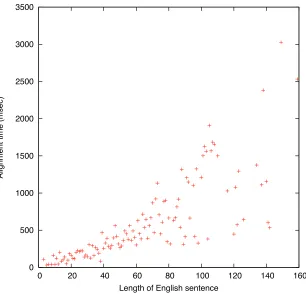
Figure 5
Average time (msec) taken by the ILP aligner at different English sentence lengths for English/Chinese alignment. The experiments were run on a single machine with a 64-bit, 2.4 GHz AMD Opteron 850 processor.
gap between GIZA++ and ILP scores. As we move to longer sentences, the alignment procedure becomes harder and GIZA++ makes more errors. Finally, Figure 5 plots the time taken for ILP alignment at different sentence lengths showing a positive correlation as well.
5. Discussion
We have determined that GIZA++ makes few search errors, despite the heuristic nature of the algorithm. These search errors do not materially affect overall alignment accuracy. In practice, this means that researchers should not spend time optimizing this particular aspect of SMT systems.
alignments would yield better counts and better overall parameter values. Of course, even if we were able to collect accurate counts, EM is not guaranteed to find a global optimum, which provides further opportunity for search errors. We leave the problem of search errors in alignment training to future study.
Acknowledgments
This work was supported by NSF grant 0904684 and DARPA GALE Contract Number HR0011-06-C-0022.
References
Al-Onaizan, Yaser, Jan Curin, Michael Jahr, Kevin Knight, John Lafferty, Franz Josef Och Dan Melamed, David Purdy, Noah Smith, and David Yarowsky. 1999. Statistical machine translation. Technical report, Johns Hopkins University. Brown, Peter, Vincent Della Pietra,
Stephen Della Pietra, and Robert Mercer. 1993. The mathematics of statistical machine translation: Parameter estimation. Computational Linguistics, 19(2):263–311.
Germann, Ulrich, Michael Jahr, Kevin Knight, Daniel Marcu, and Kenji Yamada. 2001. Fast decoding and optimal decoding for machine translation. InProceedings of the 39th Annual Meeting of the Association for Computational Linguistics (ACL), pages 228–235, Toulouse.
Och, Franz Josef and Hermann Ney. 2003. A systematic comparison of various statistical alignment models.Computational Linguistics, 29(1):19–51.